2006 SUZUKI SX4 MAIN
[x] Cancel search: MAINPage 352 of 1556

Downloaded from www.Manualslib.com manuals search engine 1D-70 Engine Mechanical:
Main Bearing Cap No.1 Bolt
Measure each thread diameter main bearing cap No.1
bolts (1) at “A” on 60 mm (2.36 in.) from seat side of
flange bolt and “B” on 90 mm (3.54 in.) from seat side of
flange bolt by using a micrometer (2).
Calculate difference in diameters (“A” – “B”).
If it exceeds limit, replace with new one.
Main bearing cap No.1 bolt diameter measurement
points
“a”: 60 mm (2.36 in.)
“b”: 90 mm (3.54 in.)
Main bearing cap No.1 bolt diameter difference
Limit (“A” – “B”): 0.2 mm (0.008 in.)
Sensor Plate InspectionS6RW0D1406041
Check sensor plate for crack damage.
If malcondition is found, replace it.
Rear Oil Seal InspectionS6RW0D1406042
Carefully inspect oil seal (1) for wear or damage. If its lip
is worn or damaged, replace it.
Flywheel InspectionS6RW0D1406043
Visual Inspection
• If ring gear is damaged, cracked or worn, replace
flywheel.
• If the surface contacting clutch disc is damaged, or
excessively worn, replace flywheel.
Flywheel Face Runout
Check flywheel face runout with a dial gauge.
If runout exceeds its limit, replace flywheel.
Flywheel face runout
Limit: 0.2 mm (0.0079 in.)
Cylinder Block InspectionS6RW0D1406044
Distortion of Gasketed Surface
Using straightedge and thickness gauge, check
gasketed surface for distortion and, if flatness exceeds
its limit, correct It.
Cylinder block flatness
Limit: 0.03 mm (0.0012 in.)
“A”
“a”
“b”“B”
1
1
2
I2RH0B140145-01
I2RH0B140151-01
I4RS0A140020-01
I2RH01140198-01
I2RH01140199-01
Page 353 of 1556
Downloaded from www.Manualslib.com manuals search engine Engine Mechanical: 1D-71
Honing or Reboring Cylinders
1) When any cylinder needs reboring, all other
cylinders must also be rebored at the same time.
2) Select oversized piston according to amount of
cylinder wear.
Oversize piston specification
Oversize 0.50: 78.453 – 78.468 mm (3.0887 –
3.0893 in.)
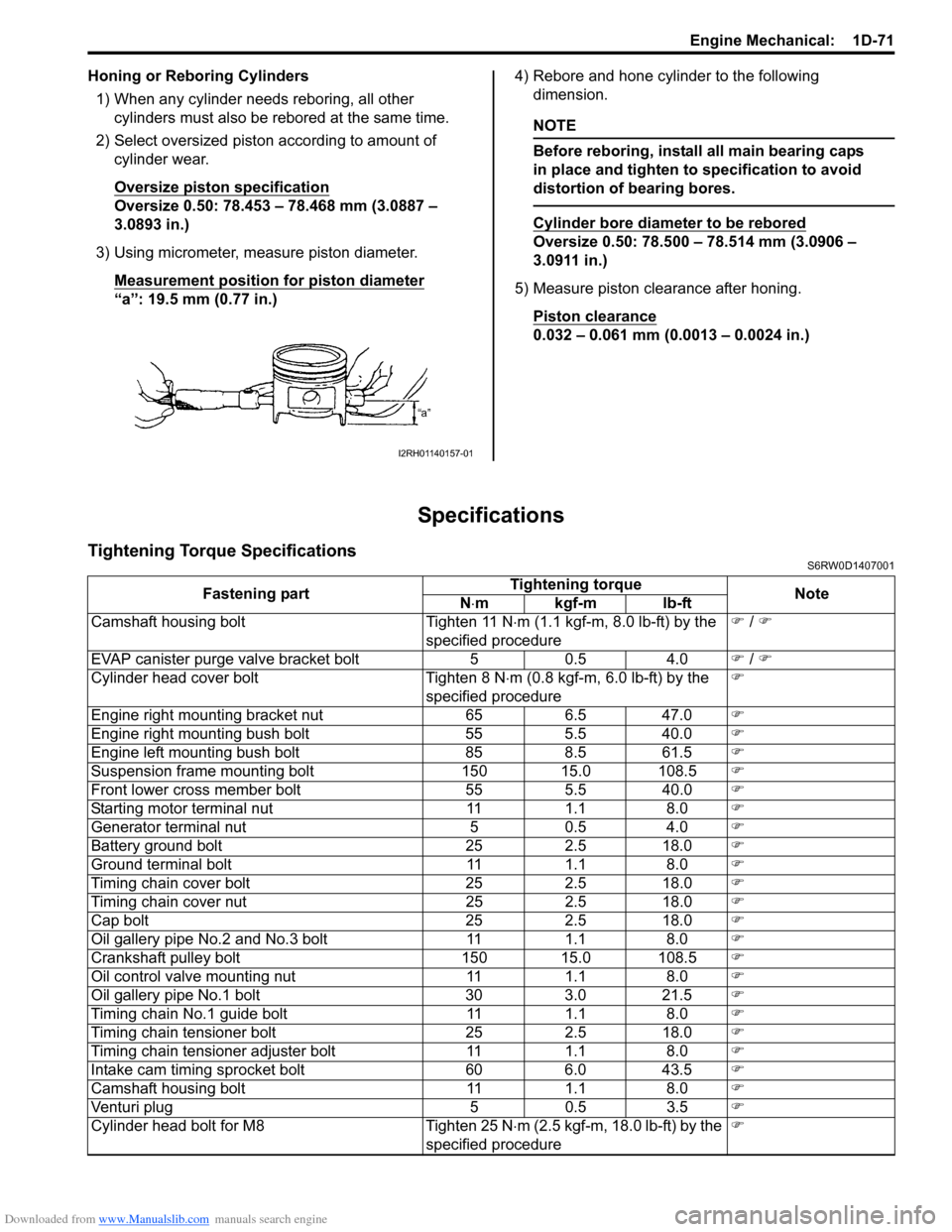
3) Using micrometer, measure piston diameter.
Measurement position for piston diameter
“a”: 19.5 mm (0.77 in.)4) Rebore and hone cylinder to the following
dimension.
NOTE
Before reboring, install all main bearing caps
in place and tighten to specification to avoid
distortion of bearing bores.
Cylinder bore diameter to be rebored
Oversize 0.50: 78.500 – 78.514 mm (3.0906 –
3.0911 in.)
5) Measure piston clearance after honing.
Piston clearance
0.032 – 0.061 mm (0.0013 – 0.0024 in.)
Specifications
Tightening Torque SpecificationsS6RW0D1407001
I2RH01140157-01
Fastening partTightening torque
Note
N⋅mkgf-mlb-ft
Camshaft housing bolt Tighten 11 N⋅m (1.1 kgf-m, 8.0 lb-ft) by the
specified procedure) / )
EVAP canister purge valve bracket bolt 5 0.5 4.0) / )
Cylinder head cover bolt Tighten 8 N⋅m (0.8 kgf-m, 6.0 lb-ft) by the
specified procedure)
Engine right mounting bracket nut 65 6.5 47.0)
Engine right mounting bush bolt 55 5.5 40.0)
Engine left mounting bush bolt 85 8.5 61.5)
Suspension frame mounting bolt 150 15.0 108.5)
Front lower cross member bolt 55 5.5 40.0)
Starting motor terminal nut 11 1.1 8.0)
Generator terminal nut 5 0.5 4.0)
Battery ground bolt 25 2.5 18.0)
Ground terminal bolt 11 1.1 8.0)
Timing chain cover bolt 25 2.5 18.0)
Timing chain cover nut 25 2.5 18.0)
Cap bolt 25 2.5 18.0)
Oil gallery pipe No.2 and No.3 bolt 11 1.1 8.0)
Crankshaft pulley bolt 150 15.0 108.5)
Oil control valve mounting nut 11 1.1 8.0)
Oil gallery pipe No.1 bolt 30 3.0 21.5)
Timing chain No.1 guide bolt 11 1.1 8.0)
Timing chain tensioner bolt 25 2.5 18.0)
Timing chain tensioner adjuster bolt 11 1.1 8.0)
Intake cam timing sprocket bolt 60 6.0 43.5)
Camshaft housing bolt 11 1.1 8.0)
Venturi plug 5 0.5 3.5)
Cylinder head bolt for M8 Tighten 25 N⋅m (2.5 kgf-m, 18.0 lb-ft) by the
specified procedure)
Page 354 of 1556

Downloaded from www.Manualslib.com manuals search engine 1D-72 Engine Mechanical:
NOTE
The specified tightening torque is also described in the following.
“Air Intake System Components”
“Engine Mountings Components”
“Timing Chain Cover Components”
“Timing Chain and Chain Tensioner Components”
“Camshaft, Tappet and Shim Components”
“Valves and Cylinder Head Components”
“Pistons, Piston Rings, Connecting Rods and Cylinders Components”
“Main Bearings, Crankshaft and Cylinder Block Components”
Reference:
For the tightening torque of fastener not specified in this section, refer to “Fasteners Information in Section 0A”. Cylinder head bolt for M10 Tighten 20 N⋅m (2.0 kgf-m, 14.5 lb-ft), 40
N⋅m (4.0 kgf-m, 29.0 lb-ft), 60° and 60° by
the specified procedure)
Connecting rod bearing cap nut Tighten 15 N⋅m (1.5 kgf-m, 11.0 lb-ft), 45°
and 45° by the specified procedure) / )
Sensor plate bolt 11 1.1 8.0)
Main bearing cap No.1 bolt Tighten 30 N⋅m (3.0 kgf-m, 22.0 lb-ft), 50
N⋅m (5.0 kgf-m, 36.5 lb-ft) and 60° by the
specified procedure) / ) / )
Main bearing cap No.2 bolt Tighten 25 N⋅m (2.5 kgf-m, 18.0 lb-ft) by the
specified procedure) / ) / )
Rear oil seal housing bolt 11 1.1 8.0)
Flywheel or drive plate bolt 70 7.0 51.0) Fastening partTightening torque
Note
N⋅mkgf-mlb-ft
Page 355 of 1556

Downloaded from www.Manualslib.com manuals search engine Engine Mechanical: 1D-73
Special Tools and Equipment
Recommended Service MaterialS6RW0D1408001
NOTE
Required service material is also described in the following.
“Timing Chain Cover Components”
“Timing Chain and Chain Tensioner Components”
“Camshaft, Tappet and Shim Components”
“Valves and Cylinder Head Components”
“Pistons, Piston Rings, Connecting Rods and Cylinders Components”
“Main Bearings, Crankshaft and Cylinder Block Components”
Special ToolS6RW0D1408002
Material SUZUKI recommended product or Specification Note
Sealant SUZUKI Bond No.1217G P/No.: 99000–31260)
Water tight sealant SUZUKI Bond No.1207B P/No.: 99000–31140)
SUZUKI Bond No.1207F P/No.: 99000–31250) / ) / )
09911–97720 09911–97821
Oil seal installer Oil seal installer
))
09913–75810 09915–64512
Bearing installer Compression gauge
))
09915–64530 09915–67010
Compression gauge hose Compression gauge
attachment (C)
))
09915–67311 09916–14510
Vacuum gauge Valve lifter
)) / )
09916–14521 09916–34542
Valve spring compressor
attachmentReamer handle
) / )) / )
Page 366 of 1556

Downloaded from www.Manualslib.com manuals search engine 1F-1 Engine Cooling System:
Engine
Engine Cooling System
General Description
Cooling System DescriptionS6RW0D1601001
The cooling system consists of the radiator cap, radiator,
coolant reservoir, hoses, water pump, cooling fan and
thermostat. The radiator is of tube-and-fin type.
Coolant DescriptionS6RW0D1601002
WARNING!
• Do not remove radiator cap to check
engine coolant level; check coolant
visually at the see-through coolant
reservoir. Coolant should be added only to
reservoir as necessary.
• As long as there is pressure in the cooling
system, the temperature can be
considerably higher than the boiling
temperature of the solution in the radiator
without causing the solution to boil.
Removal of the radiator cap while engine is
hot and pressure is high will cause the
solution to boil instantaneously and
possibly with explosive force, spewing the
solution over engine, fenders and person
removing cap. If the solution contains
flammable anti-freeze such as alcohol (not
recommended for use at any time), there is
also the possibility of causing a serious
fire.
• Check to make sure that engine coolant
temperature is cold before removing any
part of cooling system.
• Also be sure to disconnect negative cable
from battery terminal before removing any
part.
The coolant recovery system is standard. The coolant in
the radiator expands with heat, and the coolant is
overflowed to the reservoir.
When the system cools down, the coolant is drawn back
into the radiator.
The cooling system has been filled with a quality coolant
that is a 50/50 mixture of water and ethylene glycol
antifreeze.
This 50/50 mixture coolant solution provides freezing
protection to –36 °C (–33 °F).
• Maintain cooling system freeze protection at –36 °C (–
33 °F) to ensure protection against corrosion and loss
of coolant from boiling. This should be done even if
freezing temperatures are not expected.
• Add ethylene glycol base coolant when coolant has to
be added because of coolant loss or to provide added
protection against freezing at temperature lower than
–36 °C (–33 °F).
NOTE
• Alcohol or methanol base coolant or plain
water alone should not be used in cooling
system at any time as damage to cooling
system could occur.
• Coolant must be mixed with demineralized
water or distilled water.
Anti-freeze proportioning table
Coolant capacity
M/T:
• Engine, radiator and heater: 6.8 liters (14.37/11.97
US/lmp pt.)
• Reservoir: 0.7 liters (1.48/1.23 us/lmp pt.)
• Total: 7.5 liters (15.85/13.20 US/lmp pt.)
A/T:
• Engine, radiator and heater: 6.9 liters (14.58/16.63
US/lmp pt.)
• Reservoir: 0.7 liters (1.48/1.23 us/lmp pt.)
• Total: 7.6 liters (16.06/13.38 US/lmp pt.)For M/T
modelFor A/T
model
Freezing
temperature°C–36–36
°F–33–33
Anti-freeze / Anti-
corrosion coolant
concentration%5050
Ratio of compound
to cooling waterltr. 3.75/3.75 3.8/3.8
US pt. 7.92/7.92 8.03/8.03
Imp pt. 6.60/6.60 6.69/6.69
Page 373 of 1556

Downloaded from www.Manualslib.com manuals search engine Engine Cooling System: 1F-8
Radiator Cooling Fan Assembly On-Vehicle
Inspection
S6RW0D1606009
1) Check continuity between terminals. If there is no
continuity, replace radiator fan assembly.
2) Connect battery to radiator fan motor coupler as
shown in figure, then check that the radiator fan
motor operates smoothly. If radiator fan motor does
not operate smoothly, replace radiator fan assembly.
Reference: Fan motor specified current at 12 V
: 5.7 – 7.7 A
Radiator Cooling Fan Relay InspectionS6RW0D1606010
1) Disconnect negative (–) cable from battery.
2) Remove radiator cooling fan relay (1) from main fuse
box.
3) Check that there is no continuity between terminal
“c” and “d”. If there is continuity, replace relay.
4) Connect battery positive (+) terminal to terminal “b”
of relay and battery negative (–) terminal to terminal
“a” of relay, and then check continuity between
terminal “c” and “d”. If there is no continuity, replace
relay.
Radiator Cooling Fan Assembly Removal and
Installation
S6RW0D1606011
Removal
1) Disconnect negative (–) cable at battery.
2) Disconnect connector of cooling fan motor.
3) Drain coolant referring to “Cooling System Draining”.
4) Remove radiator inlet hose (1) and reservoir (2).
I5RW0A160004-01
I5RW0A160005-01
“d” “b”“
a”
“c”
1
I5RW0A160008-02
1
2
I6RW0B160004-02
Page 379 of 1556

Downloaded from www.Manualslib.com manuals search engine Fuel System: 1G-2
General Description
Fuel System DescriptionS6RW0D1701001
CAUTION!
This engine requires the unleaded fuel only.
The leaded and/or low lead fuel can result in
engine damage and reduce the effectiveness
of the emission control system.
The main components of the fuel system are fuel tank,
fuel pump assembly (with fuel filter, fuel level gauge, fuel
pressure regulator), fuel feed line and fuel vapor line.
For the details of fuel flow, refer to “Fuel Delivery System
Diagram”.
Fuel Delivery System DescriptionS6RW0D1701002
The fuel delivery system consists of the fuel tank, fuel
pump assembly (with built-in fuel filter and fuel pressure
regulator), delivery pipe, injectors and fuel feed line.
The fuel in the fuel tank is pumped up by the fuel pump,
sent into delivery pipe and injected by the injectors.
As the fuel pump assembly is equipped with built-in fuel
filter and fuel pressure regulator, the fuel is filtered and
its pressure is regulated before being sent to the feed
pipe.
The excess fuel at fuel pressure regulation process is
returned back into the fuel tank.
Also, fuel vapor generated in fuel tank is led through the
fuel vapor line into the EVAP canister.
For system diagram, refer to “Fuel Delivery System
Diagram”.
Fuel Pump DescriptionS6RW0D1701003
The fuel pump (1) is an in-tank type electric pump.
Incorporated in the pump assembly are;
a fuel filter (2), a fuel pressure regulator (3) and a fuel
level sensor (gauge) (4).
2
41
3
I7RW01170001-01
Page 392 of 1556

Downloaded from www.Manualslib.com manuals search engine 1G-15 Fuel System:
Fuel Tank Purging ProcedureS6RW0D1706013
WARNING!
• Before starting the following procedure, be
sure to observe “Precautions on Fuel
System Service” in order to reduce the risk
of fire and personal injury.
• This purging procedure will not remove all
fuel vapor.
Do not attempt any repair on tank using
heat of flame as an explosion resulting in
personal injury could occur.
CAUTION!
Never remain water in fuel tank after washing,
or fuel tank inside will get corrosion.
The following procedure are used for purging fuel tank.
1) After removing fuel tank, remove all hoses, pipes
and fuel pump assembly from fuel tank.
2) Drain all remaining fuel from tank.
3) Place fuel tank to flushing area.
4) Fill tank with warm water or tap water, and agitate
vigorously and drain. Repeat this washing until
inside of tank is clean. Replace tank if its inside is
rusty.
5) Completely flush out remaining water after washing.
6) Be sure to dry fuel tank assembly thoroughly out of
direct sunlight after washing.
Fuel Pump On-Vehicle InspectionS6RW0D1706014
WARNING!
Before starting the following procedure, be
sure to observe “Precautions on Fuel System
Service” in order to reduce the risk of fire and
personal injury.
NOTE
The fuel pressure regulator is incorporated
with the fuel pump assembly so individual
inspection of it is impossible.
1) Remove filler cap and turn ON ignition switch (2).
Then fuel pump operating sound should be heard
from fuel filler (1) for about 2 seconds and stop. Be
sure to reinstall fuel filler cap after checking.
If the check result is not satisfactory, go to “Fuel
Pump and Its Circuit Check in Section 1A”.2) Turn OFF ignition switch and leave over 10 minutes
as it is.
3) Fuel pressure should be felt at fuel feed hose (1) for
about 2 seconds after ignition switch ON.
If fuel pressure is not felt, go to “Fuel Pressure
Check in Section 1A”.
Fuel Pump Assembly Removal and InstallationS6RW0D1706015
WARNING!
Before starting the following procedure, be
sure to observe “Precautions on Fuel System
Service” in order to reduce the risk of fire and
personal injury.
Removal
1) Remove fuel tank from vehicle referring to “Fuel
Tank Removal and Installation”.
2) Disconnect fuel pipe (1) from fuel pump assembly (2)
referring to “Fuel Hose Disconnecting and
Reconnecting”.
3) Remove fuel pump assembly and earth bracket from
fuel tank.
IVSY01170013-01
1I5RW0A170019-01
1
2
I7RW01170011-01