2006 SUZUKI SX4 Can
[x] Cancel search: CanPage 225 of 1556

Downloaded from www.Manualslib.com manuals search engine Engine General Information and Diagnosis: 1A-175
C01-19WHT/
REDEGR valve
(stepper motor coil
3) output (if
equipped10 – 14 V Ignition switch turned ON. —
*0 – 1 V
↑↓
10 – 14 V
(“Reference
waveform No.4: ”)Ignition switch is turned to
ST (cranking) position.Output signal is active low
duty pulse. Number of
pulse generated times
varies depending on
vehicle condition.
C01-20RED/
YELCMP sensor signal0 – 1 V or 4 – 5 V Ignition switch turned ON. —
*0 – 0.6 V
↑↓
4 – 5 V
(“Reference
waveform No.13: ”
and “Reference
waveform No.14: ”)Engine running at idle
after warmed up engine.Sensor signal is pulse.
Pulse frequency varies
depending on engine
speed.
(6 pulses are generated
per 1 camshaft revolution.)
C01-21 PNK CKP sensor signal0 – 1 V or 4 – 5 V Ignition switch turned ON. —
*4 – 5 V
↑↓
0 – 0.6 V
(“Reference
waveform No.13: ”
and “Reference
waveform No.14: ”)Engine running at idle
after warming up engine.Sensor signal is pulse.
Pulse frequency varies
depending on engine
speed.
(30 (36 – 6) pulses are
generated per 1
crankshaft revolution.)
C01-22 — — — — —
C01-23 — — — — —
C01-24 LT GRNEngine coolant
temp. (ECT)
sensor signal3.5 – 4.0 VIgnition switch turned ON,
ECT at 0 °C, 32 °F.
— 1.38 – 1.72 VIgnition switch turned ON,
ECT at 50 °C, 122 °F.
0.40 – 0.53 VIgnition switch turned ON,
ECT at 100 °C, 212 °F.
C01-25BLK/
YELIntake air temp.
(IAT) sensor signal3.18 – 3.67 VIgnition switch turned ON,
IAT at 0 °C, 32 °F.
— 1.32 – 1.65 VIgnition switch turned ON,
IAT at 40 °C, 104 °F.
0.46 – 0.60 VIgnition switch turned ON,
IAT at 80 °C, 176 °F.
C01-26GRN/
BLKMass air flow
(MAF) sensor
signal0.5 – 1.5 VIgnition switch turned ON
with engine at stop.
— 1.5 – 2.0 V
(“Reference
waveform No.15: ”)When engine running at
specified idle speed after
warmed up.
C01-27 GRYGround for MAF
sensorBelow 0.3 V Ignition switch turned ON. —
C01-28BLU /
YELGeneral control
signal output0 – 1 VEngine: Stop
IG switch: ON
—
10 – 14 VEngine: Idle speed after
warning up
C01-29BLU/
BLKEVAP canister
purge valve output10 – 14 VIgnition switch turned ON
with engine at stop.—
*0 – 0.6 V
↑↓
10 – 14 V
(“Reference
waveform No.16: ”)Set EVAP canister purge
valve at 52% by using
“Engine / Active Test” of
scan tool.Output signal is active low
duty pulse. Duty ratio
varies depending on
vehicle condition.
C01-30 BLK Ground for ECM Below 0.3 V Ignition switch turned ON. —
C01-31 — — — — —
C01-32 — — — — —
C01-33 — — — — — Terminal
No.Wire
colorCircuit Normal voltage Condition Remarks
Page 227 of 1556

Downloaded from www.Manualslib.com manuals search engine Engine General Information and Diagnosis: 1A-177
C01-48YEL/
GRNStarting motor
signal0 – 1 V Ignition switch turned ON.
—
6 – 14 V While engine cranking.
C01-49 — — — — —
C01-50WHT/
BLUGround of ECM for
shield wireBelow 0.3 V Ignition switch turned ON. —
C01-51 — — — — —
C01-52 — — — — —
C01-53RED/
BLKManifold absolute
pressure (MAP)
sensor signal (if
equipped)Approx. 4 V
(“Reference
waveform No.17: ”)Ignition switch turned ON
with barometric pressure
at 100 kPa, 760 mmHg.
—
0.4 – 2.0 V
(“Reference
waveform No.18: ”)While engine running at
specified idle speed after
warmed up with
barometric pressure at
100 kPa, 760 mmHg.
C01c01-
54GRNThrottle position
sensor (main)
signal0.75 – 1.08 VIgnition switch turned ON
and accelerator pedal at
idle position after warmed
up engine.
—
3.67 – 4.24 V
(“Reference
waveform No.29: ”)Ignition switch turned ON
and accelerator pedal at
full depressed position
after warmed up engine.
C01-55GRY/
BLUGround for sensors Below 0.3 V Ignition switch turned ON. —
C01-56 REDKnock sensor
signal2 – 3 V
(“Reference
waveform No.19: ”
and “Reference
waveform No.20: ”)Ignition switch turned ON.
— Engine running at 4000 r/
min. after warmed up.
C01-57 ORN Ground for sensors Below 0.3 V Ignition switch turned ON. —
C01-58BLK/
ORNGround for ECM Below 0.3 V Ignition switch turned ON. —
C01-59GRN/
WHTOil control valve
ground (for engine
with VVT system)Below 1.3 V Ignition switch turned ON. —
C01-60GRN/
REDOil control valve
output (for engine
with VVT system)*0 – 0.6 V
↑↓
10 – 14 V
(“Reference
waveform No.21: ”
and “Reference
waveform No.22: ”)At the moment of ignition
switch turned ON.Output signal is active
high pulse. Duty ratio
varies depending on
vehicle condition. Terminal
No.Wire
colorCircuit Normal voltage Condition Remarks
Terminal
No.Wire
colorCircuit Normal voltage Condition Remarks
E01-1BLK/
REDMain power supply 10 – 14 V Ignition switch turned ON. —
E01-2WHT/
REDPower source for
ECM internal
memory10 – 14 V Ignition switch turned ON. —
E01-3 REDCAN (high)
communication line
(active high signal)
to ABS control
module*2.5 – 4.5 V
(“Reference
waveform No.23: ”)Ignition switch turned ON
with engine at stop.CAN communication line
signal is pulse. Pulse
signal displayed with a
regular frequency with
varies depending on
engine condition.
Page 228 of 1556

Downloaded from www.Manualslib.com manuals search engine 1A-178 Engine General Information and Diagnosis:
E01-4 BRNEngine revolution
signal output for P/
S control module0 – 0.8 VIgnition switch turned ON
with engine at stop.—
*0 – 1 V
↑↓
8 – 14 V
(“Reference
waveform No.24: ”
and “Reference
waveform No.25: ”)While engine running.Output signal is pulse.
Pulse frequency varies
depending on engine
speed.
(2 pulses are generated
per 1 crankshaft
revolution.)
(3000 r/min. = 100 Hz)
E01-5 — — — — —
E01-6 — — — — —
E01-7 — — — — —
E01-8 — — — — —
E01-9 — — — — —
E01-10 — — — — —
E01-11 — — — — —
E01-12 — — — — —
E01-13YEL/
REDClock signal for
immobilizer coil
antenna10 – 14 V Ignition switch turned ON. —
E01-14 — — — — —
E01-15GRN/
WHTFuel pump relay
output0 – 2.5 VFor 2 sec. from the time
ignition switch is turned
ON or while engine is
running.
—
10 – 14 VOn and after 2 sec. from
the time ignition switch is
turned ON or while engine
is at stop.
E01-16BLK/
REDMain power supply 10 – 14 V Ignition switch turned ON. —
E01-17 — — — — —
E01-18 WHTCAN (low)
communication line
(active low signal)
to ABS control
module*0.5 – 2.5 V
(“Reference
waveform No.23: ”)Ignition switch turned ON
with engine at stop.CAN communication line
signal is pulse. Pulse
signal displayed with a
regular frequency which
varies depending on
engine condition.
E01-19 BLU/
WHTElectric load signal
for heater blower
motor10 – 14 VIG switch: ON Blower
selector < 3rd position
(Manual A/C model)
— IG switch: ON Blower
selector < 2nd position
(Auto A/C model)
0 – 1 VIG switch: ON Blower
selector > 2nd position
E01-20GRN/
WHTBrake light switch
signal0 – 1 VIgnition switch turned ON,
stop lamp not lit up.
—
10 – 14 VIgnition switch turned ON,
stop lamp lit up.
E01-21 — — — — —
E01-22 — — — — —
E01-23 — — — — —
E01-24YEL/
REDFuel level sensor
signal0 – 6 VIgnition switch turned ON.
Voltage varies depends on
fuel level.—
E01-25 — — — — — Terminal
No.Wire
colorCircuit Normal voltage Condition Remarks
Page 237 of 1556

Downloaded from www.Manualslib.com manuals search engine Engine General Information and Diagnosis: 1A-187
Reference waveform No.15
Mass air flow sensor signal (1) with engine racing
Reference waveform No.16
EVAP canister purge valve signalReference waveform No.17
Manifold absolute pressure sensor signal (1) with
ignition switch turned ON
Reference waveform No.18
Manifold absolute pressure sensor signal (1) with engine
racing Measurement
terminalCH1: “C01-26” to “C01-27”
CH2: “C01-54” to “C01-55”
Oscilloscope
settingCH1: 1 V/DIV, CH2: 1 V/DIV
TIME: 200 ms/DIV
Measurement
condition• After warmed up to normal
operating temperature
• Engine racing
2. Throttle position sensor signal
3. Racing
4. Idle
Measurement
terminalCH1: “C01-29” to “C01-58”
Oscilloscope
settingCH1: 10 V/DIV
TIME: 40 ms/DIV
Measurement
condition• After warmed up to normal
operating temperature
• EVAP canister purge valve setting
at 52% by using “Engine / Active
Test” of scan tool.
1. ON signal 3. One duty cycle
2. OFF signal 4. 10 – 14 V
I4RS0B110066-01
I4RS0B110067-01
Measurement
terminalCH1: “C01-53” to “C01-55”
CH2: “C01-54” to “C01-55”
Oscilloscope
settingCH1: 2 V/DIV, CH2: 1 V/DIV
TIME: 200 ms/DIV
Measurement
condition• After warmed up to normal
operating temperature
• Ignition switch turned ON
2. Throttle position sensor signal
Measurement
terminalCH1: “C01-53” to “C01-55”
CH2: “C01-54” to “C01-55”
Oscilloscope
settingCH1: 2 V/DIV, CH2: 2 V/DIV
TIME: 200 ms/DIV
Measurement
condition• After warmed up to normal
operating temperature
• Engine racing
2. Throttle position sensor signal
3. Racing
4. Idle
I4RS0B110070-01
I4RS0B110071-01
Page 239 of 1556

Downloaded from www.Manualslib.com manuals search engine Engine General Information and Diagnosis: 1A-189
Reference waveform No.23
CAN communication line signal from ABS / ESP®
control module assembly or TCM with ignition switch
turned ONReference waveform No.24
Ignition pulse (engine revolution) signal (2) with engine
idling
Measurement
terminalCH1: “E01-3” to “C01-58” / CH1:
“C01-13” to “C01-58”
CH2: “E01-18” to “C01-58” / CH2:
“C01-12” to “C01-58”
Oscilloscope
settingCH1: 1 V/DIV, CH2: 1 V/DIV
TIME: 40 µs/DIV
Measurement
conditionIgnition switch turned ON
(Signal pattern is depending on
engine condition)
1. CAN communication line signal (High)
2. CAN communication line signal (Low)
I4RS0B110076-01
Measurement
terminalCH1: “C01-20” to “C01-58”
CH2: “E01-4” to “C01-58”
Oscilloscope
settingCH1: 5 V/DIV, CH2: 5 V/DIV
TIME: 40 ms/DIV
Measurement
condition• After warmed up to normal
operating temperature
• Engine at specified idle speed
[A]: For VVT model
[B]: For non-VVT model
1. Cylinder reference signal (CMP reference signal)
3. 720° crank angle
I4RS0B110077-01
Page 242 of 1556

Downloaded from www.Manualslib.com manuals search engine 1A-192 Engine General Information and Diagnosis:
Resistance Check
1) Remove ECM from its bracket referring to “Engine Control Module (ECM) Removal and Installation in Section 1C”.
CAUTION!
Never touch terminals of ECM itself or connect voltmeter or ohmmeter (2).
2) Connect special tool to ECM connectors (1) securely.
NOTE
Do not connect the other connector of special tool to ECM.
Special tool
(A): 09933–06320
3) Check resistance between each pair of terminals of special tool connectors (1) as listed in the following table.
CAUTION!
• Be sure to connect ohmmeter probe from wire harness side of coupler.
• Be sure to turn OFF ignition switch for this check.
• Resistance in the following table represents that measured when parts temperature is 20 °C (68 °F).
1
(A)
2
3
I7RW01110032-02
Terminals Circuit Standard resistance Condition
C01-47 to E01-29 Heater of HO2S-2 4 – 15 Ω—
E01-46 to E01-1/16 Radiator cooling fan relay No.1 160 – 240 Ω—
E01-60 to E01-29 Main relay 160 – 240 ΩBattery disconnected and
ignition switch turned ON
E01-15 to E01-29 Fuel pump relay 160 – 240 Ω—
C01-16 to E01-1/16No.3 fuel injector
10.8 – 18.2 Ω—
C01-17 to E01-1/16No.4 fuel injector
C01-4 to E01-1/16EGR valve (stepping motor No.1 coil) (if
equipped)20 – 31 Ω—
C01-29 to E01-1/16 EVAP canister purge valve 28 – 35 Ω—
C01-2 to E01-1/16 No.2 fuel injector 10.8 – 18.2 Ω—
C01-3 to E01-1/16EGR valve (stepping motor No.2 coil) (if
equipped)
20 – 31 Ω— C01-18 to E01-1/16EGR valve (stepping motor No.4 coil) (if
equipped)
C01-19 to E01-1/16EGR valve (stepping motor No.3 coil) (if
equipped)
C01-46 to E01-29 Heater of HO2S-1 2 – 11 Ω—
C01-1 to E01-1/16 No.1 fuel injector 10.8 – 18.2 Ω—
E01-29 to E01-47 A/C compressor relay (if equipped with A/C) 160 – 240 Ω—
E01-58 to E01-1/16A/C condenser cooling fan relay
(if equipped with A/C)160 – 240 Ω—
C01-60 to C01-59 Oil control valve (for engine with VVT system) 6 – 15 Ω—
E01-45 to E01-1/16 Throttle actuator control relay 160 – 240 Ω—
Page 252 of 1556
Downloaded from www.Manualslib.com manuals search engine 1A-202 Engine General Information and Diagnosis:
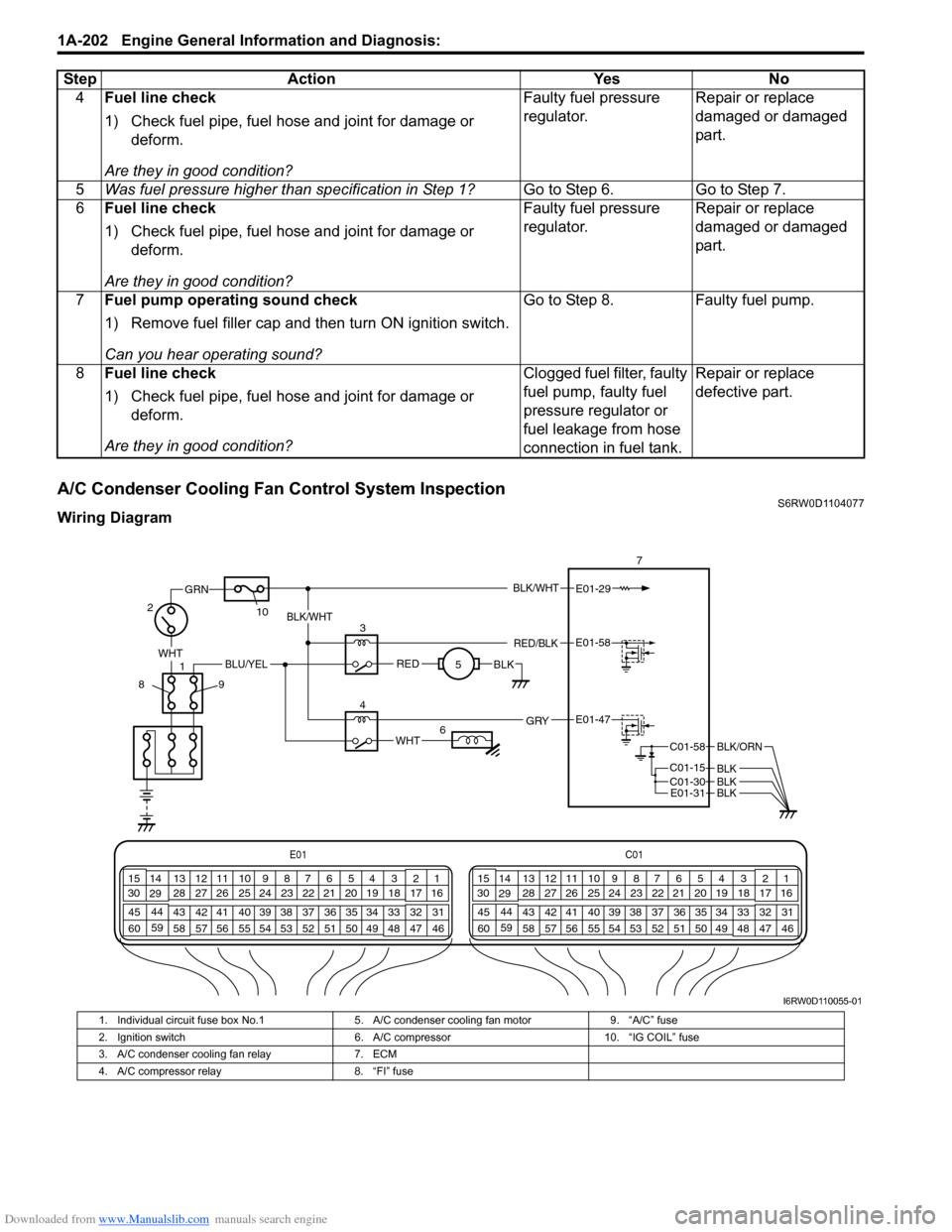
A/C Condenser Cooling Fan Control System InspectionS6RW0D1104077
Wiring Diagram4Fuel line check
1) Check fuel pipe, fuel hose and joint for damage or
deform.
Are they in good condition?Faulty fuel pressure
regulator.Repair or replace
damaged or damaged
part.
5Was fuel pressure higher than specification in Step 1?Go to Step 6. Go to Step 7.
6Fuel line check
1) Check fuel pipe, fuel hose and joint for damage or
deform.
Are they in good condition?Faulty fuel pressure
regulator.Repair or replace
damaged or damaged
part.
7Fuel pump operating sound check
1) Remove fuel filler cap and then turn ON ignition switch.
Can you hear operating sound?Go to Step 8. Faulty fuel pump.
8Fuel line check
1) Check fuel pipe, fuel hose and joint for damage or
deform.
Are they in good condition?Clogged fuel filter, faulty
fuel pump, faulty fuel
pressure regulator or
fuel leakage from hose
connection in fuel tank.Repair or replace
defective part. Step Action Yes No
E01C01
3 4
18 19 5 6 7 10 11
17 20
47 46 49 50 51 21 22
5216 259
24 14
29
55 57 54 53 59
60 582
26 27 28 15
30
56 4832 31 34 35 36 37 40 42 39 38 44
45 43 41 331 12 13
238 3 4
18 19 5 6 7 10 11
17 20
47 46 49 50 51 21 22
5216 259
24 14
29
55 57 54 53 59
60 582
26 27 28 15
30
56 4832 31 34 35 36 37 40 42 39 38 44
45 43 41 331 12 13
238
BLK/WHT
WHT
1
GRN
27
E01-29
10
89
REDBLK
3
5BLK/WHT
RED/BLKE01-58
WHT
4E01-47 GRY
BLU/YEL
6
C01-58
C01-15 C01-30
BLK/ORN
BLKBLKE01-31BLK
I6RW0D110055-01
1. Individual circuit fuse box No.1 5. A/C condenser cooling fan motor 9. “A/C” fuse
2. Ignition switch 6. A/C compressor 10. “IG COIL” fuse
3. A/C condenser cooling fan relay 7. ECM
4. A/C compressor relay 8. “FI” fuse
Page 253 of 1556

Downloaded from www.Manualslib.com manuals search engine Engine General Information and Diagnosis: 1A-203
Troubleshooting
Step Action Yes No
1Check A/C condenser fan control system
Is A/C condenser fan started when A/C is operating?Intermittent trouble.
Check for intermittent
referring to “Intermittent
and Poor Connection
Inspection in Section
00”.Go to Step 2.
2Check A/C condenser fan relay and its circuit
1) Connect scan tool to DLC with ignition switch OFF.
2) Check pending DTC and DTC with scan tool.
Is DTC P0481 displayed?Go to “DTC P0481:
Cooling Fan 2 (A/C
Condenser Fan) Control
Circuit”.Go to Step 3.
3Check A/C refrigerant
1) Check amount of A/C refrigerant referring to “A/C
System Performance Inspection in Section 7B”.
Is it good condition?Go to Step 4. Recharge refrigerant.
4Check wire circuit
1) Disconnect A/C condenser cooling fan control relay from
individual circuit fuse box No.1 with ignition switch
turned OFF.
2) Turn ON ignition switch, measure voltage between
engine ground and “BLU/YEL” wire terminal of A/C
condenser cooling fan control relay connector.
Is voltage 10 – 14V?Go to Step 7. Go to Step 5.
5Check wire circuit
1) Disconnect A/C compressor control relay from individual
circuit fuse box No.1 with ignition switch turn OFF.
2) Turn ON ignition switch, measure voltage between
engine ground and “BLU/YEL” wire terminal of A/C
compressor control relay connector.
Is voltage 10 – 14 V?Faulty A/C compressor
control relay.Go to Step 6.
6Check wire circuit
1) Remove “A/C” fuse “20 A” from individual circuit fuse box
No.1 with ignition switch turned OFF.
2) Measure resistance between “BLU/YEL” wire terminal of
main fuse connector and engine ground.
Is resistance infinity?Open wire in “BLU/YEL”
circuit. If OK, go to Step
7.“BLU/YEL” wire shorted
to ground circuit.
7Check wire circuit
1) Disconnect connector from A/C condenser cooling fan
with ignition switch tun OFF.
2) Measure resistance between engine ground and “RED”
wire terminal of A/C condenser fan connector.
Is resistance infinity?Go to Step 8. “RED” wire shorted to
ground circuit.
8Check A/C condenser cooling fan control relay
1) Check A/C condenser cooling fan control relay referring
to “A/C System Relay Inspection in Section 7B”.
Is result in good condition?Go to Step 9. Replace relay.