2006 SUBARU IMPREZA Specification
[x] Cancel search: SpecificationPage 1 of 365

Foreword
Congratulations on choosing a SUBARU vehicle. This Owners
Manual has all the information necessary to keep yo ur SUBARU in
excellent condition and to properly maintain the em ission control
system for minimizing emission pollutants. We urge y ou to read
this manual carefully so that you may understand yo ur vehicle and
its operation. For information not found in this Ow ners Manual,
such as details concerning repairs or adjustments, please contact
the dealer from whom you purchased your SUBARU or t he nearest
SUBARU dealer.
The information, specifications and illustrations f ound in this man-
ual are those in effect at the time of printing. FU JI HEAVY INDUS-
TRIES LTD. reserves the right to change specificati ons and de-
signs at any time without prior notice and without incurring any ob-
ligation to make the same or similar changes on veh icles previous-
ly sold. This Owner s Manual applies to all models and covers all
equipment, including factory installed options. Som e explanations,
therefore may be for equipment not installed in you r vehicle.
Please leave this manual in the vehicle at the time of resale. The
next owner will need the information found herein.
FUJI HEAVY INDUSTRIES LTD., TOKYO, JAPAN
is a registered trademark of FUJI HEAVY INDUSTRIES LTD.
© copyright 2005 FUJI HEAVY INDUSTRIES LTD.
Page 5 of 365
2
the climate control.
Chapter 5: Audio
This chapter informs you how to operate
your audio system.
Chapter 6: Interior equipment
This chapter informs you how to operate
interior equipment.
Chapter 7: Starting and operating
This chapter informs you how to start and
operate your SUBARU.
Chapter 8: Driving tips
This chapter informs you how to drive your
SUBARU in various conditions and ex-
plains some safety tips on driving.
Chapter 9: In case of emergency
This chapter informs you what to do if you
have a problem while driving, such as a
flat tire or engine overheating.
Chapter 10: Appearance care
This chapter informs you how to keep your
SUBARU looking good.
Chapter 11: Maintenance and service
This chapter informs you when you need
to take your SUBARU to the dealer for
scheduled maintenance and informs you
how to keep your SUBARU running prop-
erly.
Chapter 12: Specifications
This chapter informs you about dimension
and capacities of your SUBARU.
Chapter 13: Consumer information and
Reporting safety defectsThis chapter informs you about Uniform
tire quality grading standards and Report-
ing safety defects.
Chapter 14: Index
This is an alphabetical listing of all that
s in
this manual. You can use it to quickly find
something you want to read.
Safety warnings
You will find a number of WARNINGs,
CAUTIONs and NOTEs in this manual.
These safety warnings alert you to poten-
tial hazards that could result in injury to
you or others.
Please read these safety warnings as well
as all other portions of this manual careful-
ly in order to gain a better understanding
of how to use your SUBARU vehicle safe-
ly.
NOTE
A NOTE gives information or sugges-
tions how to make better use of your
vehicle.
Safety symbol
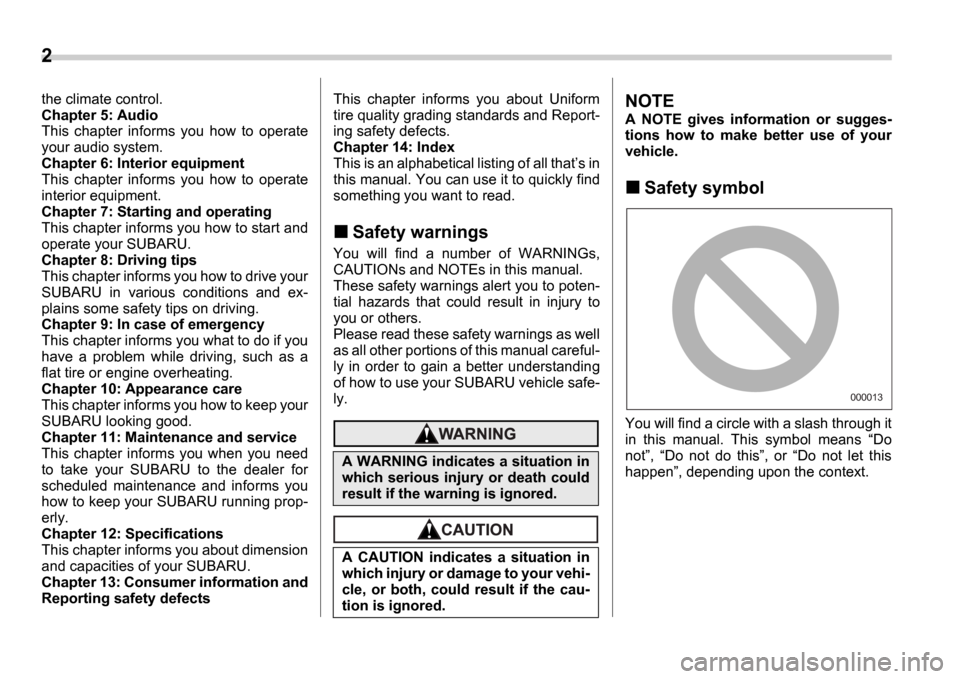
You will find a circle with a slash through it
in this manual. This symbol means Do
not , Do not do this , or Do not let this
happen , depending upon the context.
A WARNING indicates a situation in
which serious injury or death could
result if the warning is ignored.
A CAUTION indicates a situation in
which injury or damage to your vehi-
cle, or both, could result if the cau-
tion is ignored.
000013
Page 12 of 365

1
2
3
4
5
6
7
8
9
10
11
12
13
14
Table of contentsSeat, seatbelt and SRS airbags
Keys and doors
Instruments and controls
Climate control
Audio
Interior equipment
Starting and operating
Driving tips
In case of emergency
Appearance care
Maintenance and service
Specifications
Consumer information and Reporting safety defects
Index
Page 199 of 365
7-2 Starting and operating
Starting and operatingFuel
Fuel requirements
2.5-liter non-turbo models
The 2.5-liter non-turbo engine is designed
to operate using unleaded gasoline with
an octane rating of 87 AKI or higher.
WRX
The 2.5-liter turbo engine is designed to
operate using premium unleaded gasoline
with an octane rating of 91 AKI or higher.
If premium unleaded gasoline is not avail-
able, regular unleaded gasoline with an
octane rating of 87 AKI or higher may be
temporarily used. For optimum engine
performance and driveability, it is required
that you use premium grade unleaded
gasoline.
NOTE
Be sure to use premium unleaded gas-
oline of 91 AKI or higher for WRX. If
other gasoline (lower than 91 AKI) is
used, knocking, reduced output and poor accelerator response will result.
WRX-STI
The 2.5-liter turbo engine is designed to
operate using super-premium unleaded
gasoline with an octane rating of 93 AKI or
higher. If super-premium unleaded gaso-
line with an octane rating of 93 AKI or
higher is not available, premium unleaded
gasoline with an octane rating of 91 AKI or
higher may be temporarily used. For opti-
mum engine performance and driveability,
it is required that you use super-premium
grade unleaded gasoline with an octane
rating of 93 AKI or higher.
NOTE
Be sure to use super-premium unlead-
ed gasoline of 93 AKI or higher for
WRX-STI. If other gasoline (lower than
93 AKI) is used, knocking, reduced out-
put and poor accelerator response will
result.
Fuel octane rating
This octane rating is the average of the
Research Octane and Motor Octane num-
bers and is commonly referred to as the
Anti Knock Index (AKI).
Using a gasoline with a lower octane rat-
ing can cause persistent and heavy
knocking, which can damage the engine.
Do not be concerned if your vehicle some- times knocks lightly when you drive up a
hill or when you accelerate. See your
dealer or a qualified service technician if
you use a fuel with the specified octane
rating and your vehicle knocks heavily or
persistently.
Unleaded gasoline
The neck of the fuel filler pipe is designed
to accept only an unleaded gasoline filler
nozzle. Under no circumstances should
leaded gasoline be used because it will
damage the emission control system and
may impair driveability and fuel economy.
Gasoline for California-certified LEV
Your vehicle was certified to California s
low emission vehicle (LEV) standards as
indicated on the underhood tune-up label,
it is designed to optimize engine and
emission performance with gasoline that
meets the clean burning low-sulfur Califor-
nia gasoline specifications. If you live in
any other state than California, your vehi-
cle will operate on gasoline meeting Fed-
eral specifications. Gasoline sold outside
California is permitted to have higher sul-
fur levels, which may affect the perfor-
mance of your vehicle s catalytic convert-
er and may produce a sulfur exhaust odor
or smell. SUBARU recommends that you
try a different brand of unleaded gasoline
having lower sulfur to determine if the
Use of a fuel which is low in quality
or use of an inappropriate fuel addi-
tive may cause engine damage.
Page 252 of 365
Driving tips 8-25
CONTINUED
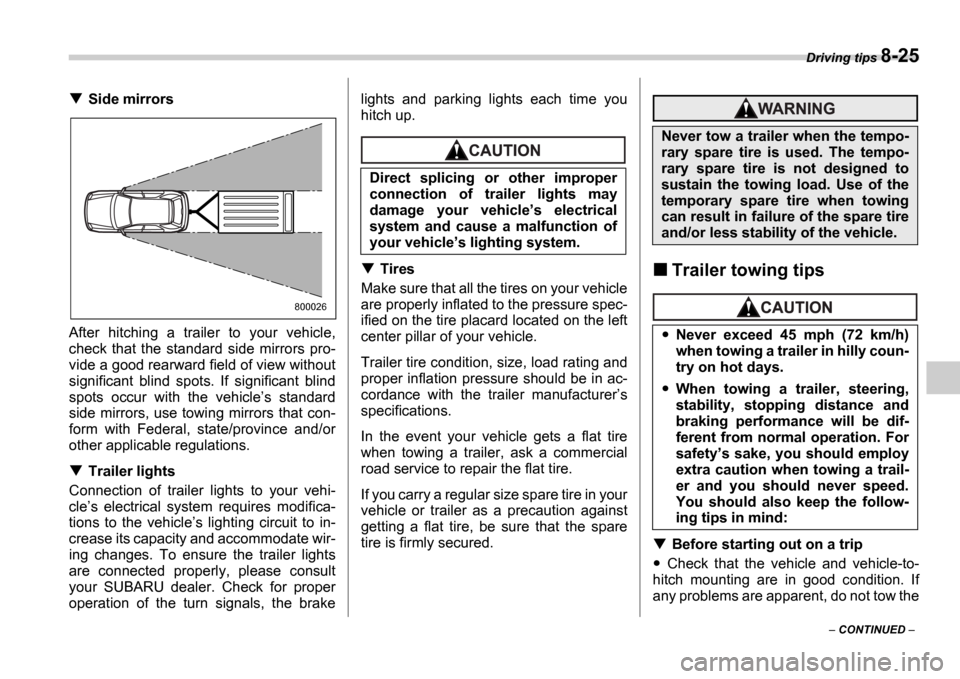
Side mirrors
After hitching a trailer to your vehicle,
check that the standard side mirrors pro-
vide a good rearward field of view without
significant blind spots. If significant blind
spots occur with the vehicle s standard
side mirrors, use towing mirrors that con-
form with Federal, state/province and/or
other applicable regulations.
Trailer lights
Connection of trailer lights to your vehi-
cle s electrical system requires modifica-
tions to the vehicle s lighting circuit to in-
crease its capacity and accommodate wir-
ing changes. To ensure the trailer lights
are connected properly, please consult
your SUBARU dealer. Check for proper
operation of the turn signals, the brake lights and parking lights each time you
hitch up.
Tires
Make sure that all the tires on your vehicle
are properly inflated to the pressure spec-
ified on the tire placard located on the left
center pillar of your vehicle.
Trailer tire condition, size, load rating and
proper inflation pressure should be in ac-
cordance with the trailer manufacturer s
specifications.
In the event your vehicle gets a flat tire
when towing a trailer, ask a commercial
road service to repair the flat tire.
If you carry a regular size spare tire in your
vehicle or trailer as a precaution against
getting a flat tire, be sure that the spare
tire is firmly secured.Trailer towing tips
Before starting out on a trip
Check that the vehicle and vehicle-to-
hitch mounting are in good condition. If
any problems are apparent, do not tow the
800026
Direct splicing or other improper
connection of trailer lights may
damage your vehicle s electrical
system and cause a malfunction of
your vehicle s lighting system.
Never tow a trailer when the tempo-
rary spare tire is used. The tempo-
rary spare tire is not designed to
sustain the towing load. Use of the
temporary spare tire when towing
can result in failure of the spare tire
and/or less stability of the vehicle.
Never exceed 45 mph (72 km/h)
when towing a trailer in hilly coun-
try on hot days.
When towing a trailer, steering,
stability, stopping distance and
braking performance will be dif-
ferent from normal operation. For
safety s sake, you should employ
extra caution when towing a trail-
er and you should never speed.
You should also keep the follow-
ing tips in mind:
Page 306 of 365
Maintenance and service 11-27
Brake booster
If the brake booster does not operate as
described in the following, have it checked
by your SUBARU dealer.
1. With the engine off, depress the brake
pedal several times, applying the same
pedal force each time. The distance the
pedal travels should not vary.
2. With the brake pedal depressed, start
the engine. The pedal should move slight-
ly down to the floor.
3. With the brake pedal depressed, stop
the engine and keep the pedal depressed
for 30 seconds. The pedal height should
not change.
4. Start the engine again and run for ap-
proximately one minute then turn it off.
Depress the brake pedal several times to
check the brake booster. The brake boost-
er operates properly if the pedal stroke de-
creases with each depression.
Brake pedal
Check the brake pedal free play and re-
serve distance according to the mainte-
nance schedule in the Warranty and
Maintenance Booklet .
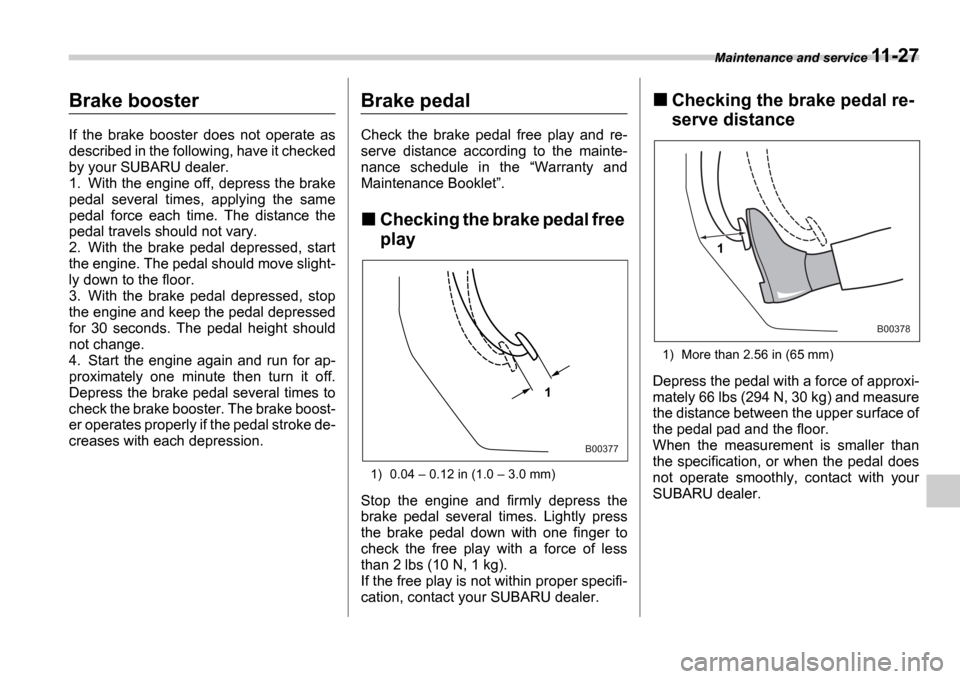
Checking the brake pedal free
play
1) 0.04 0.12 in (1.0 3.0 mm)
Stop the engine and firmly depress the
brake pedal several times. Lightly press
the brake pedal down with one finger to
check the free play with a force of less
than 2 lbs (10 N, 1 kg).
If the free play is not within proper specifi-
cation, contact your SUBARU dealer.
Checking the brake pedal re-
serve distance
1) More than 2.56 in (65 mm)
Depress the pedal with a force of approxi-
mately 66 lbs (294 N, 30 kg) and measure
the distance between the upper surface of
the pedal pad and the floor.
When the measurement is smaller than
the specification, or when the pedal does
not operate smoothly, contact with your
SUBARU dealer.1
B00377
1
B00378
Page 313 of 365

11-34 Maintenance and service
placard and to have a speed symbol and
load index matching those shown on the
tire placard.
Using tires of a non-specified size detracts
from controllability, ride comfort, braking
performance, speedometer accuracy and
odometer accuracy. It also creates incor-
rect body-to-tire clearances and inappro-
priately changes the vehicle s ground
clearance.
All four tires must be the same in terms of
manufacturer, brand (tread pattern), con-
struction, and size. You are advised to re-
place the tires with new ones that are
identical to those fitted as standard equip-
ment.
For safe vehicle operation, SUBARU rec-
ommends replacing all four tires at the
same time.
Wheel replacement
When replacing wheels due, for example,
to damage, make sure the replacement
wheels match the specifications of the
wheels that are fitted as standard equip-
ment. Replacement wheels are available
from SUBARU dealers.
NOTE
When any of the wheels is removed
and replaced for tire rotation or to
change a flat tire, always check the
tightness of the wheel nuts after driv-
ing approximately 600 miles (1,000
km). If any nut is loose, tighten it to the
specified torque.
All four tires must be the same in
terms of manufacturer, brand
(tread pattern), construction, de-
gree of wear, speed symbol, load
index and size. Mixing tires of dif-
ferent types, sizes or degrees of
wear can result in damage to vehi-
cle s power train. Use of different
types or sizes of tires can also
dangerously reduce controllabili-
ty and braking performance and
can lead to an accident.
Use only radial tires. Do not use
radial tires together with belted
bias tires and/or bias-ply tires. Do-
ing so can dangerously reduce
controllability, resulting in an ac-
cident.
Use only those wheels that are
specified for your vehicle. Wheels
not meeting specifications could in-
terfere with brake caliper operation
and may cause the tires to rub
against the wheel well housing dur-
ing turns. The resulting loss of vehi-
cle control could lead to an acci-
dent.
Page 332 of 365

12
Specifications
Specifications ..................................................... 12-2
Dimensions ........................................ ..................... 12-2
Engine ............................................ .......................... 12-3
Electrical system ................................. ................... 12-3
Capacities ........................................ ........................ 12-4
Tires ............................................. ............................ 12-4
Wheel alignment ................................... .................. 12-5
Fuses and circuits ................................ .............. 12-6
Fuse panel located behind the coin tray .......... ... 12-6
Fuse panel located in the engine compartment ....................................... .................. 12-8
Bulb chart ........................................ .................... 12-9
Vehicle identification ............................ ............. 12-10