2006 SUBARU IMPREZA Specification
[x] Cancel search: SpecificationPage 341 of 365
12-10 Specifications
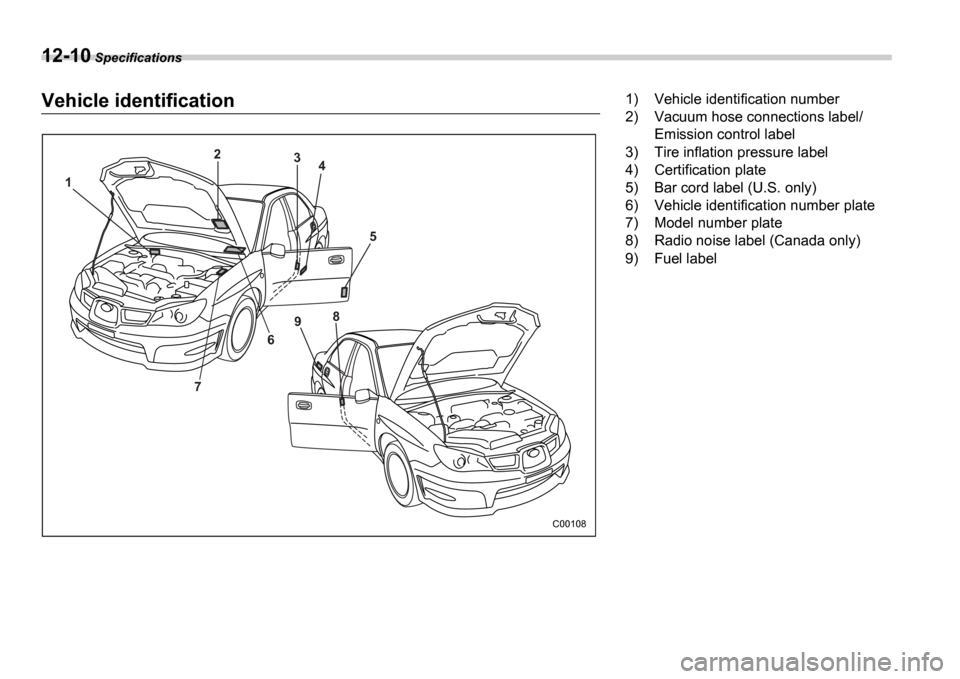
Vehicle identification
1 2
3
4
5
6
7 9
8
C00108
1) Vehicle identification number
2) Vacuum hose connections label/
Emission control label
3) Tire inflation pressure label
4) Certification plate
5) Bar cord label (U.S. only)
6) Vehicle identification number plate
7) Model number plate
8) Radio noise label (Canada only)
9) Fuel label
Page 348 of 365

Consumer information and Reporting safety defects 13-7
CONTINUED
asymmetrical tire that has a particu-
lar side that must always face out-
ward when mounting on a vehicle.
Accessory weight
The combined weight (in excess of
those standard items which may be
replaced) of floor mats, leather seats
and cross bars to the extent that these
items are available as factory-in-
stalled equipment (whether installed
or not).
Curb weight
The weight of a motor vehicle with
standard equipment including the
maximum capacity of fuel, oil, and
coolant and air conditioning.
Maximum loaded vehicle weight
The sum of curb weight, accessory
weight, vehicle capacity weight and
production options weight.
Normal occupant weight
150 lbs (68 kg) times the number of
occupants (3 occupants).
Occupant distribution
Distribution of occupants in a vehicle,
2 in front, 1 in rear seat.
Production options weight
The combined weight of those in-
stalled regular production options weighing over 5.1 lbs (2.3 kg) in ex-
cess of those standards items which
they replace, not previously consid-
ered in curb weight or accessory
weight.
Vehicle capacity weight
The total weight of cargo, luggage
and occupants that can be added to
the vehicle.
Vehicle maximum load on a tire
Load on an individual tire that is deter-
mined by distributing to each axle its
share of the maximum loaded vehicle
weight and dividing by two.
Vehicle normal load on a tire
Load on an individual tire that is deter-
mined by distributing to each axle its
share of the curb weight, accessory
weight, and normal occupant weight
and dividing by two.
Tire care maintenance and
safety practices
Check on a daily basis that the tires
are free from serious damage, nails,
and stones. At the same time, check
the tires for abnormal wear.
Inspect the tire tread regularly and
replace the tires before their tread wear indicators become visible. When
a tire
s tread wear indicator becomes
visible, the tire is worn beyond the ac-
ceptable limit and must be replaced
immediately. With a tire in this condi-
tion, driving at even low speeds in wet
weather can cause the vehicle to hy-
droplane. Possible resulting loss of
vehicle control can lead to an acci-
dent.
To maximize the life of each tire and
ensure that the tires wear uniformly, it
is best to rotate the tires every 7,500
miles (12,500 km). Rotating the tires
involves switching the front and rear
tires on the right-hand side of the ve-
hicle and similarly switching the front
and rear tires on the left-hand side of
the vehicle. (Each tire must be kept on
its original side of the vehicle.) Re-
place any damaged or unevenly worn
tire at the time of rotation. After tire ro-
tation, adjust the tire pressures and
make sure the wheel nuts are correct-
ly tightened. A tightening torque spec-
ification and a tightening sequence
specification for the wheel nuts can be
found Flat tires section in chapter 9.
Page 362 of 365

Index 14-7
Map light ......................................... ........................... 11-50
Parking light ...................................... ......................... 11-48
Rear combination lights ............................ ................. 11-48
Trunk light ........................................ .......................... 11-51
REV indicator light and buzzer ...................... ..................... 3-9
Rocking the vehicle ................................... ....................... 8-12
Roof rail and crossbar ............................... ....................... 8-14
S
Seat Fabric ............................................ ............................... 10-5
Heater ............................................ ................................ 1-5
Seatbelt .......................................... ....................................... 4
Extender ........................................... ........................... 1-19
Maintenance ........................................ ........................ 1-18
Pretensioners ....................................... ....................... 1-20
Safety tips ......................................... ............................. 1-9
Warning light and chime ............................ ......... 1-11, 3-14
Seatbelts .......................................... .................................. 1-9
Selector lever ...................................... ............................. 7-16
Position indicator .................................. ....................... 3-20
Shift lock release ................................... ........................... 7-19
Shock sensors .......................................... ........................ 2-17
Side ventilators ................................... ................................ 4-3
Snow tires ......................................... ................................ 8-10
Sounding a panic alarm ............................. ......................... 2-8
Spark plugs ......................................... ........................... 11-17
Specifications ....................................... ............................ 12-2
Speedometer ....................................... ...................... 3-6, 3-11
SRS airbag (Supplemental Restraint System
airbag) ........................................... ............................ 4, 1-35
SRS airbag system monitors ............................ ................ 1-56SRS airbag system servicing ............................
................ 1-57
SRS airbag system warning light ..................... ................. 3-15
SRS side airbag ................................... ............................. 1-51
Starting the engine ............................... ............................... 7-7
State emission testing (U.S. only) ................. ...................... 7-5
Stopping the engine ............................... ............................. 7-8
Storage compartments ................................ ....................... 6-4
Sun shades .......................................... ............................. 2-25
Sun visors ........................................... ................................ 6-3
Supplemental Restraint System airbag (SRS) ........... ....... 1-35
Synthetic leather upholstery .......................... ................... 10-5
T
Tachometer ......................................... ....................... 3-7, 3-12
Temperature gauge ................................. .................. 3-8, 3-13
Temporary spare tire ................................ .......................... 9-2
Tilt steering wheel ................................ ............................. 3-35
Tire
Chains ............................................. ............................. 8-11
Inspection ......................................... .......................... 11-30
Pressures and wear ................................... ................ 11-30
Replacement ........................................ ...................... 11-33
Rotation .......................................... ............................ 11-33
Tires .............................................. .................................... 12-4
Types ............................................... .......................... 11-30
Tires and wheels .................................... ......................... 11-30
Top tether anchorages ............................... ....................... 1-33
Towing ............................................ .................................. 9-11
All wheels on the ground ........................... ................... 9-14
Flat-bed truck ..................................... .......................... 9-13
Trailer Hitch .............................................. ............................... 8-17