2006 SKODA FABIA lock
[x] Cancel search: lockPage 199 of 258

Inspecting and Replenishing198
Opening the bonnet
– Unlock the bonnet ⇒page 197, fig. 141.
– Ensure that the arms of the windscreen wipers are correctly in
place against the windscreen before opening the bonnet other-
wise damage could occur to the paintwork.
– Press the locking button ⇒page 197, fig. 142, the bonnet unlocks
itself.
– Grip the bonnet and lift it up.
– Take the bonnet support out of its holder and set it in the opening
designed for it ⇒page 197, fig. 143.
Closing the bonnet
– Lift the bonnet slightly and unhook the bonnet support. Press the
bonnet support into the holder designed to hold it.
– Allow the bonnet to drop from a height of about 30 cm into the lock
- bonnet do not press down on it!
WARNING
•Never open the bonnet if you see that steam or coolant is flowing out of the engine compartment - risk of scalding! Wait long enough until the steam or coolant has stopped escaping.
•For safety reasons, the bonnet must always be properly closed when driving. One should therefore check that the lock has in fact engaged properly after closing the bonnet.
•Stop your vehicle immediately whil e driving if you notice that the lock is not properly engaged and close the bonnet properly - risk of an accident!
Caution
•Before opening the bonnet, ensure that the arms of the windscreen wipers are correctly in place against the windscreen. Otherwise, there is a risk of damage to the paintwork.
Working in the engine compartment
Particular care is required when carrying out any work in the
engine compartment!
There is a risk of injuries, scalding, accidents and fire when working in the engine compartment, e.g. inspecting and replenishing oil and other fluids. For this reason, it is essential to comply with the warning instructions stated below and with the general appl icable rules of safety. The engine compartment of your car is a hazardous area ⇒.
WARNING
•Never open the bonnet if you see that steam or coolant is flowing out of the engine compartment - risk of scalding! Wait long enough until the steam or coolant has stopped escaping.
•Switch off the engine and pull out the ignition key.
•Apply the handbrake firmly.
•If your vehicle is fitted with a manual gearbox, move the gearshift lever into Neutral, or if it is fitted with automatic gearbox, move the selector lever into position P.
•Allow the engine to cool down.
•Keep children clear of the engine compartment.
•Do not touch any hot engine parts - risk of burns!
NKO A05Fabia 20.book Page 198 Tuesday, September 26, 2006 8:38 AM
Page 200 of 258

Inspecting and Replenishing199
Using the systemSafetyDriving TipsGeneral MaintenanceBreakdown assistanceTechnical Data
•Never spill oil and other fluids over the hot engine. Such fluids (e.g. the antifreeze contained in the coolant) may ignite!
•Avoid short circuits in the electrical system - particularly on the battery.
•Never place your hand into the radiator fan as long as the engine is still warm. The fan might suddenly start running!
•Never open the cap of the coolant expansion bottle as long as the engine is still warm. The co oling system is pressurized!
•Cover over the cap of the coolant expansion reservoir with a large cloth when opening it as protection for your face, hands and arms from hot steam or hot coolant.
•Do not let objects, such as e.g cleaning cloth or tools lie in the engine compartment.
•If you wish to work under the vehicle, you must secure the vehicle from rolling away and support it with suitable supporting blocks: the car jack is not sufficient for this - risk of injury!
•In cases where it be necessary to carry out inspection work when the engine is running there is an additional risk from rotating parts (e.g. the V-ribbed belt, alternator, radiator fan) and from the high-voltage igni- tion system. Please observe in addition the following:
− Never touch the electrical cables of the ignition system.
− Absolutely avoid any jewellery, loose items of clothing or long hair from getting into the rotating part s of the engine - Hazard! Therefore remove any jewellery beforehand, tie up your hair and wear tight fitting clothing.
•Please also comply with the warnin g instructions stated below when carrying out any essential work on th e fuel system or on the electrical system:
− Always separate the car battery from the electrical system.
− Do not smoke.
− Never carry out any work close to naked flames.
− Always keep a working fire extinguisher at hand.
Caution
When replenishing fluids in the engine, always ensure that the fluids are on no account mixed up. This may result in ma jor operating problems and also vehicle damage!
Overview of the engine compartment
The main inspection points.
Fig. 144 Diesel engine 1.9 litre/77 kW
WARNING (continued)WARNING (continued)
NKO A05Fabia 20.book Page 199 Tuesday, September 26, 2006 8:38 AM
Page 205 of 258
Inspecting and Replenishing204
Inspecting the coolant level
The coolant expansion bottle is located in the engine compartment on
the right.
– Switch the engine off.
– Open the bonnet ⇒ in “Working in the engine compartment”
on page 198.
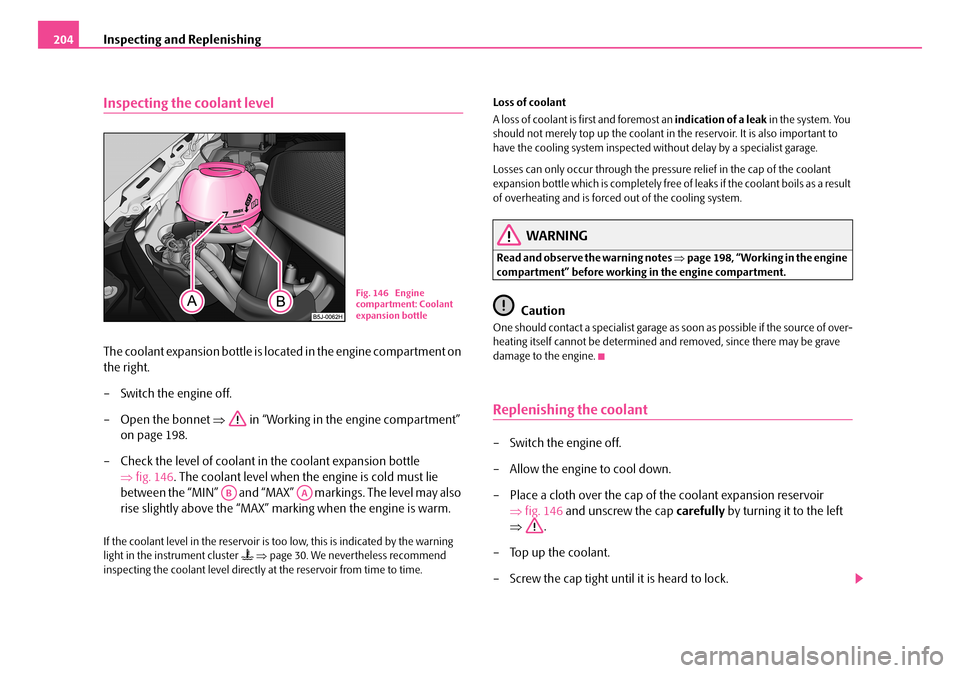
– Check the level of coolant in the coolant expansion bottle
⇒ fig. 146. The coolant level when the engine is cold must lie
between the “MIN” and “MAX” markings. The level may also
rise slightly above the “MAX” ma rking when the engine is warm.
If the coolant level in the reservoir is too low, this is indicated by the warning light in the instrument cluster ⇒page 30. We nevertheless recommend inspecting the coolant level directly at the reservoir from time to time.
Loss of coolant
A loss of coolant is first and foremost an indication of a leak in the system. You should not merely top up the coolant in the reservoir. It is also important to have the cooling system inspected without delay by a specialist garage.
Losses can only occur through the pressure relief in the cap of the coolant expansion bottle which is completely free of leaks if the coolant boils as a result of overheating and is forced out of the cooling system.
WARNING
Read and observe the warning notes ⇒page 198, “Working in the engine compartment” before working in the engine compartment.
Caution
One should contact a specialist garage as soon as possible if the source of over- heating itself cannot be determined an d removed, since there may be grave damage to the engine.
Replenishing the coolant
– Switch the engine off.
– Allow the engine to cool down.
– Place a cloth over the cap of the coolant expansion reservoir
⇒ fig. 146 and unscrew the cap carefully by turning it to the left
⇒ .
– Top up the coolant.
– Screw the cap tight until it is heard to lock.
Fig. 146 Engine compartment: Coolant expansion bottle
ABAA
NKO A05Fabia 20.book Page 204 Tuesday, September 26, 2006 8:38 AM
Page 208 of 258

Inspecting and Replenishing207
Using the systemSafetyDriving TipsGeneral MaintenanceBreakdown assistanceTechnical Data
WARNING
•Using old brake fluid can result in severe stress on the brakes because of the formation of vapour bubbles in the brake system. This greatly impairs the braking efficiency and thus also the safety of your vehicle.
•Brake fluid is toxic! It must therefore be kept safely in closed original containers and well away from children and unauthorized persons.
Caution
Brake fluid damages the paintwork of the vehicle.
For the sake of the environment
In view of the problems involved with prop er disposal of brake fluid, the special tools and the professional knowledge required, we recommend you have the brake fluid replaced by a Škoda Service Partner.
Battery
Working on the battery
The battery is located in the engine compartment below a plastic box.
– Unlock the interlock on the positi ve terminal side of the battery
⇒ fig. 148.
– Open the cover in direction of arrow.
– The installation of the battery co ver on the positive terminal side
takes place in the reverse order.
Removal and installation of the battery is not recommended since it can, under certain circumstances, lead to major da mage to the battery and fuse boxes. Contact a specialist garage.
Fig. 148 The battery: Open up the cover
NKO A05Fabia 20.book Page 207 Tuesday, September 26, 2006 8:38 AM
Page 220 of 258

Wheels and Tyres219
Using the systemSafetyDriving TipsGeneral MaintenanceBreakdown assistanceTechnical Data
Only use fine-link snow chains. They must not project more than 9 mm - including the chain lock.
Remove the full wheel trims before installing the snow chains.
Observe the national legal requirements relating to the use of snow chains and the maximum vehicle speed with snow chains.
WARNING
Please pay attention to the information in the supplied fitting instruc-tions of the snow chain manufacturer.
Caution
You must take the chains off as soon as you drive on roads which are free of snow. They adversely affect the handling of your vehicle, damage the tyres and are rapidly destroyed.
Note
•Only fit snow chains from the ra nge of Škoda genuine accessories.
•When driving with snow chains, switch off the traction control system (TCS).
Wheel sizeDepth (D)Tyre s iz e
5J x 1335 mm155/80
5J x 1435 mm165/70
6J x 1437 mm185/60
6J x 1543 mm185/55
NKO A05Fabia 20.book Page 219 Tuesday, September 26, 2006 8:38 AM
Page 223 of 258

Breakdown assistance222
Note
•The fire extinguisher must comply with the relevant and valid legal require- ments.
•Pay attention to the expiration date of the fire extinguisher. If the fire extin- guisher is used after the expiration da te, its proper function is no longer assured.
•The fire extinguisher is only supplied in certain countries within the scope of delivery.
Vehicle tool kit
The vehicle tool kit and the lifting jack ar e stored in a locable plastic box in the spare wheel ⇒fig. 154. There is also space here for the removable ball for the trailer towing device.
The vehicle tool kit contains the foll owing parts (depending on equipment fitted):
•Torx wrench,
•Wheel wrench,
•Hook for pulling off a full wheel trim,
•To w i n g e y e ,
•Adapter for the wheel bolts lock.
After using the lifting jack, screw in the arm of the lifting jack fully before placing it back in its stowage area.
WARNING
•The hexagon socket in the handle of the screwdriver should only be used to fit on the wheel bolts. Neve r use the hexagon socket of the screw- driver for tightening the wheel bolt s because you will not be able to achieve the necessary tightening torque with the hexagon socket - risk of accident!
•The factory-supplied lifting jack is only intended for your model of vehicle. On no account attempt to lift a heavier vehicle or other loads - risk of injury!
•Ensure that the vehicle tool kit is safely attached in the luggage compartment.
Tyre repair kit*
The tyre repair kit is intended for the repair of minor tyre defects. The tyre repair kit contains a compressor, inflation bottle, operating instructions and accesso-ries.
Fig. 154 Luggage compartment: Storage compartment for vehicle too kit
NKO A05Fabia 20.book Page 222 Tuesday, September 26, 2006 8:38 AM
Page 225 of 258

Breakdown assistance224
–Engage 1st gear or if your vehicle is fitted with an automatic
gearbox, position the selector lever into position P.
– If a trailer is coupled, uncouple it.
– Take the vehicle tool kit and the spare wheel ⇒page 222 out of
the luggage compartment.
WARNING
•If you find yourself in flowing traffic switch on the hazard warning lights system and place the warning tria ngle on the side of the road at the prescribed distance from your vehicl e while observing all national legal provisions. In this way you are protecting not only yourself but also other road users.
•Never start the engine with the vehi cle sitting on the raised jack - danger of suffering injury!
Caution
If you have to change a wheel on a slope first block the opposite wheel with a stone or similar object in order to secure the vehicle from unexpectedly rolling away.
Note
Comply with the national legal regulations.
Changing a wheel
Always change a wheel on a level surface as far as possible.
– Take off the full wheel trim* ⇒page 225 or the caps ⇒page 226.
– In the case of light alloy wheels remove the wheel trim cap
⇒ page 226.
– Slacken the wheel bolts ⇒page 227.
– Jack up the vehicle until the wheel to be changed is clear of the
ground ⇒page 227.
– Unscrew the wheel bolts and place them on a clean surface (cloth,
paper etc.).
– Take off the wheel.
– Fit on the spare wheel and tighten the wheel bolts slightly.
– Lower the car.
– Tighten the wheel bolts firmly, alternately and diagonally using the
wheel wrench ⇒page 227.
– Mount the full wheel trim/wh eel trim cap or the caps.
Note
•All bolts must be clean and must turn easily.
•You must never grease or oil the wheel bolts!
•When fitting on unidirectional tyres, ensure that the tyres rotate in the correct direction ⇒page 213.
Subsequent steps
After changing the wheel, you must perform the following steps.
NKO A05Fabia 20.book Page 224 Tuesday, September 26, 2006 8:38 AM
Page 226 of 258

Breakdown assistance225
Using the systemSafetyDriving TipsGeneral MaintenanceBreakdown assistanceTechnical Data
– Stow and attach the replaced wheel in the spare wheel well.
– Stow the vehicle tool kit in the space provided.
– Check the tyre pressure on the spare wheel just mounted as soon
as possible.
– Have the tightening torque of the wheel bolts checked with a
torque wrench as soon as possible. The tightening torque for steel
and light alloy wheels must be 120 Nm.
– Have the defective tyre repaired as soon as possible.
WARNING
It is necessary to observ e the guidelines given on ⇒page 215, “New tyres and wheels” if the vehicle is subsequently fitted with tyres which are different to those it was fitted with at the works.
Note
•If you find, when changing the wheel, that the wheel bolts are corroded and difficult to turn, the bolts must be re placed before checking the tightening torque.
•Drive cautiously and only at a moderate speed to a workshop where the tightening torque can be checked.
Full wheel trim*
Pulling off
– Hook the clamp found in the vehicle tool kit into the reinforced
edge of the full wheel trim.
– Push the wheel key through the clamp, support the wheel key on
the tyre and pull off the wheel trim ⇒fig. 156.
Installing
– First press the full wheel trim onto the wheel at the valve opening
provided. Then press the full wheel trim into the wheel in such a
way that its entire circumfere nce locks correctly in place.
Caution
•Use the pressure of your hand, do no t knock on the full wheel trim! Heavy knocks mainly on the points where the full wheel trim has not been inserted
Fig. 156 Removing the full wheel trim
NKO A05Fabia 20.book Page 225 Tuesday, September 26, 2006 8:38 AM