2006 SKODA FABIA lock
[x] Cancel search: lockPage 142 of 258

Seat belts141
Using the systemSafetyDriving TipsGeneral MaintenanceBreakdown assistanceTechnical Data
How are seat belts correctly fastened?
Fastening three-point seat belts
Fasten your seat belt before starting!
– Correctly adjust the seat and the head restraint before fastening
your seat belt ⇒page 135, “Correct seated position”.
– Slowly pull the belt webbing at th e tongue of the lock over your
chest and pelvis ⇒.
– Insert the tongue of the lock into the seat belt buckle belonging to
the seat until it is heard to lock in place.
– Pull on the belt to check that it has also reliably engaged in the lock.
Each three-point seat belt is equipped with an inertia reel. This inertia reel offers you complete freedom of movement if the belt is unreeled slowly. If the brakes are applied suddenly, the inertia reel will block. It also blocks the belts when the car accelerates, when driving downhill and when cornering.
Expectant mothers must also wear the seat belt ⇒.
WARNING
•The shoulder part of the seat belt must never run across your neck but must run approximately over th e middle of the shoulder and fit snugly against the chest. The lap part of the belt must run across the hip and must never be routed across the stomach. It must always fit snugly ⇒ fig. 109. Adjust the belt webbing as required.
•The lap part of the belt should be positioned as low as possible at the pelvis of an expectant mother in or der to avoid exerting any pressure on the lower abdomen.
•Always ensure that the webbing of the seat belts is properly routed. Seat belts which are not correctly adjusted can themselves cause injuries even in minor accidents.
•A seat belt which is hanging too loose can result in injuries as your body is moved forward by the kineti c energy produced in an accident and is then suddenly held firm by the belt.
Fig. 109 Routing of webbing over the shoul-ders and the lap belt
Fig. 110 Routing of belt webbing for an expectant mother
NKO A05Fabia 20.book Page 141 Tuesday, September 26, 2006 8:38 AM
Page 143 of 258

Seat belts142
•Only insert the lock tongue into the lock which is the correct one for your seat. This will affect the protection which the belt offers and increase the risk of an injury.
Seat belt height adjuster on the front seats
The seat belt height adjuster make s it possible for you to adapt the
routing of the front three-point seat belt in the area of the shoulder to
match your body size.
– To adjust the belt height press the height adjuster and move it up
or down ⇒fig. 111.
– Then pull firmly on the belt to en sure that the seat belt height
adjuster has correctly locked in place.
WARNING
Adjust the height of the belt in such a way that the shoulder part of the belt is positioned approximately acro ss the middle of your shoulder - on no account across your neck.
Note
It is also possible to adapt the routing of the belt webbing on the front seats by adjusting the height of the seat*.
Taking seat belts off
– Press the red button in the belt lock ⇒fig. 112. The spring force
causes the tongue of the lock to jump out.
– Guide the belt back with your ha nd to enable the inertia reel to
wind up the belt webbing more easily.
WARNING (continued)
Fig. 111 Front seat: Seat belt height adjuster
Fig. 112 Releasing lock tongue from belt lock
NKO A05Fabia 20.book Page 142 Tuesday, September 26, 2006 8:38 AM
Page 144 of 258

Seat belts143
Using the systemSafetyDriving TipsGeneral MaintenanceBreakdown assistanceTechnical Data
A plastic knob in the belt webbing holds the belt tongue in a position which is easy to get hold of.
Three-point safety belt for the middle rear seat
It is used in the same way as the normal three-point seat belts on the left and right (at front and rear).
WARNING
•The three-point safety belt for the rear middle seat can only fulfil its function reliably when the backrests are correctly locked into position ⇒ page 73.
Belt tensioner
Safety for the driver and front passenger wearing their seat belts is enhanced by the belt tensioners fitted to the inertia reels of the front three-point seat belts.
The fastened three-point seat belts are automatically tensioned in the event of a frontal collision of a certain severity. The belts tensioners are also deployed if the seat belts are not fastened.
Belt tensioners are not activated in the event of minor frontal collisions, side and rear-end collisions, in the case of a rollover and also not in accidents in which no major forces are produced from the front.
WARNING
•Any work on the belt tightener sy stem, including removal and instal- lation of system components because of other repair work, must only be carried out by a specialist garage.
•The protective function of the system is only adequate for a single accident. If the belt tensioners have been deployed, it is then necessary to replace the entire system.
•The Owner's Manual must also be handed over to the new owner if the vehicle is sold.
Note
•Smoke is generated when the belt tensioners are deployed. This is not an indication of a fire in the vehicle.
•It is essential to pay attention to releva nt safety regulations if the vehicle or individual parts of the system are scrapped. Škoda Service Partners are familiar with these regulations and will be able to provide you with detailed information in this respect.
•When disposing of vehicle or parts of the system, it is important to comply with the national legal requirements.
NKO A05Fabia 20.book Page 143 Tuesday, September 26, 2006 8:38 AM
Page 146 of 258

Airbag system145
Using the systemSafetyDriving TipsGeneral MaintenanceBreakdown assistanceTechnical Data
•If you sell your car, please hand over the complete vehicle documen- tation to the new owener. Please note that the documents relating to the possibility of deactivating the front pa ssenger airbag are also part of the vehicle documents!
•If the vehicle or individual parts of the airbag system are scrapped, it is essential to observe the relevant safety precautions. Škoda Service Partners are familiar with these regulations.
•When disposing of vehicle or parts of the airbag system, it is impor- tant to comply with the national legal requirements.
When are the airbags deployed?
The airbag system is designed in such a way that the driver and the front passenger airbag* are deployed in the event of a frontal collision of major severity .
In the case of a violent side crash, the side airbag* in the front seat and the head airbag* on the side of the car at which the collision occurs are deployed.
It is also possible under certain special accident situations that the front as well as the side airbags and head airbags* are deployed.
The airbags are not deployed in the case of minor frontal and side collisions, in the case of rear-end collisions and vehicle rollover.
Deployment factors
It is not possible to state globally wh ich deployment conditions apply to the airbag system in every situation as the circumstances which exist in the case of accidents vary greatly. An important role in this case, for example, is played by factors such as the type of object agains t which the vehicle impacts (hard, soft), the angle of impact, the vehicle speed etc.
A decisive factor for the deployment of the airbags is the deceleration which occurs during a collision. The control uni t analyses the nature of the collision and activates the relevant restraint system. If the vehicle deceleration which occurs and is measured during the collision remains below the prescribed reference values specified in the cont rol unit, the airbags are not deployed although the vehicle may well suffer severe damage to the bodywork as a consequence of the accident.
The airbags are not deployed if:
•ignition off,
•a minor frontal collision,
•a minor side collision,
•a rear-end collision,
•rollover.
Caution
The dash panel must be replaced afte r the front passenger airbag has been deployed.
Note
•A grey white or red, non harmful gas is released when airbag is inflated. This is perfectly normal and is not an in dication of a fire in the vehicle.
•In the event of an accident in which the airbags are deployed:
− The interior lighting comes on (if the switch for the interior light is in the door contact position),
− The hazard warning light is switched on,
− All the doors are unlocked.
WARNING (continued)
NKO A05Fabia 20.book Page 145 Tuesday, September 26, 2006 8:38 AM
Page 164 of 258

Transporting children safely163
Using the systemSafetyDriving TipsGeneral MaintenanceBreakdown assistanceTechnical Data
Attaching a child seat using the “ISOFIX”
system*
There are two fixing eyes between the backrest and the seat itself on
both of the outer rear seats for fixing the “ISOFIX” system child seat in
place.
– Insert the mounting funnels on to the locking eyes between
the backrest and seat cushion ⇒fig. 130.
– Push the notched arms of the child seat over the mounting funnels
into the locking eyes, until it is heard to lock ⇒fig. 131.
– Pull on both sides of the child seat!
One can mount a child safety seat using the “ISOFIX” system quickly, easily and reliably. Please pay close attention to instructions from the manufacturer of the child safety seat when installing and removing the seat.
Child seats fitted with the “ISOFIX” cl amping system can only be mounted and fixed in a vehicle fitted with an “ISOFIX system” when these child seats have been released for your type of vehi cle according to the ECE-R 44 standard.
You can purchase child seat s with the “ISOFIX” attachment system from Škoda Service Partners who will install it as well.
Complete installation instructions are enclosed with the child safety seat.
WARNING
•The locking eyes have just been developed for child safety seats which use the “ISOFIX” system. You sh ould therefore never attach other child safety seats, seat belts or objects to the locking eyes - hazard!
•Ask a Škoda Service Partner whether a child seat which you bought for another vehicle is recommended for use in a Škoda before using an “ISOFIX” system.
•Certain child seats which use the “ISOFIX” system can be attached with standard three-point seat belts. Please pay close attention to
Fig. 130 Locking eyes (ISOFIX system)
Fig. 131 The ISOFIX child seat is pushed into the mounting funnels
AAAB
NKO A05Fabia 20.book Page 163 Tuesday, September 26, 2006 8:38 AM
Page 166 of 258

Intelligent Technology165
Using the systemSafetyDriving TipsGeneral MaintenanceBreakdown assistanceTechnical Data
Driving Tips
Intelligent Technology
Electronic stability programme (ESP)*
General
General
The ESP aids you maintain control of your vehicle in situations in borderline driving situations such as when negotiatin g a curve too fast. The risk of skidding is reduced and your car thus offers greater driving stability depending on the conditions of the road surface. This occurs at all speeds.
The following systems are integrated in to the electronic stability programme:
•Electronic Differential Lock (EDL),
•Traction control system (TCS),
•Antilock brake system (ABS),
•Brake Assist.
Operating principle
The ESP switches on automatically wh en the engine is started and then conducts a self-test. The ESP control uni t processes data from the individual systems. It also processes additional measurement data which are supplied by highly sensitive sensors: the rotational velocity of the vehicle about its vertical axis, the lateral acceleration of the vehicle, the braking pressure and the steering angle.
The direction which the driver wishes to take is determined based on the steering angle and the speed of the vehicle and is constantly compared with the actual behaviour of the vehicl e. If differences exist, such as the car beginning to skid, the ESP will automatically brake the appropriate wheel.
The car is stabilised again by the forces which take effect when the wheel is braked. Intervention into the brake system takes place primarily on the outer front wheel of a vehicle which tends to oversteer (tendency for the rear of the vehicle to break away) while occurs this is on the inner rear wheel of a vehicle which tends to understeer (tendency to shift out of the curve). This braking control cycle is accompanied by noises.
The ESP operates in combination with the ABS ⇒page 169, “Antilock brake system (ABS)*”. If there is a fault in the ABS system, the ESP also does not operate.
The ESP warning light ⇒page 33 lights up in the instrument cluster when there is a fault on the ESP.
Fig. 133 ESP switch
NKO A05Fabia 20.book Page 165 Tuesday, September 26, 2006 8:38 AM
Page 167 of 258
Intelligent Technology166
Switching off
You can switch the ESP off and on again as you wish, by pressing the button ⇒ page 165, fig. 133. The ESP warning light ⇒page 33 lights up in the instru- ment cluster when the ESP is switched off.
The ESP should normally al ways be switched on. It may be good practice in certain exceptional cases, such as when you wish to have wheel slip, to switch off the system.
Examples:
•when driving with snow chains,
•when driving in deep snow or on a loose surface,
•when it is necessary to rock a car free when it has become stuck.
then you should switch on the ESP again.
WARNING
It is also not possible for the ESP to overcome the physical limits of the vehicle. Even if a vehicle fitted with ESP you should still always adapt your style of driving to the condition of the road surface and the traffic situation. This particularly applies when driving on slippery and wet roads. The increased safety offered must not tempt you to take greater risks than otherwise - risk of an accident!
Note
•All four wheels must be fitted with the same tyres in order to achieve problem-free operation of the ESP. Differ ing rolling circumferences of the tyres can lead to an undesirable reduction in the engine output.
•Changes to vehicle (e.g. on engine, on the brakes, on chassis or other assignment of tyres and wheels) can influence the function of the ESP ⇒ page 220, “Accessories, changes and replacement of parts”.
Traction control system (TCS)*
The traction control system prevents the driven wheels from
spinning when accelerating.
General
The TCS makes it much easier, and sometimes at all possible, to start off, accel- erate and climb a steep hill when the co nditions of the road surface are unfa- vourable.
Operating principle
The TCS switches on automatically when the engine is started and then conducts a self-test. The system monitors the speeds of the driven wheels with the aid of the ABS sensors. If the wheels are spinning, the force transmitted to the road surface is automatically adap ted by reducing the engine speed. This occurs at all speeds.
The TCS operates in combination with the ABS ⇒page 169, “Antilock brake system (ABS)*”. The TCS will not function if a fault exists in the ABS system.
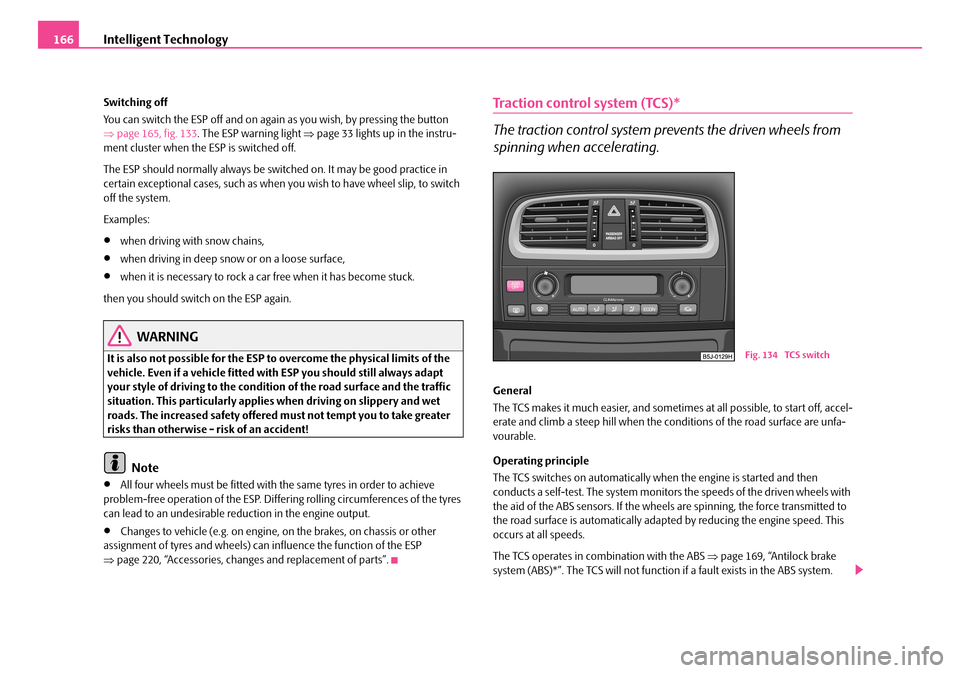
Fig. 134 TCS switch
NKO A05Fabia 20.book Page 166 Tuesday, September 26, 2006 8:38 AM
Page 168 of 258

Intelligent Technology167
Using the systemSafetyDriving TipsGeneral MaintenanceBreakdown assistanceTechnical Data
The TCS warning light ⇒page 33 lights up in the instrument cluster when there is a fault on the TCS.
Switching off
You can switch the TCS off and on again as you wish by pressing the button ⇒ page 166, fig. 134. The TCS warning light ⇒page 33 lights up in the instru- ment cluster when the TCS is switched off.
The TCS should normally al ways be switched on. It may be good practice in certain exceptional cases, such as when you wish to have wheel slip, to switch off the system.
Examples:
•when driving with snow chains,
•when driving in deep snow or on a loose surface,
•when it is necessary to rock a car free when it has become stuck.
then you should switch on the TCS again.
WARNING
You should always adjust your style of driving to the conditions of the road surface and the traffic situation. The increased safety offered must not tempt you to take greater risks than otherwise - risk of an accident!
Note
•All four wheels must be fitted with the same tyres in order to achieve problem-free operation of the TCS. Differing rolling circumferences of the tyres can lead to an undesirable re duction in the engine output.
•Changes to vehicle (e.g. on engine, on the brakes, on chassis or other assignment of tyres and wheels) can influence the function of the TCS ⇒ page 220, “Accessories, changes and replacement of parts”.
Electronic Differential Lock (EDL)*
The electronic differential lock prevents an individual wheel
from slipping.
Models fitted with ESP are equipped with electronic differential lock (EDL).
General
The EDL makes it much easier, and sometimes at all possible, to start off, accel- erate and climb a steep hill when the conditions of the road surface are unfa- vourable.
Operating principle
The EDL is activated automatically, that is without any action on the part of the driver. It monitors the speeds of the driven wheels with the aid of the ABS sensors. Should only one drive wheel begin spinning on a slippery surface there will be an appreciable di fference in the speed of the driven wheels. The EDL function brakes the slipping wheel and the differential transmits a greater driving force to the other driven wheel. This control process is also accompa- nied by noises.
Overheating of the brakes
The EDL switches off automati cally if unusually severe stresses exist in order to avoid excessive heat generation in the disc brake on the wheel which is being braked. The vehicle can continue to be driven and has the same characteristics as a vehicle not fitted with EDL.
The EDL switches on again automatically as soon as the brake has cooled down.
WARNING
•Depress the accelerator carefully when accelerating on uniformly slippery road surfaces, such as ic e and snow. The driven wheels might still spin despite the EDL and affect the stability of the vehicle - risk of an accident!
NKO A05Fabia 20.book Page 167 Tuesday, September 26, 2006 8:38 AM