2006 NISSAN PATROL check engine
[x] Cancel search: check enginePage 306 of 1226
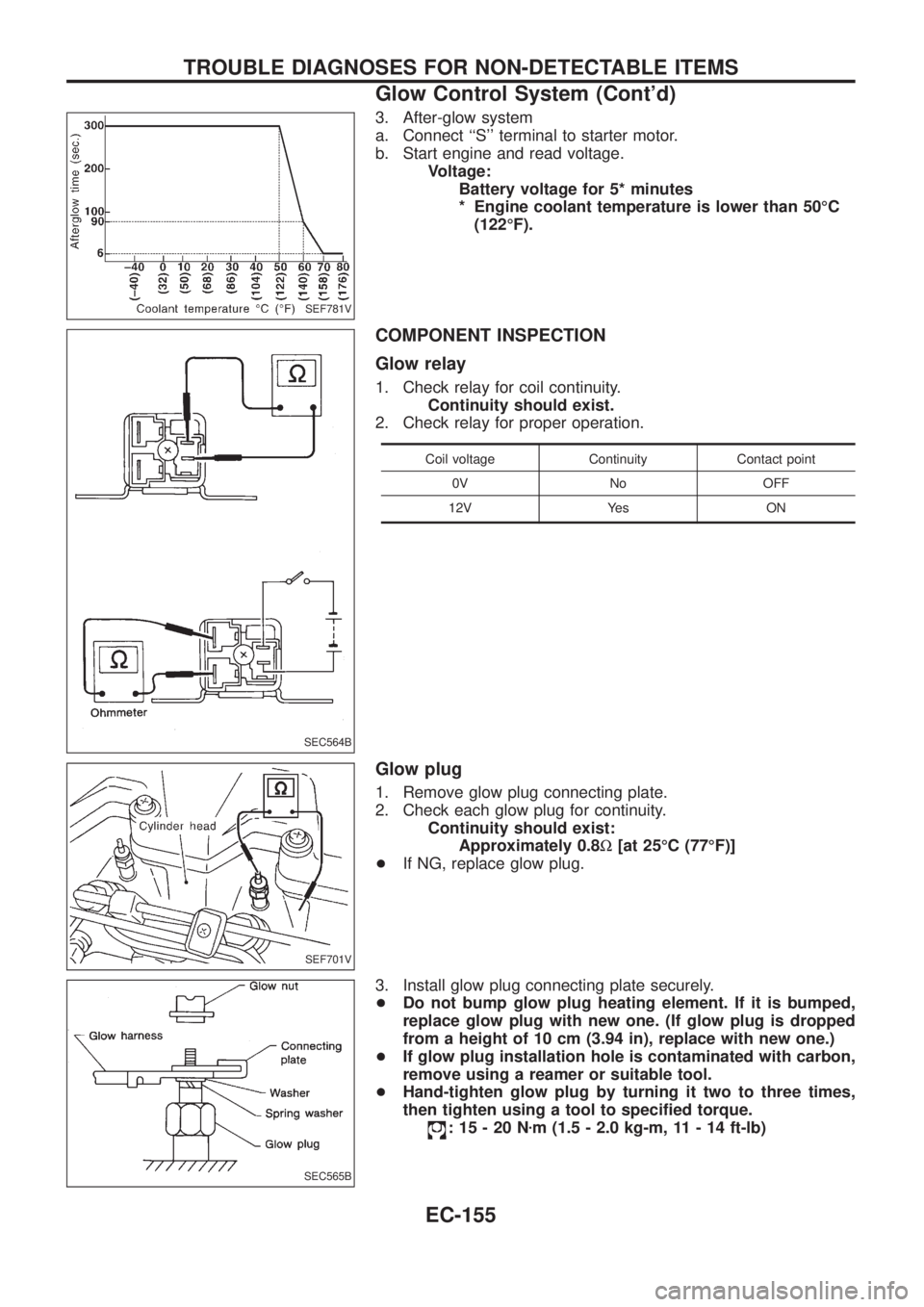
3. After-glow system
a. Connect ``S'' terminal to starter motor.
b. Start engine and read voltage.
Voltage:
Battery voltage for 5* minutes
* Engine coolant temperature is lower than 50ÉC
(122ÉF).
COMPONENT INSPECTION
Glow relay
1. Check relay for coil continuity.
Continuity should exist.
2. Check relay for proper operation.
Coil voltage Continuity Contact point
0V No OFF
12V Yes ON
Glow plug
1. Remove glow plug connecting plate.
2. Check each glow plug for continuity.
Continuity should exist:
Approximately 0.8W[at 25ÉC (77ÉF)]
+If NG, replace glow plug.
3. Install glow plug connecting plate securely.
+Do not bump glow plug heating element. If it is bumped,
replace glow plug with new one. (If glow plug is dropped
from a height of 10 cm (3.94 in), replace with new one.)
+If glow plug installation hole is contaminated with carbon,
remove using a reamer or suitable tool.
+Hand-tighten glow plug by turning it two to three times,
then tighten using a tool to speci®ed torque.
:15-20Nzm (1.5 - 2.0 kg-m, 11 - 14 ft-lb)
SEF781V
SEC564B
SEF701V
SEC565B
TROUBLE DIAGNOSES FOR NON-DETECTABLE ITEMS
Glow Control System (Cont'd)
EC-155
Page 310 of 1226
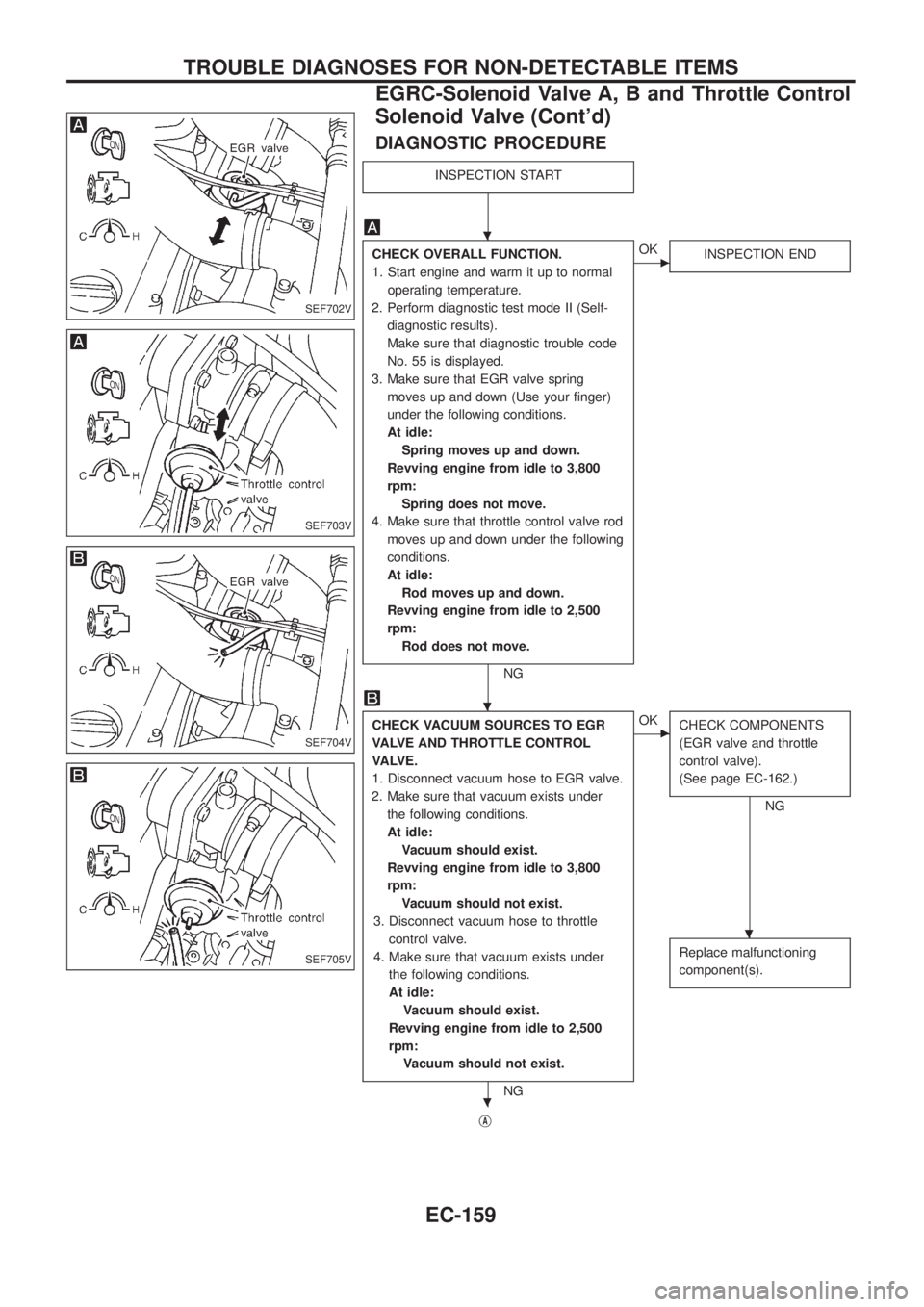
DIAGNOSTIC PROCEDURE
INSPECTION START
CHECK OVERALL FUNCTION.
1. Start engine and warm it up to normal
operating temperature.
2. Perform diagnostic test mode II (Self-
diagnostic results).
Make sure that diagnostic trouble code
No. 55 is displayed.
3. Make sure that EGR valve spring
moves up and down (Use your ®nger)
under the following conditions.
At idle:
Spring moves up and down.
Revving engine from idle to 3,800
rpm:
Spring does not move.
4. Make sure that throttle control valve rod
moves up and down under the following
conditions.
At idle:
Rod moves up and down.
Revving engine from idle to 2,500
rpm:
Rod does not move.
NG
cOK
INSPECTION END
CHECK VACUUM SOURCES TO EGR
VALVE AND THROTTLE CONTROL
VALVE.
1. Disconnect vacuum hose to EGR valve.
2. Make sure that vacuum exists under
the following conditions.
At idle:
Vacuum should exist.
Revving engine from idle to 3,800
rpm:
Vacuum should not exist.
3. Disconnect vacuum hose to throttle
control valve.
4. Make sure that vacuum exists under
the following conditions.
At idle:
Vacuum should exist.
Revving engine from idle to 2,500
rpm:
Vacuum should not exist.
NG
cOK
CHECK COMPONENTS
(EGR valve and throttle
control valve).
(See page EC-162.)
NG
Replace malfunctioning
component(s).
jA
SEF702V
SEF703V
SEF704V
SEF705V
.
.
.
.
TROUBLE DIAGNOSES FOR NON-DETECTABLE ITEMS
EGRC-Solenoid Valve A, B and Throttle Control
Solenoid Valve (Cont'd)
EC-159
Page 311 of 1226
jA
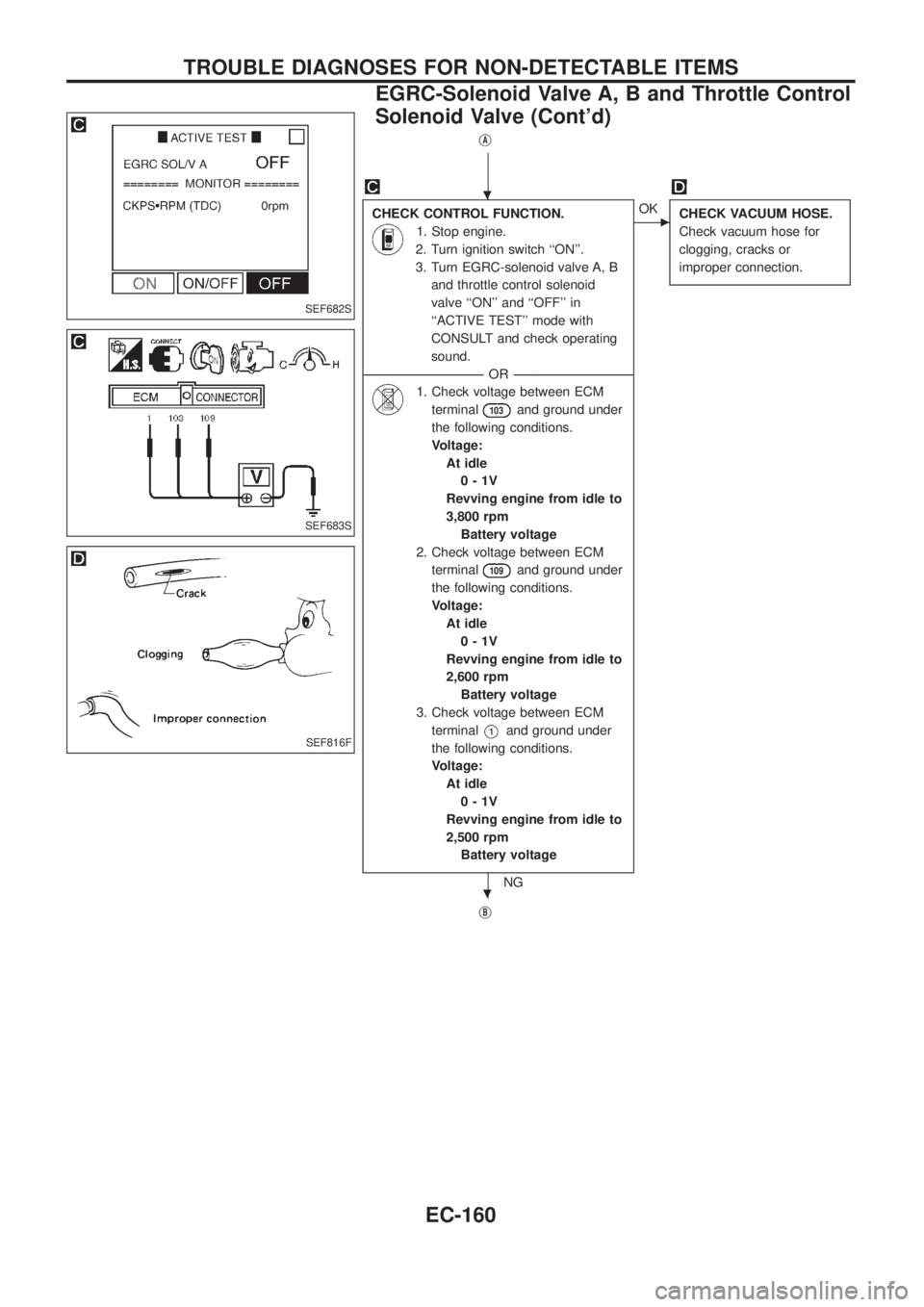
CHECK CONTROL FUNCTION.
1. Stop engine.
2. Turn ignition switch ``ON''.
3. Turn EGRC-solenoid valve A, B
and throttle control solenoid
valve ``ON'' and ``OFF'' in
``ACTIVE TEST'' mode with
CONSULT and check operating
sound.
--------------------------------------------------------------------------------------------------------------------------------------OR--------------------------------------------------------------------------------------------------------------------------------------
1. Check voltage between ECM
terminal
103and ground under
the following conditions.
Voltage:
At idle
0-1V
Revving engine from idle to
3,800 rpm
Battery voltage
2. Check voltage between ECM
terminal
109and ground under
the following conditions.
Voltage:
At idle
0-1V
Revving engine from idle to
2,600 rpm
Battery voltage
3. Check voltage between ECM
terminal
V1and ground under
the following conditions.
Voltage:
At idle
0-1V
Revving engine from idle to
2,500 rpm
Battery voltage
NG
cOK
CHECK VACUUM HOSE.
Check vacuum hose for
clogging, cracks or
improper connection.
jB
SEF682S
SEF683S
SEF816F
.
.
TROUBLE DIAGNOSES FOR NON-DETECTABLE ITEMS
EGRC-Solenoid Valve A, B and Throttle Control
Solenoid Valve (Cont'd)
EC-160
Page 320 of 1226
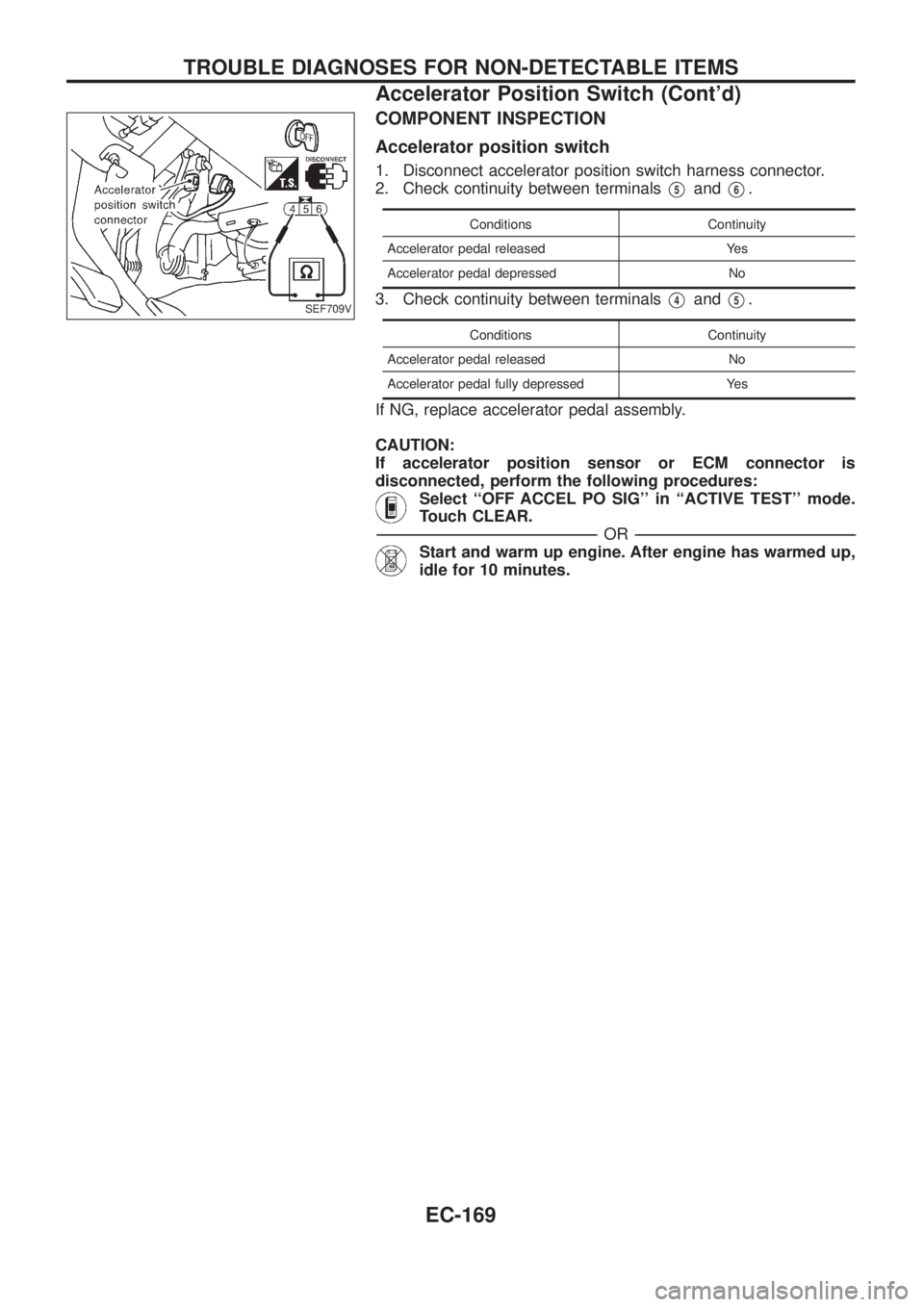
COMPONENT INSPECTION
Accelerator position switch
1. Disconnect accelerator position switch harness connector.
2. Check continuity between terminals
V5andV6.
Conditions Continuity
Accelerator pedal released Yes
Accelerator pedal depressed No
3. Check continuity between terminalsV4andV5.
Conditions Continuity
Accelerator pedal released No
Accelerator pedal fully depressed Yes
If NG, replace accelerator pedal assembly.
CAUTION:
If accelerator position sensor or ECM connector is
disconnected, perform the following procedures:
Select ``OFF ACCEL PO SIG'' in ``ACTIVE TEST'' mode.
Touch CLEAR.
-------------------------------------------------------------------------------------------------------------------------------------------------------------------------------------------------------------------------------------------------------OR-------------------------------------------------------------------------------------------------------------------------------------------------------------------------------------------------------------------------------------------------------
Start and warm up engine. After engine has warmed up,
idle for 10 minutes.
SEF709V
TROUBLE DIAGNOSES FOR NON-DETECTABLE ITEMS
Accelerator Position Switch (Cont'd)
EC-169
Page 328 of 1226
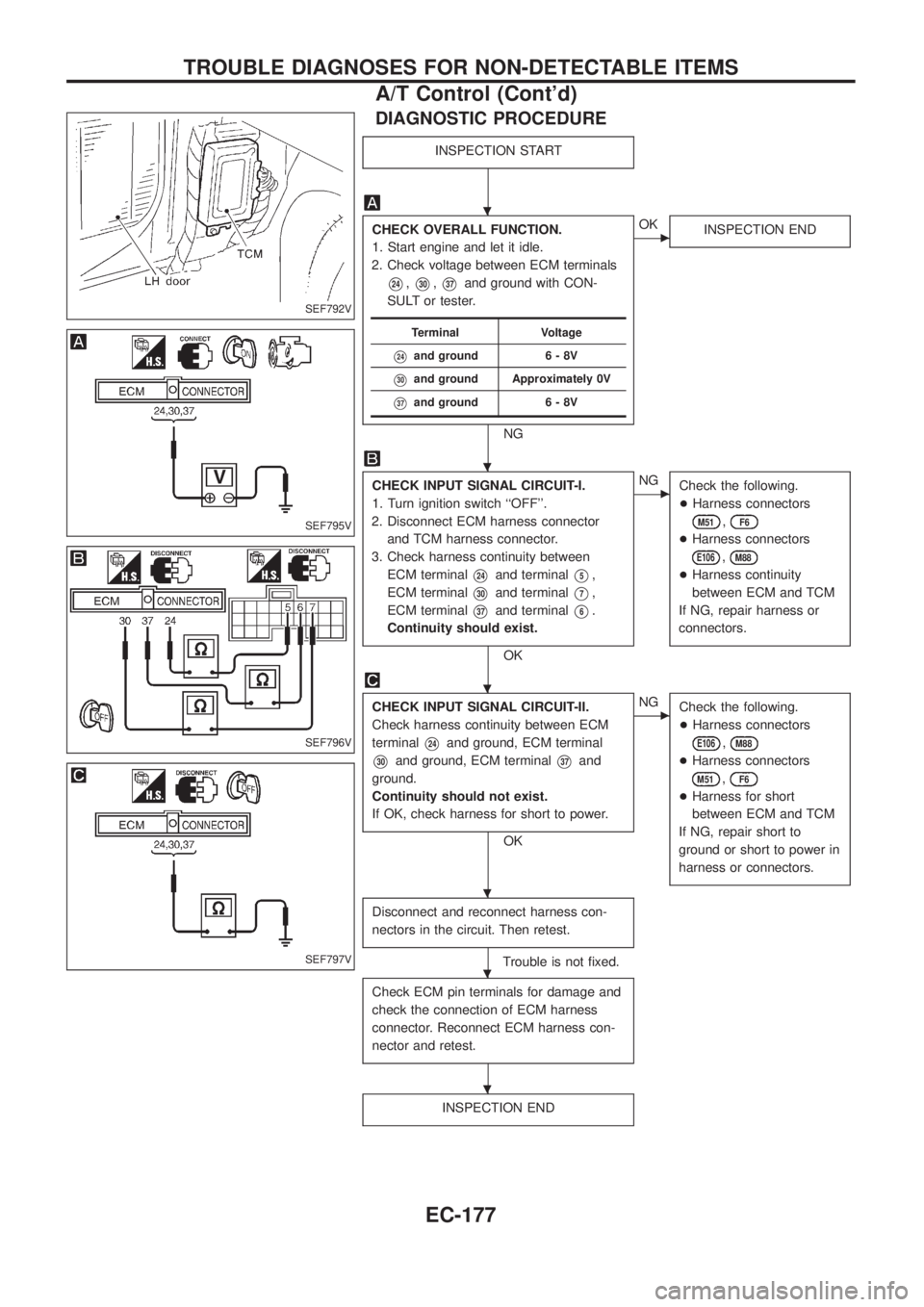
DIAGNOSTIC PROCEDURE
INSPECTION START
CHECK OVERALL FUNCTION.
1. Start engine and let it idle.
2. Check voltage between ECM terminals
V24,V30,V37and ground with CON-
SULT or tester.
NG
cOK
INSPECTION END
CHECK INPUT SIGNAL CIRCUIT-I.
1. Turn ignition switch ``OFF''.
2. Disconnect ECM harness connector
and TCM harness connector.
3. Check harness continuity between
ECM terminal
V24and terminalV5,
ECM terminal
V30and terminalV7,
ECM terminal
V37and terminalV6.
Continuity should exist.
OK
cNG
Check the following.
+Harness connectors
M51,F6
+Harness connectors
E106,M88
+Harness continuity
between ECM and TCM
If NG, repair harness or
connectors.
CHECK INPUT SIGNAL CIRCUIT-II.
Check harness continuity between ECM
terminal
V24and ground, ECM terminal
V30and ground, ECM terminalV37and
ground.
Continuity should not exist.
If OK, check harness for short to power.
OK
cNG
Check the following.
+Harness connectors
E106,M88
+Harness connectors
M51,F6
+Harness for short
between ECM and TCM
If NG, repair short to
ground or short to power in
harness or connectors.
Disconnect and reconnect harness con-
nectors in the circuit. Then retest.
Trouble is not ®xed.
Check ECM pin terminals for damage and
check the connection of ECM harness
connector. Reconnect ECM harness con-
nector and retest.
INSPECTION END
Terminal Voltage
V24and ground 6 - 8V
V30and ground Approximately 0V
V37and ground 6 - 8V
SEF792V
SEF795V
SEF796V
SEF797V
.
.
.
.
.
.
TROUBLE DIAGNOSES FOR NON-DETECTABLE ITEMS
A/T Control (Cont'd)
EC-177
Page 331 of 1226
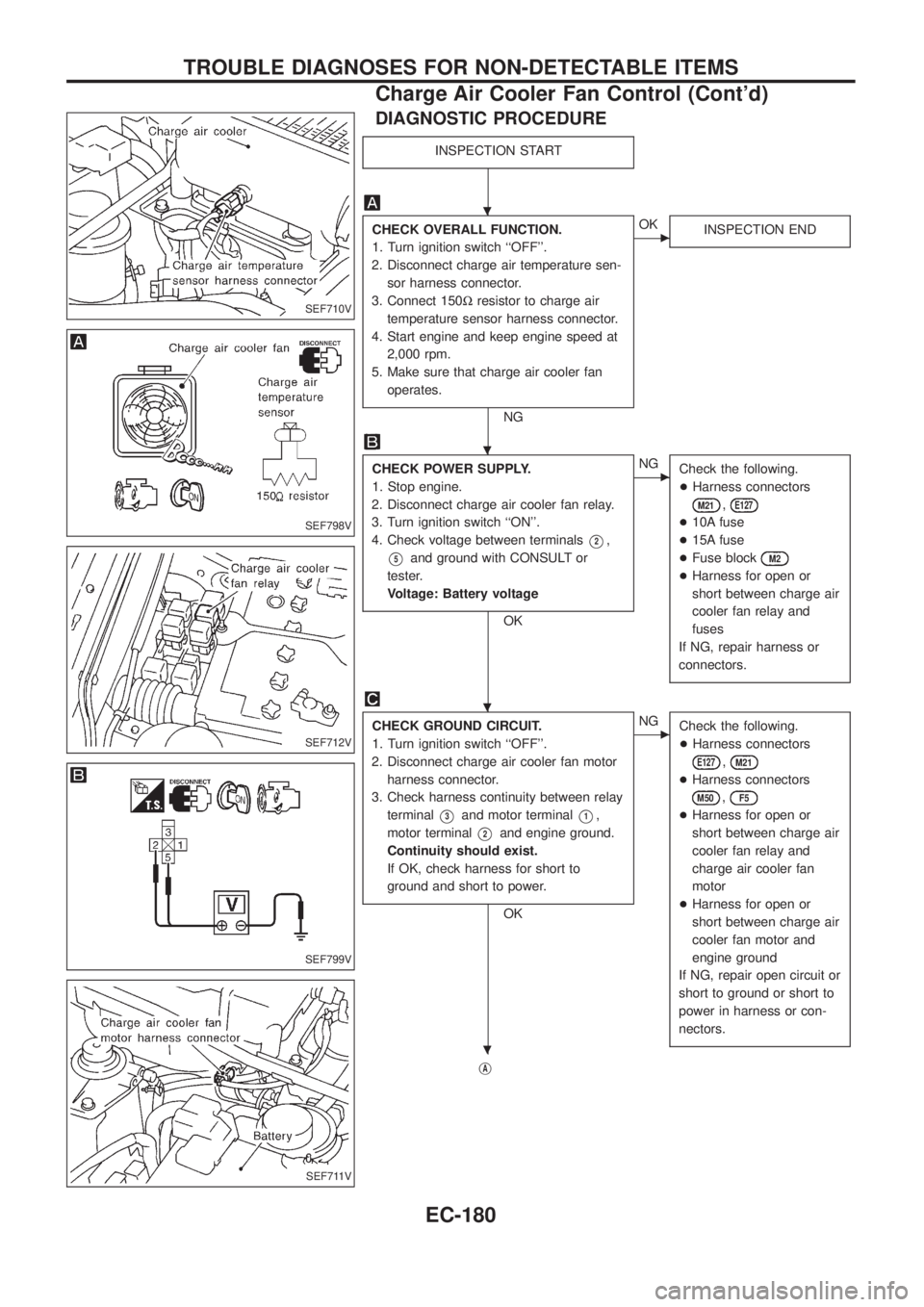
DIAGNOSTIC PROCEDURE
INSPECTION START
CHECK OVERALL FUNCTION.
1. Turn ignition switch ``OFF''.
2. Disconnect charge air temperature sen-
sor harness connector.
3. Connect 150Wresistor to charge air
temperature sensor harness connector.
4. Start engine and keep engine speed at
2,000 rpm.
5. Make sure that charge air cooler fan
operates.
NG
cOK
INSPECTION END
CHECK POWER SUPPLY.
1. Stop engine.
2. Disconnect charge air cooler fan relay.
3. Turn ignition switch ``ON''.
4. Check voltage between terminals
V2,
V5and ground with CONSULT or
tester.
Voltage: Battery voltage
OK
cNG
Check the following.
+Harness connectors
M21,E127
+10A fuse
+15A fuse
+Fuse block
M2
+Harness for open or
short between charge air
cooler fan relay and
fuses
If NG, repair harness or
connectors.
CHECK GROUND CIRCUIT.
1. Turn ignition switch ``OFF''.
2. Disconnect charge air cooler fan motor
harness connector.
3. Check harness continuity between relay
terminal
V3and motor terminalV1,
motor terminal
V2and engine ground.
Continuity should exist.
If OK, check harness for short to
ground and short to power.
OK
cNG
Check the following.
+Harness connectors
E127,M21
+Harness connectors
M50,F5
+Harness for open or
short between charge air
cooler fan relay and
charge air cooler fan
motor
+Harness for open or
short between charge air
cooler fan motor and
engine ground
If NG, repair open circuit or
short to ground or short to
power in harness or con-
nectors.
jA
SEF710V
SEF798V
SEF712V
SEF799V
SEF711V
.
.
.
.
TROUBLE DIAGNOSES FOR NON-DETECTABLE ITEMS
Charge Air Cooler Fan Control (Cont'd)
EC-180
Page 342 of 1226

ELECTRICAL SYSTEM
SECTION
EL
When you read wiring diagrams:
+Read GI section, ``HOW TO READ WIRING DIAGRAMS''.
When you perform trouble diagnoses, read GI section, ``HOW TO FOLLOW FLOW
CHART IN TROUBLE DIAGNOSES'' and ``HOW TO PERFORM EFFICIENT DIAGNOSIS
FOR AN ELECTRICAL INCIDENT''.
+Check for any service bulletins before servicing the vehicle.
CONTENTS
PRECAUTIONS...............................................................1
Supplemental Restraint System (SRS) ``AIR
BAG'' and ``SEAT BELT PRE-TENSIONER''...............1
HARNESS CONNECTOR................................................2
Description ...................................................................2
STANDARDIZED RELAY................................................3
Description ...................................................................3
POWER SUPPLY ROUTING...........................................5
Schematic ....................................................................5
Wiring Diagram Ð POWER Ð....................................6
Fuse ...........................................................................14
Fusible Link................................................................14
Circuit Breaker Inspection .........................................14
GROUND DISTRIBUTION/LHD MODELS....................15
Engine Room Harness ..............................................15
Main Harness.............................................................19
Body Harness ............................................................22
Body No. 2 Harness ..................................................23
Back Door and Rear Window Defogger Harness .....24
Room Lamp Harness.................................................25
GROUND DISTRIBUTION/RHD MODELS...................26
Engine Room Harness ..............................................26
Main Harness.............................................................30
Body Harness ............................................................33
Body No. 2 Harness ..................................................34
Back Door and Rear Window Defogger Harness .....35
Room Lamp Harness.................................................36
BATTERY.......................................................................37
How to Handle Battery ..............................................37
Battery Test and Charging Chart ...............................40
Service Data and Speci®cations (SDS).....................44
STARTING SYSTEM.....................................................45
Wiring Diagram Ð START Ð ....................................45Trouble Diagnoses.....................................................46
Construction ...............................................................47
Removal and Installation ...........................................47
Inspection...................................................................47
Assembly ...................................................................50
Service Data and Speci®cations (SDS).....................51
CHARGING SYSTEM....................................................52
Wiring Diagram Ð CHARGE Ð ................................52
Trouble Diagnoses.....................................................53
Construction ...............................................................54
Removal and Installation ...........................................54
Disassembly...............................................................54
Inspection...................................................................55
Assembly ...................................................................56
Service Data and Speci®cations (SDS).....................56
COMBINATION SWITCH...............................................57
Check .........................................................................57
Replacement ..............................................................58
STEERING SWITCH......................................................59
Check .........................................................................59
HEADLAMP Ð Conventional Type Ð........................61
Wiring Diagram Ð H/LAMP Ð ..................................61
Trouble Diagnoses.....................................................62
Bulb Replacement .....................................................63
Aiming Adjustment .....................................................63
HEADLAMP Ð Daytime Light System Ð..................65
System Description ....................................................65
Wiring Diagram Ð DTRL Ð ......................................67
Trouble Diagnoses.....................................................69
Bulb Replacement .....................................................69
Aiming Adjustment .....................................................69
HEADLAMP Ð Headlamp Aiming Control Ð............70
System Description ....................................................70
EL
Page 382 of 1226
CAUTION:
If it becomes necessary to start the engine with a booster bat-
tery and jumper cables,
a. Use a 12-volt booster battery.
b. After connecting battery cables, ensure that they are
tightly clamped to battery terminals for good contact.
c. Never add distilled water through the hole used to check
speci®c gravity.
How to Handle Battery
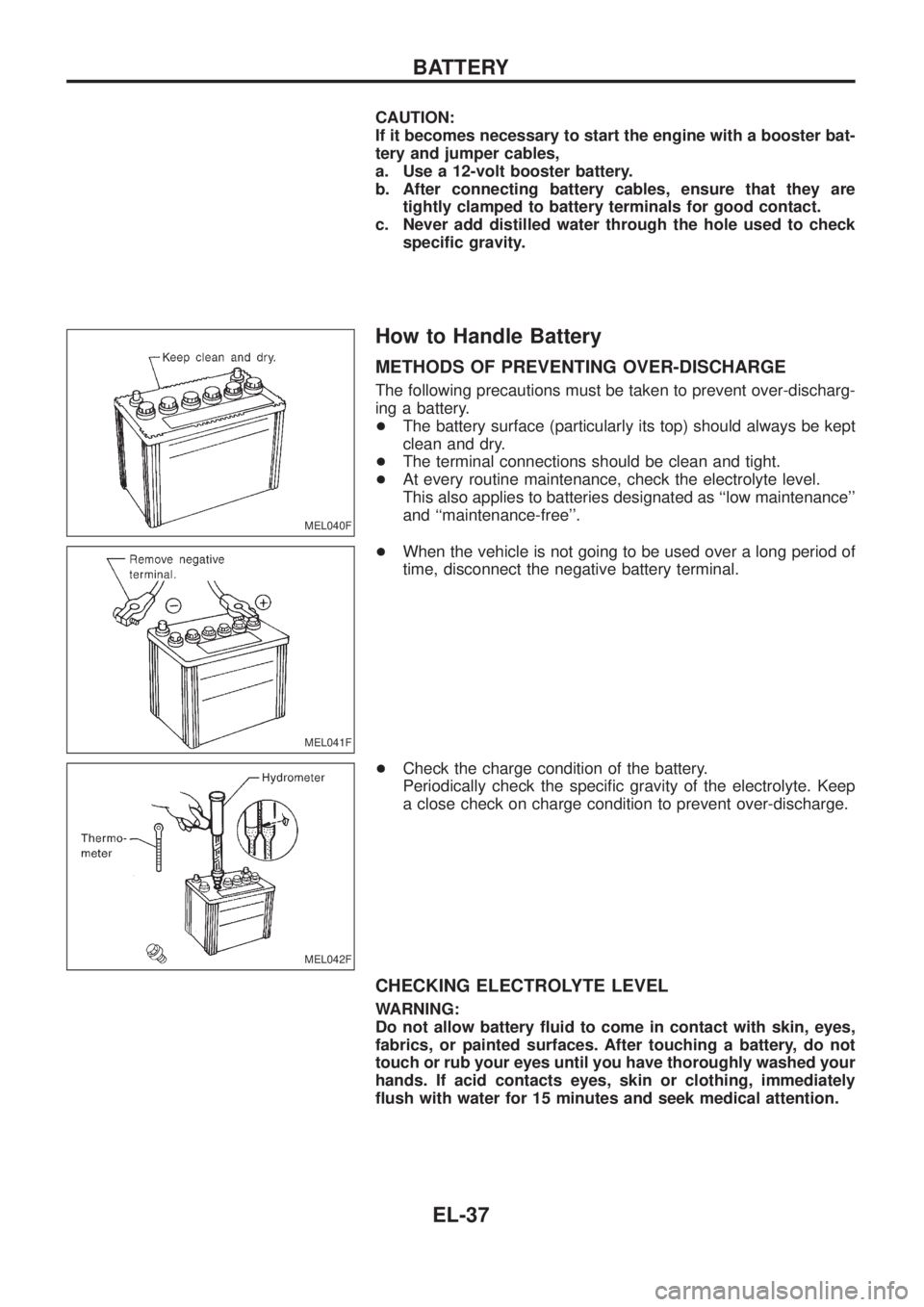
METHODS OF PREVENTING OVER-DISCHARGE
The following precautions must be taken to prevent over-discharg-
ing a battery.
+The battery surface (particularly its top) should always be kept
clean and dry.
+The terminal connections should be clean and tight.
+At every routine maintenance, check the electrolyte level.
This also applies to batteries designated as ``low maintenance''
and ``maintenance-free''.
+When the vehicle is not going to be used over a long period of
time, disconnect the negative battery terminal.
+Check the charge condition of the battery.
Periodically check the speci®c gravity of the electrolyte. Keep
a close check on charge condition to prevent over-discharge.
CHECKING ELECTROLYTE LEVEL
WARNING:
Do not allow battery ¯uid to come in contact with skin, eyes,
fabrics, or painted surfaces. After touching a battery, do not
touch or rub your eyes until you have thoroughly washed your
hands. If acid contacts eyes, skin or clothing, immediately
¯ush with water for 15 minutes and seek medical attention.
MEL040F
MEL041F
MEL042F
BATTERY
EL-37