2006 MERCEDES-BENZ SPRINTER clock
[x] Cancel search: clockPage 1506 of 2305
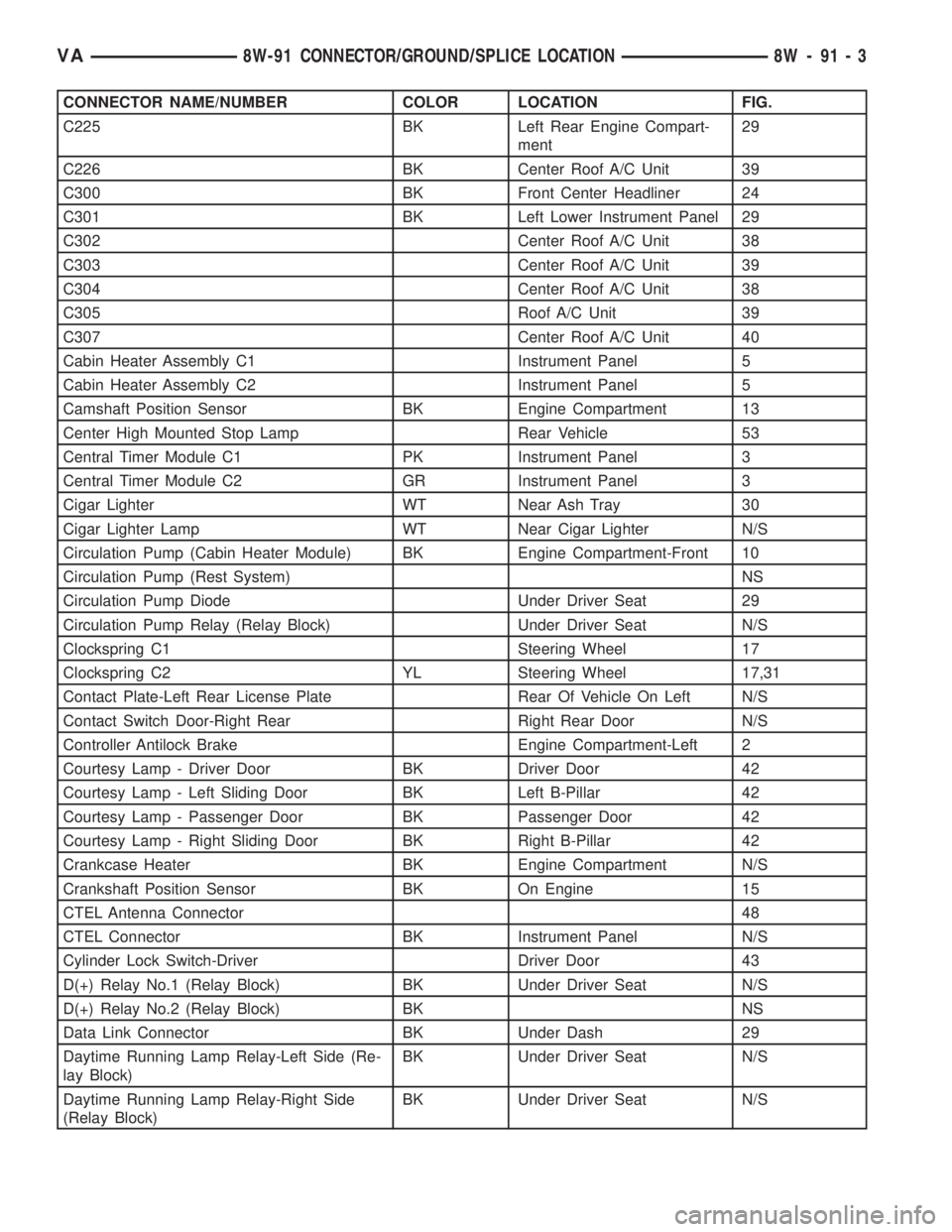
CONNECTOR NAME/NUMBER COLOR LOCATION FIG.
C225 BK Left Rear Engine Compart-
ment29
C226 BK Center Roof A/C Unit 39
C300 BK Front Center Headliner 24
C301 BK Left Lower Instrument Panel 29
C302 Center Roof A/C Unit 38
C303 Center Roof A/C Unit 39
C304 Center Roof A/C Unit 38
C305 Roof A/C Unit 39
C307 Center Roof A/C Unit 40
Cabin Heater Assembly C1 Instrument Panel 5
Cabin Heater Assembly C2 Instrument Panel 5
Camshaft Position Sensor BK Engine Compartment 13
Center High Mounted Stop Lamp Rear Vehicle 53
Central Timer Module C1 PK Instrument Panel 3
Central Timer Module C2 GR Instrument Panel 3
Cigar Lighter WT Near Ash Tray 30
Cigar Lighter Lamp WT Near Cigar Lighter N/S
Circulation Pump (Cabin Heater Module) BK Engine Compartment-Front 10
Circulation Pump (Rest System) NS
Circulation Pump Diode Under Driver Seat 29
Circulation Pump Relay (Relay Block) Under Driver Seat N/S
Clockspring C1 Steering Wheel 17
Clockspring C2 YL Steering Wheel 17,31
Contact Plate-Left Rear License Plate Rear Of Vehicle On Left N/S
Contact Switch Door-Right Rear Right Rear Door N/S
Controller Antilock Brake Engine Compartment-Left 2
Courtesy Lamp - Driver Door BK Driver Door 42
Courtesy Lamp - Left Sliding Door BK Left B-Pillar 42
Courtesy Lamp - Passenger Door BK Passenger Door 42
Courtesy Lamp - Right Sliding Door BK Right B-Pillar 42
Crankcase Heater BK Engine Compartment N/S
Crankshaft Position Sensor BK On Engine 15
CTEL Antenna Connector48
CTEL Connector BK Instrument Panel N/S
Cylinder Lock Switch-Driver Driver Door 43
D(+) Relay No.1 (Relay Block) BK Under Driver Seat N/S
D(+) Relay No.2 (Relay Block) BK NS
Data Link Connector BK Under Dash 29
Daytime Running Lamp Relay-Left Side (Re-
lay Block)BK Under Driver Seat N/S
Daytime Running Lamp Relay-Right Side
(Relay Block)BK Under Driver Seat N/S
VA8W-91 CONNECTOR/GROUND/SPLICE LOCATION 8W - 91 - 3
Page 1578 of 2305
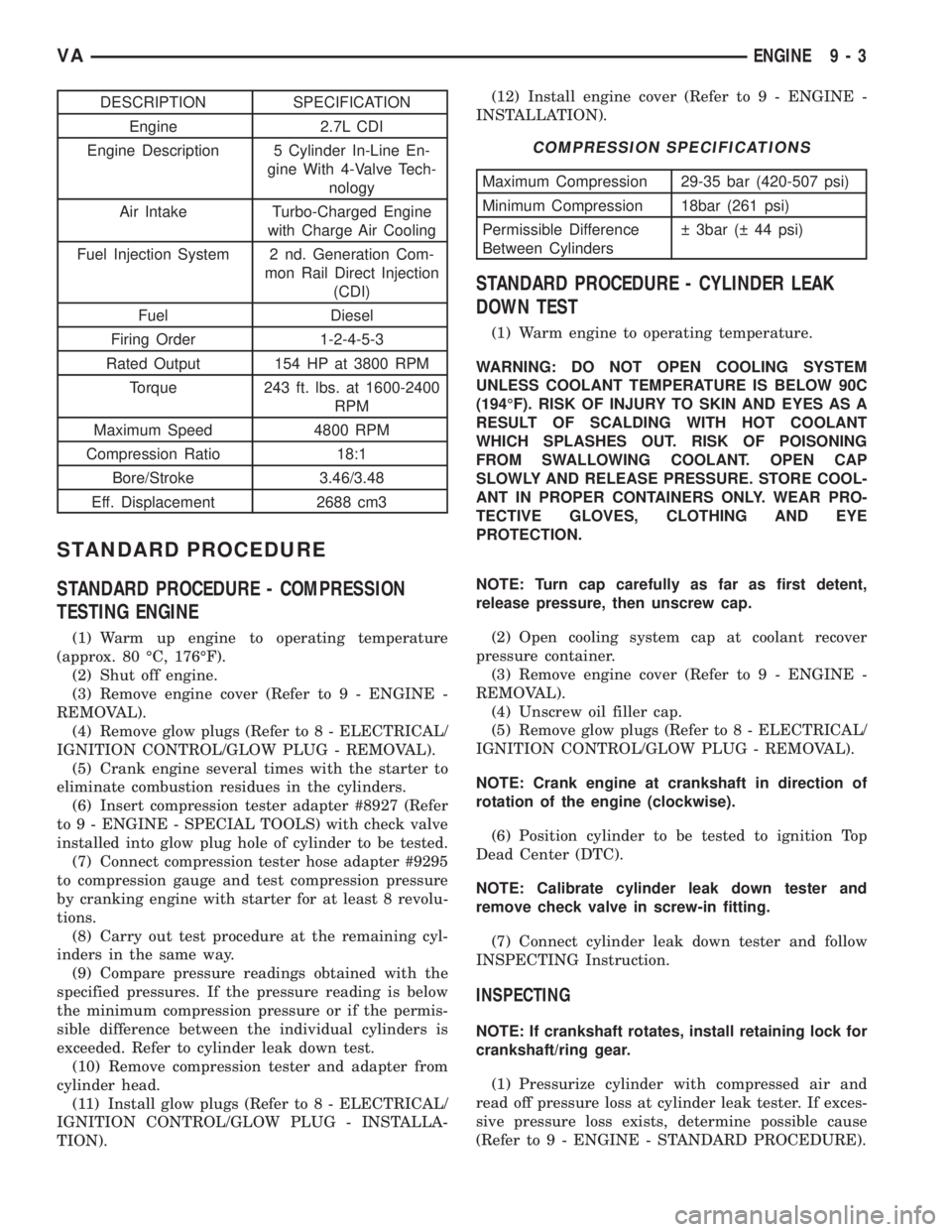
DESCRIPTION SPECIFICATION
Engine 2.7L CDI
Engine Description 5 Cylinder In-Line En-
gine With 4-Valve Tech-
nology
Air Intake Turbo-Charged Engine
with Charge Air Cooling
Fuel Injection System 2 nd. Generation Com-
mon Rail Direct Injection
(CDI)
Fuel Diesel
Firing Order 1-2-4-5-3
Rated Output 154 HP at 3800 RPM
Torque 243 ft. lbs. at 1600-2400
RPM
Maximum Speed 4800 RPM
Compression Ratio 18:1
Bore/Stroke 3.46/3.48
Eff. Displacement 2688 cm3
STANDARD PROCEDURE
STANDARD PROCEDURE - COMPRESSION
TESTING ENGINE
(1) Warm up engine to operating temperature
(approx. 80 ÉC, 176ÉF).
(2) Shut off engine.
(3) Remove engine cover (Refer to 9 - ENGINE -
REMOVAL).
(4) Remove glow plugs (Refer to 8 - ELECTRICAL/
IGNITION CONTROL/GLOW PLUG - REMOVAL).
(5) Crank engine several times with the starter to
eliminate combustion residues in the cylinders.
(6) Insert compression tester adapter #8927 (Refer
to 9 - ENGINE - SPECIAL TOOLS) with check valve
installed into glow plug hole of cylinder to be tested.
(7) Connect compression tester hose adapter #9295
to compression gauge and test compression pressure
by cranking engine with starter for at least 8 revolu-
tions.
(8) Carry out test procedure at the remaining cyl-
inders in the same way.
(9) Compare pressure readings obtained with the
specified pressures. If the pressure reading is below
the minimum compression pressure or if the permis-
sible difference between the individual cylinders is
exceeded. Refer to cylinder leak down test.
(10) Remove compression tester and adapter from
cylinder head.
(11) Install glow plugs (Refer to 8 - ELECTRICAL/
IGNITION CONTROL/GLOW PLUG - INSTALLA-
TION).(12) Install engine cover (Refer to 9 - ENGINE -
INSTALLATION).
COMPRESSION SPECIFICATIONS
Maximum Compression 29-35 bar (420-507 psi)
Minimum Compression 18bar (261 psi)
Permissible Difference
Between Cylinders 3bar ( 44 psi)
STANDARD PROCEDURE - CYLINDER LEAK
DOWN TEST
(1) Warm engine to operating temperature.
WARNING: DO NOT OPEN COOLING SYSTEM
UNLESS COOLANT TEMPERATURE IS BELOW 90C
(194ÉF). RISK OF INJURY TO SKIN AND EYES AS A
RESULT OF SCALDING WITH HOT COOLANT
WHICH SPLASHES OUT. RISK OF POISONING
FROM SWALLOWING COOLANT. OPEN CAP
SLOWLY AND RELEASE PRESSURE. STORE COOL-
ANT IN PROPER CONTAINERS ONLY. WEAR PRO-
TECTIVE GLOVES, CLOTHING AND EYE
PROTECTION.
NOTE: Turn cap carefully as far as first detent,
release pressure, then unscrew cap.
(2) Open cooling system cap at coolant recover
pressure container.
(3) Remove engine cover (Refer to 9 - ENGINE -
REMOVAL).
(4) Unscrew oil filler cap.
(5) Remove glow plugs (Refer to 8 - ELECTRICAL/
IGNITION CONTROL/GLOW PLUG - REMOVAL).
NOTE: Crank engine at crankshaft in direction of
rotation of the engine (clockwise).
(6) Position cylinder to be tested to ignition Top
Dead Center (DTC).
NOTE: Calibrate cylinder leak down tester and
remove check valve in screw-in fitting.
(7) Connect cylinder leak down tester and follow
INSPECTING Instruction.
INSPECTING
NOTE: If crankshaft rotates, install retaining lock for
crankshaft/ring gear.
(1) Pressurize cylinder with compressed air and
read off pressure loss at cylinder leak tester. If exces-
sive pressure loss exists, determine possible cause
(Refer to 9 - ENGINE - STANDARD PROCEDURE).
VAENGINE 9 - 3
Page 1607 of 2305
INSTALLATION
CAUTION: The camshafts are sensitive to fractur-
ing. Ensure they are installed free of stress. Oil
bucket tappets and camshaft bearing points.
Inspect ease of operation of bucket tappets.
CAUTION: Pay attention to assignment of cam-
shafts. Camshaft code numbers are visible on the
thrust collar of the axial bearing. Install camshafts
so that the two holes in camshaft sprockets are
positioned opposite and the markings of the cam-
shaft and camshaft bearing cap are aligned.
(1) Install inlet and exhaust camshafts.
NOTE: Tappets are Only serviced when replacing
the camshaft housing. Inspect tappet clearence
(Refer to 9 - ENGINE/CYLINDER HEAD/CAM-
SHAFT(S) - STANDARD PROCEDURE).
(2) Align inlet and exhaust camshafts at axial
bearing (Refer to 9 - ENGINE/CYLINDER HEAD/
CAMSHAFT(S) - STANDARD PROCEDURE).NOTE: Pay attention to markings on camshaft bear-
ing caps.
CAUTION: Do not rotate engine counter clockwise.
(3) Position the piston of cylinder #1 to ignition
TDC.
NOTE: Pay attention to markings on camshaft bear-
ing caps and follow the tightening procedure below.
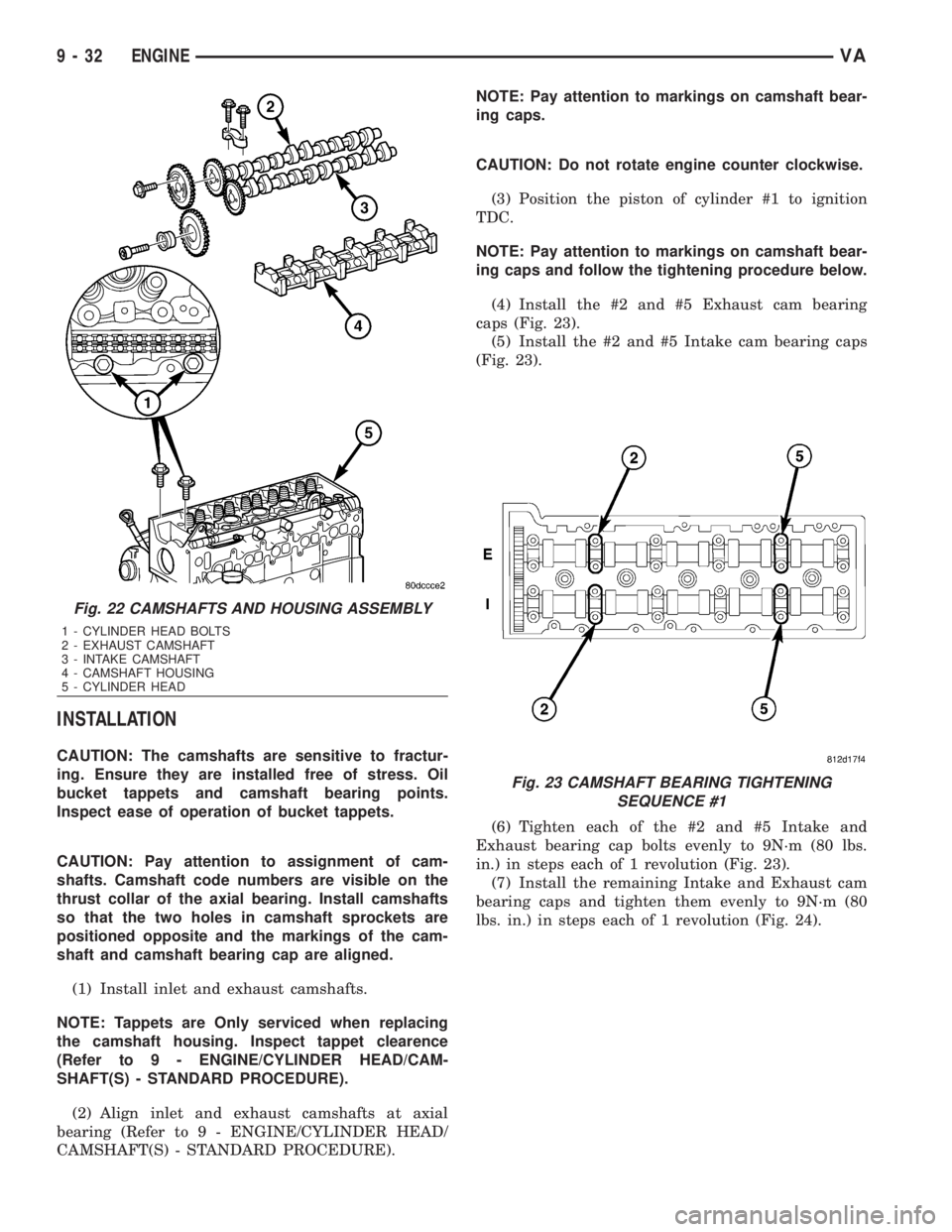
(4) Install the #2 and #5 Exhaust cam bearing
caps (Fig. 23).
(5) Install the #2 and #5 Intake cam bearing caps
(Fig. 23).
(6) Tighten each of the #2 and #5 Intake and
Exhaust bearing cap bolts evenly to 9N´m (80 lbs.
in.) in steps each of 1 revolution (Fig. 23).
(7) Install the remaining Intake and Exhaust cam
bearing caps and tighten them evenly to 9N´m (80
lbs. in.) in steps each of 1 revolution (Fig. 24).
Fig. 22 CAMSHAFTS AND HOUSING ASSEMBLY
1 - CYLINDER HEAD BOLTS
2 - EXHAUST CAMSHAFT
3 - INTAKE CAMSHAFT
4 - CAMSHAFT HOUSING
5 - CYLINDER HEAD
Fig. 23 CAMSHAFT BEARING TIGHTENING
SEQUENCE #1
9 - 32 ENGINEVA
Page 1610 of 2305
VALVE SPRINGS
REMOVAL
REMOVAL - VALVE SPRINGS
(1) Disconnect negative battery cable.
(2) Remove injectors (Refer to 14 - FUEL SYS-
TEM/FUEL INJECTION/FUEL INJECTOR -
REMOVAL).
(3) Remove cylinder head cover (Refer to 9 -
ENGINE/CYLINDER HEAD/CYLINDER HEAD
COVER(S) - REMOVAL).
(4) Remove timing chain tensioner (Refer to 9 -
ENGINE/VALVE TIMING/TIMING BELT/CHAIN
AND SPROCKETS - REMOVAL).
(5) Remove front cover at cylinder head (Refer to 9
- ENGINE/CYLINDER HEAD - REMOVAL).
(6) Remove top guide rail (Refer to 9 - ENGINE/
CYLINDER HEAD - REMOVAL).
(7) Remove camshafts (Refer to 9 - ENGINE/CYL-
INDER HEAD/CAMSHAFT(S) - REMOVAL).
NOTE: The timing chain must be held in up position
so as not to jam during procedure.
(8) Position piston of cylinder to be processed to
DTC by rotating the crankshaft clockwise.DO NOT
crank engine. DO NOT rotate engine backward.
CAUTION: Make sure the crankshaft lock is in posi-
tion and properly secured for each cylinder being
serviced. Failure to do so may result in damage to
the vehicle or personal injury.
(9) Install crankshaft lock, special tool #8932.
(10) Seal injector hole with adaptor # 9534 and
retain with original tensioning claw.
(11) Connect regulated air supply to special tool #
9534 and pressurize the cylinder to 5 bar (73 psi.).
WARNING: Valve springs and retainers must be
kept in order of the cylinder they were removed.
NOTE: Using valve service tools #9307, screw
retaining fork into threaded edge of cylinder head
and position thrust piece vertically at top of each
exhaust valve spring retainer. Use the cam bearing
cap threaded holes to position service tool for
removal of intake valve spring retainers.
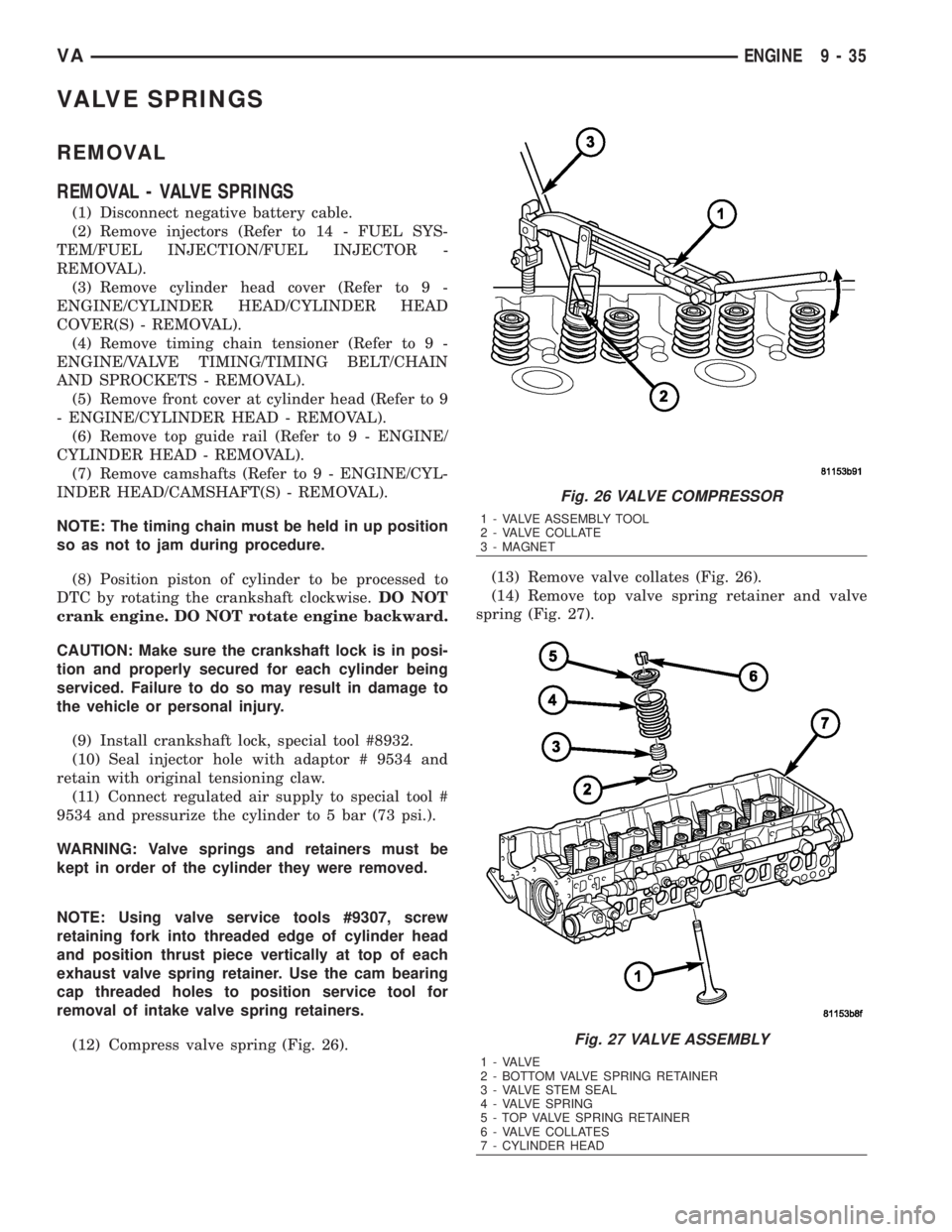
(12) Compress valve spring (Fig. 26).(13) Remove valve collates (Fig. 26).
(14) Remove top valve spring retainer and valve
spring (Fig. 27).
Fig. 26 VALVE COMPRESSOR
1 - VALVE ASSEMBLY TOOL
2 - VALVE COLLATE
3 - MAGNET
Fig. 27 VALVE ASSEMBLY
1 - VALVE
2 - BOTTOM VALVE SPRING RETAINER
3 - VALVE STEM SEAL
4 - VALVE SPRING
5 - TOP VALVE SPRING RETAINER
6 - VALVE COLLATES
7 - CYLINDER HEAD
VAENGINE 9 - 35
Page 1611 of 2305
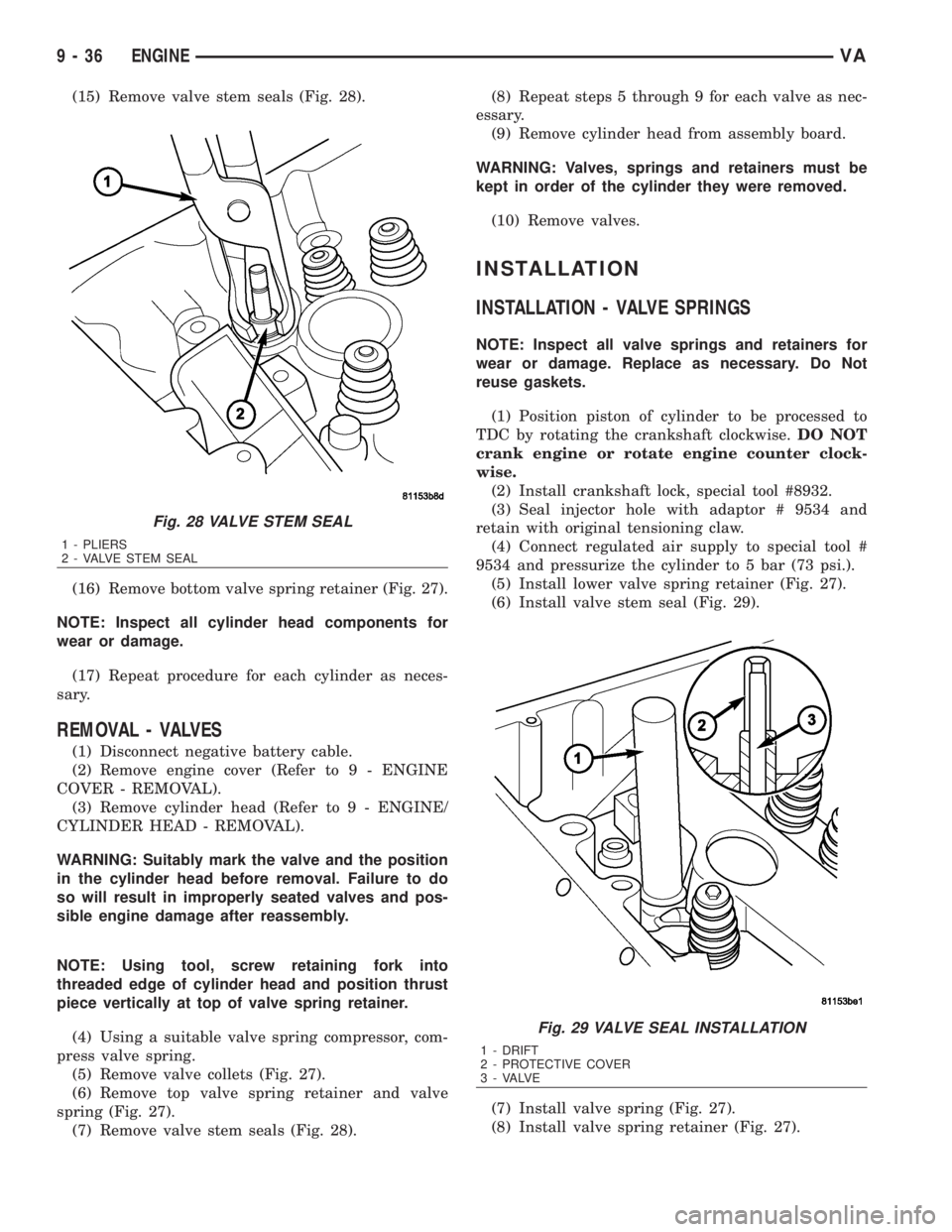
(15) Remove valve stem seals (Fig. 28).
(16) Remove bottom valve spring retainer (Fig. 27).
NOTE: Inspect all cylinder head components for
wear or damage.
(17) Repeat procedure for each cylinder as neces-
sary.
REMOVAL - VALVES
(1) Disconnect negative battery cable.
(2) Remove engine cover (Refer to 9 - ENGINE
COVER - REMOVAL).
(3) Remove cylinder head (Refer to 9 - ENGINE/
CYLINDER HEAD - REMOVAL).
WARNING: Suitably mark the valve and the position
in the cylinder head before removal. Failure to do
so will result in improperly seated valves and pos-
sible engine damage after reassembly.
NOTE: Using tool, screw retaining fork into
threaded edge of cylinder head and position thrust
piece vertically at top of valve spring retainer.
(4) Using a suitable valve spring compressor, com-
press valve spring.
(5) Remove valve collets (Fig. 27).
(6) Remove top valve spring retainer and valve
spring (Fig. 27).
(7) Remove valve stem seals (Fig. 28).(8) Repeat steps 5 through 9 for each valve as nec-
essary.
(9) Remove cylinder head from assembly board.
WARNING: Valves, springs and retainers must be
kept in order of the cylinder they were removed.
(10) Remove valves.
INSTALLATION
INSTALLATION - VALVE SPRINGS
NOTE: Inspect all valve springs and retainers for
wear or damage. Replace as necessary. Do Not
reuse gaskets.
(1) Position piston of cylinder to be processed to
TDC by rotating the crankshaft clockwise.DO NOT
crank engine or rotate engine counter clock-
wise.
(2) Install crankshaft lock, special tool #8932.
(3) Seal injector hole with adaptor # 9534 and
retain with original tensioning claw.
(4) Connect regulated air supply to special tool #
9534 and pressurize the cylinder to 5 bar (73 psi.).
(5) Install lower valve spring retainer (Fig. 27).
(6) Install valve stem seal (Fig. 29).
(7) Install valve spring (Fig. 27).
(8) Install valve spring retainer (Fig. 27).
Fig. 28 VALVE STEM SEAL
1 - PLIERS
2 - VALVE STEM SEAL
Fig. 29 VALVE SEAL INSTALLATION
1 - DRIFT
2 - PROTECTIVE COVER
3 - VALVE
9 - 36 ENGINEVA
Page 1637 of 2305
(6) Remove pressed - out oil pump chain pin from
chain seperation tool.
CAUTION: IT IS ESSENTIAL that the installation pro-
cedure for the oil pump chain is followed exactly.
Failure to do so will result in severe engine dam-
age.
INSTALLATION
INSTALLATION
NOTE: If the oil pump is dry, fill it with clean engine
oil before installation. Clean the oil pick±up tube
and strainer.
(1) Clean all sealing surfaces.
(2) Position the oil pump onto the drive chain and
reset tensioner.
(3) Install oil pump retaining bolts and tighten to
18 N´m (160 lbs. in.).
(4) Install the oil pan (Refer to 9 - ENGINE/LU-
BRICATION/OIL PUMP - INSTALLATION).
(5) Refill the crankcase to the appropriate level
with the proper engine oil (Refer to LUBRICATION
& MAINTENANCE/FLUID TYPES - SPECIFICA-
TIONS).
WARNING: USE EXTREME CAUTION WHEN THE
ENGINE IS OPERATING. DO NOT PUT YOUR
HANDS NEAR THE PULLEYS, BELTS OR FAN. DO
NOT WEAR LOOSE CLOTHES.
(6) Start the vehicle and inspect for leaks.
INSTALLATION - OIL PUMP CHAIN
CAUTION: IT IS ESSENTIAL that the installation pro-
cedure is followed exactly. Failure to do so will
result in severe engine damage.
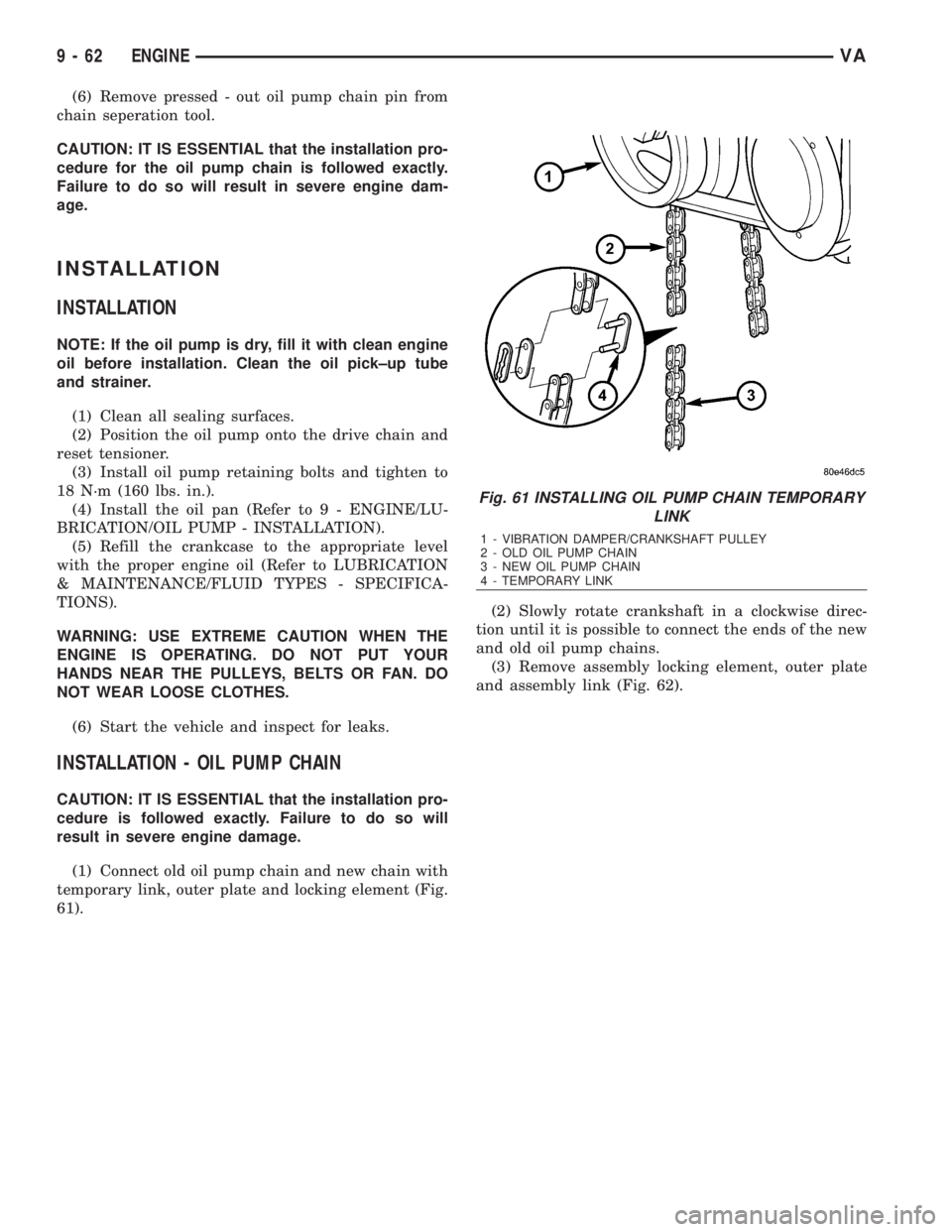
(1) Connect old oil pump chain and new chain with
temporary link, outer plate and locking element (Fig.
61).(2) Slowly rotate crankshaft in a clockwise direc-
tion until it is possible to connect the ends of the new
and old oil pump chains.
(3) Remove assembly locking element, outer plate
and assembly link (Fig. 62).
Fig. 61 INSTALLING OIL PUMP CHAIN TEMPORARY
LINK
1 - VIBRATION DAMPER/CRANKSHAFT PULLEY
2 - OLD OIL PUMP CHAIN
3 - NEW OIL PUMP CHAIN
4 - TEMPORARY LINK
9 - 62 ENGINEVA
Page 1650 of 2305
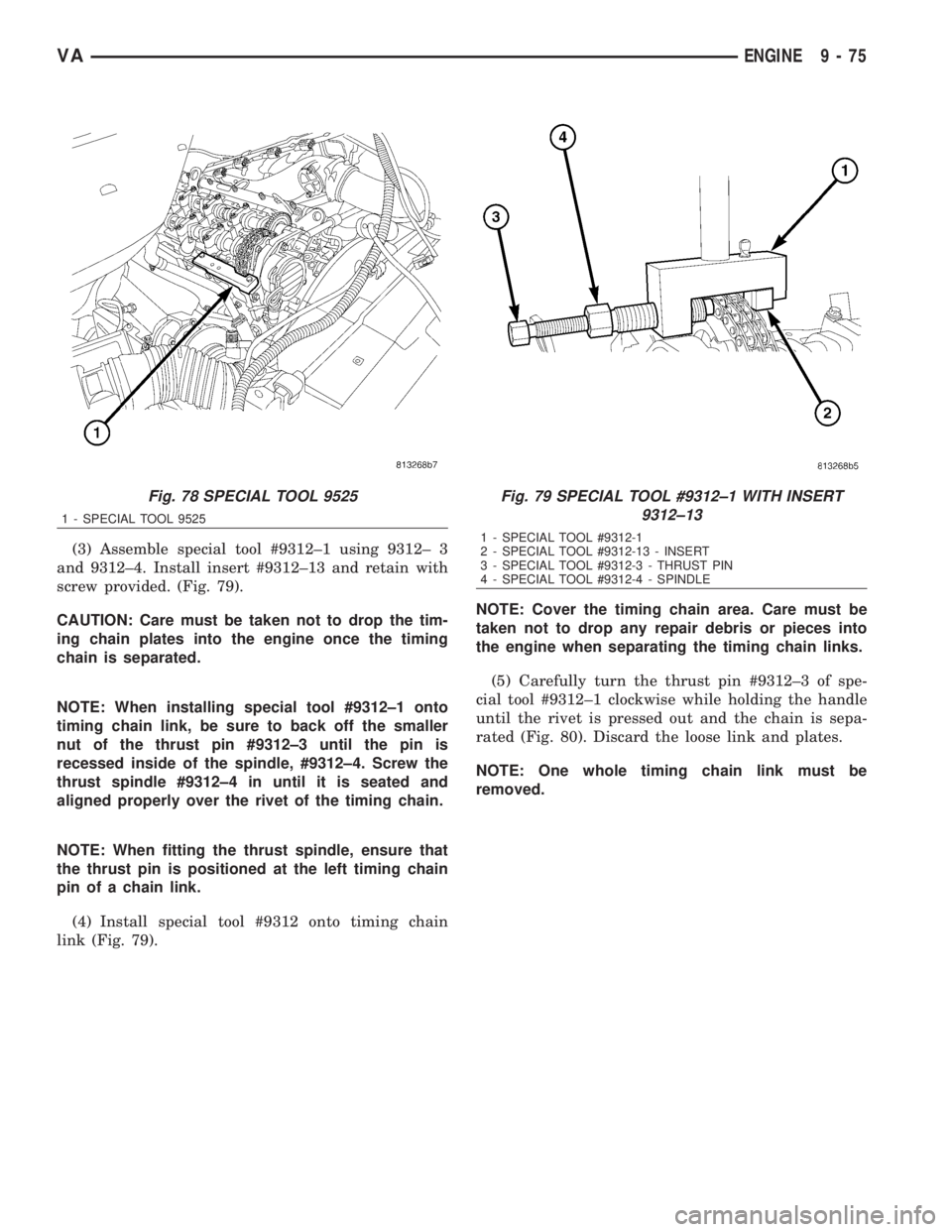
(3) Assemble special tool #9312±1 using 9312± 3
and 9312±4. Install insert #9312±13 and retain with
screw provided. (Fig. 79).
CAUTION: Care must be taken not to drop the tim-
ing chain plates into the engine once the timing
chain is separated.
NOTE: When installing special tool #9312±1 onto
timing chain link, be sure to back off the smaller
nut of the thrust pin #9312±3 until the pin is
recessed inside of the spindle, #9312±4. Screw the
thrust spindle #9312±4 in until it is seated and
aligned properly over the rivet of the timing chain.
NOTE: When fitting the thrust spindle, ensure that
the thrust pin is positioned at the left timing chain
pin of a chain link.
(4) Install special tool #9312 onto timing chain
link (Fig. 79).NOTE: Cover the timing chain area. Care must be
taken not to drop any repair debris or pieces into
the engine when separating the timing chain links.
(5) Carefully turn the thrust pin #9312±3 of spe-
cial tool #9312±1 clockwise while holding the handle
until the rivet is pressed out and the chain is sepa-
rated (Fig. 80). Discard the loose link and plates.
NOTE: One whole timing chain link must be
removed.
Fig. 78 SPECIAL TOOL 9525
1 - SPECIAL TOOL 9525
Fig. 79 SPECIAL TOOL #9312±1 WITH INSERT
9312±13
1 - SPECIAL TOOL #9312-1
2 - SPECIAL TOOL #9312-13 - INSERT
3 - SPECIAL TOOL #9312-3 - THRUST PIN
4 - SPECIAL TOOL #9312-4 - SPINDLE
VAENGINE 9 - 75
Page 1653 of 2305
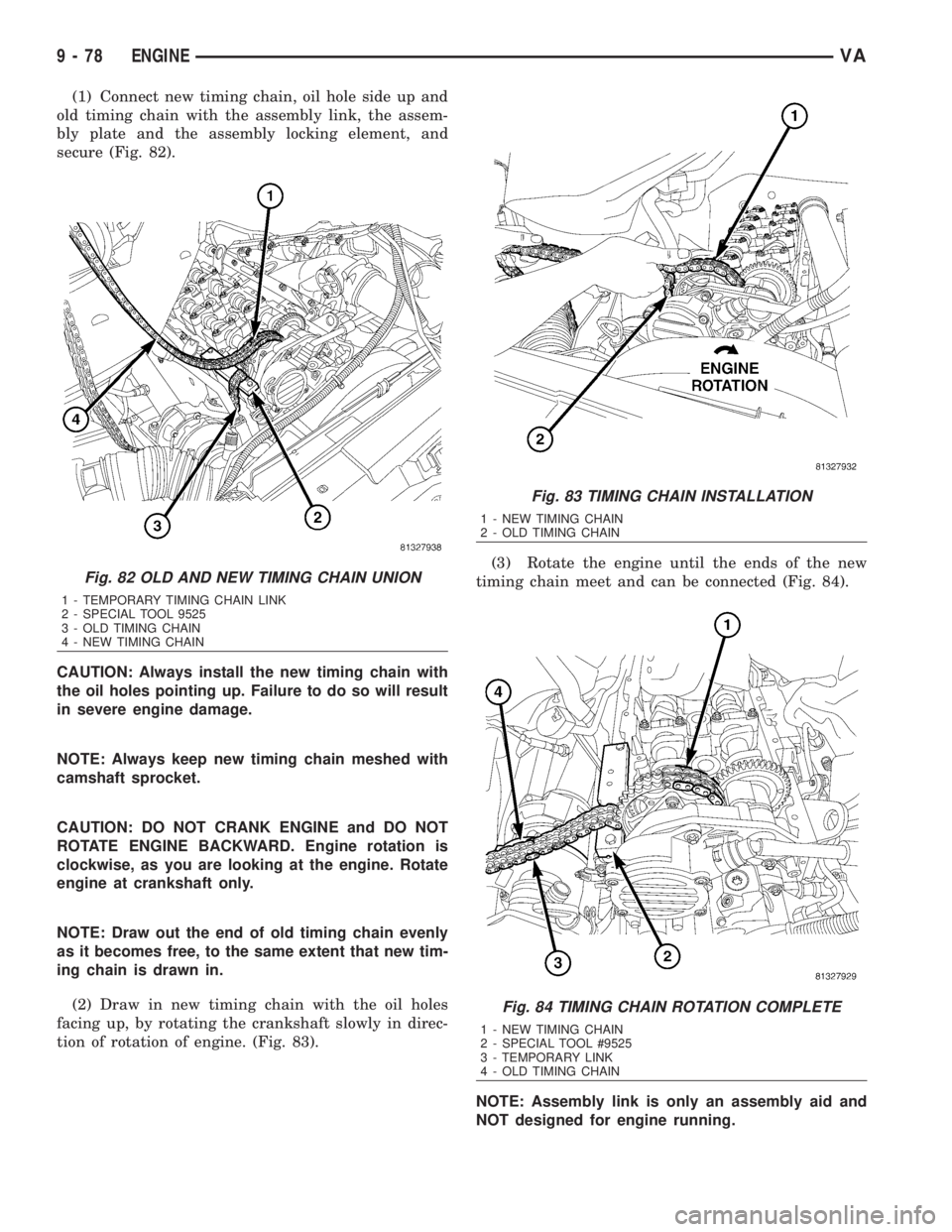
(1) Connect new timing chain, oil hole side up and
old timing chain with the assembly link, the assem-
bly plate and the assembly locking element, and
secure (Fig. 82).
CAUTION: Always install the new timing chain with
the oil holes pointing up. Failure to do so will result
in severe engine damage.
NOTE: Always keep new timing chain meshed with
camshaft sprocket.
CAUTION: DO NOT CRANK ENGINE and DO NOT
ROTATE ENGINE BACKWARD. Engine rotation is
clockwise, as you are looking at the engine. Rotate
engine at crankshaft only.
NOTE: Draw out the end of old timing chain evenly
as it becomes free, to the same extent that new tim-
ing chain is drawn in.
(2) Draw in new timing chain with the oil holes
facing up, by rotating the crankshaft slowly in direc-
tion of rotation of engine. (Fig. 83).(3) Rotate the engine until the ends of the new
timing chain meet and can be connected (Fig. 84).
NOTE: Assembly link is only an assembly aid and
NOT designed for engine running.
Fig. 82 OLD AND NEW TIMING CHAIN UNION
1 - TEMPORARY TIMING CHAIN LINK
2 - SPECIAL TOOL 9525
3 - OLD TIMING CHAIN
4 - NEW TIMING CHAIN
Fig. 83 TIMING CHAIN INSTALLATION
1 - NEW TIMING CHAIN
2 - OLD TIMING CHAIN
Fig. 84 TIMING CHAIN ROTATION COMPLETE
1 - NEW TIMING CHAIN
2 - SPECIAL TOOL #9525
3 - TEMPORARY LINK
4 - OLD TIMING CHAIN
9 - 78 ENGINEVA