2006 MERCEDES-BENZ SPRINTER steering wheel
[x] Cancel search: steering wheelPage 68 of 2305
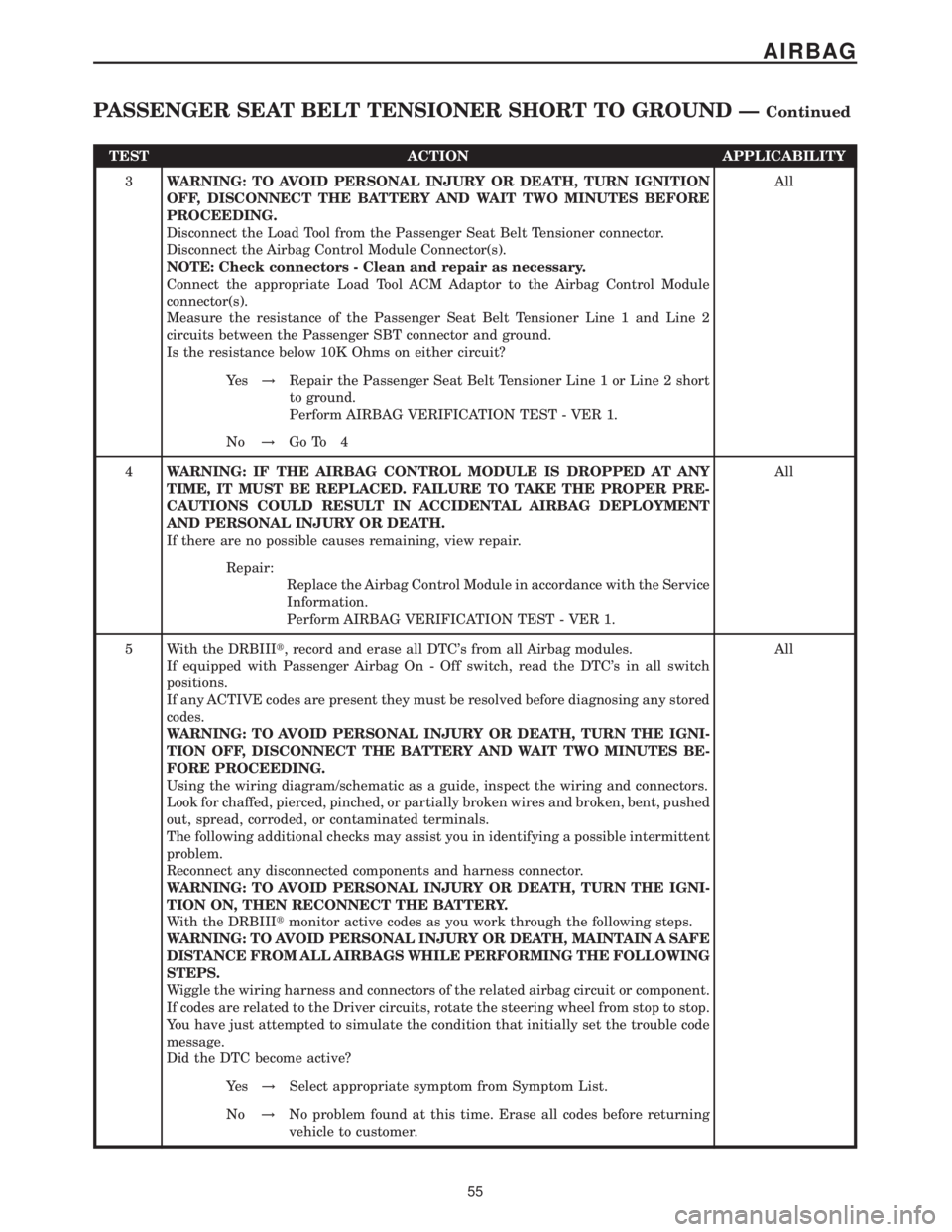
TEST ACTION APPLICABILITY
3WARNING: TO AVOID PERSONAL INJURY OR DEATH, TURN IGNITION
OFF, DISCONNECT THE BATTERY AND WAIT TWO MINUTES BEFORE
PROCEEDING.
Disconnect the Load Tool from the Passenger Seat Belt Tensioner connector.
Disconnect the Airbag Control Module Connector(s).
NOTE: Check connectors - Clean and repair as necessary.
Connect the appropriate Load Tool ACM Adaptor to the Airbag Control Module
connector(s).
Measure the resistance of the Passenger Seat Belt Tensioner Line 1 and Line 2
circuits between the Passenger SBT connector and ground.
Is the resistance below 10K Ohms on either circuit?All
Ye s!Repair the Passenger Seat Belt Tensioner Line 1 or Line 2 short
to ground.
Perform AIRBAG VERIFICATION TEST - VER 1.
No!Go To 4
4WARNING: IF THE AIRBAG CONTROL MODULE IS DROPPED AT ANY
TIME, IT MUST BE REPLACED. FAILURE TO TAKE THE PROPER PRE-
CAUTIONS COULD RESULT IN ACCIDENTAL AIRBAG DEPLOYMENT
AND PERSONAL INJURY OR DEATH.
If there are no possible causes remaining, view repair.All
Repair:
Replace the Airbag Control Module in accordance with the Service
Information.
Perform AIRBAG VERIFICATION TEST - VER 1.
5 With the DRBIIIt, record and erase all DTC's from all Airbag modules.
If equipped with Passenger Airbag On - Off switch, read the DTC's in all switch
positions.
If any ACTIVE codes are present they must be resolved before diagnosing any stored
codes.
WARNING: TO AVOID PERSONAL INJURY OR DEATH, TURN THE IGNI-
TION OFF, DISCONNECT THE BATTERY AND WAIT TWO MINUTES BE-
FORE PROCEEDING.
Using the wiring diagram/schematic as a guide, inspect the wiring and connectors.
Look for chaffed, pierced, pinched, or partially broken wires and broken, bent, pushed
out, spread, corroded, or contaminated terminals.
The following additional checks may assist you in identifying a possible intermittent
problem.
Reconnect any disconnected components and harness connector.
WARNING: TO AVOID PERSONAL INJURY OR DEATH, TURN THE IGNI-
TION ON, THEN RECONNECT THE BATTERY.
With the DRBIIItmonitor active codes as you work through the following steps.
WARNING: TO AVOID PERSONAL INJURY OR DEATH, MAINTAIN A SAFE
DISTANCE FROM ALL AIRBAGS WHILE PERFORMING THE FOLLOWING
STEPS.
Wiggle the wiring harness and connectors of the related airbag circuit or component.
If codes are related to the Driver circuits, rotate the steering wheel from stop to stop.
You have just attempted to simulate the condition that initially set the trouble code
message.
Did the DTC become active?All
Ye s!Select appropriate symptom from Symptom List.
No!No problem found at this time. Erase all codes before returning
vehicle to customer.
55
AIRBAG
PASSENGER SEAT BELT TENSIONER SHORT TO GROUND ÐContinued
Page 71 of 2305
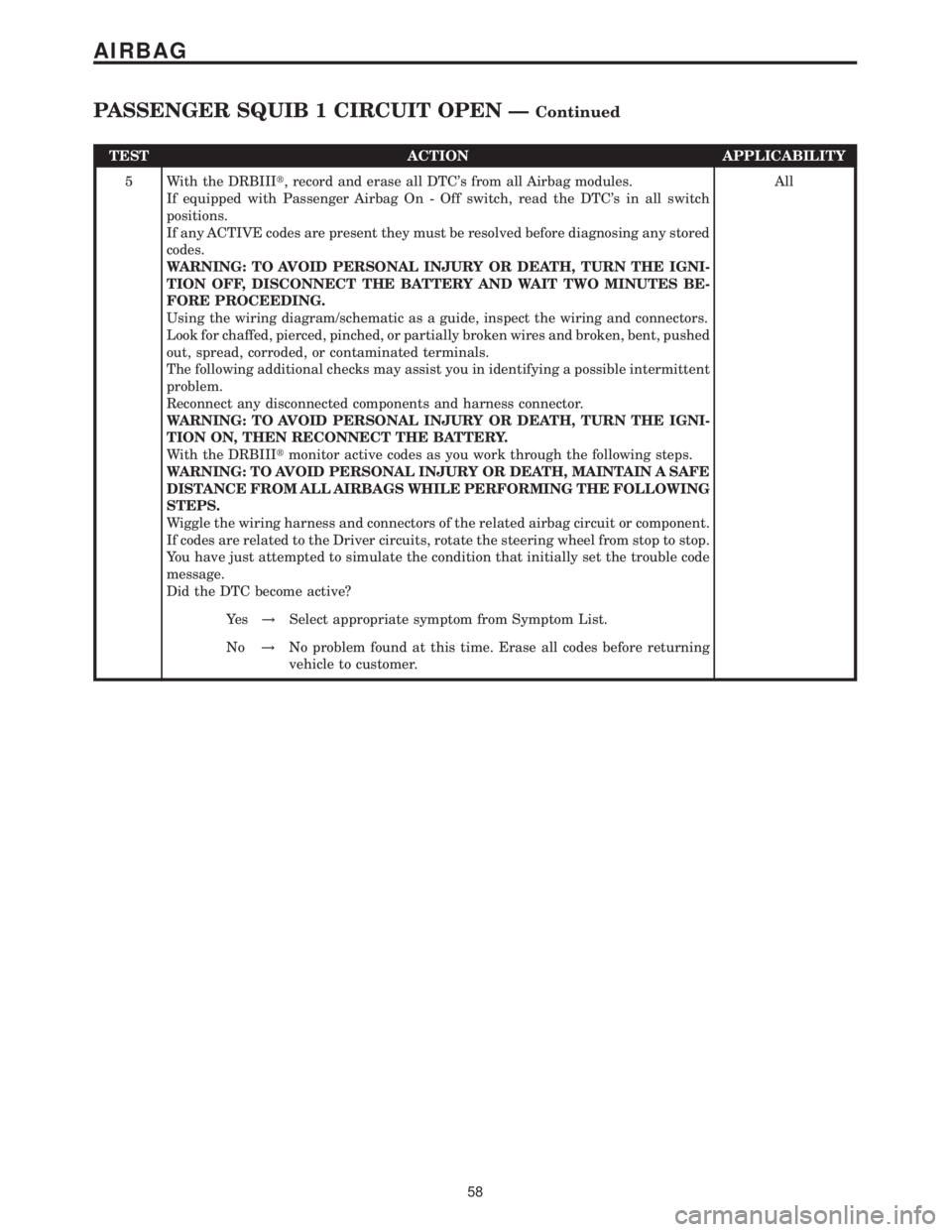
TEST ACTION APPLICABILITY
5 With the DRBIIIt, record and erase all DTC's from all Airbag modules.
If equipped with Passenger Airbag On - Off switch, read the DTC's in all switch
positions.
If any ACTIVE codes are present they must be resolved before diagnosing any stored
codes.
WARNING: TO AVOID PERSONAL INJURY OR DEATH, TURN THE IGNI-
TION OFF, DISCONNECT THE BATTERY AND WAIT TWO MINUTES BE-
FORE PROCEEDING.
Using the wiring diagram/schematic as a guide, inspect the wiring and connectors.
Look for chaffed, pierced, pinched, or partially broken wires and broken, bent, pushed
out, spread, corroded, or contaminated terminals.
The following additional checks may assist you in identifying a possible intermittent
problem.
Reconnect any disconnected components and harness connector.
WARNING: TO AVOID PERSONAL INJURY OR DEATH, TURN THE IGNI-
TION ON, THEN RECONNECT THE BATTERY.
With the DRBIIItmonitor active codes as you work through the following steps.
WARNING: TO AVOID PERSONAL INJURY OR DEATH, MAINTAIN A SAFE
DISTANCE FROM ALL AIRBAGS WHILE PERFORMING THE FOLLOWING
STEPS.
Wiggle the wiring harness and connectors of the related airbag circuit or component.
If codes are related to the Driver circuits, rotate the steering wheel from stop to stop.
You have just attempted to simulate the condition that initially set the trouble code
message.
Did the DTC become active?All
Ye s!Select appropriate symptom from Symptom List.
No!No problem found at this time. Erase all codes before returning
vehicle to customer.
58
AIRBAG
PASSENGER SQUIB 1 CIRCUIT OPEN ÐContinued
Page 74 of 2305
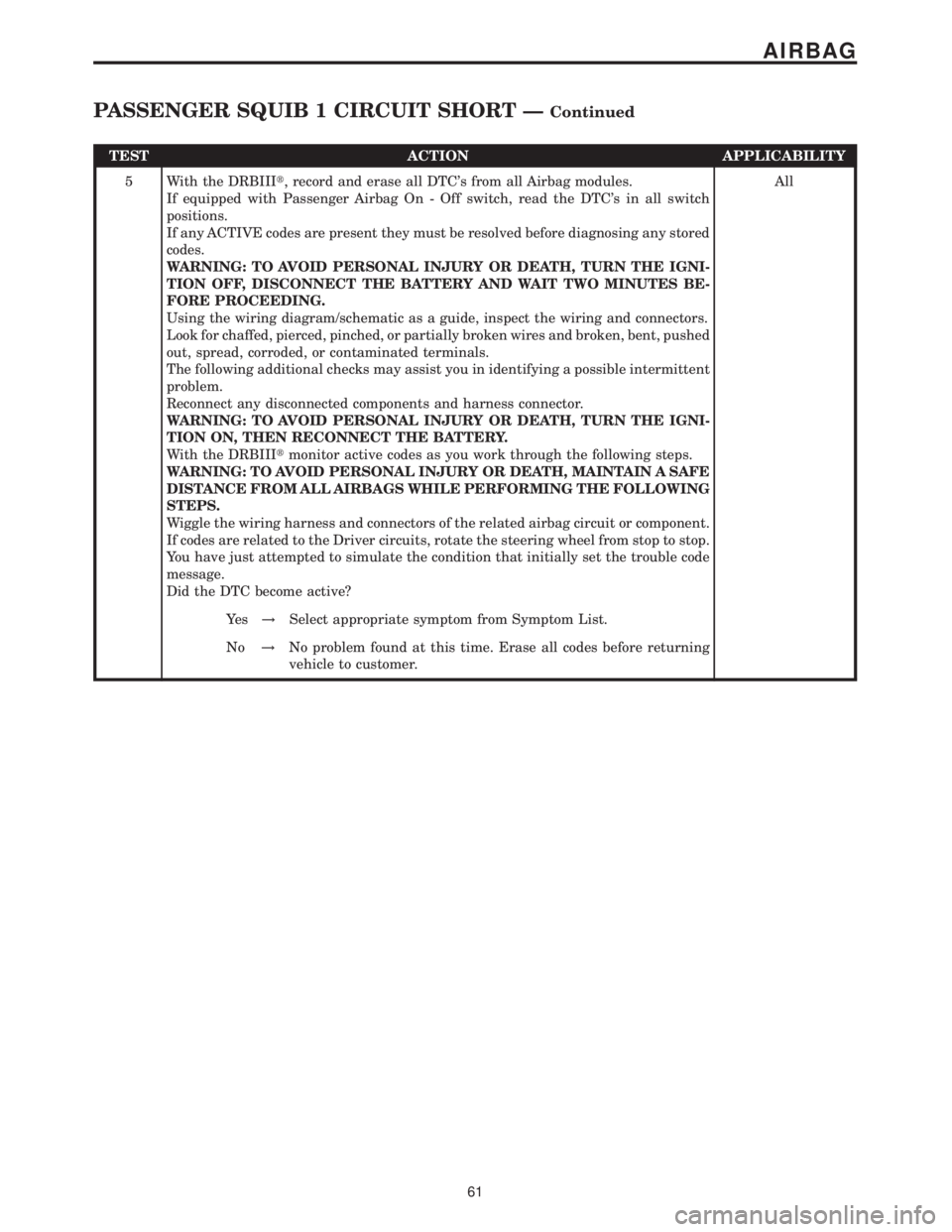
TEST ACTION APPLICABILITY
5 With the DRBIIIt, record and erase all DTC's from all Airbag modules.
If equipped with Passenger Airbag On - Off switch, read the DTC's in all switch
positions.
If any ACTIVE codes are present they must be resolved before diagnosing any stored
codes.
WARNING: TO AVOID PERSONAL INJURY OR DEATH, TURN THE IGNI-
TION OFF, DISCONNECT THE BATTERY AND WAIT TWO MINUTES BE-
FORE PROCEEDING.
Using the wiring diagram/schematic as a guide, inspect the wiring and connectors.
Look for chaffed, pierced, pinched, or partially broken wires and broken, bent, pushed
out, spread, corroded, or contaminated terminals.
The following additional checks may assist you in identifying a possible intermittent
problem.
Reconnect any disconnected components and harness connector.
WARNING: TO AVOID PERSONAL INJURY OR DEATH, TURN THE IGNI-
TION ON, THEN RECONNECT THE BATTERY.
With the DRBIIItmonitor active codes as you work through the following steps.
WARNING: TO AVOID PERSONAL INJURY OR DEATH, MAINTAIN A SAFE
DISTANCE FROM ALL AIRBAGS WHILE PERFORMING THE FOLLOWING
STEPS.
Wiggle the wiring harness and connectors of the related airbag circuit or component.
If codes are related to the Driver circuits, rotate the steering wheel from stop to stop.
You have just attempted to simulate the condition that initially set the trouble code
message.
Did the DTC become active?All
Ye s!Select appropriate symptom from Symptom List.
No!No problem found at this time. Erase all codes before returning
vehicle to customer.
61
AIRBAG
PASSENGER SQUIB 1 CIRCUIT SHORT ÐContinued
Page 77 of 2305
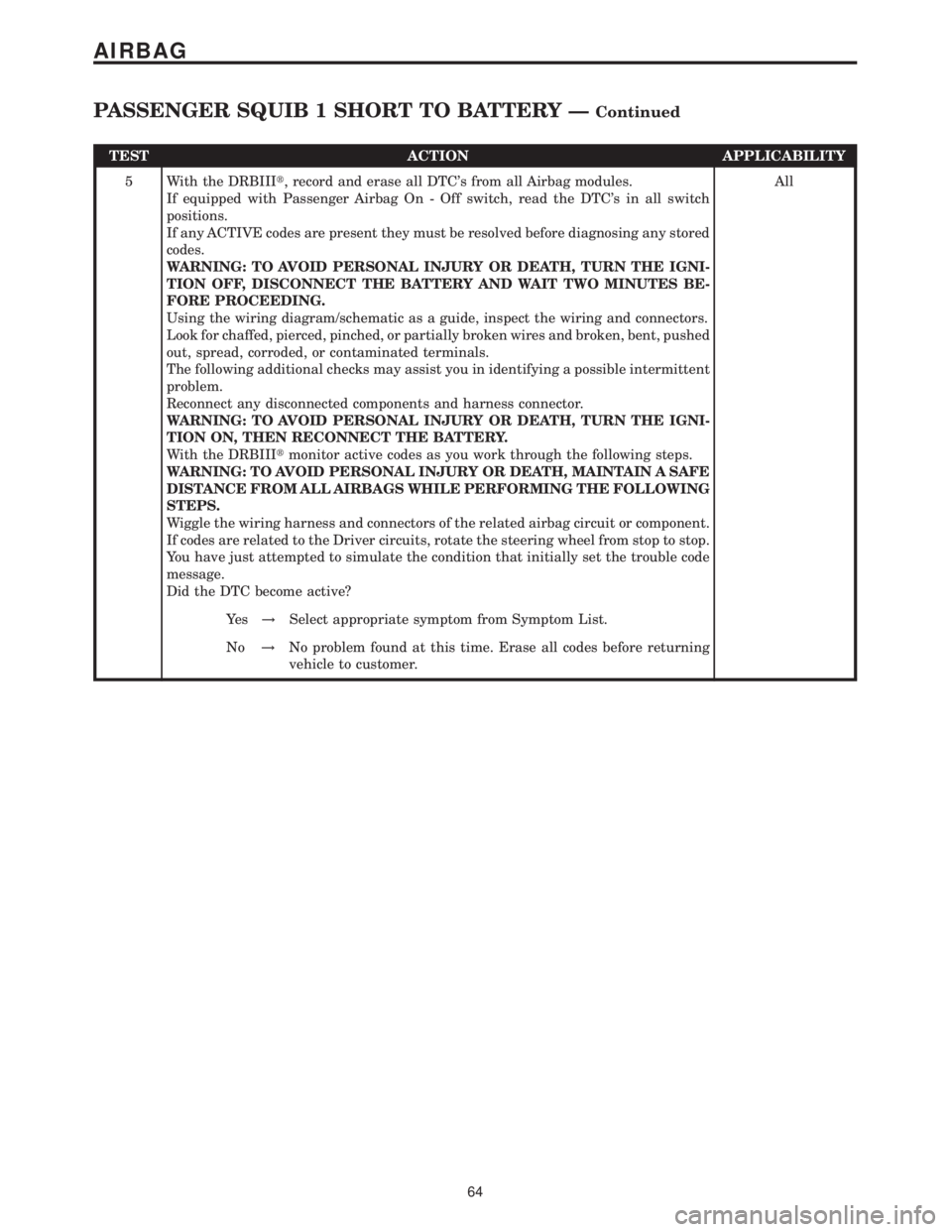
TEST ACTION APPLICABILITY
5 With the DRBIIIt, record and erase all DTC's from all Airbag modules.
If equipped with Passenger Airbag On - Off switch, read the DTC's in all switch
positions.
If any ACTIVE codes are present they must be resolved before diagnosing any stored
codes.
WARNING: TO AVOID PERSONAL INJURY OR DEATH, TURN THE IGNI-
TION OFF, DISCONNECT THE BATTERY AND WAIT TWO MINUTES BE-
FORE PROCEEDING.
Using the wiring diagram/schematic as a guide, inspect the wiring and connectors.
Look for chaffed, pierced, pinched, or partially broken wires and broken, bent, pushed
out, spread, corroded, or contaminated terminals.
The following additional checks may assist you in identifying a possible intermittent
problem.
Reconnect any disconnected components and harness connector.
WARNING: TO AVOID PERSONAL INJURY OR DEATH, TURN THE IGNI-
TION ON, THEN RECONNECT THE BATTERY.
With the DRBIIItmonitor active codes as you work through the following steps.
WARNING: TO AVOID PERSONAL INJURY OR DEATH, MAINTAIN A SAFE
DISTANCE FROM ALL AIRBAGS WHILE PERFORMING THE FOLLOWING
STEPS.
Wiggle the wiring harness and connectors of the related airbag circuit or component.
If codes are related to the Driver circuits, rotate the steering wheel from stop to stop.
You have just attempted to simulate the condition that initially set the trouble code
message.
Did the DTC become active?All
Ye s!Select appropriate symptom from Symptom List.
No!No problem found at this time. Erase all codes before returning
vehicle to customer.
64
AIRBAG
PASSENGER SQUIB 1 SHORT TO BATTERY ÐContinued
Page 80 of 2305
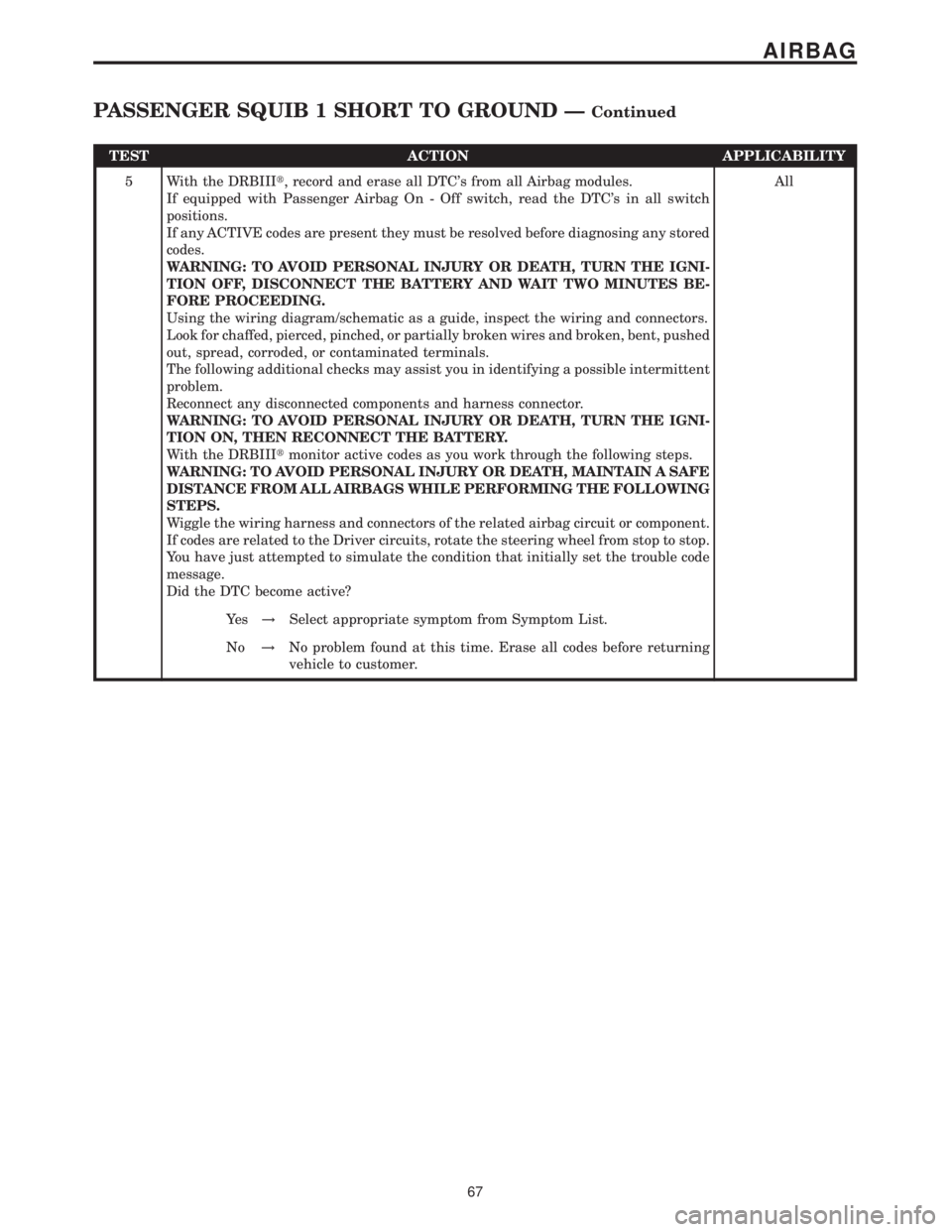
TEST ACTION APPLICABILITY
5 With the DRBIIIt, record and erase all DTC's from all Airbag modules.
If equipped with Passenger Airbag On - Off switch, read the DTC's in all switch
positions.
If any ACTIVE codes are present they must be resolved before diagnosing any stored
codes.
WARNING: TO AVOID PERSONAL INJURY OR DEATH, TURN THE IGNI-
TION OFF, DISCONNECT THE BATTERY AND WAIT TWO MINUTES BE-
FORE PROCEEDING.
Using the wiring diagram/schematic as a guide, inspect the wiring and connectors.
Look for chaffed, pierced, pinched, or partially broken wires and broken, bent, pushed
out, spread, corroded, or contaminated terminals.
The following additional checks may assist you in identifying a possible intermittent
problem.
Reconnect any disconnected components and harness connector.
WARNING: TO AVOID PERSONAL INJURY OR DEATH, TURN THE IGNI-
TION ON, THEN RECONNECT THE BATTERY.
With the DRBIIItmonitor active codes as you work through the following steps.
WARNING: TO AVOID PERSONAL INJURY OR DEATH, MAINTAIN A SAFE
DISTANCE FROM ALL AIRBAGS WHILE PERFORMING THE FOLLOWING
STEPS.
Wiggle the wiring harness and connectors of the related airbag circuit or component.
If codes are related to the Driver circuits, rotate the steering wheel from stop to stop.
You have just attempted to simulate the condition that initially set the trouble code
message.
Did the DTC become active?All
Ye s!Select appropriate symptom from Symptom List.
No!No problem found at this time. Erase all codes before returning
vehicle to customer.
67
AIRBAG
PASSENGER SQUIB 1 SHORT TO GROUND ÐContinued
Page 319 of 2305

TABLE OF CONTENTS - Continued
DRIVE TEST COMPLETED SUCCESSFULLY................................28
DRIVE TEST ERROR....................................................29
INCORRECT TONE WHEEL..............................................32
LATERAL ACCELERATION SENSOR CIRCUIT...............................36
LATERAL ACCELERATION SENSOR IMPLAUSIBLE..........................36
LATERAL ACCELERATION SENSOR INTERNAL FAULT.......................39
LEFT FRONT INLET SOLENOID...........................................40
LEFT FRONT OUTLET SOLENOID.........................................40
LEFT FRONT, RIGHT REAR INLET SOLENOID..............................40
LEFT FRONT, RIGHT REAR OUTLET SOLENOID............................40
LEFT REAR INLET SOLENOID............................................40
LEFT REAR OUTLET SOLENOID..........................................40
RIGHT FRONT INLET SOLENOID..........................................40
RIGHT FRONT OUTLET SOLENOID.......................................40
RIGHT FRONT, LEFT REAR INLET SOLENOID..............................40
RIGHT FRONT, LEFT REAR OUTLET SOLENOID............................40
RIGHT REAR INLET SOLENOID...........................................40
RIGHT REAR OUTLET SOLENOID.........................................40
LEFT FRONT WHEEL SPEED SENSOR CIRCUIT............................43
LEFT REAR WHEEL SPEED SENSOR CIRCUIT..............................43
RIGHT FRONT WHEEL SPEED SENSOR CIRCUIT...........................43
RIGHT REAR WHEEL SPEED SENSOR CIRCUIT............................43
LEFT FRONT WHEEL SPEED SENSOR SIGNAL.............................46
LEFT REAR WHEEL SPEED SENSOR SIGNAL..............................46
RIGHT FRONT WHEEL SPEED SENSOR SIGNAL............................46
RIGHT REAR WHEEL SPEED SENSOR SIGNAL.............................46
WHEEL SPEED SENSOR SIGNAL ERROR..................................46
NO COMMUNICATION WITH BUS.........................................49
NO COMMUNICATION WITH ECM.........................................52
NO COMMUNICATION WITH IC...........................................54
PARAMETERIZATION ERROR............................................56
PUMP MOTOR.........................................................57
RELAY OUTPUT VOLTAGE...............................................60
SOLENOID RELAY......................................................63
STEERING ANGLE SENSOR CALIBRATION ERROR..........................65
STEERING ANGLE SENSOR GREATER THAN 720 DEGREES.................66
STEERING ANGLE SENSOR IMPLAUSIBLE CAN SIGNAL.....................68
STEERING ANGLE SENSOR IMPLAUSIBLE VALUE..........................70
STEERING ANGLE SENSOR IMPLAUSIBLE WHEEL SPEED...................72
STEERING ANGLE SENSOR INTERNAL FAULT..............................74
SYSTEM OVERVOLTAGE................................................75
SYSTEM UNDERVOLTAGE...............................................77
VERIFICATION TESTS
VERIFICATION TESTS...................................................79
8.0 COMPONENT LOCATIONS...............................................81
8.1DLC ± INDICATORS................................................81
8.2CAB ± WSS.......................................................82
ii
Page 320 of 2305

TABLE OF CONTENTS - Continued
9.0 CONNECTOR PINOUTS.................................................83
BRAKE FLUID LEVEL SWITCH............................................83
BRAKE LAMP SWITCH C1 (EXCEPT ESP)..................................83
BRAKE LAMP SWITCH C2 (EXCEPT ESP) - BLACK..........................83
CONTROLLER ANTILOCK BRAKE.........................................84
INSTRUMENT CLUSTER C2 - WHITE......................................85
STEERING ANGLE SENSOR..............................................85
TCS SWITCH (ASR) - BLACK.............................................85
WHEEL SPEED SENSOR-LEFT FRONT....................................85
WHEEL SPEED SENSOR-LEFT REAR......................................86
WHEEL SPEED SENSOR-RIGHT FRONT...................................86
WHEEL SPEED SENSOR-RIGHT REAR....................................86
10.0 SCHEMATIC DIAGRAMS.................................................87
10.1BOSCH 5.7 ANTILOCK BRAKE SYSTEM ± ABS.........................87
iii
Page 322 of 2305

1.0 INTRODUCTION
The procedures contained in this manual include
all the specifications, instructions, and graphics
needed to diagnose the Sprinter Chassis system
problems: Bosch 5.7 ABS/ESP/TCS (ASR) Braking
System. The diagnostics in this manual are based
on the failure condition or symptom being present
at time of diagnosis.
Please follow the recommendations below when
choosing your diagnostic path.
1. First make sure the DRBIIItis communicating
with the vehicle system being diagnosed. If the
DRBIIItdisplays a ``No Response'' condition, you
must diagnose that first.
2. Read DTC's (diagnostic trouble codes) with the
DRBIIIt.
3. If no DTC's are present, identify the customer
complaint.
4. Once the DTC or customer complaint is iden-
tified locate the matching test in the Table of
Contents and begin to diagnose the system.
All component location views are in Section 8.0.
All connector pinouts are in Section 9.0. All sche-
matics are in Section 10.0.
When repairs are required, refer to the appropri-
ate service manual for the proper removal and
repair procedure.
Diagnostic procedures change every year. New
diagnostic systems may be added; carryover sys-
tems maybe enhanced. READ THIS MANUAL BE-
FORE TRYING TO DIAGNOSE A VEHICLE DI-
AGNOSTIC TROUBLE CODE. It is recommended
that you review the entire manual to become famil-
iar with all new and changed diagnostic procedures.
This manual reflects many suggested changes
from readers of past issues. After using this man-
ual, if you have any comments or recommendations,
please fill out the form at the back of the manual
and mail it back.
1.1 SYSTEM COVERAGE
This diagnostic procedure manual covers the An-
tilock Braking System (ABS), the Electronic Stabil-
ity Program (ESP) and the Traction Control System
(TCS) found on the Sprinter.
1.2 SIX-STEP TROUBLESHOOTING
PROCEDURE
Diagnosis of the Antilock Brake Systems is done
in six basic steps:
²Verification of complaint
²Verification of any related symptoms
²Symptom analysis
²Problem isolation
²Repair of isolated problem
²Verification of proper operation
2.0 INDENTIFICATION OF
SYSTEM
The Bosch 5.7 system can be identified by the 42
way Controller Antilock Brake (CAB), Hydraulic
Control Unit (HCU) and Pump Motor being an
integral electronic/hydraulic unit mounted below
the Master Cylinder with four Wheel Speed Sen-
sors, one at each wheel.
Vehicles with the Traction Control System (TCS/
ASR) can be identified by the presence of the
Traction Control System Switch (TCCS) located on
the center instrument panel.
Vehicles with Electronic Stability Program (ESP)
can be identified by the presence of the Steering
Angle Sensor and the Lateral Acceleration/Yaw
Sensor.
3.0 SYSTEM DESCRIPTION AND
FUNCTIONAL OPERATION
3.1 ESP
The ESP system consists of the electronic control/
hydraulic unit, steering angle sensor, lateral
acceleration/yaw sensor and wheel speed sensors.
When the vehicle is in a turn, the ESP looks at the
steering wheel angle sensor value and monitors the
wheel speed of the inner and outer wheels to ensure
the values are plausible. The steering angle sensor
also measures the speed at which the steering
wheel is turned.
The ESP control module is very similar to the
ABS/ASR module. The ESP is comprised of several
other systems, namely theHBA, ABS, TCS (ASR),
EBDandFZRsystems.
3.2 ABS
The Controller Antilock Brake (CAB) is used to
monitor wheel speeds and modulates (controls) hy-
draulic pressure in each brake channel. The modu-
lated hydraulic pressure is used to prevent wheel
lock up during braking and maintain vehicle stabil-
ity. The CAB also provides a vehicle speed signal
(VSS) to the Electronic Control Module (ECM).
During a non-ABS stop, the system functions as a
standard braking system. The CAB uses special
sortware that monitors the wheel speed(s) and
when certain criteria are met, the software will
1
GENERAL INFORMATION