2006 MERCEDES-BENZ SPRINTER light
[x] Cancel search: lightPage 1506 of 2305
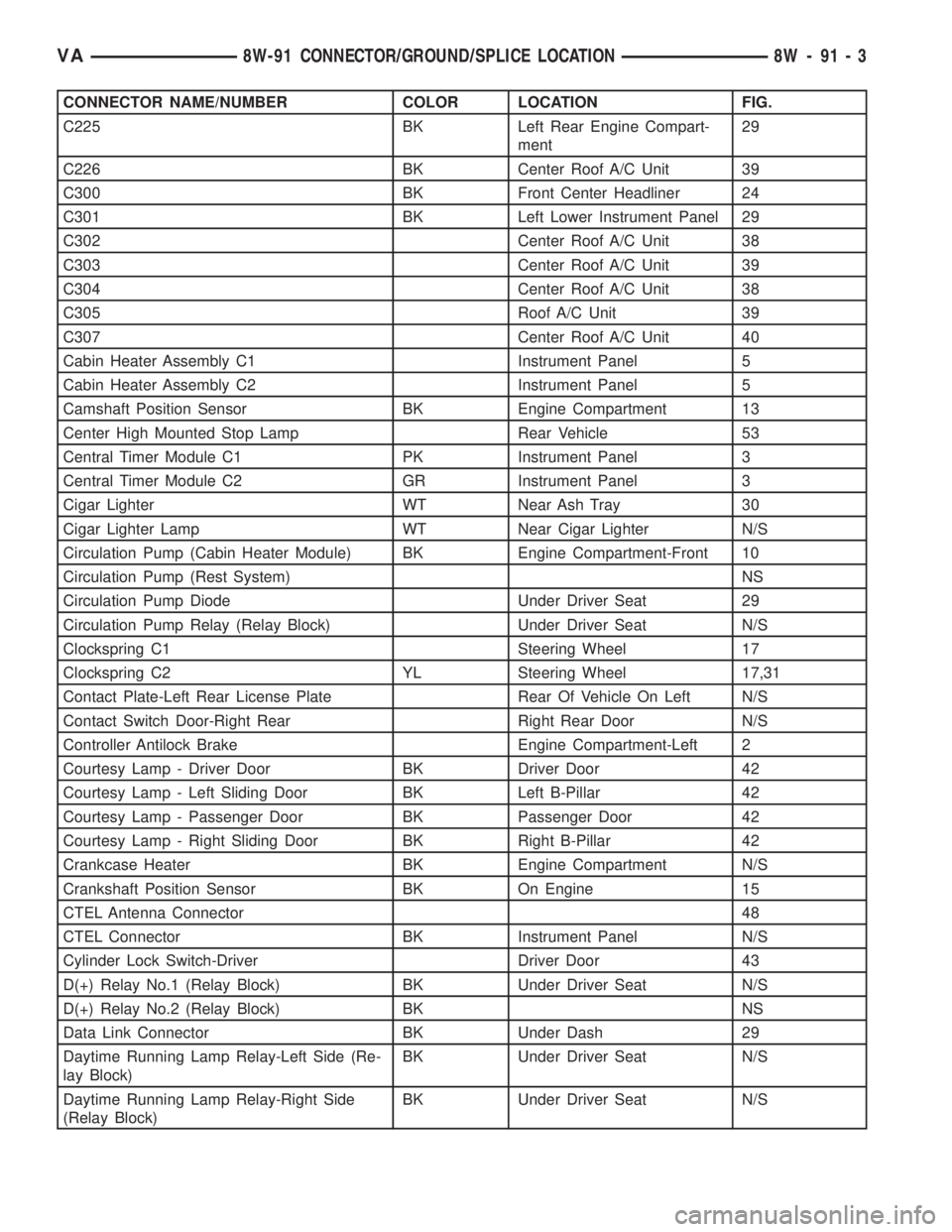
CONNECTOR NAME/NUMBER COLOR LOCATION FIG.
C225 BK Left Rear Engine Compart-
ment29
C226 BK Center Roof A/C Unit 39
C300 BK Front Center Headliner 24
C301 BK Left Lower Instrument Panel 29
C302 Center Roof A/C Unit 38
C303 Center Roof A/C Unit 39
C304 Center Roof A/C Unit 38
C305 Roof A/C Unit 39
C307 Center Roof A/C Unit 40
Cabin Heater Assembly C1 Instrument Panel 5
Cabin Heater Assembly C2 Instrument Panel 5
Camshaft Position Sensor BK Engine Compartment 13
Center High Mounted Stop Lamp Rear Vehicle 53
Central Timer Module C1 PK Instrument Panel 3
Central Timer Module C2 GR Instrument Panel 3
Cigar Lighter WT Near Ash Tray 30
Cigar Lighter Lamp WT Near Cigar Lighter N/S
Circulation Pump (Cabin Heater Module) BK Engine Compartment-Front 10
Circulation Pump (Rest System) NS
Circulation Pump Diode Under Driver Seat 29
Circulation Pump Relay (Relay Block) Under Driver Seat N/S
Clockspring C1 Steering Wheel 17
Clockspring C2 YL Steering Wheel 17,31
Contact Plate-Left Rear License Plate Rear Of Vehicle On Left N/S
Contact Switch Door-Right Rear Right Rear Door N/S
Controller Antilock Brake Engine Compartment-Left 2
Courtesy Lamp - Driver Door BK Driver Door 42
Courtesy Lamp - Left Sliding Door BK Left B-Pillar 42
Courtesy Lamp - Passenger Door BK Passenger Door 42
Courtesy Lamp - Right Sliding Door BK Right B-Pillar 42
Crankcase Heater BK Engine Compartment N/S
Crankshaft Position Sensor BK On Engine 15
CTEL Antenna Connector48
CTEL Connector BK Instrument Panel N/S
Cylinder Lock Switch-Driver Driver Door 43
D(+) Relay No.1 (Relay Block) BK Under Driver Seat N/S
D(+) Relay No.2 (Relay Block) BK NS
Data Link Connector BK Under Dash 29
Daytime Running Lamp Relay-Left Side (Re-
lay Block)BK Under Driver Seat N/S
Daytime Running Lamp Relay-Right Side
(Relay Block)BK Under Driver Seat N/S
VA8W-91 CONNECTOR/GROUND/SPLICE LOCATION 8W - 91 - 3
Page 1509 of 2305
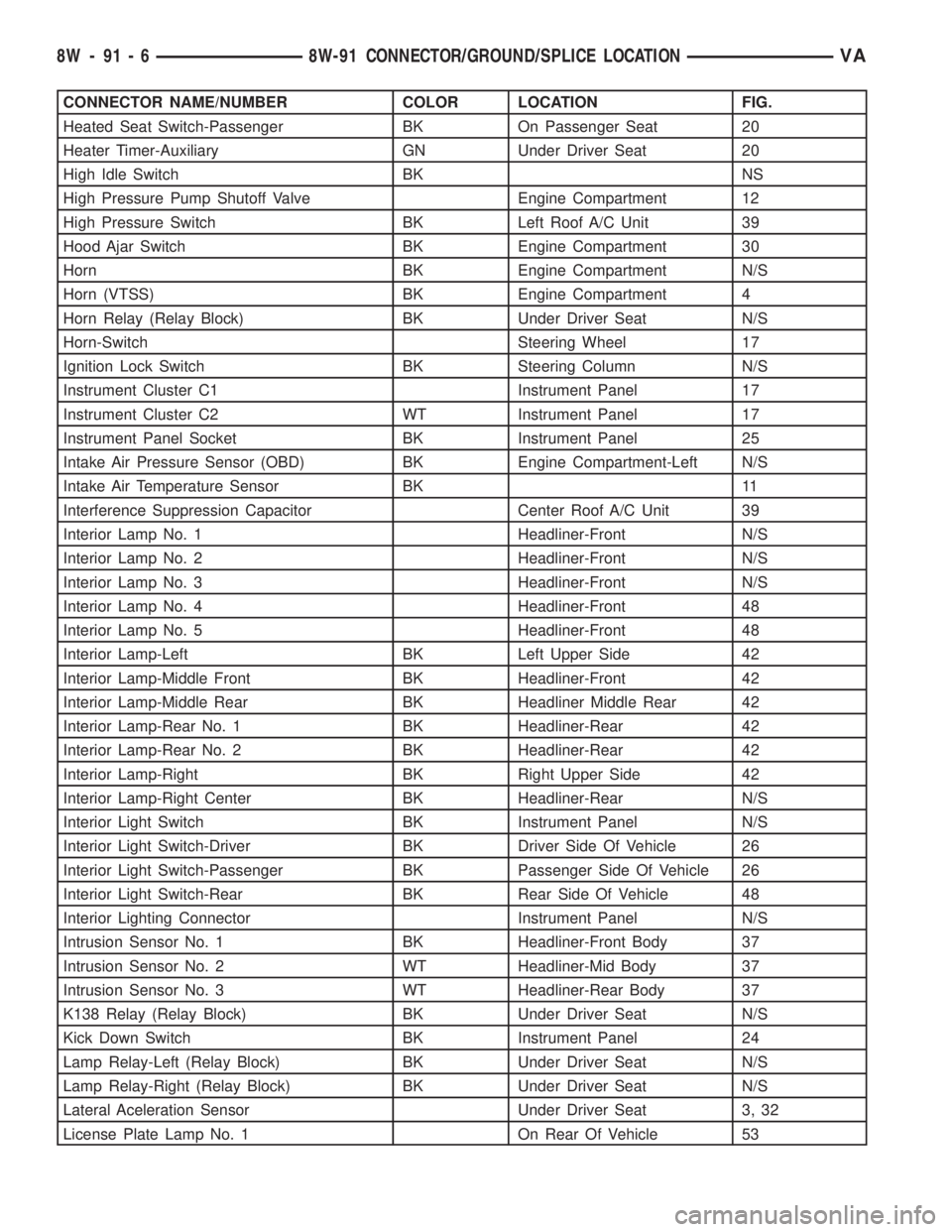
CONNECTOR NAME/NUMBER COLOR LOCATION FIG.
Heated Seat Switch-Passenger BK On Passenger Seat 20
Heater Timer-Auxiliary GN Under Driver Seat 20
High Idle Switch BK NS
High Pressure Pump Shutoff Valve Engine Compartment 12
High Pressure Switch BK Left Roof A/C Unit 39
Hood Ajar Switch BK Engine Compartment 30
Horn BK Engine Compartment N/S
Horn (VTSS) BK Engine Compartment 4
Horn Relay (Relay Block) BK Under Driver Seat N/S
Horn-Switch Steering Wheel 17
Ignition Lock Switch BK Steering Column N/S
Instrument Cluster C1 Instrument Panel 17
Instrument Cluster C2 WT Instrument Panel 17
Instrument Panel Socket BK Instrument Panel 25
Intake Air Pressure Sensor (OBD) BK Engine Compartment-Left N/S
Intake Air Temperature Sensor BK 11
Interference Suppression Capacitor Center Roof A/C Unit 39
Interior Lamp No. 1 Headliner-Front N/S
Interior Lamp No. 2 Headliner-Front N/S
Interior Lamp No. 3 Headliner-Front N/S
Interior Lamp No. 4 Headliner-Front 48
Interior Lamp No. 5 Headliner-Front 48
Interior Lamp-Left BK Left Upper Side 42
Interior Lamp-Middle Front BK Headliner-Front 42
Interior Lamp-Middle Rear BK Headliner Middle Rear 42
Interior Lamp-Rear No. 1 BK Headliner-Rear 42
Interior Lamp-Rear No. 2 BK Headliner-Rear 42
Interior Lamp-Right BK Right Upper Side 42
Interior Lamp-Right Center BK Headliner-Rear N/S
Interior Light Switch BK Instrument Panel N/S
Interior Light Switch-Driver BK Driver Side Of Vehicle 26
Interior Light Switch-Passenger BK Passenger Side Of Vehicle 26
Interior Light Switch-Rear BK Rear Side Of Vehicle 48
Interior Lighting Connector Instrument Panel N/S
Intrusion Sensor No. 1 BK Headliner-Front Body 37
Intrusion Sensor No. 2 WT Headliner-Mid Body 37
Intrusion Sensor No. 3 WT Headliner-Rear Body 37
K138 Relay (Relay Block) BK Under Driver Seat N/S
Kick Down Switch BK Instrument Panel 24
Lamp Relay-Left (Relay Block) BK Under Driver Seat N/S
Lamp Relay-Right (Relay Block) BK Under Driver Seat N/S
Lateral Aceleration Sensor Under Driver Seat 3, 32
License Plate Lamp No. 1 On Rear Of Vehicle 53
8W - 91 - 6 8W-91 CONNECTOR/GROUND/SPLICE LOCATIONVA
Page 1515 of 2305
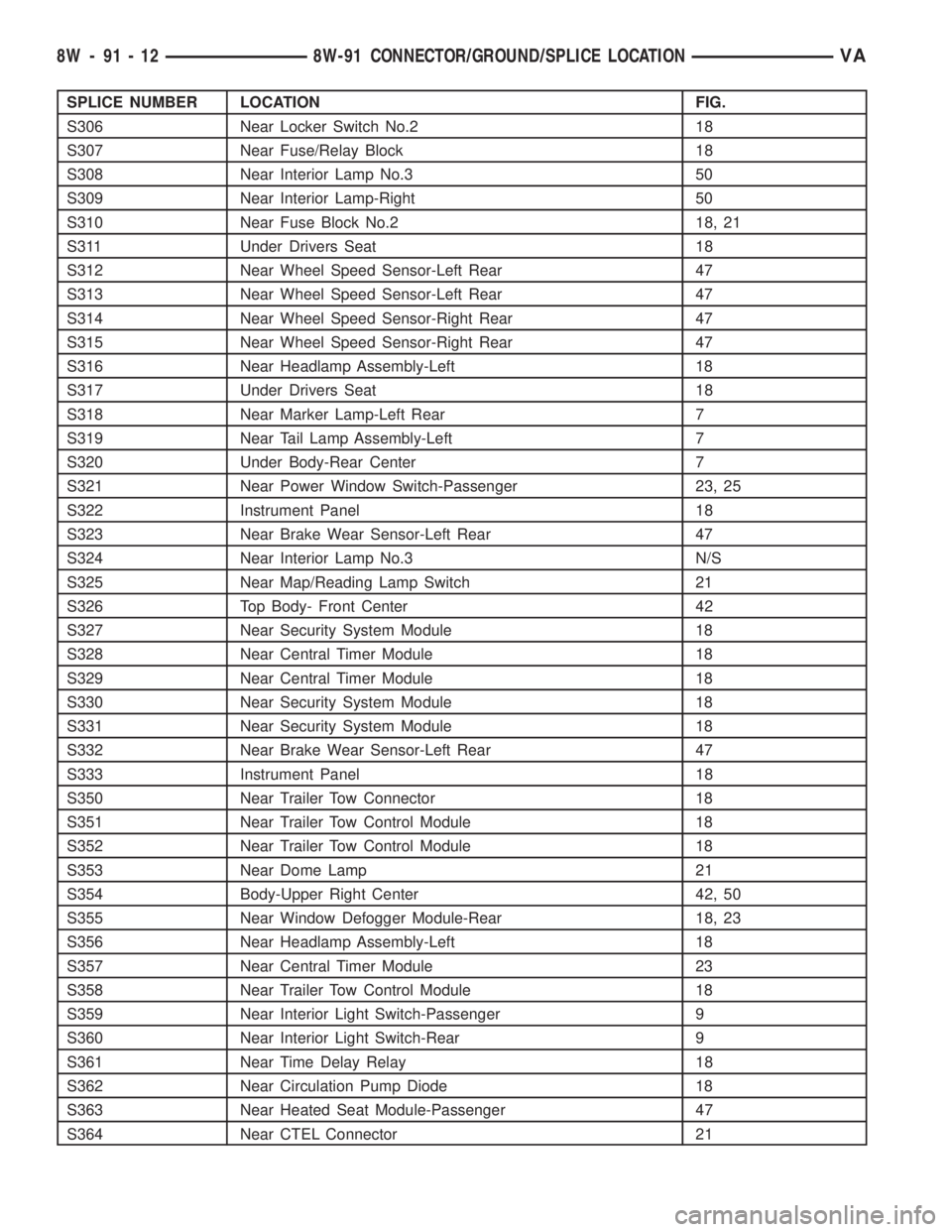
SPLICE NUMBER LOCATION FIG.
S306 Near Locker Switch No.2 18
S307 Near Fuse/Relay Block 18
S308 Near Interior Lamp No.3 50
S309 Near Interior Lamp-Right 50
S310 Near Fuse Block No.2 18, 21
S311 Under Drivers Seat 18
S312 Near Wheel Speed Sensor-Left Rear 47
S313 Near Wheel Speed Sensor-Left Rear 47
S314 Near Wheel Speed Sensor-Right Rear 47
S315 Near Wheel Speed Sensor-Right Rear 47
S316 Near Headlamp Assembly-Left 18
S317 Under Drivers Seat 18
S318 Near Marker Lamp-Left Rear 7
S319 Near Tail Lamp Assembly-Left 7
S320 Under Body-Rear Center 7
S321 Near Power Window Switch-Passenger 23, 25
S322 Instrument Panel 18
S323 Near Brake Wear Sensor-Left Rear 47
S324 Near Interior Lamp No.3 N/S
S325 Near Map/Reading Lamp Switch 21
S326 Top Body- Front Center 42
S327 Near Security System Module 18
S328 Near Central Timer Module 18
S329 Near Central Timer Module 18
S330 Near Security System Module 18
S331 Near Security System Module 18
S332 Near Brake Wear Sensor-Left Rear 47
S333 Instrument Panel 18
S350 Near Trailer Tow Connector 18
S351 Near Trailer Tow Control Module 18
S352 Near Trailer Tow Control Module 18
S353 Near Dome Lamp 21
S354 Body-Upper Right Center 42, 50
S355 Near Window Defogger Module-Rear 18, 23
S356 Near Headlamp Assembly-Left 18
S357 Near Central Timer Module 23
S358 Near Trailer Tow Control Module 18
S359 Near Interior Light Switch-Passenger 9
S360 Near Interior Light Switch-Rear 9
S361 Near Time Delay Relay 18
S362 Near Circulation Pump Diode 18
S363 Near Heated Seat Module-Passenger 47
S364 Near CTEL Connector 21
8W - 91 - 12 8W-91 CONNECTOR/GROUND/SPLICE LOCATIONVA
Page 1546 of 2305

Fig. 30 AJAR SWITHES, LIGHTER, ROOF FAN
VA8W-91 CONNECTOR/GROUND/SPLICE LOCATION 8W - 91 - 43
Page 1569 of 2305

Fig. 53 REAR LIGHTING
8W - 91 - 66 8W-91 CONNECTOR/GROUND/SPLICE LOCATIONVA
Page 1570 of 2305
8W-97 POWER DISTRIBUTION
TABLE OF CONTENTS
page page
POWER DISTRIBUTION
DESCRIPTION..........................1
OPERATION............................1
CIGAR LIGHTER OUTLET
DESCRIPTION..........................1
OPERATION............................2
DIAGNOSIS AND TESTING - CIGAR LIGHTER
OUTLET.............................2
REMOVAL.............................2
CIRCUIT BREAKER
DESCRIPTION..........................2
OPERATION............................2
DIAGNOSIS AND TESTING - CIRCUIT
BREAKER............................2
FUSE BLOCK #1
DESCRIPTION..........................2
OPERATION............................3
REMOVAL.............................3
INSTALLATION..........................3FUSE BLOCK #2
DESCRIPTION..........................3
OPERATION............................3
POWER DISTRIBUTION CENTER
DESCRIPTION..........................3
OPERATION............................3
POWER OUTLET
DESCRIPTION..........................3
OPERATION............................4
DIAGNOSIS AND TESTING - POWER OUTLET . 4
REMOVAL.............................4
INSTALLATION..........................4
RELAY
DESCRIPTION..........................4
OPERATION............................5
DIAGNOSIS AND TESTING - RELAY.........5
REMOVAL.............................5
INSTALLATION..........................5
POWER DISTRIBUTION
DESCRIPTION
This section describes the power distribution com-
ponents used on this model as well as the methods in
which battery voltage and charging system voltage is
distributed throughout the vehicle. The power distri-
bution system for this vehicle consists of the follow-
ing major components which are covered in further
detail later in this section:
²Fuseblock #1
²Fuseblock #2
²Power Distribution Center (PDC)
The power distribution system also incorporates
various types of circuit control and protection fea-
tures, including:
²Automatic resetting circuit breakers
²Blade-type fuses
²Cartridge fuses
²Relays
Following are general descriptions and theory of
operation for the major components in the power dis-
tribution system. Refer to Wiring for the location of
complete circuit diagrams for the various power dis-
tribution system components.
OPERATION
The power distribution system for this vehicle is
designed to provide safe, reliable, and centralized dis-
tribution points for the electrical current required to
operate all of the standard and optional factory-in-
stalled electrical and powertrain, chassis, safety,
security and convenience systems. At the same time,
the power distribution system was designed to pro-
vide easy access to these electrical distribution points
for the vehicle technician to use when conducting
diagnosis and repair of faulty circuits. The power dis-
tribution system can also prove useful for the addi-
tion of electrical circuits that may be required to
operate accessories that the vehicle owner may
choose to have installed in the aftermarket.
CIGAR LIGHTER OUTLET
DESCRIPTION
The cigar lighter outlet is installed in the instru-
ment panel, near the center of the instrument panel.
The cigar lighter outlet is secured by a snap fit
within the instrument panel.
The cigar lighter knob/heating element, and the
cigar lighter outlet are available for service. These
components cannot be repaired and, if faulty or dam-
aged, they must be replaced.
VA8W-97 POWER DISTRIBUTION 8W - 97 - 1
Page 1571 of 2305
OPERATION
The cigar lighter consists of two major components:
a knob and heating element unit, and the cigar
lighter base or receptacle shell. The receptacle shell
is connected to ground, and an insulated contact in
the bottom of the shell is connected to battery cur-
rent. The cigar lighter receives battery voltage from a
fuse in the fuseblock only when the ignition switch is
in the Accessory or On positions.
The knob and heating element are encased within
a spring-loaded housing, which also features a sliding
protective heat shield. When the heating element is
inserted in the receptacle shell, the heating element
resistor coil is grounded through its housing to the
receptacle shell. If the cigar lighter knob is pushed
inward, the heat shield slides up toward the knob
exposing the heating element.
Two small spring-clip retainers are located on
either side of the insulated contact inside the bottom
of the receptacle shell. These clips engage and hold
the heating element against the insulated contact
long enough for the resistor coil to heat up and glow.
When the resistor coil becomes sufficiently heated,
excess heat radiates from the heating element caus-
ing the spring-clips to expand. Once the spring-clips
expand far enough to release the heating element,
the spring-loaded housing forces the knob and heat-
ing element to pop back outward to their relaxed
position. When the cigar lighter knob and element
are pulled out of the receptacle shell, the protective
heat shield slides downward on the housing so that
the heating element is recessed and shielded around
its circumference for safety.
DIAGNOSIS AND TESTING - CIGAR LIGHTER
OUTLET
For cigar lighter outlet diagnosis and testing pro-
cedures (Refer to 8 - ELECTRICAL/POWER DISTRI-
BUTION/POWER OUTLET - DIAGNOSIS AND
TESTING)
REMOVAL
For cigar lighter outlet removal procedure (Refer to
8 - ELECTRICAL/POWER DISTRIBUTION/POWER
OUTLET - REMOVAL).
CIRCUIT BREAKER
DESCRIPTION
Automatic resetting circuit breakers are used to
protect the power window voltage supply circuits.
These circuit breakers can protect the systems from a
short circuit, or from an overload condition caused byan obstructed or stuck power window regulator or
switch.
The circuit breaker cannot be repaired and, if
faulty or damaged, it must be replaced.
OPERATION
The circuit breaker contains a bi-metal strip sand-
wiched between two contacts forming the connection
in the circuit. An overload condition causes the
bi-metal strip to heat and bend to the open position,
disconnecting current flow to the circuit. Then as the
system overload or short circuit is removed, the
bi-metal strip cools, re-establishing contact to allow
current flow to the circuit.
DIAGNOSIS AND TESTING - CIRCUIT BREAKER
For complete circuit descriptions and diagrams,
refer toWiring.
(1) Locate the correct circuit breaker in the fuse-
block. Pull out the circuit breaker slightly, but be cer-
tain that the circuit breaker terminals still contact
the terminals in the fuseblock cavities.
(2) Connect the negative lead of a 12-volt DC volt-
meter to a good ground.
(3) With the voltmeter positive lead, check both
terminals of the circuit breaker for battery voltage.
If only one terminal has battery voltage, the circuit
breaker is faulty and must be replaced. If neither ter-
minal has battery voltage, repair the open circuit
from the Power Distribution Center as required.
FUSE BLOCK #1
DESCRIPTION
An electrical fuse block is concealed under the
driver side steering column. The fuse block serves to
distribute electrical current to many of the electrical
systems in the vehicle. The fuse block contains blade-
type mini fuses, relays and micro processors that
enable automatic control of some of the power distri-
bution circuits throughout the vehicle.
The molded plastic fuse block housing has an inte-
gral mounting bracket that is secured with screws to
the steering column. A finger recess is molded into
the cover for easy removal. A fuse layout map is
molded onto the back side of the cover to ensure
proper fuse identification.
The fuse block cannot be repaired, if the fuse block
is faulty or damaged or if any internal circuit is
faulty or damaged, the entire fuse block must be
replaced.
8W - 97 - 2 8W-97 POWER DISTRIBUTIONVA
Page 1572 of 2305
OPERATION
All of the circuits entering and leaving the fuse
block do so through the instrument panel wire har-
ness. Internal connection of all of the fuse block cir-
cuits is accomplished by an intricate combination of
hard wiring and bus bars. Internal relays and micro
processors allow the vehicle electronics to control
some of the power distribution circuits throughout
the vehicle. Refer to the Wiring section for complete
circuit diagrams.
REMOVAL
(1) Disconnect and isolate the negative battery
cable.
(2) Remove fuse block cover by rotating locking
screw 90É.
(3) Remove the steering column cover. Refer to the
Body section for the procedure.
(4) Unscrew fuse block connections and disconnect
all electrical connectors from the fuse block.
(5) Remove the fuse block from the steering col-
umn.
INSTALLATION
(1) Position the fuse block in the steering column.
(2) Install fuse block connections and connect all
electrical connectors on the fuse block.
(3) Install the steering column cover. Refer to the
Body section for the procedure.
(4) Install fuse block cover by rotating locking
screw 90É.
(5) Connect the negative battery cable.
(6) Set time and radio stations.
FUSE BLOCK #2
DESCRIPTION
An electrical fuse block is concealed under the
driver side front seat. The fuse block serves to dis-
tribute electrical current to many of the electrical
systems in the vehicle. The fuse block houses blade-
type mini fuses, blade-type automatic resetting cir-
cuit breakers and International Standards
Organization relays. Additional provisions are avail-
able in the fuse block for additional fuses and ISO
relays.
The molded plastic fuse block housing has an inte-
gral mounting bracket that is secured with screws to
the seat base. The driver side seat base also has a
snap-fit fuse access panel that can be removed for
service of the fuses and the relays. A finger recess is
molded into one end for easy removal. A fuse layout
map is molded onto the back side of the panel to
ensure proper fuse identification.
The fuse block is integral to the body wire harness.
If any internal circuit or the fuse block housing isfaulty or damaged, the entire fuse block and body
wire harness unit must be replaced.
OPERATION
All of the circuits entering and leaving the fuse
block do so through the body wire harness. Internal
connection of all of the fuse block circuits is accom-
plished by an intricate combination of hard wiring
and bus bars.
POWER DISTRIBUTION CEN-
TER
DESCRIPTION
All of the electrical current distributed throughout
this vehicle is directed through the Power Distribu-
tion Center (PDC). The molded plastic PDC housing
is located in the left front corner of the engine com-
partment, on the battery positive cable. The PDC
housing has a molded plastic cover that slides over
the PDC housing. The PDC cover is easily opened or
removed for service access.
The PDC unit cannot be repaired and is only ser-
viced as a unit with the headlamp and dash wire
harness. If the internal circuits or the PDC housing
are faulty or damaged, the headlamp and dash wire
harness unit must be replaced.
OPERATION
All of the current from the battery and the gener-
ator output enters the PDC through the positive bat-
tery cable. The PDC cover is removed to access the
battery and generator output connection B(+) termi-
nal studs. Internal connection of all of the PDC cir-
cuits is accomplished by an intricate combination of
hard wiring and bus bars. Refer to Wiring Diagrams
for the location of complete PDC circuit diagrams.
POWER OUTLET
DESCRIPTION
The power outlet is installed in the instrument
panel accessory switch plate, which is located near
the center of the instrument panel. The power outlet
base is secured by a snap fit within the instrument
panel. A plastic protective cap snaps over the power
outlet base when the power outlet is not being used.
While the power outlet is very similar to a cigar
lighter base unit, it does not include the two small
spring-clip retainers inside the bottom of the recepta-
cle shell that are used to secure the cigar lighter
heating element to the insulated contact.
The power outlet receptacle unit are available for
service. The power outlet receptacle cannot be
VA8W-97 POWER DISTRIBUTION 8W - 97 - 3