2006 MERCEDES-BENZ SPRINTER door lock
[x] Cancel search: door lockPage 18 of 2305

3.2.2 CAN BUS
The CAN bus (controller area network) is a data
bus system specifically design for inter module
communication on this vehicle. The CAN bus con-
sists of a special twisted two-core cable. Control
modules are connected to this9twisted pair9. The
CAN bus incorporates two terminating resistors.
One terminator is built into the Engine Control
Module (ECM) and the other is built into the Sentry
Key Remote Entry Module (SKREEM). Each resis-
tor has a value of 120 ohms. The resistor condition
can be confirmed by disconnecting the control mod-
ule and measuring the resistance value at the
appropriate control module pins. This measure-
ment should read 120 ohms. The two CAN circuits,
CAN C Bus (+) and CAN C Bus (-), are bridged by
these two terminating resistors when all control
modules are connected to the bus. These two resis-
tors are connected to the CAN bus network in
parallel. The measurement between the two
twisted CAN circuits, with both the ECM and
SKREEM connected, should measure a value of 60
ohms.
The CAN bus is bi-directional. This means that
each connected control module can send and receive
information. Transmission of data takes place re-
dundantly via both circuits. The data bus levels are
mirrored, meaning that if the binary level on one
circuit is 0, the other circuit transmits binary level
1 and vice versa. The two line concept is used for
two reasons: for fault identification and as a safety
concept.
If a voltage peak occurs on just one circuit, the
receivers can identify this as a fault and ignore the
voltage peak. If a short circuit or interruption
occurs on one of the two CAN circuits, a software-
hardware linked safety concept allows switching to
a single-line operation. The defective CAN circuit is
shut down. A specific data protocol controls how and
when the participants can send and receive.
NOTE: It is important to note the CAN Bus
circuits are used for inter-module
communication only, and is no way
connected to the K-Lines.
The following modules that use the CAN Bus on
this vehicle are:
²Automatic Temperature Control (ATC)
²Controller Antilock Brake (CAB)
²Engine Control Module (ECM)
²Instrument Cluster (IC)
²Sentry Key Remote Entry Module (SKREEM)
²Shifter Assembly (SA)
²Transmission Control Module (TCM)
3.3 HEATING & A/C SYSTEM
3.3.1 AUTOMATIC TEMPERATURE
CONTROL (ATC)
3.3.1.1 SYSTEM CONTROLS
The ATC Module:
²is fully addressable with the DRBIIIt.
IThe DRBIIItcommunicates with the ATC
Module through the Diagnostic Link Connector
(DLC) via a K-Line.
²communicates with other modules over the Con-
troller Area Network (CAN) C Bus.
²controls A/C clutch operation.
²controls EBL operation.
²controls water cycle valve operation.
IThe water cycle valve is a normally open valve,
meaning that it allows full engine coolant flow
through the heater core when no power is
delivered to the valve. The ATC controls the
valve with a pulse width signal. The lower the
percentage of the pulse width signal the more
the valve is open.
²controls Residual Heat Utilization (REST) func-
tion.
²controls blower motor operation, providing four
blower speeds (Low, M1, M2, & High).
²controls recirculation air solenoid valve.
²controls the mode door via cables.
²controls the main power supply to the Heater
Booster (if equipped).
²uses air inlet temperature sensor, air outlet tem-
perature sensor, and evaporator temperature
sensor input, as well as data from other modules
to maintain occupant comfort levels.
3.3.1.2 SYSTEM DIAGNOSTICS
Fault detection is through active and stored Diag-
nostic Trouble Codes (DTCs)
²DTCs are displayed by the DRBIIIt.
²Active DTCs are those which currently exist in
the system. The condition causing the fault must
be repaired in order to clear this type of DTC.
²Stored DTCs are those which occurred in the
system since the ATC Module received the last
9clear diagnostic info9message.
Testing Preparation & Diagnostics
Set the necessary system functions accordingly so
that all of the following prerequisites are met prior
to performing diagnostic tests on the ATC system:
5
GENERAL INFORMATION
Page 22 of 2305
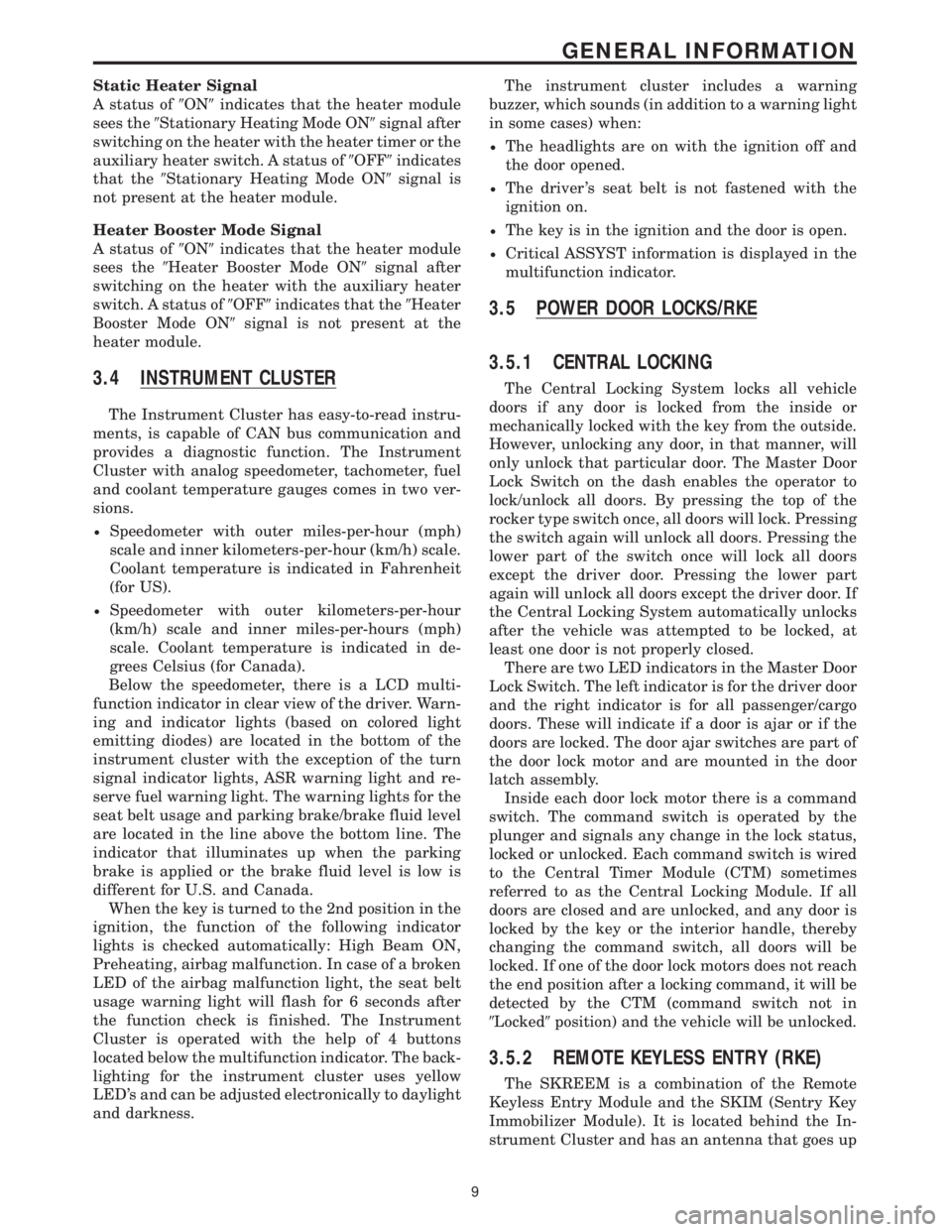
Static Heater Signal
A status of9ON9indicates that the heater module
sees the9Stationary Heating Mode ON9signal after
switching on the heater with the heater timer or the
auxiliary heater switch. A status of9OFF9indicates
that the9Stationary Heating Mode ON9signal is
not present at the heater module.
Heater Booster Mode Signal
A status of9ON9indicates that the heater module
sees the9Heater Booster Mode ON9signal after
switching on the heater with the auxiliary heater
switch. A status of9OFF9indicates that the9Heater
Booster Mode ON9signal is not present at the
heater module.
3.4 INSTRUMENT CLUSTER
The Instrument Cluster has easy-to-read instru-
ments, is capable of CAN bus communication and
provides a diagnostic function. The Instrument
Cluster with analog speedometer, tachometer, fuel
and coolant temperature gauges comes in two ver-
sions.
²Speedometer with outer miles-per-hour (mph)
scale and inner kilometers-per-hour (km/h) scale.
Coolant temperature is indicated in Fahrenheit
(for US).
²Speedometer with outer kilometers-per-hour
(km/h) scale and inner miles-per-hours (mph)
scale. Coolant temperature is indicated in de-
grees Celsius (for Canada).
Below the speedometer, there is a LCD multi-
function indicator in clear view of the driver. Warn-
ing and indicator lights (based on colored light
emitting diodes) are located in the bottom of the
instrument cluster with the exception of the turn
signal indicator lights, ASR warning light and re-
serve fuel warning light. The warning lights for the
seat belt usage and parking brake/brake fluid level
are located in the line above the bottom line. The
indicator that illuminates up when the parking
brake is applied or the brake fluid level is low is
different for U.S. and Canada.
When the key is turned to the 2nd position in the
ignition, the function of the following indicator
lights is checked automatically: High Beam ON,
Preheating, airbag malfunction. In case of a broken
LED of the airbag malfunction light, the seat belt
usage warning light will flash for 6 seconds after
the function check is finished. The Instrument
Cluster is operated with the help of 4 buttons
located below the multifunction indicator. The back-
lighting for the instrument cluster uses yellow
LED's and can be adjusted electronically to daylight
and darkness.The instrument cluster includes a warning
buzzer, which sounds (in addition to a warning light
in some cases) when:
²The headlights are on with the ignition off and
the door opened.
²The driver 's seat belt is not fastened with the
ignition on.
²The key is in the ignition and the door is open.
²Critical ASSYST information is displayed in the
multifunction indicator.
3.5 POWER DOOR LOCKS/RKE
3.5.1 CENTRAL LOCKING
The Central Locking System locks all vehicle
doors if any door is locked from the inside or
mechanically locked with the key from the outside.
However, unlocking any door, in that manner, will
only unlock that particular door. The Master Door
Lock Switch on the dash enables the operator to
lock/unlock all doors. By pressing the top of the
rocker type switch once, all doors will lock. Pressing
the switch again will unlock all doors. Pressing the
lower part of the switch once will lock all doors
except the driver door. Pressing the lower part
again will unlock all doors except the driver door. If
the Central Locking System automatically unlocks
after the vehicle was attempted to be locked, at
least one door is not properly closed.
There are two LED indicators in the Master Door
Lock Switch. The left indicator is for the driver door
and the right indicator is for all passenger/cargo
doors. These will indicate if a door is ajar or if the
doors are locked. The door ajar switches are part of
the door lock motor and are mounted in the door
latch assembly.
Inside each door lock motor there is a command
switch. The command switch is operated by the
plunger and signals any change in the lock status,
locked or unlocked. Each command switch is wired
to the Central Timer Module (CTM) sometimes
referred to as the Central Locking Module. If all
doors are closed and are unlocked, and any door is
locked by the key or the interior handle, thereby
changing the command switch, all doors will be
locked. If one of the door lock motors does not reach
the end position after a locking command, it will be
detected by the CTM (command switch not in
9Locked9position) and the vehicle will be unlocked.
3.5.2 REMOTE KEYLESS ENTRY (RKE)
The SKREEM is a combination of the Remote
Keyless Entry Module and the SKIM (Sentry Key
Immobilizer Module). It is located behind the In-
strument Cluster and has an antenna that goes up
9
GENERAL INFORMATION
Page 23 of 2305

the A-pillar. The SKREEM receives radio messages
from the RKE transmitter (fob) and sends com-
mands via the RKE Interface circuit to the CTM. If
the vehicle is equipped with VTSS, the Security
System Module will be connected in series between
the SKREEM and the CTM.
Confirmation of the RKE Lock/Unlock state is
accomplished via the turn signals. When the vehicle
is locked via RKE the turn signals will flash three
times. When it is unlocked via RKE, the turn
signals will flash one time. If the vehicle has been
unlocked via RKE and no door is opened within 40
seconds, the entire vehicle will be locked again
automatically.
If a transmitter (fob) is operated more than 255
times in succession beyond the range of the receiver
(SKREEM), the RKE portion of the key will become
inoperative. In order to put it back in synchroniza-
tion it will be necessary to have ALL the other
transmitters that are used with this vehicle avail-
able and follow the following procedure:
1. Cycle the ignition on and off 2 times within 6
seconds (leave in off position).
2. Press the lock or unlock button of the disabled
transmitter within 3 seconds of turning the
ignition off.
3. Press any button (lock or unlock) 3 more times
within 6 seconds.
4. Wait 10 seconds.
5. Press any button of ALL other transmitters
belonging to this vehicle at least once within
the next 20 seconds.
For problems related to the Immobilizer function
of the SKREEM, see Service Information.
3.5.3 AUTO DOOR LOCKS
Whenever the engine is started, the CTM receives
a message to lock all doors except the drivers door.
This is accomplished through the D+ Relay. The D+
Relay is controlled by the Instrument Cluster which
receives a command from the ECM that the engine
is running. This relay supplies power to the CTM
(for auto locking), the daytime running lamps and
the rear window defogger.
3.5.4 ACCIDENT RESPONSE
The CTM is hardwired to the Airbag Control
Module through the Enhanced Accident Report
Driver circuit. Anytime the vehicle airbags are
deployed, the CTM will unlock all doors and a
9Crash9DTC will be stored in memory. The door
locks will be inoperative until that code is cleared. If
the vehicle is severly jarred, but not enough to
deploy the airbags, it is possible that the DTC could
be set and therefore the door locks would be inop-
erable. Whenever the door locks are not opera-tional, use the DRBIII and check DTC's . If the code
9ACM has unlocked the doors9appears, use the
DRBIII and erase it.
3.6 VEHICLE THEFT SECURITY SYSTEM
(VTSS)
The Security System Module (SSM) is located
under the driver's seat. The SSM communicates
with the DRBIII over the K-line. If equipped the
Vehicle Theft Security System will monitor the
following:
²door jamb switches
²hood ajar switch
²ignition switch
²interior of the vehicle for movement
²longitudinal and transverse movement of the
vehicle
²rear defogger grids for glass breakage
²trailer connector
To arm the system the hood and all of the doors
must be closed when the vehicle is locked with the
RKE transmitter or with the use of the key in the
driver door. If the key is used, it must be held in the
lock position for 2 seconds. When the system is first
activated, the hazard lamps will flash 3 times. Also
with the system armed, the Towing/Intrusion Sen-
sor On/Off Switch indicator will flash to indicate an
armed system. To disarm the system use the RKE
or the driver door lock cylinder. Unlocking and
opening one of the other doors with the system
armed will trip the vehicle theft security system.
Interior monitoring is done by the use of an
Intrusion Sensor located in the front headliner and
with one or two sensors in the ceiling of the cargo
area depending on how the vehicle is equipped.
Monitoring of the interior of the vehicle will begin
after the system has been armed for 30 seconds. The
on/off switch located on the instrument panel can be
used to turn off this feature with the ignition switch
in either the Locked/Off or ACC position. The vehi-
cle tow-monitoring feature can also be switched off
using this switch. Re-locking the vehicle a second
time will reactivate these features.
If a trailer is connected to the vehicle when the
system is armed, the SSM will sense a resistance
change on the turn signal circuits if the trailer
harness becomes disconnected and will trip the
alarm.
Tripping the vehicle theft security system will
cause the hazard lamps to flash and the siren to
sound at 30-second intervals. The siren is equipped
with it's own self-contained battery. In the event the
vehicle's battery power is disconnected the siren
will continue to sound on it's own.
10
GENERAL INFORMATION
Page 209 of 2305
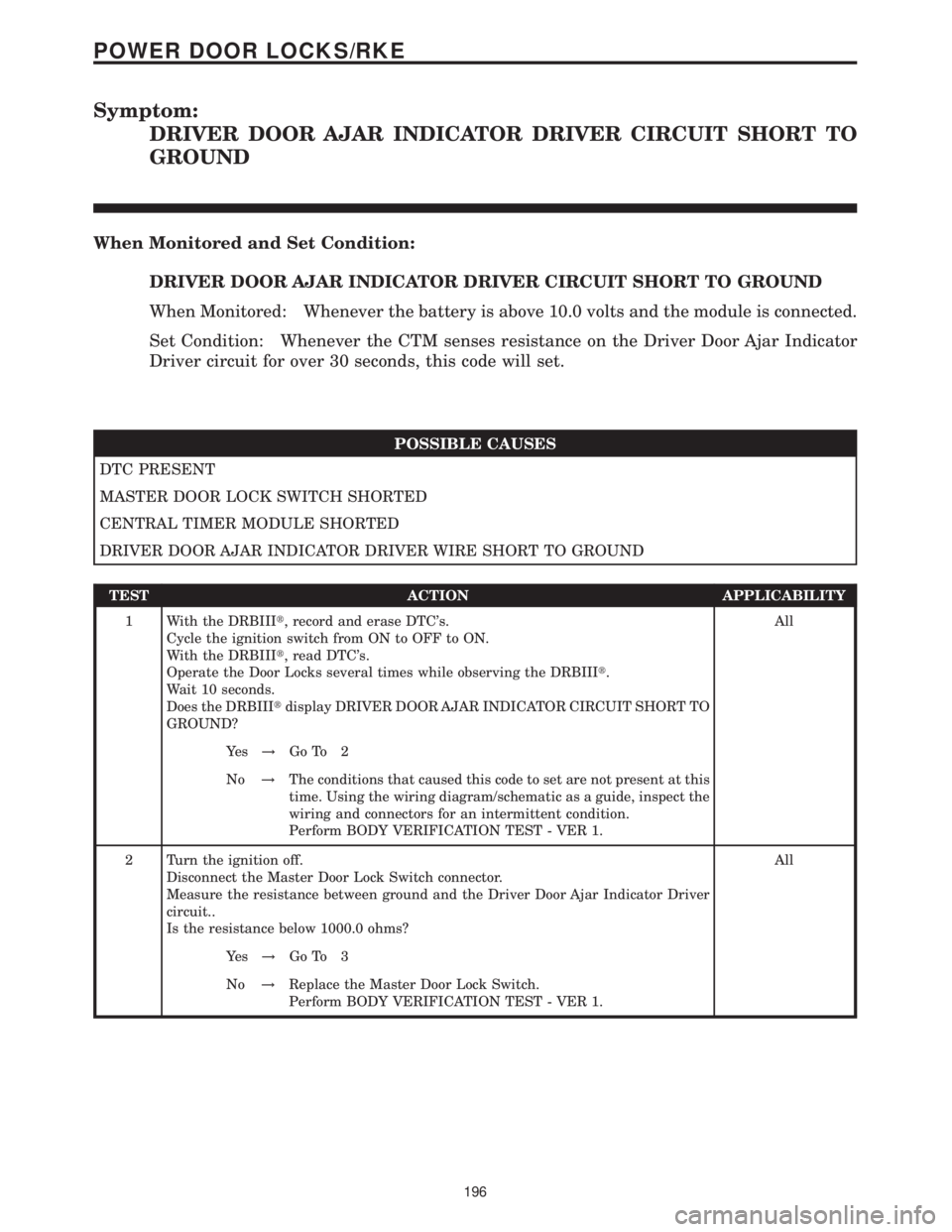
Symptom:
DRIVER DOOR AJAR INDICATOR DRIVER CIRCUIT SHORT TO
GROUND
When Monitored and Set Condition:
DRIVER DOOR AJAR INDICATOR DRIVER CIRCUIT SHORT TO GROUND
When Monitored: Whenever the battery is above 10.0 volts and the module is connected.
Set Condition: Whenever the CTM senses resistance on the Driver Door Ajar Indicator
Driver circuit for over 30 seconds, this code will set.
POSSIBLE CAUSES
DTC PRESENT
MASTER DOOR LOCK SWITCH SHORTED
CENTRAL TIMER MODULE SHORTED
DRIVER DOOR AJAR INDICATOR DRIVER WIRE SHORT TO GROUND
TEST ACTION APPLICABILITY
1 With the DRBIIIt, record and erase DTC's.
Cycle the ignition switch from ON to OFF to ON.
With the DRBIIIt, read DTC's.
Operate the Door Locks several times while observing the DRBIIIt.
Wait 10 seconds.
Does the DRBIIItdisplay DRIVER DOOR AJAR INDICATOR CIRCUIT SHORT TO
GROUND?All
Ye s!Go To 2
No!The conditions that caused this code to set are not present at this
time. Using the wiring diagram/schematic as a guide, inspect the
wiring and connectors for an intermittent condition.
Perform BODY VERIFICATION TEST - VER 1.
2 Turn the ignition off.
Disconnect the Master Door Lock Switch connector.
Measure the resistance between ground and the Driver Door Ajar Indicator Driver
circuit..
Is the resistance below 1000.0 ohms?All
Ye s!Go To 3
No!Replace the Master Door Lock Switch.
Perform BODY VERIFICATION TEST - VER 1.
196
POWER DOOR LOCKS/RKE
Page 210 of 2305
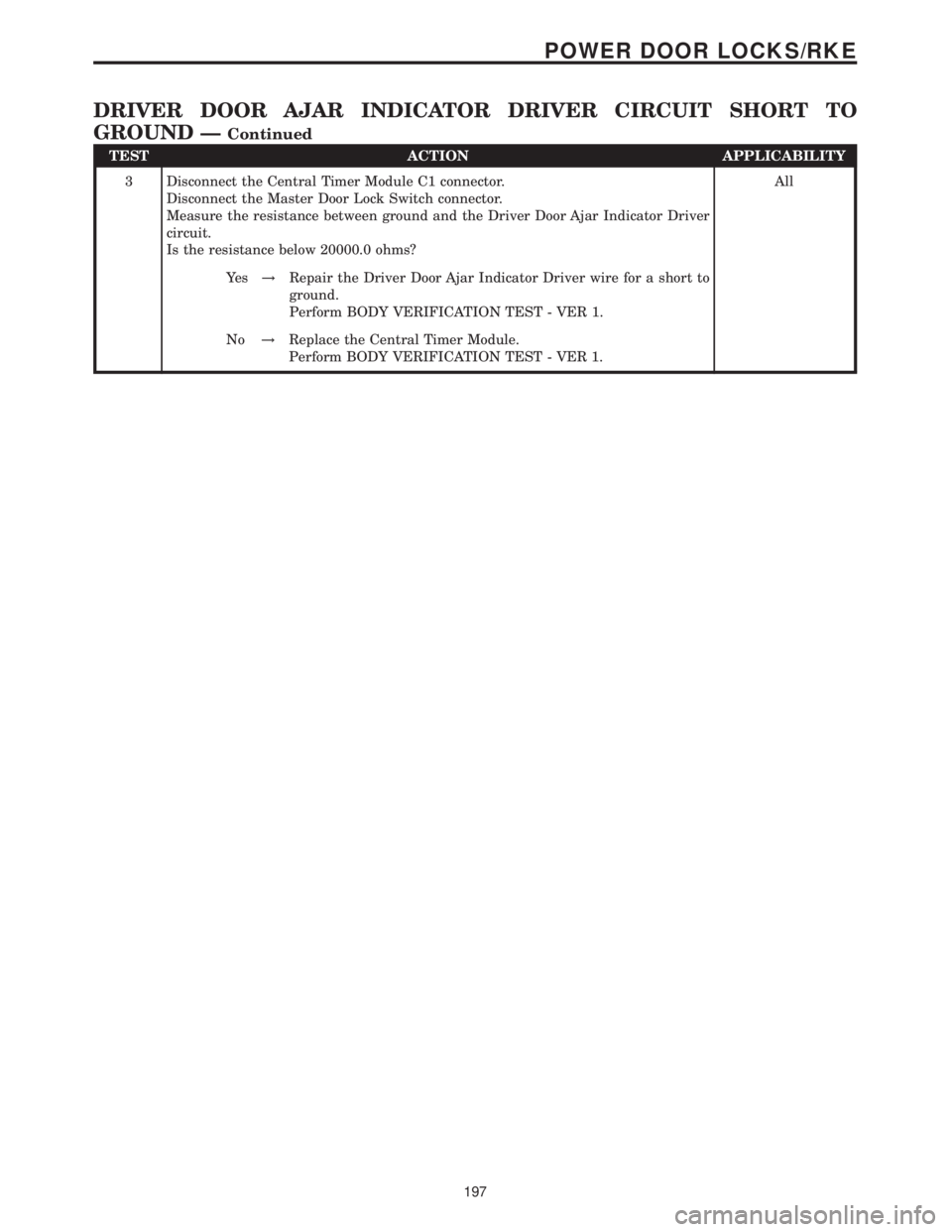
TEST ACTION APPLICABILITY
3 Disconnect the Central Timer Module C1 connector.
Disconnect the Master Door Lock Switch connector.
Measure the resistance between ground and the Driver Door Ajar Indicator Driver
circuit.
Is the resistance below 20000.0 ohms?All
Ye s!Repair the Driver Door Ajar Indicator Driver wire for a short to
ground.
Perform BODY VERIFICATION TEST - VER 1.
No!Replace the Central Timer Module.
Perform BODY VERIFICATION TEST - VER 1.
197
POWER DOOR LOCKS/RKE
DRIVER DOOR AJAR INDICATOR DRIVER CIRCUIT SHORT TO
GROUND Ð
Continued
Page 211 of 2305
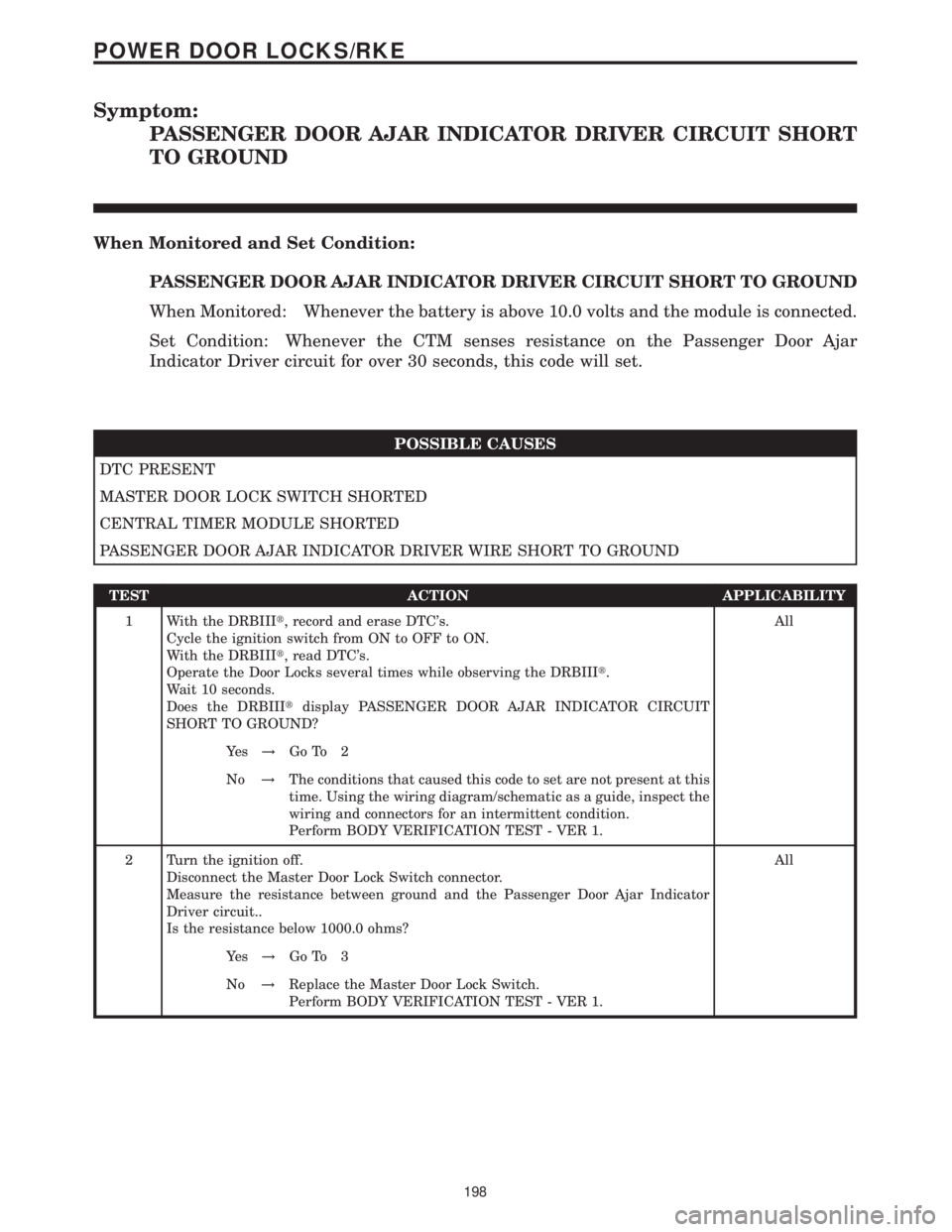
Symptom:
PASSENGER DOOR AJAR INDICATOR DRIVER CIRCUIT SHORT
TO GROUND
When Monitored and Set Condition:
PASSENGER DOOR AJAR INDICATOR DRIVER CIRCUIT SHORT TO GROUND
When Monitored: Whenever the battery is above 10.0 volts and the module is connected.
Set Condition: Whenever the CTM senses resistance on the Passenger Door Ajar
Indicator Driver circuit for over 30 seconds, this code will set.
POSSIBLE CAUSES
DTC PRESENT
MASTER DOOR LOCK SWITCH SHORTED
CENTRAL TIMER MODULE SHORTED
PASSENGER DOOR AJAR INDICATOR DRIVER WIRE SHORT TO GROUND
TEST ACTION APPLICABILITY
1 With the DRBIIIt, record and erase DTC's.
Cycle the ignition switch from ON to OFF to ON.
With the DRBIIIt, read DTC's.
Operate the Door Locks several times while observing the DRBIIIt.
Wait 10 seconds.
Does the DRBIIItdisplay PASSENGER DOOR AJAR INDICATOR CIRCUIT
SHORT TO GROUND?All
Ye s!Go To 2
No!The conditions that caused this code to set are not present at this
time. Using the wiring diagram/schematic as a guide, inspect the
wiring and connectors for an intermittent condition.
Perform BODY VERIFICATION TEST - VER 1.
2 Turn the ignition off.
Disconnect the Master Door Lock Switch connector.
Measure the resistance between ground and the Passenger Door Ajar Indicator
Driver circuit..
Is the resistance below 1000.0 ohms?All
Ye s!Go To 3
No!Replace the Master Door Lock Switch.
Perform BODY VERIFICATION TEST - VER 1.
198
POWER DOOR LOCKS/RKE
Page 212 of 2305
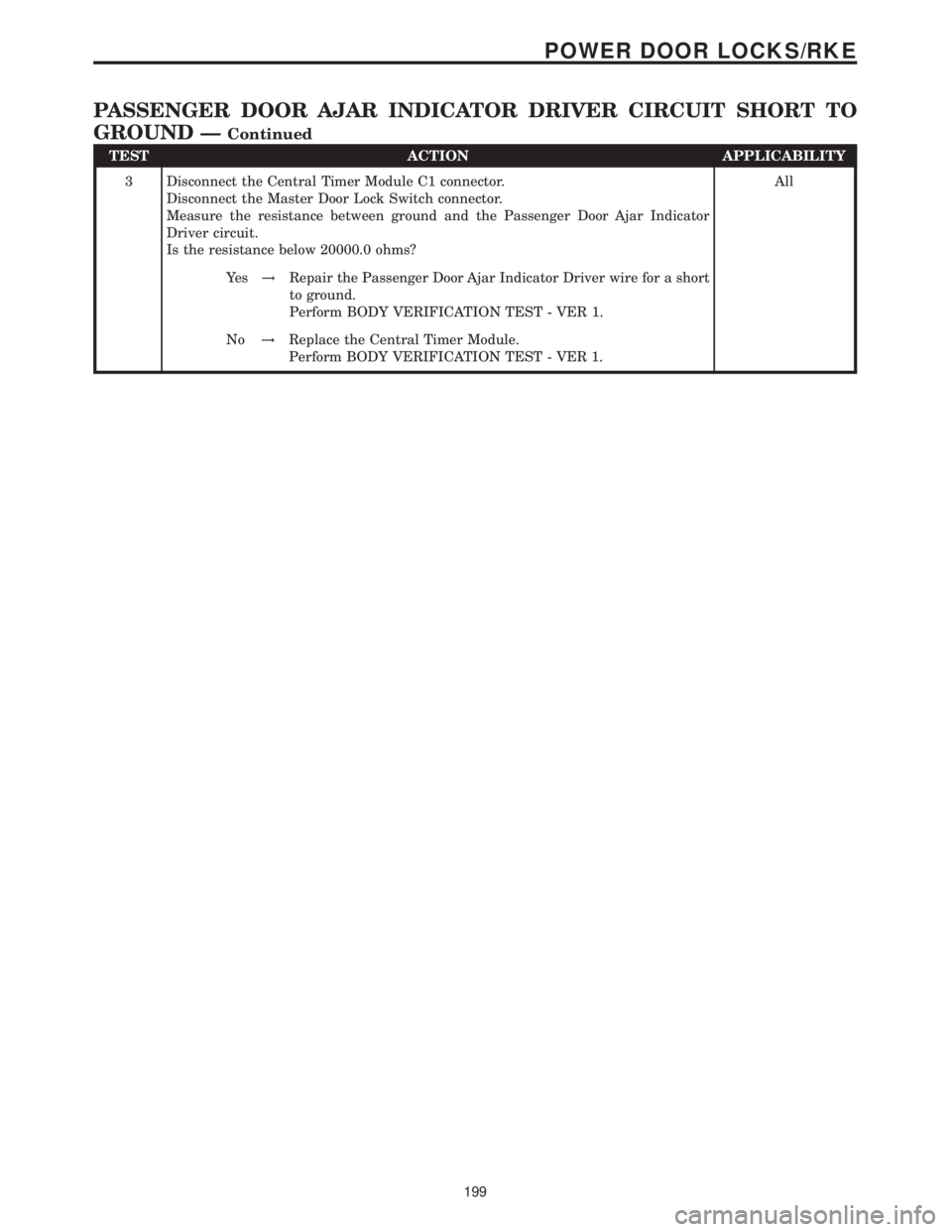
TEST ACTION APPLICABILITY
3 Disconnect the Central Timer Module C1 connector.
Disconnect the Master Door Lock Switch connector.
Measure the resistance between ground and the Passenger Door Ajar Indicator
Driver circuit.
Is the resistance below 20000.0 ohms?All
Ye s!Repair the Passenger Door Ajar Indicator Driver wire for a short
to ground.
Perform BODY VERIFICATION TEST - VER 1.
No!Replace the Central Timer Module.
Perform BODY VERIFICATION TEST - VER 1.
199
POWER DOOR LOCKS/RKE
PASSENGER DOOR AJAR INDICATOR DRIVER CIRCUIT SHORT TO
GROUND Ð
Continued
Page 213 of 2305
Symptom:
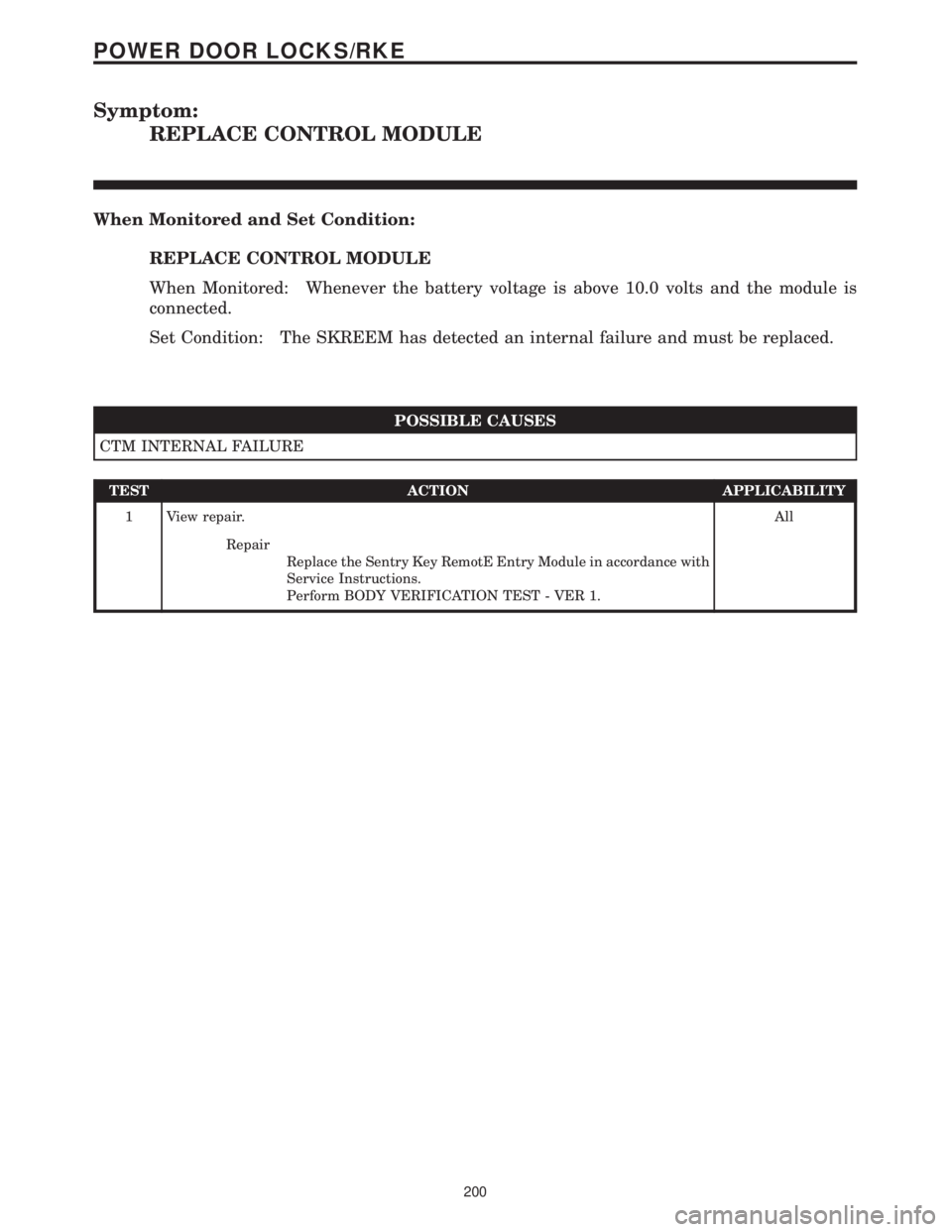
REPLACE CONTROL MODULE
When Monitored and Set Condition:
REPLACE CONTROL MODULE
When Monitored: Whenever the battery voltage is above 10.0 volts and the module is
connected.
Set Condition: The SKREEM has detected an internal failure and must be replaced.
POSSIBLE CAUSES
CTM INTERNAL FAILURE
TEST ACTION APPLICABILITY
1 View repair.All
Repair
Replace the Sentry Key RemotE Entry Module in accordance with
Service Instructions.
Perform BODY VERIFICATION TEST - VER 1.
200
POWER DOOR LOCKS/RKE