2006 MERCEDES-BENZ SPRINTER ABS
[x] Cancel search: ABSPage 761 of 2305

INSTALLATION
Fig. 4 SINGLE REAR WHEEL AXLE
1 - REAR SPRING 12 - WEAR INDICATOR CONNECTOR
2 - U-BRACKET 13 - BRAKE HOSE
3 - PLATE 14 - WHEEL BOLT
4 - NUT 15 - BOLT
5 - BRAKE CABLE 16 - NUT
6 - REAR AXLE 17 - PROPELLER SHAFT
7 - ABL LEVER 18 - BOLT
8 - NUT 19 - ABS SENSOR
9 - SHOCK ABSORBER 20 - SENSOR BUSHING
10 - BOLT 21 - VENT LINE
11 - WEAR INDICATOR CABLE
3 - 16 REAR AXLEVA
Page 762 of 2305

(1) Raise axle into position.
(2) Install plates and U-brackets (Fig. 4) and (Fig.
5) withnewnuts. Tighten nuts to 170 N´m (125 ft.
lbs.).
(3) Install propeller shaft and tighten bolts to 70
N´m (52 ft. lbs.).
NOTE: On installation of the propeller shaft, joint
arrows must be flush and must point towards the
frame floor. Tighten the propeller shaft in this posi-
tion.
(4) Install ALB lever to axle bracket and tighten
newnut 34 N´m (46 ft. lbs.).
(5) Install shock absorbers to rear axle and tighten
bolts to:
²M12 x 1.5 Bolt - 70 N´m (52 ft. lbs.)
²M14 x 1.5 Bolt - 110 N´m (81 ft. lbs.)
(6) Install stabilizer bar to axle and tighten bolts
to:
²SRW Axle - 25 N´m (18 ft. lbs.)²DRW Axle - 70 N´m (52 ft. lbs.)
(7) Install calipers with adapters and lines.
(8) Install brake hoses and hold-down clips.
(9) Install and adjust park brake cables.
(10) Install connection cable of brake pad wear
indicator and ABS sensor cable up to the relay unit
of the parking brake.
(11) Install cable ties to the park brake cables.
(12) Install ABS sensor and clamp bushing to
mounting bore.
NOTE: The right-hand ABS sensor cable is labeled
at the factory with a white tag.
(13) Attach connector cable for brake pad wear
indicator.
(14) Plug in cable of brake pad wear indicator.
(15) Install the wheels and tires.
(16) Fill axle with appropriate lubricant.
(17) Remove lifting device from under the axle.
(18) Remove support and lower vehicle.
Fig. 5 DUAL REAR WHEEL AXLE
1 - SPRING 12 - BRAKE HOSE
2 - SPRING SHACKLE 13 - LUG NUT
3 - PLATE 14 - NUT
4 - COLLAR NUT 15 - WASHER
5 - BRAKE CABLE 16 - BOLT
6 - REAR AXLE 17 - SHOCK ABSORBER
7 - ALB LEVER 18 - PROPELLER SHAFT
8 - NUT 19 - BOLT
9 - BOLT 20 - ABS SENSOR
10 - WEAR INDICATOR CABLE 21 - SENSOR BUSHING
11 - WEAR INDICATOR CONNECTOR
VAREAR AXLE 3 - 17
Page 768 of 2305

SHAFT - AXLE SINGLE REAR WHEEL
REMOVAL-SINGLE REAR WHEEL
(1) Remove wheels.
(2) Detach front brake cable.
(3) Pull ABS sensor (18) together with clamp bush-
ing (19) out of bearing cap (Fig. 6).
(4) Remove brake caliper (16) and disk (10) at rear
axle (14). Attach brake caliper with lines connected
in wheel house.
(5) Remove brake shoes (2) of parking brake.
(6) Remove brake control cable lock.
(7) Remove bearing cap bolts (17) and pull axle
shaft out of axle tube (1) (Fig. 6).
(8) Remove seal/gasket.
Fig. 6 AXLE SHAFT
1 - REAR AXLE 11 - BOLT
2 - BRAKE SHOE 12 - WHEEL BOLT
3 - PRESSURE SPRING 13 - BRAKE ADJUSTER
4 - RETURN SPRING 14 - REAR AXLE SHAFT
5 - RETURN SPRING 15 - GASKET
6 - CABLE LOCK 16 - BRAKE CABLE
7 - PARK BRAKE CABLE 17 - BOLT
8 - LOCKING PIN 18 - ABS SENSOR
9 - BOLT 19 - SENSOR BUSHING
10 - BRAKE DISC
VAREAR AXLE 3 - 23
Page 769 of 2305

INSTALLATION - SINGLE REAR WHEEL
(1) Install sealing ring.
(2) Install axle shaft (1) in the axle tube (2) (Fig.
7).
(3) Installnewbearing cap (2) bolts (1) and
tighten to 72 N´m (53 ft. lbs.) (Fig. 8).
NOTE: Tighten bolts diagonally across.
(4) Install brake control cable lock.
(5) Install parking brake shoes.
(6) Install brake disk and calipers.
(7) Coat clamping bush with acid-free grease.
Insert ABS sensor with clamping bush fully into the
mounting hole.
(8) Install front brake cable.(9) Operate brake pedal several times until brake
pads contact brake discs (brake pressure built up).
(10) Install wheels.
BEARING / SEAL - AXLE
REMOVAL
(1) Remove rear axle shaft.
(2) With a punch (2) and hammer straighten bear-
ing (4) nut (1) locking ring (3) (Fig. 9).
(3) Install two wheel mounting bolts into the axle
shaft (1) and clamp in vise. Loosen bearing (4) nut
(2) with Wrench 9279 (3) (Fig. 10).
Fig. 7 AXLE SHAFT AND TUBE
1 - AXLE SHAFT
2 - AXLE TUBE
3 - AXLE BEARINGS
4 - DUST SHIELD
Fig. 8 BEARING CAP BOLTS
1 - BEARING CAP BOLTS
2 - BEARING CAP
3 - AXLE SHAFT FLANGE
Fig. 9 LOCKING RING
1 - BEARING NUT
2 - PUNCH
3 - LOCKING RING
4 - BEARING
Fig. 10 BEARING NUT WRENCH
1 - AXLE SHAFT
2 - BEARING NUT
3 - WRENCH
4 - BEARING
3 - 24 REAR AXLEVA
Page 774 of 2305

(7) Pry out ABS sensor ring (1) and seal (2) from
hub (Fig. 23).
(8) Remove hub bearings (1) (3) from hub (2) (Fig.
24).
(9) Remove inner and outer bearing cups from hub
with a hammer and drift.
INSTALLATION
(1) Install hub bearing cups with Installer 9291
and a hammer.
(2) Clean and thoroughly grease bearings with
Multi-purpose grease.
(3) Install inner wheel bearing.
(4) Coat outer circumference ofnewseal (2) with
Hylomar SQ 32 M sealant.
CAUTION: Do not coat seals rubberized sealing sur-
faces with sealant.
(5) Install seal (2) into hub with an appropriate
installer.
NOTE: Seal ring should be flush with wheel hub or
max. 3mm (0.12 in.) deep.
(6) Coat contact surface of ABS sensor ring (1)
with Hylomar SQ 32 M sealant (Fig. 25).
(7) Drive ABS sensor ring (1) in as far as the stop
with a plastic hammer (Fig. 25).
(8) Install hub on axle tube.
Fig. 23 SENSOR RING & OIL SEAL
1 - ABS SENSOR RING
2 - SEAL
Fig. 24 AXLE HUB BEARINGS
1 - REAR BEARING
2 - HUB
3 - FRONT BEARING
4 - ROTOR
Fig. 25 SENSOR RING & OIL SEAL
1 - ABS SENSOR RING
2 - SEAL
VAREAR AXLE 3 - 29
Page 790 of 2305
BRAKES
TABLE OF CONTENTS
page page
BRAKES - BASE........................... 1BRAKES - ABS........................... 30
BRAKES - BASE
TABLE OF CONTENTS
page page
BRAKES - BASE
DIAGNOSIS AND TESTING - BASE BRAKE
SYSTEM.............................2
STANDARD PROCEDURE
STANDARD PROCEDURE - MANUAL
BLEEDING............................4
STANDARD PROCEDURE - PRESSURE
BLEEDING............................5
HYDRAULIC/MECHANICAL
SPECIFICATIONS
SPECIFICATIONS - TORQUE CHART.......5
BASE BRAKE.........................6
SPECIAL TOOLS
BRAKES.............................7
BRAKE LINES
STANDARD PROCEDURE
STANDARD PROCEDURE - ISO FLARING . . . 8
STANDARD PROCEDURE - DOUBLE
INVERTED FLARING....................8
BRAKE PADS/SHOES
REMOVAL
REMOVAL - FRONT (SRW)...............8
REMOVAL - FRONT (DRW)...............9
REMOVAL - REAR (16º WHEELS) (SRW)....9
REMOVAL - REAR (15º WHEELS) (SRW) . . . 10
REMOVAL - REAR (DRW)...............10
INSTALLATION
INSTALLATION - FRONT (SRW)...........11
INSTALLATION - FRONT (DRW)..........11
INSTALLATION - REAR (16º WHEELS)
(SRW) ..............................11
INSTALLATION - REAR (16º WHEELS)
(SRW) ..............................11
INSTALLATION - REAR (DRW)...........11
DISC BRAKE CALIPERS
REMOVAL
REMOVAL - FRONT (SRW)..............11
REMOVAL - FRONT (DRW)..............12
REMOVAL - REAR (SRW)...............12
REMOVAL - REAR (DRW)...............13INSTALLATION
INSTALLATION - FRONT (SRW)..........13
INSTALLATION - FRONT (DRW)..........13
INSTALLATION - REAR (SRW)...........14
INSTALLATION - REAR (DRW)...........14
DISC BRAKE CALIPER ADAPTER
REMOVAL
REMOVAL - FRONT....................14
REMOVAL - REAR.....................14
INSTALLATION
INSTALLATION - FRONT................14
INSTALLATION - REAR.................14
FLUID
DIAGNOSIS AND TESTING - BRAKE FLUID
CONTAMINATION.....................15
STANDARD PROCEDURE - BRAKE FLUID
LEVEL..............................15
SPECIFICATIONS
BRAKE FLUID........................15
FLUID RESERVOIR
REMOVAL.............................15
INSTALLATION.........................15
ALB LEVER
REMOVAL.............................16
INSTALLATION.........................16
ALB CONTROLLER
REMOVAL.............................16
INSTALLATION.........................16
ADJUSTMENTS
ADJUSTMENT........................16
MASTER CYLINDER
DIAGNOSIS AND TESTING - MASTER
CYLINDER/POWER BOOSTER...........17
STANDARD PROCEDURE - MASTER
CYLINDER BLEEDING..................18
REMOVAL.............................18
INSTALLATION.........................19
PEDAL
REMOVAL.............................19
INSTALLATION.........................19
VABRAKES 5 - 1
Page 792 of 2305
(3) During road test, make normal and firm brake
stops in 25-40 mph range. Note faulty brake opera-
tion such as low pedal, hard pedal, fade, pedal pulsa-
tion, pull, grab, drag, noise, etc.
(4) Attempt to stop the vehicle with the parking
brake only and note grab, drag, noise, etc.
PEDAL FALLS AWAY
A brake pedal that falls away under steady foot
pressure is generally the result of a system leak. The
leak point could be at a brake line, fitting, hose, or
caliper/wheel cylinder. If leakage is severe, fluid will
be evident at or around the leaking component.
Internal leakage (seal by-pass) in the master cylin-
der caused by worn or damaged piston cups, may
also be the problem cause.
An internal leak in the ABS or RWAL system may
also be the problem with no physical evidence.
LOW PEDAL
If a low pedal is experienced, pump the pedal sev-
eral times. If the pedal comes back up worn linings,
rotors, drums, or rear brakes out of adjustment are
the most likely causes. The proper course of action is
to inspect and replace all worn component and make
the proper adjustments.
SPONGY PEDAL
A spongy pedal is most often caused by air in the
system. However, thin brake drums or substandard
brake lines and hoses can also cause a spongy pedal.
The proper course of action is to bleed the system,
and replace thin drums and substandard quality
brake hoses if suspected.
HARD PEDAL OR HIGH PEDAL EFFORT
A hard pedal or high pedal effort may be due to
lining that is water soaked, contaminated, glazed, or
badly worn. The power booster or check valve could
also be faulty.
PEDAL PULSATION
Pedal pulsation is caused by components that are
loose, or beyond tolerance limits.
The primary cause of pulsation are disc brake
rotors with excessive lateral runout or thickness vari-
ation, or out of round brake drums. Other causes are
loose wheel bearings or calipers and worn, damaged
tires.
NOTE: Some pedal pulsation may be felt during
ABS activation.
BRAKE DRAG
Brake drag occurs when the lining is in constant
contact with the rotor or drum. Drag can occur at one
wheel, all wheels, fronts only, or rears only.Drag is a product of incomplete brake shoe release.
Drag can be minor or severe enough to overheat the
linings, rotors and drums.
Minor drag will usually cause slight surface char-
ring of the lining. It can also generate hard spots in
rotors and drums from the overheat-cool down pro-
cess. In most cases, the rotors, drums, wheels and
tires are quite warm to the touch after the vehicle is
stopped.
Severe drag can char the brake lining all the way
through. It can also distort and score rotors and
drums to the point of replacement. The wheels, tires
and brake components will be extremely hot. In
severe cases, the lining may generate smoke as it
chars from overheating.
Common causes of brake drag are:
²Seized or improperly adjusted parking brake
cables.
²Loose/worn wheel bearing.
²Seized caliper or wheel cylinder piston.
²Caliper binding on corroded bushings or rusted
slide surfaces.
²Loose caliper mounting.
²Drum brake shoes binding on worn/damaged
support plates.
²Mis-assembled components.
²Long booster output rod.
If brake drag occurs at all wheels, the problem
may be related to a blocked master cylinder return
port, or faulty power booster (binds-does not release).
BRAKE FADE
Brake fade is usually a product of overheating
caused by brake drag. However, brake overheating
and resulting fade can also be caused by riding the
brake pedal, making repeated high deceleration stops
in a short time span, or constant braking on steep
mountain roads. Refer to the Brake Drag information
in this section for causes.
BRAKE PULL
Front brake pull condition could result from:
²Contaminated lining in one caliper
²Seized caliper piston
²Binding caliper
²Loose caliper
²Rusty caliper slide surfaces
²Improper brake pads
²Damaged rotor
A worn, damaged wheel bearing or suspension
component are further causes of pull. A damaged
front tire (bruised, ply separation) can also cause
pull.
A common and frequently misdiagnosed pull condi-
tion is where direction of pull changes after a few
stops. The cause is a combination of brake drag fol-
lowed by fade at one of the brake units.
VABRAKES - BASE 5 - 3
Page 804 of 2305
FLUID
DIAGNOSIS AND TESTING - BRAKE FLUID
CONTAMINATION
Indications of fluid contamination are swollen or
deteriorated rubber parts.
Swollen rubber parts indicate the presence of
petroleum in the brake fluid.
To test for contamination, put a small amount of
drained brake fluid in clear glass jar. If fluid sepa-
rates into layers, there is mineral oil or other fluid
contamination of the brake fluid.
If brake fluid is contaminated, drain and thor-
oughly flush system. Replace master cylinder, ALB
Controller, caliper seals, Antilock Brakes hydraulic
unit and all hydraulic fluid hoses.
STANDARD PROCEDURE - BRAKE FLUID
LEVEL
Always clean the master cylinder reservoir and
caps before checking fluid level. If not cleaned, dirt
could enter the fluid.
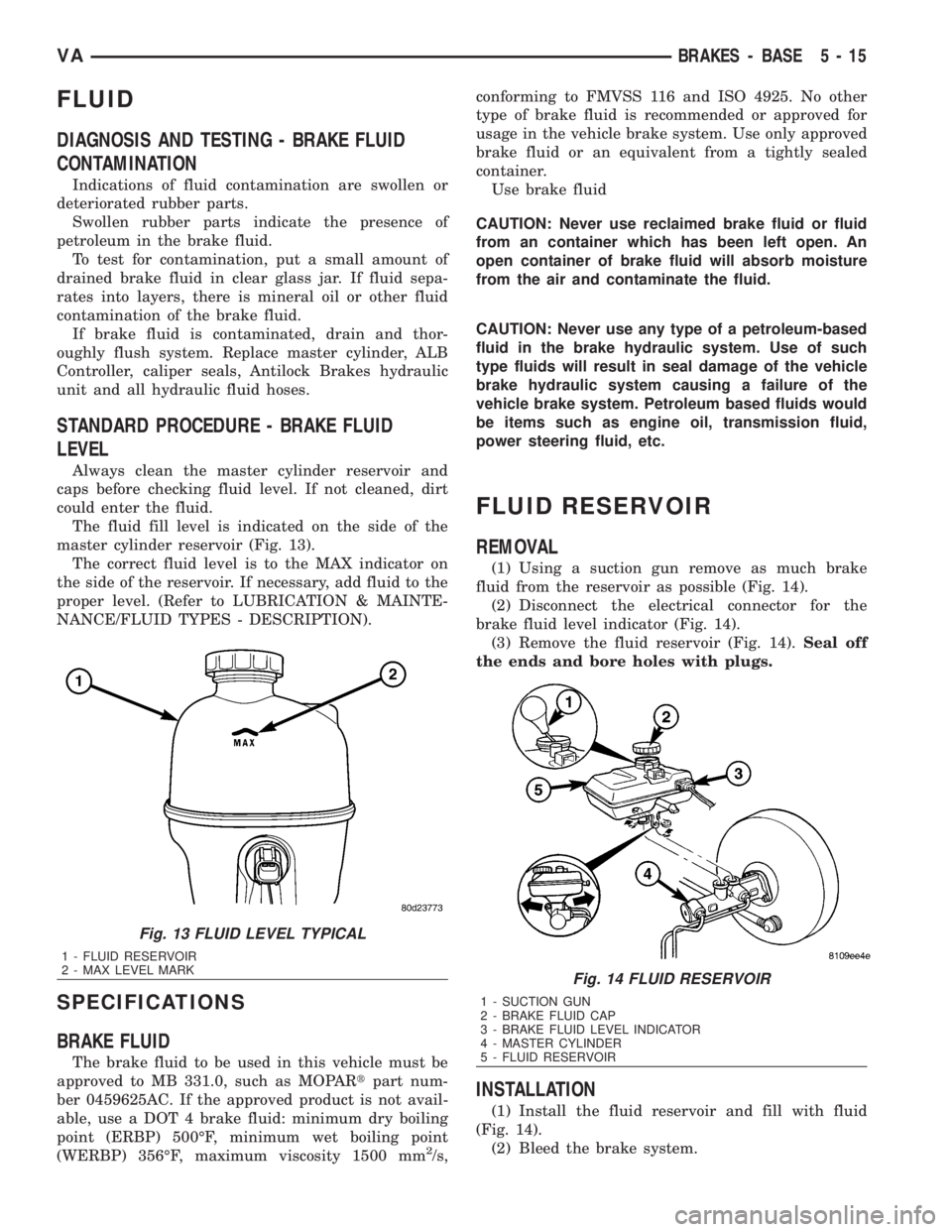
The fluid fill level is indicated on the side of the
master cylinder reservoir (Fig. 13).
The correct fluid level is to the MAX indicator on
the side of the reservoir. If necessary, add fluid to the
proper level. (Refer to LUBRICATION & MAINTE-
NANCE/FLUID TYPES - DESCRIPTION).
SPECIFICATIONS
BRAKE FLUID
The brake fluid to be used in this vehicle must be
approved to MB 331.0, such as MOPARtpart num-
ber 0459625AC. If the approved product is not avail-
able, use a DOT 4 brake fluid: minimum dry boiling
point (ERBP) 500ÉF, minimum wet boiling point
(WERBP) 356ÉF, maximum viscosity 1500 mm
2/s,conforming to FMVSS 116 and ISO 4925. No other
type of brake fluid is recommended or approved for
usage in the vehicle brake system. Use only approved
brake fluid or an equivalent from a tightly sealed
container.
Use brake fluid
CAUTION: Never use reclaimed brake fluid or fluid
from an container which has been left open. An
open container of brake fluid will absorb moisture
from the air and contaminate the fluid.
CAUTION: Never use any type of a petroleum-based
fluid in the brake hydraulic system. Use of such
type fluids will result in seal damage of the vehicle
brake hydraulic system causing a failure of the
vehicle brake system. Petroleum based fluids would
be items such as engine oil, transmission fluid,
power steering fluid, etc.
FLUID RESERVOIR
REMOVAL
(1) Using a suction gun remove as much brake
fluid from the reservoir as possible (Fig. 14).
(2) Disconnect the electrical connector for the
brake fluid level indicator (Fig. 14).
(3) Remove the fluid reservoir (Fig. 14).Seal off
the ends and bore holes with plugs.
INSTALLATION
(1) Install the fluid reservoir and fill with fluid
(Fig. 14).
(2) Bleed the brake system.
Fig. 13 FLUID LEVEL TYPICAL
1 - FLUID RESERVOIR
2 - MAX LEVEL MARK
Fig. 14 FLUID RESERVOIR
1 - SUCTION GUN
2 - BRAKE FLUID CAP
3 - BRAKE FLUID LEVEL INDICATOR
4 - MASTER CYLINDER
5 - FLUID RESERVOIR
VABRAKES - BASE 5 - 15