2006 KIA Sorento wheel
[x] Cancel search: wheelPage 124 of 312

For Safe Four-Wheel Drive
Operation
Your vehicle allows you to drive in
on-road and off-road conditions.
However, do not try to drive in deep
standing water, mud, or over steep
hills.
When you are driving up or down
hills, drive as close to straight up
and down the hills as possible. Use
extreme caution in going up or
down steep hills, since you can flip
your vehicle over depending on the
grade, terrain and water/mud con-
ditions.DRIVING YOUR VEHICLE4-26
WARNING
- Four-Wheel
Driving
The conditions on-road or off-
road that demand four-wheel
drive mean all functions of your
vehicle are exposed to more
extreme stress than under high-
way conditions. Slow down,
look ahead, and be ready for
sudden changes in the compo-
sition and traction of the sur-
face under your tires. If you
have any doubt about the safety
of the conditions you are fac-
ing, stop and consider the best
way to proceed. Do not exceed
the ability of yourself or your
vehicle to operate safely.
WARNING
- Steep Hills
Driving across the contour of
steep hills can be extremely
dangerous. This danger can
come from slight changes in the
hill angle which can destabilize
the vehicle. Even if the vehicle
is maintaining stability under
power, it can lose that stability if
the vehicle stops its forward
motion. Your vehicle may roll
over without warning and with-
out time for you to correct a
mistake that could cause seri-
ous injury or death.
HILL1/HILL2 Approach Hill Straight
Up/DownDo not Approach at
Angle
BL-ENG (CAN)-4.qxd 7/28/05 5:55 PM Page 26
Page 125 of 312

You must learn how to corner in a
4WD vehicle as soon as possible.
Do not rely on your experience in
conventional 2WD vehicles in
choosing a safe cornering speed.
You must drive more slowly.
Drive off-road carefully because
your vehicle may be damaged by
rocks or roots of trees. Become
familiar with the off-road conditions
you are going to drive before you
start.
Always hold the steering wheel
firmly when you are driving off-
road.
Make sure all passengers are
wearing seat belts.If you need to drive in water, stop
your vehicle, set your transfer lever
to “4LO’’or “LOW”and drive at less
than 5 mph (8 km/h).
DRIVING YOUR VEHICLE
4-27
WARNING
- Turning
Corners
Reduce speed when you turn
corners. The center of gravity of
4WD vehicles is raised higher
than that of conventional 2WD
vehicles, making them more
likely to roll over when you turn
corners too fast.
WARNING
Do not grab inside of the steer-
ing wheel when you are driving
off-road. Your arm may be hurt
by a sudden steering maneuver
or from steering wheel rebound
due to impact with objects on
the ground. You could lose con-
trol of the steering wheel.
WARNING
If you are driving in heavy wind,
the vehicle’s higher center of
gravity decreases your steering
control. Drive more slowly than
you would in calm conditions.
SRSAIRBAG
R
E
S
A
C
C
E
LC
O
A
S
T
S
E
T
PWRSEEK
CANCEL
S2BLC499
BL-ENG (CAN)-4.qxd 7/28/05 5:55 PM Page 27
Page 126 of 312

Do not drive in water if the level is
higher than the bottom of the wheel
hubs.
Check your brake condition once
you are out of mud or water. Press
the brake pedal several times as
you move slowly until you feel nor-
mal braking forces return.
Shorten your scheduled mainte-
nance interval if you drive off-road in
conditions such as sand, mud or
water (see “Scheduled Maintenance’’
in the Index). Always wash your car
thoroughly.
The full time four wheel drive vehi-
cle cannot be towed by an ordinari-
ly tow truck. Make sure that the
vehicle is towed with its four wheels
raised off the ground.Since the driving torque is always
applied to the 4 wheels the perform-
ance of the 4WD vehicle is greatly
affected by the condition of the tires.
Be sure to equip them with all four
tires with same size and type.DRIVING YOUR VEHICLE4-28
CAUTION
While the full-time 4WD vehicle
is being raised on a jack, never
start the engine or cause the
tires to rotate.
There is the danger that rotating
tires touching the ground could
cause the vehicle to go off the
jack and to jump forward.
If one of the front or rear wheels
begins to spin in mud, snow,
etc. the vehicle can sometimes
be driven out by depressing the
accelerator pedal further; how-
ever avoid running the engine
continuously at high rpm
because doing so could dam-
age the 4WD system.
WARNING
-Driving Through Water
If you are driving too fast in
water, the water spray can get
into the engine compartment
and wet the ignition system,
causing your vehicle to sudden-
ly stop. If this happens and your
vehicle is in a tilted position,
your vehicle may roll over.
WARNING
Your vehicle is equipped with
tires designed to provide for safe
ride and handling capability. Do
not use a size and type of tire
and wheel that is different from
the one that is originally
installed on your vehicle. It can
affect the safety and perform-
ance of your vehicle, which
could lead to handling failure or
rollover and serious injury.
When replacing the tires, be
sure to equip all four tires with
the tire and wheel of the same
size, type, tread, brand and
load-carrying capacity. If you
nevertheless decide to equip
your vehicle with any tire/wheel
combination not recommended
by Kia for off road driving, you
should not use these tires for
highway driving.
BL-ENG (CAN)-4.qxd 7/28/05 5:55 PM Page 28
Page 127 of 312
DRIVING YOUR VEHICLE
4-29
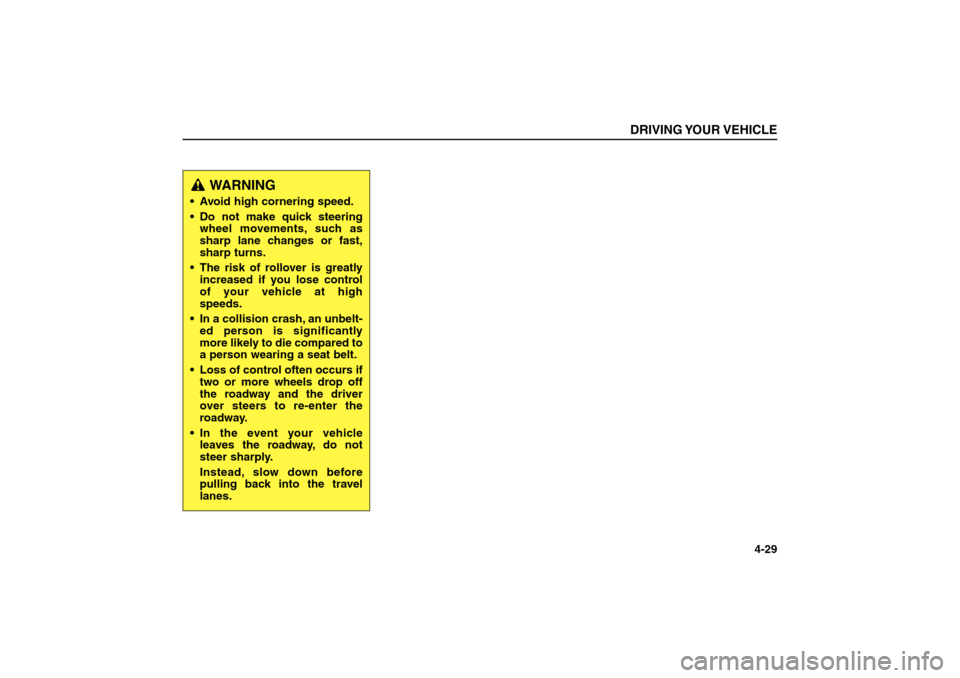
WARNING
Avoid high cornering speed.
Do not make quick steering
wheel movements, such as
sharp lane changes or fast,
sharp turns.
The risk of rollover is greatly
increased if you lose control
of your vehicle at high
speeds.
In a collision crash, an unbelt-
ed person is significantly
more likely to die compared to
a person wearing a seat belt.
Loss of control often occurs if
two or more wheels drop off
the roadway and the driver
over steers to re-enter the
roadway.
In the event your vehicle
leaves the roadway, do not
steer sharply.
Instead, slow down before
pulling back into the travel
lanes.
BL-ENG (CAN)-4.qxd 7/28/05 5:55 PM Page 29
Page 128 of 312

LIMITED SLIP DIFFERENTIAL
(IF EQUIPPED) A limited slip differential if equipped,
is for the rear wheel differential only.
The features of this limited slip differ-
ential are described below;
Just as with conventional differential,
the wheel on one side is allowed to
turn at a different speed from the
wheel on the other side when the
vehicle is cornering.
The difference between the limited
slip differential and a conventional
differential is that if the wheel on one
side of the vehicle loses traction, a
greater amount of torque is applied to
the rear wheel on the other side to
improve traction.
BRAKE SYSTEMPower Brakes
Your vehicle has power-assisted
brakes that adjust automatically
through normal usage.
In the event that the power-assisted
brakes lose power because of a
stalled engine or some other reason,
you can still stop your vehicle by
applying greater force to the brake
pedal than you normally would. The
stopping distance, however, will be
longer. Refer to the scheduled main-
tenance guide for scheduled mainte-
nance intervals.
When the engine is not running, the
reserve brake power is partially
depleted each time the brake pedal is
applied. Do not pump the brake pedal
when the power assist has been
interrupted. Pump the brake pedal
only when necessary to maintain
steering control on slippery surfaces.
DRIVING YOUR VEHICLE4-30
WARNING
To avoid injury, never run the
engine with one wheel off the
ground, such as when changing
a tire.
BL-ENG (CAN)-4.qxd 7/28/05 5:55 PM Page 30
Page 132 of 312
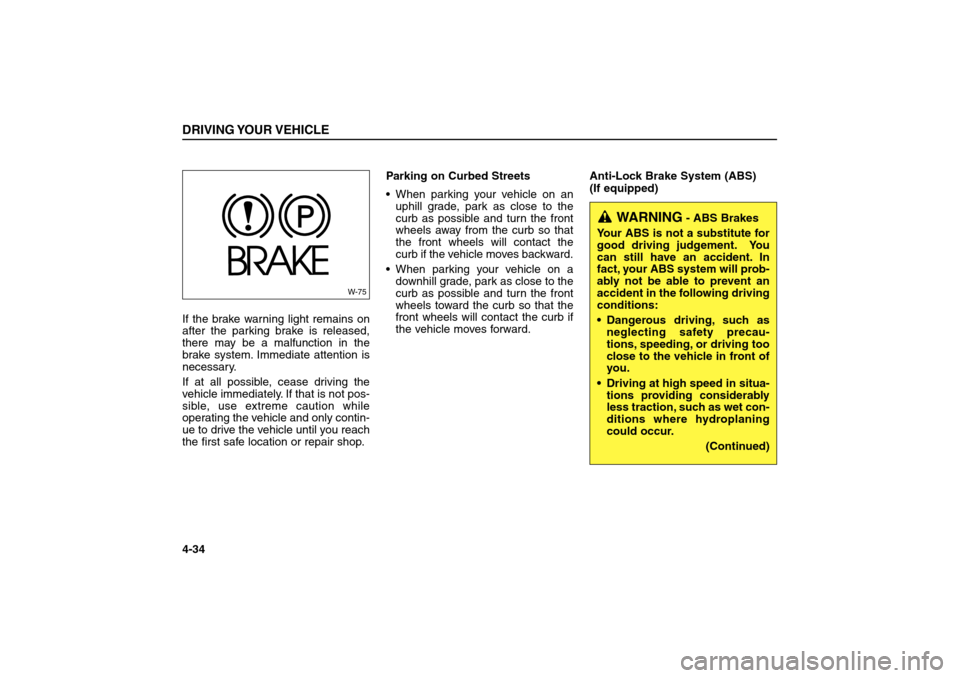
If the brake warning light remains on
after the parking brake is released,
there may be a malfunction in the
brake system. Immediate attention is
necessary.
If at all possible, cease driving the
vehicle immediately. If that is not pos-
sible, use extreme caution while
operating the vehicle and only contin-
ue to drive the vehicle until you reach
the first safe location or repair shop.Parking on Curbed Streets
When parking your vehicle on an
uphill grade, park as close to the
curb as possible and turn the front
wheels away from the curb so that
the front wheels will contact the
curb if the vehicle moves backward.
When parking your vehicle on a
downhill grade, park as close to the
curb as possible and turn the front
wheels toward the curb so that the
front wheels will contact the curb if
the vehicle moves forward.Anti-Lock Brake System (ABS)
(If equipped)DRIVING YOUR VEHICLE4-34
WARNING
- ABS Brakes
Your ABS is not a substitute for
good driving judgement. You
can still have an accident. In
fact, your ABS system will prob-
ably not be able to prevent an
accident in the following driving
conditions:
Dangerous driving, such as
neglecting safety precau-
tions, speeding, or driving too
close to the vehicle in front of
you.
Driving at high speed in situa-
tions providing considerably
less traction, such as wet con-
ditions where hydroplaning
could occur.
(Continued)
W-75
BL-ENG (CAN)-4.qxd 7/28/05 5:55 PM Page 34
Page 133 of 312

The ABS system continuously sens-
es the speed of the wheels. If the
wheels are going to lock, the ABS
system repeatedly modulates the
hydraulic brake pressure to the
wheels.
When you apply your brakes under
conditions which may lock the
wheels, you may hear a “tik-tik’’
sound from the brakes, or feel a cor-
responding sensation in the brake
pedal. This is normal and it means
your ABS system is active.
In order to obtain the maximum ben-
efit from your ABS system in an
emergency situation, do not attempt
to modulate your brake pressure and
do not try to pump your brakes. Press
your brake pedal as hard as possible
or as hard as the situation warrants
and allow the ABS system to control
the force being delivered to the rear
brakes.Even with the anti-lock brake sys-
tem, your vehicle still requires suffi-
cient stopping distance. Always
maintain a safe distance from the
vehicle in front of you.
Always slow down when cornering.
The anti-lock brake system cannot
prevent accidents resulting from
excessive speeds.
On loose or uneven road surfaces,
operation of the anti-lock brake sys-
tem may result in a longer stopping
distance than for vehicles equipped
with a conventional brake system.
DRIVING YOUR VEHICLE
4-35
ABS
W-78
(Continued)
Driving too fast on poor road
surfaces. The ABS is
designed to improve maxi-
mum braking effectiveness on
typical highways and roads in
good condition. On poor road
surfaces in poor condition,
the ABS may actually reduce
braking effectiveness.
BL-ENG (CAN)-4.qxd 7/28/05 5:55 PM Page 35
Page 135 of 312

POWER STEERINGPower steering uses energy from the
engine to assist you in steering the
vehicle. If the engine is off or if the
power steering system becomes
inoperative, the vehicle may still be
steered, but it will require increased
steering effort.
Should you notice any change in the
effort required to steer during normal
vehicle operation, have the power
steering system checked by an
authorized Kia dealer.
DRIVING YOUR VEHICLE
4-37
✽ ✽
NOTICEIf the vehicle is parked for extended
periods outside in cold weather
(below-10°C (14°F)), the power
steering may require increased
effort when the engine is first start-
ed. This is caused by increased fluid
viscosity due to the cold weather
and does not indicate a malfunc-
tion.
When this happens, increase the
engine RPM to 1500rpm then
release or let the engine idle for two
or three minutes to warm up the
fluid.
✽ ✽
NOTICE Never hold the steering wheel
against a stop (extreme right or
left turn) for more than five sec-
onds with the engine running.
Holding the steering wheel for
more than five seconds in either
position may cause damage to the
power steering pump.
If the power steering drive belt
breaks or if the power steering
pump malfunctions, the steering
effort will greatly increase.
BL-ENG (CAN)-4.qxd 7/28/05 5:55 PM Page 37