2006 KIA Sorento wheel
[x] Cancel search: wheelPage 136 of 312

CRUISE CONTROLThe cruise control system allows you
to program the vehicle to maintain a
constant speed without resting your
foot on the accelerator pedal.
With cruise control, you can set and
automatically maintain any speed of
more than about 24 mph (40km/h).
To Set Cruise Control Speed:
1. Push the CRUISE switch, located
on the left side of the steering col-
umn, to the ON position.
2. Accelerate to the desired speed,
which must be more than 24 mph
(40 km/h).3. Depress the COAST/SET switch,
located on the steering wheel, and
release it at the speed you want.
Release the accelerator at the
same time. The desired speed will
automatically be maintained and
the CRUISE light on your instru-
ment cluster will illuminate.
The SET function cannot be activated
until approximately 2 seconds after
the CRUISE MAIN switch has been
engaged.
On a steep grade, the vehicle may
momentarily slow down while going
downhill.DRIVING YOUR VEHICLE4-38
SRSAIRBAG
R
E
S
A
C
C
E
LCOAST
SET
P
W
RSEEK
C
A
N
C
E
L
S2BLA421
LOWAUTOCRUiSE
S2BLA420
WARNING- Cruise Control
Do not use the cruise control
feature under the following con-
ditions:
Heavy or unsteady traffic
Slippery or winding roads
Situations that involve vary-
ing speeds
WARNING
If the CRUISE MAIN switch is
left on, the cruise control can be
switched on accidentally. Keep
the CRUISE MAIN switch off
when cruise control is not in
use.
BL-ENG (CAN)-4.qxd 7/28/05 5:55 PM Page 38
Page 137 of 312

To Cancel Cruise Control, do one
of the following:
Depress the brake pedal.
Depress the clutch pedal with a
manual transmission, or shift into N
(Neutral) with an automatic trans-
mission.
Depress the CANCEL switch locat-
ed on the steering wheel.
Depress the COAST/SET and
RES/ACCEL switches at the same
time.
Each of these actions will cancel
cruise control operation, but it will not
turn the system off. If you wish to
resume cruise control operation,
depress the RES/ACCEL switch
located on your steering wheel. You
will return to your previously preset
speed.To turn cruise control off, do one
of the following:
Push the CRUISE switch to the
OFF position.
Turn the ignition off.
Both of these actions also cancel
cruise control operation. If you want
to resume cruise control operation,
repeat the steps provided in “To Set
Cruise Control Speed” on the previ-
ous page.
To Increase Cruise Control Set
Speed:
Follow either of these procedures:
Depress the RES/ACCEL switch
and hold it. Your vehicle will accel-
erate. Release the switch at the
speed you want.
Depress the RES/ACCEL switch
and release it immediately. The
cruising speed will increase 1mph
(1.6 km/h) by one touch and will be
memorized to the reset speed.
DRIVING YOUR VEHICLE
4-39
SRSAIRBAG
R
E
S
A
C
C
E
LCOAST
SET
P
W
RSEEK
C
A
N
C
E
L
S2BLA422A
BL-ENG (CAN)-4.qxd 7/28/05 5:55 PM Page 39
Page 188 of 312

5-1
DRIVING TIPSFuel Requirements . . . . . . . . . . . . . . . . . . . . . . . . . . . . . . . . . 5-2
Emission Control System . . . . . . . . . . . . . . . . . . . . . . . . . . . 5-3
Tips on Driving Your Vehicle . . . . . . . . . . . . . . . . . . . . . . . . . 5-5
Suggestions for Economical Operation . . . . . . . . . . . . . . . . 5-6
Special Driving Conditions . . . . . . . . . . . . . . . . . . . . . . . . . . 5-8
Using Four-Wheel Drive . . . . . . . . . . . . . . . . . . . . . . . . . . . . 5-14
Weight of the Vehicle - with and without a Trailer . . . . . . . .5-32
Trailer Towing . . . . . . . . . . . . . . . . . . . . . . . . . . . . . . . . . . . . 5-34
Overloading . . . . . . . . . . . . . . . . . . . . . . . . . . . . . . . . . . . . . 5-43
Label Information . . . . . . . . . . . . . . . . . . . . . . . . . . . . . . . . . 5-43
5
BL-ENG (CAN)-5.qxd 7/28/05 5:56 PM Page 1
Page 191 of 312
Operating Precautions for
Catalytic Converters
Your vehicle is equipped with a cat-
alytic converter emission control
device.
Therefore, the following precautions
must be observed:
Use only UNLEADED FUEL.
Do not operate the vehicle when
there are signs of engine malfunc-
tion, such as misfire or a noticeable
loss of performance.
Do not misuse or abuse the engine.
Examples of misuse are coasting
with the ignition off and descending
steep grades in gear with the igni-
tion off. Do not operate the engine at high
idle speed for extended periods (5
minutes or more).
Do not modify or tamper with any
part of the engine or emission con-
trol system. All inspections and
adjustments must be made by a
qualified technician.
Failure to observe these precautions
could result in damage to the catalyt-
ic converter and to your vehicle.
Additionally, such actions could void
your warranties.DRIVING TIPS5-4
WARNING
Your Full-time Four-Wheel Drive
vehicle must never be tested on
a two-wheel dynamometer.
Serious transmission damage
and uncontrolled vehicle move-
ment could result.
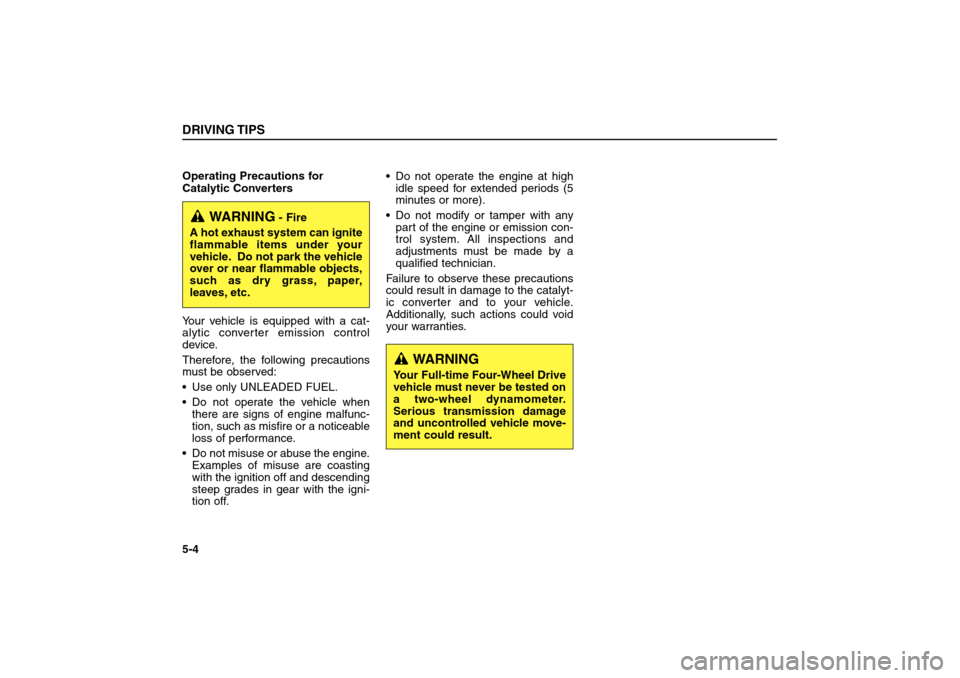
WARNING
- Fire
A hot exhaust system can ignite
flammable items under your
vehicle. Do not park the vehicle
over or near flammable objects,
such as dry grass, paper,
leaves, etc.
BL-ENG (CAN)-5.qxd 7/28/05 5:56 PM Page 4
Page 193 of 312

SUGGESTIONS FOR
ECONOMICAL OPERATIONYour vehicle’s fuel economy depends
mainly on your style of driving, where
you drive and when you drive.
Each of these factors affects how
many miles (kilometers) you can get
from a gallon (liter) of fuel. To operate
your vehicle as economically as pos-
sible, use the following driving sug-
gestions to help save money in both
fuel and repairs:
Avoid lengthy warm-up idling. Once
the engine is running smoothly,
begin driving. Remember, engine
warm-up may take a little longer on
cold days.
Save fuel by accelerating slowly
after stopping.
Keep the engine in tune and follow
the recommended periodic mainte-
nance schedule. This will increase
the life of all parts and lower your
operating costs. Do not use the air conditioner
unnecessarily.
Slow down when driving on rough
roads.
For longer tire life and better fuel
economy, always keep the tires
inflated to the recommended pres-
sures.
Maintain a safe distance from other
vehicles to avoid sudden stops.
This will reduce wear on brake lin-
ings and pads. Driving in such a
way will also save fuel because
extra fuel is required to accelerate
back to driving speed.
Do not carry unnecessary weight in
the vehicle.
Do not rest your foot on the brake
pedal while driving. This can cause
needless wear, possible damage to
the brakes, and poor fuel economy. Improper wheel alignment results
in faster tire wear and lower fuel
economy.
Open windows at high speeds can
reduce fuel economy.
Fuel economy is less in crosswinds
and headwinds. To help offset
some of this loss, slow down when
driving in these conditions.
Keeping a vehicle in good operating
condition is important both for econo-
my and safety. Therefore, have an
authorized Kia dealer perform sched-
uled inspections and maintenance.DRIVING TIPS5-6
BL-ENG (CAN)-5.qxd 7/28/05 5:56 PM Page 6
Page 195 of 312

SPECIAL DRIVING
CONDITIONSHazardous Driving Conditions
When hazardous driving conditions
are encountered such as water,
snow, ice, mud, sand, or similar haz-
ards, follow these suggestions:
Drive cautiously and allow extra
distance for braking.
Avoid sudden movements in brak-
ing or steering.
When braking in the four-wheel
drive mode (if equipped), pump the
brake pedal with a light up-and-
down motion until the vehicle is
stopped. If stalled in snow, mud, or sand, use
second gear or shift the transfer
case (if equipped) into four-wheel
drive. Accelerate slowly to avoid
spinning the drive wheels.
Use sand, rock salt, tire chains, or
other non-slip material under the
drive wheels to provide traction
when stalled in ice, snow, or mud.
(If equipped, refer to “Using Four-
Wheel Drive.’’)DRIVING TIPS5-8✽ ✽
NOTICEDo not pump the brake pedal on
ABS equipped vehicle.
WARNING
- Downshifting
On slippery surfaces, down-
shifting can cause an accident.
The sudden change in tire
speed could cause the tires to
skid. Be careful when down-
shifting on slippery surfaces.
Try to drive slowly enough so
you won’t have to make any
sudden changes in gear or vehi-
cle speed.
BL-ENG (CAN)-5.qxd 7/28/05 5:56 PM Page 8
Page 196 of 312

Rocking the Vehicle
If it is necessary to rock the vehicle to
free it from snow, sand, or mud, first
turn the steering wheel right and left
to clear the area around your front
wheels. Then, shift back and forth
between 1 (First) and R (Reverse) in
vehicles equipped with a manual
transmission or R (Reverse) and any
forward gear in vehicles equipped
with an automatic transmission. Do
not race the engine, and spin the
wheels as little as possible. If you are
still stuck after a few tries, have the
vehicle pulled out by a tow vehicle to
avoid engine overheating and possi-
ble damage to the transmission,
transfer case (if equipped), or differ-
ential.Driving at Night
Because night driving presents many
more hazards than driving in the day-
light, here are some important tips to
remember:
Slow down and keep more distance
between you and other vehicles, as
it may be more difficult to see at
night, especially in areas where
there may not be any street lights.
Adjust your mirrors to reduce the
glare from other driver’s headlights.
Keep your headlights clean and
properly aimed. Dirty or improperly
aimed headlights will make it much
more difficult to see at night.
Avoid staring directly at the head-
lights of oncoming vehicles. You
could be temporarily blinded, and it
will take several seconds for your
eyes to readjust to the darkness.
DRIVING TIPS
5-9
✽ ✽
NOTICEProlonged rocking may cause
engine over-heating, transmission
or transfer case (if equipped) dam-
age or failure, and tire damage.
WARNING- Spinning Tires
Do not spin the wheels, espe-
cially at speeds more than 35
mph (56 km/h). Spinning the
wheels at high speeds when the
vehicle is stationary could
cause a tire to overheat,
explode and injure bystanders.
BL-ENG (CAN)-5.qxd 7/28/05 5:56 PM Page 9
Page 198 of 312

Use antifreeze-formulated wind-
shield washer fluid. (Do not use
engine coolant antifreeze.)
Do not use the parking brake if it
might freeze. When parking, shift to
1 (First) or R (Reverse) with a man-
ual transmission or P (Park) with an
automatic transmission, and block
the rear wheels.Snow Tires
If you mount snow tires on your Kia,
make sure they are radial tires of the
same size and load range as the orig-
inal tires. Mount snow tires on all four
wheels to balance your vehicle’s han-
dling in all weather conditions. Keep
in mind that the traction provided by
snow tires on dry roads may not be
as high as your vehicle’s original
equipment tires. You should drive
cautiously even when the roads are
clear. Check with the tire dealer for
maximum speed recommendations.Do not install studded tires without
first checking local, provincial and
municipal regulations for possible
restrictions against their use.
DRIVING TIPS
5-11
WARNING- Snow Tire Size
Snow tires should be equivalent
in size and type to the vehicle’s
standard tires. Otherwise, the
safety and handling of your
vehicle may be adversely affect-
ed.
BL-ENG (CAN)-5.qxd 7/28/05 5:56 PM Page 11