2006 KIA Sorento wheel
[x] Cancel search: wheelPage 199 of 312

Driving in Flooded Areas
Avoid driving through flooded areas
unless you are sure the water is no
higher than the bottom of the wheel
hub. Drive through any water slowly.
Allow adequate stopping distance
because brake performance may be
affected.
After driving through water, dry the
brakes by gently applying them sev-
eral times while the vehicle is moving
slowly.Reducing the Risk of a Rollover
This multi-purpose passenger vehicle
is defined as a Sports Utility Vehicle
(SUV). SUV’s have higher ground
clearance and a narrower track to
make them capable of performing in
a wide variety of off-road applica-
tions. Specific design characteristics
give them a higher center of gravity
than ordinary cars. An advantage of
the higher ground clearance is a bet-
ter view of the road, which allows you
to anticipate problems. They are not
designed for cornering at the same
speeds as conventional passenger
drive vehicles, any more than low-rid-
ing sports cars are designed to per-
form satisfactorily in off-road condi-
tions. Due to this risk, driver and pas-
sengers are strongly recommended
to buckle their seatbelts.In a rollover crash, an unbelted per-
son is more likely to die than a person
wearing a seatbelt. There are steps
that a driver can make to reduce the
risk of a rollover. If at all possible,
avoid sharp turns or abrupt maneu-
vers, do not load your roof rack with
heavy cargo, and never modify your
vehicle in any way.DRIVING TIPS5-12
BL-ENG (CAN)-5.qxd 7/28/05 5:56 PM Page 12
Page 200 of 312
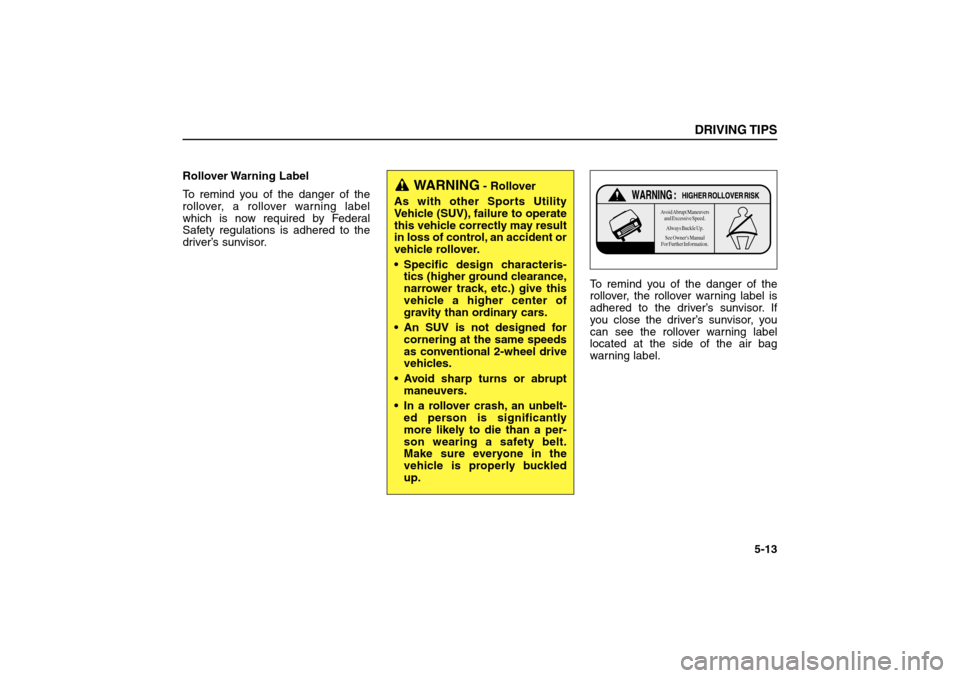
Rollover Warning Label
To remind you of the danger of the
rollover, a rollover warning label
which is now required by Federal
Safety regulations is adhered to the
driver’s sunvisor.
To remind you of the danger of the
rollover, the rollover warning label is
adhered to the driver’s sunvisor. If
you close the driver’s sunvisor, you
can see the rollover warning label
located at the side of the air bag
warning label.
DRIVING TIPS
5-13
Avoid Abrupt Maneuvers
and Excessive Speed.
Always Buckle Up.
See Owner's Manual
For Further Information.
WARNING
- Rollover
As with other Sports Utility
Vehicle (SUV), failure to operate
this vehicle correctly may result
in loss of control, an accident or
vehicle rollover.
Specific design characteris-
tics (higher ground clearance,
narrower track, etc.) give this
vehicle a higher center of
gravity than ordinary cars.
An SUV is not designed for
cornering at the same speeds
as conventional 2-wheel drive
vehicles.
Avoid sharp turns or abrupt
maneuvers.
In a rollover crash, an unbelt-
ed person is significantly
more likely to die than a per-
son wearing a safety belt.
Make sure everyone in the
vehicle is properly buckled
up.
BL-ENG (CAN)-5.qxd 7/28/05 5:56 PM Page 13
Page 201 of 312

USING FOUR-WHEEL DRIVEDriving on Snow- or Ice-Covered
Roads (“4HI, 4LO” for Part-time
4WD Operation or “AUTO” for
Full-time 4WD Operation)
Use snow tires. See “Tires” in this
section for more information.
Keep an adequate distance
between yourself and other vehi-
cles.
Avoid sudden braking, acceleration
or steering. These actions can
cause your vehicle to lose traction.Driving in Sand or Mud (“4HI,
4LO” for Part-time 4WD Operation
or “AUTO” for Full-time 4WD
Operation)
Avoid sudden braking, acceleration
or steering. These actions can
cause your vehicle to get stuck in
the sand or mud.
Drive at low speeds whenever pos-
sible.
You may need to get out of your
vehicle at times to check road con-
ditions.
If you get stuck in the sand or mud,
try placing stones, wood or other
similar materials under the tires to
get traction, or move forward and
backward repeatedly to get
unstuck.DRIVING TIPS5-14
WARNING
- Traction
Make sure that no one stands in
front of or behind the tires when
materials are placed under the
tires to get more traction. The
tires may cause loose materials
to fly out from under the vehi-
cle, potentially causing serious
bodily injury or death.
✽ ✽
NOTICEProlonged rocking may cause
engine damage, overheating, trans-
mission differential or transfer case
damage or failure and tire damage.
BL-ENG (CAN)-5.qxd 7/28/05 5:56 PM Page 14
Page 202 of 312

Driving on a Hill (“4LO” for Part-
time 4WD Operation or “LOW” for
Full-time 4WD operation)
Use low gear when going uphill or
downhill and avoid sudden braking.
Do not shift gears or use your
clutch when going downhill. Do not
coast downhill in Neutral.Crossing a Ditch (“4LO” for Part-
time 4WD Operation or “LOW” for
Full-time 4WD operation)
Avoid driving through ditches if pos-
sible, especially if there is water in
the ditch. Your vehicle may stall if
the electrical system gets wet. If
you must cross a ditch, shift the
transfer knob to 4LO or LOW.
Avoid driving where the water level
is higher than the bottom of the
wheel hub. If the water level rises
above this mark, your vehicle will
need to be serviced.
Tap lightly on the brake pedal dur-
ing and after driving through water.
This will help keep the brakes dry
and in proper working order.
Do not shift gears while crossing a
ditch.Tight Corner Brake Effect
This is called tight corner brake
effect. Tight corner brake effect is a
unique characteristic of four-wheel
drive vehicles caused by the differ-
ence in tire rotation at the four wheels
and the zero-degree alignment of the
front wheels and suspension.
Sharp turns at low speeds should be
carried out with caution.
DRIVING TIPS
5-15
CAUTION
When turning sharply on a paved
road at low speed while in four-
wheel drive, steering control will be
difficult.
BL-ENG (CAN)-5.qxd 7/28/05 5:56 PM Page 15
Page 203 of 312
Off-Road Driving with Your Four-
Wheel Drive Vehicle
Off-road driving can be great fun. But
it has definite hazards. The greatest
of these is the terrain itself.
“Off-roading” means you’ve left the
paved road system behind. Traffic
lanes are not marked. Curves are not
banked.
There are no carefully engineered
road signs to warn you of dangerous
conditions or to advise you of a safe
speed. You have to assess the envi-
ronment yourself. Surfaces can be
slippery, rough, uphill or downhill.
Off-road driving involves learning
new skills. That’s why it’s important
that you read and understand this
section. You’ll find useful driving infor-
mation and suggestions. These will
help make your off-road driving safer
and more enjoyable.Before you go Off-Roading
There are some things to do before
you leave the paved roads. Be sure to
have all necessary maintenance and
service work done beforehand. Be
sure to read all the information about
your four-wheel drive vehicle in this
manual. Is there enough fuel? Is the
spare tire fully inflated? Are the fluid
levels at the proper levels? What are
the local laws that apply to off-road-
ing where you’ll be driving? If you
don’t know, you should check with
law enforcement people in the area.
Will you be on someone’s private
land? If so, be sure to get the neces-
sary permission.DRIVING TIPS5-16
WARNING
- Rollover
As with other Sports Utility
Vehicles (SUVs), failure to oper-
ate this vehicle correctly may
result in loss of control, an acci-
dent or vehicle rollover.
Specific design characteris-
tics (higher ground clearance,
narrower track, etc.) give this
vehicle a higher center of
gravity than ordinary cars.
A SUV is not designed for cor-
nering at the same speeds as
conventional 2-wheel drive
vehicles.
Avoid sharp turns or abrupt
maneuvers.
In a rollover crash, an unbelt-
ed person is significantly
more likely to die than a per-
son wearing a safety belt.
Make sure everyone in the
vehicle is properly buckled
up.
BL-ENG (CAN)-5.qxd 7/28/05 5:56 PM Page 16
Page 206 of 312

Scanning the terrain
Off-road driving can take you over
many different kinds of terrain. You
need to be familiar with the terrain
and its many different features. Here
are some things to consider.
Surface conditions
Off-roading can take you over hard-
packed dirt, gravel, rocks, grass,
sand, mud, snow or ice. Each of
these surfaces affects the steering,
acceleration, and braking of your
vehicle in different ways.
Depending upon the kind of surface
you are on, you may experience slip-
ping, sliding, wheel spinning, delayed
acceleration, poor traction, and
longer braking distances.Surface obstacles
Unseen or hidden obstacles can be
hazardous. A rock, log, hole, rut, or
bump can startle you if you’re not pre-
pared. Often these obstacles are hid-
den by grass, bushes, snow or even
the rise and fall of the terrain itself.
Here are some things to constantly
evaluate:
Is the path ahead clear?
Will the surface texture change
ahead?
Does the path take you uphill or
downhill?
Might you have to stop suddenly or
change direction quickly?
When you drive over obstacles or
rough terrain, it is critical that you
keep a firm grip on the steering
wheel. Ruts, troughs, or other surface
features can force the wheel out of
your hands if you’re not prepared.
DRIVING TIPS
5-19
WARNING- Off Road Driving
When you’re driving off-road,
bouncing and quick changes in
direction can easily throw you
out of position. This could
cause you to lose control of the
vehicle and crash. So, whether
you are driving on or off the
road, you and your passengers
should always wear safety
belts.
BL-ENG (CAN)-5.qxd 7/28/05 5:56 PM Page 19
Page 207 of 312

When you drive over bumps, rocks,
or other obstacles, your wheels can
leave the ground. If this happens,
even with one or two wheels, you
can’t control the vehicle as well or
perhaps at all. Because you will be on
an unpaved surface, it’s especially
important to avoid sudden accelera-
tion, sudden turns, or sudden brak-
ing. Any of these actions could cause
the center of gravity of the vehicle to
shift and destabilize the vehicle, lead-
ing to a collision or rollover accident.
Off-road driving requires a different
kind of alertness from driving on
paved roads and highways. There are
no road signs, posted speed limits or
signal lights. You have to use your
own judgment about what is safe and
what isn’t. Bad judgment in this
uncontrolled environment can be
fatal.Driving on Off-Road Hills
Off-road driving often takes you up,
down, or across a hill. Driving safely
on hills requires excellent judgment
and an understanding of what your
vehicle can and can’t do. There are
some hills that simply should not be
driven.DRIVING TIPS5-20
WARNING- Drinking & Driving
Drinking and driving, or drug
use and driving can be very
dangerous on any road. This
certainly remains true for off-
road driving. At the very time
you need special alertness and
driving skills, your reflexes, per-
ceptions and judgement can be
affected by even a small amount
of alcohol or drugs. You could
have a serious - or even fatal -
accident if you drink or take
drugs and drive or ride with a
driver who has been drinking or
taking drugs.
BL-ENG (CAN)-5.qxd 7/28/05 5:56 PM Page 20
Page 209 of 312
Driving uphill
Once you decide you can safely drive
up the hill, you need to take some
special steps.
Use a low gear and get a firm grip
on the steering wheel.
Get a smooth start up the hill and
try to maintain your speed. Don’t
use more power than you need,
because you don’t want your
wheels to start spinning or sliding.
Try to drive straight up the hill, if at
all possible. If the path twists and
turns, you may have to find another
route. Slow down as you approach the top
of the hill.
Attach a flag to the vehicle to make
you more visible to approaching
traffic on trails or hills.
Sound the horn as you approach
the top of the hill to let opposing
traffic know you’re there.
Use your headlights even during
the day. They make you more visi-
ble to other drivers.DRIVING TIPS5-22
WARNING- Driving Across Hills
Turning or driving across steep
hills can be dangerous. You
could lose traction, slide side-
ways, or just reach an area too
steep to traverse. In any case, it
could cause you to roll over. You
could be seriously or fatally
injured. When driving up hills,
always try to go as straight up
as possible.
BL-ENG (CAN)-5.qxd 7/28/05 5:56 PM Page 22