Page 295 of 425
Brake-9
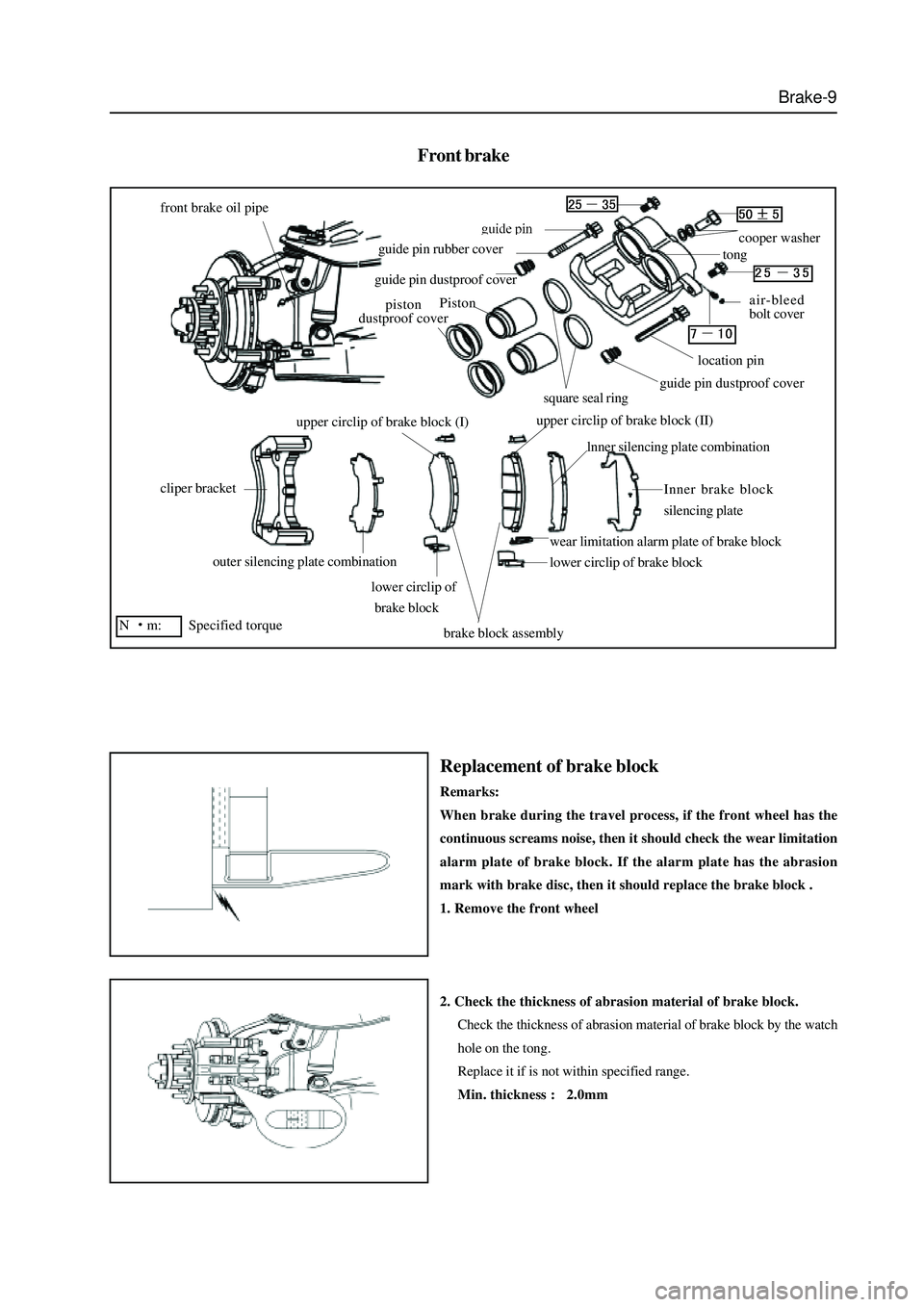
Front brake
front brake oil pipe
cliper bracket
outer silencing plate combination
lower circlip of
brake block
brake block assembly
lower circlip of brake block
wear limitation alarm plate of brake block
lnner silencing plate combination
Inner brake block
silencing plate
upper circlip of brake block (I)upper circlip of brake block (II)
piston
dustproof cover
guide pin dustproof cover
guide pin rubber covercooper washer
tong
air-bleed
bolt cover
location pin
guide pin dustproof coversquare seal ring
N
m: Specified torque
Piston
Replacement of brake block
Remarks:
When brake during the travel process, if the front wheel has the
continuous screams noise, then it should check the wear limitation
alarm plate of brake block. If the alarm plate has the abrasion
mark with brake disc, then it should replace the brake block .
1. Remove the front wheel
2. Check the thickness of abrasion material of brake block.
Check the thickness of abrasion material of brake block by the watch
hole on the tong.
Replace it if is not within specified range.
Min. thickness : 2.0mm
Page 297 of 425

Brake-11
8. Install the new brake block
a. Install a wear limitation alarm plate of brake block on the inner
brake block.
b. Install a silencing plate and a silencing plate combination on the
inner brake block.
c. Install a silencing plate combination on the on the outer brake
block.
d. Install two brake blocks; let the wear limitation alarm plate is in
the inside of brake caliper.
Caution: It is unallowable that the operating surface of brake
block andbrake disc is polluted by the grease and paint.
e. Suck a few of brake fluid form the liquid reservoir (prevent the
brake fluid from overflowing from liquid reservoir).
f. Use the special tools to press the piston .
9. Install the brake pump
Install and tighten the hexagon flange bolt.
Tightening force: 25
35Nm
Remarks: Only can replace the brake block on a wheel in one
time to avoid the piston on another wheel is pushed out.
10. Install the front wheel
Tightening force of the wheel fixing nut is 120N
m
11. Check whether the brake fluid level is in the specified position.
Page 302 of 425

Brake-16
Rear brake (Disk-and-drum type)
tong bracket
pin rubber cover
brake caliper locking bolt 100
silencing plate
combination
outside brake block
inside brake block
brake block wearing
indication plate
cylinder hole
dustproof cover
wire clip
rectangle seal ring
piston
tong body (left)
copper washer
brake oil pipe fastening blot 55
location pin 2530
bleed screw
bleed screw dustproof cover
guide pin 2530
rear brake oil pipeline
N
m: specified torque
peepholesilencing
plate
Replacement of brake block
Remarks: if the rear wheel generates the cheep during the braking,
it should check the abrasion indication plate of brake block. If the
indication plate has the abrasion mark with brake disc, then it
should replace the brake block .
1. Remove the rear wheel
2. Check the thickness of brake block bush.
Measure the thickness of the brake block bush (abrasion material)
from the eyehole of tong. If the thickness is not within the specified
range, then it should replace the brake block.
minimum thickness: 2.0mm.
Page 304 of 425

Brake-18
8. Install new brake block
a. Install a brake block bush wearing indication plate on the internal
brake block.
b. Install one silencing plate and one silencing plate combination on
each brake block.
Remarks: Coat the two sides of silencing plate with disc brake
oil (which cannot be replaced with oil of other models).
c. Install two brake blocks, make the wearing indication plate in the
lower position (near the tank cylinder).
Remarks: The working surface of the brake block and brake
disc are not allowed to be contaminated by grease and paint.
9. Install the sub pump
a. Unscrew the release screw, absorb some of the brake fluid.
b. Press the plunger with hammer beam or similar tools, and unscrew
the release screw at the same time.
Tightening force: 8
13Nm
Remarks: Only the brake block of one wheel can be replaced for
once, lest the plunger on the opposite side be bounced.
c. Install and tighten the location pin.
Tightening force: 25
30Nm
10. Install the rear wheel
Tightening force: 120N
m
11. Fill up with the brake fluid and drain the air in the brake
system after the completion of replacement.
Page 309 of 425
Brake-23
1. Remove the rear wheel
2. Remove the rear brake caliper
3. Remove the rear brake disc
Remarks: If the brake disc is difficult to remove, remove the
adjust ment spout plug, insert the screwdriver into the adjust
ment spout of the rear brake bedplate, Release the brake shoe
adjustment device through twisting the clearance-adjusting gear.
4. Remove the shoe plate, pull-out the piece spring , pull-out piece
spring seat, pull-out piece spring draw bar
5. Remove the lower tension spring and clearance-adjusting device
Use clipper to remove the extension spring, release the clearance
adjusting device and remove it.
6. Remove the two upper extension springs
7. Remove the brake shoe
a. Remove the brake shoe, baffle, baffle return spring.
b. Remove the band brake stay wire from the stay and brake pulling
arm.
Page 311 of 425

Brake-25
1. Install the clearance-adjusting device assembly
Insert the clearance-adjusting shaft head into the clearance-adjusting
wheel; screw the clearance-adjusting screw rod into the clearance
adjusting wheel.
Remarks:The screw direction of left clearance-adjusting screw
rod is the left hand.
The screw direction of right clearance-adjusting
screw rod is the right hand.
2. Coat the following components with the proper anti-high tem
perature grease :
a. Contact position of brake soleplate and brake shoe.
b. Contacting surface of push plate and shoe plate; contacting sur-
face of clearance-adjusting device assembly and shoe plate.
Assembly of rear parking brake
Remarks: Assemble the component according to the direction shown in figure;
It is prohibited strictly that the working surface of brake drum and abrasion disk is polluted by the paint and grease. It
should be removed by the fine abrasive paper if the abrasion disk has little dirty. The brake shoe should be replaced when
the polluted area is large, otherwise it will cause the serious effect of insufficient brake force.
left wheel
frontright wheel
front
Page 314 of 425
Brake-28
10. Adjust the clearance between the brake drum and brake shoe.
Poke the adjusting hole plug on the brake drum, insert the screwdriver
into the clearance-adjusting hole; rotate the clearance-adjusting gear
to expand the brake shoe until the brake disc can not be rotated by
hand. Then rotate it for 3-5 teeth in anticlockwise, rotate the brake
disc by hand at the same time, it is proper that it can rotate freely
and without the contact between the abrasion and disc. It is allowable
that the non-running-in brake shoe has the slight abrasion sensing.
When adjust the clearance, the left and right wheel must be adjust at
the same, install the adjusting hole plug after the completion of
adjusting .
11.Rear brake caliper assembly
12.Rear wheel assembly
Tighten torque :120N.m
Page 315 of 425

Brake-29
The action of load-sensing proportional valve is to prevent the rear wheel is braked before the front wheel is braked by adjusting the
distribution of front and rear brake force according to the difference of vehicle rear shaft load, then avoid the risk of vehicle rotation.
The adjustment of proportional valve is shown as follows:
a. The rear shaft load can be 820Kg after adjustment (including driver).
b. Install the brake pressure measuring meter and drain the air.
c. Increase the front brake pressure to 12Mpa, the rear brake pressure should be within 8
9 Mpa.
d. If necessary, adjust the hydraulic pressure.
1. Move the sensing spring bracket on the rear axle, the right hook of sensing spring moves to right; the rear brake
pressure is increased .
2. Vice versa, the rear brake pressure decreases, the adjustment scope of the frame is 20mm.
3. The extension amount of spring of load sensing proportional valve is controlled within 84
95mm.
Adjustment load-sensing proportional valve

