2006 FORD EXPLORER light
[x] Cancel search: lightPage 299 of 328
²Theindicator may come on. For more information on the ªCheck
Engineº or the ªService engine soonº indicator, refer toWarning
lights and chimesin theInstrument Clusterchapter.
ESSENTIALS OF GOOD FUEL ECONOMY
Measuring techniques
Your best source of information about actual fuel economy is you, the
driver. You must gather information as accurately and consistently as
possible. Fuel expense, frequency of fill-ups or fuel gauge readings are
NOT accurate as a measure of fuel economy. We do not recommend taking
fuel economy measurements during the first 1,000 miles (1,600 km) of
driving (engine break-in period). You will get a more accurate
measurement after 2,000 miles-3,000 miles (3,000 km±5,000 km).
Filling the tank
The advertised fuel capacity of the fuel tank on your vehicle is equal to
the rated refill capacity of the fuel tank as listed in theRefill capacities
section of this chapter.
The advertised capacity is the amount of the indicated capacity and the
empty reserve combined. Indicated capacity is the difference in the
amount of fuel in a full tank and a tank when the fuel gauge indicates
empty. Empty reserve is the small amount of fuel remaining in the fuel
tank after the fuel gauge indicates empty.
The amount of usable fuel in the empty reserve varies and should
not be relied upon to increase driving range. When refueling your
vehicle after the fuel gauge indicates empty, you might not be
able to refuel the full amount of the advertised capacity of the
fuel tank due to the empty reserve still present in the tank.
For consistent results when filling the fuel tank:
²Turn the engine/ignition switch to the off position prior to refueling,
an error in the reading will result if the engine is left running.
²Use the same filling rate setting (low Ð medium Ð high) each time
the tank is filled.
²Allow no more than two automatic click-offs when filling.
²Always use fuel with the recommended octane rating.
²Use a known quality gasoline, preferably a national brand.
²Use the same side of the same pump and have the vehicle facing the
same direction each time you fill up.
Maintenance and Specifications
299
Page 301 of 328

²Revving the engine before turning it off may reduce fuel economy.
²Using the air conditioner or defroster may reduce fuel economy.
²
You may want to turn off the speed control in hilly terrain if unnecessary
shifting between third and fourth gear occurs. Unnecessary shifting of
this type could result in reduced fuel economy.
²Warming up a vehicle on cold mornings is not required and may
reduce fuel economy.
²Resting your foot on the brake pedal while driving may reduce fuel
economy.
²Combine errands and minimize stop-and-go driving.
Maintenance
²Keep tires properly inflated and use only recommended size.
²Operating a vehicle with the wheels out of alignment will reduce fuel
economy.
²Use recommended engine oil. Refer toLubricant specificationsin
this chapter.
²Perform all regularly scheduled maintenance items. Follow the
recommended maintenance schedule and owner maintenance checks
found inscheduled maintenance information.
Conditions
²Heavily loading a vehicle or towing a trailer may reduce fuel economy
at any speed.
²Carrying unnecessary weight may reduce fuel economy (approximately
1 mpg [0.4 km/L] is lost for every 400 lb [180 kg] of weight carried).
²Adding certain accessories to your vehicle (for example bug
deflectors, rollbars/light bars, running boards, ski/luggage racks) may
reduce fuel economy.
²Fuel economy may decrease with lower temperatures during the first
8±10 miles (12±16 km) of driving.
²Driving on flat terrain offers improved fuel economy as compared to
driving on hilly terrain.
²Transmissions give their best fuel economy when operated in the top
cruise gear and with steady pressure on the gas pedal.
²Four-wheel-drive operation (if equipped) is less fuel efficient than
two-wheel-drive operation.
Maintenance and Specifications
301
Page 302 of 328
²Close windows for high speed driving.
EPA window sticker
Every new vehicle should have the EPA window sticker. Contact your
authorized dealer if the window sticker is not supplied with your vehicle.
The EPA window sticker should be your guide for the fuel economy
comparisons with other vehicles.
It is important to note the box in the lower left corner of the window
sticker. These numbers represent the Range of MPG (L/100 km)
expected on the vehicle under optimum conditions. Your fuel economy
may vary depending upon the method of operation and conditions.
EMISSION CONTROL SYSTEM
Your vehicle is equipped with various emission control components and a
catalytic converter which will enable your vehicle to comply with
applicable exhaust emission standards. To make sure that the catalytic
converter and other emission control components continue to work
properly:
²Use only the specified fuel listed.
²Avoid running out of fuel.
²Do not turn off the ignition while your vehicle is moving, especially at
high speeds.
²Have the items listed inscheduled maintenance information
performed according to the specified schedule.
The scheduled maintenance items listed inscheduled maintenance
informationare essential to the life and performance of your vehicle
and to its emissions system.
If other than Ford, Motorcraft or Ford-authorized parts are used for
maintenance replacements or for service of components affecting
emission control, such non-Ford parts should be equivalent to genuine
Ford Motor Company parts in performance and durability.
Do not park, idle, or drive your vehicle in dry grass or other dry
ground cover. The emission system heats up the engine
compartment and exhaust system, which can start a fire.
Illumination of the
indicator, charging system warning light or the
temperature warning light, fluid leaks, strange odors, smoke or loss of
engine power, could indicate that the emission control system is not
working properly.
Maintenance and Specifications
302
Page 304 of 328
Readiness for Inspection/Maintenance (I/M) testing
In some localities, it may be a legal requirement to pass an I/M test of
the on-board diagnostics system. If your
indicator is on, refer to
the description in theWarning lights and chimessection of the
Instrument Clusterchapter. Your vehicle may not pass the I/M test with
the
indicator on.
If the vehicle's powertrain system or its battery has just been serviced,
the on-board diagnostics system is reset to a ªnot ready for I/M testº
condition. To ready the on-board diagnostics system for I/M testing, a
minimum of 30 minutes of city and highway driving is necessary as
described below:
²First, at least 10 minutes of driving on an expressway or highway.
²Next, at least 20 minutes driving in stop-and-go, city-type traffic with
at least four idle periods.
Allow the vehicle to sit for at least eight hours without starting the
engine. Then, start the engine and complete the above driving cycle. The
engine must warm up to its normal operating temperature. Once started,
do not turn off the engine until the above driving cycle is complete.
POWER STEERING FLUID
Check the power steering fluid. Refer to thescheduled maintenance
guidefor the service interval schedules. If adding fluid is necessary, use
only MERCONtAT F.
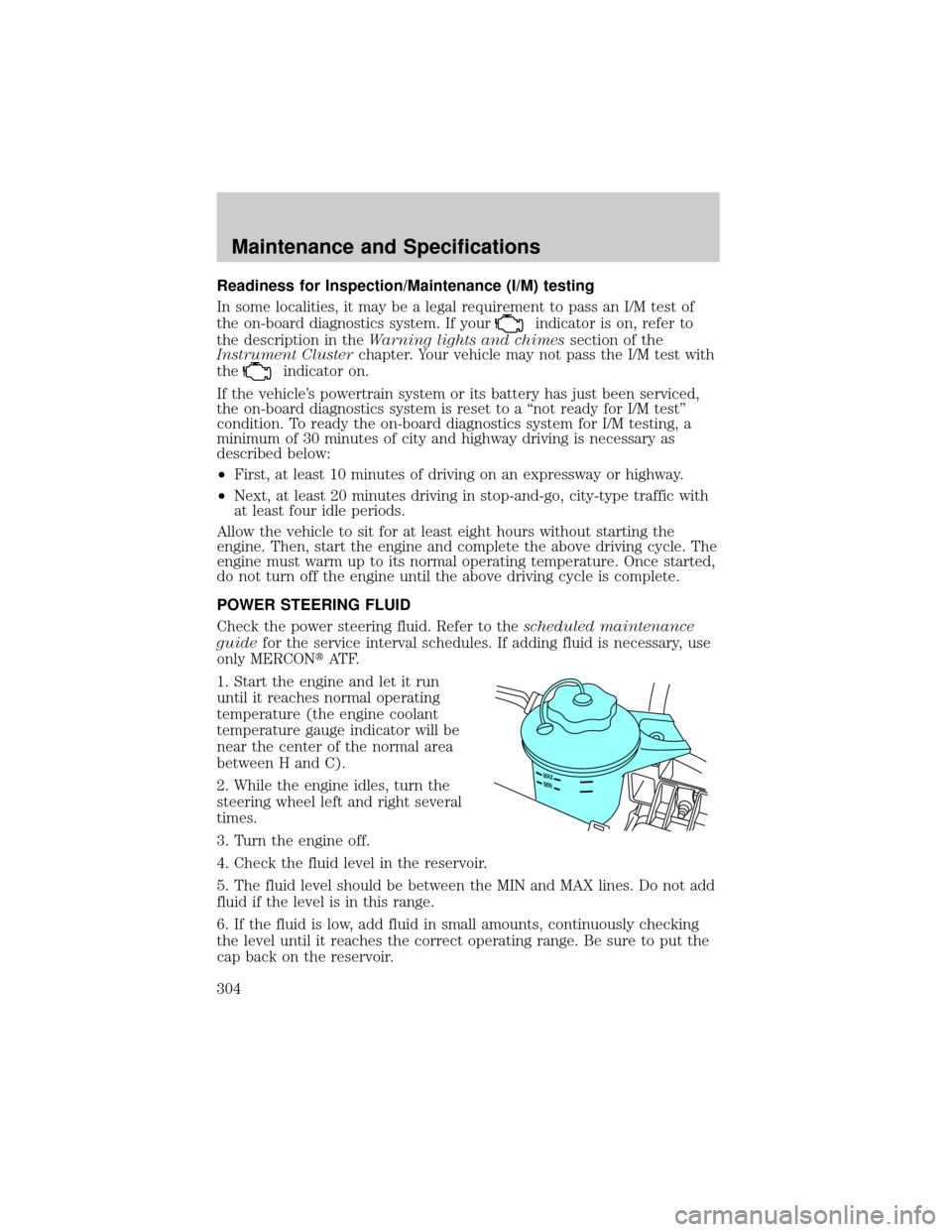
1. Start the engine and let it run
until it reaches normal operating
temperature (the engine coolant
temperature gauge indicator will be
near the center of the normal area
between H and C).
2. While the engine idles, turn the
steering wheel left and right several
times.
3. Turn the engine off.
4. Check the fluid level in the reservoir.
5. The fluid level should be between the MIN and MAX lines. Do not add
fluid if the level is in this range.
6. If the fluid is low, add fluid in small amounts, continuously checking
the level until it reaches the correct operating range. Be sure to put the
cap back on the reservoir.
Maintenance and Specifications
304
Page 317 of 328

GENUINE FORD ACCESSORIES FOR YOUR VEHICLE
A wide selection of Genuine Ford Accessories are available for your
vehicle through your local authorized Ford or Ford of Canada dealer.
These quality accessories have been specifically engineered to fulfill your
automotive needs; they are custom designed to complement the style
and aerodynamic appearance of your vehicle. In addition, each accessory
is made from high quality materials and meets or exceeds Ford's rigorous
engineering and safety specifications. Ford Motor Company will repair or
replace any properly dealer-installed Genuine Ford Accessory found to
be defective in factory-supplied materials or workmanship during the
warranty period, as well as any component damaged by the defective
accessory. The accessory will be warranted for whichever provides you
the greatest benefit:
²12 months or 12,000 miles (20,000 km) (whichever occurs first), or
²the remainder of your new vehicle limited warranty.
This means that Genuine Ford Accessories purchased along with your
new vehicle and installed by the authorized dealer are covered for the
full length of your New Vehicle's Limited Warranty Ð 3 years or 36,000
miles (60,000 km) (whichever occurs first). Contact your authorized
dealer for details and a copy of the warranty.
Not all accessories are available for all models.
The following is a list of several Genuine Ford Accessory products. Not
all accessories are available for all models. For a complete listing of the
accessories that are available for your vehicle, please contact your
authorized dealer or visit our online store at:
www.fordaccessoriesstore.com.
Exterior style
Bug shields
Deflectors
Front end covers
Headlamps, fog lights and Daytime Running Lamps (DRLs)
Running boards
Splash guards
Step Bars
Wheels
Accessories
317
Page 320 of 328

A
Accessory delay ..........................58
AdvanceTrac ..............................212
Air cleaner filter ...............306±307
Air conditioning ..........................37
Airbag supplemental
restraint system ........141, 150, 152
and child safety seats ............143
description ..............141, 150, 152
disposal ....................................155
driver airbag ............143, 151, 153
indicator light .................150, 155
operation .................143, 151, 153
passenger airbag .....143, 151, 153
side airbag ...............................150
Ambulance packages ....................8
Antifreeze
(see Engine coolant) ................288
Anti-lock brake system
(see Brakes) ..............................210
Audio system
(see Radio) ......................21, 25, 29
Automatic transmission
driving an automatic
overdrive .........................218, 221
fluid, adding ............................305
fluid, checking ........................305
fluid, refill capacities ..............308
fluid, specification ..................313
Auxiliary power point .................55
Axle
lubricant specifications ..310, 313
refill capacities ........................308
B
Battery .......................................286acid, treating emergencies .....286
jumping a disabled battery ....256
maintenance-free ....................286
replacement, specifications ...307
servicing ..................................286
BeltMinder .................................136
Brakes ........................................210
anti-lock ...................................210
anti-lock brake system (ABS)
warning light ...........................210
fluid, checking and adding ....305
fluid, refill capacities ..............308
fluid, specifications .........310, 313
lubricant specifications ..310, 313
parking ....................................211
shift interlock ..........................217
C
Calculating load ........................199
Capacities for refilling fluids ....308
Cargo cover ...........................94±95
Cassette tape player .............21, 25
Cell phone use ..............................8
Changing a tire .........................246
Child safety restraints ..............156
child safety belts ....................156
Child safety seats ......................160
attaching with tether straps ..164
in front seat ............................161
in rear seat ..............................161
Cleaning your vehicle
engine compartment ..............270
instrument panel ....................272
interior .....................................273
interior trim ............................273
plastic parts ............................272
washing ....................................269
waxing .....................................269
Index
320
Page 322 of 328

checking and adding ..............281
dipstick ....................................281
filter, specifications ........284, 307
recommendations ...................284
refill capacities ........................308
specifications ..................310, 313
Exhaust fumes ..........................209
F
Fail safe cooling ........................293
Floor mats ...................................94
Fluid capacities .........................308
Foglamps .....................................42
Four-Wheel Drive vehicles .......226
driving off road .......................227
indicator light .........................226
preparing to drive your
vehicle .....................................216
Fuel ............................................294
calculating fuel
economy ......................71, 82, 299
cap ...........................................296
capacity ...................................308
choosing the right fuel ...........297
comparisons with EPA fuel
economy estimates .................302
detergent in fuel .....................298
filling your vehicle with
fuel ...........................294, 296, 299
filter, specifications ........294, 307
fuel pump shut-off switch .....237
improving fuel economy ........299
octane rating ...................298, 313
quality ......................................298
running out of fuel .................298
safety information relating to
automotive fuels .....................294
Fuses ..................................238, 240G
Garage door opener ....................54
Garage Door Opener
(see Homelink wireless
control system) ...........................65
Gas cap (see Fuel cap) ............296
Gas mileage
(see Fuel economy) .................299
Gauges .........................................18
GAWR (Gross Axle Weight
Rating)
calculating ...............................199
GVWR (Gross Vehicle Weight
Rating)
calculating ...............................199
H
Hazard flashers .........................237
Head restraints .........................114
Headlamps
aiming ........................................44
bulb specifications ....................47
daytime running lights .............43
flash to pass ..............................43
high beam .................................43
Heating
heating and air conditioning
system .................................35, 37
Homelink wireless control
system ..........................................65
Hood ..........................................277
I
Ignition ...............................207, 313
Infant seats
(see Safety seats) .....................160
Index
322
Page 323 of 328

Inspection/maintenance (I/M)
testing ........................................304
Instrument panel
cleaning ...................................272
cluster ........................................12
J
Jack ....................................246, 250
positioning .......................246, 252
storage .....................246, 249±250
Jump-starting your vehicle ......256
K
Keyless entry system ...............106
autolock ...........................108±109
Keys
positions of the ignition .........207
L
Lamps
bulb replacement
specifications chart ............46±47
daytime running light ...............43
fog lamps ...................................42
interior lamps ...........................46
Liftgate ................................96, 102
Lights, warning and indicator ....12
anti-lock brakes (ABS) ..........210
Load limits .................................192
Loading instructions .................199
Locks
autolock ...........................108±109
childproof ................................100
doors ..........................................98
Lubricant specifications ...310, 313
Lug nuts ....................................255Luggage rack ...............................97
Lumbar support, seats .....116, 119
M
Message center ...............69, 80±81
english/metric button .........73, 85
system check button ..........72, 84
warning messages ...............77, 91
Mirrors .........................................53
automatic dimming rearview
mirror ........................................58
fold away ...................................59
heated ........................................59
side view mirrors (power) .......58
Moon roof ....................................64
Motorcraft parts ........274, 294, 307
N
Navigation system .......................34
O
Octane rating ............................298
Oil (see Engine oil) ..................281
P
Parking brake ............................211
Parts (see Motorcraft parts) ....307
Passenger Occupant
Classification Sensor .................127
Pedals (see Power adjustable
foot pedals) .................................59
Power adjustable foot pedals .....59
Power distribution box
(see Fuses) ...............................243
Power door locks ........................98
Index
323