2005 SKODA OCTAVIA heating
[x] Cancel search: heatingPage 137 of 315

Heating and air conditioning system
136
The last programmed pre-set time remains active.
The active pre-set time can be changed in the menu Aux. Heating in the
menu Activation by selecting a pre-set time.
The prerequisite for the correct switching on of the auxiliary heating (auxil-
iary heating and ventilation) according to the programmed pre-set time is
the correct setting of the current time ⇒page 17 and weekday ⇒ page 135.
If the system is running, a warning light in the button for direct switching
on/off of the auxiliary heating lights up.
The running system deactivates after expiration of the operating period or
is deactivated earlier by pressing the button for direct switching on/off of
the auxiliary heating ⇒page 136.
The deactivation of a desired pre-set time can be performed by selecting
the menu Deactive in the menu Active .
It is possible to re-establish the factory setting using the menu Factory
setting in the menu Aux. Heating .Direct switching on/off
Fig. 126 Button for direct switching on/off of the auxiliary heating (auxiliary
heating and ventilation) on the operating part of the Climatic
The auxiliary heating (auxiliary heating and ventilation) can be switched
on or off at any time directly using the button on the operating part of
the Climatic ⇒fig. 126 , if necessary the operating part of the heating
⇒ page 119, fig. 116 or the operating part of the Climatronic ⇒page 130,
fig. 122 .
The auxiliary heating system (auxiliary heating and ventilation) switches
off automatically after expiration of the set operating period in the menu
Running time , if it is not switched off beforehand by you.
WARNING
•The auxiliary heating must never be operated in closed rooms -
risk of poisoning!
•The auxiliary heating must not be running during refueling - risk
of fire.
s24s.book Page 136 Thursday, November 24, 2005 12:27 PM
Page 138 of 315

Heating and air conditioning system 137
Using the systemSafetyDriving TipsGeneral MaintenanceBreakdown assistanceTechnical Data
•The exhaust pipe of the auxiliary heating is located on the
underside of the vehicle. Therefore do not place the vehicle, if you
wish to operate the auxiliary heating, in such a way that the exhaust
gases of the auxiliary heating can come easily into contact with
inflammable materials (e.g. dry grass) or easily inflammable
substances (e.g. fuel run out).
Note
•If the auxiliary heating runs, the fuel consumption comes from the
vehicle tank. Therefore the auxiliary heating should not be operated, if
there is very little fuel in the tank.
•The exhaust pipe of the auxiliary heating, which is located on the
underside of the vehicle, must not be clogged and the exhaust flow must
not be blocked.
•If the auxiliary heating and ventilation is running, the vehicle battery
discharges. If the auxiliary heating and ventilation has been operated
several times over a longer period, the vehicle must be driven a few kilom-
eters in order to recharge the vehicle battery.
•The auxiliary heating only switches the blower on, if it has achieved a
coolant temperature of approx. 50 °C.
•At low outside temperatures, this can result in a formation of water
vapour in the area of the engine compartment. This is quite normal and is
not an operating problem.
•After switching off the auxiliary heating, the coolant pump runs for a
short period.
•The auxiliary heating and ventilation does not switch on or comes on,
if the vehicle battery indicates a low loading state.
•The auxiliary heating (auxiliary heating) switches on, if in the informa-
tion display: Please refuel! is indicated or was indicated before switching
off the ignition.
•When driving, the auxiliary heating can only be switched on, if the exte-
rior temperature is lower than 5 °C.
•The air inlet in front of the windscreen must be free of ice, snow or
leaves in order to ensure that the auxiliary heating operates properly.
•So that the warm air can flow into the vehicle interior after switching on
the auxiliary heating (auxiliary heating), the control dial ⇒page 119,
fig. 116 must be turned up to the stop to the right when heating. With
Climatic and Climatronic, you can maintain the temperature normally
selected by you (we recommend 22 °C). It is recommended to put the air
flow in the position
. For heating and climatic put the blower switch
⇒ page 119, fig. 116 if necessary ⇒page 124, fig. 119 in the position 2.
WARNING (continued)
AA
AB
s24s.book Page 137 Thursday, November 24, 2005 12:27 PM
Page 140 of 315

Starting-off and Driving139
Using the systemSafetyDriving TipsGeneral MaintenanceBreakdown assistanceTechnical Data
way (e.g. in the middle of the steering wheel or at the inner steering
wheel edge). In such cases, injuries to the arms, the hands and the
head can occur when the driver airbag is deployed.
Ignition lock
Petrol engines
- ignition switched off, engine off, the steering can be locked.
- ignition switched on
- start engine
Diesel engines - interruption of fuel supply, ignition switched off, engine off, the
steering can be locked. - heating glow plugs on, ignition switched on
•You should not switch on any major electrical components during the
heating period otherwise the vehicle battery will be drained unnecessarily.
- start engine
Applies to all models:
Position
To lock the steering , with the ignition key withdrawn, turn the steering
wheel until the steering locking pin is heard to engage. You should always
lock the steering as a general rule if you leave your vehicle. This acts as
a deterrent against possible theft of your vehicle ⇒.
Position
Move the steering wheel back and forward a little if the ignition key cannot,
or cannot easily be turned into this position, in order to release the
steering lock.
Position
The engine is started in this position. At the same time switched on low
beam or main beam or other electrical components with major power
consumption are briefly switched off. The ignition key moves back into
position when one releases the key.
The ignition key must be turned back into position each time before
starting the engine again. The starter repeat lock in the ignition lock
prevents the starter being engaged when the engine is running and thus
getting damaged.
Ignition key withdrawal lock (automatic gearbox)
You can only withdraw the ignition key after switching off the ignition if the
selector lever is in position P.
WARNING (continued)
Fig. 129 Ignition lock
positions
A1
A2
A3
A1
A2
A3
A1
A2
A3
A2
A1
s24s.book Page 139 Thursday, November 24, 2005 12:27 PM
Page 142 of 315

Starting-off and Driving141
Using the systemSafetyDriving TipsGeneral MaintenanceBreakdown assistanceTechnical Data
Petrol engines
These engines are fitted with a starter system which selects the correct
fuel/air mixture for every external air temperature.
•Do not operate accelerator before and when starting engine.
•Interrupt the attempt at starting after 10 seconds if the engine does not
start right awayand wait for about 30 seconds before repeating the
attempt.
•It is possible that the fuse on the electrical fuel pump is defect if the
engine still does not start. Check the fuse and replace it if necessary
⇒ page 288.
•Contact the nearest specialist garage to obtain professional assist-
ance.
It may be necessary, if the engine is very hot, to slightly depress the
accelerator after the engine has started.
Diesel engines
Glow plug system
Diesel engines are equipped with a glow plug system, the preglow period
being controlled automatically in line with the coolant temperature and
outside temperature.
The preglow indicator light
comes on after the ignition has been
switched on.
You should not switch on any major electrical components during
the heating period otherwise the ve hicle battery will be drained
unnecessarily.
•You should start the engine immediately after the glow plug warning
light has gone out.
•The glow plug warning light will come on for about one second if the
engine is at a normal operating temperature or if the outside temperature
is above +5°C. This means that you can start the engine right away.
•Interrupt the attempt at starting after 10 seconds if the engine does not
start right awayand wait for about 30 seconds before repeating the
attempt.
•It is possible that the fuse on the diesel preglow system is defect if the
engine still does not start. Check the fuse and replace it if necessary
⇒ page 288.
•Contact the nearest specialist garage to obtain professional assist-
ance.
Starting the engine after the fuel tank has run dry
It may take longer than normal to start the engine after refuelling if the fuel
tank has run completely dry - up to one minute. This is because the fuel
system must first of all be filled while the attempting to start the engine.
Switching the engine off
– The engine can be switched off by turning the ignition key from position ⇒page 139, fig. 129 into position .
WARNING
•Never switch off the engine before the vehicle is stationary - risk
of accident!
•The brake booster only operates when the engine is running.
Greater physical effort for braking is required when engine is
switched off. Because if you do not stop as normal, this can cause
an accident and severe injuries.
A1
s24s.book Page 141 Thursday, November 24, 2005 12:27 PM
Page 144 of 315
Starting-off and Driving143
Using the systemSafetyDriving TipsGeneral MaintenanceBreakdown assistanceTechnical Data
•Depress the clutch pedal fully when changing gears, in order to avoid
unnecessary wear and damage.
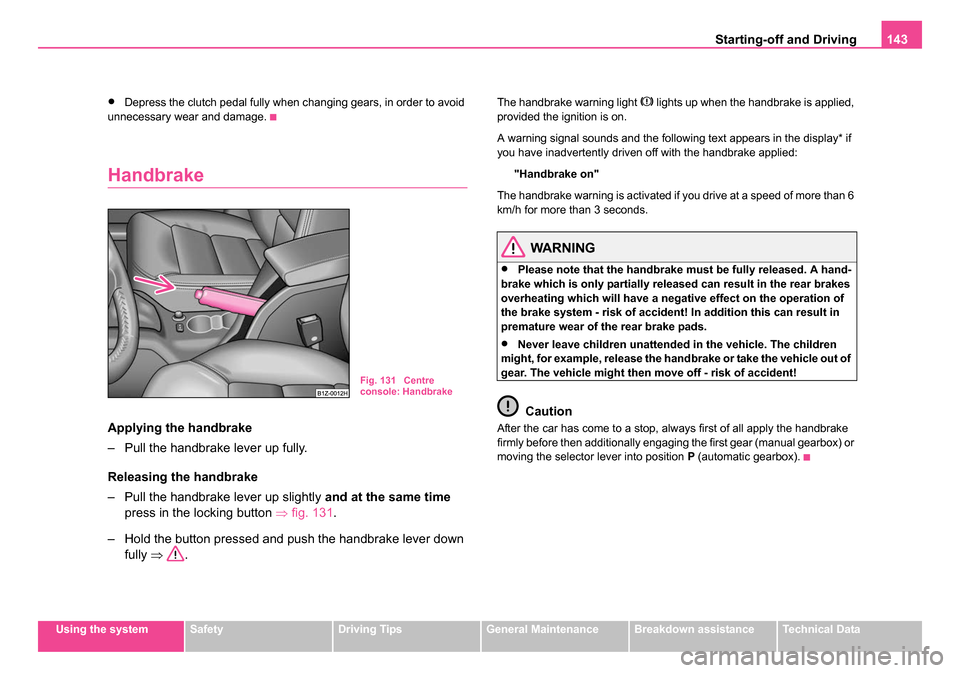
Handbrake
Applying the handbrake
– Pull the handbrake lever up fully.
Releasing the handbrake
– Pull the handbrake lever up slightly and at the same time
press in the locking button ⇒fig. 131 .
– Hold the button pressed and push the handbrake lever down fully ⇒ .
The handbrake warning light lights up when the handbrake is applied,
provided the ignition is on.
A warning signal sounds and the following text appears in the display* if
you have inadvertently driven off with the handbrake applied:
"Handbrake on"
The handbrake warning is activated if you drive at a speed of more than 6
km/h for more than 3 seconds.
WARNING
•Please note that the handbrake must be fully released. A hand-
brake which is only partially released can result in the rear brakes
overheating which will have a nega tive effect on the operation of
the brake system - risk of accident! In addition this can result in
premature wear of the rear brake pads.
•Never leave children unattended in the vehicle. The children
might, for example, release the handbrake or take the vehicle out of
gear. The vehicle might then move off - risk of accident!
Caution
After the car has come to a stop, always first of all apply the handbrake
firmly before then additionally engaging the first gear (manual gearbox) or
moving the selector lever into position P (automatic gearbox).
Fig. 131 Centre
console: Handbrake
s24s.book Page 143 Thursday, November 24, 2005 12:27 PM
Page 158 of 315

Automatic gearbox DSG157
Using the systemSafetyDriving TipsGeneral MaintenanceBreakdown assistanceTechnical Data
speed of the engine to be reached before engaging a drive position in the
selector lever.
WARNING
•Do not depress the accelerator when changing the position of
the selector lever if the car is stationary and the engine is running
- risk of accident!
•Never move the selector lever into position R or P when driving
- risk of an accident!
•If you are stopping at a hill (downhill section), never try to hold
the car stationary with the gear engaged by means of the “acceler-
ator”, this means by letting the cl utch slip. This can lead to over-
heating of the clutch. If there is a risk of overheating of the clutch
due to overload, the clutch is opened automatically and the vehicle
rolls backward - risk of accident!
•If you must stop at a slope, depress and hold the brake pedal,
so that you can prevent the vehicle from rolling back.
Caution
•The double clutch on the automatic gearbox DSG is equipped with an
overload protection. If you make use of the uphill function on a vehicle
which is stationary or driving slowly uphill, it will result in an increase of
thermal stress of the clutches.
•An overheating of the clutches can be detected by the flashing of the
selector level indicator and the “jerk” of the clutches, finally the clutches
are opened. The power transmission from the engine to the front wheels
is interrupted and as a result of this the vehicle can no longer be driven. If
the clutch opens automatically, depress the brake pedal, wait a few
seconds and only then continue driving.
Selector lever positions
The selector lever position you have engaged is shown in the information
display of the instrument cluster with the corresponding gear symbol high-
Fig. 141 Selector lever
Fig. 142 Information
display: Selector lever
positions
s24s.book Page 157 Thursday, November 24, 2005 12:27 PM
Page 215 of 315

Intelligent Technology
214
The ESP operates in combination with the ABS ⇒page 218, “Antilock
brake system (ABS)”. If there is a fault in the ABS system, the ESP also
does not operate.
The ESP warning light ⇒page 40 lights up in the instrument cluster when
there is a fault on the ESP.
Switching off
You can switch the ESP off and on again as you wish, by pressing the
button ⇒page 213, fig. 180 . The ESP warning light ⇒page 40 lights up in
the instrument cluster when the ESP is switched off.
The ESP should normally always be switched on. It may be good practice
in certain exceptional cases, such as when you wish to have wheel slip,
to switch off the system.
Examples:
•when driving with snow chains
•when driving in deep snow or on a loose surface
•when it is necessary to rock a car free when it has become stuck
then you should switch on the ESP again.
WARNING
It is also not possible for the E SP to overcome the physical limits
of the vehicle. Even if a vehicle fitted with ESP you should still
always adapt your style of driving to the condition of the road
surface and the traffic situation. This particularly applies when
driving on slippery and wet roads. The increased safety offered
must not tempt you to take greater risks than otherwise - risk of an
accident!
Note
•All four wheels must be fitted with the same tyres in order to achieve
problem-free operation of the ESP. Differing rolling circumferences of the
tyres can lead to an undesirable reduction in the engine output.
•Changes to vehicle (e.g. on engine, on the brakes, on chassis or other
assignment of tyres and wheels) can influence the function of the ESP
⇒ page 270, “Accessories, changes and replacement of parts”.
Electronic Differential Lock (EDL)*
The electronic differential lock prevents an individual
wheel from slipping.
Models fitted with ESP are equipped with electronic differential lock (EDL).
General
The EDL makes it much easier, and sometimes at all possible, to start off,
accelerate and climb a steep hill when the conditions of the road surface
are unfavourable.
Operating principle
The EDL is activated automatically, that is without any action on the part
of the driver. It monitors the speeds of the driven wheels with the aid of the
ABS sensors. Should only one drive wheel begin spinning on a slippery
surface there will be an appreciable difference in the speed of the driven
wheels. The EDL function brakes the slipping wheel and the differential
transmits a greater driving force to the other driven wheel. This control
process is also accompanied by noises.
Overheating of the brakes
The EDL switches off automatically if unusually severe stresses exist in
order to avoid excessive heat generation in the disc brake on the wheel
s24s.book Page 214 Thursday, November 24, 2005 12:27 PM
Page 232 of 315

Towing a trailer231
Using the systemSafetyDriving TipsGeneral MaintenanceBreakdown assistanceTechnical Data
before negotiating a downhill section to allow the engine to also act as a
brake.
Engine overheating
Please keep a check on the coolant temperature gauge if you have to
negotiate a lengthy slope in a low gear at a high engine speed when the
outside temperature is very high
⇒page 14.
If the needle of the coolant temperature gauge moves into the right-hand
area or even the red area of the scale, reduce your speed immediately.
Stop and switch off the engine if the warning light
in the instrument
cluster begins flashing. Wait a few minutes and check the level of coolant
in the coolant expansion bottle ⇒page 254, “Inspecting the coolant level”.
Please refer to the following guidelines ⇒page 35, “Coolant tempera-
ture/coolant level ”.
The coolant temperature can be reduced by switching on the heating.
Any increase in the cooling effect of the coolant fan through shifting down
a gear and increasing the engine speed is not possible since the fan
speed is independent of the engine speed. One should also not drop a
gear for this reason when towing a trailer as long as the engine can
manage the slope without any drop in speed.
Detachable ball head*
The detachable ball head of the towing device is stowed in a box for the
car tool kit in the spare wheel well in the luggage compartment.
An instruction for correct installation and removal of the ball head of the
towing device is supplied with the ball head
Inspect the ball head to ensure that it is properly locked each time before
setting off. The inspection is performed by turning the closed locking lever
downwards. If the locking lever can only be turned around a small angle
(approx. 5°), the locking mechanism is O.K. After the inspection pull the
locking lever back again to its stop. The towing device must not be used,
if it does not wish to close or the locking lever turns slightly in the closed
position.
Fig. 186 Detachable
ball head
s24s.book Page 231 Thursday, November 24, 2005 12:27 PM