Page 867 of 1500
COMPRESSOR ASSEMBLY AND DRIVE BELT
HEATER, AIR CONDITIONING AND VENTILATION55-166
INSPECTIONM1552014301083
COMPRESSOR AIR CONDITIONING
COMPRESSOR CLUTCH OPERATION CHECK
Connect the compressor connector terminal to the battery posi-
tive (+) terminal and ground the battery’s negative (-) terminal
to the compressor unit. At that time, the air conditioning com-
pressor clutch should make a definite operating sound.
.
AIR GAP ADJUSTMENT
Check whether or not the air gap of the clutch is within the stan-
dard value.
Standard value:
0.35
0.60mm
NOTE: If there is a deviation of the air gap from the standard
value, assess the operation of the clutch and replace the com-
pressor assembly as required.
Page 870 of 1500
CONDENSER AND CONDENSER FAN
HEATER, AIR CONDITIONING AND VENTILATION55-169
>>B<< CONDENSER INSTALLATION
When replacing the condenser, refill it with a specified amount
of compressor oil and install it to the vehicle.
Compressor oil: ND Oil 8
Quantity: 40 ml
INSPECTIONM1552014301102
CONDENSER FAN MOTOR CHECK
Check to be sure that the condenser fan motor operates when
battery voltage is applied to terminal 2 and terminal 1
grounded.
Page 902 of 1500
00E-1
GROUP 00E
GENERAL
CONTENTS
HARNESS CONNECTOR
INSPECTION . . . . . . . . . . . . . . . . . . .00E-2
HOW TO DIAGNOSE . . . . . . . . . . . . .00E-2
HOW TO DIAGNOSE . . . . . . . . . . . . . . . . . 00E-2
TROUBLESHOOTING STEPS . . . . . . . . . . 00E-3
INFORMATION FOR DIAGNOSIS . . . . . . . 00E-3
INSPECTION . . . . . . . . . . . . . . . . . . . . . . . 00E-4INSPECTION INSTRUMENTS . . . . . . . . . . 00E-5
CHECKING FUSES . . . . . . . . . . . . . . . . . . . 00E-6
CHECKING SWITCHES . . . . . . . . . . . . . . . 00E-7
CHECKING RELAYS . . . . . . . . . . . . . . . . . 00E-8
CABLES AND WIRES CHECK . . . . . . . . . . 00E-9
BATTERY HANDLING . . . . . . . . . . . . . . . . 00E-9
GENERAL ELECTRICAL SYSTEM CHECK00E-9
Page 906 of 1500
HOW TO DIAGNOSE
GENERAL 00E-5
INSPECTION INSTRUMENTSM1001004700040
For inspection, use the following instruments:
Never use a test light for checking ECU-related circuits or
ECUs.
1. Test light
A test light consists of a 12V bulb and lead wires. It is used
to check voltages or short circuits.
2. Self-powered test light
A self-powered test light consists of a bulb, battery and lead
wires connected in series. It is used to check continuity or
grounding.
Never use a jumper wire to connect a power supply
directly to a load.
3. Jumper wire
A jumper wire is used to close an open circuit.
4. Voltmeter
A voltmeter is used to measure the circuit voltage. Normally,
the positive (red lead) test probe is applied to the point of
voltage measurement and the negative (black lead) test
probe to the body ground. Use a digital voltmeter to check
for voltage drop before or after a component.
Page 909 of 1500

HOW TO DIAGNOSE
GENERAL 00E-8
CHECKING RELAYSM1001004900152
1. By using a relay, a heavy current can be turned on and off by
a switch using much less current. For example, in the circuit
shown here, when the switch is turned on (closed), current
flows to the coil of the relay. Then, its contact is turned on
(closed) and the light comes on. The current flowing through
the switch is much less than that for the light.
2. When current flows through the coil of a relay, its core is
magnetized to attract the iron piece, closing (ON) the
contact at the tip of the iron piece. When the coil current is
turned off, the iron piece returns to its original position by a
spring, opening the contact (OFF).
3. Relays may be classified as the normally open-type or the
normally closed-type, depending on their contact
construction.
NOTE: The deenergised state means that no current is flow-
ing through the coil. The energised state means that current
is flowing through the coil.
(1) The normally open-type
When a normally open relay as illustrated here is
checked, there should be no continuity between terminals
3 and 4 when the relay is deenergised. There should be
continuity between terminals 3 and 4 when battery
voltage and ground are applied to terminals 1 and 2. The
relay condition is determined by this check.
NOTE: Check the relay in both situation which is
energised and is not energised.
(2) The normally closed-type
When a normally closed relay as illustrated here is
checked, there should be continuity between terminals 3
and 4 when the relay is deenergised. There should be no
continuity between terminals 3 and 4 when battery
voltage and ground are applied to terminals 1 and 2. The
relay condition is determined by this check.
NOTE: Check the relay in both situation which is
energised and is not energised.
Page 910 of 1500

HOW TO DIAGNOSE
GENERAL 00E-9
CABLES AND WIRES CHECKM1001005100041
1. Check connections for looseness, rust, and stains.
2. Check terminals and wires for corrosion.
3. Check terminals and wires for open circuit or impending
open circuit.
4. Check wire insulation and coating for damage, cracks, and
wear.
5. Check conductive parts of terminals for contact with other
metallic parts (vehicle body and other parts).
6. Check grounding parts to verify that there is complete
continuity between attaching bolt(s) and vehicle body.
7. Check for incorrect wiring.
8. Check that harnesses are secured to prevent contact with
sharp edges and corners or hot parts (exhaust manifold,
pipe, etc.).
9. Check that harnesses are secured firmly to provide enough
clearance from the fan pulley, fan belt, and other rotating or
moving parts.
10.Check that the harnesses between fixed parts (such as the
vehicle body) and vibrating parts (such as the engine) are
long enough to allow for vibration and movement.
BATTERY HANDLINGM1001005200048
Battery posts, terminals and related accessories con-
tain lead and lead compounds. WASH HANDS AFTER
HANDLING.
When checking or servicing does not require power from the
vehicle battery, be sure to disconnect the cable from the battery
(
) terminal. This will prevent problems that could be caused by
a short circuit. Disconnect the (
) battery terminal first and
reconnect it last.
GENERAL ELECTRICAL SYSTEM CHECKM1001005300045
A circuit consists of the power supply, switch, relay, load,
ground, etc. There are various methods to check a circuit
including an overall check, voltage check, short-circuit check,
and continuity check. Each of the methods briefly described
below applies only to circuits similar to the illustration.
Page 946 of 1500
ON-VEHICLE SERVICE
ENGINE COOLING14-31
FAN CONTROL RELAY CONTINUITY CHECKM1141006200310
BATTERY
VOLTAGETERMINAL NO. TO
BE CONNECTED
TO TESTERCONTINUITY TEST
RESULTS
Not applied 4
2 Open circuit
Connect
terminal No.3
and battery (
)
terminal.
Connect
terminal No.1
and battery (+)
terminal.4
2 Less than 2 ohms
Page 950 of 1500
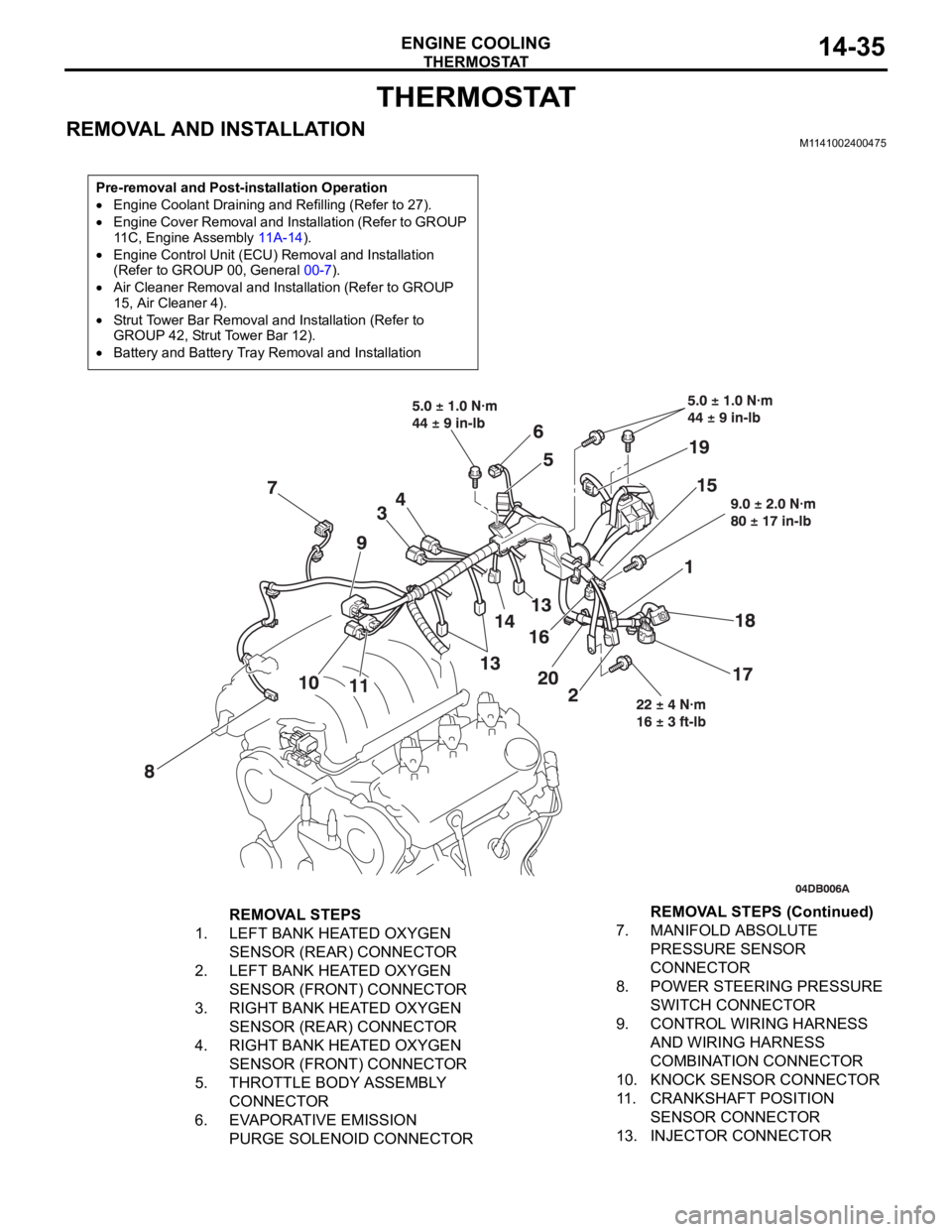
THERMOSTAT
ENGINE COOLING14-35
THERMOSTAT
REMOVAL AND INSTALLATIONM1141002400475
Pre-removal and Post-installation Operation
Engine Coolant Draining and Refilling (Refer to 27).
Engine Cover Removal and Installation (Refer to GROUP
11C, Engine Assembly 11A-14).
Engine Control Unit (ECU) Removal and Installation
(Refer to GROUP 00, General 00-7).
Air Cleaner Removal and Installation (Refer to GROUP
15, Air Cleaner 4).
Strut Tower Bar Removal and Installation (Refer to
GROUP 42, Strut Tower Bar 12).
Battery and Battery Tray Removal and Installation
REMOVAL STEPS
1. LEFT BANK HEATED OXYGEN
SENSOR (REAR) CONNECTOR
2. LEFT BANK HEATED OXYGEN
SENSOR (FRONT) CONNECTOR
3. RIGHT BANK HEATED OXYGEN
SENSOR (REAR) CONNECTOR
4. RIGHT BANK HEATED OXYGEN
SENSOR (FRONT) CONNECTOR
5. THROTTLE BODY ASSEMBLY
CONNECTOR
6. EVAPORATIVE EMISSION
PURGE SOLENOID CONNECTOR7. MANIFOLD ABSOLUTE
PRESSURE SENSOR
CONNECTOR
8. POWER STEERING PRESSURE
SWITCH CONNECTOR
9. CONTROL WIRING HARNESS
AND WIRING HARNESS
COMBINATION CONNECTOR
10. KNOCK SENSOR CONNECTOR
11. CRANKSHAFT POSITION
SENSOR CONNECTOR
13. INJECTOR CONNECTORREMOVAL STEPS (Continued)


