2004 SUBARU FORESTER meter
[x] Cancel search: meterPage 767 of 2870
PM-30
PERIODIC MAINTENANCE SERVICE
Brake Line
18.Brake Line
A: INSPECTION
1. BRAKE LINE
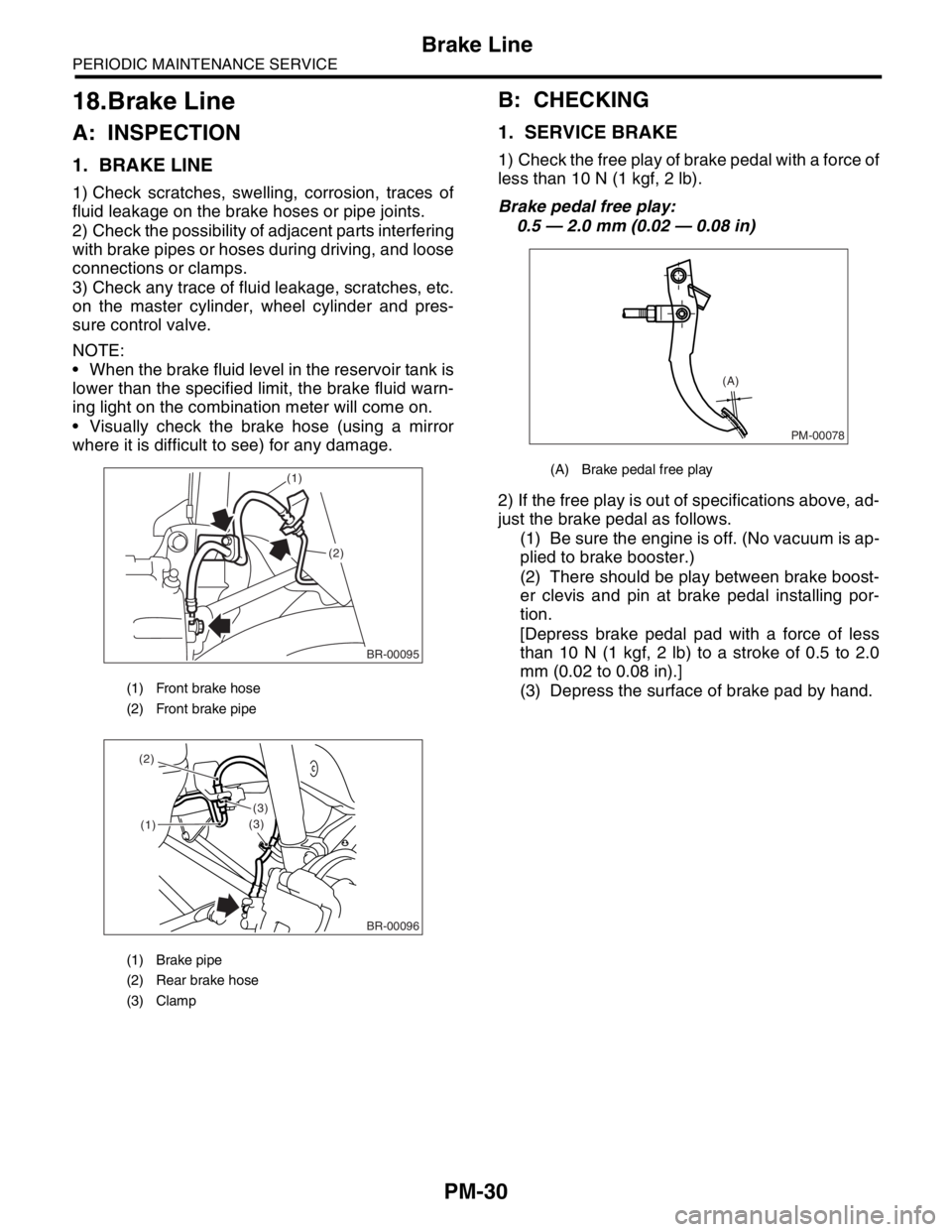
1) Check scratches, swelling, corrosion, traces of
fluid leakage on the brake hoses or pipe joints.
2) Check the possibility of adjacent parts interfering
with brake pipes or hoses during driving, and loose
connections or clamps.
3) Check any trace of fluid leakage, scratches, etc.
on the master cylinder, wheel cylinder and pres-
sure control valve.
NOTE:
When the brake fluid level in the reservoir tank is
lower than the specified limit, the brake fluid warn-
ing light on the combination meter will come on.
Visually check the brake hose (using a mirror
where it is difficult to see) for any damage.
B: CHECKING
1. SERVICE BRAKE
1) Check the free play of brake pedal with a force of
less than 10 N (1 kgf, 2 lb).
Brake pedal free play:
0.5 — 2.0 mm (0.02 — 0.08 in)
2) If the free play is out of specifications above, ad-
just the brake pedal as follows.
(1) Be sure the engine is off. (No vacuum is ap-
plied to brake booster.)
(2) There should be play between brake boost-
er clevis and pin at brake pedal installing por-
tion.
[Depress brake pedal pad with a force of less
than 10 N (1 kgf, 2 lb) to a stroke of 0.5 to 2.0
mm (0.02 to 0.08 in).]
(3) Depress the surface of brake pad by hand.
(1) Front brake hose
(2) Front brake pipe
(1) Brake pipe
(2) Rear brake hose
(3) Clamp
BR-00095
(1)
(2)
(1)
(3)
(3) (2)
BR-00096
(A) Brake pedal free play
PM-00078
(A)
Page 771 of 2870
PM-34
PERIODIC MAINTENANCE SERVICE
Brake Linings and Drums
21.Brake Linings and Drums
A: INSPECTION
1. REAR DRUM BRAKE
1) Remove the brake drum, and check that there is
no fluid leakage from wheel cylinder.
If there is fluid leakage from wheel cylinder, inspect
the wheel cylinder, and then repair or replace it.
2) Inspect the brake shoes for damage or deformi-
ties and check brake linings for wear.
CAUTION:
Always replace both leading and trailing
brake shoes for the right and left wheels at the
same time.
When either the right and left brake assembly
is replaced, always replace the leading shoe
and trailing shoe of the other.
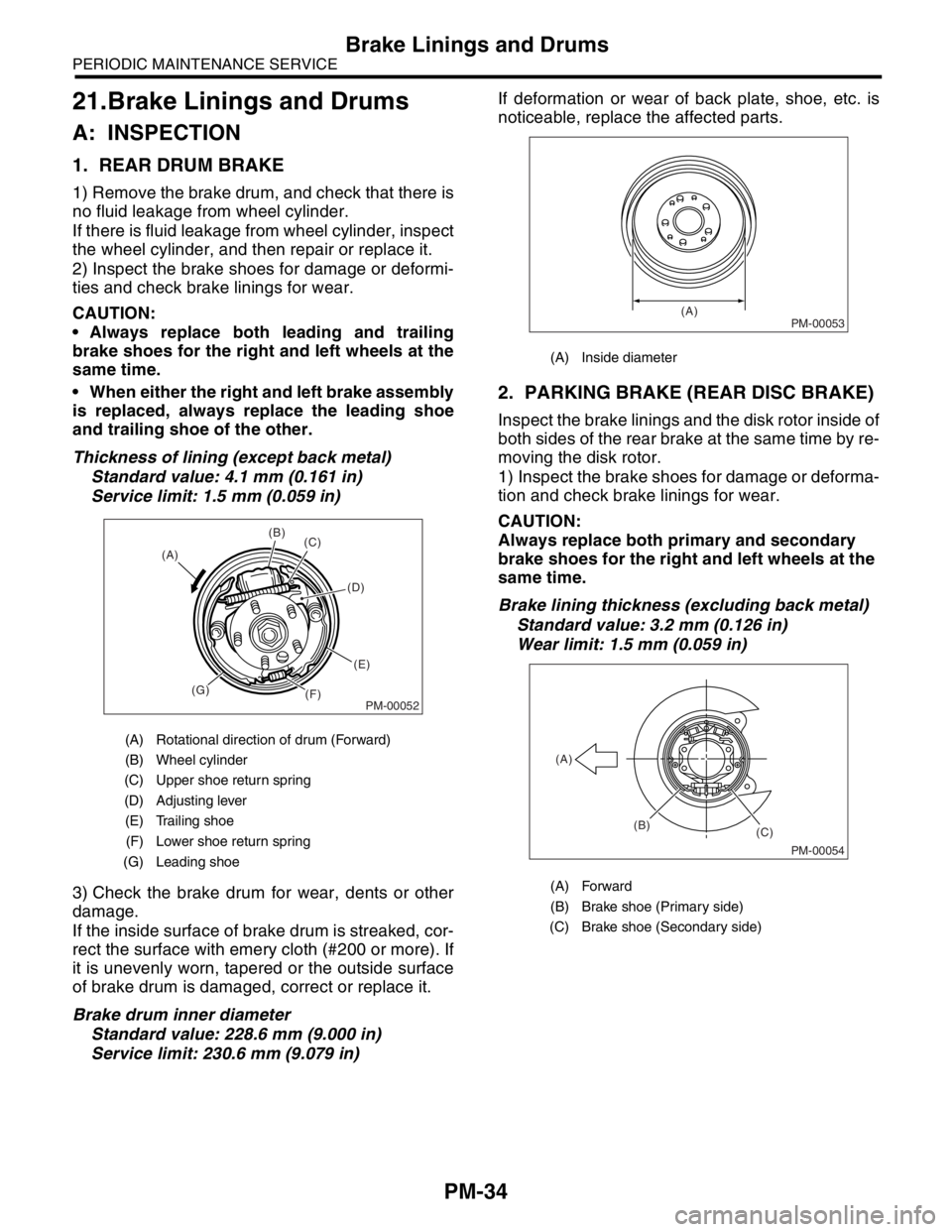
Thickness of lining (except back metal)
Standard value: 4.1 mm (0.161 in)
Service limit: 1.5 mm (0.059 in)
3) Check the brake drum for wear, dents or other
damage.
If the inside surface of brake drum is streaked, cor-
rect the surface with emery cloth (#200 or more). If
it is unevenly worn, tapered or the outside surface
of brake drum is damaged, correct or replace it.
Brake drum inner diameter
Standard value: 228.6 mm (9.000 in)
Service limit: 230.6 mm (9.079 in)If deformation or wear of back plate, shoe, etc. is
noticeable, replace the affected parts.
2. PARKING BRAKE (REAR DISC BRAKE)
Inspect the brake linings and the disk rotor inside of
both sides of the rear brake at the same time by re-
moving the disk rotor.
1) Inspect the brake shoes for damage or deforma-
tion and check brake linings for wear.
CAUTION:
Always replace both primary and secondary
brake shoes for the right and left wheels at the
same time.
Brake lining thickness (excluding back metal)
Standard value: 3.2 mm (0.126 in)
Wear limit: 1.5 mm (0.059 in)
(A) Rotational direction of drum (Forward)
(B) Wheel cylinder
(C) Upper shoe return spring
(D) Adjusting lever
(E) Trailing shoe
(F) Lower shoe return spring
(G) Leading shoe
PM-00052
(B)
(C)
(D)
(E)
(F) (G) (A)
(A) Inside diameter
(A) Forward
(B) Brake shoe (Primary side)
(C) Brake shoe (Secondary side)
PM-00053(A)
PM-00054
(B)
(C) (A)
Page 772 of 2870
PM-35
PERIODIC MAINTENANCE SERVICE
Brake Linings and Drums
2) Check the disk rotor for wear, dents or other
damage. If the inside surface of disk rotor is
streaked, correct the surface with emery cloth
(#200 or more). If it is unevenly worn or tapered,
correct or replace it.
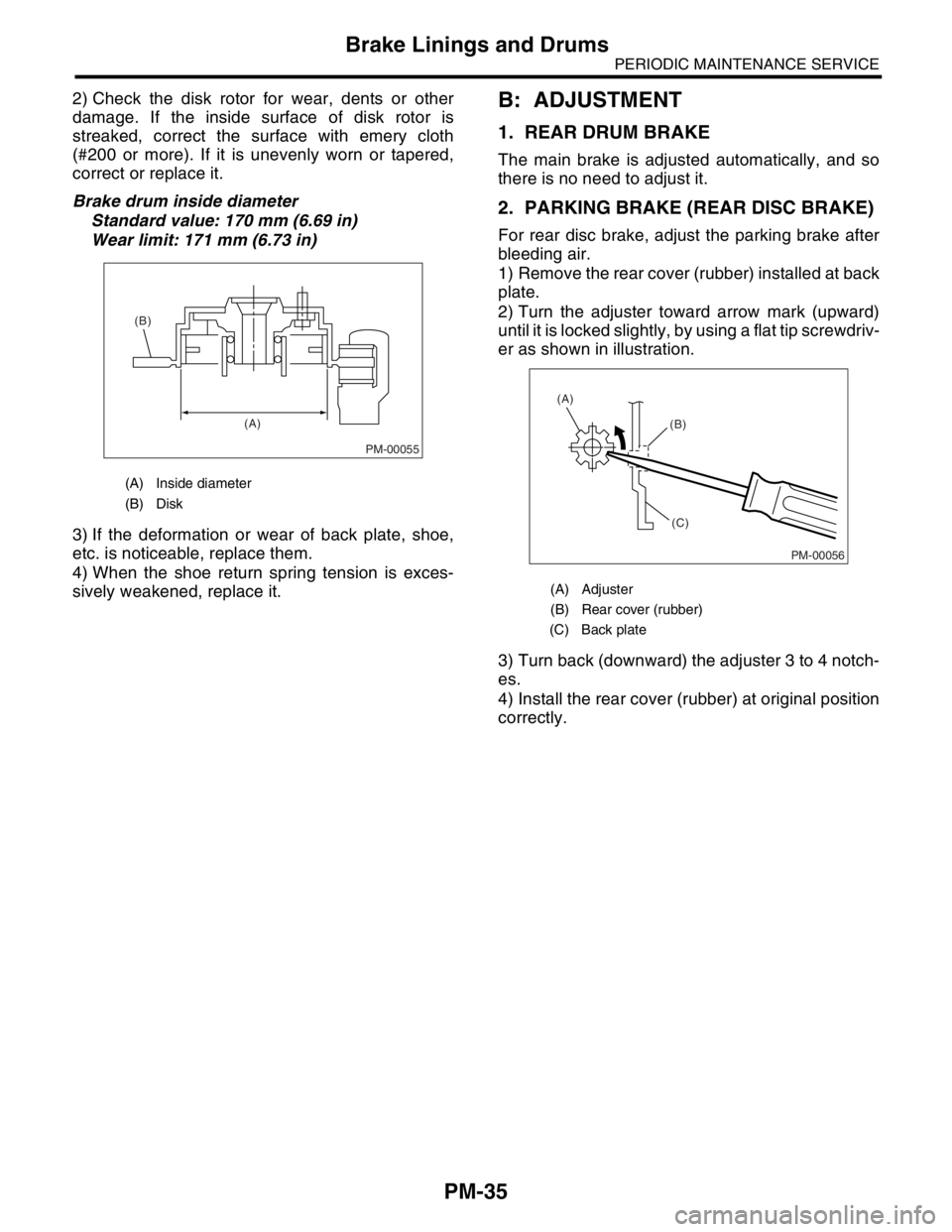
Brake drum inside diameter
Standard value: 170 mm (6.69 in)
Wear limit: 171 mm (6.73 in)
3) If the deformation or wear of back plate, shoe,
etc. is noticeable, replace them.
4) When the shoe return spring tension is exces-
sively weakened, replace it.B: ADJUSTMENT
1. REAR DRUM BRAKE
The main brake is adjusted automatically, and so
there is no need to adjust it.
2. PARKING BRAKE (REAR DISC BRAKE)
For rear disc brake, adjust the parking brake after
bleeding air.
1) Remove the rear cover (rubber) installed at back
plate.
2) Turn the adjuster toward arrow mark (upward)
until it is locked slightly, by using a flat tip screwdriv-
er as shown in illustration.
3) Turn back (downward) the adjuster 3 to 4 notch-
es.
4) Install the rear cover (rubber) at original position
correctly.
(A) Inside diameter
(B) Disk
PM-00055
(A) (B)
(A) Adjuster
(B) Rear cover (rubber)
(C) Back plate
PM-00056
(B)
(C) (A)
Page 779 of 2870
PM-42
PERIODIC MAINTENANCE SERVICE
Steering System (Power Steering)
(2) Retighten the adjusting screw to 7.4 N·m
(0.75 kgf-m, 5.4 ft-lb) and back off 25°.
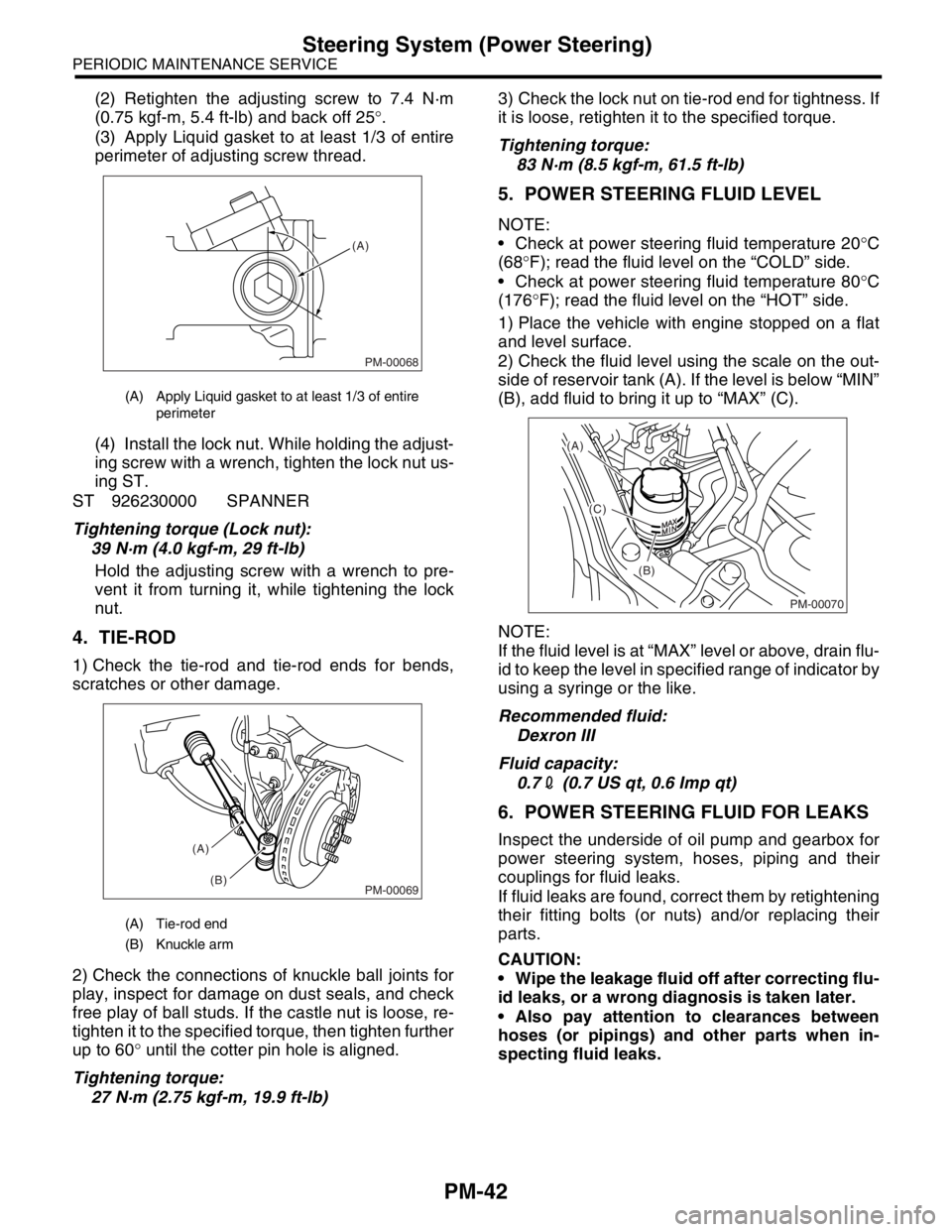
(3) Apply Liquid gasket to at least 1/3 of entire
perimeter of adjusting screw thread.
(4) Install the lock nut. While holding the adjust-
ing screw with a wrench, tighten the lock nut us-
ing ST.
ST 926230000 SPANNER
Tightening torque (Lock nut):
39 N·m (4.0 kgf-m, 29 ft-lb)
Hold the adjusting screw with a wrench to pre-
vent it from turning it, while tightening the lock
nut.
4. TIE-ROD
1) Check the tie-rod and tie-rod ends for bends,
scratches or other damage.
2) Check the connections of knuckle ball joints for
play, inspect for damage on dust seals, and check
free play of ball studs. If the castle nut is loose, re-
tighten it to the specified torque, then tighten further
up to 60° until the cotter pin hole is aligned.
Tightening torque:
27 N·m (2.75 kgf-m, 19.9 ft-lb)3) Check the lock nut on tie-rod end for tightness. If
it is loose, retighten it to the specified torque.
Tightening torque:
83 N·m (8.5 kgf-m, 61.5 ft-lb)
5. POWER STEERING FLUID LEVEL
NOTE:
Check at power steering fluid temperature 20°C
(68°F); read the fluid level on the “COLD” side.
Check at power steering fluid temperature 80°C
(176°F); read the fluid level on the “HOT” side.
1) Place the vehicle with engine stopped on a flat
and level surface.
2) Check the fluid level using the scale on the out-
side of reservoir tank (A). If the level is below “MIN”
(B), add fluid to bring it up to “MAX” (C).
NOTE:
If the fluid level is at “MAX” level or above, drain flu-
id to keep the level in specified range of indicator by
using a syringe or the like.
Recommended fluid:
Dexron III
Fluid capacity:
0.72 (0.7 US qt, 0.6 Imp qt)
6. POWER STEERING FLUID FOR LEAKS
Inspect the underside of oil pump and gearbox for
power steering system, hoses, piping and their
couplings for fluid leaks.
If fluid leaks are found, correct them by retightening
their fitting bolts (or nuts) and/or replacing their
parts.
CAUTION:
Wipe the leakage fluid off after correcting flu-
id leaks, or a wrong diagnosis is taken later.
Also pay attention to clearances between
hoses (or pipings) and other parts when in-
specting fluid leaks.
(A) Apply Liquid gasket to at least 1/3 of entire
perimeter
(A) Tie-rod end
(B) Knuckle arm
PM-00068
(A)
PM-00069
(A)
(B)
PM-00070
(A)
(C)
(B)
Page 811 of 2870
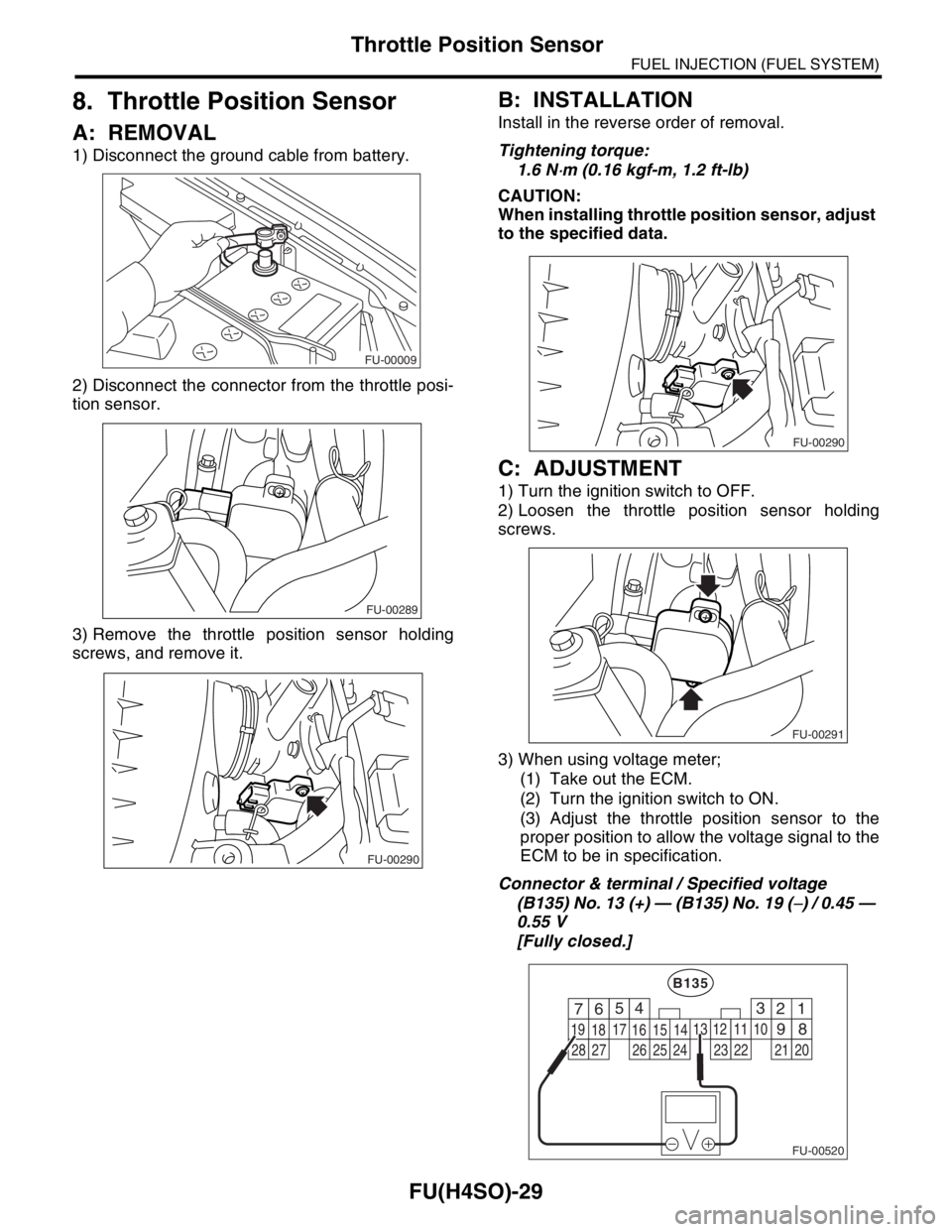
FU(H4SO)-29
FUEL INJECTION (FUEL SYSTEM)
Throttle Position Sensor
8. Throttle Position Sensor
A: REMOVAL
1) Disconnect the ground cable from battery.
2) Disconnect the connector from the throttle posi-
tion sensor.
3) Remove the throttle position sensor holding
screws, and remove it.
B: INSTALLATION
Install in the reverse order of removal.
Tightening torque:
1.6 N
⋅m (0.16 kgf-m, 1.2 ft-lb)
CAUTION:
When installing throttle position sensor, adjust
to the specified data.
C: ADJUSTMENT
1) Turn the ignition switch to OFF.
2) Loosen the throttle position sensor holding
screws.
3) When using voltage meter;
(1) Take out the ECM.
(2) Turn the ignition switch to ON.
(3) Adjust the throttle position sensor to the
proper position to allow the voltage signal to the
ECM to be in specification.
Connector & terminal / Specified voltage
(B135) No. 13 (+) — (B135) No. 19 (
−) / 0.45 —
0.55 V
[Fully closed.]
FU-00009
FU-00289
FU-00290
FU-00290
FU-00291
FU-00520
4
1 526
18 1516
7
891011
17
19
20121314
B135
3
2122232425262728
Page 848 of 2870

FU(H4SO)-66
FUEL INJECTION (FUEL SYSTEM)
Fuel System Trouble in General
29.Fuel System Trouble in General
A: INSPECTION
NOTE:
When the vehicle is left unattended for an ex-
tended period of time, water may accumulate in the
fuel tank.
To prevent water condensation.
(1) Top off the fuel tank or drain the fuel com-
pletely.
(2) Drain the water condensation from the fuel
filter.
Refilling the fuel tank.
Refill the fuel tank while there is still some fuel left in
the tank.
Protecting the fuel system against freezing and
water condensation.
(3) Cold areas :
In snow-covered areas, mountainous areas, ski-
ing areas, etc. where ambient temperatures
drop below 0°C (32°F) throughout the winter
season, use an anti-freeze solution in the fuel
tank. Refueling will also complement the effect
of anti-freeze solution each time the fuel leveldrops to about one-half. After the winter season,
drain the water which may have accumulated in
the fuel filter and fuel tank in the manner same
as that described under “Affected areas” below.
(4) Affected areas :
When the water condensation is notched in the
fuel filter, drain the water from both the fuel filter
and fuel tank or use a water removing agent (or
anti-freeze solution) in the fuel tank.
Observe the instructions, notes, etc., indicated
on the label affixed to the anti-freeze solution (wa-
ter removing agent) container before use.
Trouble and possible cause Corrective action
1. Insufficient fuel supply to the injector
1) Fuel pump will not operate.
❍Defective terminal contact.Inspect connections, especially ground, and tighten
securely.
❍Trouble in electromagnetic or electronic circuit parts. Replace fuel pump.
2) Lowering of fuel pump function. Replace fuel pump.
3) Clogged dust or water in the fuel filter. Replace fuel filter, clean or replace fuel tank.
4) Clogged or bent fuel pipe or hose. Clean, correct or replace fuel pipe or hose.
5) Air is mixed in the fuel system. Inspect or retighten each connection part.
6) Clogged or bent breather tube or pipe. Clean, correct or replace air breather tube or pipe.
7) Damaged diaphragm of pressure regulator. Replace.
2. Leakage or blow out fuel
1) Loosened joints of the fuel pipe. Retightening.
2) Cracked fuel pipe, hose and fuel tank. Replace.
3) Defective welding part on the fuel tank. Replace.
4) Defective drain packing of the fuel tank. Replace.
5) Clogged or bent air breather tube or air vent tube.Clean, correct or replace air breather tube or air vent
tube.
3. Gasoline smell inside of compartment
1)Loose joints at air breather tube, air vent tube and fuel filler
pipe.Retightening.
2) Defective packing air tightness on the fuel saucer. Correct or replace packing.
3) Cracked fuel separator. Replace separator.
4) Inoperative fuel pump modulator or circuit. Replace.
4. Defective fuel meter indicator
1) Defective operation of fuel level sensor. Replace.
2) Defective operation of fuel meter. Replace.
5. Noise
1) Large operation noise or vibration of fuel pump. Replace.
Page 871 of 2870

ME(H4SO)-2
MECHANICAL
General Description
1. General Description
A: SPECIFICATION
NOTE:
STD: Standard I.D.: Inner Diameter O.D.: Outer Diameter US: Undersize OS: Oversize
EngineModel 2.0 L 2.5 L
Ty p eHorizontally opposed, liquid cooled, 4-cylinder, 4-stroke gaso-
line engine
Valve arrangement Belt driven, single over-head camshaft, 4-valve/cylinder
Bore×Stroke mm (in) 92×75 (3.62×2.95)99.5×79.0
(3.917×3.110)
Displacement
cm
3 (cu in)1,994 (121.67) 2,457 (150)
Compression ratio 10.0
Compression pressure
(at 200 — 300 rpm)kPa (kg/cm
2, psi)1,079 — 1,275 (11.0 — 13.0, 156 — 185)
Number of piston rings Pressure ring: 2, Oil ring: 1
Intake valve timingOpen 4° BTDC 1° BTDC
Close 48° ABDC 51° ABDC
Exhaust valve timingOpen 48° BBDC 50° BBDC
Close 4° AT D C 6° AT D C
Valve clearance Intake mm (in) 0.20±0.04 (0.0079±0.0016)
Exhaust mm (in) 0.25±0.04 (0.0098±0.0016)
Idling speed [at neutral position on
MT, or “P” or “N” range on AT]rpm650±100 (No load)
850±100 (A/C switch ON)
Firing order 1 → 3 → 2 → 4
Ignition timing BTDC/rpm 10°±10°/650
Belt
tensioner
adjusterProtrusion of adjuster rod mm (in) 5.7 — 6.7 (0.224 — 0.263)
Belt
tensionerSpacer O.D. mm (in) 17.955 — 17.975 (0.7069 — 0.7077)
Tensioner bush I.D. mm (in) 18.00 — 18.08 (0.7087 — 0.7118)
Clearance between spacer and bush mm (in)STD 0.025 — 0.125 (0.0010 — 0.0049)
Limit 0.175 (0.0069)
Side clearance of spacer mm (in)STD 0.20 — 0.55 (0.0079 — 0.0217)
Limit 0.81 (0.0319)
Valve rocker
armClearance between shaft and arm mm (in)STD 0.020 — 0.054 (0.0008 — 0.0021)
Limit 0.10 (0.0039)
CamshaftBend limit mm (in) 0.025 (0.0010)
Thrust clearance mm (in)STD 0.030 — 0.090 (0.0012 — 0.0035)
Limit 0.10 (0.0039)
Cam lobe height mm (in)2.0 LIntakeSTD 38.732 — 38.832 (1.5249 — 1.5288)
Limit 38.632 (1.5209)
ExhaustSTD 39.259 — 39.359 (1.5456 — 1.5496)
Limit 39.157 (1.5417)
2.5 LIntakeSTD 39.485 — 39.585 (1.5545 — 1.5585)
Limit 39.385 (1.5506)
ExhaustSTD 39.259 — 39.359 (1.5456 — 1.5496)
Limit 39.159 (1.5417)
Camshaft journal O.D. mm (in) 31.928 — 31.945 (1.2570 — 1.2577)
Camshaft journal hole I.D. (Cylinder head) mm (in) 32.000 — 32.018 (1.2598 — 1.2605)
Oil clearance mm (in)STD 0.055 — 0.090 (0.0022 — 0.0035)
Limit 0.10 (0.0039)
Page 872 of 2870

ME(H4SO)-3
MECHANICAL
General Description
Cylinder
headSurface warpage limit (mating with cylinder block) mm (in) 0.05 (0.0020)
Grinding limit mm (in) 0.1 (0.004)
Standard height mm (in) 97.5 (3.84)
Va l ve s e a tRefacing angle90°
Contacting width mm (in)IntakeSTD 1.1 (0.043)
Limit 1.8 (0.070)
ExhaustSTD 1.5 (0.059)
Limit 2.2 (0.087)
Valve guideInner diameter mm (in) 6.000 — 6.012 (0.2362 — 0.2367)
Protrusion above head mm (in)Intake 20.0 — 20.5 (0.787 — 0.807)
Exhaust 16.5 — 17.0 (0.650 — 0.669)
Va l veHead edge thickness mm (in)IntakeSTD 1.0 (0.039)
Limit 0.6 (0.024)
ExhaustSTD 1.2 (0.047)
Limit 0.6 (0.024)
Stem outer diameter mm (in)Intake 5.950 — 5.965 (0.2343 — 0.2348)
Exhaust 5.945 — 5.960(0.2341 — 0.2346)
Stem oil clearance mm (in)STDIntake 0.035 — 0.062 (0.0014 — 0.0024)
Exhaust 0.040 — 0.067 (0.0016 — 0.0026)
Limit — 0.15 (0.0059)
Overall length mm (in)Intake 120.6 (4.75)
Exhaust 121.7 (4.79)
Valve springFree length mm (in) 54.30 (2.1378)
Squareness mm (in) 2.5°, 2.4 (0.094)
Tension/spring height N (kgf, lb)/mm (in)Set214 — 246 (22 — 25, 48 — 55)/
45.0 (1.772)
Lift526 — 582 (54 — 59, 119 — 130)/
34.7 (1.366)
Cylinder
blockSurface warpage limit (mating with cylinder head) mm (in) 0.05 (0.0020)
Grinding limit mm (in) 0.1 (0.004)
Cylinder inner
diametermm (in)2.0 L STDA 92.005 — 92.015 (3.6222 — 3.6226)
B 91.995 — 92.005 (3.6218 — 3.6222)
2.5 L STDA 99.505 — 99.515 (3.9175 — 3.9179)
B 99.495 — 99.505 (3.9171 — 3.9175)
Ta p e r m m ( i n )STD 0.015 (0.0006)
Limit 0.050 (0.0020)
Out-of-roundness mm (in)STD 0.010 (0.0004)
Limit 0.050 (0.0020)
Piston clearance mm (in)STD 0.010 — 0.030 (0.0004 — 0.0012)
Limit 0.050 (0.0020)
Boring mm (in) 0.5 (0.020)
PistonOuter diameter mm (in)2.0 LSTDA 91.985 — 91.995 (3.6214 — 3.6218)
B 91.975 — 91.985 (3.6211 — 3.6214)
0.25 (0.0098) OS 92.225 — 92.235 (3.6309 — 3.6313)
0.50 (0.0197) OS 92.475 — 92.485 (3.6407 — 3.6411)
2.5 LSTDA 99.485 — 99.495 (3.9167 — 3.9171)
B 99.475 — 99.485 (3.9163 — 3.9167)
0.25 (0.0098) OS 99.725 — 99.735 (3.9262 — 3.9266)
0.50 (0.0197) OS 99.975 — 99.985 (3.9360 — 3.9364)
Piston pin standard diameter mm (in) 23.000 — 23.006 (0.9055 — 0.9057)