2004 SUBARU FORESTER replace brake
[x] Cancel search: replace brakePage 773 of 2870
PM-36
PERIODIC MAINTENANCE SERVICE
Suspension
22.Suspension
A: INSPECTION
1. SUSPENSION BALL JOINT
1) Jack-up the vehicle until front wheels are off
ground.
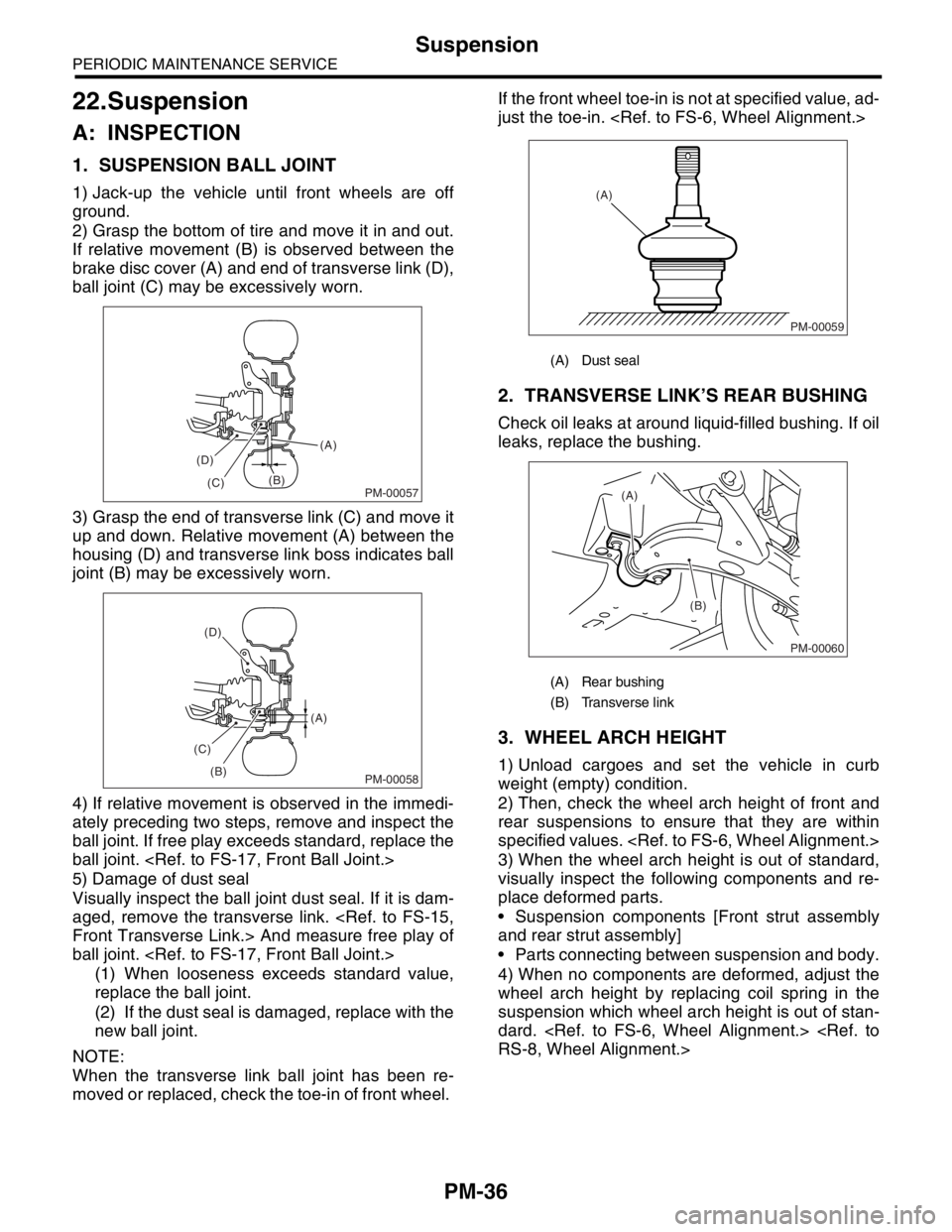
2) Grasp the bottom of tire and move it in and out.
If relative movement (B) is observed between the
brake disc cover (A) and end of transverse link (D),
ball joint (C) may be excessively worn.
3) Grasp the end of transverse link (C) and move it
up and down. Relative movement (A) between the
housing (D) and transverse link boss indicates ball
joint (B) may be excessively worn.
4) If relative movement is observed in the immedi-
ately preceding two steps, remove and inspect the
ball joint. If free play exceeds standard, replace the
ball joint.
5) Damage of dust seal
Visually inspect the ball joint dust seal. If it is dam-
aged, remove the transverse link.
ball joint.
(1) When looseness exceeds standard value,
replace the ball joint.
(2) If the dust seal is damaged, replace with the
new ball joint.
NOTE:
When the transverse link ball joint has been re-
moved or replaced, check the toe-in of front wheel. If the front wheel toe-in is not at specified value, ad-
just the toe-in.
2. TRANSVERSE LINK’S REAR BUSHING
Check oil leaks at around liquid-filled bushing. If oil
leaks, replace the bushing.
3. WHEEL ARCH HEIGHT
1) Unload cargoes and set the vehicle in curb
weight (empty) condition.
2) Then, check the wheel arch height of front and
rear suspensions to ensure that they are within
specified values.
3) When the wheel arch height is out of standard,
visually inspect the following components and re-
place deformed parts.
Suspension components [Front strut assembly
and rear strut assembly]
Parts connecting between suspension and body.
4) When no components are deformed, adjust the
wheel arch height by replacing coil spring in the
suspension which wheel arch height is out of stan-
dard.
PM-00057
(A)
(B)
(C) (D)
PM-00058
(A)
(B) (C)(D)
(A) Dust seal
(A) Rear bushing
(B) Transverse link
PM-00059
(A)
PM-00060
(A)
(B)
Page 909 of 2870
ME(H4SO)-40
MECHANICAL
Engine Assembly
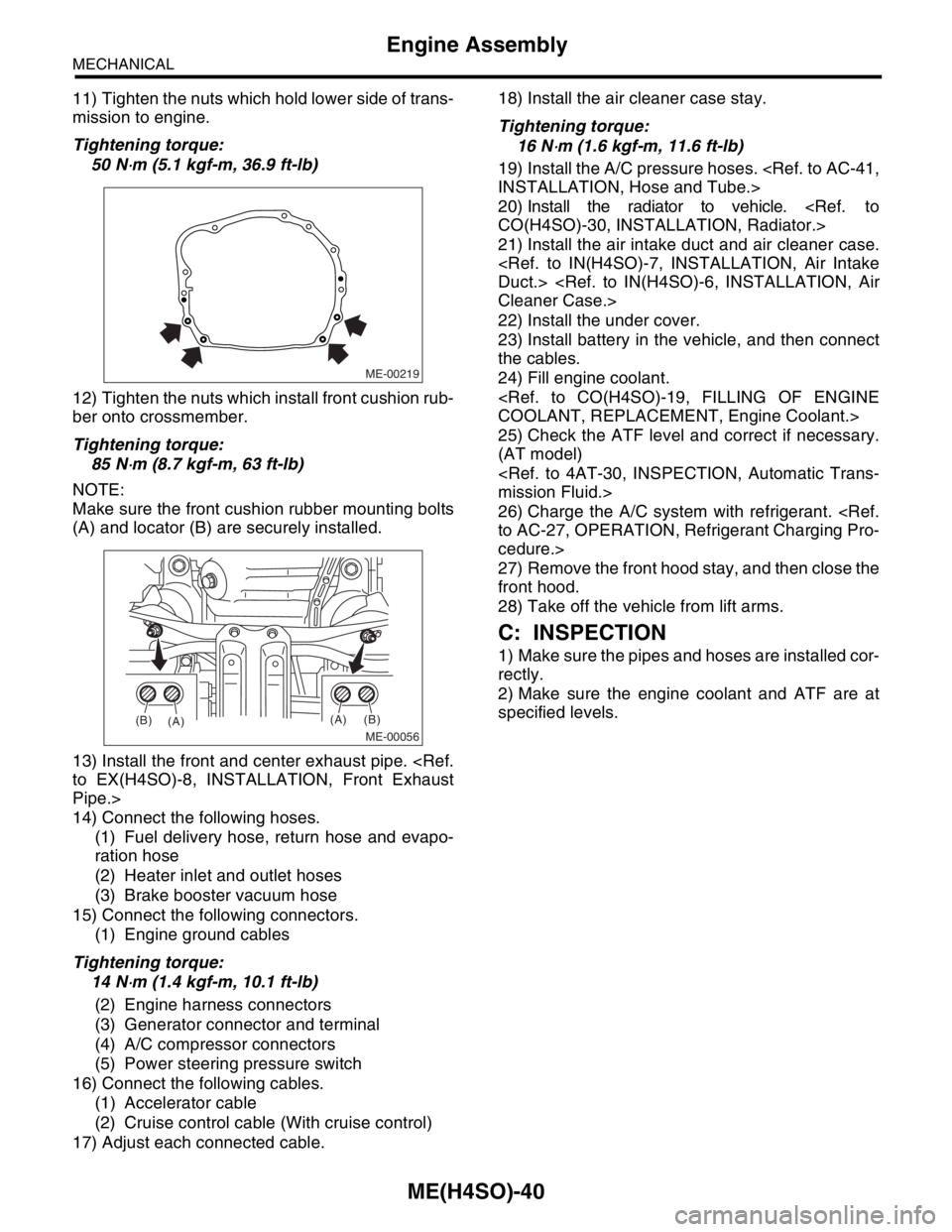
11) Tighten the nuts which hold lower side of trans-
mission to engine.
Tightening torque:
50 N
⋅m (5.1 kgf-m, 36.9 ft-lb)
12) Tighten the nuts which install front cushion rub-
ber onto crossmember.
Tightening torque:
85 N
⋅m (8.7 kgf-m, 63 ft-lb)
NOTE:
Make sure the front cushion rubber mounting bolts
(A) and locator (B) are securely installed.
13) Install the front and center exhaust pipe.
Pipe.>
14) Connect the following hoses.
(1) Fuel delivery hose, return hose and evapo-
ration hose
(2) Heater inlet and outlet hoses
(3) Brake booster vacuum hose
15) Connect the following connectors.
(1) Engine ground cables
Tightening torque:
14 N
⋅m (1.4 kgf-m, 10.1 ft-lb)
(2) Engine harness connectors
(3) Generator connector and terminal
(4) A/C compressor connectors
(5) Power steering pressure switch
16) Connect the following cables.
(1) Accelerator cable
(2) Cruise control cable (With cruise control)
17) Adjust each connected cable.18) Install the air cleaner case stay.
Tightening torque:
16 N
⋅m (1.6 kgf-m, 11.6 ft-lb)
19) Install the A/C pressure hoses.
20) Install the radiator to vehicle.
21) Install the air intake duct and air cleaner case.
22) Install the under cover.
23) Install battery in the vehicle, and then connect
the cables.
24) Fill engine coolant.
25) Check the ATF level and correct if necessary.
(AT model)
26) Charge the A/C system with refrigerant.
cedure.>
27) Remove the front hood stay, and then close the
front hood.
28) Take off the vehicle from lift arms.
C: INSPECTION
1) Make sure the pipes and hoses are installed cor-
rectly.
2) Make sure the engine coolant and ATF are at
specified levels.
ME-00219
ME-00056
(A)
(A)(B)
(B)
Page 1026 of 2870

CO(H4SO)-43
COOLING
Engine Cooling System Trouble in General
12.Engine Cooling System Trouble in General
A: INSPECTION
Trouble Possible cause Corrective action
Over-heatinga. Insufficient engine coolantReplenish the engine coolant, inspect for leakage, and
repair.
b. Loose timing belt Repair or replace the timing belt tensioner.
c. Oil on drive belt Replace.
d. Malfunction of thermostat Replace.
e. Malfunction of water pump Replace.
f. Clogged engine coolant passage Clean.
g. Improper ignition timingInspect and repair the ignition control system.
h. Clogged or leaking radiator Clean or repair, or replace.
i. Improper engine oil in engine coolant Replace the engine coolant.
j. Air/fuel mixture ratio too leanInspect and repair the fuel injection system.
k. Excessive back pressure in exhaust system Clean or replace.
l. Insufficient clearance between piston and cylinder Adjust or replace.
m. Slipping clutch Repair or replace.
n. Dragging brake Adjust.
o. Defective thermostat Replace.
p. Malfunction of radiator fanInspect the radiator fan relay, engine coolant tempera-
ture sensor or radiator motor and replace there.
Over-coolinga. Atmospheric temperature extremely low Partly cover the radiator front area.
b. Defective thermostat Replace.
Engine coolant
leaks.a. Loosened or damaged connecting units on hoses Repair or replace.
b. Leakage from water pump Replace.
c. Leakage from water pipe Repair or replace.
d. Leakage around cylinder head gasket Retighten the cylinder head bolts or replace gasket.
e. Damaged or cracked cylinder head and crankcase Repair or replace.
f. Damaged or cracked thermostat case Repair or replace.
g. Leakage from radiator Repair or replace.
Noisea. Defective drive belt Replace.
b. Defective radiator fan Replace.
c. Defective water pump bearing Replace the water pump.
d. Defective water pump mechanical seal Replace the water pump.
Page 1304 of 2870
EN(H4SO)-206
ENGINE (DIAGNOSTIC)
Diagnostic Procedure with Diagnostic Trouble Code (DTC)
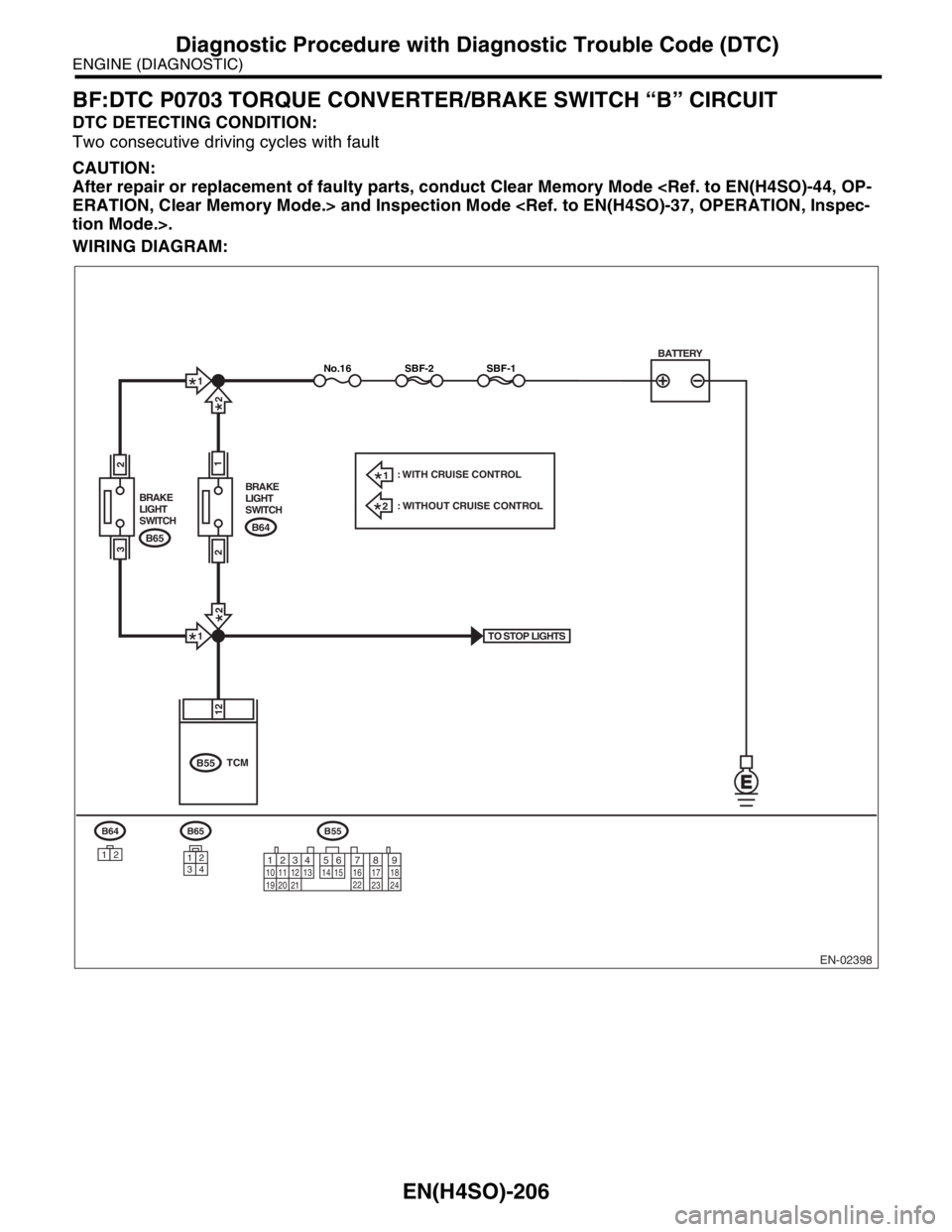
BF:DTC P0703 TORQUE CONVERTER/BRAKE SWITCH “B” CIRCUIT
DTC DETECTING CONDITION:
Two consecutive driving cycles with fault
CAUTION:
After repair or replacement of faulty parts, conduct Clear Memory Mode
WIRING DIAGRAM:
EN-02398
BATTERY
B65
34
12
TO STOP LIGHTS
SBF-1SBF-2No.16
B65 BRAKE
LIGHT
SWITCH
2
3
B64 BRAKE
LIGHT
SWITCH
1
B64
12
B55
B55
12
TCM
2
1
2
2
1
2
1: WITH CRUISE CONTROL
: WITHOUT CRUISE CONTROL
12
789 56 3410 11 12
19 20 2113 14 15 16 17 18
22
23
24
Page 1305 of 2870

EN(H4SO)-207
ENGINE (DIAGNOSTIC)
Diagnostic Procedure with Diagnostic Trouble Code (DTC)
Step Check Yes No
1 CHECK OPERATION OF BRAKE LIGHT.Does the brake light come on
when depressing the brake
pedal?Go to step 2.Repair or replace
the brake light cir-
cuit.
2 CHECK HARNESS BETWEEN TCM AND
BRAKE LIGHT SWITCH CONNECTOR.
1) Disconnect the connectors from TCM and
brake light switch.
2) Measure the resistance of harness
between TCM and brake light switch connec-
tor.
Connector & terminal
WITHOUT CRUISE CONTROL
(B55) No. 12 — (B64) No. 2:
WITH CRUISE CONTROL
(B55) No. 12 — (B65) No. 3:Is the resistance less than 1
Ω?Go to step 3.Repair or replace
the harness and
connector.
N
OTE:
In this case repair
the following:
Open circuit in
harness between
TCM and brake
light switch con-
nector
Poor contact in
TCM connector
Poor contact in
brake light switch
connector
3 CHECK HARNESS BETWEEN TCM AND
BRAKE LIGHT SWITCH CONNECTOR.
Measure the resistance of harness between
TCM and chassis ground.
Connector & terminal
(B55) No. 12 — Chassis ground:Is the resistance more than 1
MΩ?Go to step 4.Repair ground
short circuit in har-
ness between
TCM and brake
light switch con-
nector.
4 CHECK INPUT SIGNAL FOR TCM.
1) Connect the connectors to TCM and brake
light switch.
2) Measure the voltage between TCM and
chassis ground.
Connector & terminal
(B55) No. 12 (+) — Chassis ground (
−):Is the voltage less than 1 V
when releasing the brake
pedal?Go to step 5.Adjust or replace
the brake light
switch.
SWITCH,
INSPECTION,
Stop Light Sys-
tem.>
5 CHECK INPUT SIGNAL FOR TCM.
Measure the voltage between TCM and chas-
sis ground.
Connector & terminal
(B55) No. 12 (+) — Chassis ground (
−):Is the voltage more than 10 V
when depressing the brake
pedal?Go to step 6.Adjust or replace
the brake light
switch.
SWITCH,
INSPECTION,
Stop Light Sys-
tem.>
6 CHECK POOR CONTACT.
Check poor contact in TCM connector.Is there poor contact in TCM
connector?Repair poor con-
tact in TCM con-
nector.Replace the TCM.
trol Module
(TCM).>
Page 1307 of 2870

EN(H4SO)-209
ENGINE (DIAGNOSTIC)
Diagnostic Procedure with Diagnostic Trouble Code (DTC)
BJ:DTC P0734 GEAR 4 INCORRECT RATIO
DTC DETECTING CONDITION:
Two consecutive driving cycles with fault
TROUBLE SYMPTOM:
Shift point too high or too low.
Engine brake not effected in 3rd range.
Excessive shift shock.
Excessive tight corner braking.
CAUTION:
After repair or replacement of faulty parts, conduct Clear Memory Mode
Step Check Yes No
1 CHECK ANY OTHER DTC ON DISPLAY.Is any other DTC displayed? Inspect the rele-
vant DTC using
“List of Diagnostic
Trouble Code
(DTC)”.
of Diagnostic Trou-
ble Code (DTC).>Go to step 2.
2 CHECK THROTTLE POSITION SENSOR
CIRCUIT.
Check the throttle position sensor circuit.
TION SENSOR, Diagnostic Procedure with
Diagnostic Trouble Code (DTC).>Is there any trouble in throttle
position sensor circuit?Repair or replace
the throttle posi-
tion sensor circuit.Go to step 3.
3 CHECK FRONT VEHICLE SPEED SENSOR
CIRCUIT.
Check front vehicle speed sensor circuit.
SPEED SENSOR, Diagnostic Procedure with
Diagnostic Trouble Code (DTC).>Is there any trouble in front
vehicle speed sensor circuit?Repair or replace
the front vehicle
speed sensor cir-
cuit.Go to step 4.
4 CHECK TORQUE CONVERTER TURBINE
SPEED SENSOR CIRCUIT.
Check torque converter turbine speed sensor
circuit.
SENSOR, Diagnostic Procedure with Diagnos-
tic Trouble Code (DTC).>Is there any trouble in torque
converter turbine speed sensor
circuit?Repair or replace
the torque con-
ver ter turbine
speed sensor cir-
cuit.Go to step 5.
5 CHECK POOR CONTACT.
Check poor contact in TCM connector.Is there poor contact in TCM
connector?Repair poor con-
tact in TCM con-
nector.Go to step 6.
6 CHECK MECHANICAL TROUBLE.
Check mechanical trouble in automatic trans-
mission.Is there any mechanical trou-
ble in automatic transmission?Repair or replace
the automatic
transmission.
Road Test.>Replace the TCM.
trol Module
(TCM).>
Page 1308 of 2870

EN(H4SO)-210
ENGINE (DIAGNOSTIC)
Diagnostic Procedure with Diagnostic Trouble Code (DTC)
BK:DTC P0741 TORQUE CONVERTER CLUTCH CIRCUIT PERFORMANCE OR
STUCK OFF
DTC DETECTING CONDITION:
Two consecutive driving cycles with fault
TROUBLE SYMPTOM:
No lock-up (after engine warm-up)
No shift or excessive tight corner “braking”
CAUTION:
After repair or replacement of faulty parts, conduct Clear Memory Mode
Step Check Yes No
1 CHECK ANY OTHER DTC ON DISPLAY.Is any other DTC displayed? Inspect the rele-
vant DTC using
“List of Diagnostic
Trouble Code
(DTC)”.
of Diagnostic Trou-
ble Code (DTC).>Go to step 2.
2 CHECK LOCK-UP DUTY SOLENOID CIR-
CUIT.
Check lock-up duty solenoid circuit.
SOLENOID, Diagnostic Procedure with Diag-
nostic Trouble Code (DTC).>Is there any trouble in lock-up
duty solenoid circuit?Repair or replace
the lock-up duty
solenoid circuit.Go to step 3.
3 CHECK THROTTLE POSITION SENSOR
CIRCUIT.
Check the throttle position sensor circuit.
TION SENSOR, Diagnostic Procedure with
Diagnostic Trouble Code (DTC).>Is there any trouble in throttle
position sensor circuit?Repair or replace
the throttle posi-
tion sensor circuit.Go to step 4.
4 CHECK TORQUE CONVERTER TURBINE
SPEED SENSOR CIRCUIT.
Check torque converter turbine speed sensor
circuit.
SENSOR, Diagnostic Procedure with Diagnos-
tic Trouble Code (DTC).>Is there any trouble in torque
converter turbine speed sensor
circuit?Repair or replace
the torque con-
ver ter turbine
speed sensor cir-
cuit.Go to step 5.
5 CHECK ENGINE SPEED INPUT CIRCUIT.
Check engine speed input circuit.
NAL, Diagnostic Procedure with Diagnostic
Trouble Code (DTC).>Is there any trouble in engine
speed input circuit?Repair or replace
the engine speed
input circuit.Go to step 6.
6 CHECK INHIBITOR SWITCH CIRCUIT.
Check inhibitor switch circuit.
Diagnostic Procedure without Diagnostic Trou-
ble Code (DTC).>Is there any trouble in inhibitor
switch circuit?Repair or replace
the inhibitor switch
circuit.Go to step 7.
7 CHECK BRAKE LIGHT SWITCH CIRCUIT.
Check brake light switch circuit.
Diagnostic Procedure without Diagnostic Trou-
ble Code (DTC).>Is there any trouble in brake
light switch circuit?Repair or replace
the brake light
switch circuit.Go to step 8.
Page 2384 of 2870
4AT-71
AUTOMATIC TRANSMISSION
Shift Solenoids, Duty Solenoids and ATF Temperature Sensor
19.Shift Solenoids, Duty Sole-
noids and ATF Temperature
Sensor
A: REMOVAL
1. SHIFT SOLENOID AND DUTY SOLE-
NOID
1) Lift-up the vehicle.
2) Clean the transmission exterior.
3) Drain the ATF completely.
4) Replace the gasket with new one, and then tight-
en the drain plug (ATF).
Tightening torque:
25 N
⋅m (2.5 kgf-m, 18.1 ft-lb)
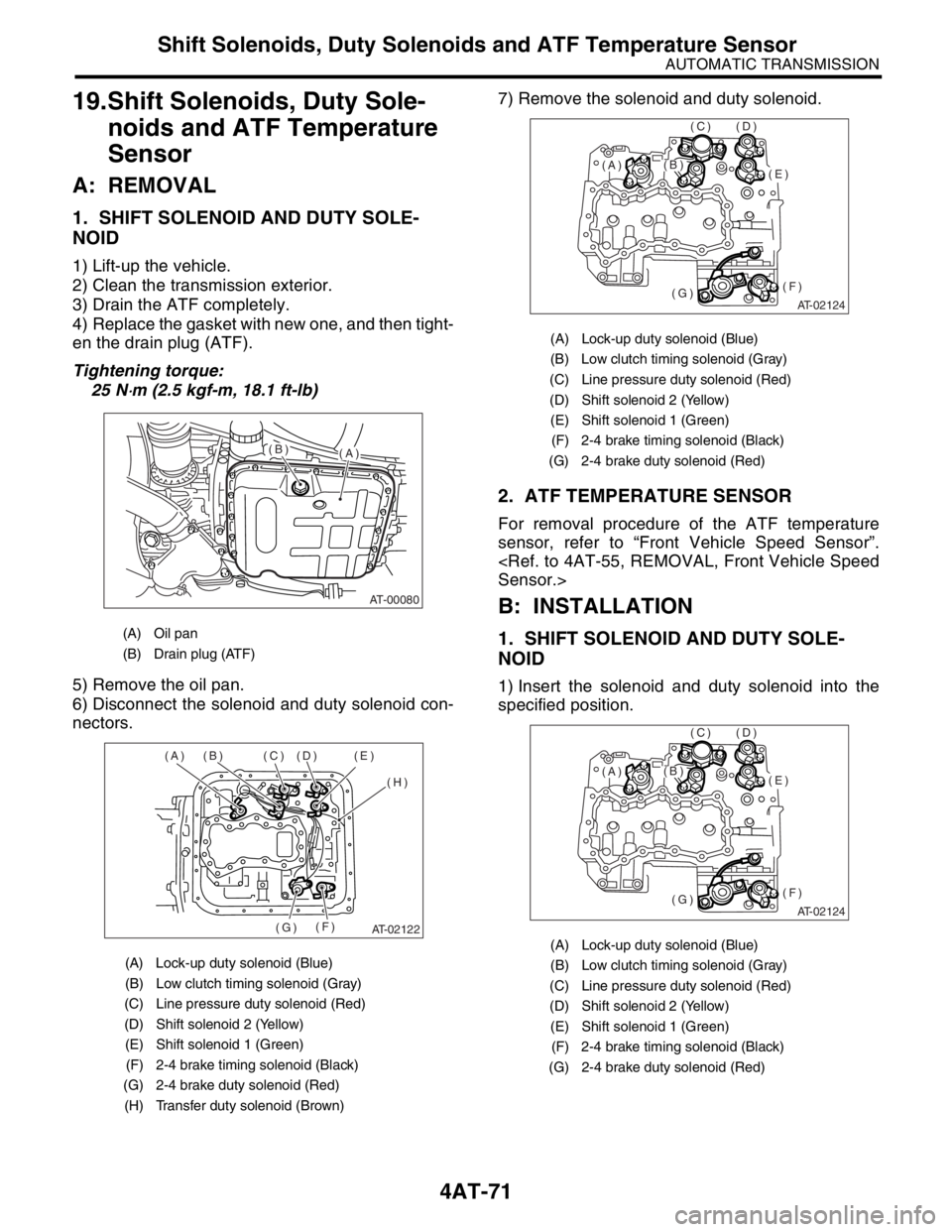
5) Remove the oil pan.
6) Disconnect the solenoid and duty solenoid con-
nectors.7) Remove the solenoid and duty solenoid.
2. ATF TEMPERATURE SENSOR
For removal procedure of the ATF temperature
sensor, refer to “Front Vehicle Speed Sensor”.
B: INSTALLATION
1. SHIFT SOLENOID AND DUTY SOLE-
NOID
1) Insert the solenoid and duty solenoid into the
specified position.
(A) Oil pan
(B) Drain plug (ATF)
(A) Lock-up duty solenoid (Blue)
(B) Low clutch timing solenoid (Gray)
(C) Line pressure duty solenoid (Red)
(D) Shift solenoid 2 (Yellow)
(E) Shift solenoid 1 (Green)
(F) 2-4 brake timing solenoid (Black)
(G) 2-4 brake duty solenoid (Red)
(H) Transfer duty solenoid (Brown)
AT-00080
(A)(B)
AT-02122
(A) (B) (C) (D) (E)
(H)
(F)
(G)
(A) Lock-up duty solenoid (Blue)
(B) Low clutch timing solenoid (Gray)
(C) Line pressure duty solenoid (Red)
(D) Shift solenoid 2 (Yellow)
(E) Shift solenoid 1 (Green)
(F) 2-4 brake timing solenoid (Black)
(G) 2-4 brake duty solenoid (Red)
(A) Lock-up duty solenoid (Blue)
(B) Low clutch timing solenoid (Gray)
(C) Line pressure duty solenoid (Red)
(D) Shift solenoid 2 (Yellow)
(E) Shift solenoid 1 (Green)
(F) 2-4 brake timing solenoid (Black)
(G) 2-4 brake duty solenoid (Red)
AT-02124
(E)
(F)(G)
(D)(C)
(B)(A)
AT-02124
(E)
(F)(G)
(D)(C)
(B)(A)