2004 SUBARU FORESTER replace brake
[x] Cancel search: replace brakePage 2526 of 2870

4AT(H4SO)-67
AUTOMATIC TRANSMISSION (DIAGNOSTIC)
Diagnostic Procedure with Diagnostic Trouble Code (DTC)
6 CHECK POOR CONTACT.Is there poor contact in 2-4
brake timing solenoid circuit?Repair the poor
contact.Replace the TCM.
trol Module
(TCM).>
7 CHECK 2-4 BRAKE TIMING SOLENOID (IN
TRANSMISSION).
1) Remove the transmission connector from
bracket.
2) Lift-up or raise the vehicle and support with
rigid rack.
N
OTE:
Raise all wheels off ground.
3) Drain the ATF.
CAUTION:
Do not drain the ATF until it cools down.
4) Remove the oil pan, and disconnect con-
nector from 2-4 brake timing solenoid.
5) Measure the resistance between 2-4 brake
timing solenoid connector and transmission
ground.
Te r m i n a l s
No. 1 — Transmission ground:Is the resistance 10 — 16 Ω? Go to step 8.Replace the 2-4
brake timing sole-
noid.
noids, Duty Sole-
noids and ATF
Temperature Sen-
sor.>
8 CHECK HARNESS CONNECTOR BETWEEN
2-4 BRAKE TIMING SOLENOID AND
TRANSMISSION.
Measure the resistance of harness between 2-
4 brake timing solenoid and transmission con-
nector.
Connector & terminal
(AT8) No. 1 — (T4) No. 4:Is the resistance less than 1
Ω?Go to step 9.Repair the open
circuit in harness
between 2-4 brake
timing solenoid
and transmission
connector.
9 CHECK HARNESS CONNECTOR BETWEEN
2-4 BRAKE TIMING SOLENOID AND
TRANSMISSION.
Measure the resistance of harness between 2-
4 brake timing solenoid connector and trans-
mission ground.
Connector & terminal
(T4) No. 4 — Transmission ground:Is the resistance more than 1
MΩ?Even if the
POWER indicator
light was blinking,
the circuit has
returned to a nor-
mal condition at
this time. A tempo-
rary poor contact
of the connector or
harness may be
the cause. Repair
the harness or
connector in 2-4
brake timing sole-
noid and transmis-
sion.Repair the short
circuit harness
between 2-4 brake
timing solenoid
and transmission
connector. Step Check Yes No
Page 2532 of 2870

4AT(H4SO)-73
AUTOMATIC TRANSMISSION (DIAGNOSTIC)
Diagnostic Procedure with Diagnostic Trouble Code (DTC)
8 CHECK OUTPUT SIGNAL EMITTED FROM
TCM USING SUBARU SELECT MONITOR.
1) Turn the ignition switch to ON (engine
OFF).
2) Throttle is fully open.
3) Read the data of 2-4 brake duty solenoid
using Subaru Select Monitor.Is the value less than 25%? Even if the
POWER indicator
light was blinking,
the circuit has
returned to a nor-
mal condition at
this time. A tempo-
rary poor contact
of the connector or
harness may be
the cause. Repair
the harness or
connector in TCM
and transmission.Go to step 9.
9 CHECK POOR CONTACT.Is there poor contact in 2-4
brake duty solenoid circuit?Repair the poor
contact.Replace the TCM.
trol Module
(TCM).>
10 CHECK 2-4 BRAKE DUTY SOLENOID (IN
TRANSMISSION).
1) Remove the transmission connector from
bracket.
2) Drain the ATF.
CAUTION:
Do not drain the ATF until it cools down.
3) Remove the oil pan, and disconnect con-
nector from 2-4 brake duty solenoid.
4) Measure the resistance between 2-4 brake
duty solenoid connector and transmission
ground.
Te r m i n a l s
No. 1 — Transmission ground:Is the resistance 2.0 — 4.5 Ω? Go to step 11.Replace the 2-4
brake duty sole-
noid.
noids, Duty Sole-
noids and ATF
Temperature Sen-
sor.>
11 CHECK HARNESS CONNECTOR BETWEEN
TRANSMISSION AND 2-4 BRAKE DUTY SO-
LENOID.
Measure the resistance of harness between 2-
4 brake duty solenoid and transmission con-
nector.
Connector & terminal
(T4) No. 9 — (AT7) No. 1:Is the resistance less than 1
Ω?Go to step 12.Repair the open
circuit in harness
between 2-4 brake
duty solenoid and
transmission con-
nector.
12 CHECK HARNESS CONNECTOR BETWEEN
TRANSMISSION AND 2-4 BRAKE DUTY SO-
LENOID.
Measure the resistance of harness between
transmission connector and transmission
ground.
Connector & terminal
(T4) No. 9 — Transmission ground:Is the resistance more than 1
MΩ?Even if the
POWER indicator
light was blinking,
the circuit has
returned to a nor-
mal condition at
this time. A tempo-
rary poor contact
of the connector or
harness may be
the cause. Repair
the harness or
connector in line
pressure duty
solenoid and
transmission.Repair the short
circuit in harness
between 2-4 brake
duty solenoid and
transmission con-
nector. Step Check Yes No
Page 2545 of 2870

4AT(H4SO)-86
AUTOMATIC TRANSMISSION (DIAGNOSTIC)
Diagnostic Procedure without Diagnostic Trouble Code (DTC)
Step Check Yes No
1 CHECK FWD SWITCH.
Connect the Subaru Select Monitor to data link
connector, and then change to LED display
screen.When the fuse is inserted to
FWD switch, does LED light
up?Go to step CHECK
BRAKE SWITCH.
CHECK BRAKE
SWITCH, Diag-
nostic Procedure
without Diagnostic
Trouble Code
(DTC).>Go to step 2.
2 CHECK FWD INDICATOR LIGHT.
1) Turn the ignition switch to OFF.
2) Disconnect the TCM connector.
3) Turn the ignition switch to ON.
4) Short the combination meter connector to
chassis ground.
CAUTION:
Be sure to short through fuse.
Connector & terminal
(i10) No. 22 — Chassis ground:Does the FWD indicator light
illuminate?Go to step 3.Inspect the combi-
nation meter.
Meter Assembly.>
3 CHECK HARNESS CONNECTOR BETWEEN
TCM AND FWD SWITCH.
1) Turn the ignition switch to OFF.
2) Disconnect the connector from TCM and
FWD switch.
3) Measure the resistance of harness
between TCM and FWD switch connector.
Connector & terminal
(B55) No. 20 — (F27) No. 36:Is the resistance less than 1
Ω?Go to step 4.Repair the open
circuit in harness
between TCM and
FWD switch con-
nector.
4 CHECK HARNESS CONNECTOR BETWEEN
TCM AND FWD SWITCH.
Measure the resistance of harness connector
between TCM and body to make sure that cir-
cuit does not short.
Connector & terminal
(B55) No. 20 — Chassis ground:Is the resistance more than 1
MΩ?Go to step 5.Repair the short
circuit in harness
between TCM and
FWD switch con-
nector.
5 CHECK HARNESS CONNECTOR BETWEEN
FWD SWITCH AND CHASSIS GROUND.
Measure the resistance of harness between
FWD switch and chassis ground.
Connector & terminal
(F27) No. 35 — Chassis ground:Is the resistance less than 1
Ω?Go to step 6.Repair the open
circuit in harness
between FWD
switch connector
and chassis
ground.
6 CHECK INPUT SIGNAL FOR TCM.
1) Turn the ignition switch to OFF.
2) Connect the connector to TCM and FWD
switch.
3) Turn the ignition switch to ON.
4) Measure the signal voltage for TCM while
installing the fuse to FWD switch connector.
Connector & terminal
(B55) No. 20 (+) — Chassis ground (
−):Is the voltage less than 1 V? Go to step 7.Go to step 11.
7 CHECK INPUT SIGNAL FOR TCM.
Measure the signal voltage for TCM while
removing the fuse from FWD switch connector.
Connector & terminal
(B55) No. 20 (+) — Chassis ground (
−):Is the voltage 6 — 9.1 V? Go to step 8.Replace the TCM.
trol Module
(TCM).>
Page 2654 of 2870

4AT(H4DOTC)-78
AUTOMATIC TRANSMISSION (DIAGNOSTIC)
Diagnostic Procedure with Diagnostic Trouble Code (DTC)
9 CHECK POOR CONTACT.Is there poor contact in 2-4
brake duty solenoid circuit?Repair the poor
contact.Replace the TCM.
trol Module
(TCM).>
10 CHECK 2-4 BRAKE DUTY SOLENOID (IN
TRANSMISSION).
1) Remove the transmission connector from
bracket.
2) Drain the ATF.
CAUTION:
Do not drain the ATF until it cools down.
3) Remove the oil pan, and disconnect con-
nector from 2-4 brake duty solenoid.
4) Measure the resistance of harness
between 2-4 brake duty solenoid connector
and transmission ground.
Connector & terminal
(AT12) No. 6 — Transmission ground:Is the resistance 2.0 — 4.5 Ω? Go to step 11.Replace the control
valve body.
Valve Body.>
11 CHECK HARNESS CONNECTOR BETWEEN
2-4 BRAKE DUTY SOLENOID AND TRANS-
MISSION.
Measure the resistance of harness between 2-
4 brake duty solenoid and transmission con-
nector.
Connector & terminal
(T4) No. 3 — (AT12) No. 6:Is the resistance less than 1
Ω?Go to step 12.Repair the open
circuit in harness
between 2-4 brake
clutch duty sole-
noid and transmis-
sion connector.
12 CHECK HARNESS CONNECTOR BETWEEN
2-4 BRAKE DUTY SOLENOID AND TRANS-
MISSION.
Measure the resistance of harness between
transmission connector and transmission
ground.
Connector & terminal
(T4) No. 3 — Transmission ground:Is the resistance more than 1
MΩ?Even if the POWER
indicator light was
blinking, the circuit
has returned to a
normal condition at
this time. A tempo-
rary poor contact of
the connector or
harness may be the
cause. Repair the
harness or connec-
tor in 2-4 brake duty
solenoid and trans-
mission.Repair the short
circuit harness
between 2-4 brake
duty solenoid and
transmission con-
nector. Step Check Yes No
Page 2661 of 2870

4AT(H4DOTC)-85
AUTOMATIC TRANSMISSION (DIAGNOSTIC)
Diagnostic Procedure with Diagnostic Trouble Code (DTC)
8 CHECK OUTPUT SIGNAL FROM TCM US-
ING SUBARU SELECT MONITOR.
1) Shift the select lever to “1” range.
2) Read the data of low & reverse duty sole-
noid.Is the value 61.5%? Even if the POWER
indicator light was
blinking, the circuit
has returned to a
normal condition at
this time. A tempo-
rary poor contact of
the connector or
harness may be the
cause. Repair the
harness or connec-
tor in TCM and
transmission.Go to step 9.
9 CHECK POOR CONTACT.Is there poor contact in low &
reverse duty solenoid circuit?Repair the poor
contact.Replace the TCM.
trol Module
(TCM).>
10 CHECK LOW & REVERSE BRAKE DUTY
SOLENOID (IN TRANSMISSION).
1) Remove the transmission connector from
bracket.
2) Drain the ATF.
CAUTION:
Do not drain the ATF until it cools down.
3) Remove the oil pan, and disconnect con-
nector from low & reverse brake duty solenoid.
4) Measure the resistance between low &
reverse brake duty solenoid connector and
transmission ground.
Connector & terminal
(AT12) No. 1 — Transmission ground:Is the resistance 2.0 — 4.5 Ω? Go to step 11.Replace the control
valve body.
Valve Body.>
11 CHECK HARNESS CONNECTOR BETWEEN
TRANSMISSION AND LOW & REVERSE
BRAKE DUTY SOLENOID.
Measure the resistance of harness between
low & reverse brake duty solenoid and trans-
mission connector.
Connector & terminal
(T4) No. 6 — (AT12) No. 1:Is the resistance less than 1
Ω?Go to step 12.Repair the open
circuit in harness
between low &
reverse brake duty
solenoid and
transmission con-
nector.
12 CHECK HARNESS CONNECTOR BETWEEN
TRANSMISSION AND LOW & REVERSE
BRAKE DUTY SOLENOID.
Measure the resistance of harness between
transmission connector and transmission
ground.
Connector & terminal
(T4) No. 6 — Transmission ground:Is the resistance more than 1
MΩ?Even if the POWER
indicator light was
blinking, the circuit
has returned to a
normal condition at
this time. A tempo-
rary poor contact of
the connector or
harness may be the
cause. Repair the
harness or connec-
tor in low & reverse
brake duty solenoid
and transmission.Repair the short
circuit in harness
between low &
reverse brake duty
solenoid and
transmission con-
nector. Step Check Yes No
Page 2857 of 2870
CL-31
CLUTCH SYSTEM
Clutch Fluid
8. Clutch Fluid
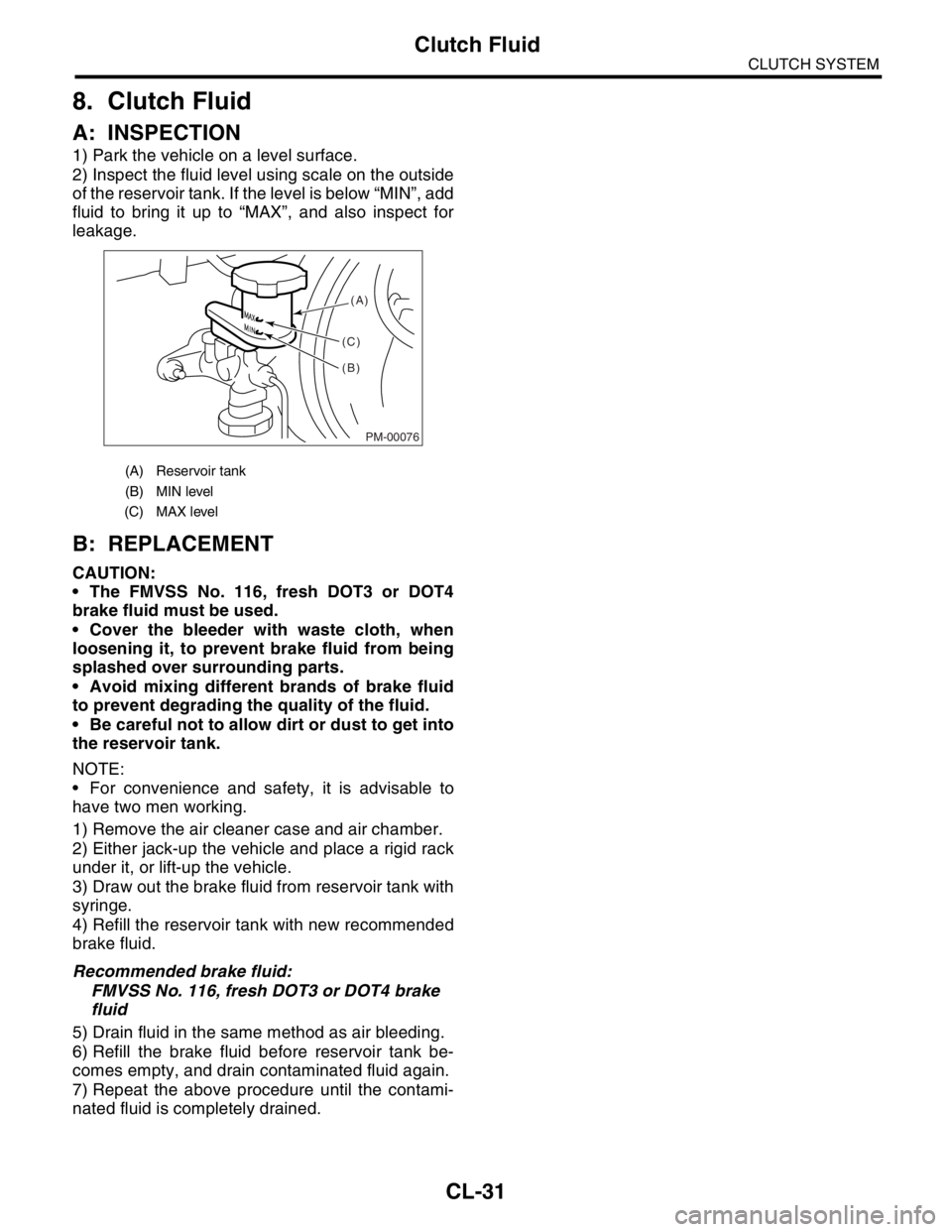
A: INSPECTION
1) Park the vehicle on a level surface.
2) Inspect the fluid level using scale on the outside
of the reservoir tank. If the level is below “MIN”, add
fluid to bring it up to “MAX”, and also inspect for
leakage.
B: REPLACEMENT
CAUTION:
The FMVSS No. 116, fresh DOT3 or DOT4
brake fluid must be used.
Cover the bleeder with waste cloth, when
loosening it, to prevent brake fluid from being
splashed over surrounding parts.
Avoid mixing different brands of brake fluid
to prevent degrading the quality of the fluid.
Be careful not to allow dirt or dust to get into
the reservoir tank.
NOTE:
For convenience and safety, it is advisable to
have two men working.
1) Remove the air cleaner case and air chamber.
2) Either jack-up the vehicle and place a rigid rack
under it, or lift-up the vehicle.
3) Draw out the brake fluid from reservoir tank with
syringe.
4) Refill the reservoir tank with new recommended
brake fluid.
Recommended brake fluid:
FMVSS No. 116, fresh DOT3 or DOT4 brake
fluid
5) Drain fluid in the same method as air bleeding.
6) Refill the brake fluid before reservoir tank be-
comes empty, and drain contaminated fluid again.
7) Repeat the above procedure until the contami-
nated fluid is completely drained.
(A) Reservoir tank
(B) MIN level
(C) MAX level
PM-00076
(A)
(B) (C)
Page 2863 of 2870
CL-37
CLUTCH SYSTEM
Clutch Pedal
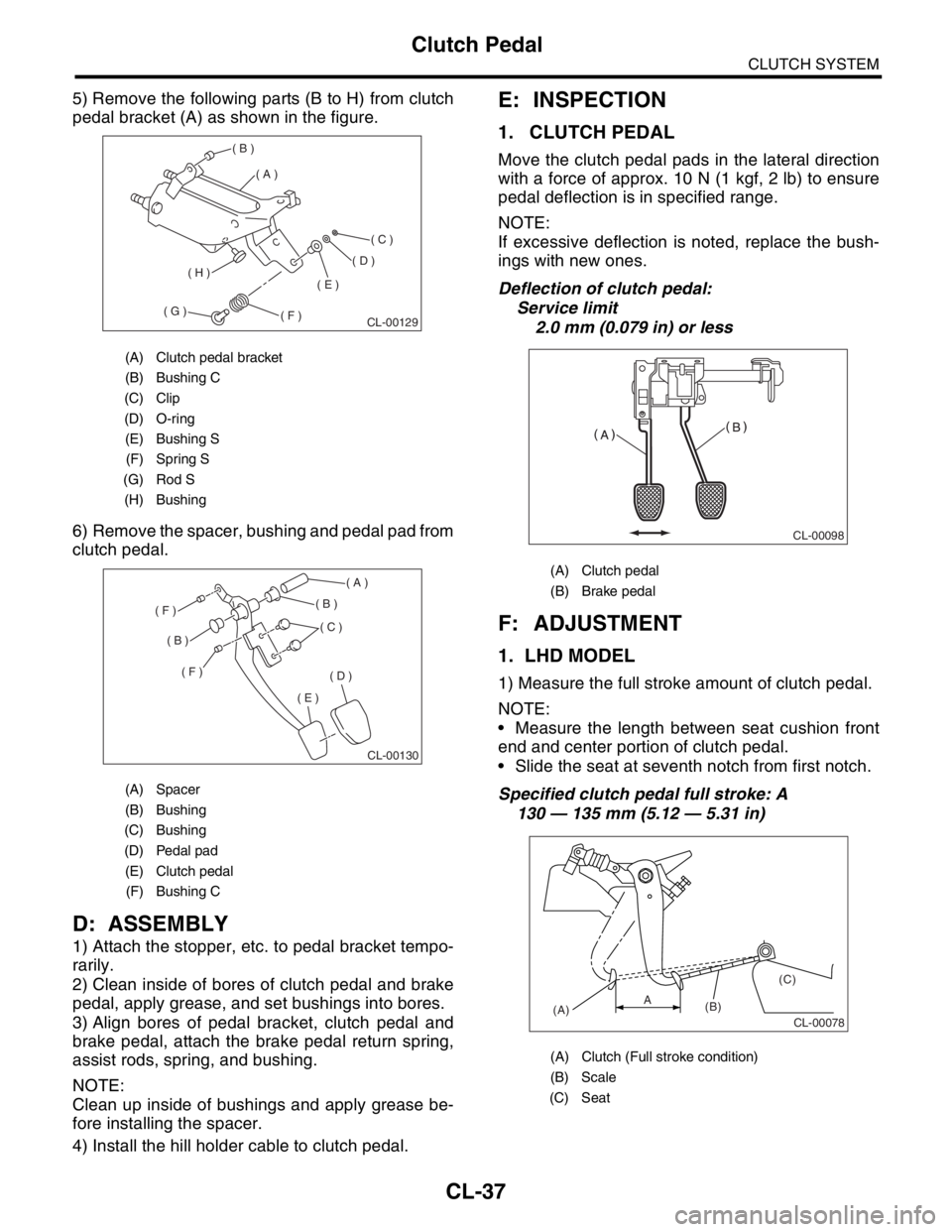
5) Remove the following parts (B to H) from clutch
pedal bracket (A) as shown in the figure.
6) Remove the spacer, bushing and pedal pad from
clutch pedal.
D: ASSEMBLY
1) Attach the stopper, etc. to pedal bracket tempo-
rarily.
2) Clean inside of bores of clutch pedal and brake
pedal, apply grease, and set bushings into bores.
3) Align bores of pedal bracket, clutch pedal and
brake pedal, attach the brake pedal return spring,
assist rods, spring, and bushing.
NOTE:
Clean up inside of bushings and apply grease be-
fore installing the spacer.
4) Install the hill holder cable to clutch pedal.
E: INSPECTION
1. CLUTCH PEDAL
Move the clutch pedal pads in the lateral direction
with a force of approx. 10 N (1 kgf, 2 lb) to ensure
pedal deflection is in specified range.
NOTE:
If excessive deflection is noted, replace the bush-
ings with new ones.
Deflection of clutch pedal:
Service limit
2.0 mm (0.079 in) or less
F: ADJUSTMENT
1. LHD MODEL
1) Measure the full stroke amount of clutch pedal.
NOTE:
Measure the length between seat cushion front
end and center portion of clutch pedal.
Slide the seat at seventh notch from first notch.
Specified clutch pedal full stroke: A
130 — 135 mm (5.12 — 5.31 in)
(A) Clutch pedal bracket
(B) Bushing C
(C) Clip
(D) O-ring
(E) Bushing S
(F) Spring S
(G) Rod S
(H) Bushing
(A) Spacer
(B) Bushing
(C) Bushing
(D) Pedal pad
(E) Clutch pedal
(F) Bushing C
( A )
( B )
( C )
( D )
( E )
( F )( G )
( H )
CL-00129
( A )
( B )
( B )
( C )
( D )
( E )
( F )
( F )
CL-00130
(A) Clutch pedal
(B) Brake pedal
(A) Clutch (Full stroke condition)
(B) Scale
(C) Seat
CL-00098
CL-00078(A)(B)(C)A
Page 2868 of 2870

CL-42
CLUTCH SYSTEM
General Diagnostic Table
12.General Diagnostic Table
A: INSPECTION
1. CLUTCH
Symptom Possible cause Corrective
1. Clutch slippage.
It is hard to perceive clutch slippage in
the early stage, but pay attention to the
following symptoms
Engine speed up when shifting.
High speed driving is impossible; espe-
cially rapid acceleration impossible and
vehicle speed does not increase in pro-
portion to an increase in engine speed.
Power falls, particularly when ascend-
ing a slope, and there is a smell of burn-
ing of the clutch facing.
Method of testing: Put the vehicle in
stationary condition with parking brake
fully applied. Disengage the clutch and
shift the transmission gear into the first.
Gradually allow the clutch to engage
while gradually increasing the engine
speed. The clutch function is satisfactory
if the engine stalls. However, the clutch is
slipping if the vehicle does not start off
and the engine does not stall.(a) Clutch facing smeared by oil Replace.
(b) Worn clutch facing Replace.
(c) Deteriorated diaphragm spring Replace.
(d) Distorted pressure plate or flywheel Replace.
(e) Defective release bearing holder Replace.
2. Clutch drags.
As a symptom of this trouble, a harsh
scratching noise develops and control
becomes quite difficult when shifting
gears. The symptom becomes more
apparent when shifting into the first gear.
However, because much trouble of this
sort is due to defective synchronization
mechanism, carry out the test as
described after.
Method of testing:
DRAG, INSPECTION, General Diagnos-
tic Table.>
It may be judged as insufficient disen-
gagement of clutch if any noise occurs
during this test.(a) Worn or rusty clutch disc hub spline Replace the clutch disc.
(b) Excessive deflection of clutch disc
facingReplace.
(c) Malfunction of crankshaft pilot bearing Replace.
(d) Cracked clutch disc facing Replace.
(e) Stuck clutch disc (smeared by oil or
water)Replace.
3. Clutch chatters.
Clutch chattering is an unpleasant vibra-
tion to the whole body when the vehicle is
just started with clutch partially engaged.(a) Adhesion of oil on the facing Replace the clutch disc.
(b) Weak or broken torsion spring Replace the clutch disc.
(c) Defective facing contact or excessive
disc wornReplace the clutch disc defection.
(d) Warped pressure plate or flywheel Replace.
(e) Loose disc rivets Replace the clutch disc.
(f) Loose engine mounting Retighten or replace the mounting.
(g) Improper adjustment of pitching stop-
perAdjustment.