2004 SUBARU FORESTER replace disc
[x] Cancel search: replace discPage 565 of 2870
CC-13
CRUISE CONTROL SYSTEM
Neutral Position Switch (MT model)
9. Neutral Position Switch (MT
model)
A: REMOVAL
1) Disconnect the ground cable from battery.
2) Disconnect the connector from neutral position
switch, and then remove the switch.
SWITCH, REMOVAL, Switches and Harness.>
B: INSTALLATION
Install in the reverse order of removal.
C: INSPECTION
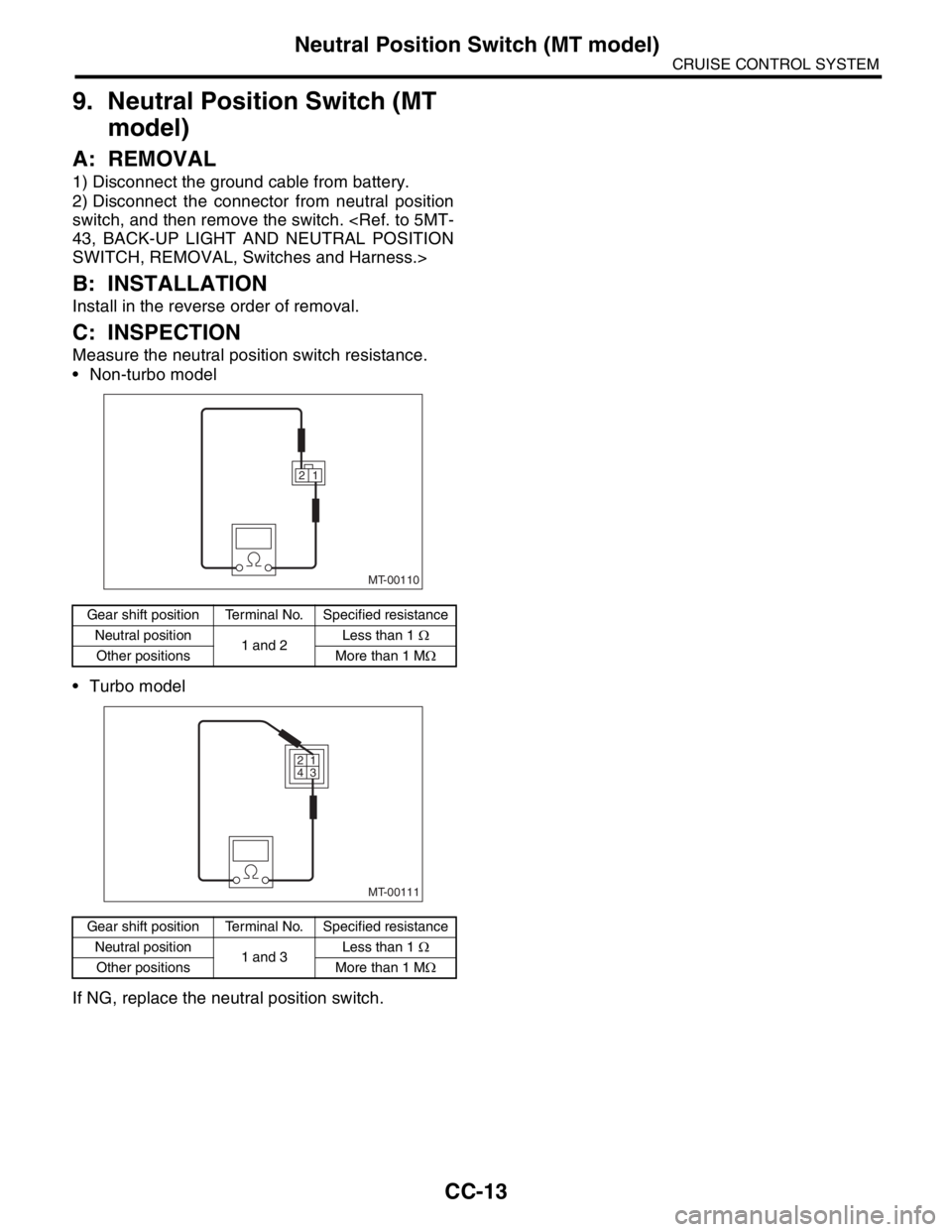
Measure the neutral position switch resistance.
Non-turbo model
Turbo model
If NG, replace the neutral position switch.
Gear shift position Terminal No. Specified resistance
Neutral position
1 and 2Less than 1 Ω
Other positions More than 1 MΩ
Gear shift position Terminal No. Specified resistance
Neutral position
1 and 3Less than 1 Ω
Other positions More than 1 MΩ
MT-00110
1 2
MT-00111
1 2
3 4
Page 584 of 2870

CC(H4SO)-16
CRUISE CONTROL SYSTEM (DIAGNOSTIC)
Diagnostic Procedure with Symptom
Step Check Yes No
1 CHECK CRUISE CONTROL MAIN SWITCH
CIRCUIT.
1) Turn the ignition switch to OFF.
2) Disconnect the cruise control main switch
harness connector.
3) Turn the ignition switch to ON.
4) Measure the voltage between harness con-
nector terminal and chassis ground.
Connector & terminal
With indicator built in combination
meter:
(B161) No. 3 (+) — Chassis ground (
−):
With indicator built in main switch:
(B161) No. 2 (+) — Chassis ground (
−):Is the voltage more than 10 V? Go to step 2. Check the fuse
No. 18 (in fuse &
relay box).
Check the har-
ness for open or
short between
cruise control main
switch and fuse &
relay box.
2 CHECK CRUISE CONTROL MAIN SWITCH
CIRCUIT.
1) Turn the ignition switch OFF.
2) Disconnect the cruise control module har-
ness connector.
3) Measure the resistance between cruise
control module harness connector terminal
and cruise control main switch harness con-
nector terminal.
Connector & terminal
With indicator built in combination
meter:
(B94) No. 15 — (B161) No. 5:
With indicator built in main switch:
(B94) No. 15 — (B161) No. 1:Is the resistance less than 10
Ω?Go to step 3.Repair the har-
ness.
3 CHECK CRUISE CONTROL MAIN SWITCH.
Remove and check the cruise control main
switch.
switch OK?Replace the cruise
control module.Replace the cruise
control main
switch.
Page 586 of 2870

CC(H4SO)-18
CRUISE CONTROL SYSTEM (DIAGNOSTIC)
Diagnostic Procedure with Symptom
Step Check Yes No
1 CHECK CRUISE INDICATOR LIGHT CIR-
CUIT.
1) Turn the ignition switch to OFF.
2) With indicator built in combination meter:
Disconnect the combination meter harness
connector.
With indicator built in main switch:
Disconnect the cruise control main switch har-
ness connector.
3) Turn the ignition switch to ON.
4) Measure the voltage between harness con-
nector terminal and chassis ground.
Connector & terminal
With indicator built in combination
meter:
(i10) No. 9 (+) — Chassis ground (
−):
With indicator built in main switch:
(B161) No. 3 (+) — Chassis ground (
−):Is the voltage more than 10 V? Go to step 2. Check the fuse
No. 13 (in fuse &
relay box).
Check the har-
ness for open or
short between
combination meter
and fuse & relay
box.
2 CHECK CRUISE INDICATOR LIGHT CIR-
CUIT.
1) Turn the ignition switch to OFF.
2) Disconnect the cruise control module har-
ness connector.
3) Measure the resistance between cruise
control module harness connector terminal
and combination meter harness connector ter-
minal.
Connector & terminal
With indicator built in combination
meter:
(B94) No. 1 (+) — (i10) No. 16:
With indicator built in main switch:
(B94) No. 1 (+) — (B161) No. 4:Is the resistance less than 10
Ω?Go to step 3.Repair the har-
ness.
3 CHECK CRUISE INDICATOR LIGHT CIR-
CUIT.
Ground the cruise control module harness
connector terminal with a suitable wire.
Connector & terminal
(B94) No. 1 — Chassis ground:Does the cruise indicator light
illuminate?Replace the cruise
control module. With indicator
built in combina-
tion meter: Check
the cruise indicator
light bulb in combi-
nation meter, and
replace it if mal-
function
occurred.No mal-
function found,
replace the printed
circuit of combina-
tion meter.
With indicator
built in main
switch: Replace
the cruise control
main switch.
Page 588 of 2870

CC(H4SO)-20
CRUISE CONTROL SYSTEM (DIAGNOSTIC)
Diagnostic Procedure with Symptom
Step Check Yes No
1 CHECK SET/COAST SWITCH CIRCUIT.
1) Turn the ignition switch to OFF.
2) Disconnect the cruise control module har-
ness connector.
3) Measure the voltage between harness con-
nector terminal and chassis ground when SET/
COAST switch is pressed and not pressed.
Connector & terminal
(B94) No. 10 (+) — Chassis ground (
−):Is the voltage 0 V when the
SET/COAST switch is not
pressed? Is the voltage more
than 10 V when the SET/
COAST switch is pressed?Go to step 2.Go to step 4.
2 CHECK RESUME/ACCEL SWITCH CIRCUIT.
Measure the voltage between harness connec-
tor terminal and chassis ground when
RESUME/ACCEL switch is pressed and not
pressed.
Connector & terminal
(B94) No. 9 (+) — Chassis ground (
−):Is the voltage 0 V when the
RESUME/ACCEL switch is not
pressed? Is the voltage more
than 10 V when the RESUME/
ACCEL switch is pressed?Go to step 3.Go to step 4.
3 CHECK CANCEL SWITCH CIRCUIT.
Measure the voltage between harness connec-
tor terminal and chassis ground when CAN-
CEL switch is pressed and not pressed.
Connector & terminal
(B94) No. 9 (+) — Chassis ground (
−):
(B94) No. 10 (+) — Chassis ground (
−): Is the voltage 0 V when the
CANCEL switch is not
pressed? Is the voltage more
than 10 V when the CANCEL
switch is pressed?Cruise control
command switch
circuit is OK.Go to step 4.
4 CHECK POWER SUPPLY FOR COMMAND
SWITCH.
Check the horn operation.Does the horn sound? Go to step 5. Check the fuse
No. 6 (in main fuse
box).
Check the horn
relay.
TION, Horn Sys-
tem.>
Check the har-
ness for open or
short between
cruise control
command switch
and fuse & relay
box.
5 CHECK CRUISE CONTROL COMMAND
SWITCH.
Remove and check the cruise control com-
mand switch.
switch OK?Check the harness
between cruise
control command
switch and cruise
control module.Replace the cruise
control command
switch.
Page 590 of 2870

CC(H4SO)-22
CRUISE CONTROL SYSTEM (DIAGNOSTIC)
Diagnostic Procedure with Symptom
Step Check Yes No
1 CHECK STOP LIGHT SWITCH AND BRAKE
SWITCH CIRCUIT.
1) Turn the ignition switch to OFF.
2) Disconnect the stop light switch and brake
switch harness connector.
3) Turn the ignition switch to ON.
4) Turn the cruise control main switch to ON.
5) Measure the voltage between harness con-
nector terminal and chassis ground.
Connector & terminal
(B65) No. 2 (+) — Chassis ground (
−): Is the voltage more than 10 V? Go to step 2. Check the fuse
No. 16 (in fuse &
relay box).
Check the har-
ness for open or
short between
stop light/brake
switch and fuse &
relay box.
2 CHECK STOP LIGHT SWITCH AND BRAKE
SWITCH CIRCUIT.
Measure the voltage between harness connec-
tor terminal and chassis ground.
Connector & terminal
(B65) No. 4 (+) — Chassis ground (
−): Is the voltage more than 10 V? Go to step 3. Check the har-
ness for open or
short between
stop light/brake
switch and cruise
control module (AT
model).
Check the clutch
switch and circuit
(MT model).
3 CHECK STOP LIGHT SWITCH AND BRAKE
SWITCH CIRCUIT.
1) Turn the cruise control main switch and
ignition switch to OFF.
2) Disconnect the cruise control module har-
ness connector.
3) Measure the resistance between cruise
control module harness connector terminal
and stop light switch and brake switch harness
connector terminal.
Connector & terminal
(B94) No. 20 — (B65) No. 3:
(B94) No. 16 — (B65) No. 1: Is the resistance less than 10
Ω?Go to step 4.Repair the har-
ness.
4 CHECK STOP LIGHT SWITCH AND BRAKE
SWITCH.
Remove and check the stop light switch and
brake switch.
brake switch are OK?Stop light switch
and brake switch
circuit are OK.Replace the stop
light switch and
brake switch.
Page 592 of 2870

CC(H4SO)-24
CRUISE CONTROL SYSTEM (DIAGNOSTIC)
Diagnostic Procedure with Symptom
Step Check Yes No
1 CHECK CLUTCH SWITCH CIRCUIT.
1) Turn the ignition switch to OFF.
2) Disconnect the clutch switch harness con-
nector.
3) Turn the ignition switch to ON.
4) Turn the cruise control main switch to ON.
5) Measure the voltage between harness con-
nector terminal and chassis ground.
Connector & terminal
(B107) No. 2 (+) — Chassis ground (
−):Is the voltage more than 10 V? Go to step 2.Check the harness
for open or short
between clutch
switch and cruise
control module.
2 CHECK CLUTCH SWITCH CIRCUIT.
1) Turn the cruise control main switch and
ignition switch OFF.
2) Disconnect the stop light switch and brake
switch harness connector.
3) Measure the resistance between clutch
switch harness connector terminal and stop
light switch and brake switch harness connec-
tor terminal.
Connector & terminal
(B107) No. 1 — (B65) No. 4:Is the resistance less than 10
Ω?Go to step 3.Repair the har-
ness.
3 CHECK CLUTCH SWITCH.
Remove and check the clutch switch.
cuit is OK.Replace the clutch
switch.
Page 594 of 2870

CC(H4SO)-26
CRUISE CONTROL SYSTEM (DIAGNOSTIC)
Diagnostic Procedure with Symptom
Step Check Yes No
1 CHECK INHIBITOR SWITCH CIRCUIT.
1) Turn the ignition switch to OFF.
2) Disconnect the inhibitor switch harness
connector.
3) Turn the ignition switch to ON.
4) Turn the cruise control main switch to ON.
5) Measure the voltage between harness con-
nector terminal and chassis ground.
Connector & terminal
(T7) No. 12 (+) — Chassis ground (
−): Is the voltage more than 10 V? Go to step 2.Check the harness
for open or short
between inhibitor
switch and cruise
control module.
2 CHECK INHIBITOR SWITCH CIRCUIT.
1) Turn the cruise control main switch and
ignition switch to OFF.
2) Disconnect the starter motor harness con-
nector.
3) Measure the resistance between inhibitor
switch harness connector terminal and starter
motor harness connector terminal.
Connector & terminal
(T7) No. 7 — (B14) No. 1: Is the resistance less than 10
Ω?Go to step 3.Repair the har-
ness.
3 CHECK INHIBITOR SWITCH.
Remove and check the inhibitor switch.
cuit is OK.Replace the inhibi-
tor switch.
Page 599 of 2870

CC(H4SO)-31
CRUISE CONTROL SYSTEM (DIAGNOSTIC)
Diagnostic Procedure with Diagnostic Trouble Code (DTC)
Step Check Yes No
1 CHECK TRANSMISSION TYPE.Is the target MT model? Go to step 2.Go to step 6.
2 CHECK HARNESS BETWEEN BATTERY
AND VEHICLE SPEED SENSOR.
1) Turn the ignition switch to OFF.
2) Disconnect the harness connector from
vehicle speed sensor.
3) Turn the ignition switch to ON.
4) Measure the voltage between vehicle
speed sensor harness connector terminal and
chassis ground.
Connector & terminal
(B17) No. 3 (+) — Chassis ground (
−):Is the voltage more than 10 V? Go to step 3.Check the harness
for open or short
between fuse relay
and vehicle speed
sensor.
3 CHECK HARNESS BETWEEN CRUISE CON-
TROL MODULE AND VEHICLE SPEED SEN-
SOR.
1) Turn the ignition switch to OFF.
2) Disconnect the harness connector from
cruise control module.
3) Measure the resistance between vehicle
speed sensor harness connector terminal and
cruise control module harness connector ter-
minal.
Connector & terminal
(B17) No. 1 — (B94) No. 19:Is the resistance less than 10
Ω?Go to step 4.Repair the har-
ness.
4 CHECK HARNESS BETWEEN VEHICLE
SPEED SENSOR AND ENGINE GROUND.
1) Turn the ignition switch to OFF.
2) Measure the resistance between vehicle
speed sensor harness connector terminal and
engine ground.
Connector & terminal
(B17) No. 2 — Engine ground:Is the resistance less than 10
Ω?Go to step 5.Repair the har-
ness.
5 CHECK VEHICLE SPEED SENSOR.
1) Connect the harness connector to vehicle
speed sensor.
2) Lift-up the vehicle and support with rigid
racks.
3) Drive the vehicle at speed greater than 20
km/h (12 MPH).
Warning:
Be careful not to be caught up by the run-
ning wheels.
4) Measure the voltage between cruise control
module harness connector terminal and chas-
sis ground.
Connector & terminal
(B94) No. 19 (+) — Chassis ground (
−):Is the voltage less than 0 V ←
→ more than 5 V?Replace the cruise
control module.
Module.>Replace the vehi-
cle speed sensor.
6 CHECK HARNESS BETWEEN CRUISE CON-
TROL MODULE AND TCM.
1) Turn the ignition switch to OFF.
2) Disconnect the harness connector from
TCM and cruise control module.
3) Measure the resistance between cruise
control module harness connector terminal
and TCM harness connector terminal.
Connector & terminal
(B94) No. 19 — (B56) No. 17:Is the resistance less than 10
Ω?Go to step 7.Repair the har-
ness.