2004 NISSAN TERRANO check engine
[x] Cancel search: check enginePage 582 of 1833
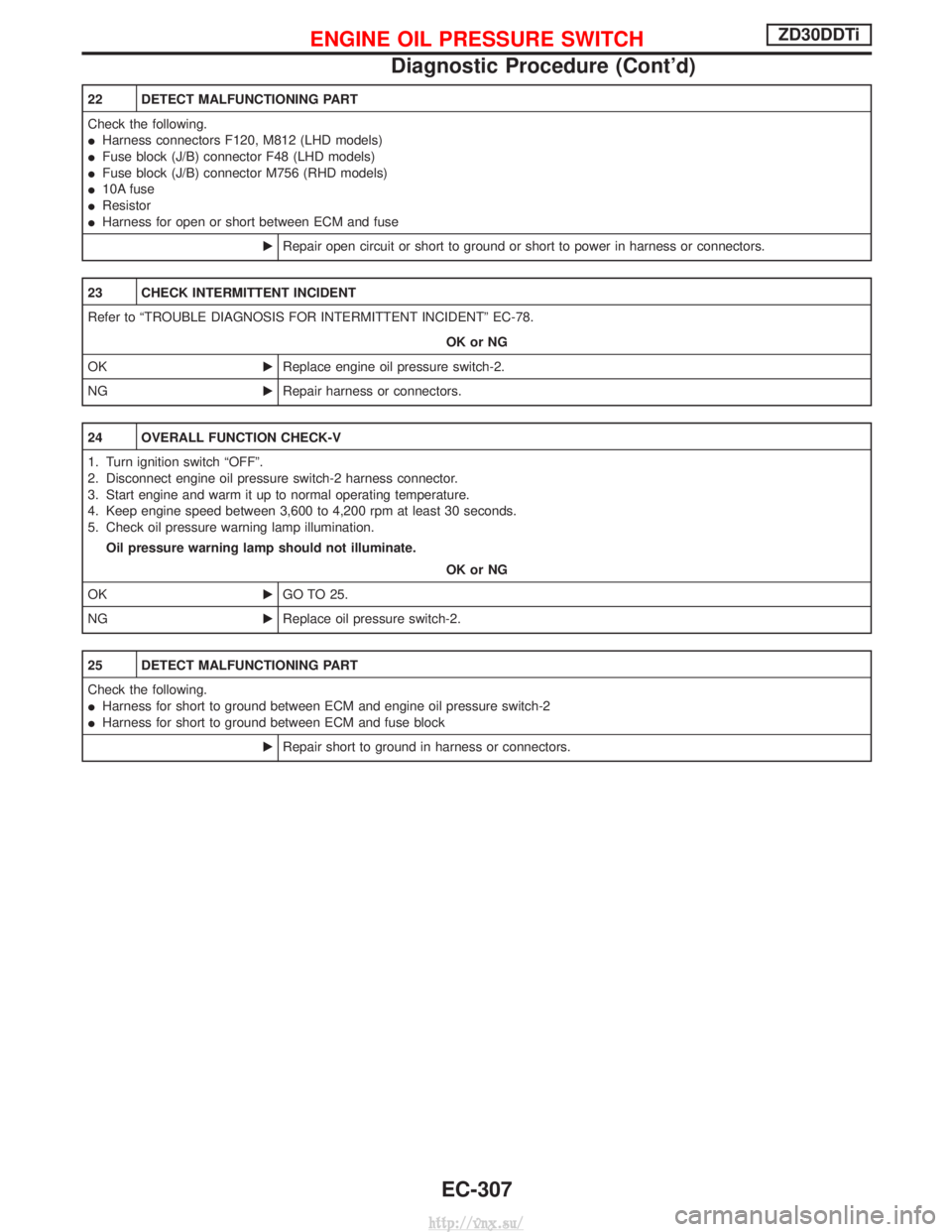
22 DETECT MALFUNCTIONING PART
Check the following.
IHarness connectors F120, M812 (LHD models)
I Fuse block (J/B) connector F48 (LHD models)
I Fuse block (J/B) connector M756 (RHD models)
I 10A fuse
I Resistor
I Harness for open or short between ECM and fuse
ERepair open circuit or short to ground or short to power in harness or connectors.
23 CHECK INTERMITTENT INCIDENT
Refer to ªTROUBLE DIAGNOSIS FOR INTERMITTENT INCIDENTº EC-78.
OK or NG
OK EReplace engine oil pressure switch-2.
NG ERepair harness or connectors.
24 OVERALL FUNCTION CHECK-V
1. Turn ignition switch ªOFFº.
2. Disconnect engine oil pressure switch-2 harness connector.
3. Start engine and warm it up to normal operating temperature.
4. Keep engine speed between 3,600 to 4,200 rpm at least 30 seconds.
5. Check oil pressure warning lamp illumination.
Oil pressure warning lamp should not illuminate.
OK or NG
OK EGO TO 25.
NG EReplace oil pressure switch-2.
25 DETECT MALFUNCTIONING PART
Check the following.
IHarness for short to ground between ECM and engine oil pressure switch-2
I Harness for short to ground between ECM and fuse block
ERepair short to ground in harness or connectors.
ENGINE OIL PRESSURE SWITCHZD30DDTi
Diagnostic Procedure (Cont'd)
EC-307
http://vnx.su/
Page 591 of 1833
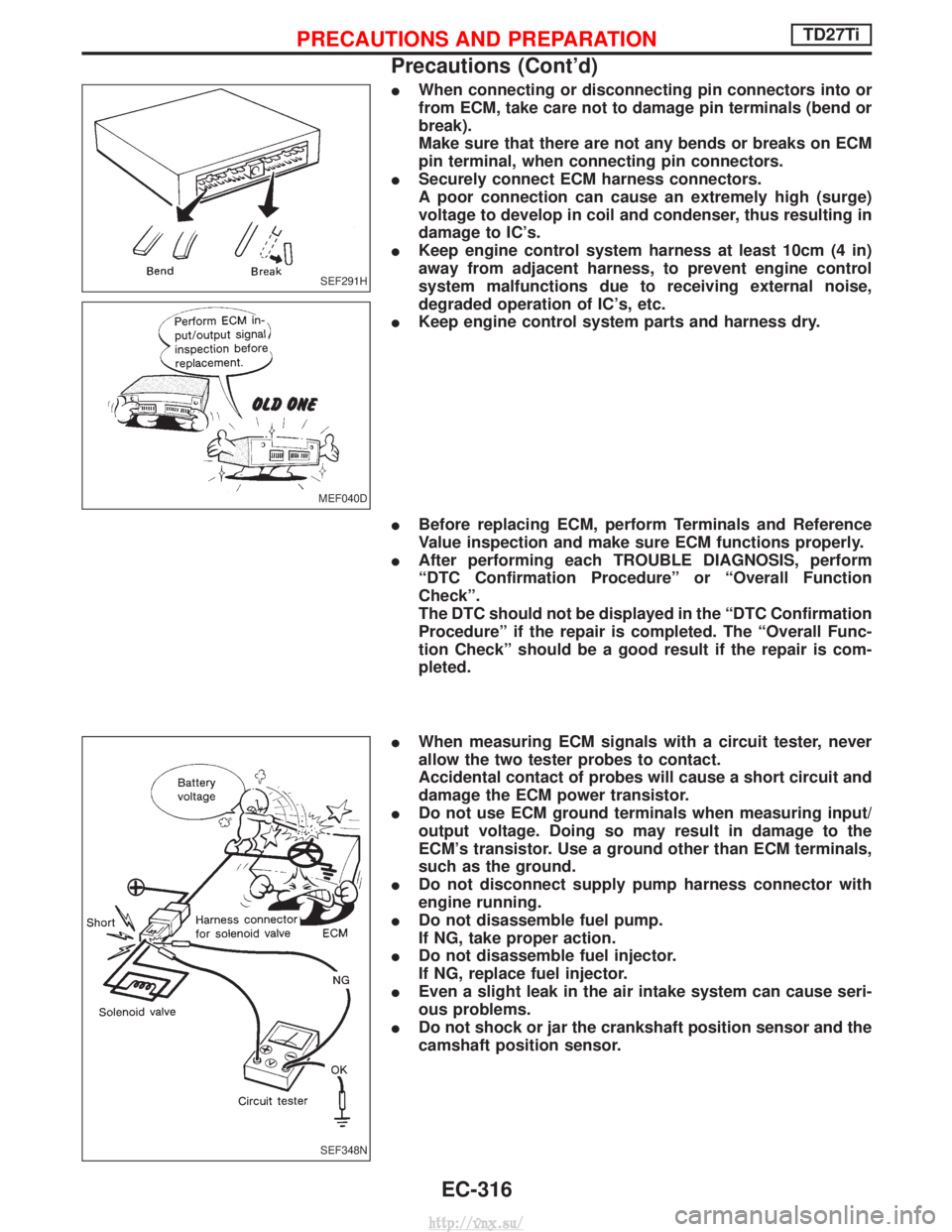
IWhen connecting or disconnecting pin connectors into or
from ECM, take care not to damage pin terminals (bend or
break).
Make sure that there are not any bends or breaks on ECM
pin terminal, when connecting pin connectors.
I Securely connect ECM harness connectors.
A poor connection can cause an extremely high (surge)
voltage to develop in coil and condenser, thus resulting in
damage to IC's.
I Keep engine control system harness at least 10cm (4 in)
away from adjacent harness, to prevent engine control
system malfunctions due to receiving external noise,
degraded operation of IC's, etc.
I Keep engine control system parts and harness dry.
I Before replacing ECM, perform Terminals and Reference
Value inspection and make sure ECM functions properly.
I After performing each TROUBLE DIAGNOSIS, perform
ªDTC Confirmation Procedureº or ªOverall Function
Checkº.
The DTC should not be displayed in the ªDTC Confirmation
Procedureº if the repair is completed. The ªOverall Func-
tion Checkº should be a good result if the repair is com-
pleted.
I When measuring ECM signals with a circuit tester, never
allow the two tester probes to contact.
Accidental contact of probes will cause a short circuit and
damage the ECM power transistor.
I Do not use ECM ground terminals when measuring input/
output voltage. Doing so may result in damage to the
ECM's transistor. Use a ground other than ECM terminals,
such as the ground.
I Do not disconnect supply pump harness connector with
engine running.
I Do not disassemble fuel pump.
If NG, take proper action.
I Do not disassemble fuel injector.
If NG, replace fuel injector.
I Even a slight leak in the air intake system can cause seri-
ous problems.
I Do not shock or jar the crankshaft position sensor and the
camshaft position sensor.
SEF291H
MEF040D
SEF348N
PRECAUTIONS AND PREPARATIONTD27Ti
Precautions (Cont'd)
EC-316
http://vnx.su/
Page 596 of 1833

PRECAUTIONS
IBefore connecting or disconnecting the ECM harness
connector, turn ignition switch OFF and disconnect nega-
tive battery terminal. Failure to do so may damage the ECM
because battery voltage is applied to ECM even if ignition
switch is turned off.
I When connecting ECM harness connector, open the ports
on harness connector then meet the ports with the pins on
ECM as shown. Push slider on harness connector until it
stops.
I Before replacing ECM, perform Terminals and Reference
Value inspection and make sure ECM functions properly.
Refer to EC-369.
I If MI illuminates or flashes irregularly while the engine is
running, water may have accumulated in fuel filter. Drain
water from fuel filter. If this does not correct the problem,
perform specified trouble diagnostic procedures.
I After performing each TROUBLE DIAGNOSIS, perform
ªOVERALL FUNCTION CHECKº or ªDTC (Diagnostic
Trouble Code) CONFIRMATION PROCEDUREº.
The DTC should not be displayed in the ªDTC CONFIRMA-
TION PROCEDUREº if the repair is successful. The ªOVER-
ALL FUNCTION CHECKº should indicate a good result if
the repair is completed successfully.
SEF289H
NEF754
NEF755
MEF040D
SAT652J
PRECAUTIONS AND PREPARATIONTD27Ti
Engine Fuel & Emission Control System
(Cont'd)
EC-321
http://vnx.su/
Page 620 of 1833
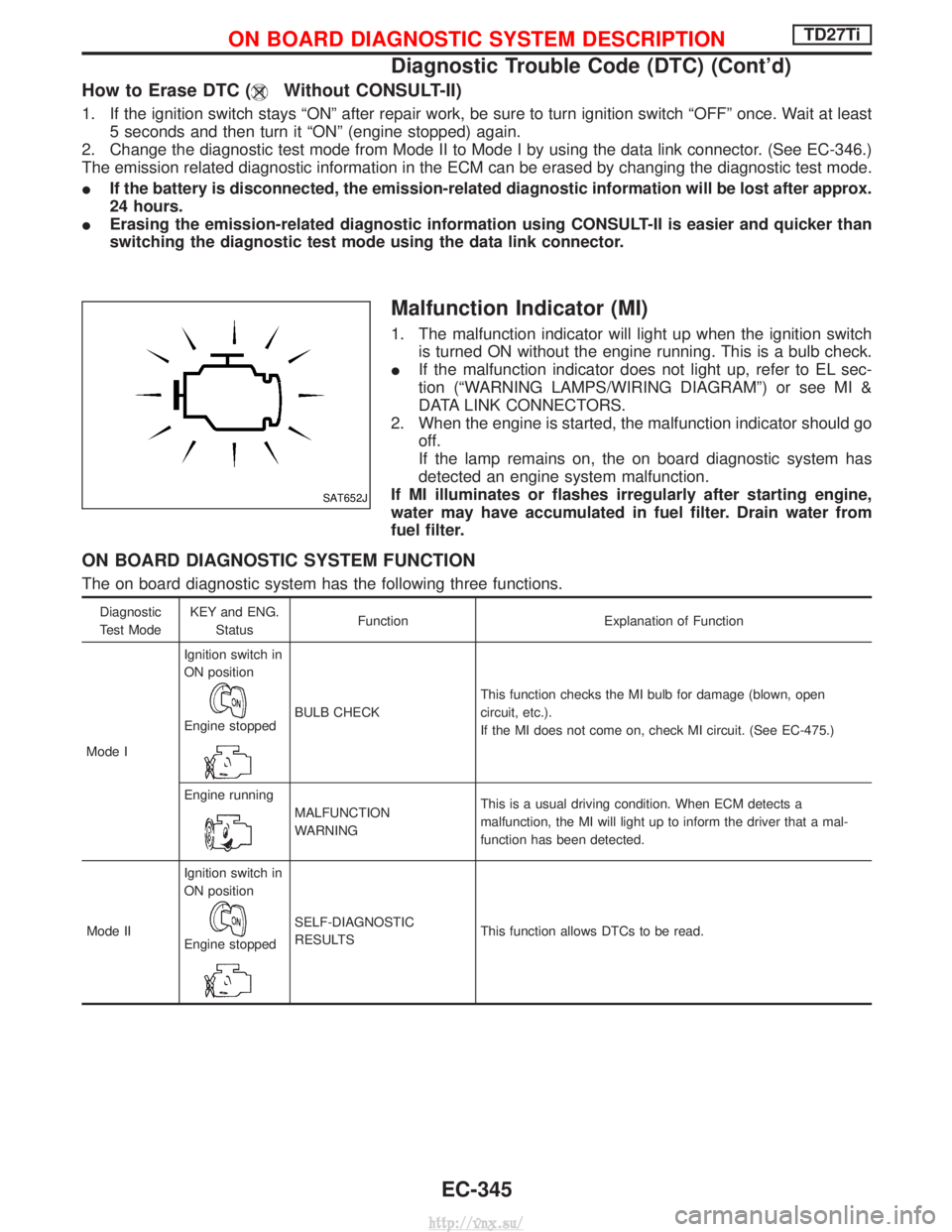
How to Erase DTC (Without CONSULT-II)
1. If the ignition switch stays ªONº after repair work, be sure to turn ignition switch ªOFFº once. Wait at least5 seconds and then turn it ªONº (engine stopped) again.
2. Change the diagnostic test mode from Mode II to Mode I by using the data link connector. (See EC-346.)
The emission related diagnostic information in the ECM can be erased by changing the diagnostic test mode.
I If the battery is disconnected, the emission-related diagnostic information will be lost after approx.
24 hours.
I Erasing the emission-related diagnostic information using CONSULT-II is easier and quicker than
switching the diagnostic test mode using the data link connector.
Malfunction Indicator (MI)
1. The malfunction indicator will light up when the ignition switch
is turned ON without the engine running. This is a bulb check.
I If the malfunction indicator does not light up, refer to EL sec-
tion (ªWARNING LAMPS/WIRING DIAGRAMº) or see MI &
DATA LINK CONNECTORS.
2. When the engine is started, the malfunction indicator should go off.
If the lamp remains on, the on board diagnostic system has
detected an engine system malfunction.
If MI illuminates or flashes irregularly after starting engine,
water may have accumulated in fuel filter. Drain water from
fuel filter.
ON BOARD DIAGNOSTIC SYSTEM FUNCTION
The on board diagnostic system has the following three functions.
Diagnostic
Test Mode KEY and ENG.
Status Function Explanation of Function
Mode I Ignition switch in
ON position
Engine stoppedBULB CHECK
This function checks the MI bulb for damage (blown, open
circuit, etc.).
If the MI does not come on, check MI circuit. (See EC-475.)
Engine running
MALFUNCTION
WARNING This is a usual driving condition. When ECM detects a
malfunction, the MI will light up to inform the driver that a mal-
function has been detected.
Mode II Ignition switch in
ON position
Engine stopped
SELF-DIAGNOSTIC
RESULTS
This function allows DTCs to be read.
SAT652J
ON BOARD DIAGNOSTIC SYSTEM DESCRIPTIONTD27Ti
Diagnostic Trouble Code (DTC) (Cont'd)
EC-345
http://vnx.su/
Page 629 of 1833
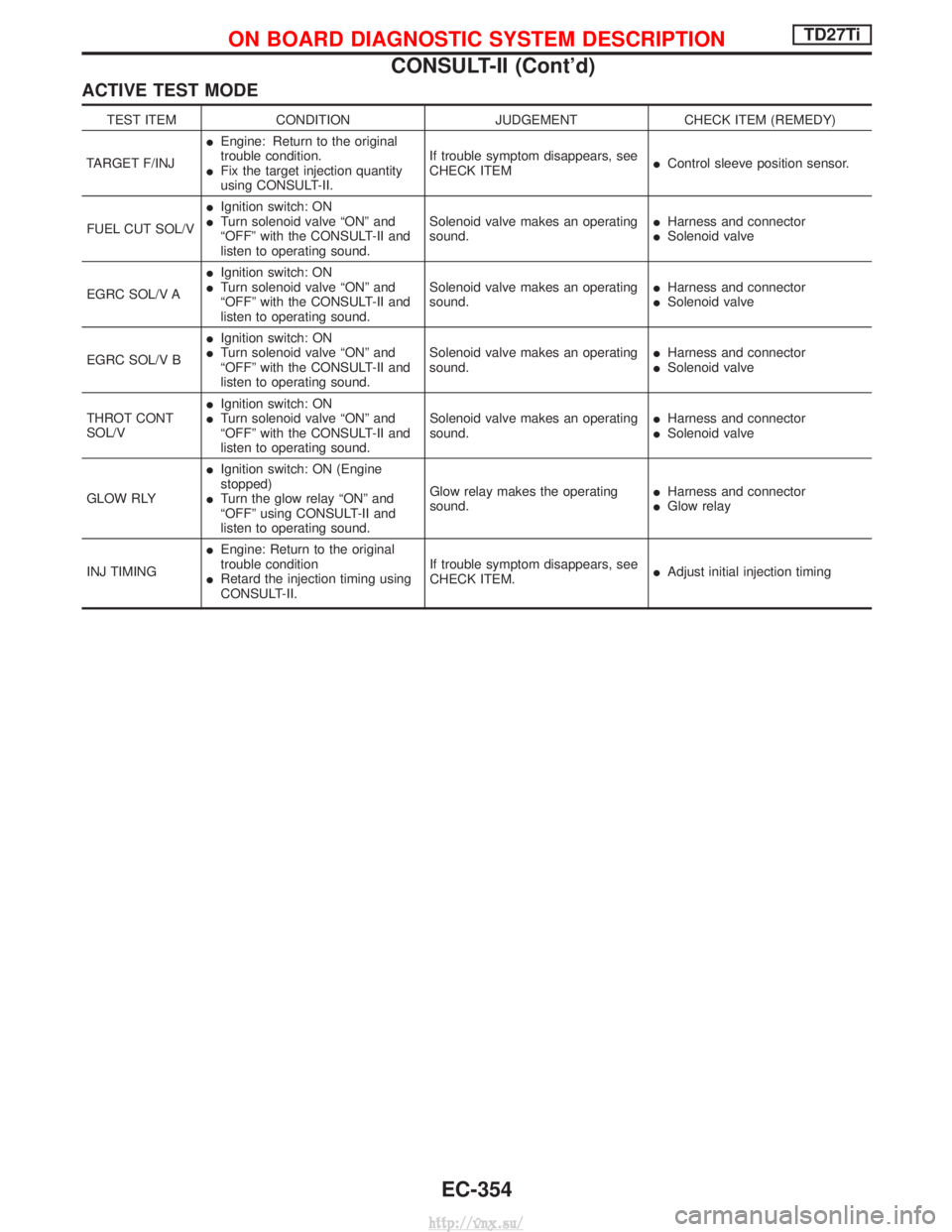
ACTIVE TEST MODE
TEST ITEMCONDITION JUDGEMENTCHECK ITEM (REMEDY)
TARGET F/INJ I
Engine: Return to the original
trouble condition.
I Fix the target injection quantity
using CONSULT-II. If trouble symptom disappears, see
CHECK ITEM
I
Control sleeve position sensor.
FUEL CUT SOL/V I
Ignition switch: ON
I Turn solenoid valve ªONº and
ªOFFº with the CONSULT-II and
listen to operating sound. Solenoid valve makes an operating
sound.
I
Harness and connector
I Solenoid valve
EGRC SOL/V A I
Ignition switch: ON
I Turn solenoid valve ªONº and
ªOFFº with the CONSULT-II and
listen to operating sound. Solenoid valve makes an operating
sound.
I
Harness and connector
I Solenoid valve
EGRC SOL/V B I
Ignition switch: ON
I Turn solenoid valve ªONº and
ªOFFº with the CONSULT-II and
listen to operating sound. Solenoid valve makes an operating
sound.
I
Harness and connector
I Solenoid valve
THROT CONT
SOL/V I
Ignition switch: ON
I Turn solenoid valve ªONº and
ªOFFº with the CONSULT-II and
listen to operating sound. Solenoid valve makes an operating
sound.
I
Harness and connector
I Solenoid valve
GLOW RLY I
Ignition switch: ON (Engine
stopped)
I Turn the glow relay ªONº and
ªOFFº using CONSULT-II and
listen to operating sound. Glow relay makes the operating
sound.
I
Harness and connector
I Glow relay
INJ TIMING I
Engine: Return to the original
trouble condition
I Retard the injection timing using
CONSULT-II. If trouble symptom disappears, see
CHECK ITEM.
I
Adjust initial injection timing
ON BOARD DIAGNOSTIC SYSTEM DESCRIPTIONTD27Ti
CONSULT-II (Cont'd)
EC-354
http://vnx.su/
Page 632 of 1833
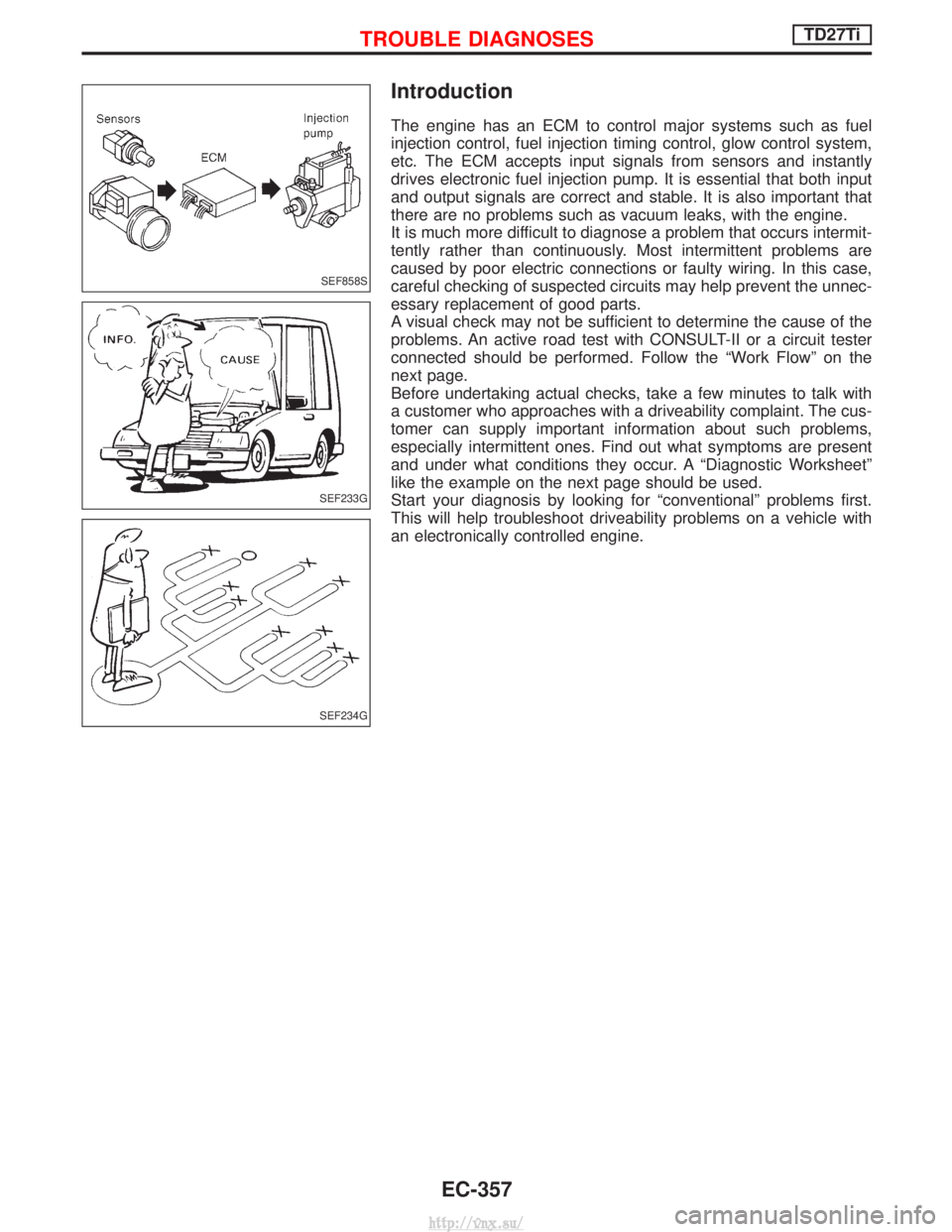
Introduction
The engine has an ECM to control major systems such as fuel
injection control, fuel injection timing control, glow control system,
etc. The ECM accepts input signals from sensors and instantly
drives electronic fuel injection pump. It is essential that both input
and output signals are correct and stable. It is also important that
there are no problems such as vacuum leaks, with the engine.
It is much more difficult to diagnose a problem that occurs intermit-
tently rather than continuously. Most intermittent problems are
caused by poor electric connections or faulty wiring. In this case,
careful checking of suspected circuits may help prevent the unnec-
essary replacement of good parts.
A visual check may not be sufficient to determine the cause of the
problems. An active road test with CONSULT-II or a circuit tester
connected should be performed. Follow the ªWork Flowº on the
next page.
Before undertaking actual checks, take a few minutes to talk with
a customer who approaches with a driveability complaint. The cus-
tomer can supply important information about such problems,
especially intermittent ones. Find out what symptoms are present
and under what conditions they occur. A ªDiagnostic Worksheetº
like the example on the next page should be used.
Start your diagnosis by looking for ªconventionalº problems first.
This will help troubleshoot driveability problems on a vehicle with
an electronically controlled engine.
SEF858S
SEF233G
SEF234G
TROUBLE DIAGNOSESTD27Ti
EC-357
http://vnx.su/
Page 635 of 1833
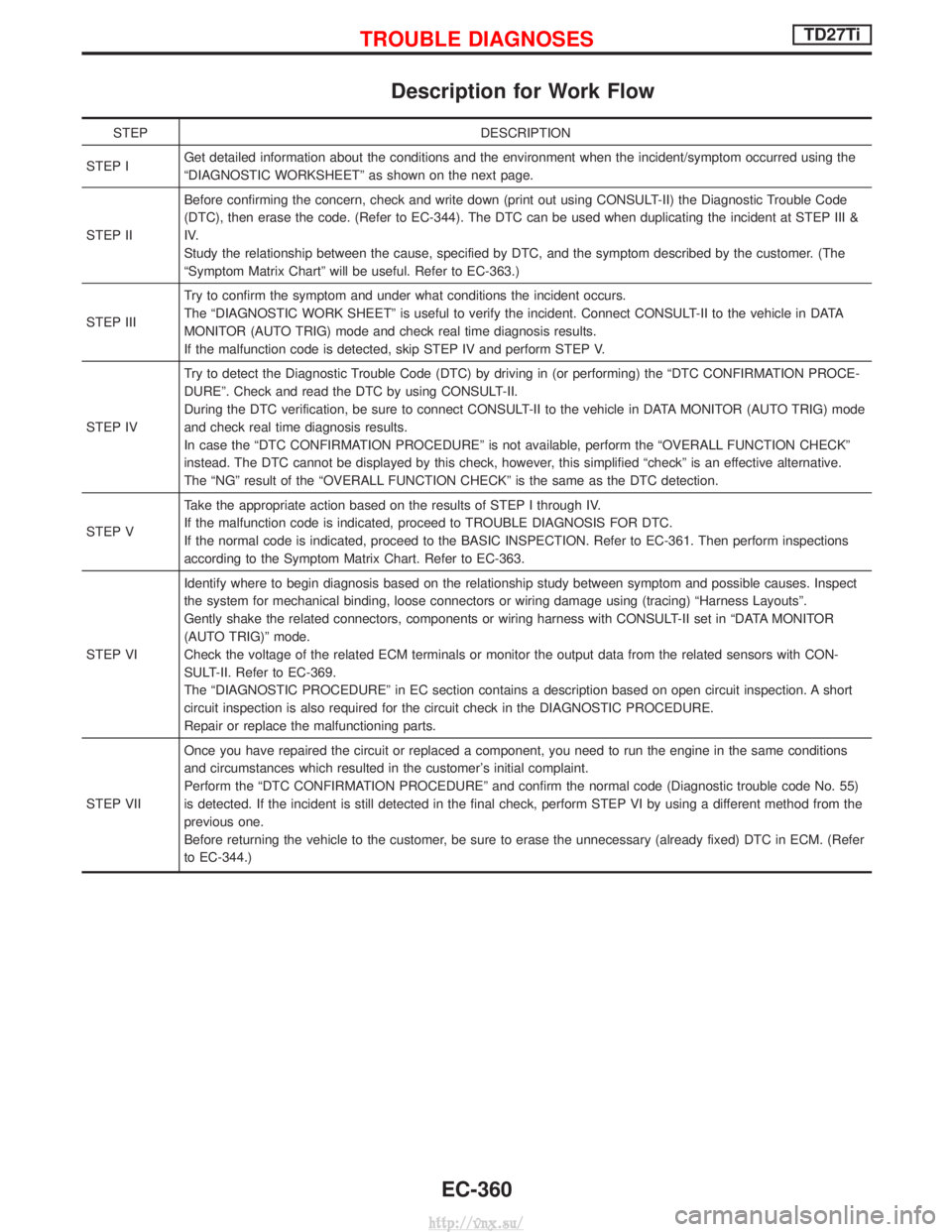
Description for Work Flow
STEPDESCRIPTION
STEP I Get detailed information about the conditions and the environment when the incident/symptom occurred using the
ªDIAGNOSTIC WORKSHEETº as shown on the next page.
STEP II Before confirming the concern, check and write down (print out using CONSULT-II) the Diagnostic Trouble Code
(DTC), then erase the code. (Refer to EC-344). The DTC can be used when duplicating the incident at STEP III &
IV.
Study the relationship between the cause, specified by DTC, and the symptom described by the customer. (The
ªSymptom Matrix Chartº will be useful. Refer to EC-363.)
STEP III Try to confirm the symptom and under what conditions the incident occurs.
The ªDIAGNOSTIC WORK SHEETº is useful to verify the incident. Connect CONSULT-II to the vehicle in DATA
MONITOR (AUTO TRIG) mode and check real time diagnosis results.
If the malfunction code is detected, skip STEP IV and perform STEP V.
STEP IV Try to detect the Diagnostic Trouble Code (DTC) by driving in (or performing) the ªDTC CONFIRMATION PROCE-
DUREº. Check and read the DTC by using CONSULT-II.
During the DTC verification, be sure to connect CONSULT-II to the vehicle in DATA MONITOR (AUTO TRIG) mode
and check real time diagnosis results.
In case the ªDTC CONFIRMATION PROCEDUREº is not available, perform the ªOVERALL FUNCTION CHECKº
instead. The DTC cannot be displayed by this check, however, this simplified ªcheckº is an effective alternative.
The ªNGº result of the ªOVERALL FUNCTION CHECKº is the same as the DTC detection.
STEP V Take the appropriate action based on the results of STEP I through IV.
If the malfunction code is indicated, proceed to TROUBLE DIAGNOSIS FOR DTC.
If the normal code is indicated, proceed to the BASIC INSPECTION. Refer to EC-361. Then perform inspections
according to the Symptom Matrix Chart. Refer to EC-363.
STEP VI Identify where to begin diagnosis based on the relationship study between symptom and possible causes. Inspect
the system for mechanical binding, loose connectors or wiring damage using (tracing) ªHarness Layoutsº.
Gently shake the related connectors, components or wiring harness with CONSULT-II set in ªDATA MONITOR
(AUTO TRIG)º mode.
Check the voltage of the related ECM terminals or monitor the output data from the related sensors with CON-
SULT-II. Refer to EC-369.
The ªDIAGNOSTIC PROCEDUREº in EC section contains a description based on open circuit inspection. A short
circuit inspection is also required for the circuit check in the DIAGNOSTIC PROCEDURE.
Repair or replace the malfunctioning parts.
STEP VII Once you have repaired the circuit or replaced a component, you need to run the engine in the same conditions
and circumstances which resulted in the customer's initial complaint.
Perform the ªDTC CONFIRMATION PROCEDUREº and confirm the normal code (Diagnostic trouble code No. 55)
is detected. If the incident is still detected in the final check, perform STEP VI by using a different method from the
previous one.
Before returning the vehicle to the customer, be sure to erase the unnecessary (already fixed) DTC in ECM. (Refer
to EC-344.)
TROUBLE DIAGNOSESTD27Ti
EC-360
http://vnx.su/
Page 636 of 1833
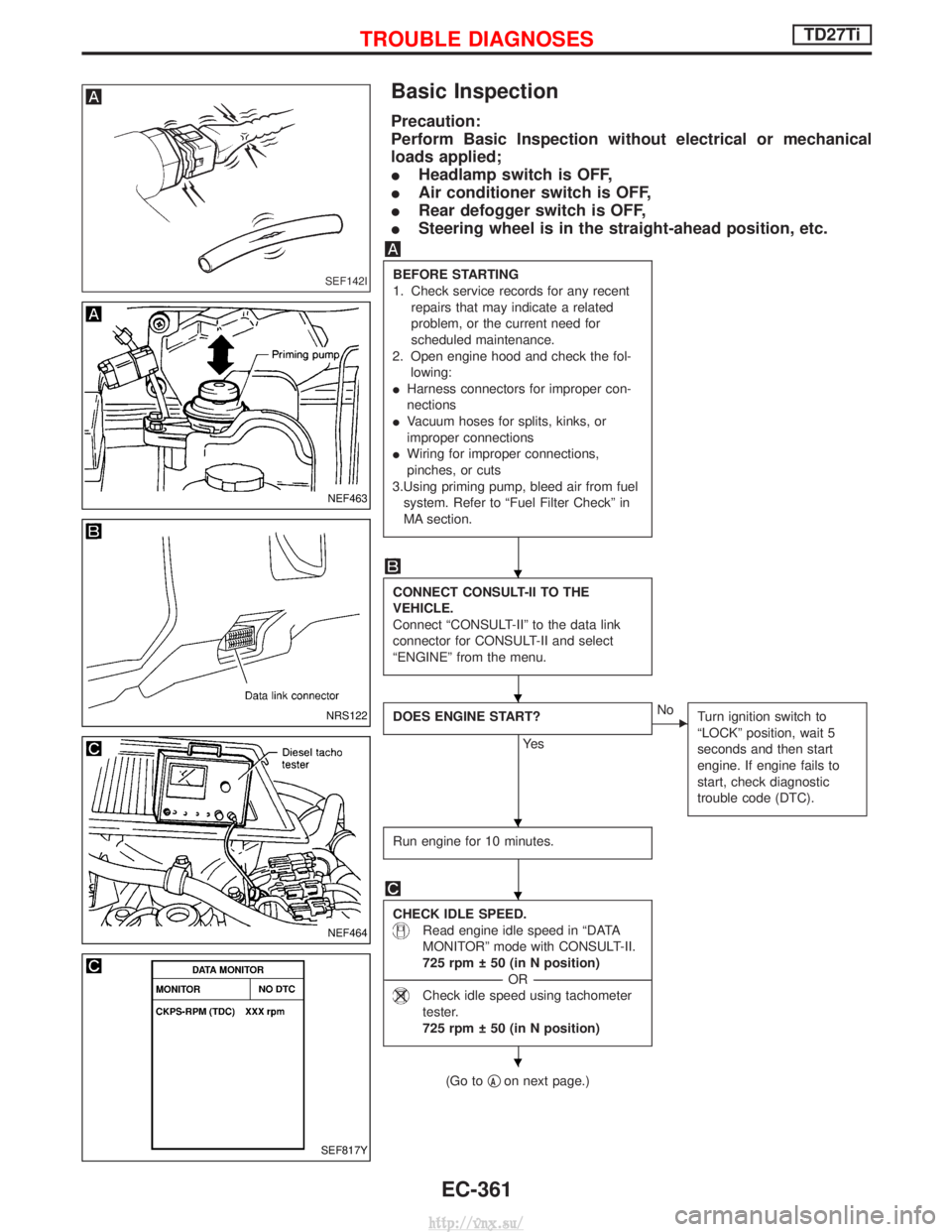
Basic Inspection
Precaution:
Perform Basic Inspection without electrical or mechanical
loads applied;
IHeadlamp switch is OFF,
I Air conditioner switch is OFF,
I Rear defogger switch is OFF,
I Steering wheel is in the straight-ahead position, etc.
BEFORE STARTING
1. Check service records for any recent
repairs that may indicate a related
problem, or the current need for
scheduled maintenance.
2. Open engine hood and check the fol- lowing:
I Harness connectors for improper con-
nections
I Vacuum hoses for splits, kinks, or
improper connections
I Wiring for improper connections,
pinches, or cuts
3.Using priming pump, bleed air from fuel system. Refer to ªFuel Filter Checkº in
MA section.
CONNECT CONSULT-II TO THE
VEHICLE.
Connect ªCONSULT-IIº to the data link
connector for CONSULT-II and select
ªENGINEº from the menu.
DOES ENGINE START?
Ye s
ENo Turn ignition switch to
ªLOCKº position, wait 5
seconds and then start
engine. If engine fails to
start, check diagnostic
trouble code (DTC).
Run engine for 10 minutes.
CHECK IDLE SPEED.
Read engine idle speed in ªDATA
MONITORº mode with CONSULT-II.
725 rpm 50 (in N position)
----------------------------------------------------------------------------------------------------------------------------------- -OR------------------------------------------------------------------------------------------------------------------------------------
Check idle speed using tachometer
tester.
725 rpm 50 (in N position)
(Go to qAon next page.)
SEF142I
NEF463
NRS122
NEF464
SEF817Y
H
H
H
H
H
TROUBLE DIAGNOSESTD27Ti
EC-361
http://vnx.su/