Page 558 of 4449
HEATER & COOLING UNIT ASSEMBLY
ATC-129
C
D
E
F
G
H
I
K
L
MA
B
AT C
Revision: 2004 November 2004 FX35/FX45
19. Insulator 20. Heater case (right) 21. Low-pressure pipe 2
22. High-pressure pipe 3 23. Expansion valve 24. Evaporator
25. Heater case (left) 26. Foot duct (left) 27. Center case
28. Max. cool door (left) 29. Ventilator door 30. Side link
31. Mode door motor 32. Defroster door 33. Max. cool door (right)
34. Defroster door lever 35. Defroster door link
Page 561 of 4449
ATC-132
HEATER CORE
Revision: 2004 November 2004 FX35/FX45
HEATER COREPFP:27140
Removal and InstallationAJS0015N
REMOVAL
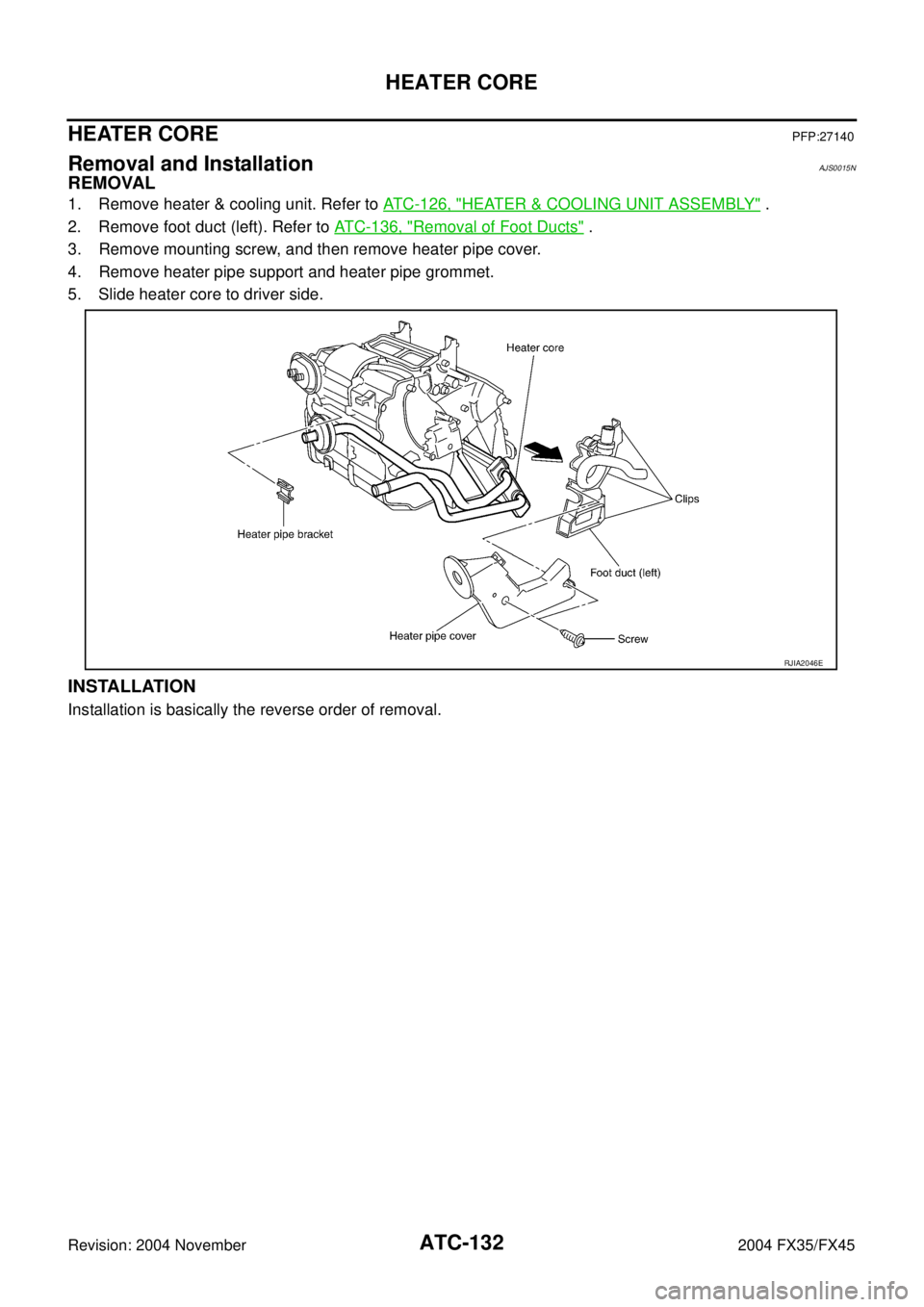
1. Remove heater & cooling unit. Refer to ATC-126, "HEATER & COOLING UNIT ASSEMBLY" .
2. Remove foot duct (left). Refer to ATC-136, "
Removal of Foot Ducts" .
3. Remove mounting screw, and then remove heater pipe cover.
4. Remove heater pipe support and heater pipe grommet.
5. Slide heater core to driver side.
INSTALLATION
Installation is basically the reverse order of removal.
RJIA2046E
Page 565 of 4449
ATC-136
DUCTS AND GRILLES
Revision: 2004 November 2004 FX35/FX45
Removal of Foot Ducts
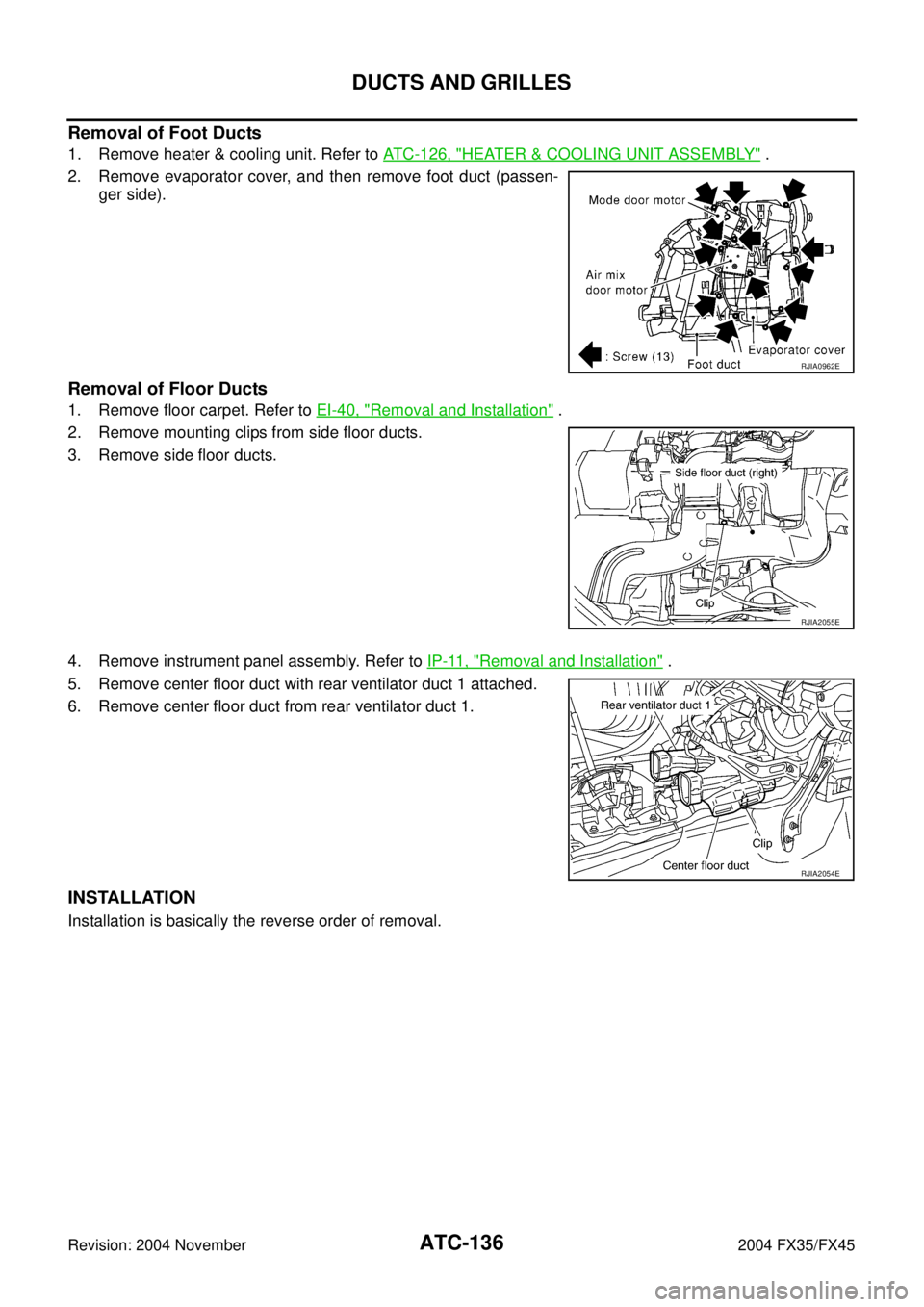
1. Remove heater & cooling unit. Refer to ATC-126, "HEATER & COOLING UNIT ASSEMBLY" .
2. Remove evaporator cover, and then remove foot duct (passen-
ger side).
Removal of Floor Ducts
1. Remove floor carpet. Refer to EI-40, "Removal and Installation" .
2. Remove mounting clips from side floor ducts.
3. Remove side floor ducts.
4. Remove instrument panel assembly. Refer to IP-11, "
Removal and Installation" .
5. Remove center floor duct with rear ventilator duct 1 attached.
6. Remove center floor duct from rear ventilator duct 1.
INSTALLATION
Installation is basically the reverse order of removal.
RJIA0962E
RJIA2055E
RJIA2054E
Page 570 of 4449
REFRIGERANT LINES
ATC-141
C
D
E
F
G
H
I
K
L
MA
B
AT C
Revision: 2004 November 2004 FX35/FX45
VQ35DE
1. Use a refrigerant collecting equipment (for HFC-134a) to discharge the refrigerant.
2. Remove the air cleaner and air duct. Refer to EM-17, "
AIR CLEANER AND AIR DUCT" (VQ35DE) or EM-
172, "AIR CLEANER AND AIR DUCT" (VK45DE).
3. Remove front engine undercover, using power tools.
4. Remove cooling fan shroud (lower). Refer to CO-39, "
RADIATOR" (VK45DE).
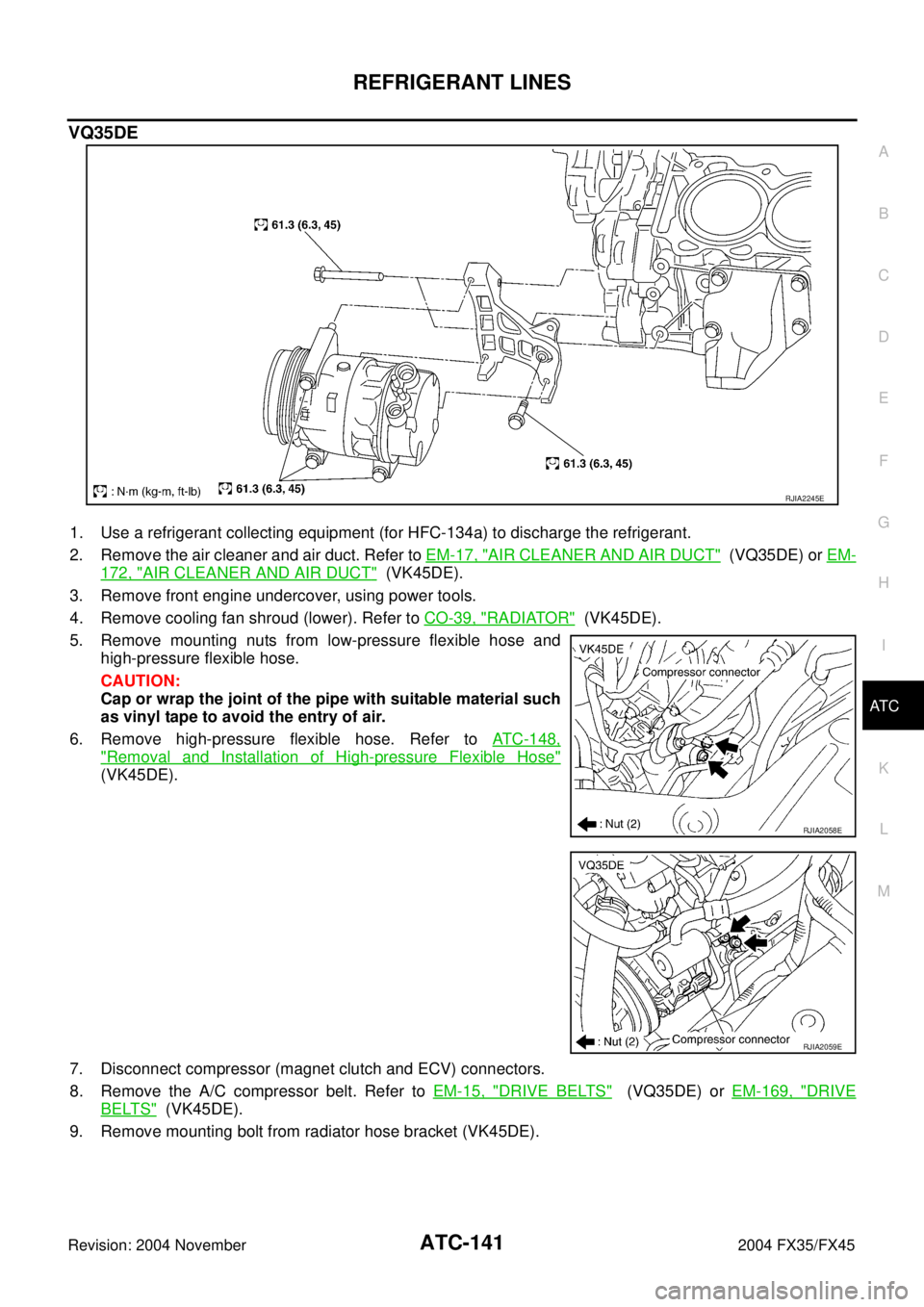
5. Remove mounting nuts from low-pressure flexible hose and
high-pressure flexible hose.
CAUTION:
Cap or wrap the joint of the pipe with suitable material such
as vinyl tape to avoid the entry of air.
6. Remove high-pressure flexible hose. Refer to ATC-148,
"Removal and Installation of High-pressure Flexible Hose"
(VK45DE).
7. Disconnect compressor (magnet clutch and ECV) connectors.
8. Remove the A/C compressor belt. Refer to EM-15, "
DRIVE BELTS" (VQ35DE) or EM-169, "DRIVE
BELTS" (VK45DE).
9. Remove mounting bolt from radiator hose bracket (VK45DE).
RJIA2245E
RJIA2058E
RJIA2059E
Page 583 of 4449

ATC-154
REFRIGERANT LINES
Revision: 2004 November 2004 FX35/FX45
Removal and Installation of CondenserAJS0015Z
REMOVAL
1. Use a refrigerant collecting equipment (for HFC-134a) to discharge the refrigerant.
2. Remove the air cleaner and air duct. Refer to EM-17, "
AIR CLEANER AND AIR DUCT" (VQ35DE) or EM-
172, "AIR CLEANER AND AIR DUCT" (VK45DE).
3. Remove engine undercover, using power tools.
4. Drain engine coolant (VK45DE). Refer to CO-36, "
Changing Engine Coolant" .
5. Remove cooling fan shroud after removing radiator upper hose (VK45DE). Refer to CO-39, "
RADIATOR" .
6. Remove mounting bolt for high-pressure flexible hose bracket.
7. Disconnect high-pressure flexible hose and high-pressure pipe
1 from condenser.
a. Set a disconnector (Condenser outlet: 92530-89908, Condenser
inlet: 92530-89912) on A/C piping.
b. Slide a disconnector upward until it clicks.
c. Slide A/C piping upward and disconnect it.
CAUTION:
Cap or wrap the joint of the pipe with suitable material such
as vinyl tape to avoid the entry of air.
8. Remove mounting bolts for condenser.
9. Remove radiator upper mount, move radiator and condenser to the engine side.
10. Remove condenser.
CAUTION:
Be careful not to damage the core surface of the condenser and the radiator.
INSTALLATION
Installation is basically the reverse order of removal.
CAUTION:
�Replace O-rings for A/C piping with new ones, then apply compressor oil to it when installing it.
�Connection point for female-side piping is thin. So, when inserting male-side piping, take care not
to deform female-side piping. Slowly insert in axial direction.
�Insert one-touch joint connection point securely until it clicks.
RJIA2065E
RJIA2066E
RJIA2075E
Page 584 of 4449

REFRIGERANT LINES
ATC-155
C
D
E
F
G
H
I
K
L
MA
B
AT C
Revision: 2004 November 2004 FX35/FX45
�After piping has been connected, pull male-side piping by hand to make sure piping does not
come off.
�When recharging refrigerant, check for leaks.
Removal and Installation of Refrigerant Pressure SensorAJS00160
REMOVAL
1. Remove condenser. Refer to ATC-154, "Removal and Installa-
tion of Condenser" .
2. Remove refrigerant pressure sensor from condenser.
CAUTION:
When working, be careful not to damage the condenser
fins.
INSTALLATION
Installation is basically the reverse order of removal.
CAUTION:
Apply compressor oil to the O-ring of the refrigerant pressure sensor when installing it.
Removal and Installation of EvaporatorAJS001BJ
REMOVAL
1. Set the temperature at 18°C (60°F), and then disconnect the battery negative cable.
2. Use a refrigerant collecting equipment (for HFC-134a) to discharge the refrigerant.
3. Remove low-pressure pipe 2 and high-pressure pipe 3. Refer to ATC-151, "
Removal and Installation of
Low-pressure Pipe 2 and High-pressure Pipe 3" .
CAUTION:
Cap or wrap the joint of the pipe with suitable material such as vinyl tape to avoid the entry of air.
4. Slide evaporator, and then remove it from heater & cooling unit.
5. Remove intake sensor from evaporator, and then remove evap-
orator.
INSTALLATION
Installation is basically the reverse order of removal.
CAUTION:
�Replace O-rings for A/C piping with new ones, then apply compressor oil to it when installing it.
�Connection point for female-side piping is thin. So, when inserting male-side piping, take care not
to deform female-side piping. Slowly insert in axial direction.
�Insert one-touch joint connection point securely until it clicks.
�After piping has been connected, pull male-side piping by hand to make sure piping does not
come off.
�The O-rings are different from low-pressure pipe 1 (high-pressure pipe 2) and low-pressure pipe 2
(high-pressure pipe 3).
�Mark the mounting position of the intake sensor bracket. Bolt mounting the high-pressure flexible hose bracket
Tightening torque : 5.5 N·m (0.56 kg-m, 49 in-lb)
RJIA2076E
RJIA0928E
Page 588 of 4449

REFRIGERANT LINES
ATC-159
C
D
E
F
G
H
I
K
L
MA
B
AT C
Revision: 2004 November 2004 FX35/FX45
CHECKING PROCEDURE
To prevent inaccurate or false readings, make sure there is no refrigerant vapor, shop chemicals, or cigarette
smoke in the vicinity of the vehicle. Perform the leak test in calm area (low air/wind movement) so that the
leaking refrigerant is not dispersed.
1. Turn engine OFF.
2. Connect a suitable A/C manifold gauge set to the A/C service ports.
3. Check if the A/C refrigerant pressure is at least 345 kPa (3.52 kg/cm
2 , 50 psi) above 16°C (61°F). If less
than specification, recover/evacuate and recharge the system with the specified amount of refrigerant.
NOTE:
At temperatures below 16°C (61°F), leaks may not be detected since the system may not reach 345 kPa
(3.52 kg/cm
2 , 50 psi).
4. Perform the leak test from the high-pressure side (compressor discharge a to evaporator inlet h) to the
low-pressure side [evaporator drain hose i to shaft seal o (VK45DE) or n (VQ35DE)]. Refer to ATC-139,
"Components" . Perform a leak check for the following areas carefully. Clean the component to be
checked and move the leak detected probe completely around the connection/component.
Compressor
Check the fitting of high- and low-pressure hoses, relief valve and shaft seal.
Liquid tank
Check the refrigerant connection.
Service valves
Check all around the service valves. Ensure service valve caps are secured on the service valves (to pre-
vent leaks).
NOTE:
After removing A/C manifold gauge set from service valves, wipe any residue from valves to prevent any
false readings by leak detector.
Cooling unit (Evaporator)
With engine OFF, turn blower fan on “High” for at least 15 seconds to dissipate any refrigerant trace in the
cooling unit. Wait a minimum of 10 minutes accumulation time (refer to the manufacturer′s recommended
procedure for actual wait time) before inserting the leak detector probe into the drain hose.
Keep the probe inserted for at least 10 seconds. Use caution not to contaminate the probe tip with water
or dirt that may be in the drain hose.
5. If a leak detector detects a leak, verify at least once by blowing compressed air into area of suspected
leak, then repeat check as outlined above.
6. Do not stop when one leak is found. Continue to check for additional leaks at all system components.
If no leaks are found, perform steps 7-10.
7. Start engine.
8. Set the heater A/C control as follows;
a. A/C switch: ON
b. Face mode
c. Intake position: Recirculation
d. Max cold temperature
e. Fan speed: High
9. Run engine at 1,500 rpm for at least 2 minutes.
10. Turn engine off and perform leak check again following steps 4 through 6 above.
Page 826 of 4449
RADIATOR CORE SUPPORT
BL-19
C
D
E
F
G
H
J
K
L
MA
B
BL
Revision: 2004 November 2004 FX35/FX45
RADIATOR CORE SUPPORTPFP:62500
Removal and InstallationAIS004LL
REMOVAL
1. Remove the front fender protector. Refer to EI-25, "Removal and Installation" .
2. Remove the front bumper. Refer to EI-14, "
Removal and Installation" .
3. Remove the ICC. Refer to ACS-67, "
REMOVAL AND INSTALLATION" .
4. Remove the headlamp. Refer to LT- 3 6 , "
Removal and Installation" .
5. Remove the washer tank. Refer to WW-33, "
Removal and Installation of Washer Tank" .
6. Remove the resonator.
7. Remove the power steering oil cooler. Refer to PS-41, "
HYDRAULIC LINE" .
8. Remove the ambient sensor. Refer to AT C - 11 7 , "
Removal and Installation" .
9. Remove the crash zone sensor. Refer to SRS-45, "
Removal and Installation" .
10. Remove the horn connector, blower fan connector and harness clip.
11. Remove the hood lock and disconnect hood lock control cable. Refer to BL-16, "
Removal and Installation
of Hood Lock Control" .
12. Remove the reservoir tank.
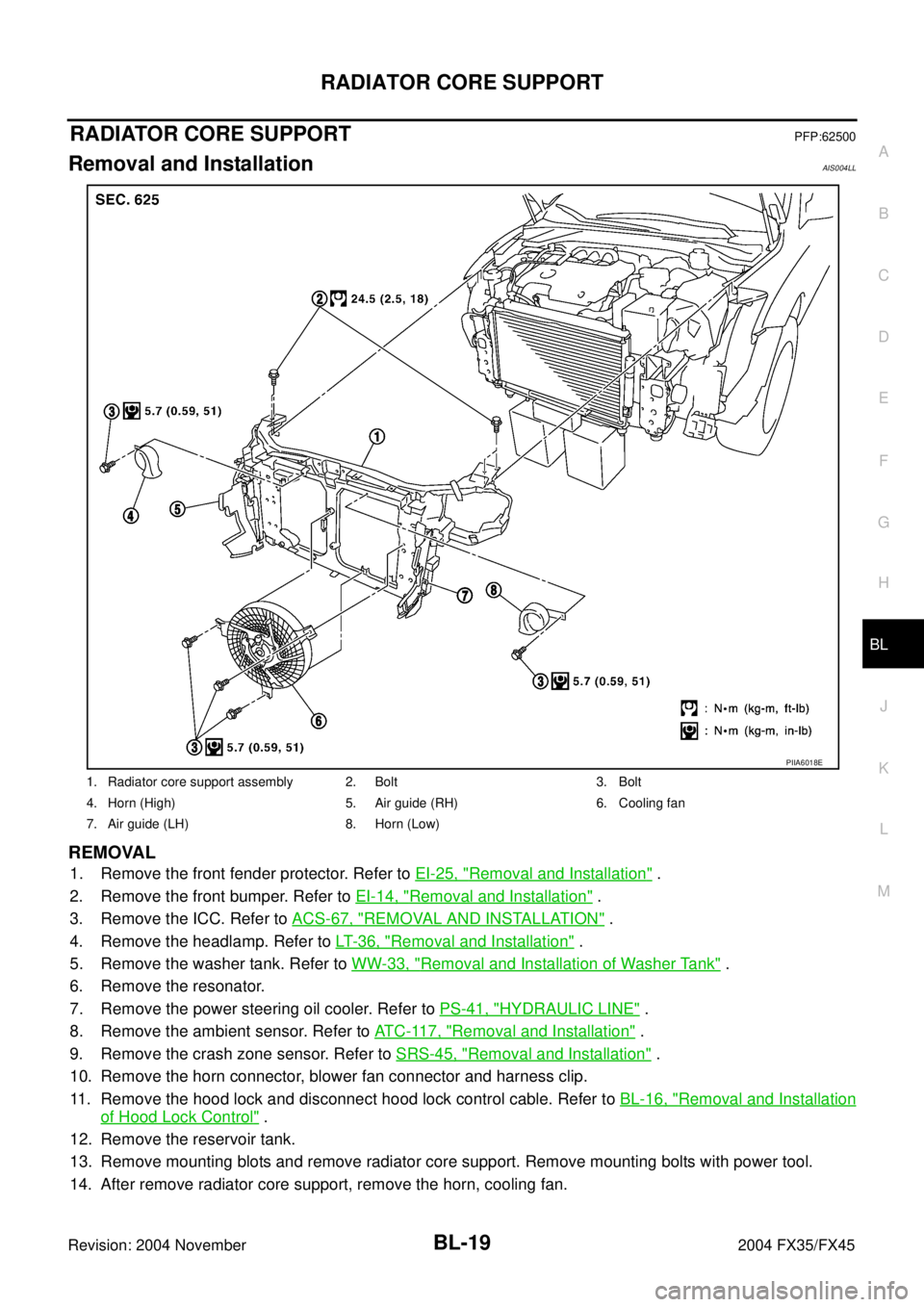
13. Remove mounting blots and remove radiator core support. Remove mounting bolts with power tool.
14. After remove radiator core support, remove the horn, cooling fan.
1. Radiator core support assembly 2. Bolt 3. Bolt
4. Horn (High) 5. Air guide (RH) 6. Cooling fan
7. Air guide (LH) 8. Horn (Low)
PIIA6018E