2004 DAEWOO LACETTI ACC
[x] Cancel search: ACCPage 225 of 2643
ENGINE ELECTRICAL 1E – 11
DAEWOO V–121 BL4
MAINTENANCE AND REPAIR
ON–VEHICLE SERVICE
GENERATOR
Removal Procedure
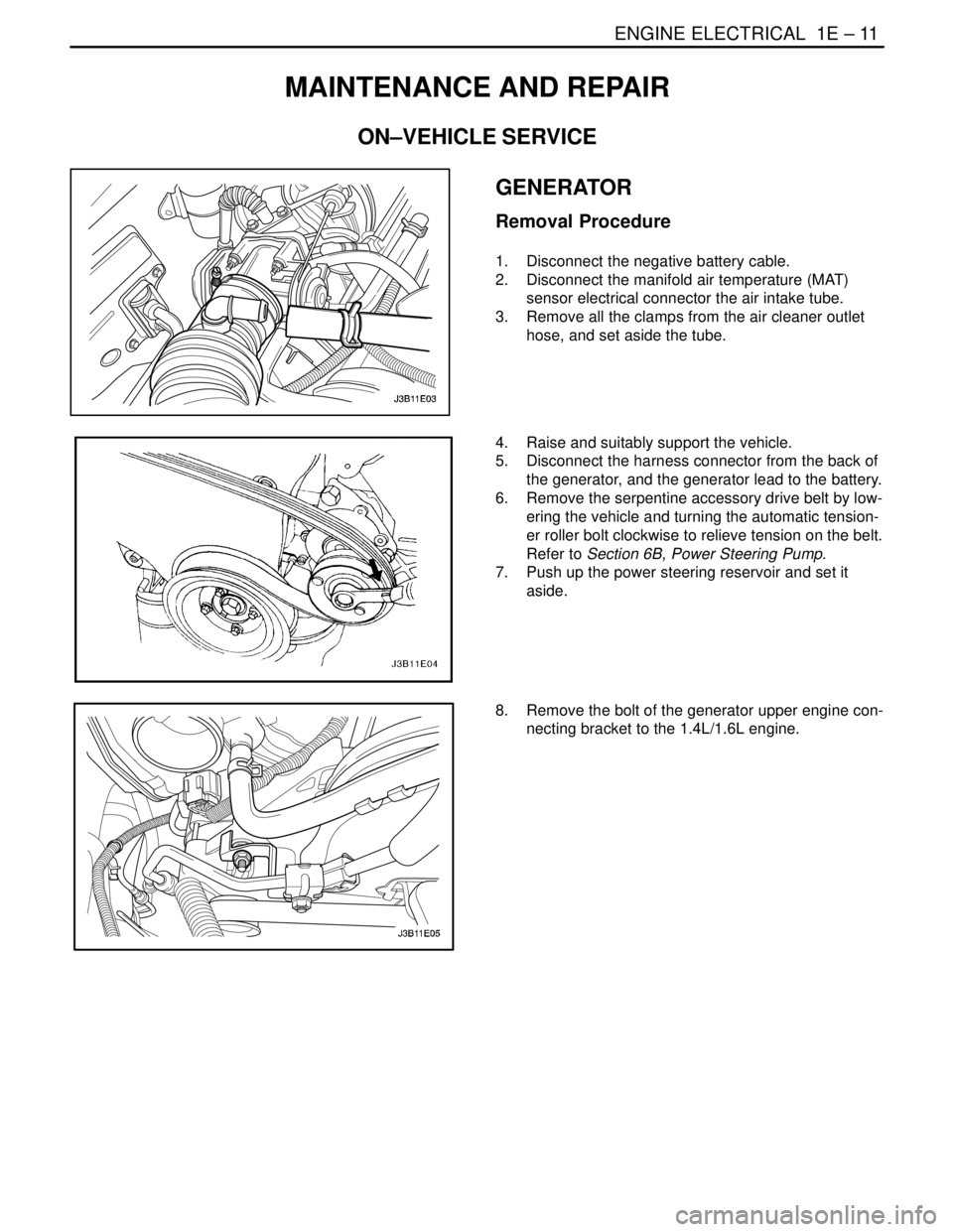
1. Disconnect the negative battery cable.
2. Disconnect the manifold air temperature (MAT)
sensor electrical connector the air intake tube.
3. Remove all the clamps from the air cleaner outlet
hose, and set aside the tube.
4. Raise and suitably support the vehicle.
5. Disconnect the harness connector from the back of
the generator, and the generator lead to the battery.
6. Remove the serpentine accessory drive belt by low-
ering the vehicle and turning the automatic tension-
er roller bolt clockwise to relieve tension on the belt.
Refer to Section 6B, Power Steering Pump.
7. Push up the power steering reservoir and set it
aside.
8. Remove the bolt of the generator upper engine con-
necting bracket to the 1.4L/1.6L engine.
Page 227 of 2643
ENGINE ELECTRICAL 1E – 13
DAEWOO V–121 BL4
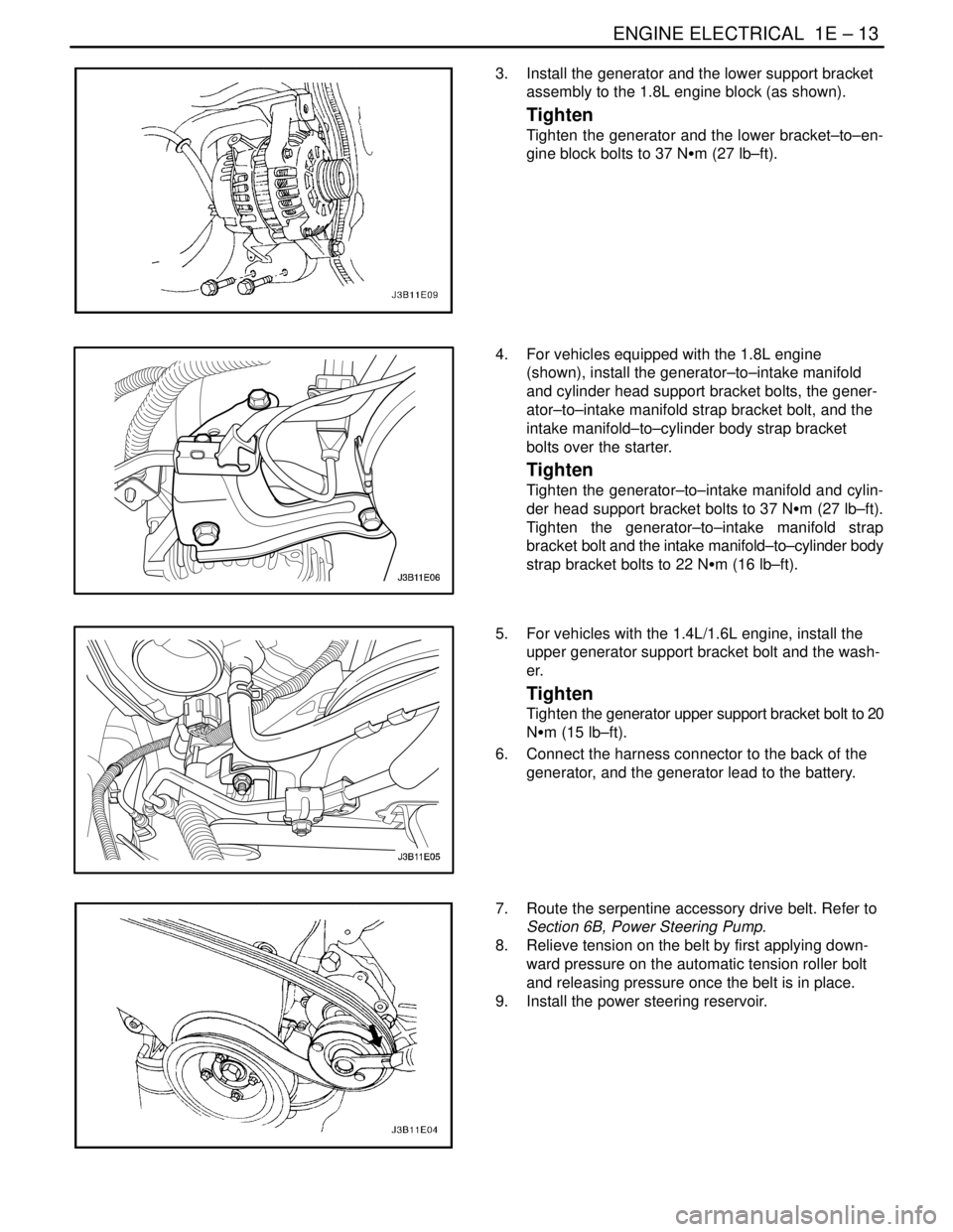
3. Install the generator and the lower support bracket
assembly to the 1.8L engine block (as shown).
Tighten
Tighten the generator and the lower bracket–to–en-
gine block bolts to 37 NSm (27 lb–ft).
4. For vehicles equipped with the 1.8L engine
(shown), install the generator–to–intake manifold
and cylinder head support bracket bolts, the gener-
ator–to–intake manifold strap bracket bolt, and the
intake manifold–to–cylinder body strap bracket
bolts over the starter.
Tighten
Tighten the generator–to–intake manifold and cylin-
der head support bracket bolts to 37 NSm (27 lb–ft).
Tighten the generator–to–intake manifold strap
bracket bolt and the intake manifold–to–cylinder body
strap bracket bolts to 22 NSm (16 lb–ft).
5. For vehicles with the 1.4L/1.6L engine, install the
upper generator support bracket bolt and the wash-
er.
Tighten
Tighten the generator upper support bracket bolt to 20
NSm (15 lb–ft).
6. Connect the harness connector to the back of the
generator, and the generator lead to the battery.
7. Route the serpentine accessory drive belt. Refer to
Section 6B, Power Steering Pump.
8. Relieve tension on the belt by first applying down-
ward pressure on the automatic tension roller bolt
and releasing pressure once the belt is in place.
9. Install the power steering reservoir.
Page 233 of 2643
ENGINE ELECTRICAL 1E – 19
DAEWOO V–121 BL4
9. Remove the plunger return spring.
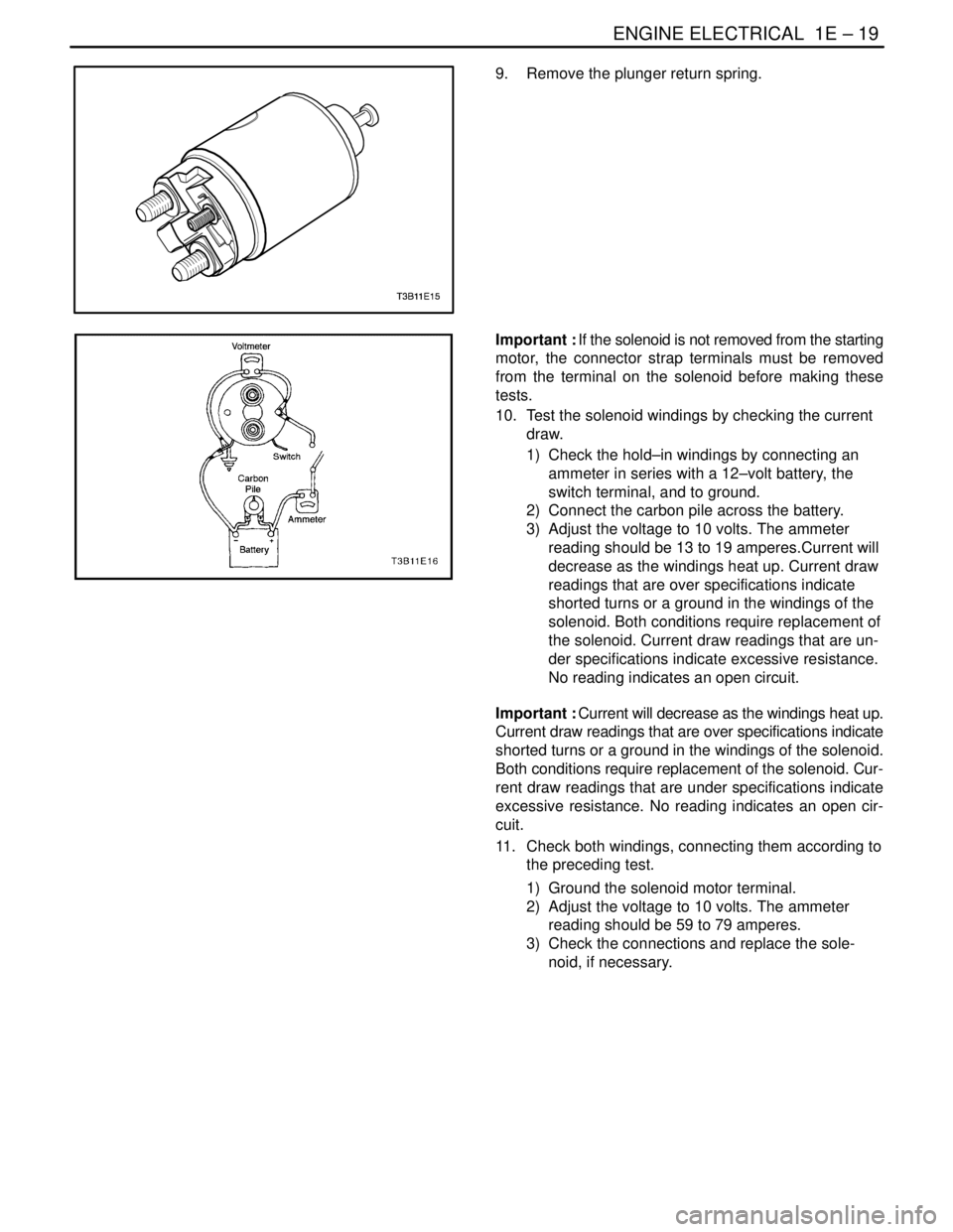
Important : If the solenoid is not removed from the starting
motor, the connector strap terminals must be removed
from the terminal on the solenoid before making these
tests.
10. Test the solenoid windings by checking the current
draw.
1) Check the hold–in windings by connecting an
ammeter in series with a 12–volt battery, the
switch terminal, and to ground.
2) Connect the carbon pile across the battery.
3) Adjust the voltage to 10 volts. The ammeter
reading should be 13 to 19 amperes.Current will
decrease as the windings heat up. Current draw
readings that are over specifications indicate
shorted turns or a ground in the windings of the
solenoid. Both conditions require replacement of
the solenoid. Current draw readings that are un-
der specifications indicate excessive resistance.
No reading indicates an open circuit.
Important : Current will decrease as the windings heat up.
Current draw readings that are over specifications indicate
shorted turns or a ground in the windings of the solenoid.
Both conditions require replacement of the solenoid. Cur-
rent draw readings that are under specifications indicate
excessive resistance. No reading indicates an open cir-
cuit.
11. Check both windings, connecting them according to
the preceding test.
1) Ground the solenoid motor terminal.
2) Adjust the voltage to 10 volts. The ammeter
reading should be 59 to 79 amperes.
3) Check the connections and replace the sole-
noid, if necessary.
Page 244 of 2643

1E – 30IENGINE ELECTRICAL
DAEWOO V–121 BL4
GENERAL DESCRIPTION
AND SYSTEM OPERATION
BATTERY
The sealed battery is standard on all cars. There are no
vent plugs in the cover. The battery is completely sealed,
except for two small vent holes in the sides. These vent
holes allow the small amount of gas produced in the bat-
tery to escape. The battery has the following advantages
over conventional batteries:
S No water addition for the life of the battery.
S Overcharge protection. If too much voltage is ap-
plied to the battery, it will not accept as much cur-
rent as a conventional battery. In a conventional
battery, the excess voltage will still try to charge the
battery, leading to gassing, which causes liquid
loss.
S Not as liable to self–discharge as compared to a
conventional battery. This is particularly important
when a battery is left standing for long periods of
time.
S More power available in a lighter and smaller case.
The battery has three major functions in the electrical sys-
tem. First, the battery provides a source of energy for
cranking the engine. Second, the battery acts as a voltage
stabilizer for the electrical system. Finally, the battery can,
for a limited time, provide energy when the electrical de-
mand exceeds the output of the generator.
RATINGS
A battery has two ratings: (1) a reserve capacity rating
designated at 27°C (80°F), which is the time a fully
charged battery will provide 25 amperes current flow at or
above 10.5 volts; (2) a cold cranking amp rating deter-
mined under testing at –18°C (0°F), which indicates the
cranking load capacity.
RESERVE CAPACITY
The reserve capacity is the maximum length of time it is
possible to travel at night with the minimum electrical load
and no generator output. Expressed in minutes, Reserve
Capacity (or RC rating) is the time required for a fully
charged battery, at a temperature of 27°C (80°F) and be-
ing discharged at a current of 25 amperes, to reach a ter-
minal voltage of 10.5 volts.
COLD CRANKING AMPERAGE
The cold cranking amperage test is expressed at a battery
temperature of –18°C (0°F). The current rating is the mini-
mum amperage, which must be maintained by the battery
for 30 seconds at the specified temperature, while meeting
a minimum voltage requirement of 7.2 volts. This rating is
a measure of cold cranking capacity.The battery is not designed to last indefinitely. However,
with proper care, the battery will provide many years of
service.
If the battery tests well, but fails to perform satisfactorily
in service for no apparent reason, the following factors
may point to the cause of the trouble:
S Vehicle accessories are left on overnight.
S Slow average driving speeds are used for short pe-
riods.
S The vehicle’s electrical load is more than the gener-
ator output, particularly with the addition of after-
market equipment.
S Defects in the charging system, such as electrical
shorts, a slipping generator belt, a faulty generator,
or a faulty voltage regulator.
S Battery abuse, including failure to keep the battery
cable terminals clean and tight, or a loose battery
hold–down clamp.
S Mechanical problems in the electrical system, such
as shorted or pinched wires.
BUILT – IN HYDROMETER
The sealed battery has a built–in, temperature–compen-
sated hydrometer in the top of the battery. This hydrome-
ter is to be used with the following diagnostic procedure:
1. When observing the hydrometer, make sure that
the battery has a clean top.
2. Under normal operation, two indications can be ob-
served:
S GREEN DOT VISIBLE – Any green appearance
is interpreted as a ”green dot,” meaning the bat-
tery is ready for testing.
S DARK GREEN DOT IS NOT VISIBLE – If there
is a cranking complaint, the battery should be
tested. The charging and electrical systems
should also be checked at this time.
3. Occasionally, a third condition may appear:
S CLEAR OR BRIGHT YELLOW – This means
the fluid level is below the bottom of the hydrom-
eter. This may have been caused by excessive
or prolonged charging, a broken case, excessive
tipping, or normal battery wear. Finding a battery
in this condition may indicate high charging by a
faulty charging system. Therefore, the charging
and the electrical systems may need to be
checked if a cranking complaint exists. If the
cranking complaint is caused by the battery, re-
place the battery.
CHARGING PROCEDURE
1. Batteries with the green dot showing do not require
charging unless they have just been discharged
(such as in cranking a vehicle).
2. When charging sealed–terminal batteries out of the
vehicle, install the adapter kit. Make sure all the
charger connections are clean and tight. For best
results, batteries should be charged while the elec-
Page 245 of 2643

ENGINE ELECTRICAL 1E – 31
DAEWOO V–121 BL4
trolyte and the plates are at room temperature. A
battery that is extremely cold may not accept cur-
rent for several hours after starting the charger.
3. Charge the battery until the green dot appears. The
battery should be checked every half–hour while
charging. Tipping or shaking the battery may be
necessary to make the green dot appear.
4. After charging, the battery should be load tested.
Refer to ”Starter Motor” in this section.
CHARGING TIME REQUIRED
The time required to charge a battery will vary depending
upon the following factors:
S Size of Battery – A completely discharged large
heavy–duty battery requires more than twice the re-
charging time as a completely discharged small pas-
senger car battery.
S Temperature – A longer time will be needed to
charge any battery at –18°C (0°F) than at 27°C
(80°F). When a fast charger is connected to a cold
battery, the current accepted by the battery will be
very low at first. The battery will accept a higher cur-
rent rate as the battery warms.
S Charger Capacity – A charger which can supply only
5 amperes will require a much longer charging period
than a charger that can supply 30 amperes or more.
S State–of–Charge – A completely discharged battery
requires more than twice as much charge as a one–
half charged battery. Because the electrolyte is nearly
pure water and a poor conductor in a completely dis-
charged battery, the current accepted by the battery
is very low at first. Later, as the charging current
causes the electrolyte acid content to increase, the
charging current will likewise increase.
CHARGING A COMPLETELY
DISCHARGED BATTERY (OFF THE
VEHICLE)
Unless this procedure is properly followed, a perfectly
good battery may need to be replaced.
The following procedure should be used to recharge a
completely discharged battery:
1. Measure the voltage at the battery terminals with
an accurate voltmeter. If the reading is below 10
volts, the charge current will be very low, and it
could take some time before the battery accepts
the current in excess of a few milliamperes. Refer
to ””Charging Time Required” in this section, which
focuses on the factors affecting both the charging
time required and the rough estimates in the table
below. Such low current may not be detectable on
ammeters available in the field.
2. Set the battery charger on the high setting.Important : Some chargers feature polarity protection cir-
cuitry, which prevents charging unless the charger leads
are correctly connected to the battery terminals. A com-
pletely discharged battery may not have enough voltage
to activate this circuitry, even though the leads are con-
nected properly, making it appear that the battery will not
accept charging current. Therefore, follow the specific
charger manufacturer’s instruction for bypassing or over-
riding the circuitry so that the charger will turn on and
charge a low–voltage battery.
3. Continue to charge the battery until the charge cur-
rent is measurable. Battery chargers vary in the
amount of voltage and current provided. The time
required for the battery to accept a measurable
charge current at various voltages may be as fol-
lows:
Voltage
Hours
16.0 or moreUp to 4 hours
14.0–15.9Up to 8 hours
13.9 or lessUp to 16 hours
S If the charge current is not measurable at the
end of the above charging times, the battery
should be replaced.
S If the charge current is measurable during the
charging time, the battery is good, and charging
should be completed in the normal manner.
Important : It is important to remember that a completely
discharged battery must be recharged for a sufficient num-
ber of ampere hours (AH) to restore the battery to a usable
state. As a general rule, using the reserve capacity rating
(RC) as the number of ampere hours of charge usually
brings the green dot into view.
S If the charge current is still not measurable after
using the charging time calculated by the above
method, the battery should be replaced.
JUMP STARTING PROCEDURE
1. Position the vehicle with the good (charged) battery
so that the jumper cables will reach.
2. Turn off the ignition, all the lights, and all the electri-
cal loads in both vehicles. Leave the hazard flasher
on if jump starting where there may be other traffic
and any other lights needed for the work area.
3. In both vehicles, apply the parking brake firmly.
Notice : To avoid vehicle damage,Make sure the cables
are not on or near pulleys, fans, or other parts that will
move when the engine starts.
4. Shift an automatic transaxle to PARK, or a manual
transaxle to NEUTRAL.
CAUTION : In order to avoid injury, do not use cables
that have loose or missing insulation.
5. Clamp one end of the first jumper cable to the posi-
tive terminal on the battery. Make sure it does not
touch any other metal parts. Clamp the other end of
Page 254 of 2643

1F – 8IENGINE CONTROLS
DAEWOO V–121 BL4
EGR Desired Position
The desired exhaust gas recirculation (EGR) position is
the commanded EGR position. The ECM calculates the
desired EGR position. The higher the percentage, the lon-
ger the ECM is commanding the EGR valve ON.
Engine Load
Indicates engine load based on manifold absolute pres-
sure. The higher the percentage, the more load the engine
is under.
Engine Run Time
The engine run time is a measure of how long the engine
has been running. When the engine stops running, the tim-
er resets to zero.
Engine Speed
Engine Speed is computed by the ECM from the fuel con-
trol reference input. It should remain close to desired idle
under the various engine loads with the engine idling.
Fan
The Fan Control (FC) Relay is commanded by the ECM.
The FC Relay displays the command as ON or OFF.
Fuel Level Sensor
The Fuel Level Sensor monitors the fuel level in the tank.
The Fuel Level Sensor monitors the rate of change of the
air pressure in the EVAP system. Several of the Enhanced
EVAP System diagnostics are dependent upon the correct
fuel level.
Fuel System Status
The Closed Loop is displayed indicating that the ECM is
controlling the fuel delivery according to the Front Heated
Oxygen Sensor (HO2S1) voltage as close to an air/fuel ra-
tio of 14.7 to 1 as possible.
IAC Position
The scan tool displays the ECM command for the Idle Air
Control (IAC) pintle position in counts. The higher the
number of counts, the greater the commanded idle speed
reads. The Idle Air Control responds to changes in the en-
gine load in order to maintain the desired idle rpm.
Ignition 1 (Voltage)
The ignition volts represent the system voltage measured
by the ECM at the ignition feed circuit.
Intake Air Temperature
The ECM converts the resistance of the Intake Air Tem-
perature (IAT) sensor to degrees in the same manner as
the engine coolant temperature (ECT) sensor. In take air
temperature is used by the ECM to adjust fuel delivery and
spark timing according to incoming air density.Knock Present
The KS Noise Channel indicates when the ECM detects
the KS signal. The ECM should display NO at idle.
Long Term FT
The Long Term Fuel Trim (FT) is derived from the short
term fuel trim value. The Long Term FT is used for the long
term correction of the fuel delivery. A value of 128 counts
(0%) indicates that the fuel delivery requires no com-
pensation in order to maintain a 14.7:1 air to fuel ratio. A
value below 128 counts means that the fuel system is too
rich and the fuel delivery is being reduced. The ECM is de-
creasing the injector pulse width. A value above 128
counts indicates that a lean condition exists for which the
ECM is compensating.
MAP
The Manifold Absolute Pressure (MAP) sensor measures
the change in the intake manifold pressure which results
from engine load and speed changes. As the intake man-
ifold pressure increases, the air density in the intake also
increases and the additional fuel is required.
Misfire History #1–4
Indicates the number of misfires that have occurred after
195 current misfires have been counted. The current mis-
fire counter will add its misfires to the history misfire count-
er after 195 total misfires have taken place. If 1 cylinder is
misfiring, the misfiring current counter will have 195 mis-
fires counted before adding to its history counter. If 2 cylin-
ders are misfiring, the misfiring current counter will add to
their history counters after 97 misfires. The counter incre-
ments only after a misfire diagnostic trouble code (DTC)
has been set.
Front Heated Oxygen Sensor
The pre–converter Front Heated Oxygen Sensor
(HO2S1) reading represents the exhaust oxygen sensor
output voltage. This voltage will fluctuate constantly be-
tween 100 mv (lean exhaust) and 900 mv (rich exhaust)
when the system is operating in a Closed Loop.
Rear Heated Oxygen Sensor
The post–converter Rear Heated Oxygen Sensor
(HO2S2) represents the exhaust oxygen output voltage
past the catalytic converter. This voltage remains inactive,
or the voltage will appear lazy within a range of 100 mv
(lean exhaust) and 900 mv (rich exhaust) when operating
in a Closed Loop.
Short Term FT
The Short Term FT represents a short term correction to
fuel delivery by the ECM in response to the amount of time
the oxygen sensor voltage spends above or below the 450
mv threshold. If the oxygen sensor has mainly been below
450 mv, indicating a lean air/fuel mixture, short term fuel
trim will increase to tell the ECM to add fuel. If the oxygen
sensor voltage stays mainly above the threshold, the ECM
will reduce fuel delivery to compensate for the indicated
rich condition.
Page 277 of 2643

ENGINE CONTROLS 1F – 31
DAEWOO V–121 BL4
TEC (TOOTH ERROR CORRECTION)
LEARN PROCEDURE
When an ECM is reflashed, initialized or replaced, and dri-
veplate of fly wheel has been replaced, follow these proce-
dures to relearn the crankshaft position (CKP) system
variation :
CAUTION : To avoid personal injury when performing
the TEC learn procedure, always set the vehicle park-
ing brake and block the drive wheels. Release the
throttle immediately when the engine starts to decel-
erate. Once the learning procedure is completed, en-
gine control will be learned to the operator, and the
engine will respond to throttle position.1. Stay the gear parking or neutral.
2. Install the scan tool and select ”TEC (Toth Error
Correction) LEARN” menu.
3. Start the engine with A/C off.
4. Keep the engine coolant temperature above 65°C
(149° F)
5. Put the acceleration pedal above 4000 RPM until
the fuel cut–off occurs.
6. Wait 10–15 seconds.
7. Fulfill this procedure again if the scan tool does not
display ”OK” message.
8. Turn the ignition switch OFF.
9. Turn the ignition swtich ON and then clear the DTC
code.
Page 325 of 2643

ENGINE CONTROLS 1F – 79
DAEWOO V–121 BL4
IDLE AIR CONTROL SYSTEM CHECK (1.4L/1.6L DOHC)
Circuit Description
The aim of the MTIA (Main Throttle Idle Actuator) is to con-
trol the idle speed with the throttle body itself. The throttle
is motorized for low opening angle (0°C, 19°C). The char-
acteristics of the airflow are not the same for low and high
opening angles. As a matter of fact, the gradient of the
mass air flow function of TPS is lower for small angles that
permits to be more precise during the idle speed control.
Out of idle speed the throttle is actuated mechanically by
a classical bowdencable.
The main throttle idle actuator (MTIA) provides a voltagesignal that changes in relation to the throttle plate angle.
The signal voltage will vary from about nearly 5.0 V at idles
to about 0.2V to 0.4 V at wide–open throttle. The TPS is
one of the most important inputs used by the ECM for fuel
control and other functions such as idle, wide open
throttle, deceleration enleanment, and acceleration en-
richment.
Diagnostic Aids
If the idle is too high, stop the engine. Fully extend the main
throttle idle actuator (MTIA) with a IAC driver. Start the en-
gine. If the idle speed is above 800 rpm, locate and repair
the vacuum leak. Also, check for a binding throttle plate or
throttle linkage or an incorrect base idle setting.