2004 DAEWOO LACETTI ACC
[x] Cancel search: ACCPage 95 of 2643

1C1 – 52I1.4L/1.6L DOHC ENGINE MECHANICAL
DAEWOO V–121 BL4
18. Connect the power steering pressure hose.
19. Connect the power steering return hose.
20. Install the A/C compressor, if equipped. Refer to
Section 7B, Manual Control Heating, Ventilation,
and Air Conditioning Systems.
21. Install the generator. Refer to Section 1E, Engine
Electrical.
22. Install the serpentine accessory drive belt. Refer to
Section 6B, Power Steering Pump.
23. Install the right front wheel well splash shield.
24. Install the right front wheel. Refer to Section 2E,
Tires and Wheels.
25. Connect the fuel feed line to the fuel rail.
26. Connect all of the necessary vacuum lines, includ-
ing the brake booster vacuum hose.
27. Connect the O2 sensor connector, if equipped.
28. Connect the starter solenoid ”S” terminal wire and
power lead.
29. Connect the generator voltage regulator connector
and power lead.
30. Connect the CTS connector.
31. Connect the MAP, MAT sensor connectors.
32. Connect the TPS connector.
33. Install the electrical wiring harness clamp at the
intake manifold support bracket.
34. Connect the fuel injector harness connectors.
35. Connect the electrical connector at the DIS coil and
the ECM ground terminal at the starter.
36. Install the air cleaner outlet hose between the
throttle body and the air cleaner housing.
37. Connect the breather tubes to the camshaft cover.
38. Install the cooling system radiator and the engine
cooling fans. Refer to Section 1D, Engine Cooling.
Page 120 of 2643

1.4L/1.6L DOHC ENGINE MECHANICAL 1C1 – 77
DAEWOO V–121 BL4
GENERAL DESCRIPTION
AND SYSTEM OPERATION
CYLINDER HEAD AND GASKET
The cylinder head is made of an aluminum alloy. The cylin-
der head uses cross–flow intake and exhaust ports. A
spark plug is located in the center of each combustion
chamber. The cylinder head houses the dual camshafts.
CRANKSHAFT
The crankshaft has eight integral weights which are cast
with it for balancing. Oil holes run through the center of the
crankshaft to supply oil to the connecting rods, the bear-
ings, the pistons, and the other components. The end
thrust load is taken by the thrust washers installed at the
center journal.
TIMING BELT
The timing belt coordinates the crankshaft and the dual
overhead camshafts and keeps them synchronized. The
timing belt also turns the water pump. The timing belt and
the pulleys are toothed so that there is no slippage be-
tween them. There are two idler pulleys. An automatic ten-
sioner pulley maintains the timing belt’s correct tension.
The timing belt is made of a tough reinforced rubber similar
to that used on the serpentine accessory drive belt. The
timing belt requires no lubrication.
OIL PUMP
The oil pump draws engine oil from the oil pan and feeds
it under pressure to the various parts of the engine. An oil
strainer is mounted before the inlet of the oil pump to re-
move impurities which could clog or damage the oil pump
or other engine components. When the drive gear rotates,
the driven gear rotates. This causes the space between
the gears to constantly open and narrow, pulling oil in from
the oil pan when the space opens and pumping the oil out
to the engine as it narrows.
At high engine speeds, the oil pump supplies a much high-
er amount of oil than is required for lubrication of the en-
gine. The oil pressure regulator prevents too much oil from
entering the engine lubrication passages. During normal
oil supply, a coil spring and valve keep the bypass closed,
directing all of the oil pumped to the engine. When the
amount of oil being pumped increases, the pressure be-
comes high enough to overcome the force of the spring.This opens the valve of the oil pressure regulator, allowing
the excess oil to flow through the valve and drain back to
the oil pan.
OIL PAN
The engine oil pan is mounted to the bottom of the cylinder
block. The engine oil pan houses the crankcase and is
made of cast metal.
Engine oil is pumped from the oil pan by the oil pump. After
it passes through the oil filter, it is fed through two paths
to lubricate the cylinder block and the cylinder head. In one
path, the oil is pumped through the oil passages in the
crankshaft to the connecting rods, then to the pistons and
the cylinders. It then drains back to the oil pan. In the sec-
ond path, the oil is pumped through the oil passages to the
camshaft. The oil passes through the internal passage-
ways in the camshafts to lubricate the valve assemblies
before draining back to the oil pan.
EXHAUST MANIFOLD
A single four–port, rear–takedown manifold is used with
this engine. The manifold is designed to direct escaping
exhaust gases out of the combustion chambers with a
minimum of back pressure. The oxygen sensor is
mounted to the exhaust manifold.
INTAKE MANIFOLD
The intake manifold has four independent long ports and
uses inertial supercharging to improve engine torque at
low and moderate speeds. The plenum is attached to the
intake manifold.
CAMSHAFTS
This engine is a dual overhead camshaft (DOHC) type,
which means there are two camshafts. One camshaft op-
erates the intake valves, and the other camshaft operates
the exhaust valves. The camshafts sit in journals on the
top of the engine in the cylinder head and are held in place
by camshaft caps. The camshaft journals of the cylinder
head are drilled to create oil passages. Engine oil travels
to the camshafts under pressure where it lubricates each
camshaft journal. The oil returns to the oil pan through
drain holes in the cylinder head. The camshaft lobes are
machined into the solid camshaft to open and close the in-
take and the exhaust valves precisely the correct amount
at the correct time. The camshaft lobes are oiled by splash
action from pressurized oil escaping from the camshaft
journals.
Page 134 of 2643
1C2 – 14I1.8L DOHC ENGINE MECHANICAL
DAEWOO V–121 BL4
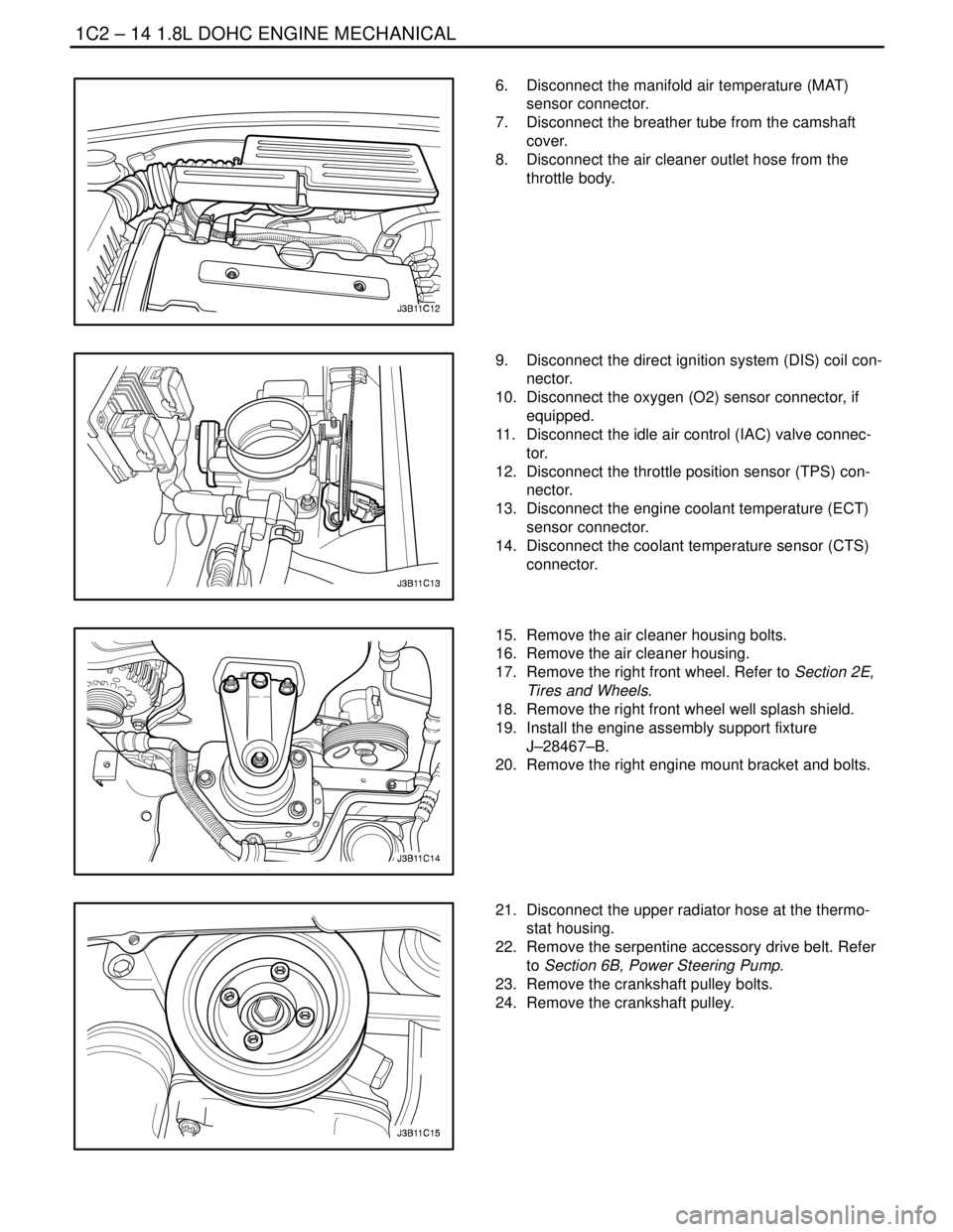
6. Disconnect the manifold air temperature (MAT)
sensor connector.
7. Disconnect the breather tube from the camshaft
cover.
8. Disconnect the air cleaner outlet hose from the
throttle body.
9. Disconnect the direct ignition system (DIS) coil con-
nector.
10. Disconnect the oxygen (O2) sensor connector, if
equipped.
11. Disconnect the idle air control (IAC) valve connec-
tor.
12. Disconnect the throttle position sensor (TPS) con-
nector.
13. Disconnect the engine coolant temperature (ECT)
sensor connector.
14. Disconnect the coolant temperature sensor (CTS)
connector.
15. Remove the air cleaner housing bolts.
16. Remove the air cleaner housing.
17. Remove the right front wheel. Refer to Section 2E,
Tires and Wheels.
18. Remove the right front wheel well splash shield.
19. Install the engine assembly support fixture
J–28467–B.
20. Remove the right engine mount bracket and bolts.
21. Disconnect the upper radiator hose at the thermo-
stat housing.
22. Remove the serpentine accessory drive belt. Refer
to Section 6B, Power Steering Pump.
23. Remove the crankshaft pulley bolts.
24. Remove the crankshaft pulley.
Page 141 of 2643

1.8L DOHC ENGINE MECHANICAL 1C2 – 21
DAEWOO V–121 BL4
39. Install the timing belt.
40. Check and adjust the timing belt tension. Refer to
”Timing Belt Check and Adjust” in this section.
41. Install the front timing belt cover.
42. Install the front timing belt cover bolts.
Tighten
Tighten the front timing belt cover bolts to 6 NSm (53
lb–in).
43. Install the crankshaft pulley.
44. Install the crankshaft pulley bolts.
Tighten
Tighten the crankshaft pulley bolts to 12 NSm (106 lb–
in).
45. Install the right engine mount bracket and retaining
bolts.
Tighten
Tighten the engine mount bracket retaining bolts to 55
NSm (41 lb–ft).
46. Remove the engine assembly lift support
J–28467–B.
47. Install the serpentine accessory drive belt. Refer to
Section 6B, Power Steering Pump.
48. Connect the upper radiator hose to the thermostat
housing.
49. Install the right front wheel well splash shield.
50. Install the right front wheel. Refer to Section 2E,
Tires and Wheels.
51. Install the air cleaner housing.
52. Install the air cleaner housing bolts.
Tighten
Tighten the air cleaner housing bolts to 10 NSm (89 lb–
in).
53. Connect the air cleaner outlet hose to the throttle
body.
54. Connect the breather tube to the camshaft cover.
55. Connect the MAT sensor connector.
Page 145 of 2643
1.8L DOHC ENGINE MECHANICAL 1C2 – 25
DAEWOO V–121 BL4
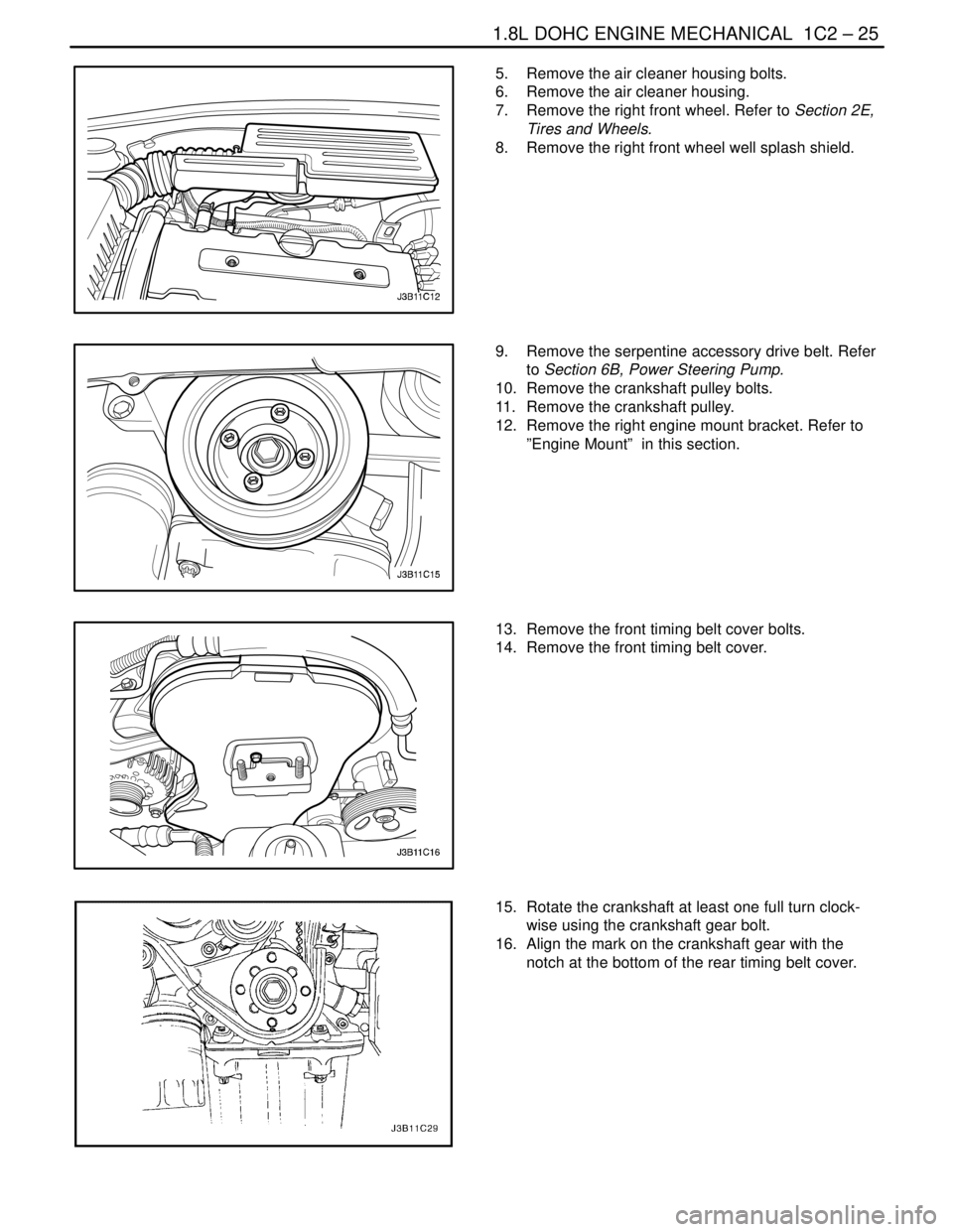
5. Remove the air cleaner housing bolts.
6. Remove the air cleaner housing.
7. Remove the right front wheel. Refer to Section 2E,
Tires and Wheels.
8. Remove the right front wheel well splash shield.
9. Remove the serpentine accessory drive belt. Refer
to Section 6B, Power Steering Pump.
10. Remove the crankshaft pulley bolts.
11. Remove the crankshaft pulley.
12. Remove the right engine mount bracket. Refer to
”Engine Mount” in this section.
13. Remove the front timing belt cover bolts.
14. Remove the front timing belt cover.
15. Rotate the crankshaft at least one full turn clock-
wise using the crankshaft gear bolt.
16. Align the mark on the crankshaft gear with the
notch at the bottom of the rear timing belt cover.
Page 147 of 2643

1.8L DOHC ENGINE MECHANICAL 1C2 – 27
DAEWOO V–121 BL4
24. Install the front timing belt cover.
25. Install the front timing belt cover bolts.
Tighten
Tighten the front timing belt cover bolts to 6 NSm (53
lb–in).
26. Install the crankshaft pulley.
27. Install the crankshaft pulley bolt.
Tighten
Tighten the crankshaft pulley bolt to 20 NSm (15 lb–ft).
28. Install the right engine mount bracket. Refer to ”En-
gine Mount” in this section.
29. Install the serpentine accessory drive belt. Refer to
Section 6B, Power Steering Pump.
30. Install the right front wheel well splash shield.
31. Install the right front wheel. Refer to Section 2E,
Tires and Wheels.
32. Install the air cleaner housing.
33. Install the air cleaner housing bolts.
Tighten
Tighten the air cleaner housing bolts to 10 NSm (89 lb–
in).
34. Connect the air cleaner outlet hose to the throttle
body.
35. Connect the breather tube to the camshaft cover.
36. Connect the MAT sensor connector.
37. Connect the negative battery cable.
Page 148 of 2643

1C2 – 28I1.8L DOHC ENGINE MECHANICAL
DAEWOO V–121 BL4
TIMING BELT
Removal Procedure
1. Disconnect the negative battery cable.
2. Disconnect the manifold air temperature (MAT)
sensor connector.
3. Disconnect the air cleaner outlet hose from the
throttle body.
4. Disconnect the breather tube from the camshaft
cover.
5. Remove the air cleaner housing bolts.
6. Remove the air cleaner housing.
7. Remove the right front wheel. Refer to Section 2E,
Tires and Wheels.
8. Remove the right front wheel well splash shield.
9. Remove the serpentine accessory drive belt. Refer
to Section 6B, Power Steering Pump.
10. Remove the crankshaft pulley bolts.
11. Remove the crankshaft pulley.
12. Remove the right engine mount bracket. Refer to
”Engine Mount” in this section.
13. Remove the front timing belt cover bolts.
14. Remove the front timing belt cover.
Page 151 of 2643

1.8L DOHC ENGINE MECHANICAL 1C2 – 31
DAEWOO V–121 BL4
11. Install the crankshaft pulley.
12. Install the crankshaft pulley bolts.
Tighten
Tighten the crankshaft pulley bolts to 20 NSm (15 lb–
ft).
13. Install the serpentine accessory drive belt. Refer to
Section 6B, Power Steering Pump.
14. Install the right front wheel well splash shield. Refer
to Section 9R, Body Front End.
15. Install the right front wheel. Refer to Section 2E,
Tires and Wheels.
16. Install the air cleaner housing.
17. Install the air cleaner housing bolts.
Tighten
Tighten the air cleaner housing bolts to 10 NSm (89 lb–
in).
18. Connect the air cleaner outlet hose to the throttle
body.
19. Connect the breather tube to the camshaft cover.
20. Connect the MAT sensor connector.
21. Connect the negative battery cable.