Page 232 of 384
Winter Driving
Here are some tips for winter driving:
•Have your vehicle in good shape for winter.
•You may want to put winter emergency supplies in
your vehicle.
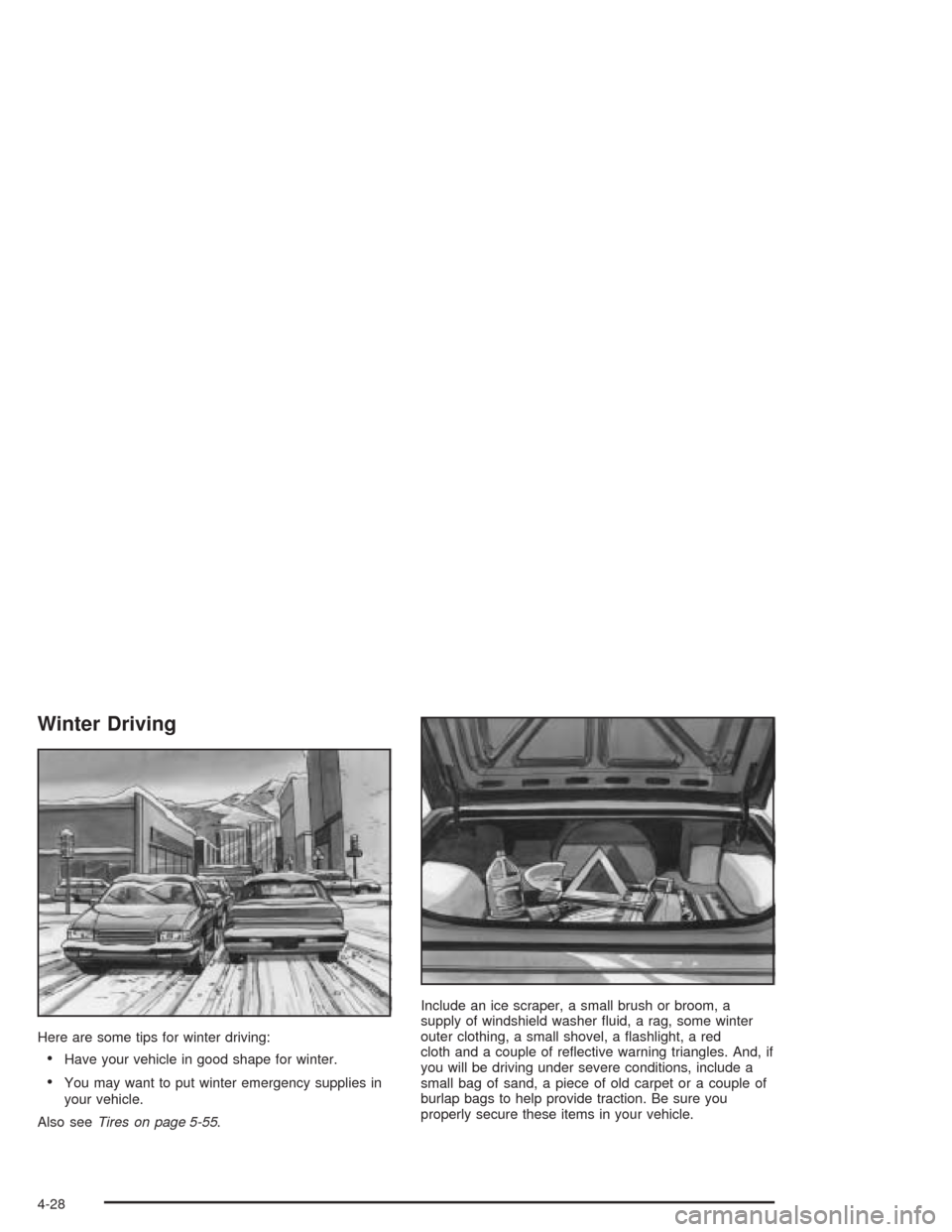
Also seeTires on page 5-55.Include an ice scraper, a small brush or broom, a
supply of windshield washer fluid, a rag, some winter
outer clothing, a small shovel, a flashlight, a red
cloth and a couple of reflective warning triangles. And, if
you will be driving under severe conditions, include a
small bag of sand, a piece of old carpet or a couple of
burlap bags to help provide traction. Be sure you
properly secure these items in your vehicle.
4-28
Page 304 of 384
The valve stems on your extended mobility tires have
sensors that are part of the Tire Pressure Monitor
(TPM). SeeTire Pressure Monitor Operation
(Except Z06) on page 5-64. The TPM sensors contain
batteries which are designed to last for 10 years
under normal driving conditions. See your dealer if you
ever need to have a wheel replaced, or if the sensors
ever need replacement.
Notice:Using liquid sealants can damage the tire
valves and tire pressure monitor sensors in your
extended mobility tires. This damage would not be
covered by warranty. Don’t use liquid sealants
in your extended mobility tires.
If you feel that winter tires are needed for your driving
conditions, Goodyear Eagle M+S EMT tires are available
in your original equipment sizes from an authorized
Goodyear EMT retailer. These tires will improve snow
traction while maintaining your vehicle’s extended
mobility feature. When using winter tires on your vehicle,
be sure to use them on all four wheels. SeeBuying
New Tires on page 5-66.Ination - Tire Pressure
The tire and loading information label, shows the correct
inflation pressures for your tires when they’re cold.
“Cold” means your vehicle has been sitting for at least
three hours or driven no more than 1 mile (1.6 km). See
Loading Your Vehicle on page 4-33, for the location
of your vehicle’s tire and loading information label.
Notice:Don’t let anyone tell you that underination
or overination is all right. It’s not. If your tires
don’t have enough air (underination), you can get
the following:
Too much exing
Too much heat
Tire overloading
Bad wear
Bad handling
Bad fuel economy
If your tires have too much air (overination), you
can get the following:
Unusual wear
Bad handling
Rough ride
Needless damage from road hazards
5-62
Page 308 of 384
Buying New Tires
To find out what kind and size of tires your vehicle
needs, look at the Tire and Loading Information label.
SeeLoading Your Vehicle on page 4-33, for an example
of the label and where it is located on your vehicle.
The tires installed on your vehicle when it was new had
a Tire Performance Criteria Specification (TPC Spec)
number on each tire’s sidewall. When you get new tires,
GM recommends that you get tires with that same
TPC Spec number. That way your vehicle will continue
to have tires that are designed to give proper
endurance, handling, load range, speed rating, traction,
ride, tire pressure monitoring system performance
and other things during normal service on your vehicle.
If your tires have an all-season tread design, the
TPC number will be followed by an “MS” (for mud
and snow).
If you ever replace your tires with those not having a
TPC Spec number, make sure they are the same size,
load range, speed rating and construction type (bias,
bias-belted or radial) as your original tires.{CAUTION:
Mixing tires could cause you to lose control
while driving. If you mix tires of different sizes
(other than those originally installed on your
vehicle) or types (radial and bias-belted tires),
the vehicle may not handle properly, and you
could have a crash. Using tires of different
sizes (other than those originally installed on
your vehicle) may also cause damage to your
vehicle. Be sure to use the correct size and
type tires on all four wheels.
If your vehicle is equipped with Extended Mobility Tires
and you feel that winter tires are needed, see
Extended Mobility Tires (Except Z06) on page 5-61.
{CAUTION:
If you use bias-ply tires on your vehicle, the
wheel rim anges could develop cracks after
many miles of driving. A tire and/or wheel
could fail suddenly, causing a crash. Use only
radial-ply tires with the wheels on your vehicle.
5-66
Page 309 of 384

Uniform Tire Quality Grading
Quality grades can be found where applicable on the
tire sidewall between tread shoulder and maximum
section width. For example:
Treadwear 200 Traction AA Temperature A
The following information relates to the system
developed by the United States National Highway
Traffic Safety Administration, which grades tires by
treadwear, traction and temperature performance. (This
applies only to vehicles sold in the United States.)
The grades are molded on the sidewalls of most
passenger car tires. The Uniform Tire Quality Grading
system does not apply to deep tread, winter-type
snow tires, space-saver or temporary use spare tires,
tires with nominal rim diameters of 10 to 12 inches
(25 to 30 cm), or to some limited-production tires.
While the tires available on General Motors passenger
cars and light trucks may vary with respect to these
grades, they must also conform to federal safety
requirements and additional General Motors Tire
Performance Criteria (TPC) standards.
Treadwear
The treadwear grade is a comparative rating based on
the wear rate of the tire when tested under controlled
conditions on a specified government test course.
For example, a tire graded 150 would wear one and
a half (1.5) times as well on the government course as
a tire graded 100. The relative performance of tires
depends upon the actual conditions of their use,
however, and may depart significantly from the norm
due to variations in driving habits, service practices and
differences in road characteristics and climate.
Traction – AA, A, B, C
The traction grades, from highest to lowest, are AA, A,
B, and C. Those grades represent the tire’s ability
to stop on wet pavement as measured under controlled
conditions on specified government test surfaces of
asphalt and concrete. A tire marked C may have poor
traction performance. Warning: The traction grade
assigned to this tire is based on straight-ahead braking
traction tests, and does not include acceleration,
cornering, hydroplaning, or peak traction characteristics.
5-67