Page 2015 of 3502
![NISSAN TEANA 2003 Service Manual IAT SENSOR
EC-733
[VQ]
C
D
E
F
G
H
I
J
K
L
MA
EC
3. CHECK INTAKE AIR TEMPERATURE SENSOR POWER SUPPLY CIRCUIT
1. Turn ignition switch OFF.
2. Disconnect mass air flow sensor (intake air temperature s](/manual-img/5/57392/w960_57392-2014.png "NISSAN TEANA 2003 Service Manual IAT SENSOR
EC-733
[VQ]
C
D
E
F
G
H
I
J
K
L
MA
EC
3. CHECK INTAKE AIR TEMPERATURE SENSOR POWER SUPPLY CIRCUIT
1. Turn ignition switch OFF.
2. Disconnect mass air flow sensor (intake air temperature s")
IAT SENSOR
EC-733
[VQ]
C
D
E
F
G
H
I
J
K
L
MA
EC
3. CHECK INTAKE AIR TEMPERATURE SENSOR POWER SUPPLY CIRCUIT
1. Turn ignition switch OFF.
2. Disconnect mass air flow sensor (intake air temperature sensor
is built-into) harness connector.
3. Turn ignition switch ON.
4. Check voltage between mass air flow sensor terminal 2 and
ground with CONSULT-II or tester.
OK or NG
OK >> GO TO 4.
NG >> Repair harness or connectors.
4. CHECK INTAKE AIR TEMPERATURE SENSOR GROUND CIRCUIT FOR OPEN AND SHORT
1. Turn ignition switch OFF.
2. Disconnect ECM harness connector.
3. Check harness continuity between mass air flow sensor terminal 1 and ECM terminal 67.
Refer to Wiring Diagram.
4. Also check harness for short to ground and short to power.
OK or NG
OK >> GO TO 5.
NG >> Repair open circuit or short to ground or short to power in harness or connectors.
5. CHECK INTAKE AIR TEMPERATURE SENSOR
Refer to EC-734, "
Component Inspection" .
OK or NG
OK >> GO TO 6.
NG >> Replace mass air flow sensor (with intake air temperature sensor).
6. CHECK INTERMITTENT INCIDENT
Refer to EC-450, "
TROUBLE DIAGNOSIS FOR INTERMITTENT INCIDENT" .
>>INSPECTION END
PBIB2105E
Voltage: Approximately 5V
PBIB1598E
Continuity should exist.
Page 2016 of 3502
EC-734
[VQ]
IAT SENSOR
Component InspectionBBS0055M
INTAKE AIR TEMPERATURE SENSOR
1. Check resistance between mass air flow sensor terminals 1 and
2 under the following conditions.
2. If NG, replace mass air flow sensor (with intake air temperature
sensor).
Removal and InstallationBBS0055N
MASS AIR FLOW SENSOR
Refer to EM-131, "AIR CLEANER AND AIR DUCT" .
Intake air temperature °C (°F) Resistance kΩ
25 (77) 1.800 - 2.200
PBIB1604E
SEF012P
Page 2032 of 3502
![NISSAN TEANA 2003 Service Manual EC-750
[VQ]
REFRIGERANT PRESSURE SENSOR
Specification data are reference values and are measured between each terminal and ground.
CAUTION:
Do not use ECM ground terminals when measuring input/outpu](/manual-img/5/57392/w960_57392-2031.png "NISSAN TEANA 2003 Service Manual EC-750
[VQ]
REFRIGERANT PRESSURE SENSOR
Specification data are reference values and are measured between each terminal and ground.
CAUTION:
Do not use ECM ground terminals when measuring input/outpu")
EC-750
[VQ]
REFRIGERANT PRESSURE SENSOR
Specification data are reference values and are measured between each terminal and ground.
CAUTION:
Do not use ECM ground terminals when measuring input/output voltage. Doing so may result in dam-
age to the ECM's transistor. Use a ground other than ECM terminals, such as the ground.
Diagnostic ProcedureBBS00571
1. CHECK REFRIGERANT PRESSURE SENSOR OVERALL FUNCTION
1. Start engine and warm it up to normal operating temperature.
2. Turn A/C switch and blower fan switch ON.
3. Check voltage between ECM terminal 70 and ground with CON-
SULT-II or tester.
OK or NG
OK >>INSPECTION END
NG >> GO TO 2.
2. CHECK GROUND CONNECTIONS
1. Turn A/C switch and blower fan switch OFF.
2. Turn ignition switch OFF.
3. Loosen and retighten two ground screws on the body.
Refer to EC-457, "
Ground Inspection" .
OK or NG
OK >> GO TO 3.
NG >> Repair or replace ground connections.
TER-
MINAL
NO.WIRE
COLORITEM CONDITION DATA (DC Voltage)
49 BR/WSensor power supply
(Refrigerant pressure sen-
sor)[Ignition switch: ON]Approximately 5V
67 B Sensor ground[Engine is running]
�Warm-up condition
�Idle speedApproximately 0V
70 W Refrigerant pressure sensor[Engine is running]
�Warm-up condition
�Both A/C switch and blower fan switch: ON
(Compressor operates.)1.0 - 4.0V
Voltage: 1.0 - 4.0V
PBIB1188E
PBIB2160E
Page 2035 of 3502
![NISSAN TEANA 2003 Service Manual VIAS
EC-753
[VQ]
C
D
E
F
G
H
I
J
K
L
MA
EC
VIASPFP:14956
DescriptionBBS00565
SYSTEM DESCRIPTION
*: ECM determines the start signal status by the signals of engine speed and battery voltage.
When the](/manual-img/5/57392/w960_57392-2034.png "NISSAN TEANA 2003 Service Manual VIAS
EC-753
[VQ]
C
D
E
F
G
H
I
J
K
L
MA
EC
VIASPFP:14956
DescriptionBBS00565
SYSTEM DESCRIPTION
*: ECM determines the start signal status by the signals of engine speed and battery voltage.
When the")
VIAS
EC-753
[VQ]
C
D
E
F
G
H
I
J
K
L
MA
EC
VIASPFP:14956
DescriptionBBS00565
SYSTEM DESCRIPTION
*: ECM determines the start signal status by the signals of engine speed and battery voltage.
When the engine is running at medium speed, the ECM sends the ON signal to the VIAS control solenoid
valve. This signal introduces the intake manifold vacuum into the power valve actuator and therefore closes
the power valve.
Under this condition, the effective intake manifold length is equivalent to the total length of passage A and pas-
sage B. This long intake manifold provides increased amount of intake air, which results in improved suction
efficiency and higher torque.
When engine is running at low or high speed, the ECM sends the OFF signal to the VIAS control solenoid
valve and the power valve is opened.
Under this condition, the effective intake manifold length is equivalent to the length of passage B. This short-
ened intake manifold length results in enhanced engine output due to reduced suction resistance under high
speeds.
COMPONENT DESCRIPTION
Power Valve
The power valve is installed in intake manifold collector and used to
control the suction passage of the variable induction air control sys-
tem. It is set in the fully closed or fully opened position by the power
valve actuator operated by the vacuum stored in the surge tank. The
vacuum in the surge tank is controlled by the VIAS control solenoid
valve.
Sensor Input Signal to ECM ECM function Actuator
Crankshaft position sensor (POS)
Camshaft position sensor (PHASE)Engine speed*
VIAS control VIAS control solenoid valve Mass air flow sensor Amount of intake air
Engine coolant temperature sensor Engine coolant temperature
Throttle position sensor Throttle position
Accelerator pedal position sensor Accelerator pedal position
Battery Battery voltage*
PBIB1822E
PBIB2108E
Page 2039 of 3502
VIAS
EC-757
[VQ]
C
D
E
F
G
H
I
J
K
L
MA
EC
Diagnostic ProcedureBBS00568
1. CHECK OVERALL FUNCTION
With CONSULT-II
1. Start engine and warm it up to normal operating temperature.
2. Perform “VIAS SOL VALVE” in “ACTIVE TEST” mode with CON-
SULT-II.
3. Turn VIAS control solenoid valve ON and OFF, and make sure
that power valve actuator rod moves.
Without CONSULT-II
1. Start engine and warm it up to normal operating temperature.
2. Rev engine up to between 1,800 and 3,600 (VQ35DE), 3,750
(VQ23DE) rpm and make sure that power valve actuator rod
moves.
OK or NG
OK >>INSPECTION END
NG (With CONSULT-II) >>GO TO 2.
NG (Without CONSULT-II) >>GO TO 3.
PBIB0844E
PBIB2472E
PBIB2472E
Page 2047 of 3502
![NISSAN TEANA 2003 Service Manual SERVICE DATA AND SPECIFICATIONS (SDS)
EC-765
[VQ]
C
D
E
F
G
H
I
J
K
L
MA
EC
SERVICE DATA AND SPECIFICATIONS (SDS)PFP:00030
Fuel PressureBBS0057G
Idle Speed and Ignition TimingBBS0057H
*: Under the f](/manual-img/5/57392/w960_57392-2046.png "NISSAN TEANA 2003 Service Manual SERVICE DATA AND SPECIFICATIONS (SDS)
EC-765
[VQ]
C
D
E
F
G
H
I
J
K
L
MA
EC
SERVICE DATA AND SPECIFICATIONS (SDS)PFP:00030
Fuel PressureBBS0057G
Idle Speed and Ignition TimingBBS0057H
*: Under the f")
SERVICE DATA AND SPECIFICATIONS (SDS)
EC-765
[VQ]
C
D
E
F
G
H
I
J
K
L
MA
EC
SERVICE DATA AND SPECIFICATIONS (SDS)PFP:00030
Fuel PressureBBS0057G
Idle Speed and Ignition TimingBBS0057H
*: Under the following conditions:
�Air conditioner switch: OFF
�Electric load: OFF (Lights, heater fan & rear window defogger)
�Steering wheel: Kept in straight-ahead position
Mass Air Flow SensorBBS0057I
*: Engine is warmed up to normal operating temperature and running under no load.
Intake Air Temperature SensorBBS0057J
Engine Coolant Temperature SensorBBS0057K
Heated Oxygen Sensor 1 HeaterBBS0057L
Heated Oxygen sensor 2 HeaterBBS0057M
Crankshaft Position Sensor (POS)BBS0057N
Refer to EC-523, "Component Inspection" .
Camshaft Position Sensor (PHASE)BBS0057O
Refer to EC-532, "Component Inspection" .
Throttle Control MotorBBS0057P
Fuel InjectorBBS0057Q
Fuel pressure at idling kPa (bar, kg/cm2 , psi)Approximately 350 (3.5, 3.57, 51)
Target idle speed No load* (in P or N position)VQ23DE: 700 ± 50 rpm
VQ35DE: 625 ± 50 rpm
Air conditioner: ONIn P or N position VQ23DE: 750 rpm or more
VQ35DE: 700 rpm or more
Ignition timing In P or N position 15 ± 5° BTDC
Supply voltageBattery voltage (11 - 14V)
Output voltage at idle0.9 - 1.1V (VQ23DE engine)*
1.0 - 1.3V (VQ35DE engine)*
Temperature °C (°F) Resistance kΩ
25 (77)1.800 - 2.200
80 (176)0.283 - 0.359
Temperature °C (°F)Resistance kΩ
20 (68)2.1 - 2.9
50 (122)0.68 - 1.00
90 (194)0.236 - 0.260
Resistance [at 25°C (77°F)] 3.3 - 4.0Ω
Resistance [at 25°C (77°F)] 5.0 - 7.0Ω
Resistance [at 25°C (77°F)] Approximately 1 - 15Ω
Resistance [at 10 - 60°C (50 - 140°F)]VQ23DE: 13.5 - 17.5Ω
VQ35DE: 11.1 - 14.5Ω
Page 2053 of 3502
SQUEAK AND RATTLE TROUBLE DIAGNOSES
EI-5
C
D
E
F
G
H
J
K
L
MA
B
EI
SQUEAK AND RATTLE TROUBLE DIAGNOSESPFP:00000
Work FlowBIS0011A
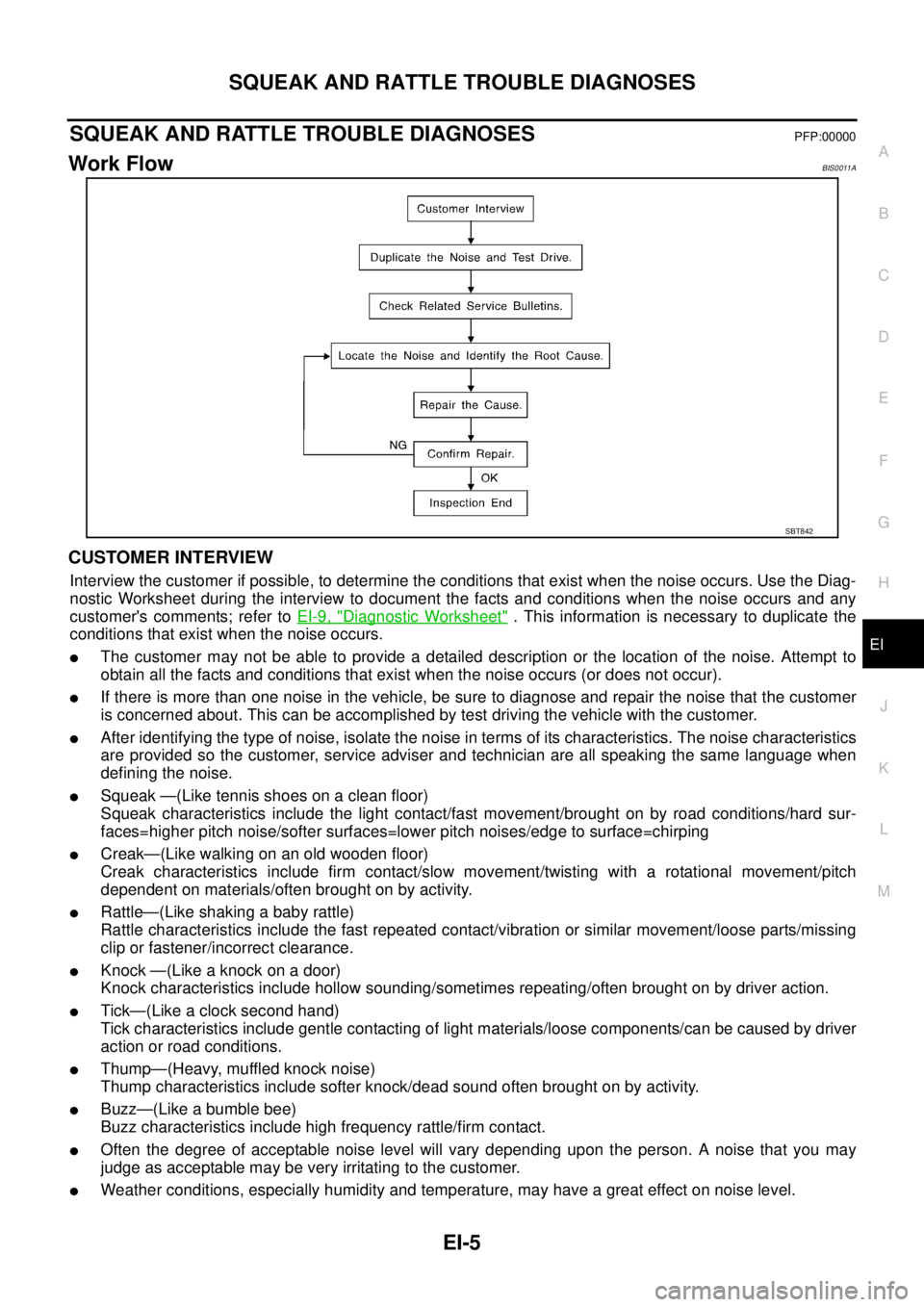
CUSTOMER INTERVIEW
Interview the customer if possible, to determine the conditions that exist when the noise occurs. Use the Diag-
nostic Worksheet during the interview to document the facts and conditions when the noise occurs and any
customer's comments; refer to EI-9, "
Diagnostic Worksheet" . This information is necessary to duplicate the
conditions that exist when the noise occurs.
�The customer may not be able to provide a detailed description or the location of the noise. Attempt to
obtain all the facts and conditions that exist when the noise occurs (or does not occur).
�If there is more than one noise in the vehicle, be sure to diagnose and repair the noise that the customer
is concerned about. This can be accomplished by test driving the vehicle with the customer.
�After identifying the type of noise, isolate the noise in terms of its characteristics. The noise characteristics
are provided so the customer, service adviser and technician are all speaking the same language when
defining the noise.
�Squeak —(Like tennis shoes on a clean floor)
Squeak characteristics include the light contact/fast movement/brought on by road conditions/hard sur-
faces=higher pitch noise/softer surfaces=lower pitch noises/edge to surface=chirping
�Creak—(Like walking on an old wooden floor)
Creak characteristics include firm contact/slow movement/twisting with a rotational movement/pitch
dependent on materials/often brought on by activity.
�Rattle—(Like shaking a baby rattle)
Rattle characteristics include the fast repeated contact/vibration or similar movement/loose parts/missing
clip or fastener/incorrect clearance.
�Knock —(Like a knock on a door)
Knock characteristics include hollow sounding/sometimes repeating/often brought on by driver action.
�Tick—(Like a clock second hand)
Tick characteristics include gentle contacting of light materials/loose components/can be caused by driver
action or road conditions.
�Thump—(Heavy, muffled knock noise)
Thump characteristics include softer knock/dead sound often brought on by activity.
�Buzz—(Like a bumble bee)
Buzz characteristics include high frequency rattle/firm contact.
�Often the degree of acceptable noise level will vary depending upon the person. A noise that you may
judge as acceptable may be very irritating to the customer.
�Weather conditions, especially humidity and temperature, may have a great effect on noise level.
SBT842
Page 2140 of 3502
EM-32
[QR]
SPARK PLUG(PLATINUM-TIPPED TYPE)
SPARK PLUG(PLATINUM-TIPPED TYPE)PFP:22401
Removal and InstallationBBS00592
REMOVAL
1. Remove engine cover. Refer to EM-19, "INTAKE MANIFOLD" .
2. Remove ignition coil. Refer to EM-31, "
IGNITION COIL" .
3. Remove spark plug with spark plug wrench (commercial service
tool).
CAUTION:
Do not drop or shock it.
INSPECTION AFTER REMOVAL
Use standard type spark plug for normal condition.
Hot type spark plug is suitable when fouling occurs with standard type spark plug under conditions such as:
�Frequent engine starts
�Low ambient temperatures
Cold type spark plug is suitable when spark plug knock occurs with standard type spark plug under conditions
such as:
�Extended highway driving
�Frequent high engine revolution
1. Ignition coil 2. Spark plug 3. Rocker cover
KBIA1974J
SEM294A
MakeNGK
Standard typePLFR5A-11
Hot typePLFR4A-11
Cold typePLFR6A-11
Gap (Nominal) : 1.1 mm (0.043 in)
![NISSAN TEANA 2003 Service Manual EC-734
[VQ]
IAT SENSOR
Component InspectionBBS0055M
INTAKE AIR TEMPERATURE SENSOR
1. Check resistance between mass air flow sensor terminals 1 and
2 under the following conditions.
2. If NG, replace](/manual-img/5/57392/w960_57392-2015.png "NISSAN TEANA 2003 Service Manual EC-734
[VQ]
IAT SENSOR
Component InspectionBBS0055M
INTAKE AIR TEMPERATURE SENSOR
1. Check resistance between mass air flow sensor terminals 1 and
2 under the following conditions.
2. If NG, replace")
![NISSAN TEANA 2003 Service Manual VIAS
EC-757
[VQ]
C
D
E
F
G
H
I
J
K
L
MA
EC
Diagnostic ProcedureBBS00568
1. CHECK OVERALL FUNCTION
With CONSULT-II
1. Start engine and warm it up to normal operating temperature.
2. Perform “VIAS](/manual-img/5/57392/w960_57392-2038.png "NISSAN TEANA 2003 Service Manual VIAS
EC-757
[VQ]
C
D
E
F
G
H
I
J
K
L
MA
EC
Diagnostic ProcedureBBS00568
1. CHECK OVERALL FUNCTION
With CONSULT-II
1. Start engine and warm it up to normal operating temperature.
2. Perform “VIAS")
![NISSAN TEANA 2003 Service Manual EM-32
[QR]
SPARK PLUG(PLATINUM-TIPPED TYPE)
SPARK PLUG(PLATINUM-TIPPED TYPE)PFP:22401
Removal and InstallationBBS00592
REMOVAL
1. Remove engine cover. Refer to EM-19, "INTAKE MANIFOLD" .
2. Remove](/manual-img/5/57392/w960_57392-2139.png "NISSAN TEANA 2003 Service Manual EM-32
[QR]
SPARK PLUG(PLATINUM-TIPPED TYPE)
SPARK PLUG(PLATINUM-TIPPED TYPE)PFP:22401
Removal and InstallationBBS00592
REMOVAL
1. Remove engine cover. Refer to EM-19, \"INTAKE MANIFOLD\" .
2. Remove")