Page 2412 of 3502
FAX-30
FRONT DRIVE SHAFT
INSPECTION AFTER DISASSEMBLY
Shaft
Check shaft for runout, cracks, or other damage. Replace if there are.
Joint-sub-Assembly (Wheel Side)
�Check joint sub-assembly for rough rotation and excessive axial looseness.
�Check the inside of joint sub-assembly for entry of foreign material.
�Check joint sub-assembly for compression scars, cracks, and fractures inside of joint sub-assembly.
Replace joint sub-assembly if there are any non-standard conditions.
Support Bearing
�Check support bearing for wear and other damage.
�Check retainer for cracks and other damage.
ASSEMBLY
Transaxle Side
1. Wrap shaft serration with tape to protect boot from damage.
Install new boot and boot bands to shaft.
2. Remove the tape wrapped around the serration on shaft.
3. Apply the specified amount of grease (NISSAN genuine grease
or equivalent) to housing inside, and then install housing to
shaft.
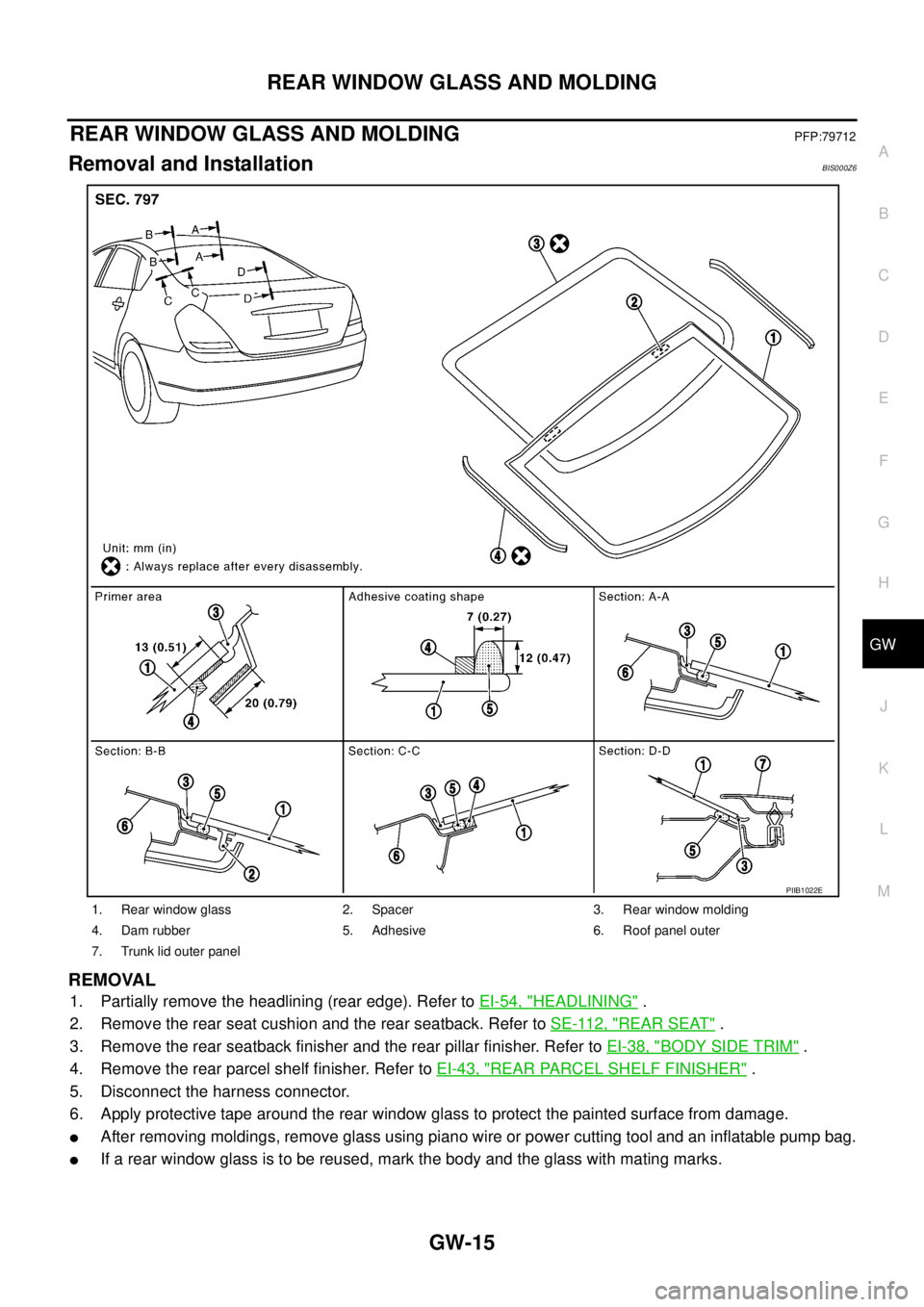
4. Install boot securely into grooves (indicated by *marks) shown in
the figure.
CAUTION:
If there is grease on boot mounting surfaces (indicated by *
marks) of shaft and housing, boot may come off. Remove
all grease from surfaces.
5. Make sure boot installation length “L” is the length indicated
below.Insert a flat-bladed screwdriver or similar tool into smaller
side of boot. Bleed air from boot to prevent boot deformation.
CAUTION:
�Boot may break if boot installation length is less than standard value.
�Take care not to touch the tip of screwdriver to inside surface of boot.
6. Install new larger and smaller boot bands securely.
NOTE:
Discard old boot bands; replace with new ones.Grease amount
QR20DE models : 132 – 142 g (4.66 – 5.00 oz)
VQ35DE models : 134 – 144 g (4.73 – 5.08 oz)
PDIA1157E
Boot installation length “L”
QR20DE models : 176.8 – 178.8 mm (6.96 – 7.04 in)
VQ35DE models : 186.8 mm (7.35 in)SDIA1760E
Page 2509 of 3502
REAR WINDOW GLASS AND MOLDING
GW-15
C
D
E
F
G
H
J
K
L
MA
B
GW
REAR WINDOW GLASS AND MOLDINGPFP:79712
Removal and InstallationBIS000Z6
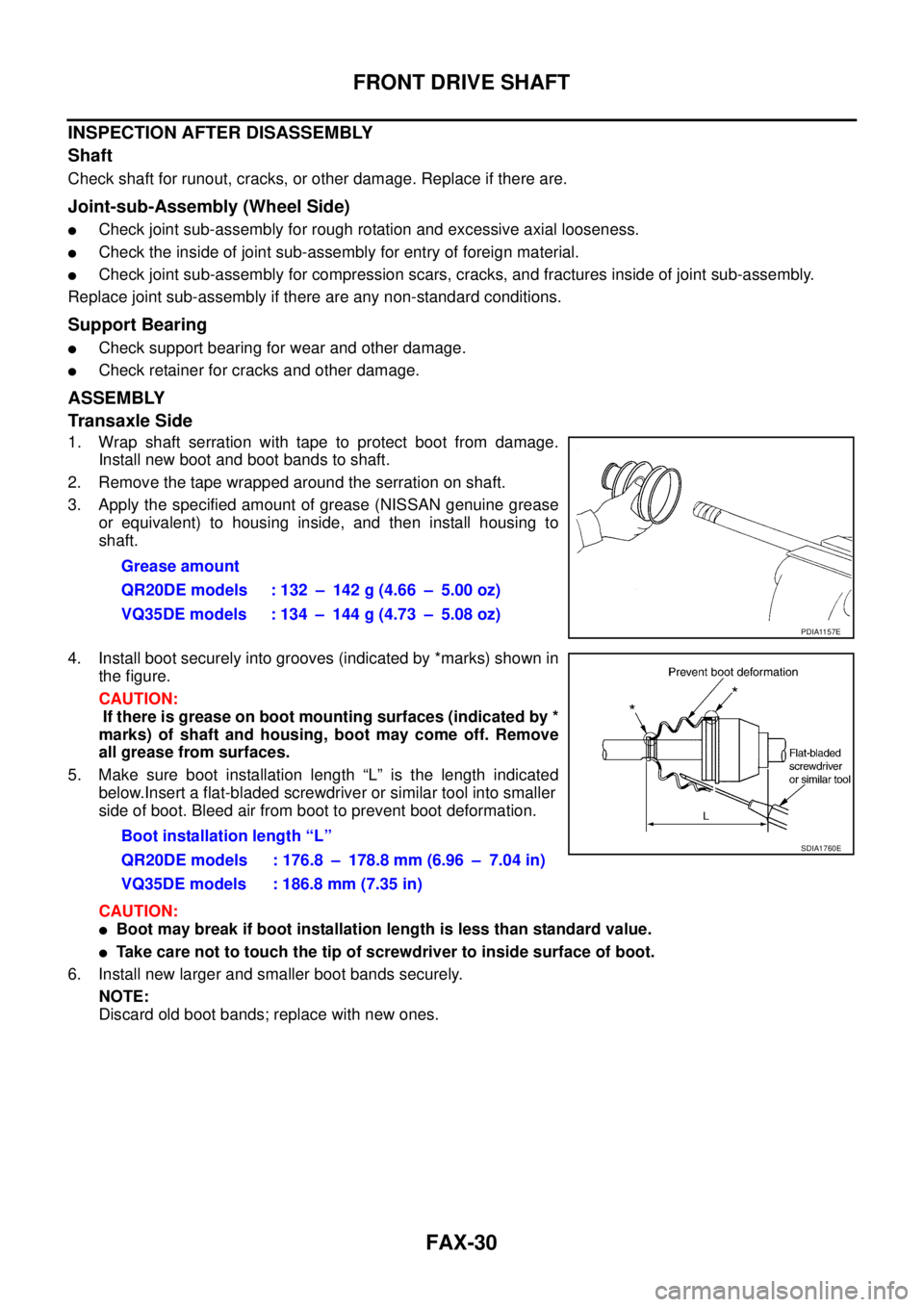
REMOVAL
1. Partially remove the headlining (rear edge). Refer to EI-54, "HEADLINING" .
2. Remove the rear seat cushion and the rear seatback. Refer to SE-112, "
REAR SEAT" .
3. Remove the rear seatback finisher and the rear pillar finisher. Refer to EI-38, "
BODY SIDE TRIM" .
4. Remove the rear parcel shelf finisher. Refer to EI-43, "
REAR PARCEL SHELF FINISHER" .
5. Disconnect the harness connector.
6. Apply protective tape around the rear window glass to protect the painted surface from damage.
�After removing moldings, remove glass using piano wire or power cutting tool and an inflatable pump bag.
�If a rear window glass is to be reused, mark the body and the glass with mating marks.
1. Rear window glass 2. Spacer 3. Rear window molding
4. Dam rubber 5. Adhesive 6. Roof panel outer
7. Trunk lid outer panel
PIIB1022E
Page 3123 of 3502
STEERING WHEEL
PS-9
C
D
E
F
H
I
J
K
L
MA
B
PS
STEERING WHEELPFP:48430
On-Vehicle Inspection and ServiceBGS0003S
CHECKING CONDITION OF INSTALLATION
�Check installation conditions of steering gear assembly, front suspension assembly, axle and steering col-
umn assembly.
�Check if movement exists when steering wheel is moved up and down, to the left and right and to the axial
direction.
�Check steering gear assembly mounting nut and bolts for looseness. Refer to PS-17, "COMPONENTS" .
CHECKING STEERING WHEEL PLAY
�Turn steering wheel so that front wheels come to the straight-ahead position. Start engine and lightly turn
steering wheel to the left and right until front wheels start to move. Measure steering wheel movement on
the outer circumference.
�When the measurement value is outside the standard value, check backlash for each joint of steering col-
umn assembly and installation condition of power steering gear assembly.
CHECKING NEUTRAL POSITION STEERING WHEEL
�Make sure that steering gear assembly, steering column and steering wheel are installed in the correct
position.
�Perform neutral position inspection after wheel alignment. Refer to FSU-5, "Wheel Alignment Inspection" .
�Set vehicle to the straight-ahead position and confirm steering wheel is in the neutral position.
�Loosen outer socket lock nut and turn inner socket to left and right equally to make fine adjustments if
steering wheel is not in the neutral position.
CHECKING STEERING WHEEL TURNING FORCE
1. Park vehicle on a level and dry surface, set parking brake.
2. Start engine.
3. Bring power steering fluid up to adequate operating temperature. [Make sure temperature of fluid is
approximately 50 to 80°C (122 to 176°F).]
NOTE:
Tires need to be inflated normal pressure.
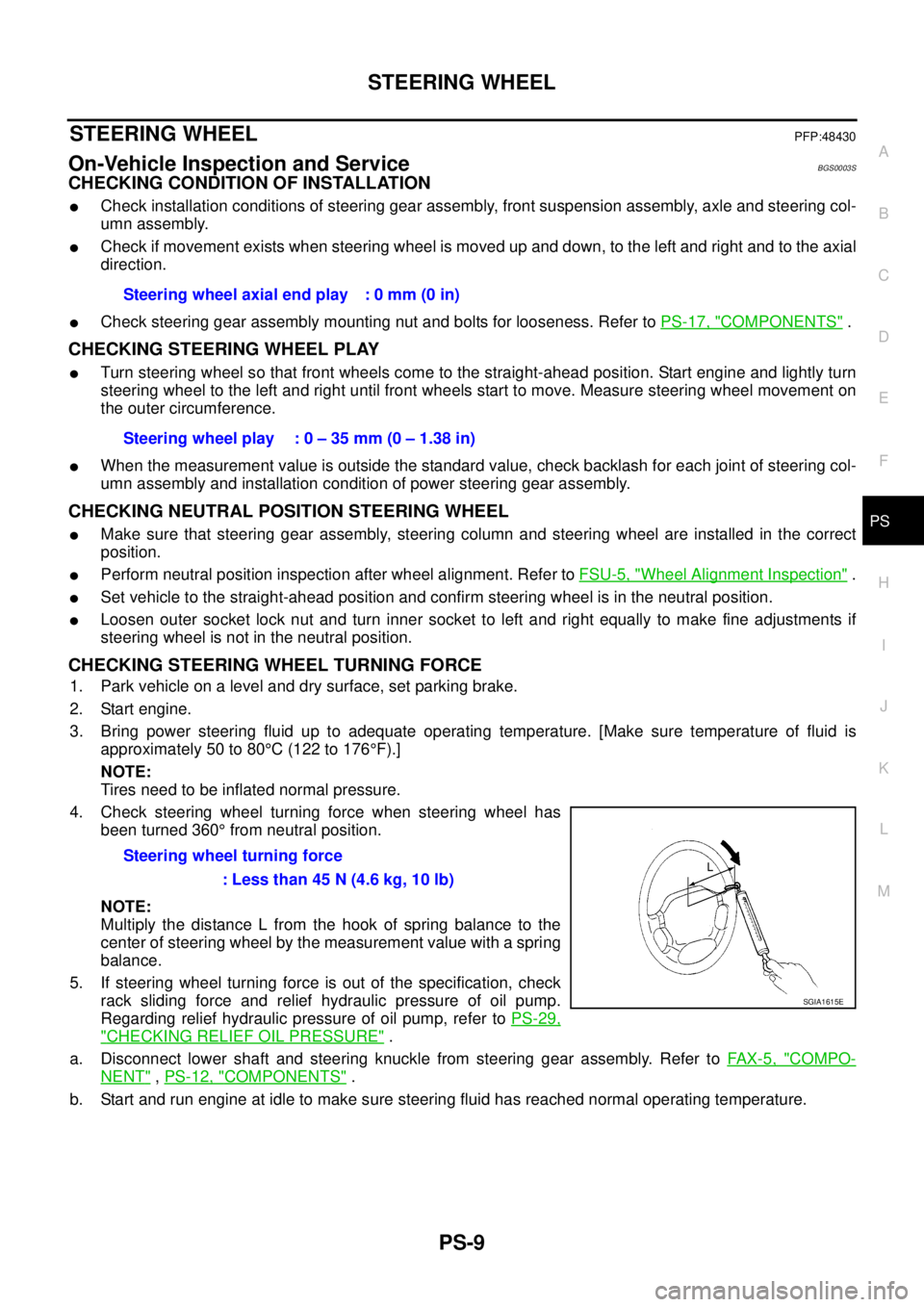
4. Check steering wheel turning force when steering wheel has
been turned 360° from neutral position.
NOTE:
Multiply the distance L from the hook of spring balance to the
center of steering wheel by the measurement value with a spring
balance.
5. If steering wheel turning force is out of the specification, check
rack sliding force and relief hydraulic pressure of oil pump.
Regarding relief hydraulic pressure of oil pump, refer to PS-29,
"CHECKING RELIEF OIL PRESSURE" .
a. Disconnect lower shaft and steering knuckle from steering gear assembly. Refer to FAX-5, "
COMPO-
NENT" , PS-12, "COMPONENTS" .
b. Start and run engine at idle to make sure steering fluid has reached normal operating temperature.Steering wheel axial end play : 0 mm (0 in)
Steering wheel play : 0 – 35 mm (0 – 1.38 in)
Steering wheel turning force
: Less than 45 N (4.6 kg, 10 lb)
SGIA1615E
Page 3435 of 3502
ROAD WHEEL
WT-3
C
D
F
G
H
I
J
K
L
MA
B
WT
ROAD WHEELPFP:40300
InspectionBES0004H
ALUMINUM WHEEL
1. Check tyres for wear and improper inflation.
2. Check wheels for deformation, cracks and other damage. If deformed, remove wheel and check wheel
runout.
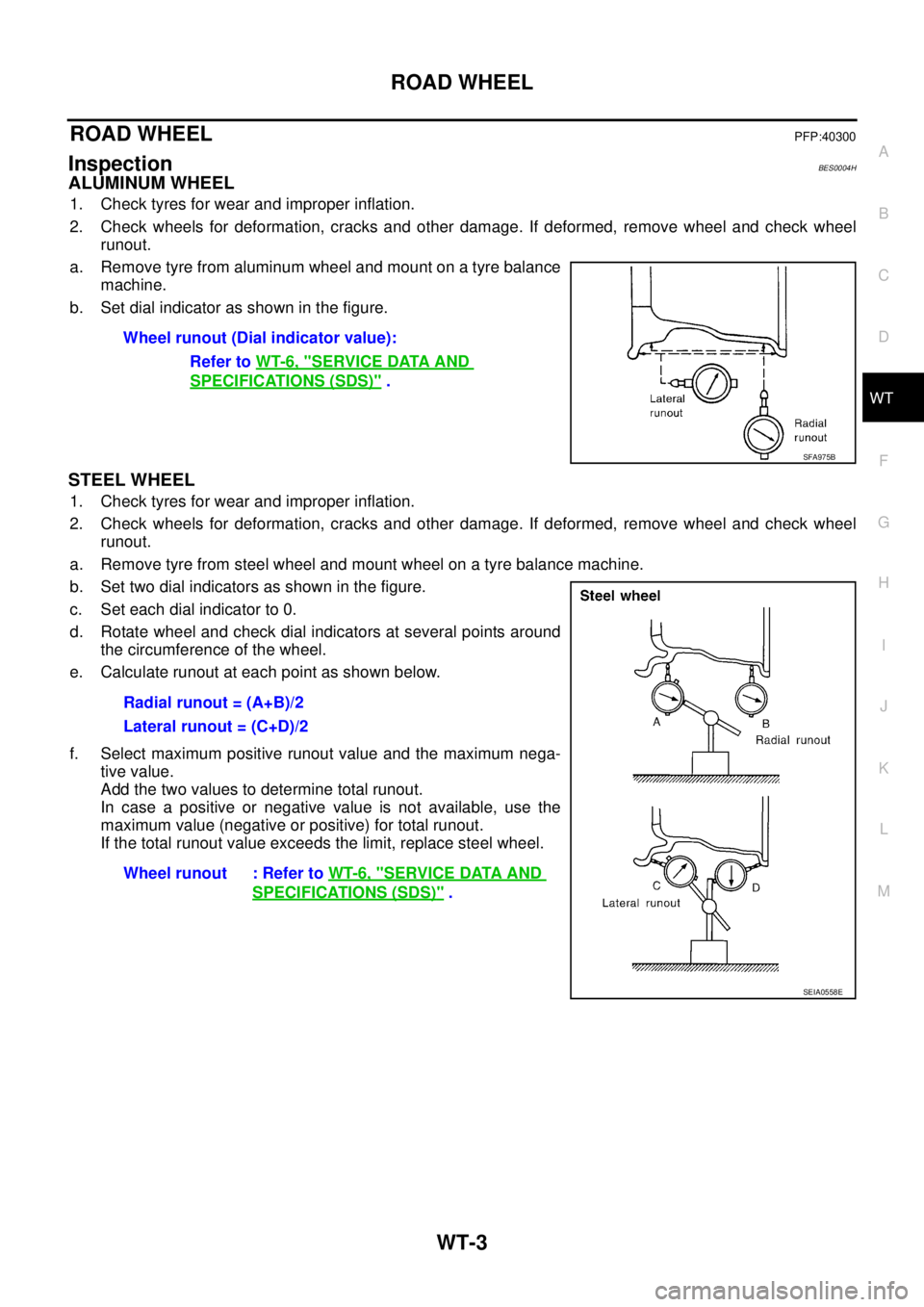
a. Remove tyre from aluminum wheel and mount on a tyre balance
machine.
b. Set dial indicator as shown in the figure.
STEEL WHEEL
1. Check tyres for wear and improper inflation.
2. Check wheels for deformation, cracks and other damage. If deformed, remove wheel and check wheel
runout.
a. Remove tyre from steel wheel and mount wheel on a tyre balance machine.
b. Set two dial indicators as shown in the figure.
c. Set each dial indicator to 0.
d. Rotate wheel and check dial indicators at several points around
the circumference of the wheel.
e. Calculate runout at each point as shown below.
f. Select maximum positive runout value and the maximum nega-
tive value.
Add the two values to determine total runout.
In case a positive or negative value is not available, use the
maximum value (negative or positive) for total runout.
If the total runout value exceeds the limit, replace steel wheel.Wheel runout (Dial indicator value):
Refer to WT-6, "
SERVICE DATA AND
SPECIFICATIONS (SDS)" .
SFA975B
Radial runout = (A+B)/2
Lateral runout = (C+D)/2
Wheel runout : Refer to WT-6, "
SERVICE DATA AND
SPECIFICATIONS (SDS)" .
SEIA0558E
Page:
< prev 1-8 9-16 17-24