2003 MITSUBISHI SHOGUN parking brake
[x] Cancel search: parking brakePage 3 of 392

Instruments and Controls
B21A601T
LHD
14- Parking brake lever→P.5-42
15- Audio*→P.6-2, 6-17
16- Hazard warning flasher switch→P.4-20
17- Multi centre display*→P.4-27
18- RV meter*→P.4-40
19- Rear window demister switch→P.4-21
20- Front heater/Manual air conditioning*
→P.6-36
Front automatic air conditioning*
→P.6-43
21- Ventilators→P.6-35
22- Supplemental restraint system-air bag*
(for front passenger’s seat)→P.3-42
23- Ashtray (for front seats)→P.6-60
24- Cigarette lighter→P.6-59
25- Heated seat switch*→P.3-10
26- Rear differential lock switch*→P.5-34
Active stability control switch*
→P.5-58
27- Wiper deicer switch*→P.4-24
28- Main switch for rear heater*/
Rear air conditioning*
(for front seats)→P.6-53
29- Rear heater* /Rear air conditioning*
→P.6-52
30- Ashtray (for rear seats)→P.6-60
31- Centre console box→P.6-64
Accessory socket*→P.6-61
32- Cup tray (for front seats)→P.6-65
33- Gearshift or selector lever
→P.5-15, 5-17
34- Transfer shift lever→P.5-24, 5-28
Div:
Out put date:
Page 5 of 392

Instruments and Controls
B21A571T
RHD
14- Supplemental restraint system-air bag
(for front passenger’s seat)→P.3-42
15- Front heater/Manual air conditioning*
→P.6-36
Front automatic air conditioning*
→P.6-43
16- Rear window demister switch→P.4-21
17- Multi centre display*→P.4-27
18- RV meter*→P.4-40
19- Hazard warning flasher switch→P.4-20
20- Audio*→P.6-2, 6-17
21- Ventilators→P.6-35
22- Parking brake lever→P.5-42
23- Ashtray (for front seats)→P.6-60
24- Cigarette lighter→P.6-59
25- Heated seat switch*→P.3-10
26- Rear differential lock switch*→P.5-34
Active stability control switch*
→P.5-58
27- Wiper deicer switch*→P.4-24
28- Main switch for rear heater*/
Rear air conditioning*
(for front seats)→P.6-53
29- Transfer shift lever→P.5-24, 5-28
30- Gearshift or selector lever
→P.5-15, 5-17
31- Cup tray (for front seats)→P.6-65
32- Centre console box→P.6-64
Accessory socket*→P.6-61
33- Ashtray (for rear seats)→P.6-60
34- Rear heater* /Rear air conditioning*
→P.6-52
Div:
Out put date:
Page 99 of 392

Brake warning lamp - red
(Brake warning buzzer/Vehicles with
anti-lock brake system)
ED23AAGa
With the ignition switch“ON ”, the brake warning
lamp illuminates under the following conditions:
(1)When the parking brake lever has been engaged.
(2)When the brake fluid level in the reservoir falls to a low level.
(3)When the brake circuit is not operating cor- rectly.
Brake warning buzzer
(Vehicles with anti-lock brake system)
When there is a danger of brake performance
becoming compromised, a buzzer will sound to alert
the driver. If this buzzer should continue to sound,
park your vehicle in a safe place and contact your
nearest authorized MITSUBISHI dealer.
NOTE
Depressing the brake pedal repeatedly may turn on
the brake warning lamp, ABS warning lamp and
brake warning buzzer. It is normal if the lamp goes
out and the buzzer stops sounding after a few sec-
onds.
CAUTION
(1)In the situations listed below, brake per- formance may be compromised or the
vehicle may become unstable if brakes are
applied suddenly; consequently, avoid driv-
ing at high speeds or applying the brakes
suddenly. Furthermore, the vehicle should
be brought to a stop in a safe location and
your nearest authorized MITSUBISHI dealer
should be contacted.
•The brake warning lamp does not illumi-
nate when the parking brake is applied or
does not turn off when the parking brake
is released.
• The brake warning lamp remains illumi-
nated during driving.
• The brake warning buzzer does not turn
off. (In the case of vehicles with anti-lock
brake systems)
(2)The vehicle should be brought to a halt in the following manner when brake perfor-
mance has deteriorated.
•Depress the brake pedal harder than
usual.
• Should the brakes fail, use engine brak-
ing to reduce your speed and slowly pull
the parking brake lever to park your
vehicle.
Depress the brake pedal to operate the
stop lamp (brake lamp) to alert the
vehicles behind you.
Instruments and controls
4-7
Div:
Out put date:
Page 159 of 392

Starting and driving
Running-in recommendations ......................................... 5- 2
Fuel selection .................................................................... 5- 3
Filling the fuel tank ........................................................... 5- 4
Catalytic converter ............................................................ 5- 6
Economical driving ........................................................... 5- 7
Trailer towing ..................................................................... 5- 8
Ignition switch ................................................................... 5-11
Starting .............................................................................. 5-12
Manual transmission ........................................................ 5-15
Automatic transmission INVECS—II Sport
Mode 5A/T
(Intelligent & Innovative Vehicle
Electronic Control System II) ...................................... 5-17
Part time 4WD.................................................................... 5-24
Super select 4WD II (SS4 II) ............................................. 5-28
Rear differential lock ........................................................ 5-34
Correct 4-wheel drive operation ...................................... 5-38
Cautions on handling of 4WD vehicles .......................... 5-42
Parking brake .................................................................... 5-42
Parking .............................................................................. 5-43
Braking ............................................................................... 5-44
Anti - lock brake system (ABS) ....................................... 5-45
Limited-slip differential..................................................... 5-48
Steering wheel height adjustment................................... 5-49
Power steering system ..................................................... 5-49
Inside rear-view mirror ..................................................... 5-50
Outside rear-view mirror .................................................. 5-50
Manual outside rear-view mirrors ................................... 5-51
Electric remote-controlled outside
rear-view mirrors .......................................................... 5-51
Auto-speed (cruise) control ............................................. 5-53
MITSUBISHI active stability &
traction control system (M-ASTC) ............................... 5-57
Div:
Out put date:
Page 172 of 392
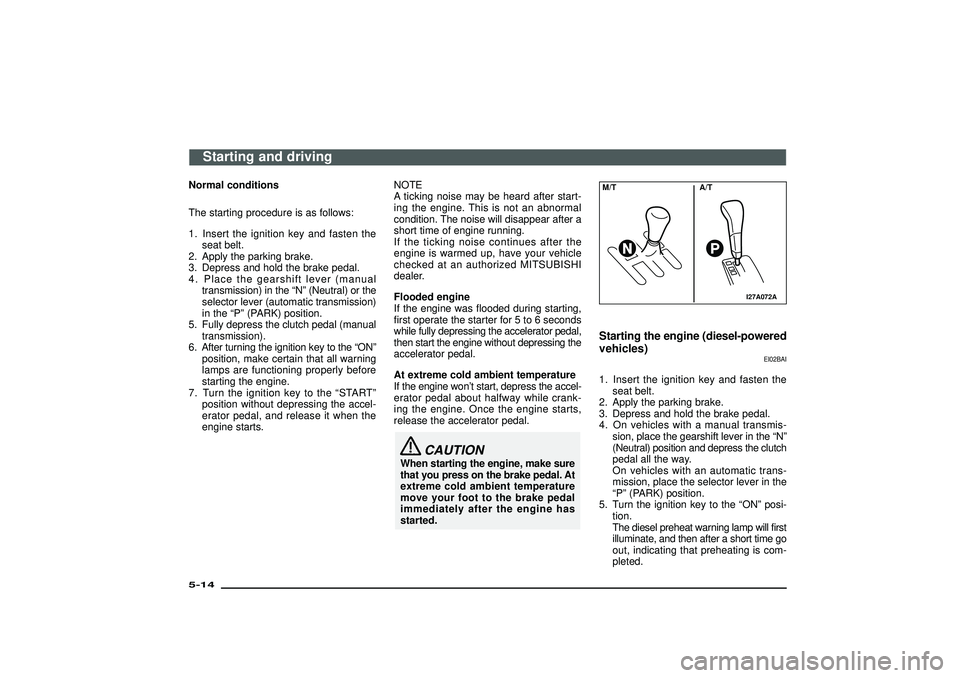
Normal conditions
The starting procedure is as follows:
1. Insert the ignition key and fasten the
seat belt.
2. Apply the parking brake.
3. Depress and hold the brake pedal.
4. Place the gearshift lever (manual
transmission) in the“N”(Neutral) or the
selector lever (automatic transmission)
in the“P”(PARK) position.
5. Fully depress the clutch pedal (manual
transmission).
6. After turning the ignition key to the“ON”
position, make certain that all warning
lamps are functioning properly before
starting the engine.
7. Turn the ignition key to the“START”
position without depressing the accel-
erator pedal, and release it when the
engine starts.NOTE
A ticking noise may be heard after start-
ing the engine. This is not an abnormal
condition. The noise will disappear after a
short time of engine running.
If the ticking noise continues after the
engine is warmed up, have your vehicle
checked at an authorized MITSUBISHI
dealer.
Flooded engine
If the engine was flooded during starting,
first operate the starter for 5 to 6 seconds
while fully depressing the accelerator pedal,
then start the engine without depressing the
accelerator pedal.
At extreme cold ambient temperature
If the engine won’t start, depress the accel-
erator pedal about halfway while crank-
ing the engine. Once the engine starts,
release the accelerator pedal.
CAUTION
When starting the engine, make sure
that you press on the brake pedal. At
extreme cold ambient temperature
move your foot to the brake pedal
immediately after the engine has
started.
I27A072A
M/T A/TStarting the engine (diesel-powered
vehicles)
EI02BAI
1. Insert the ignition key and fasten the
seat belt.
2. Apply the parking brake.
3. Depress and hold the brake pedal.
4. On vehicles with a manual transmis-
sion, place the gearshift lever in the“N”
(Neutral) position and depress the clutch
pedal all the way.
On vehicles with an automatic trans-
mission, place the selector lever in the
“P”(PARK) position.
5. Turn the ignition key to the“ON”posi-
tion.
The diesel preheat warning lamp will first
illuminate, and then after a short time go
out, indicating that preheating is com-
pleted.
Starting and driving
5-14Div:
Out put date:
Page 177 of 392

I04A196A
Indicator lamps
A- Selector lever position indicator lamps
B-“N”indicator lamp
The indicator lamps in the instrument panel
are for indicating the selector lever posi-
tion and one of them will be illuminated
when the ignition is switched“ON”.
CAUTION
If the“N”(NEUTRAL) indicator lamp
(B) in the selector lever position indi-
cator flashes while you are driving,
the automatic transmission safety
device may be operating due to a
malfunction. (If the selector lever
position is in the“P”(PARK),“R”
(REVERSE) or“N”(NEUTRAL) posi-
tion, the indicator lamp does not
flash.)
Have your vehicle inspected by an
authorized MITSUBISHI dealer as
soon as possible.
Selector positions
(Main gate)
EI04BACb
P - PARK
The“P”(PARK) position supplements the
parking brake by locking the transmis-
sion while the vehicle is parked.
The engine can be started in this posi-
tion.
Apply the parking brake before leaving the
vehicle in this position.
R - REVERSE
Shift into this position only after the vehicle
has come to a complete stop.
CAUTION
Never shift into the“P”(PARK) or
“R”(REVERSE) position while the
vehicle is in motion. If the lever is
shifted into the“P”or“R”position
while the vehicle is in motion, the
transmission may be damaged.
N - NEUTRAL
At this position the transmission is disen-
gaged. It is the same as the neutral posi-
tion on a manual transmission, and should
be used when the vehicle is stationary for
an extended length of time during driv-
ing, such as in a traffic jam.
Starting and driving
5-19
Div:
Out put date:
Page 181 of 392

Waiting
EI04G-Ee
For short waiting periods, such as at traf-
fic signal, the vehicle can be left in gear and
held stationary with the service brake.
For longer waiting periods with the engine
running, the selector lever should be placed
in the“N”(NEUTRAL) position.
CAUTION
(1) Never hold the vehicle station-
ary while in gear on a hill with
the accelerator, always apply the
parking brake and/or service
brake.
(2) Unexpected acceleration may
occur if the selector lever is in a
position other than“P”(PARK)
or“N”(NEUTRAL).
Prior to moving off after having
stopped the vehicle, make sure
that the selector lever is in“D”
(DRIVE) or“Sports mode”posi-
tion.
Parking
EI04H-Be
To park the vehicle, first bring it to a com-
plete stop, fully engage the parking brake,
and then move the selector lever to the“P”
(PARK) position.
If you are going to leave the vehicle unat-
tended, always switch off the engine and
remove the ignition key.
NOTE
On a slope, be sure to apply the parking
brake before moving the selector lever to
the“P”(PARK) position. If you move the
selector lever to the“P”(PARK) position
without first applying the parking brake, a
stronger than normal resistance force may
be encountered. In this situation, move the
selector lever strongly when you next wish
to drive.
Starting and driving
5-23
Div:
Out put date:
Page 197 of 392

CAUTION
(1) Do not force the vehicle or drive
recklessly on sandy surfaces. In
comparison with normal road
surfaces, the engine and other
drive-system components are
put under excessive strain when
driving on such a surface, and
this could lead to accidents.
(2) If any of following conditions
occur while the vehicle is being
driven, immediately park your
vehicle in a safe place and fol-
low these procedures:
•The needle in the tempera-
ture gauge approaches the
overheating zone.
Refer to the“Engine
overheating”on page 8-21.
•A/T fluid temperature warning
lamp illuminates.
Refer to the“A/T fluid tempera-
ture warning lamp”on page
4-11.
WARNING
When attempting to rock your vehicle
out of a stuck position, be sure that
the area around the vehicle is clear of
people and physical objects. The
rocking motion may cause the
vehicle to suddenly launch forward
or backward, causing injury or dam-
age to nearby people or objects.
NOTE
(1) Avoid sudden braking, acceleration, and
turning; such operations could result in
the vehicle becoming stuck.
(2) If the vehicle becomes stuck in sandy
or muddy roads, it can often be moved
a rocking motion. Move the selector
lever rhythmically between the“D”
(DRIVE) and“R”(REVERSE) posi-
tion (with manual transmission,
between 1st and Reverse), while apply-
ing slight pressure to the accelerator
pedal.
(3) It is recommended to start the vehicle
with parking brake partially, but not
completely, applied by slightly pulling
the parking brake lever.
After the vehicle has become free, do
not forget to release the parking brake.NOTE
(4) If it is necessary to drive in extremely
muddy conditions, the use of tyre
chains is recommended. Because the
extent of muddy conditions is difficult to
judge and the vehicle could become
bogged down very deeply, operation
should be at a low speed. If possible,
get out of the vehicle and check the
conditions ahead before proceeding.
(5) Driving over roads in coastal areas or
roads on which anti-skid preparations
have been spread can cause rust on
the vehicle; wash the vehicle thor-
oughly as soon as possible after such
use.
Climbing sharp gradesSet the transfer shift lever to“4L”(part time
4WD) or“4LLc”(super select 4WD II) to
maximize the engine torque.
WARNING
(1) Go straight up. Do not try to
traverse across a steep slope.
(2) If you begin to lose traction, ease
off the accelerator pedal and
gently turn the steering wheel
alternatively left and right to
regain adequate traction again.
Starting and driving
5-39
Div:
Out put date: