Page 116 of 317

This button controls the source of
the air going into the system. When
the indicator in this button is lit, air
from the car’s interior is sent
through the system again (Recircula-
tion mode). When the indicator is off,
air is brought in f rom outside the car
(Fresh Air mode).
Use Recirculation mode to heat or
cool the interior more quickly, or to
keep out smoke and dust. Leaving
the system in the Recirculation mode
with the A/C off can cause the
windows to f og up. Switch to Fresh
Air mode as soon as the interior
reaches a comf ortable temperature
or the outside smoky, dusty con-
dition clears.You can manually select the f an
speed by turning the f an speed
control dial. Turning this dial
clockwise increases the f an speed,
which increases air flow.
When the dial is set to AUTO, the
system controls the f an speed
automatically.
When the f an speed control dial is
of f , the Auto Idle Stop works under
certain conditions (see pages
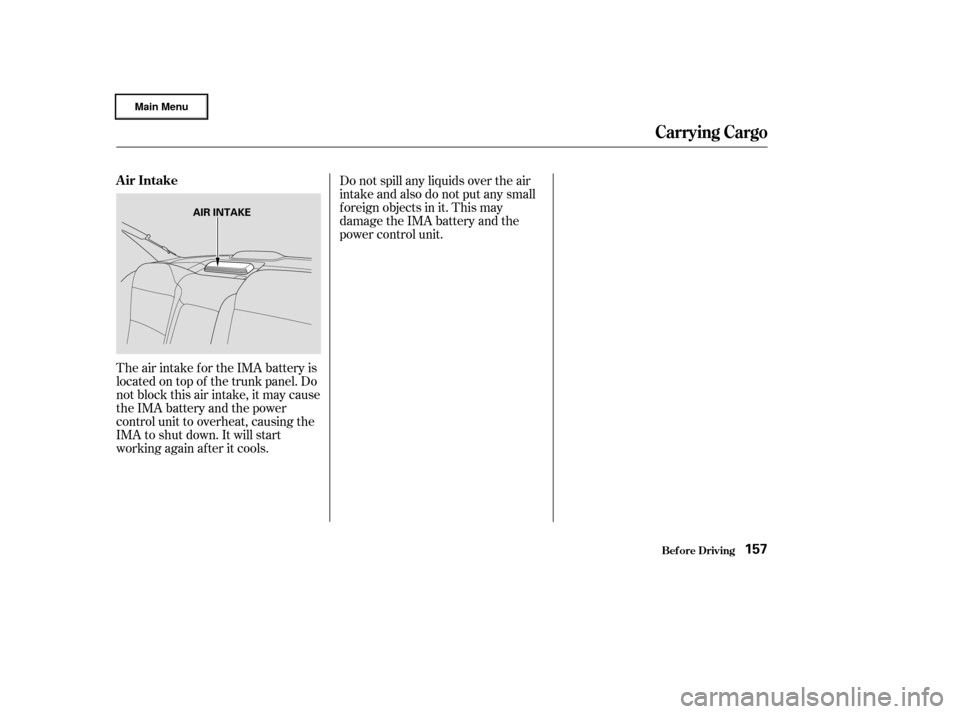
and ). Use the MODE control dial to select
the vents the air flows from. Some
air will f low f rom the dashboard
corner vents in all modes.
In AUTO mode, the system controls
the air f low direction automatically
between the dashboard vents and
the f loor vents.
163 171
CONT INUED
Heating and Cooling (Automatic System)
Comf ort and Convenience Feat ures
Recirculat ion But t on
Fan SpeedMode Cont rol Dial
113
Page 126 of 317
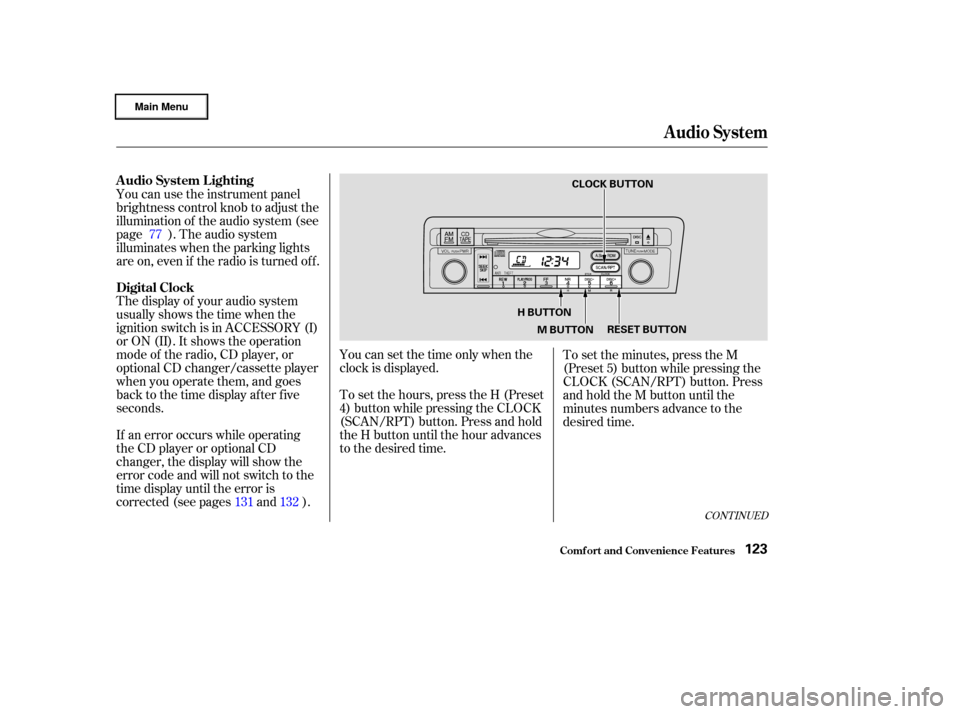
The display of your audio system
usually shows the time when the
ignition switch is in ACCESSORY (I)
or ON (II). It shows the operation
mode of the radio, CD player, or
optional CD changer/cassette player
when you operate them, and goes
back to the time display after five
seconds. You can use the instrument panel
brightness control knob to adjust the
illumination of the audio system (see
page ). The audio system
illuminates when the parking lights
are on, even if the radio is turned of f .
If an error occurs while operating
the CD player or optional CD
changer, the display will show the
error code and will not switch to the
time display until the error is
corrected (see pages and ).You can set the time only when the
clock is displayed.
To set the hours, press the H (Preset
4) button while pressing the CLOCK
(SCAN/RPT) button. Press and hold
the H button until the hour advances
to the desired time.
To set the minutes, press the M
(Preset 5) button while pressing the
CLOCK (SCAN/RPT) button. Press
andholdtheMbuttonuntilthe
minutes numbers advance to the
desired time.
77
131 132
CONT INUED
A udio System L ighting
Digital Clock
Audio System
Comf ort and Convenience Feat ures123
CLOCK BUTTON
H BUTTON M BUTTON RESET BUTTON
Page 127 of 317

Your Honda’s radio can receive the
complete AM and FM bands.
Those bands cover these f requen-
cies:
AM band:
530 to 1,710 kilohertz
FM band:
87.7 to 107.9 megahertz
Radio stations on the AM band are
assigned f requencies at least ten
kilohertz apart (530, 540, 550).
Stations on the FM band are
assigned f requencies at least 0.2
megahertz apart (87.9, 88.1, 88.3).Stations must use these exact
f requencies. It is f airly common f or
stations to round-of f the f requency in
their advertising, so your radio could
display a f requency of 100.9 even
though the announcer may identif y
the station as ‘‘FM101.’’
For example: 1:06 would RESET to 1:00.
1:52 would RESET to 2:00.
If your car’s battery is disconnected
or goes dead, the time setting will be
lost. To set the time again, f ollow the
setting procedure. You can quickly set the time to the
nearest hour. If the displayed time is
bef ore the half hour, the clock is set
back to the previous hour by
pressing and holding the CLOCK
(SCAN/RPT) button, then pressing
the R (Preset 6) button. If the
displayed time is af ter the half hour,
the clock is set forward to the
beginning of the next hour.
Audio System
Comf ort and Convenience Feat ures
Radio Frequencies
124
Page 155 of 317
Modif ying your car, or installing
some non-Honda accessories, can
make your car unsaf e. Bef ore you
make any modif ications or add any
accessories,besuretoreadthe
f ollowing inf ormation.When properly installed, cellular
phones, alarms, two-way radios, and
low-powered audio systems should
not interf ere with your car’s
computer-controlled systems, such
as the SRS and anti-lock brake
system.If possible, have your dealer inspect
the f inal installation.Have the installer contact your
Honda dealer f or assistance bef ore
installing any electronic accessory. Be sure electronic accessories do
not overload electrical circuits
(see page ). Make sure the accessory does not
obscure any lights, or interf ere
with proper car operation or
perf ormance.
Bef ore installing any accessory: However, if electronic accessories
are improperly installed, or exceed
your car’s electrical system capacity,
they can interfere with the operation
of your car, or even cause the
airbags to deploy.
Your dealer has Honda accessories
that allow you to personalize your car.
These accessories have been
designed and approved f or your car,
and are covered by warranty.
Non-Honda accessories are usually
designed f or universal applications.
Although aftermarket accessories
may f it on your car, they may not
meet f actory specif ications, and
could adversely af f ect your car’s
handling and stability. (See
‘‘Modif ications’’ on page f or
additional information.) 153 276
A ccessories
A ccessories and Modif ications
Bef ore Driving152
Improper accessories or
modifications can affect your
car’s handling, stability and
performance, and cause a
crash in which you can be hurt
or killed.
Follow all instructions in this
owner’s manual regarding
accessories and modifications.
Page 156 of 317

If a side airbag
inflates,acupholderorotherhard
object attached on or near the
door could be propelled inside the
car and hurt someone.
Covering the outside edge of a
f ront seat-back, with a non-Honda
seat cover for example, could
prevent the airbag from inflating
properly.
Some examples are:
Lowering the vehicle with an
aftermarket suspension kit that
signif icantly reduces ground
clearance can allow the
undercarriage to impact speed
bumps or other raised objects,
which could cause the airbags to
deploy.
Raising the vehicle with an
af termarket suspension kit can
af f ect the handling and stability.
Af termarket wheels, because they
are a universal design, can cause
excessive stress on suspension
components. Larger or smaller wheels and tires
can interf ere with the operation of
your vehicle’s anti-lock brakes and
other systems.
Do not modif y your steering wheel
or any other part of your
Supplemental Restraint System.
Modif ications could make the
system inef f ective.
Any object
attached to or placed on the covers
marked ‘‘SRS AIRBAG,’’ in the
center of the steering wheel and
on top of the dashboard, could
interf ere with the proper operation
of the airbags. Or, if the airbags
inf late, the objects could be
propelled inside the car and hurt
someone.
If you plan to modif y your vehicle,
consult with your Honda dealer.
Removing parts f rom your vehicle,
or replacing components with non-
Honda (af termarket) components
could seriously af f ect your vehicle’s
handling, stability, and reliability.
Only on models equipped with side
airbagsModif ications
Additional Saf ety Precautions
Do not at t ach hard object s on ornear a f ront door.
Do not place any object s over t heoutsideedgeof afront seat-back.
Do not at t ach or place object s on the f ront airbag covers.
A ccessories and Modif ications
Bef ore Driving153
Page 158 of 317
Store or secure all items that could
be thrown around and hurt
someone during a crash.
Be sure items placed on the f loor
behind the f ront seats cannot roll
under the seats and interf ere with
the driver’s ability to operate the
pedals, or with the proper
operation of the seats.
Keep the glove box closed while
driving. If the lid is open, a
passenger could injure their knees
during a crash or sudden stop. Do not put any items on top of the
trunk panel. They can block your
view and be thrown around the car
during a crash.
The maximum load for your car is
850 lbs in U. S. models and 395 kg in
Canadian models.
This f igure includes the total weight
of all occupants, cargo, and
accessories.
To f igure out how much cargo you
can carry:
Add up the weight of all occupants.
Subtract the total f rom 850 lbs in
U.S. models and 395 kg in
Canadian models.
The f inal number is the total weight
of cargo you can carry. Carrying Items in the Passenger
Compartment
Load Limit
Carrying Cargo
Bef ore Driving155
Overloading or improper
loading can affect handling and
stability and cause a crash in
which you can be hurt or killed.
Follow all load limits and other
loading guidelines in this
manual.
Page 160 of 317
The air intake f or the IMA battery is
located on top of the trunk panel. Do
not block this air intake, it may cause
the IMA battery and the power
control unit to overheat, causing the
IMA to shut down. It will start
working again af ter it cools.Do not spill any liquids over the air
intake and also do not put any small
f oreign objects in it. This may
damage the IMA battery and the
power control unit.
Carrying Cargo
Bef ore Driving
Air Intake
157
AIR INTAKE
Page 162 of 317
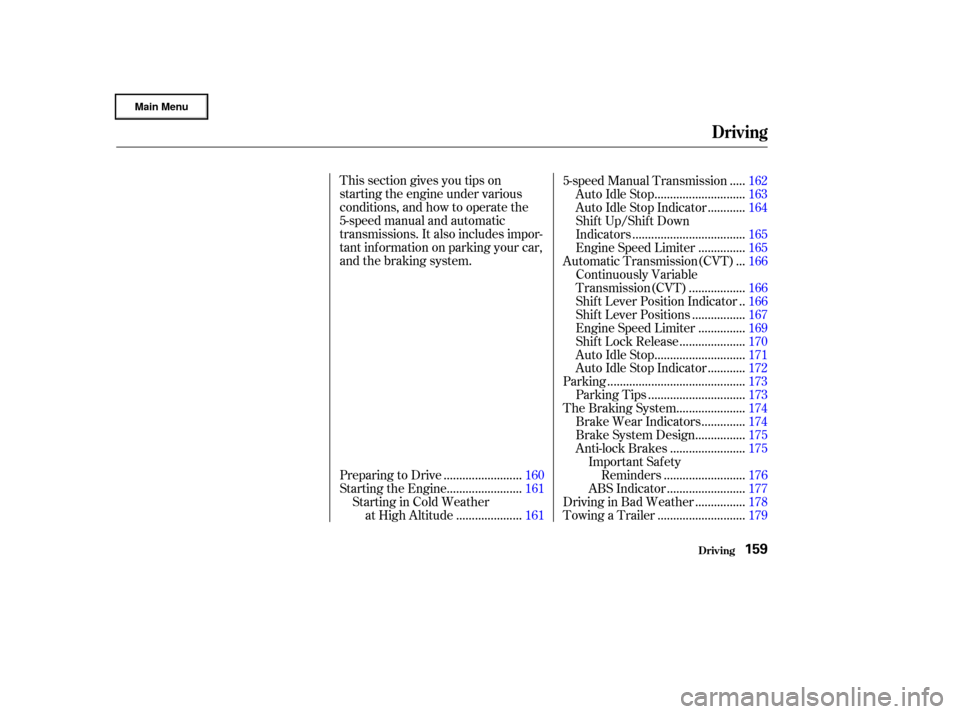
This section gives you tips on
starting the engine under various
conditions, and how to operate the
5-speed manual and automatic
transmissions. It also includes impor-
tant inf ormation on parking your car,
and the braking system.........................
Preparing to Drive .160
.......................
Starting the Engine .161
Starting in Cold Weather ....................
at High Altitude .161 ....
5-speed Manual Transmission . 162
............................
Auto Idle Stop .163
...........
Auto Idle Stop Indicator . 164
Shif t Up/Shif t Down ...................................
Indicators .165
..............
Engine Speed Limiter . 165
..
Automatic Transmission(CVT) . 166
Continuously Variable .................
Transmission(CVT) . 166
.
Shif t Lever Position Indicator . 166
................
Shif t Lever Positions . 167
..............
Engine Speed Limiter . 169
....................
Shif t Lock Release . 170
............................
Auto Idle Stop .171
...........
Auto Idle Stop Indicator . 172
...........................................
Parking .173
..............................
Parking Tips .173
.....................
The Braking System .174
.............
Brake Wear Indicators . 174
...............
Brake System Design . 175
.......................
Anti-lock Brakes .175
Important Saf ety .........................
Reminders .176
........................
ABS Indicator .177
...............
Driving in Bad Weather . 178
...........................
Towing a Trailer .179
Driving
Driving159