Page 2299 of 4378
The TCC solenoid is used to control the apply and release of the TCC.
Shift Solenoid —
SSA, SSB
Two on/off shift solenoids provide gear selection of first through fourth gears by controlling the
pressure to the three shift valves. One unit containing the two shift solenoids is located in the main
control valve body. The shift solenoids are two- way, normally open style.
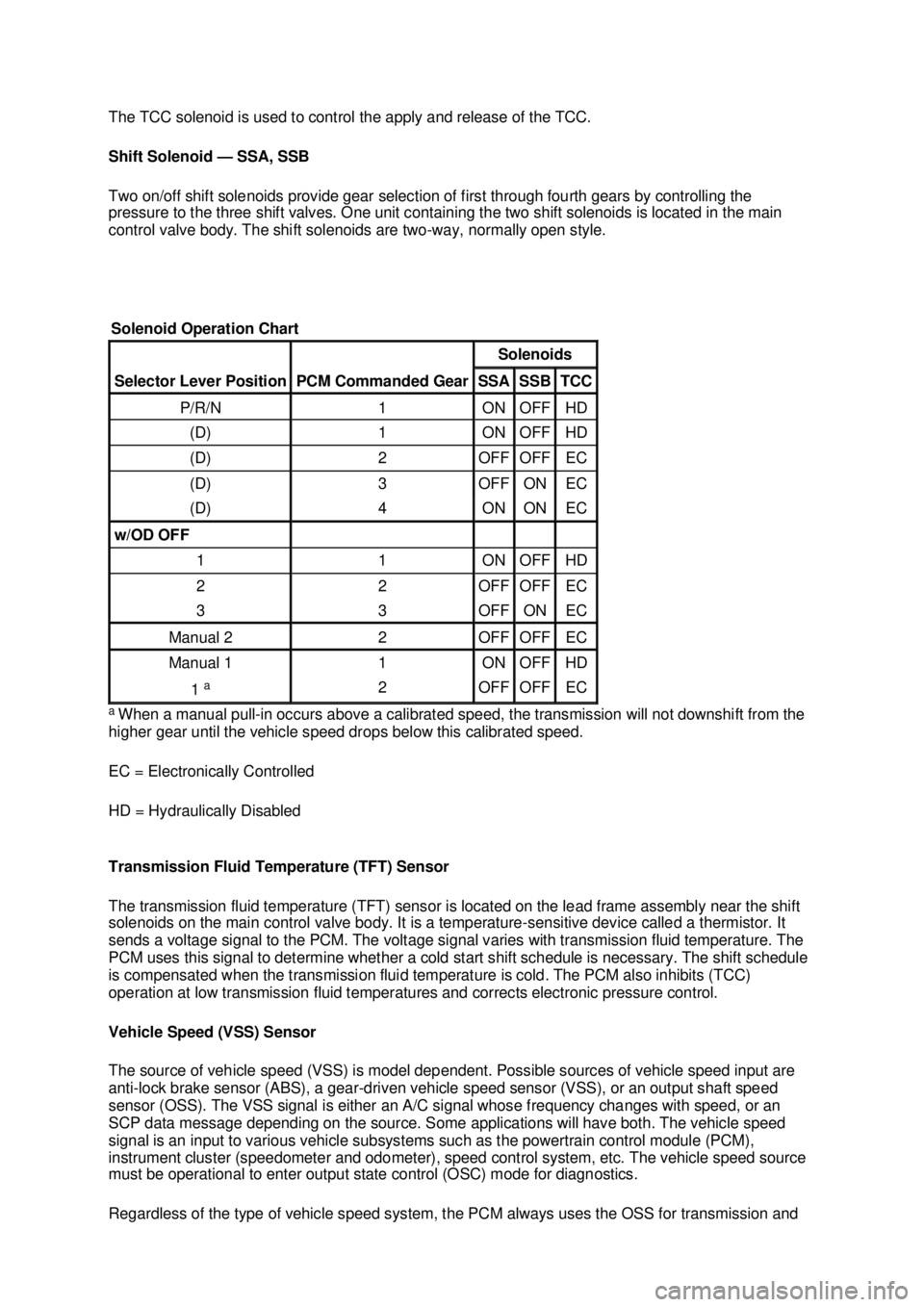
a When a manual pull- in occurs above a calibrated speed, the transmission will not downshift from the
higher gear until the vehicle speed drops below this calibrated speed.
EC = Electronically Controlled
HD = Hydraulically Disabled
Transmission Fluid Temperature (TFT) Sensor
The transmission fluid temperature (TFT) sensor is located on the lead frame assembly near the shift
solenoids on the main control valve body. It is a temperature- sensitive device called a thermistor. It
sends a voltage signal to the PCM. The voltage signal varies with transmission fluid temperature. The
PCM uses this signal to determine whether a cold start shift schedule is necessary. The shift schedule
is compensated when the transmission fluid temperature is cold. The PCM also inhibits (TCC)
operation at low transmission fluid temperatures and corrects electronic pressure control.
Vehicle Speed (VSS) Sensor
The source of vehicle speed (VSS) is model dependent. Possible sources of vehicle speed input are
anti- lock brake sensor (ABS), a gear- driven vehicle speed sensor (VSS), or an output shaft speed
sensor (OSS). The VSS signal is either an A/C signal whose frequency changes with speed, or an
SCP data message depending on the source. Some applications will have both. The vehicle speed
signal is an input to various vehicle subsystems such as the powertrain control module (PCM),
instrument cluster (speedometer and odometer), speed control system, etc. The vehicle speed source
must be operational to enter output state control (OSC) mode for diagnostics.
Regardless of the type of vehicle speed system, the PCM always uses the OSS for transmission and Solenoid Operation Chart Selector Lever Position PCM Commanded Gear Solenoids
SSA SSB TCC
P/R/N 1 ON OFF HD
(D) 1 ON OFF HD
(D) 2 OFF OFF EC
(D) 3 OFF ON EC
(D) 4 ON ON EC
w/OD OFF
1 1 ON OFF HD
2 2 OFF OFF EC
3 3 OFF ON EC
Manual 2 2 OFF OFF EC
Manual 1 1 ON OFF HD
1
a 2 OFF OFF EC �K�l�j . 3 �b�a
42003 Mustang Workshop Manual
18. 11. 2011file:///C:/Ford/2000 - 2004/tsocache/SHEF_2748/S3B~us~en~ ...
Page 2321 of 4378
DIAGNOSIS AND TESTING
Output State Control (OSC) Mode
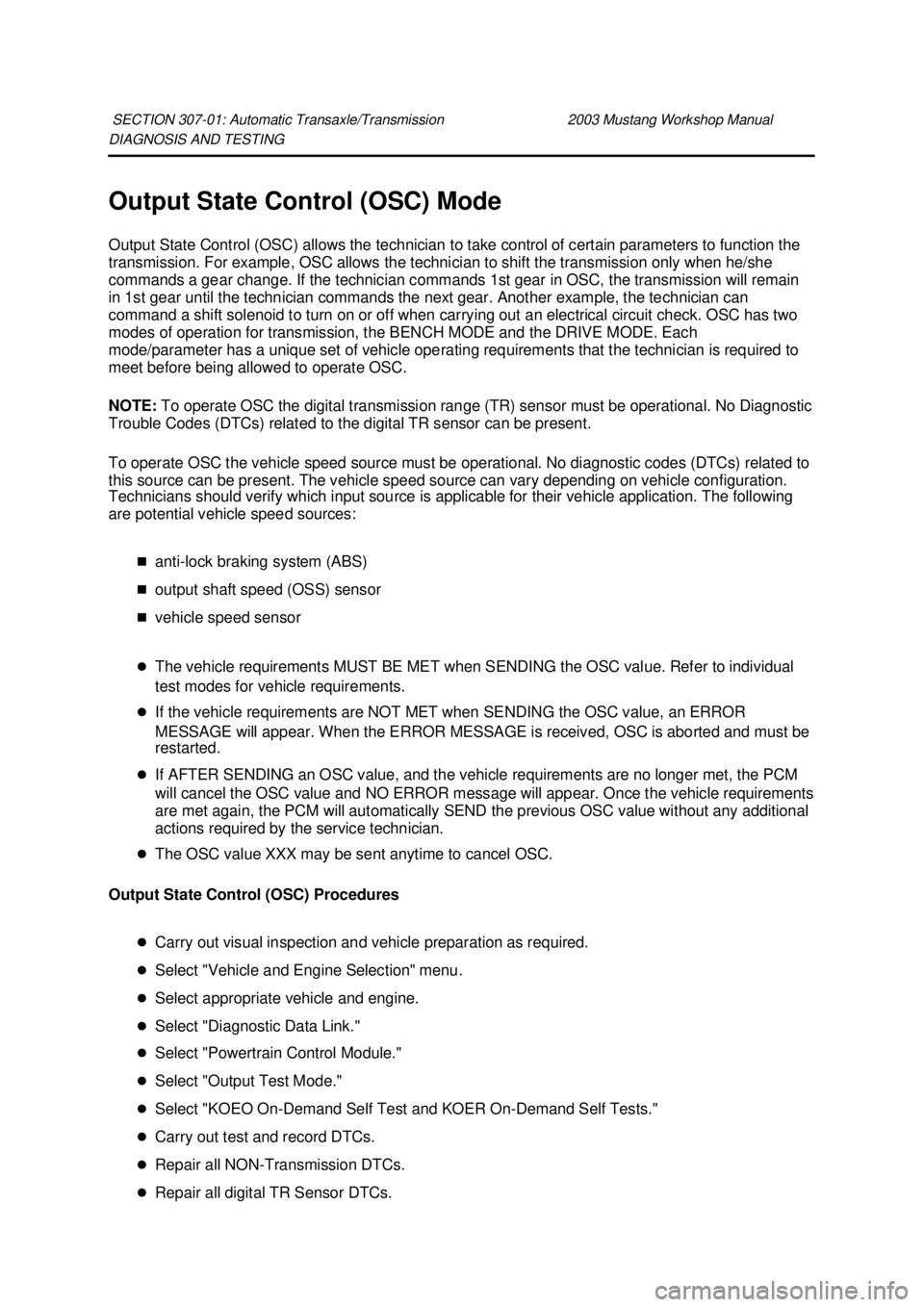
Output State Control (OSC) allows the technician to take control of certain parameters to function the
transmission. For example, OSC allows the technician to shift the transmission only when he/she
commands a gear change. If the technician commands 1st gear in OSC, the transmission will remain
in 1st gear until the technician commands the next gear. Another example, the technician can
command a shift solenoid to turn on or off when carrying out an electrical circuit check. OSC has two
modes of operation for transmission, the BENCH MODE and the DRIVE MODE. Each
mode/parameter has a unique set of vehicle operating requirements that the technician is required to
meet before being allowed to operate OSC.
NOTE:
To operate OSC the digital transmission range (TR) sensor must be operational. No Diagnostic
Trouble Codes (DTCs) related to the digital TR sensor can be present.
To operate OSC the vehicle speed source must be operational. No diagnostic codes (DTCs) related to
this source can be present. The vehicle speed source can vary depending on vehicle configuration.
Technicians should verify which input source is applicable for their vehicle application. The following
are potential vehicle speed sources:
„anti- lock braking system (ABS)
„ output shaft speed (OSS) sensor
„ vehicle speed sensor
z The vehicle requirements MUST BE MET when SENDING the OSC value. Refer to individual
test modes for vehicle requirements.
z If the vehicle requirements are NOT MET when SENDING the OSC value, an ERROR
MESSAGE will appear. When the ERROR MESSAGE is received, OSC is aborted and must be
restarted.
z If AFTER SENDING an OSC value, and the vehicle requirements are no longer met, the PCM
will cancel the OSC value and NO ERROR message will appear. Once the vehicle requirements
are met again, the PCM will automatically SEND the previous OSC value without any additional
actions required by the service technician.
z The OSC value XXX may be sent anytime to cancel OSC.
Output State Control (OSC) Procedures
zCarry out visual inspection and vehicle preparation as required.
z Select "Vehicle and Engine Selection" menu.
z Select appropriate vehicle and engine.
z Select "Diagnostic Data Link."
z Select "Powertrain Control Module."
z Select "Output Test Mode."
z Select "KOEO On- Demand Self Test and KOER On- Demand Self Tests."
z Carry out test and record DTCs.
z Repair all NON- Transmission DTCs.
z Repair all digital TR Sensor DTCs.
SECTION 307-
01: Automatic Transaxle/Transmission 2003 Mustang Workshop Manual �K�l�j . 1 �b�a
92003 Mustang Workshop Manual
18. 11. 2011file:///C:/Ford/2000 - 2004/tsocache/SHEF_2748/S3B~us~en~ ...
Page 2426 of 4378
IN-
VEHICLE REPAIR
Main Control Valve Body
Removal 1. Drain transmission fluid and remove the transmission fluid pan and filter. For additional information, refer to Fluid Pan, Gasket and Filter .
2. CAUTION: Do not pull on the molded lead frame. This may cause damage to the
connector ends. Carefully pry up on the locking tabs to disconnect the solenoids.
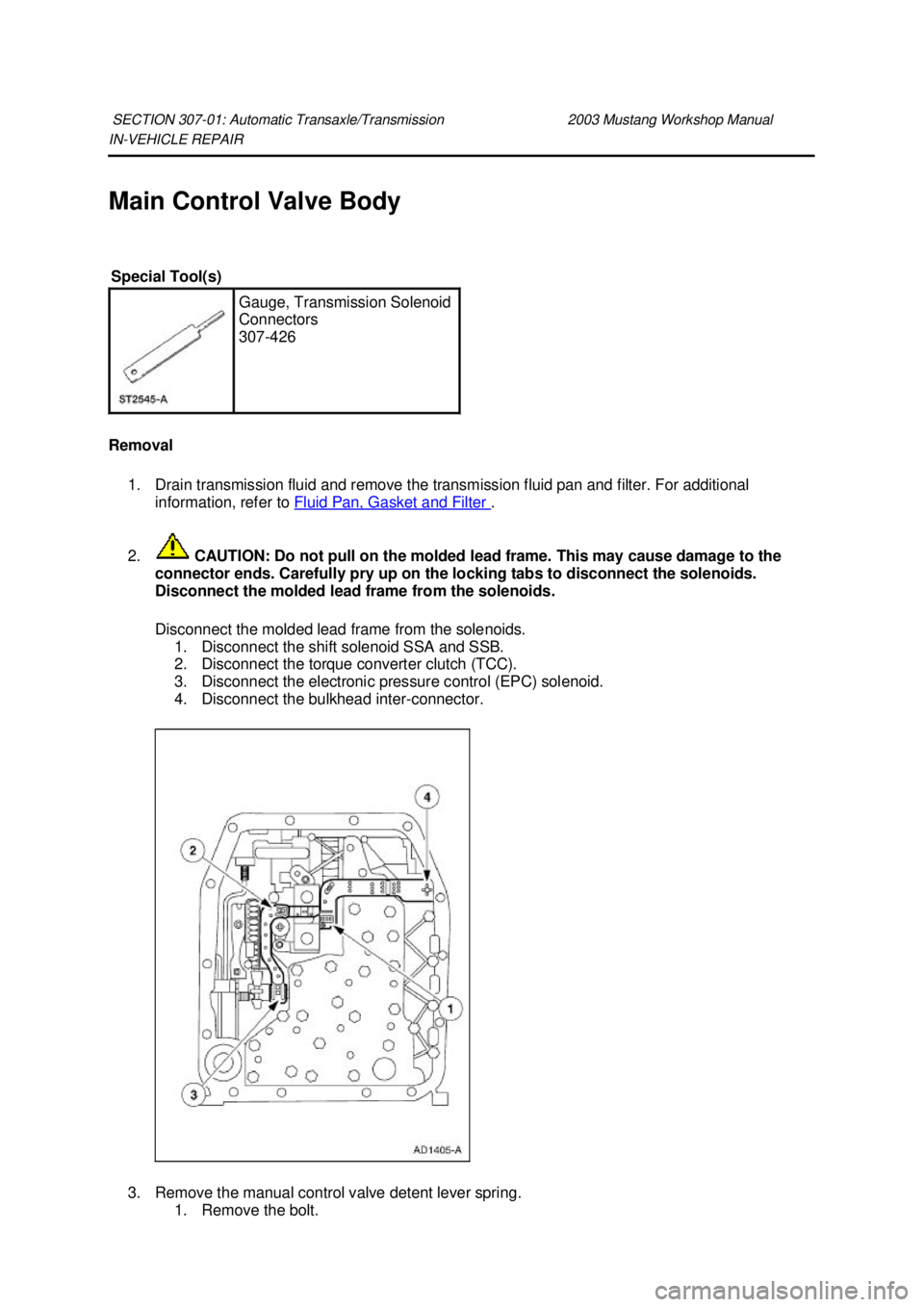
Disconnect the molded lead frame from the solenoids.
Disconnect the molded lead frame from the solenoids. 1. Disconnect the shift solenoid SSA and SSB.
2. Disconnect the torque converter clutch (TCC).
3. Disconnect the electronic pressure control (EPC) solenoid.
4. Disconnect the bulkhead inter- connector.
3. Remove the manual control valve detent lever spring. 1. Remove the bolt.
SECTION 307-
01: Automatic Transaxle/Transmission 2003 Mustang Workshop Manual Special Tool(s)
Gauge, Transmission Solenoid
Connectors
307-426 �K�l�j . 1 �b�a
72003 Mustang Workshop Manual
18. 11. 2011file:///C:/Ford/2000 - 2004/tsocache/SHEF_2748/S3B~us~en~ ...
Page 2438 of 4378
IN-
VEHICLE REPAIR
Electronic Pressure Control (EPC) Solenoid
Removal 1. Remove the manual control lever. For additional information, refer to Manual Control Lever Shaft and Seal in this section.
2. CAUTION: Do not pull on the molded lead frame. This may cause damage to the
connector ends. Carefully pry up on the locking tabs to disconnect the solenoids.
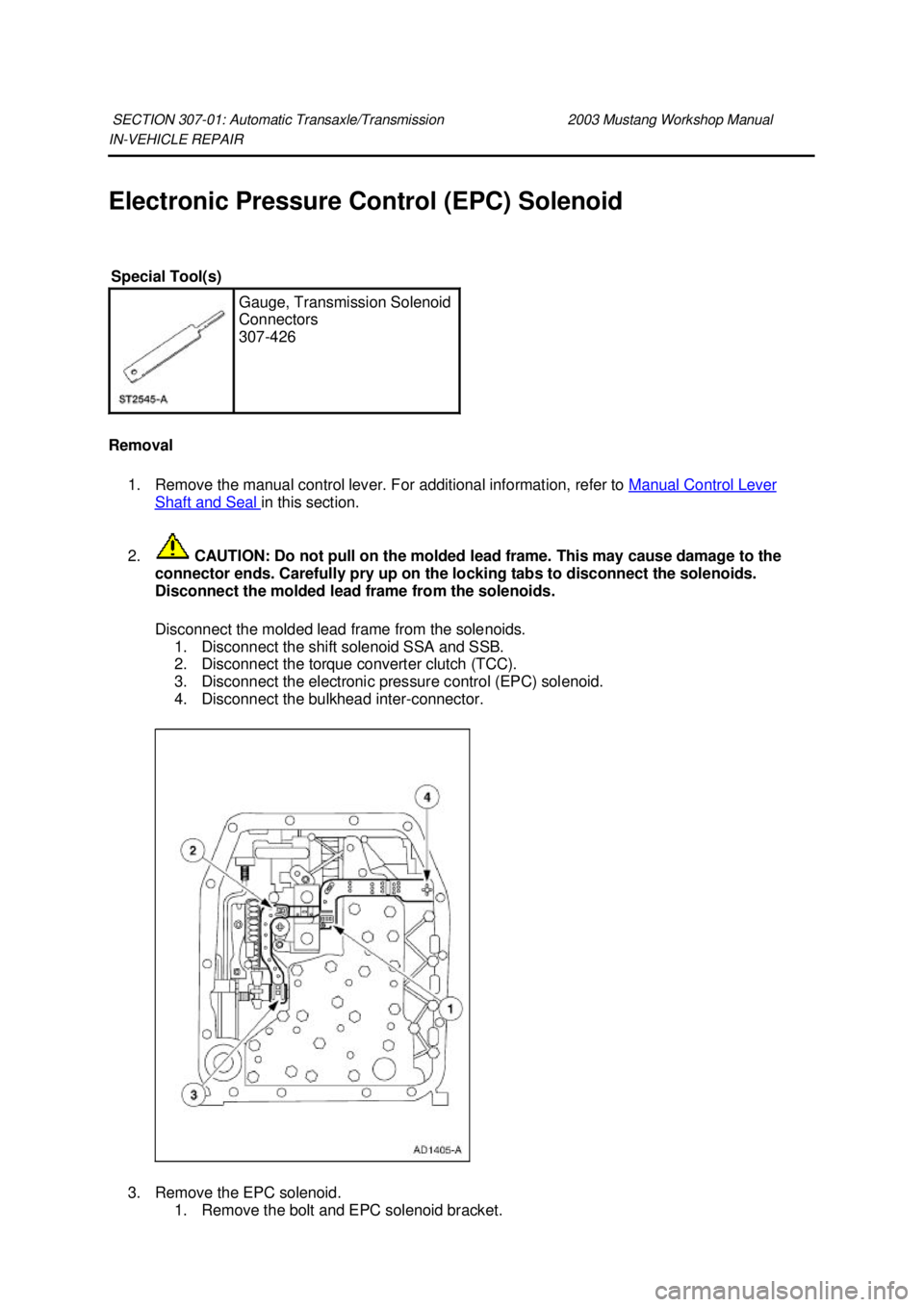
Disconnect the molded lead frame from the solenoids.
Disconnect the molded lead frame from the solenoids. 1. Disconnect the shift solenoid SSA and SSB.
2. Disconnect the torque converter clutch (TCC).
3. Disconnect the electronic pressure control (EPC) solenoid.
4. Disconnect the bulkhead inter- connector.
3. Remove the EPC solenoid. 1. Remove the bolt and EPC solenoid bracket.
SECTION 307-
01: Automatic Transaxle/Transmission 2003 Mustang Workshop Manual Special Tool(s)
Gauge, Transmission Solenoid
Connectors
307-426 �K�l�j . 1 �b�a
32003 Mustang Workshop Manual
18. 11. 2011file:///C:/Ford/2000 - 2004/tsocache/SHEF_2748/S3B~us~en~ ...
Page 2474 of 4378
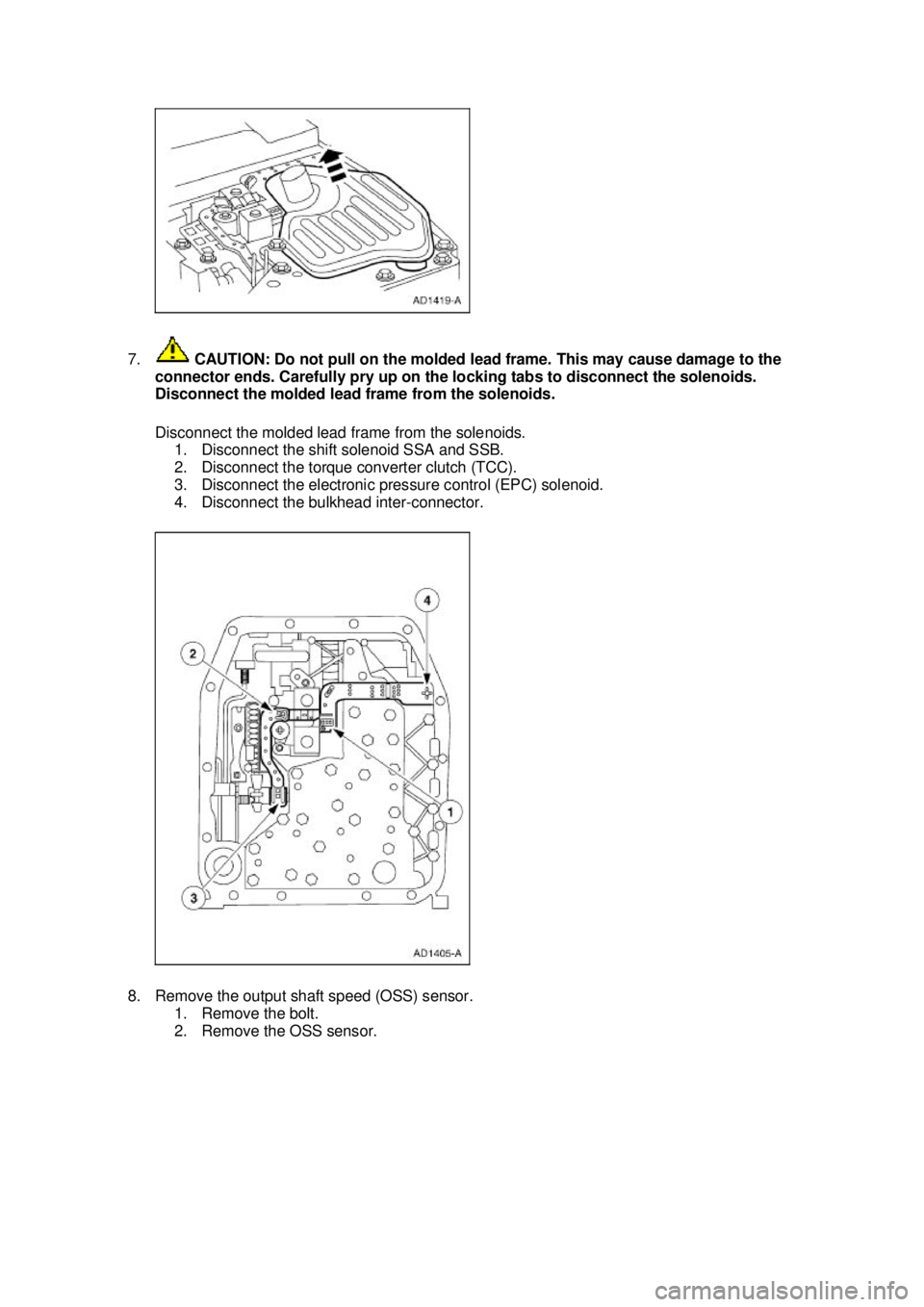
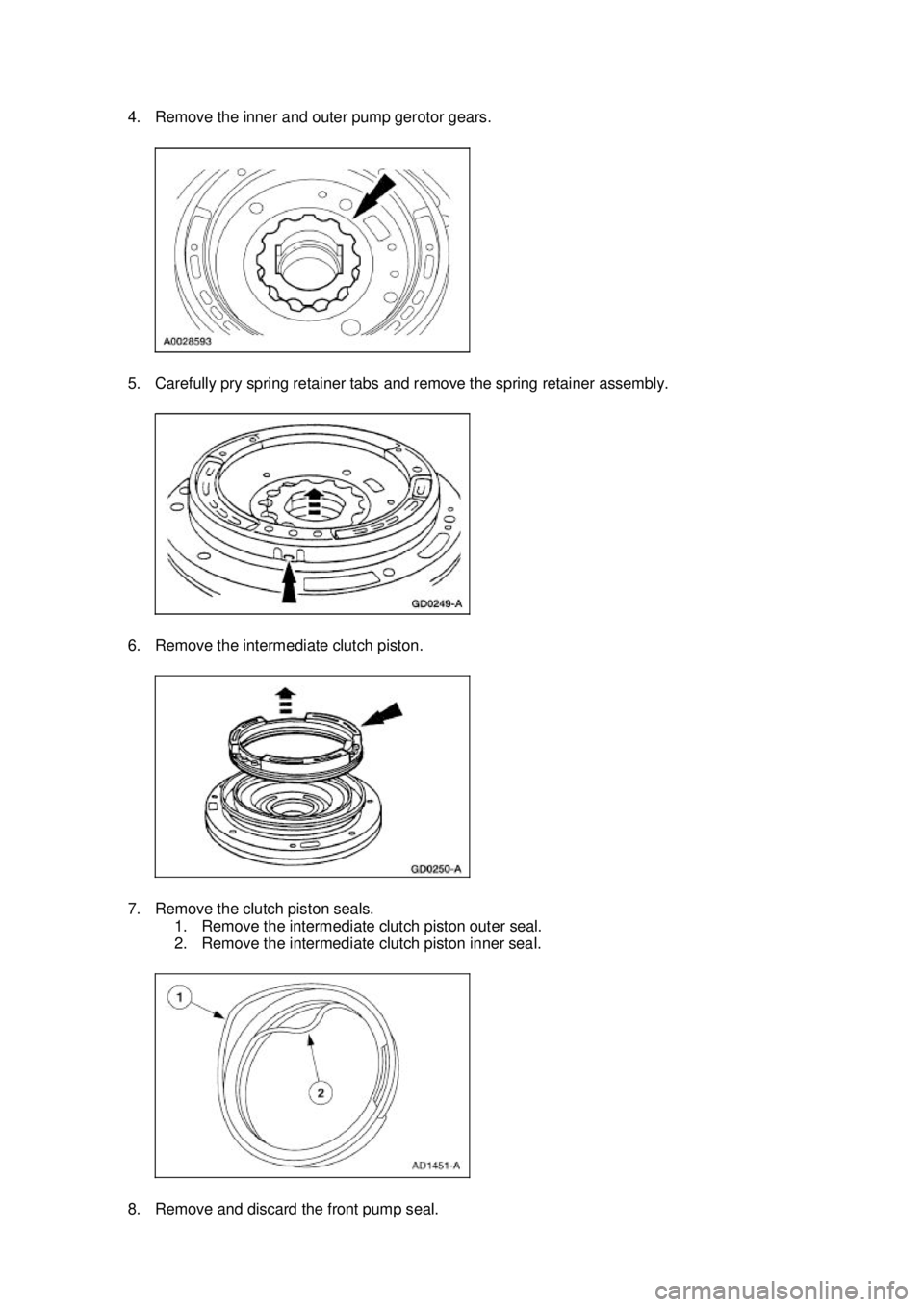
7.
CAUTION: Do not pull on the molded lead frame. This may cause damage to the
connector ends. Carefully pry up on the locking tabs to disconnect the solenoids.
Disconnect the molded lead frame from the solenoids.
Disconnect the molded lead frame from the solenoids. 1. Disconnect the shift solenoid SSA and SSB.
2. Disconnect the torque converter clutch (TCC).
3. Disconnect the electronic pressure control (EPC) solenoid.
4. Disconnect the bulkhead inter- connector.
8. Remove the output shaft speed (OSS) sensor. 1. Remove the bolt.
2. Remove the OSS sensor. �K�l�j . 4 �b�a
162003 Mustang Workshop Manual
18. 11. 2011file:///C:/Ford/2000 - 2004/tsocache/SHEF_2748/S3B~us~en~ ...
Page 2497 of 4378
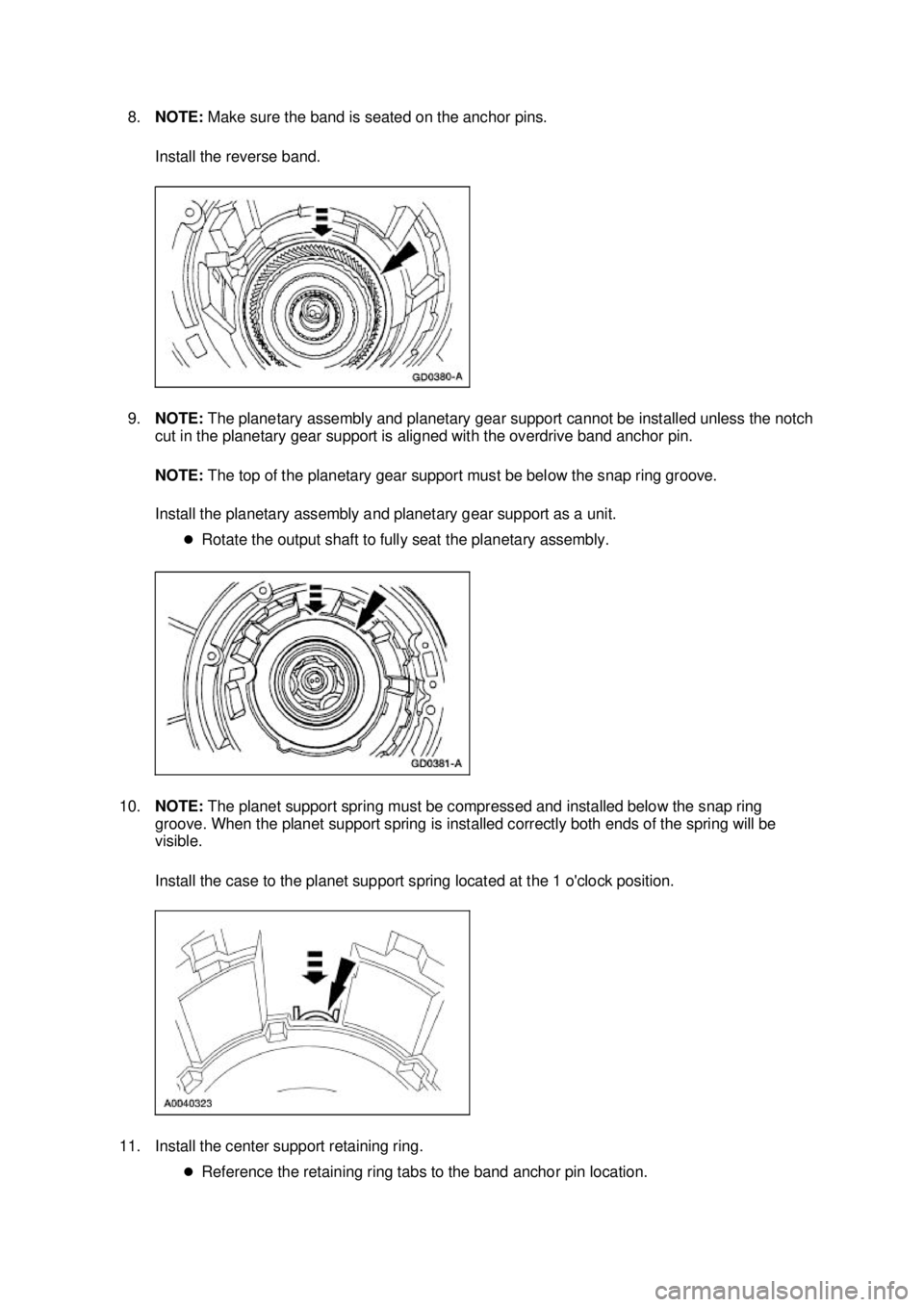
4. Remove the inner and outer pump gerotor gears.
5. Carefully pry spring retainer tabs and remove the spring retainer assembly.
6. Remove the intermediate clutch piston.
7. Remove the clutch piston seals.
1. Remove the intermediate clutch piston outer seal.
2. Remove the intermediate clutch piston inner seal.
8. Remove and discard the front pump seal. �K�l�j . 3 �b�a
72003 Mustang Workshop Manual
18. 11. 2011file:///C:/Ford/2000 - 2004/tsocache/SHEF_2748/S3B~us~en~ ...
Page 2556 of 4378
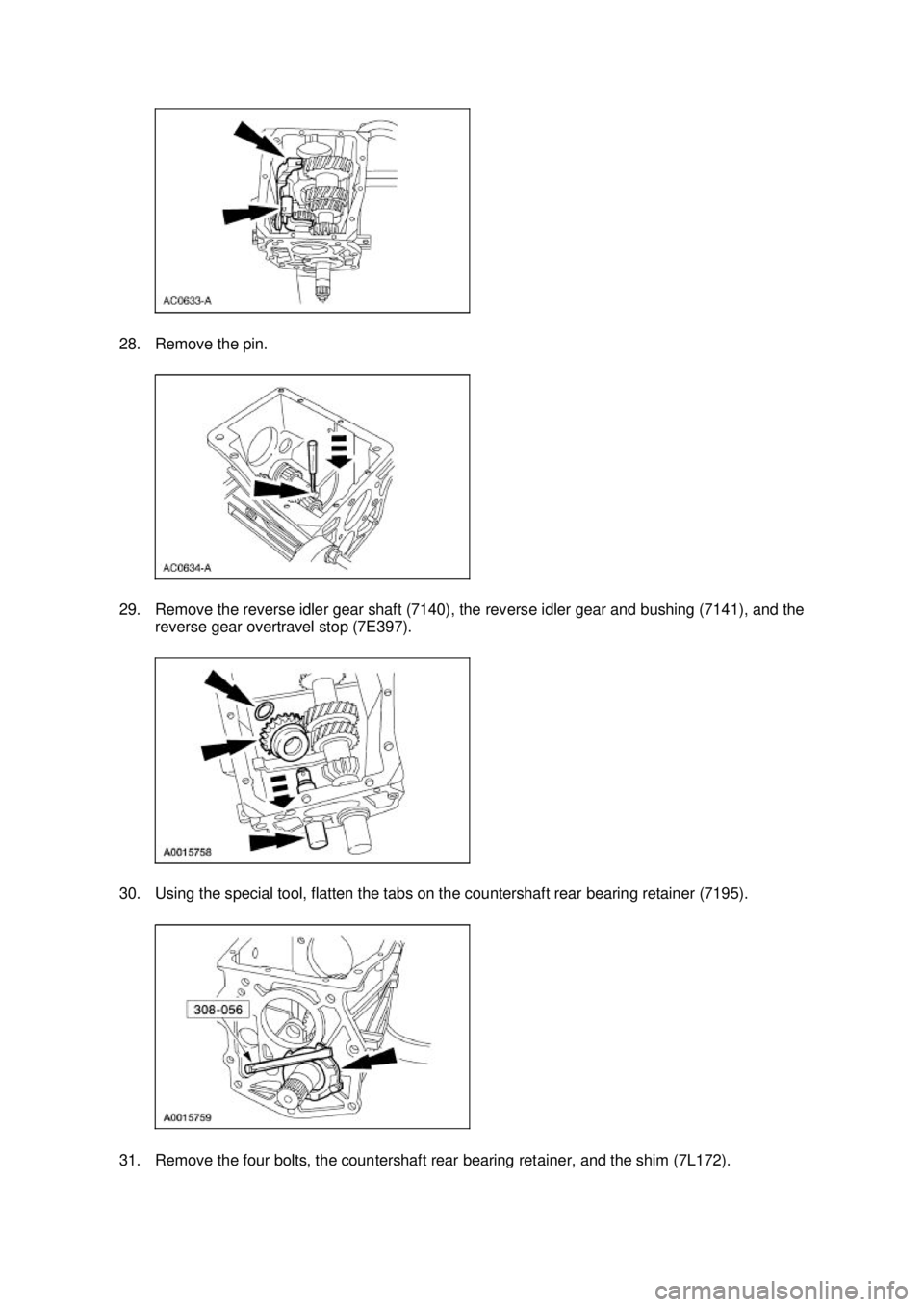
8.
NOTE: Make sure the band is seated on the anchor pins.
Install the reverse band.
9. NOTE: The planetary assembly and planetary gear support cannot be installed unless the notch
cut in the planetary gear support is aligned with the overdrive band anchor pin.
NOTE: The top of the planetary gear support must be below the snap ring groove.
Install the planetary assembly and planetary gear support as a unit. zRotate the output shaft to fully seat the planetary assembly.
10. NOTE: The planet support spring must be compressed and installed below the snap ring
groove. When the planet support spring is installed correctly both ends of the spring will be
visible.
Install the case to the planet support spring located at the 1 o'clock position.
11. Install the center support retaining ring. zReference the retaining ring tabs to the band anchor pin location. �K�l�j . 5 �b�a
252003 Mustang Workshop Manual
18. 11. 2011file:///C:/Ford/2000 - 2004/tsocache/SHEF_2748/S3B~us~en~ ...
Page 2716 of 4378
28. Remove the pin.
29. Remove the reverse idler gear shaft (7140), the reverse idler gear and bushing (7141), and the
reverse gear overtravel stop (7E397).
30. Using the special tool, flatten the tabs on the countershaft rear bearing retainer (7195). 31. Remove the four bolts, the countershaft rear bearing retainer, and the shim (7L172). �K�l�j . 9 �b�a
112003 Mustang Workshop Manual
18. 11. 2011file:///C:/Ford/2000 - 2004/tsocache/SHEF_2308/S3B~us~en~ ...