2003 DODGE RAM torque
[x] Cancel search: torquePage 212 of 2895
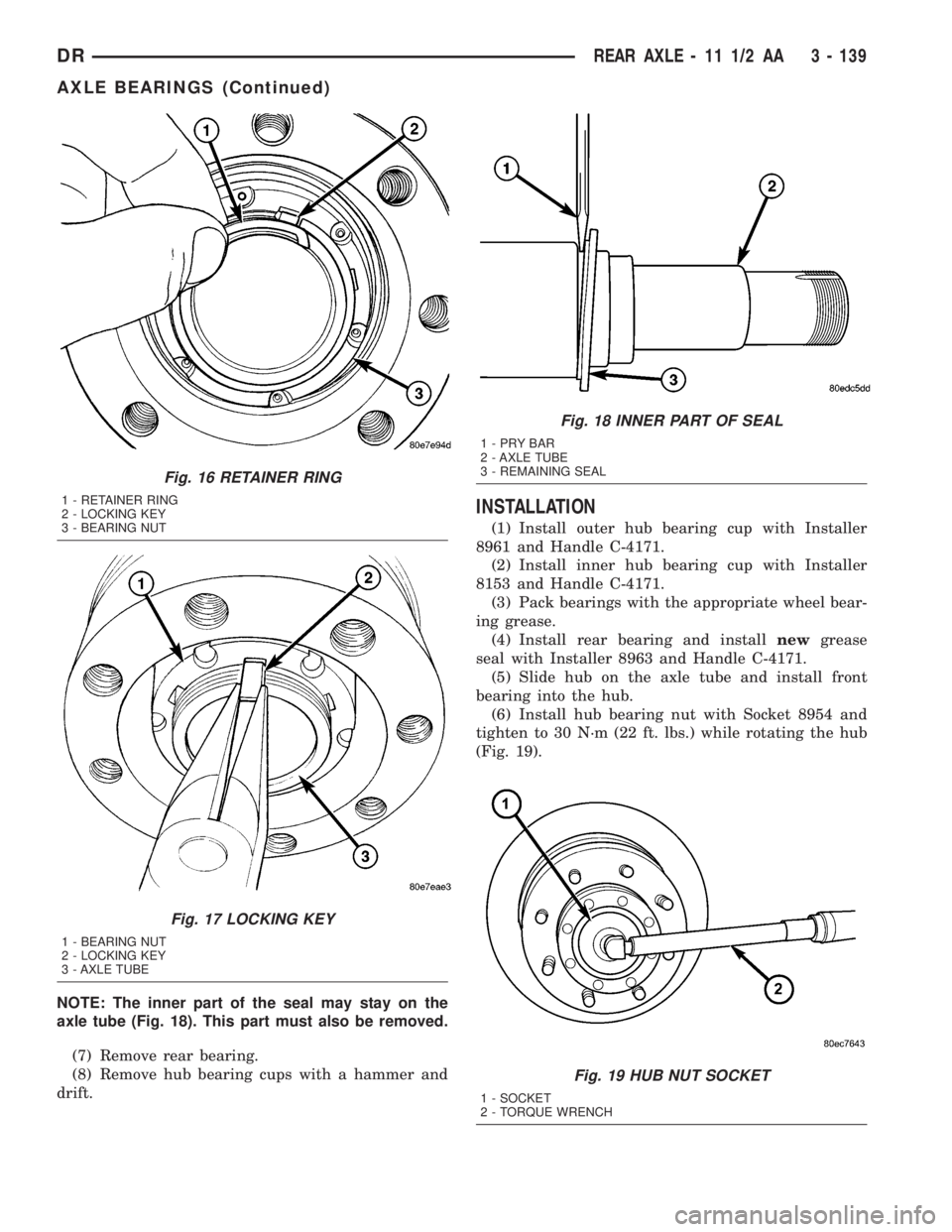
NOTE: The inner part of the seal may stay on the
axle tube (Fig. 18). This part must also be removed.
(7) Remove rear bearing.
(8) Remove hub bearing cups with a hammer and
drift.
INSTALLATION
(1) Install outer hub bearing cup with Installer
8961 and Handle C-4171.
(2) Install inner hub bearing cup with Installer
8153 and Handle C-4171.
(3) Pack bearings with the appropriate wheel bear-
ing grease.
(4) Install rear bearing and installnewgrease
seal with Installer 8963 and Handle C-4171.
(5) Slide hub on the axle tube and install front
bearing into the hub.
(6) Install hub bearing nut with Socket 8954 and
tighten to 30 N´m (22 ft. lbs.) while rotating the hub
(Fig. 19).
Fig. 16 RETAINER RING
1 - RETAINER RING
2 - LOCKING KEY
3 - BEARING NUT
Fig. 17 LOCKING KEY
1 - BEARING NUT
2 - LOCKING KEY
3 - AXLE TUBE
Fig. 18 INNER PART OF SEAL
1-PRYBAR
2 - AXLE TUBE
3 - REMAINING SEAL
Fig. 19 HUB NUT SOCKET
1 - SOCKET
2 - TORQUE WRENCH
DRREAR AXLE - 11 1/2 AA 3 - 139
AXLE BEARINGS (Continued)
Page 213 of 2895
(7) Back off nut about 30É and align next hub nut
key slot with axle tube key slot and install locking
key.
NOTE: End play should be 0.025-0.25 mm
(0.01-0.001 in.)
(8) Install retainer ring with ring end in the key
slot.
(9) Install new axle shaft gasket and install the
axle shaft.
PINION SEAL
REMOVAL
(1) Remove axle shafts.
(2) Mark the propeller shaft and pinion flange for
installation reference.
(3) Remove propeller shaft.
(4) Rotate pinion gear three or four times.
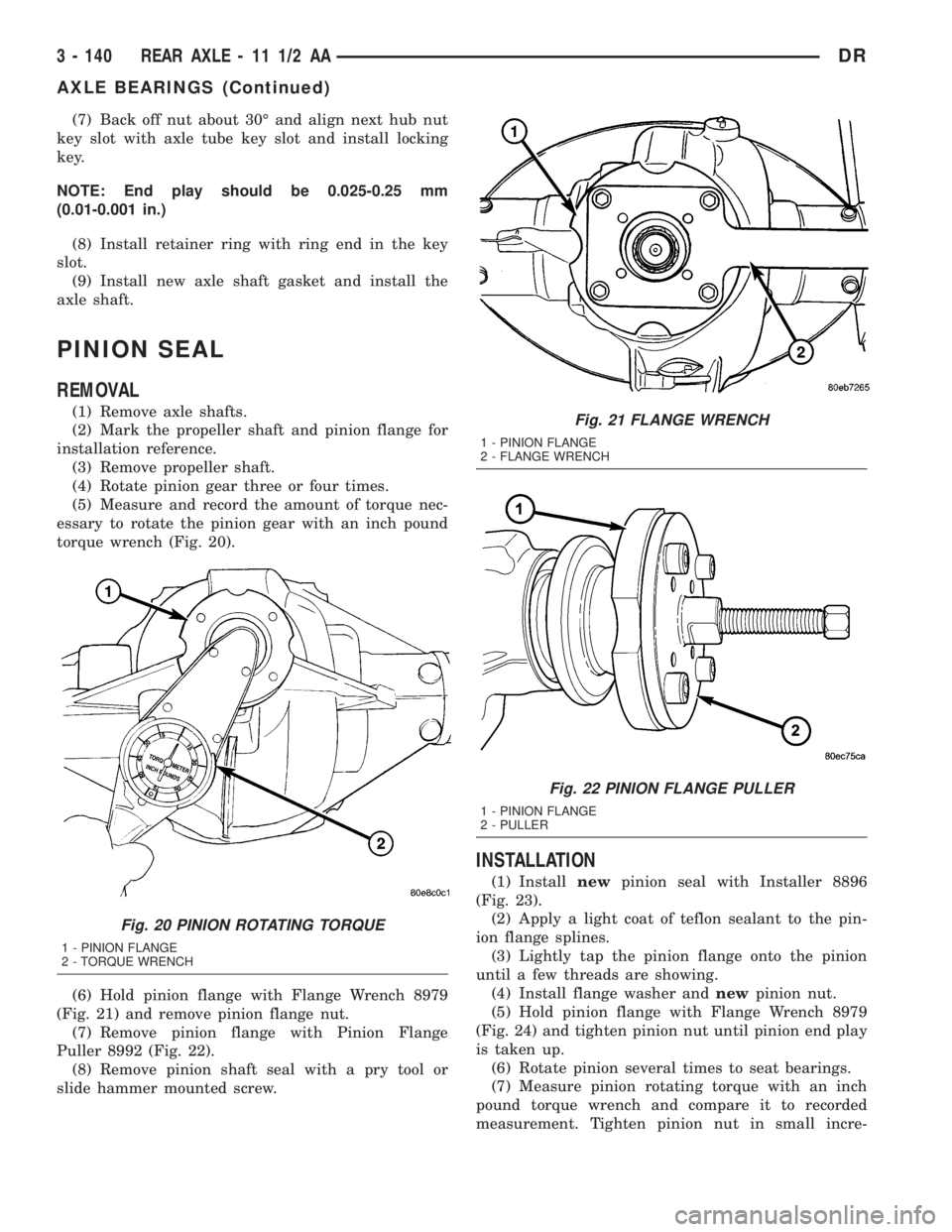
(5) Measure and record the amount of torque nec-
essary to rotate the pinion gear with an inch pound
torque wrench (Fig. 20).
(6) Hold pinion flange with Flange Wrench 8979
(Fig. 21) and remove pinion flange nut.
(7) Remove pinion flange with Pinion Flange
Puller 8992 (Fig. 22).
(8) Remove pinion shaft seal with a pry tool or
slide hammer mounted screw.
INSTALLATION
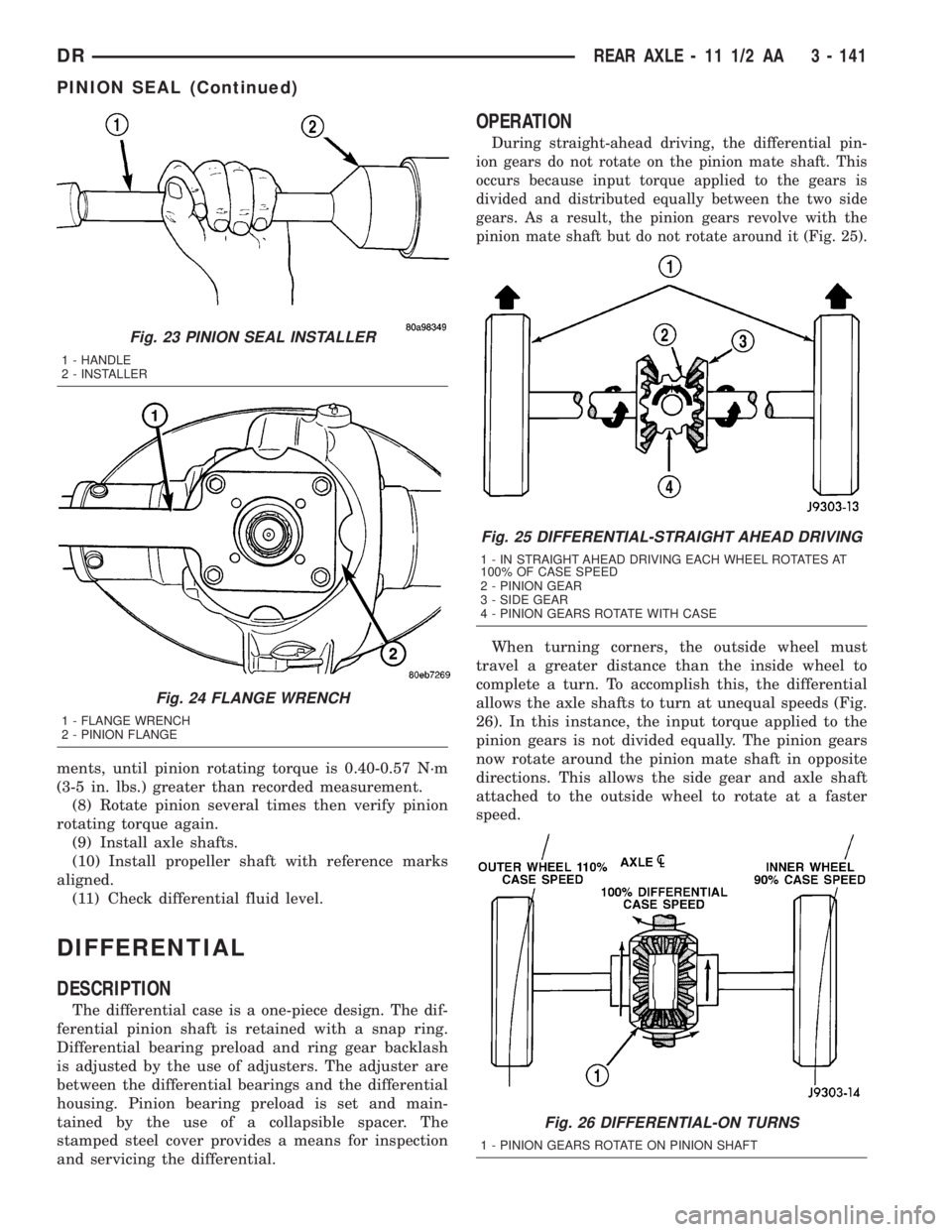
(1) Installnewpinion seal with Installer 8896
(Fig. 23).
(2) Apply a light coat of teflon sealant to the pin-
ion flange splines.
(3) Lightly tap the pinion flange onto the pinion
until a few threads are showing.
(4) Install flange washer andnewpinion nut.
(5) Hold pinion flange with Flange Wrench 8979
(Fig. 24) and tighten pinion nut until pinion end play
is taken up.
(6) Rotate pinion several times to seat bearings.
(7) Measure pinion rotating torque with an inch
pound torque wrench and compare it to recorded
measurement. Tighten pinion nut in small incre-
Fig. 20 PINION ROTATING TORQUE
1 - PINION FLANGE
2 - TORQUE WRENCH
Fig. 21 FLANGE WRENCH
1 - PINION FLANGE
2 - FLANGE WRENCH
Fig. 22 PINION FLANGE PULLER
1 - PINION FLANGE
2 - PULLER
3 - 140 REAR AXLE - 11 1/2 AADR
AXLE BEARINGS (Continued)
Page 214 of 2895
ments, until pinion rotating torque is 0.40-0.57 N´m
(3-5 in. lbs.) greater than recorded measurement.
(8) Rotate pinion several times then verify pinion
rotating torque again.
(9) Install axle shafts.
(10) Install propeller shaft with reference marks
aligned.
(11) Check differential fluid level.
DIFFERENTIAL
DESCRIPTION
The differential case is a one-piece design. The dif-
ferential pinion shaft is retained with a snap ring.
Differential bearing preload and ring gear backlash
is adjusted by the use of adjusters. The adjuster are
between the differential bearings and the differential
housing. Pinion bearing preload is set and main-
tained by the use of a collapsible spacer. The
stamped steel cover provides a means for inspection
and servicing the differential.
OPERATION
During straight-ahead driving, the differential pin-
ion gears do not rotate on the pinion mate shaft. This
occurs because input torque applied to the gears is
divided and distributed equally between the two side
gears. As a result, the pinion gears revolve with the
pinion mate shaft but do not rotate around it (Fig. 25).
When turning corners, the outside wheel must
travel a greater distance than the inside wheel to
complete a turn. To accomplish this, the differential
allows the axle shafts to turn at unequal speeds (Fig.
26). In this instance, the input torque applied to the
pinion gears is not divided equally. The pinion gears
now rotate around the pinion mate shaft in opposite
directions. This allows the side gear and axle shaft
attached to the outside wheel to rotate at a faster
speed.
Fig. 23 PINION SEAL INSTALLER
1 - HANDLE
2 - INSTALLER
Fig. 24 FLANGE WRENCH
1 - FLANGE WRENCH
2 - PINION FLANGE
Fig. 25 DIFFERENTIAL-STRAIGHT AHEAD DRIVING
1 - IN STRAIGHT AHEAD DRIVING EACH WHEEL ROTATES AT
100% OF CASE SPEED
2 - PINION GEAR
3 - SIDE GEAR
4 - PINION GEARS ROTATE WITH CASE
Fig. 26 DIFFERENTIAL-ON TURNS
1 - PINION GEARS ROTATE ON PINION SHAFT
DRREAR AXLE - 11 1/2 AA 3 - 141
PINION SEAL (Continued)
Page 217 of 2895
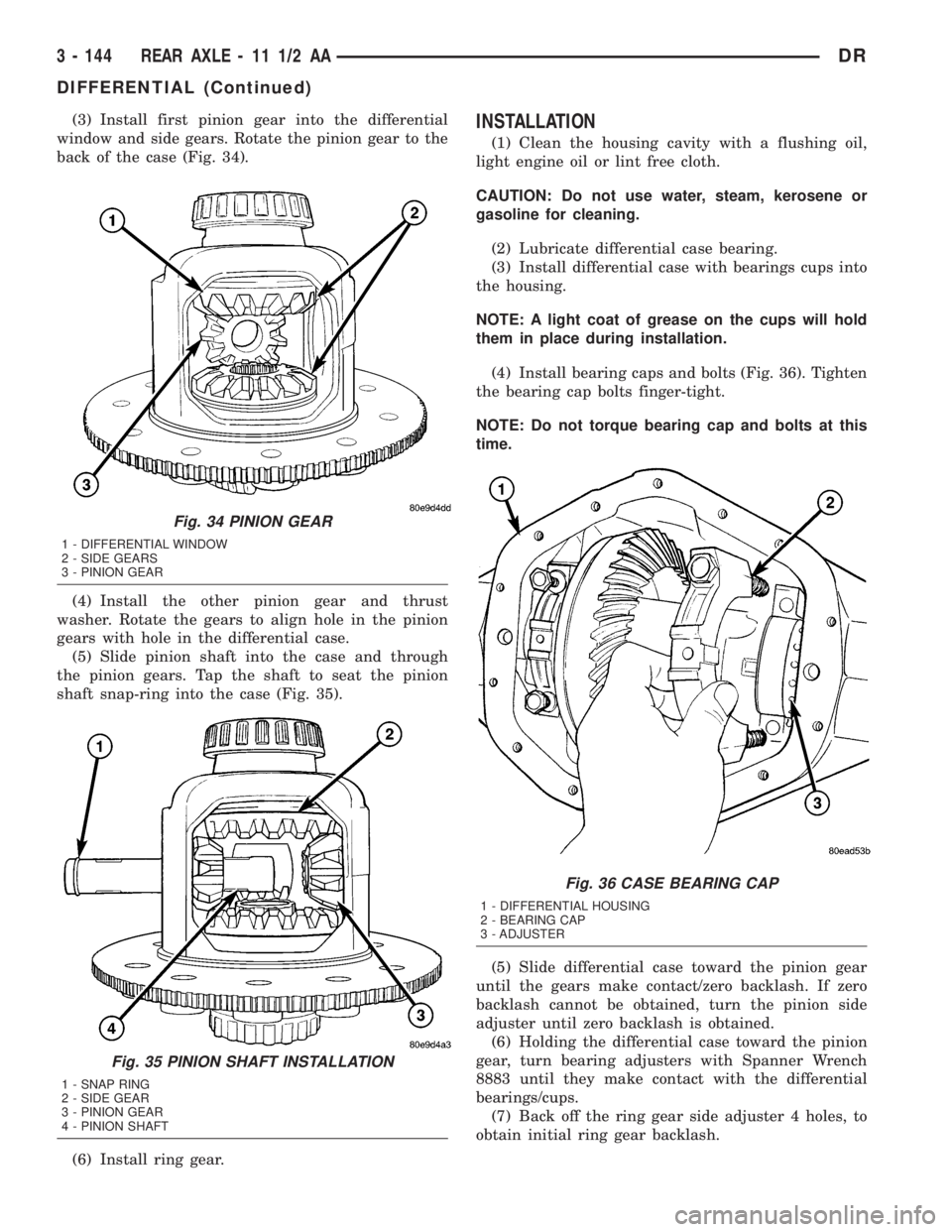
(3) Install first pinion gear into the differential
window and side gears. Rotate the pinion gear to the
back of the case (Fig. 34).
(4) Install the other pinion gear and thrust
washer. Rotate the gears to align hole in the pinion
gears with hole in the differential case.
(5) Slide pinion shaft into the case and through
the pinion gears. Tap the shaft to seat the pinion
shaft snap-ring into the case (Fig. 35).
(6) Install ring gear.INSTALLATION
(1) Clean the housing cavity with a flushing oil,
light engine oil or lint free cloth.
CAUTION: Do not use water, steam, kerosene or
gasoline for cleaning.
(2) Lubricate differential case bearing.
(3) Install differential case with bearings cups into
the housing.
NOTE: A light coat of grease on the cups will hold
them in place during installation.
(4) Install bearing caps and bolts (Fig. 36). Tighten
the bearing cap bolts finger-tight.
NOTE: Do not torque bearing cap and bolts at this
time.
(5) Slide differential case toward the pinion gear
until the gears make contact/zero backlash. If zero
backlash cannot be obtained, turn the pinion side
adjuster until zero backlash is obtained.
(6) Holding the differential case toward the pinion
gear, turn bearing adjusters with Spanner Wrench
8883 until they make contact with the differential
bearings/cups.
(7) Back off the ring gear side adjuster 4 holes, to
obtain initial ring gear backlash.
Fig. 34 PINION GEAR
1 - DIFFERENTIAL WINDOW
2 - SIDE GEARS
3 - PINION GEAR
Fig. 35 PINION SHAFT INSTALLATION
1 - SNAP RING
2 - SIDE GEAR
3 - PINION GEAR
4 - PINION SHAFT
Fig. 36 CASE BEARING CAP
1 - DIFFERENTIAL HOUSING
2 - BEARING CAP
3 - ADJUSTER
3 - 144 REAR AXLE - 11 1/2 AADR
DIFFERENTIAL (Continued)
Page 218 of 2895

(8) Install ring gear side adjuster lock and bolt. Do
not tighten adjuster lock bolt at this time.
(9) Tighten pinion gear side adjuster firmly
against the differential case bearing cup.
(10) Rotate the pinion several times to seat the dif-
ferential bearings.
(11) Loosen pinion gear side adjuster until it is no
longer in contact with the bearing cup.
(12) Tighten pinion gear side adjuster until it just
makes contact with the bearing cup.
(13)
Tighten pinion gear side adjuster an additional:
²New Bearings6 Adjuster Holes
²Original Bearings4 Adjuster Holes
(14) Install pinion gear side adjuster lock and bolt.
Do not tighten adjuster lock bolt at this time.
(15) Tighten bearing cap bolts to 281 N´m (207 ft.
lbs.).
(16) Tighten adjuster lock bolts to 25 N´m (18 ft.
lbs.) (Fig. 37).
(17) Measure ring gear backlash and check gear
tooth contact pattern. Refer to Adjustments for pro-
cedure.
(18) Install axle shaft gasket and install axle
shafts.
(19) Install differential housing gasket and cover.
Tighten cover bolts to 40 N´m (30 ft. lbs.).
(20) Fill axle with lubricant, refer to Lubrication &
Maintenance for capacity and lubricant type.
(21) Install fill plug and tighten to 32 N´m (24 ft.
lbs.).
DIFFERENTIAL TRAC-RITE
DESCRIPTION
The Trac-RiteŸ differential is a helical gear differ-
ential. The differential has two side gears, six pinion
gears and six pinion brake shoes.
NOTE: The differential is seviced as an assembly
only if damaged, but can be disassembled for
cleaning. The assembly should be cleaned every
time a bearing is changed due to damage.
OPERATION
When one wheel begins to spin the pinion gears on
that side are forced toward the pinion brake shoes.
The pinion brake shoes then cause frictional drag on
the opposite pinion gears and the side gear. These
friction forces transfer the power to the opposite
wheel. Once the frictional forces are overcome, differ-
entiation will occur. The torque will be continually
biased by the frictional forces to the high traction
wheel.
DISASSEMBLY
(1) Remove differential ring gear bolts.
(2) Remove differential case cover locating screws
(Fig. 38).
(3) Remove differential case cover.
(4) Remove side gear and thrust washer (Fig. 39).
Fig. 37 ADJUSTER LOCK BOLT
1 - DIFFERENTIAL CASE
2 - ADJUSTER LOCK
3 - ADJUSTER LOCK BOLT
4 - BEARING CAP BOLT
Fig. 38 LOCATION SCREWS
1 - DIFFERENTIAL COVER
2 - LOCATION SCREWS
DRREAR AXLE - 11 1/2 AA 3 - 145
DIFFERENTIAL (Continued)
Page 225 of 2895
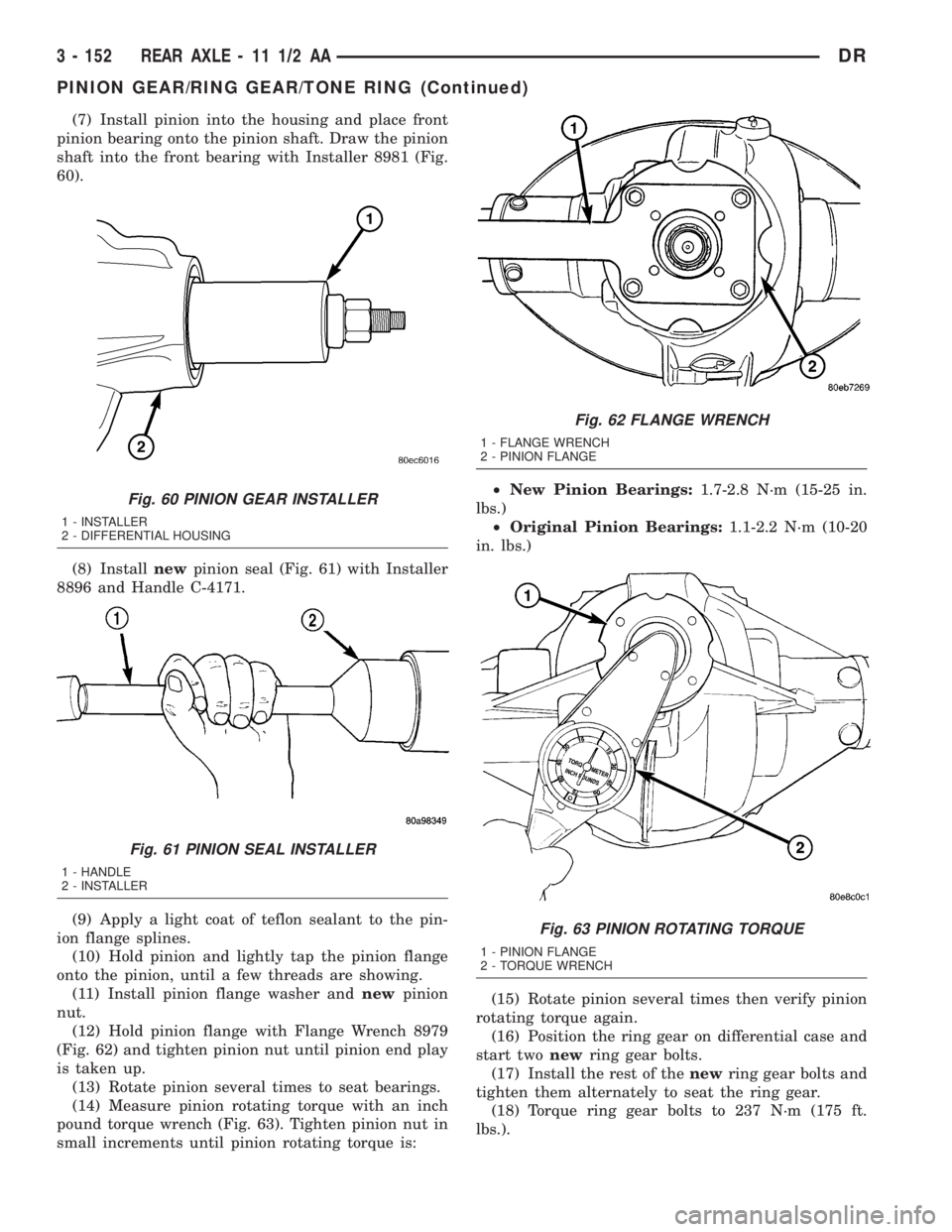
(7) Install pinion into the housing and place front
pinion bearing onto the pinion shaft. Draw the pinion
shaft into the front bearing with Installer 8981 (Fig.
60).
(8) Installnewpinion seal (Fig. 61) with Installer
8896 and Handle C-4171.
(9) Apply a light coat of teflon sealant to the pin-
ion flange splines.
(10) Hold pinion and lightly tap the pinion flange
onto the pinion, until a few threads are showing.
(11) Install pinion flange washer andnewpinion
nut.
(12) Hold pinion flange with Flange Wrench 8979
(Fig. 62) and tighten pinion nut until pinion end play
is taken up.
(13) Rotate pinion several times to seat bearings.
(14) Measure pinion rotating torque with an inch
pound torque wrench (Fig. 63). Tighten pinion nut in
small increments until pinion rotating torque is:²New Pinion Bearings:1.7-2.8 N´m (15-25 in.
lbs.)
²Original Pinion Bearings:1.1-2.2 N´m (10-20
in. lbs.)
(15) Rotate pinion several times then verify pinion
rotating torque again.
(16) Position the ring gear on differential case and
start twonewring gear bolts.
(17) Install the rest of thenewring gear bolts and
tighten them alternately to seat the ring gear.
(18) Torque ring gear bolts to 237 N´m (175 ft.
lbs.).
Fig. 60 PINION GEAR INSTALLER
1 - INSTALLER
2 - DIFFERENTIAL HOUSING
Fig. 61 PINION SEAL INSTALLER
1 - HANDLE
2 - INSTALLER
Fig. 62 FLANGE WRENCH
1 - FLANGE WRENCH
2 - PINION FLANGE
Fig. 63 PINION ROTATING TORQUE
1 - PINION FLANGE
2 - TORQUE WRENCH
3 - 152 REAR AXLE - 11 1/2 AADR
PINION GEAR/RING GEAR/TONE RING (Continued)
Page 226 of 2895

(19) If exciter ring was removed, position differen-
tial assembly on differential Plug 8965 (Fig. 64) and
place exciter ring on the differential case.
(20) Install the exciter ring on the differential case
evenly with a hammer and brass punch (Fig. 65).
Drive the ring down until it is seated against the
ring gear.
CAUTION: Do not damage exciter ring teeth during
installation.
(21) Install differential in housing and verify gear
backlash and gear contact pattern.(22) Measure final rotating torque with an inch
pound torque wrench. The final pinion rotating
torque plus differential case bearing preload is:
²New Bearings:3.4-5.6 N´m (30-50 in. lbs.)
²Original Bearings:2.8-5.1 N´m (25-45 in. lbs.)
(23) Install axle shafts.
(24) Install the propeller shaft with the reference
marks aligned.
(25) Install differential cover with gasket and
tighten bolts to 40 N´m (30 ft. lbs.).
(26) Fill differential with fluid and tighten fill plug
to 32 N´m (24 ft. lbs.).
Fig. 64 EXCITER RING
1 - EXCITER RING
2 - RING GEAR
3 - DIFFERENTIAL PLUG
4 - DIFFERENTIAL CASE
Fig. 65 EXCITER RING INSTALLATION
1 - EXCITER RING
2 - PUNSH
3 - RING GEAR
DRREAR AXLE - 11 1/2 AA 3 - 153
PINION GEAR/RING GEAR/TONE RING (Continued)
Page 228 of 2895
BRAKES
TABLE OF CONTENTS
page page
BRAKES - BASE........................... 1BRAKES - ABS........................... 39
BRAKES - BASE
TABLE OF CONTENTS
page page
BRAKES - BASE
DIAGNOSIS AND TESTING - BASE BRAKE
SYSTEM.............................2
STANDARD PROCEDURE
STANDARD PROCEDURE - MANUAL
BLEEDING............................5
STANDARD PROCEDURE - PRESSURE
BLEEDING............................5
SPECIAL TOOLS
BASE BRAKES........................5
ADJUSTABLE PEDAL SWITCH
REMOVAL.............................6
INSTALLATION..........................6
HYDRAULIC/MECHANICAL
SPECIFICATIONS
SPECIFICATIONS - TORQUE CHART.......6
BASE BRAKE.........................7
BRAKE LINES
STANDARD PROCEDURE
STANDARD PROCEDURE - DOUBLE
INVERTED FLARING....................7
STANDARD PROCEDURE - ISO FLARING . . . 7
REMOVAL
REMOVAL - REAR BRAKE HOSE..........8
REMOVAL - REAR TUBE / HOSE
ASSEMBLY...........................8
REMOVAL - FRONT HOSE...............9
INSTALLATION
INSTALLATION - REAR BRAKE HOSE......9
INSTALLATION - REAR TUBE / HOSE
ASSEMBLY...........................9
INSTALLATION - FRONT BRAKE HOSE.....9
BRAKE PADS/SHOES
REMOVAL.............................10
INSTALLATION.........................10
DISC BRAKE CALIPERS
DESCRIPTION.........................11OPERATION...........................12
REMOVAL
REMOVAL - REAR.....................12
REMOVAL - FRONT....................12
DISASSEMBLY.........................13
INSPECTION..........................14
ASSEMBLY............................15
INSTALLATION
INSTALLATION - REAR.................16
INSTALLATION - FRONT................16
DISC BRAKE CALIPER ADAPTER
REMOVAL
REMOVAL - REAR.....................16
REMOVAL - FRONT....................16
INSTALLATION
INSTALLATION - REAR.................17
INSTALLATION - FRONT................17
DISC BRAKE CALIPER ADAPTER MOUNT
REMOVAL - REAR......................17
INSTALLATION.........................17
FLUID
DIAGNOSIS AND TESTING - BRAKE FLUID
CONTAMINATION.....................18
STANDARD PROCEDURE - BRAKE FLUID
LEVEL..............................18
SPECIFICATIONS
BRAKE FLUID........................18
FLUID RESERVOIR
REMOVAL.............................19
INSTALLATION.........................19
BRAKE JUNCTION BLOCK
REMOVAL.............................19
INSTALLATION.........................19
MASTER CYLINDER
DESCRIPTION.........................19
OPERATION...........................20
DRBRAKES 5 - 1