2003 DODGE RAM lock
[x] Cancel search: lockPage 1864 of 2895
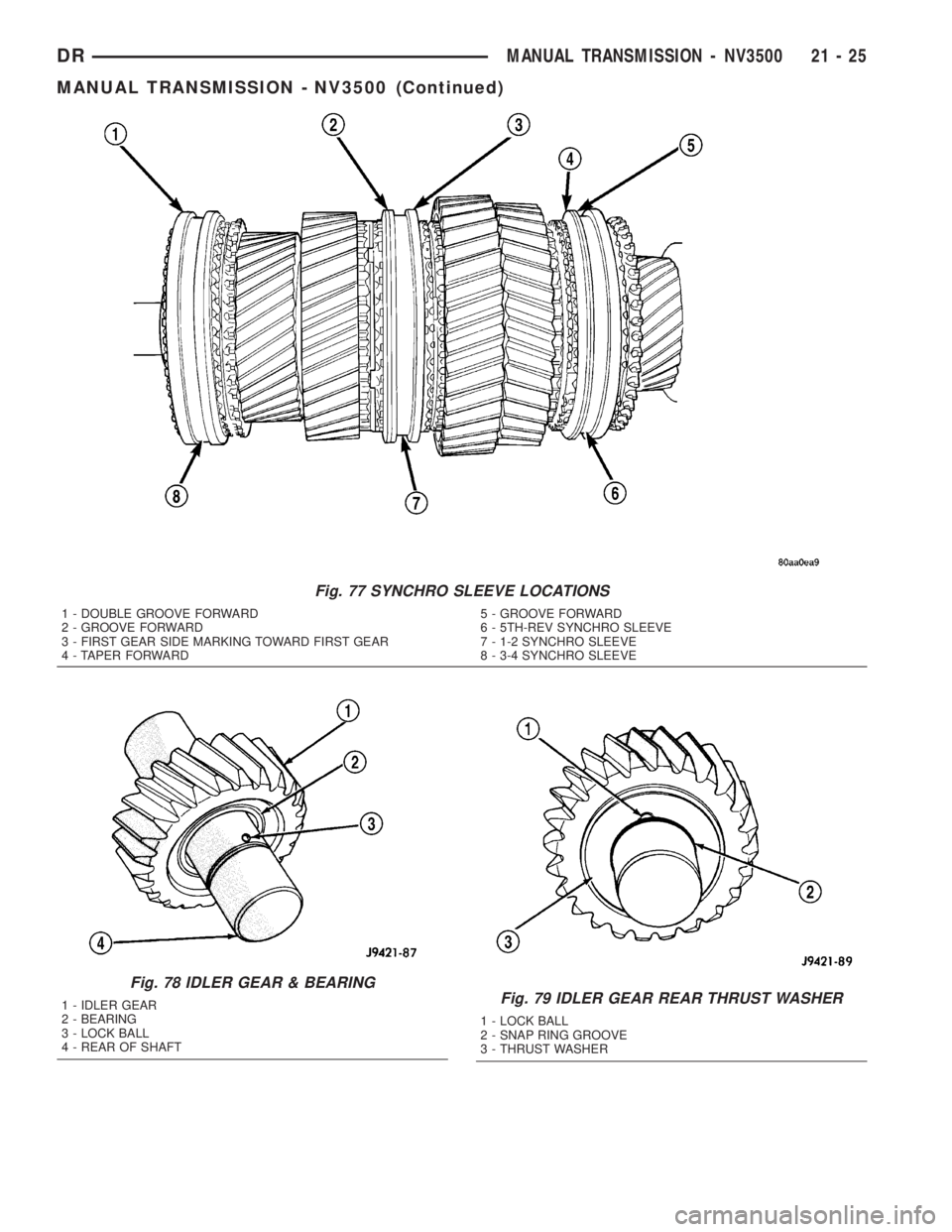
Fig. 77 SYNCHRO SLEEVE LOCATIONS
1 - DOUBLE GROOVE FORWARD
2 - GROOVE FORWARD
3 - FIRST GEAR SIDE MARKING TOWARD FIRST GEAR
4 - TAPER FORWARD5 - GROOVE FORWARD
6 - 5TH-REV SYNCHRO SLEEVE
7 - 1-2 SYNCHRO SLEEVE
8 - 3-4 SYNCHRO SLEEVE
Fig. 78 IDLER GEAR & BEARING
1 - IDLER GEAR
2 - BEARING
3 - LOCK BALL
4 - REAR OF SHAFTFig. 79 IDLER GEAR REAR THRUST WASHER
1 - LOCK BALL
2 - SNAP RING GROOVE
3 - THRUST WASHER
DRMANUAL TRANSMISSION - NV3500 21 - 25
MANUAL TRANSMISSION - NV3500 (Continued)
Page 1865 of 2895
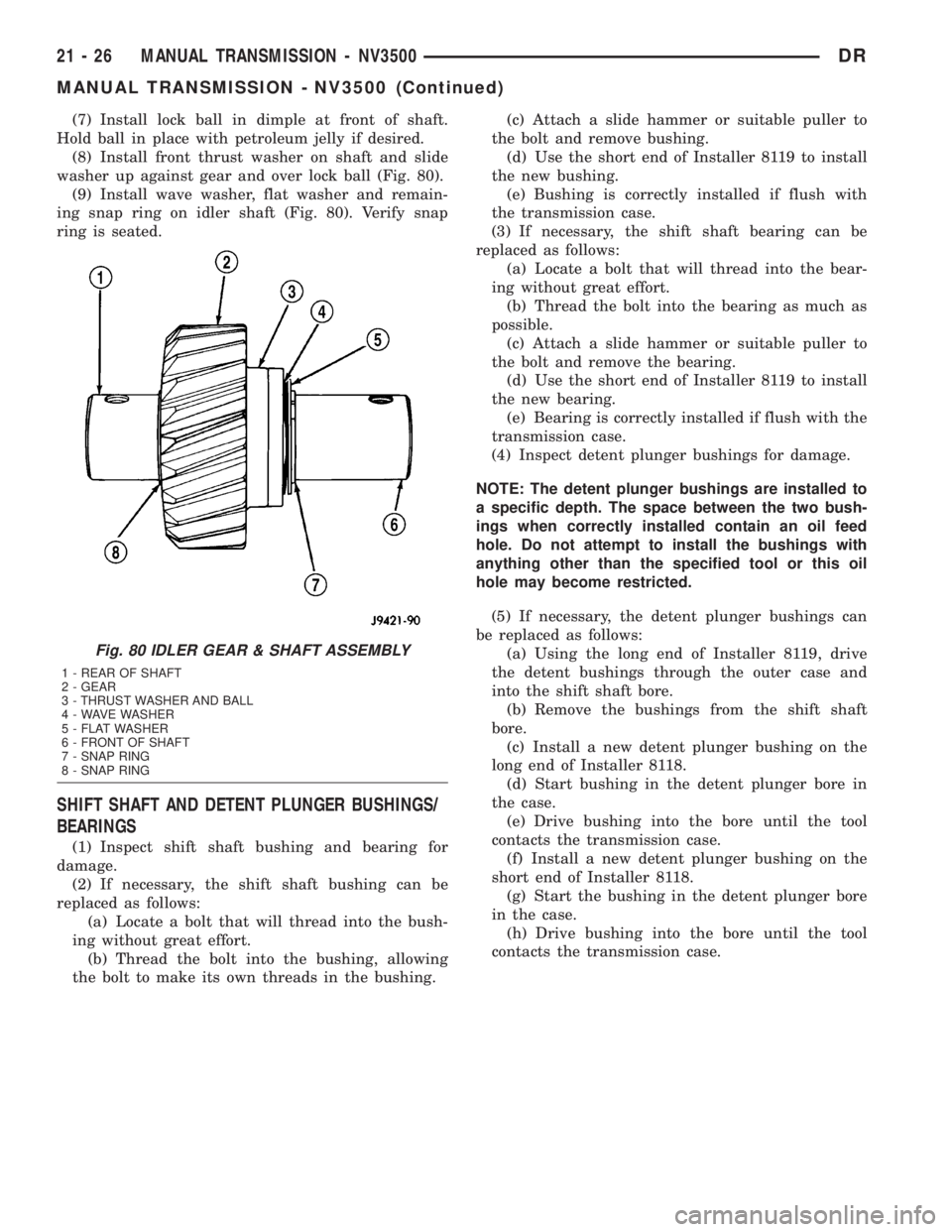
(7) Install lock ball in dimple at front of shaft.
Hold ball in place with petroleum jelly if desired.
(8) Install front thrust washer on shaft and slide
washer up against gear and over lock ball (Fig. 80).
(9) Install wave washer, flat washer and remain-
ing snap ring on idler shaft (Fig. 80). Verify snap
ring is seated.
SHIFT SHAFT AND DETENT PLUNGER BUSHINGS/
BEARINGS
(1) Inspect shift shaft bushing and bearing for
damage.
(2) If necessary, the shift shaft bushing can be
replaced as follows:
(a) Locate a bolt that will thread into the bush-
ing without great effort.
(b) Thread the bolt into the bushing, allowing
the bolt to make its own threads in the bushing.(c) Attach a slide hammer or suitable puller to
the bolt and remove bushing.
(d) Use the short end of Installer 8119 to install
the new bushing.
(e) Bushing is correctly installed if flush with
the transmission case.
(3) If necessary, the shift shaft bearing can be
replaced as follows:
(a) Locate a bolt that will thread into the bear-
ing without great effort.
(b) Thread the bolt into the bearing as much as
possible.
(c) Attach a slide hammer or suitable puller to
the bolt and remove the bearing.
(d) Use the short end of Installer 8119 to install
the new bearing.
(e) Bearing is correctly installed if flush with the
transmission case.
(4) Inspect detent plunger bushings for damage.
NOTE: The detent plunger bushings are installed to
a specific depth. The space between the two bush-
ings when correctly installed contain an oil feed
hole. Do not attempt to install the bushings with
anything other than the specified tool or this oil
hole may become restricted.
(5) If necessary, the detent plunger bushings can
be replaced as follows:
(a) Using the long end of Installer 8119, drive
the detent bushings through the outer case and
into the shift shaft bore.
(b) Remove the bushings from the shift shaft
bore.
(c) Install a new detent plunger bushing on the
long end of Installer 8118.
(d) Start bushing in the detent plunger bore in
the case.
(e) Drive bushing into the bore until the tool
contacts the transmission case.
(f) Install a new detent plunger bushing on the
short end of Installer 8118.
(g) Start the bushing in the detent plunger bore
in the case.
(h) Drive bushing into the bore until the tool
contacts the transmission case.
Fig. 80 IDLER GEAR & SHAFT ASSEMBLY
1 - REAR OF SHAFT
2 - GEAR
3 - THRUST WASHER AND BALL
4 - WAVE WASHER
5 - FLAT WASHER
6 - FRONT OF SHAFT
7 - SNAP RING
8 - SNAP RING
21 - 26 MANUAL TRANSMISSION - NV3500DR
MANUAL TRANSMISSION - NV3500 (Continued)
Page 1872 of 2895
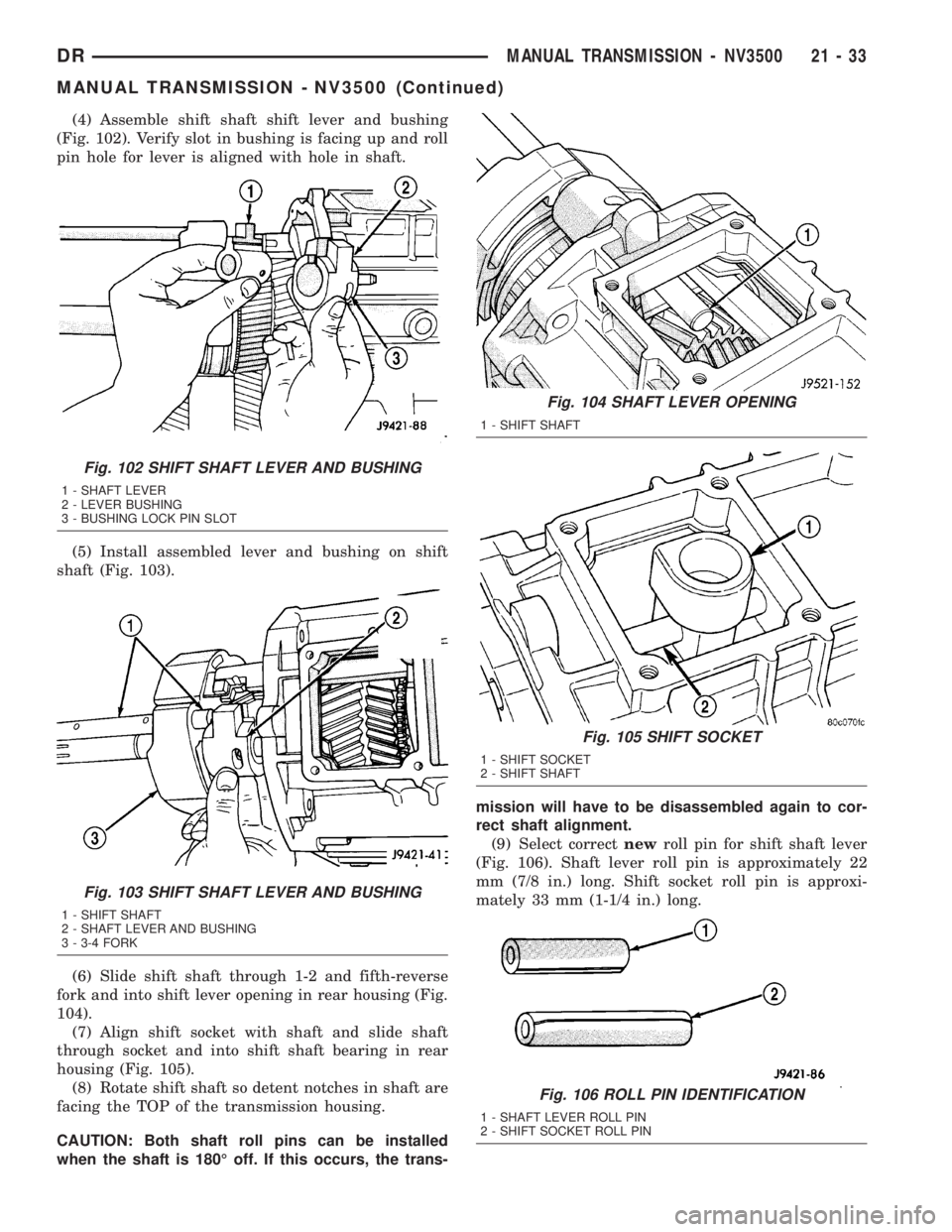
(4) Assemble shift shaft shift lever and bushing
(Fig. 102). Verify slot in bushing is facing up and roll
pin hole for lever is aligned with hole in shaft.
(5) Install assembled lever and bushing on shift
shaft (Fig. 103).
(6) Slide shift shaft through 1-2 and fifth-reverse
fork and into shift lever opening in rear housing (Fig.
104).
(7) Align shift socket with shaft and slide shaft
through socket and into shift shaft bearing in rear
housing (Fig. 105).
(8) Rotate shift shaft so detent notches in shaft are
facing the TOP of the transmission housing.
CAUTION: Both shaft roll pins can be installed
when the shaft is 180É off. If this occurs, the trans-mission will have to be disassembled again to cor-
rect shaft alignment.
(9) Select correctnewroll pin for shift shaft lever
(Fig. 106). Shaft lever roll pin is approximately 22
mm (7/8 in.) long. Shift socket roll pin is approxi-
mately 33 mm (1-1/4 in.) long.
Fig. 102 SHIFT SHAFT LEVER AND BUSHING
1 - SHAFT LEVER
2 - LEVER BUSHING
3 - BUSHING LOCK PIN SLOT
Fig. 103 SHIFT SHAFT LEVER AND BUSHING
1 - SHIFT SHAFT
2 - SHAFT LEVER AND BUSHING
3 - 3-4 FORK
Fig. 104 SHAFT LEVER OPENING
1 - SHIFT SHAFT
Fig. 105 SHIFT SOCKET
1 - SHIFT SOCKET
2 - SHIFT SHAFT
Fig. 106 ROLL PIN IDENTIFICATION
1 - SHAFT LEVER ROLL PIN
2 - SHIFT SOCKET ROLL PIN
DRMANUAL TRANSMISSION - NV3500 21 - 33
MANUAL TRANSMISSION - NV3500 (Continued)
Page 1873 of 2895
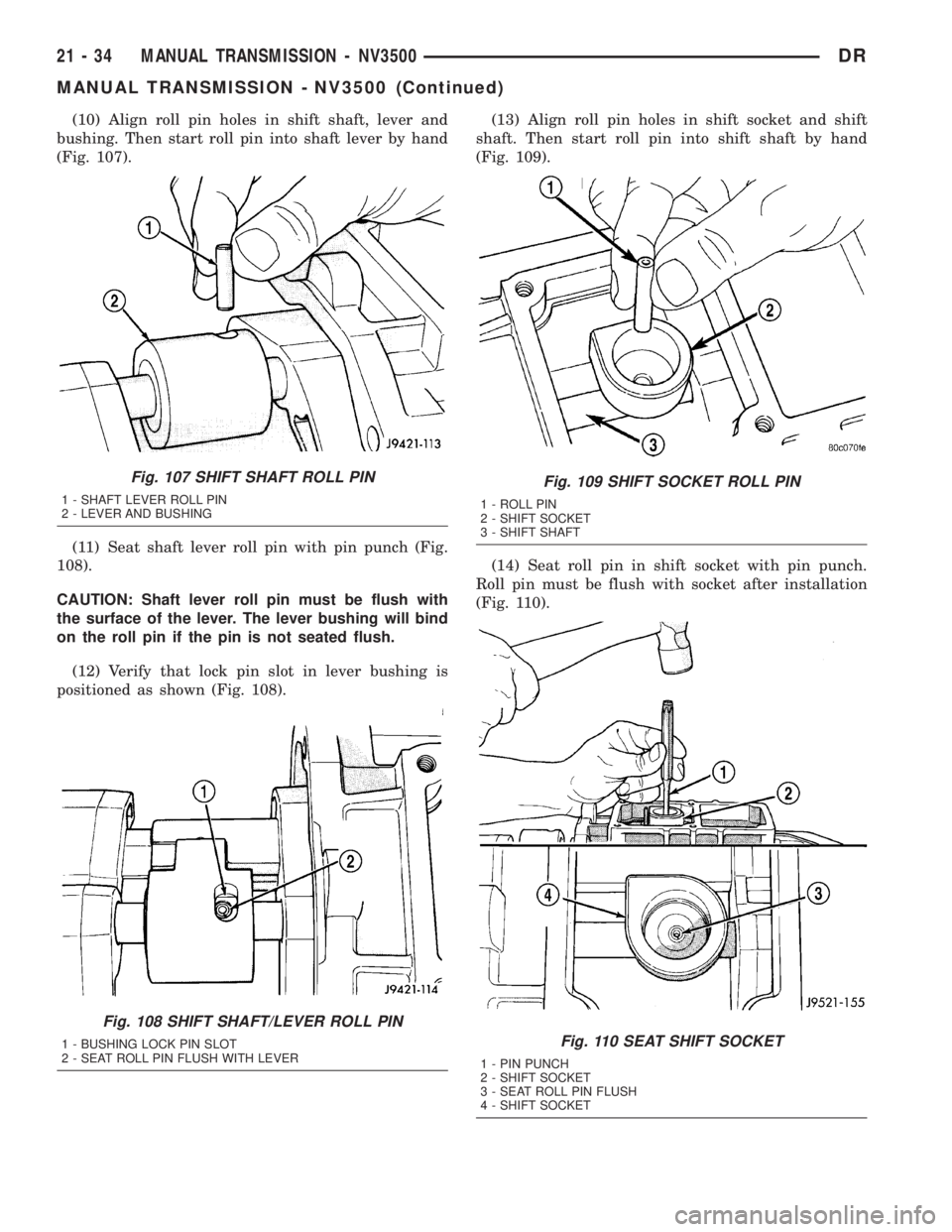
(10) Align roll pin holes in shift shaft, lever and
bushing. Then start roll pin into shaft lever by hand
(Fig. 107).
(11) Seat shaft lever roll pin with pin punch (Fig.
108).
CAUTION: Shaft lever roll pin must be flush with
the surface of the lever. The lever bushing will bind
on the roll pin if the pin is not seated flush.
(12) Verify that lock pin slot in lever bushing is
positioned as shown (Fig. 108).(13) Align roll pin holes in shift socket and shift
shaft. Then start roll pin into shift shaft by hand
(Fig. 109).
(14) Seat roll pin in shift socket with pin punch.
Roll pin must be flush with socket after installation
(Fig. 110).
Fig. 107 SHIFT SHAFT ROLL PIN
1 - SHAFT LEVER ROLL PIN
2 - LEVER AND BUSHING
Fig. 108 SHIFT SHAFT/LEVER ROLL PIN
1 - BUSHING LOCK PIN SLOT
2 - SEAT ROLL PIN FLUSH WITH LEVER
Fig. 109 SHIFT SOCKET ROLL PIN
1 - ROLL PIN
2 - SHIFT SOCKET
3 - SHIFT SHAFT
Fig. 110 SEAT SHIFT SOCKET
1 - PIN PUNCH
2 - SHIFT SOCKET
3 - SEAT ROLL PIN FLUSH
4 - SHIFT SOCKET
21 - 34 MANUAL TRANSMISSION - NV3500DR
MANUAL TRANSMISSION - NV3500 (Continued)
Page 1875 of 2895
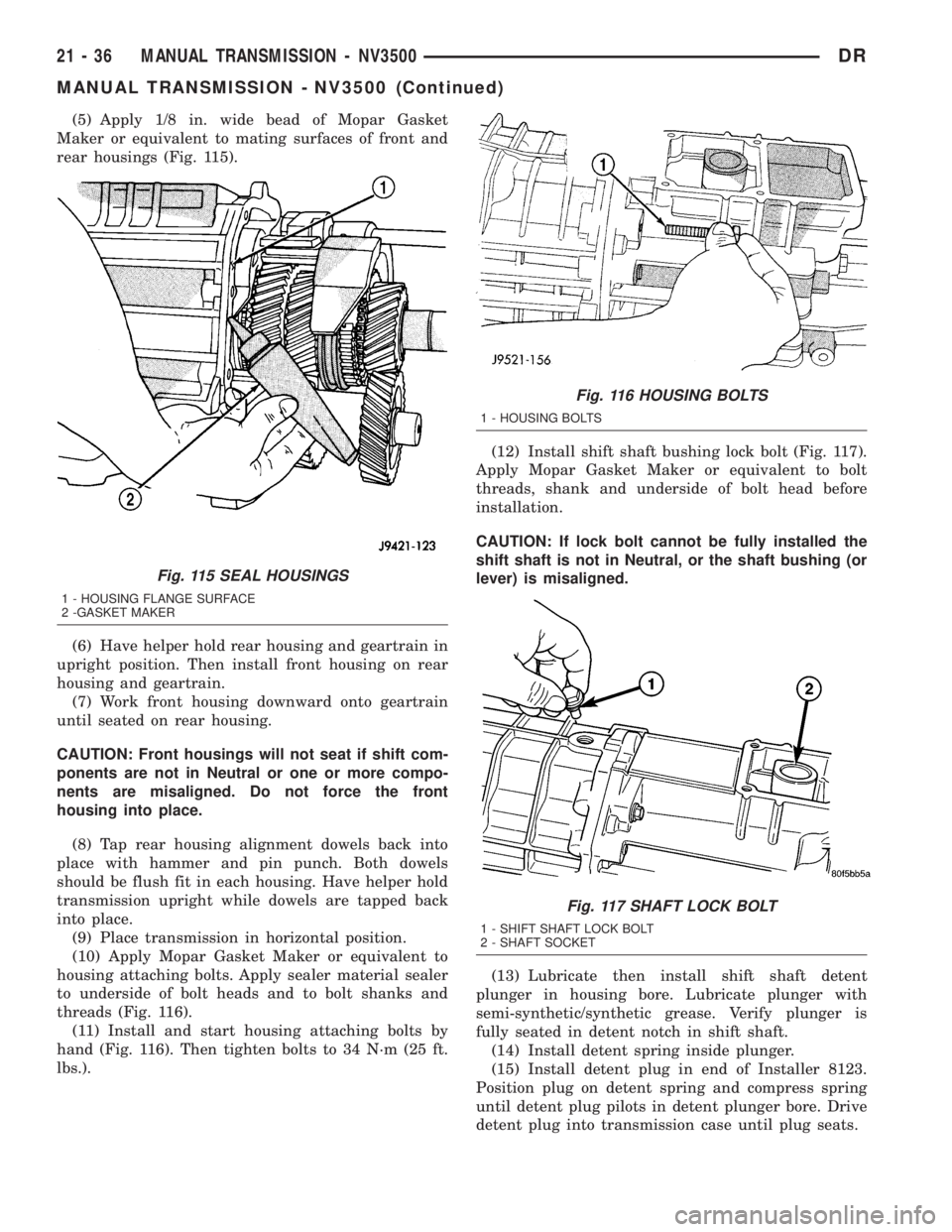
(5) Apply 1/8 in. wide bead of Mopar Gasket
Maker or equivalent to mating surfaces of front and
rear housings (Fig. 115).
(6) Have helper hold rear housing and geartrain in
upright position. Then install front housing on rear
housing and geartrain.
(7) Work front housing downward onto geartrain
until seated on rear housing.
CAUTION: Front housings will not seat if shift com-
ponents are not in Neutral or one or more compo-
nents are misaligned. Do not force the front
housing into place.
(8) Tap rear housing alignment dowels back into
place with hammer and pin punch. Both dowels
should be flush fit in each housing. Have helper hold
transmission upright while dowels are tapped back
into place.
(9) Place transmission in horizontal position.
(10) Apply Mopar Gasket Maker or equivalent to
housing attaching bolts. Apply sealer material sealer
to underside of bolt heads and to bolt shanks and
threads (Fig. 116).
(11) Install and start housing attaching bolts by
hand (Fig. 116). Then tighten bolts to 34 N´m (25 ft.
lbs.).(12) Install shift shaft bushing lock bolt (Fig. 117).
Apply Mopar Gasket Maker or equivalent to bolt
threads, shank and underside of bolt head before
installation.
CAUTION: If lock bolt cannot be fully installed the
shift shaft is not in Neutral, or the shaft bushing (or
lever) is misaligned.
(13) Lubricate then install shift shaft detent
plunger in housing bore. Lubricate plunger with
semi-synthetic/synthetic grease. Verify plunger is
fully seated in detent notch in shift shaft.
(14) Install detent spring inside plunger.
(15) Install detent plug in end of Installer 8123.
Position plug on detent spring and compress spring
until detent plug pilots in detent plunger bore. Drive
detent plug into transmission case until plug seats.
Fig. 115 SEAL HOUSINGS
1 - HOUSING FLANGE SURFACE
2 -GASKET MAKER
Fig. 116 HOUSING BOLTS
1 - HOUSING BOLTS
Fig. 117 SHAFT LOCK BOLT
1 - SHIFT SHAFT LOCK BOLT
2 - SHAFT SOCKET
21 - 36 MANUAL TRANSMISSION - NV3500DR
MANUAL TRANSMISSION - NV3500 (Continued)
Page 1882 of 2895
The driver selects a particular gear by moving the
shift lever to the desired gear position. This move-
ment moves the internal transmission shift compo-
nents to begin the shift sequence. As the shift lever
moves the selected shift rail, the shift fork attached
to that rail begins to move. The fork is positioned in
a groove in the outer circumference of the synchro-
nizer sleeve. As the shift fork moves the synchronizer
sleeve, the synchronizer begins to speed-up or slow
down the selected gear (depending on whether the
driver is up-shifting or down-shifting). The synchro-
nizer does this by having the synchronizer hub
splined to the mainshaft, or the countershaft in some
cases, and moving the blocker ring into contact with
the gear's friction cone. As the blocker ring and fric-
tion cone come together, the gear speed is brought up
or down to the speed of the synchronizer. As the two
speeds match, the splines on the inside of the syn-
chronizer sleeve become aligned with the teeth on
the blocker ring and the friction cone and eventually
will slide over the teeth, locking the gear to the
mainshaft, or countershaft, through the synchronizer.
DIAGNOSIS AND TESTING
LOW LUBRICANT LEVEL
A low transmission lubricant level is generally the
result of a leak, inadequate lubricant fill or an incor-
rect lubricant level check. A correct lubricant level
check can only be made when the vehicle is level.
Also allow the lubricant to settle for a minute or so
before checking. These recommendations will ensure
an accurate check and avoid an underfill or overfill
condition. Always check the lubricant level after any
addition of fluid to avoid an incorrect lubricant level
condition.
Leaks can occur at the mating surfaces of the gear
case, adaptor or extension housing, or from the front/
rear seals. A suspected leak could also be the result
of an overfill condition. Leaks at the rear of the
extension or adapter housing will be from the hous-
ing oil seals. Leaks at component mating surfaces
will probably be the result of inadequate sealer, gaps
in the sealer, incorrect bolt tightening or use of a
non-recommended sealer. A leak at the front of the
transmission will be from either the front bearing
retainer or retainer seal. Lubricant may be seen drip-
ping from the clutch housing after extended opera-
tion. If the leak is severe, it may also contaminate
the clutch disc causing the disc to slip, grab and or
chatter.
HARD SHIFTING
Hard shifting is usually caused by a low lubricant
level, improper or contaminated lubricants. The con-
sequence of using non-recommended lubricants isnoise, excessive wear, internal bind and hard shift-
ing. Substantial lubricant leaks can result in gear,
shift rail, synchro, and bearing damage. If a leak
goes undetected for an extended period, the first indi-
cations of component damage are usually hard shift-
ing and noise.
Component damage, incorrect clutch adjustment or
damaged clutch pressure plate or disc are additional
probable causes of increased shift effort. Incorrect
adjustment or a worn/damaged pressure plate or disc
can cause incorrect release. If clutch problem is
advanced, gear clash during shifts can result. Worn
or damaged synchro rings can cause gear clash when
shifting into any forward gear. In some new or
rebuilt transmissions, new synchro rings may tend to
stick slightly causing hard or noisy shifts. In most
cases this condition will decline as the rings wear-in.
TRANSMISSION NOISE
Most manual transmissions make some noise dur-
ing normal operation. Rotating gears generate a mild
whine that is audible, but generally only at extreme
speeds. Severe highly audible transmission noise is
generally the initial indicator of a lubricant problem.
Insufficient, improper or contaminated lubricant
will promote rapid wear of gears, synchros, shift
rails, forks and bearings. The overheating caused by
a lubricant problem, can also lead to gear breakage.
REMOVAL
(1) Shift transmission into Neutral.
(2) Remove shift boot screws from floorpan and
slide boot upward on the shift lever.
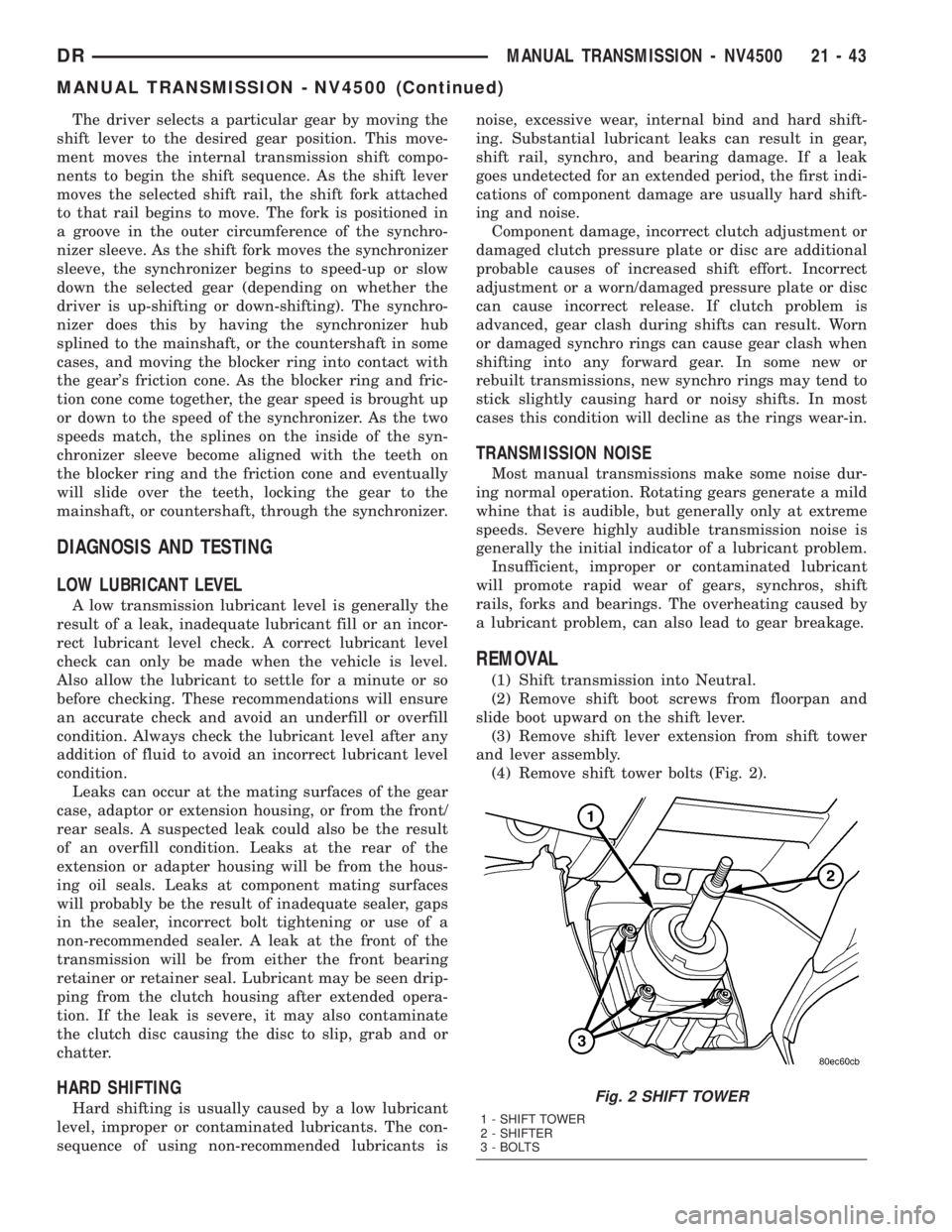
(3) Remove shift lever extension from shift tower
and lever assembly.
(4) Remove shift tower bolts (Fig. 2).
Fig. 2 SHIFT TOWER
1 - SHIFT TOWER
2 - SHIFTER
3 - BOLTS
DRMANUAL TRANSMISSION - NV4500 21 - 43
MANUAL TRANSMISSION - NV4500 (Continued)
Page 1883 of 2895
(5) Remove shift tower and isolator plate from
transmission shift cover.
(6) Raise and support vehicle.
(7) Remove skid plate, if equipped.
(8) Mark propeller shaft and axle yokes for instal-
lation reference and remove shaft/shafts.
(9) Remove exhaust system Y-pipe.
(10) Disconnect speed sensor and backup light
switch connectors.
(11) Support engine with safety stand and a wood
block.
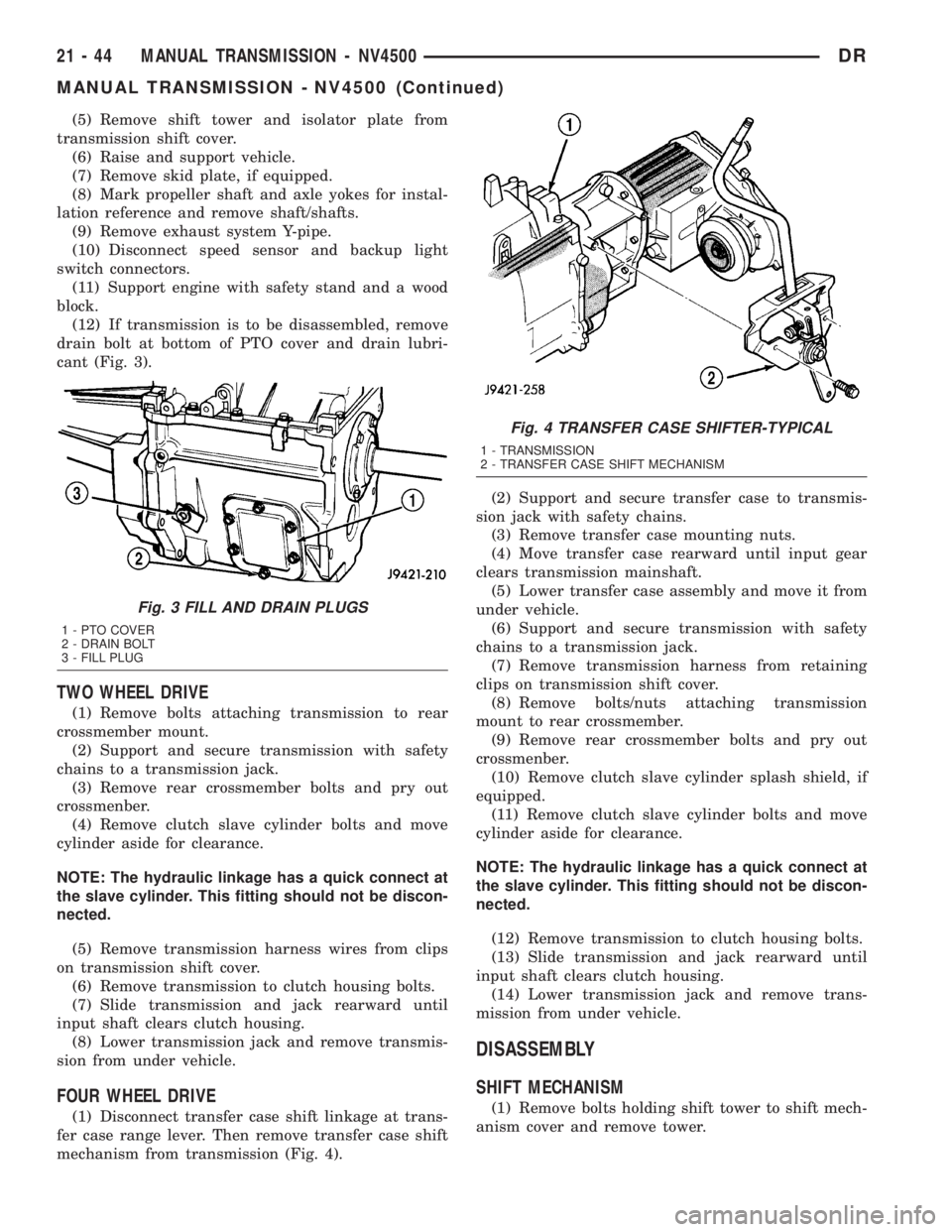
(12) If transmission is to be disassembled, remove
drain bolt at bottom of PTO cover and drain lubri-
cant (Fig. 3).
TWO WHEEL DRIVE
(1) Remove bolts attaching transmission to rear
crossmember mount.
(2) Support and secure transmission with safety
chains to a transmission jack.
(3) Remove rear crossmember bolts and pry out
crossmenber.
(4) Remove clutch slave cylinder bolts and move
cylinder aside for clearance.
NOTE: The hydraulic linkage has a quick connect at
the slave cylinder. This fitting should not be discon-
nected.
(5) Remove transmission harness wires from clips
on transmission shift cover.
(6) Remove transmission to clutch housing bolts.
(7) Slide transmission and jack rearward until
input shaft clears clutch housing.
(8) Lower transmission jack and remove transmis-
sion from under vehicle.
FOUR WHEEL DRIVE
(1) Disconnect transfer case shift linkage at trans-
fer case range lever. Then remove transfer case shift
mechanism from transmission (Fig. 4).(2) Support and secure transfer case to transmis-
sion jack with safety chains.
(3) Remove transfer case mounting nuts.
(4) Move transfer case rearward until input gear
clears transmission mainshaft.
(5) Lower transfer case assembly and move it from
under vehicle.
(6) Support and secure transmission with safety
chains to a transmission jack.
(7) Remove transmission harness from retaining
clips on transmission shift cover.
(8) Remove bolts/nuts attaching transmission
mount to rear crossmember.
(9) Remove rear crossmember bolts and pry out
crossmenber.
(10) Remove clutch slave cylinder splash shield, if
equipped.
(11) Remove clutch slave cylinder bolts and move
cylinder aside for clearance.
NOTE: The hydraulic linkage has a quick connect at
the slave cylinder. This fitting should not be discon-
nected.
(12) Remove transmission to clutch housing bolts.
(13) Slide transmission and jack rearward until
input shaft clears clutch housing.
(14) Lower transmission jack and remove trans-
mission from under vehicle.
DISASSEMBLY
SHIFT MECHANISM
(1) Remove bolts holding shift tower to shift mech-
anism cover and remove tower.
Fig. 3 FILL AND DRAIN PLUGS
1 - PTO COVER
2 - DRAIN BOLT
3 - FILL PLUG
Fig. 4 TRANSFER CASE SHIFTER-TYPICAL
1 - TRANSMISSION
2 - TRANSFER CASE SHIFT MECHANISM
21 - 44 MANUAL TRANSMISSION - NV4500DR
MANUAL TRANSMISSION - NV4500 (Continued)
Page 1889 of 2895
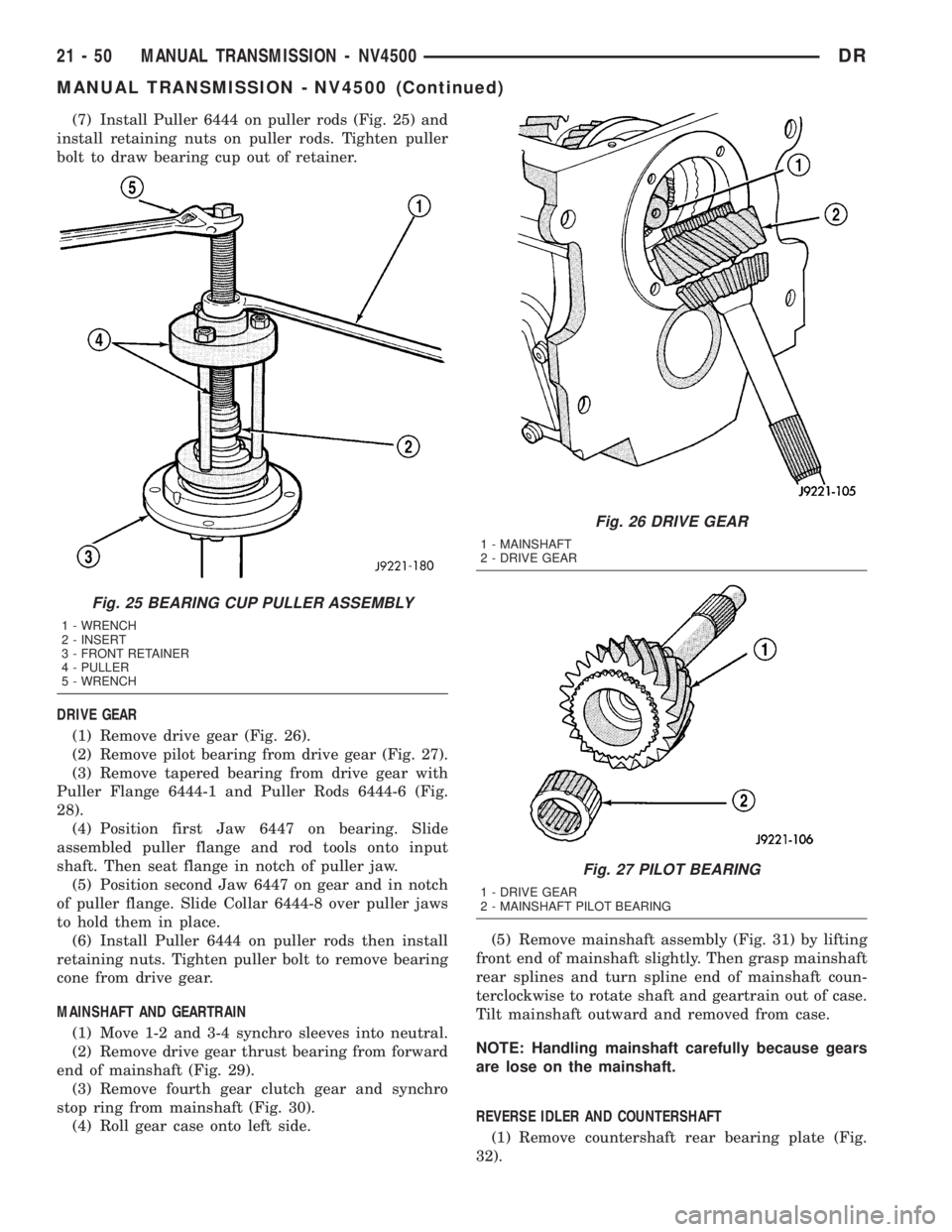
(7) Install Puller 6444 on puller rods (Fig. 25) and
install retaining nuts on puller rods. Tighten puller
bolt to draw bearing cup out of retainer.
DRIVE GEAR
(1) Remove drive gear (Fig. 26).
(2) Remove pilot bearing from drive gear (Fig. 27).
(3) Remove tapered bearing from drive gear with
Puller Flange 6444-1 and Puller Rods 6444-6 (Fig.
28).
(4) Position first Jaw 6447 on bearing. Slide
assembled puller flange and rod tools onto input
shaft. Then seat flange in notch of puller jaw.
(5) Position second Jaw 6447 on gear and in notch
of puller flange. Slide Collar 6444-8 over puller jaws
to hold them in place.
(6) Install Puller 6444 on puller rods then install
retaining nuts. Tighten puller bolt to remove bearing
cone from drive gear.
MAINSHAFT AND GEARTRAIN
(1) Move 1-2 and 3-4 synchro sleeves into neutral.
(2) Remove drive gear thrust bearing from forward
end of mainshaft (Fig. 29).
(3) Remove fourth gear clutch gear and synchro
stop ring from mainshaft (Fig. 30).
(4) Roll gear case onto left side.(5) Remove mainshaft assembly (Fig. 31) by lifting
front end of mainshaft slightly. Then grasp mainshaft
rear splines and turn spline end of mainshaft coun-
terclockwise to rotate shaft and geartrain out of case.
Tilt mainshaft outward and removed from case.
NOTE: Handling mainshaft carefully because gears
are lose on the mainshaft.
REVERSE IDLER AND COUNTERSHAFT
(1) Remove countershaft rear bearing plate (Fig.
32).
Fig. 25 BEARING CUP PULLER ASSEMBLY
1 - WRENCH
2 - INSERT
3 - FRONT RETAINER
4 - PULLER
5 - WRENCH
Fig. 26 DRIVE GEAR
1 - MAINSHAFT
2 - DRIVE GEAR
Fig. 27 PILOT BEARING
1 - DRIVE GEAR
2 - MAINSHAFT PILOT BEARING
21 - 50 MANUAL TRANSMISSION - NV4500DR
MANUAL TRANSMISSION - NV4500 (Continued)