2003 DODGE RAM app
[x] Cancel search: appPage 1835 of 2895
FLUID
DESCRIPTION
The recommended fluid for the power steering sys-
tem is MopartATF +4.
MopartATF+4, when new is red in color. The
ATF+4 is dyed red so it can be identified from other
fluids used in the vehicle such as engine oil or anti-
freeze. The red color is not permanent and is not an
indicator of fluid condition, As the vehicle is driven,
the ATF+4 will begin to look darker in color and may
eventually become brown.THIS IS NORMAL.
ATF+4 also has a unique odor that may change with
age. Consequently, odor and color cannot be used to
indicate the fluid condition or the need for a fluid
change.
STANDARD PROCEDURE - POWER STEERING
FLUID LEVEL CHECKING
WARNING: FLUID LEVEL SHOULD BE CHECKED
WITH THE ENGINE OFF TO PREVENT PERSONAL
INJURY FROM MOVING PARTS.
CAUTION: MOPARTATF+4 is to be used in the
power steering system. No other power steering or
automatic transmission fluid is to be used in the
system. Damage may result to the power steering
pump and system if any other fluid is used, and do
not overfill.
The power steering fluid level can be viewed on the
dipstick attached to the filler cap. There are two
ranges listed on the dipstick, COLD and HOT. Before
opening power steering system, wipe the reservoir
filler cap free of dirt and debris. Remove the cap and
check the fluid level on its dipstick. When the fluid is
at normal ambient temperature, approximately 21ÉC
to 27ÉC (70ÉF to 80ÉF), the fluid level should read
between the minimum and maximum area of the cold
range. When the fluid is hot, fluid level is allowed to
read up to the highest end of the HOT range. Only
add fluid when the vehicle is cold.
Use only MopartATF+4Do not overfill the
power steering system.
FLUID COOLER
REMOVAL
(1) Drain and siphon the power steering fluid.
(2) Disconnect the return and supply hoses con-
nected to the power steering fluid cooler.(3) Remove the mounting bracket bolts securing
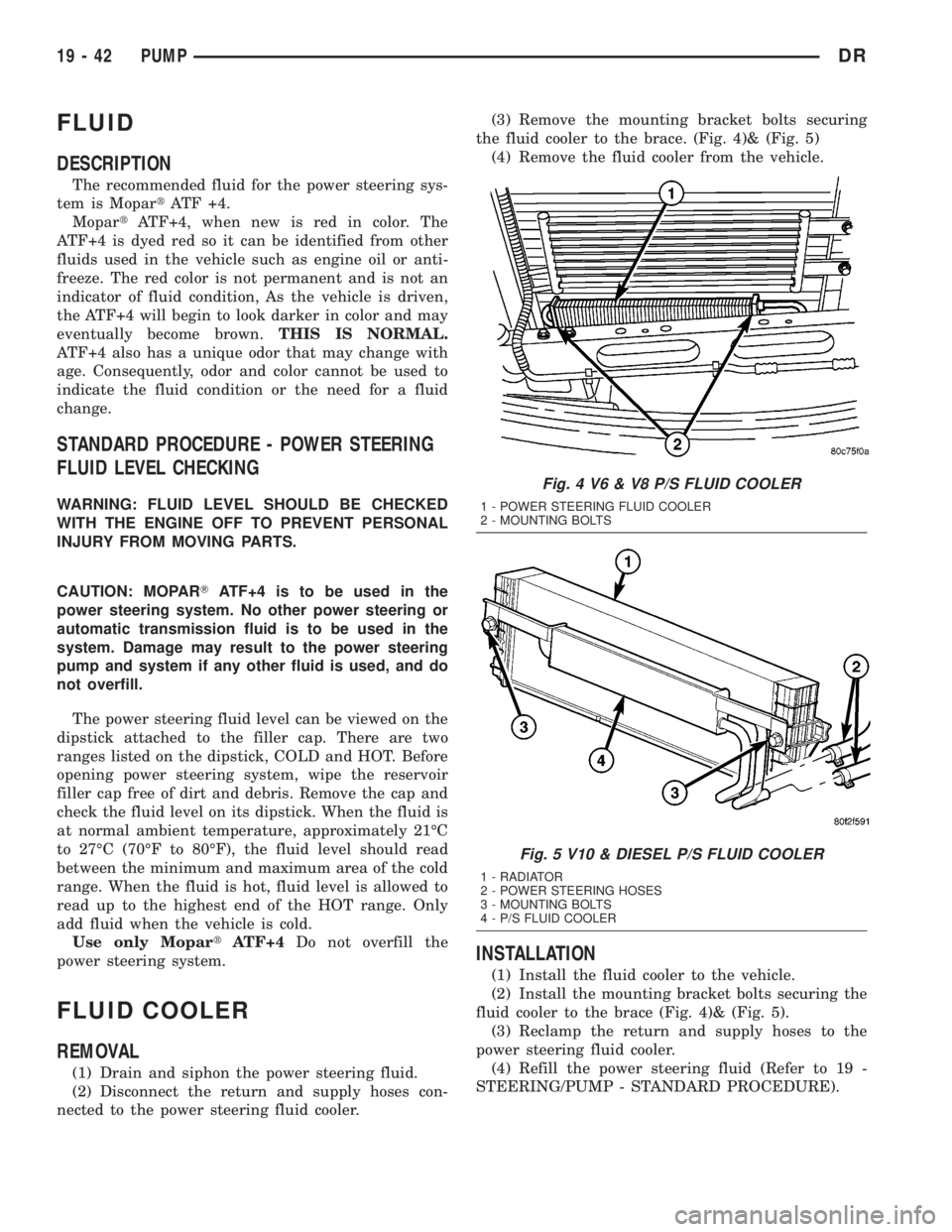
the fluid cooler to the brace. (Fig. 4)& (Fig. 5)
(4) Remove the fluid cooler from the vehicle.
INSTALLATION
(1) Install the fluid cooler to the vehicle.
(2) Install the mounting bracket bolts securing the
fluid cooler to the brace (Fig. 4)& (Fig. 5).
(3) Reclamp the return and supply hoses to the
power steering fluid cooler.
(4) Refill the power steering fluid (Refer to 19 -
STEERING/PUMP - STANDARD PROCEDURE).
Fig. 4 V6 & V8 P/S FLUID COOLER
1 - POWER STEERING FLUID COOLER
2 - MOUNTING BOLTS
Fig. 5 V10 & DIESEL P/S FLUID COOLER
1 - RADIATOR
2 - POWER STEERING HOSES
3 - MOUNTING BOLTS
4 - P/S FLUID COOLER
19 - 42 PUMPDR
Page 1838 of 2895
POWER STEERING PRESSURE
SWITCH
DESCRIPTION
A pressure sensing switch is used in the power
steering system. It is mounted on the high-pressure
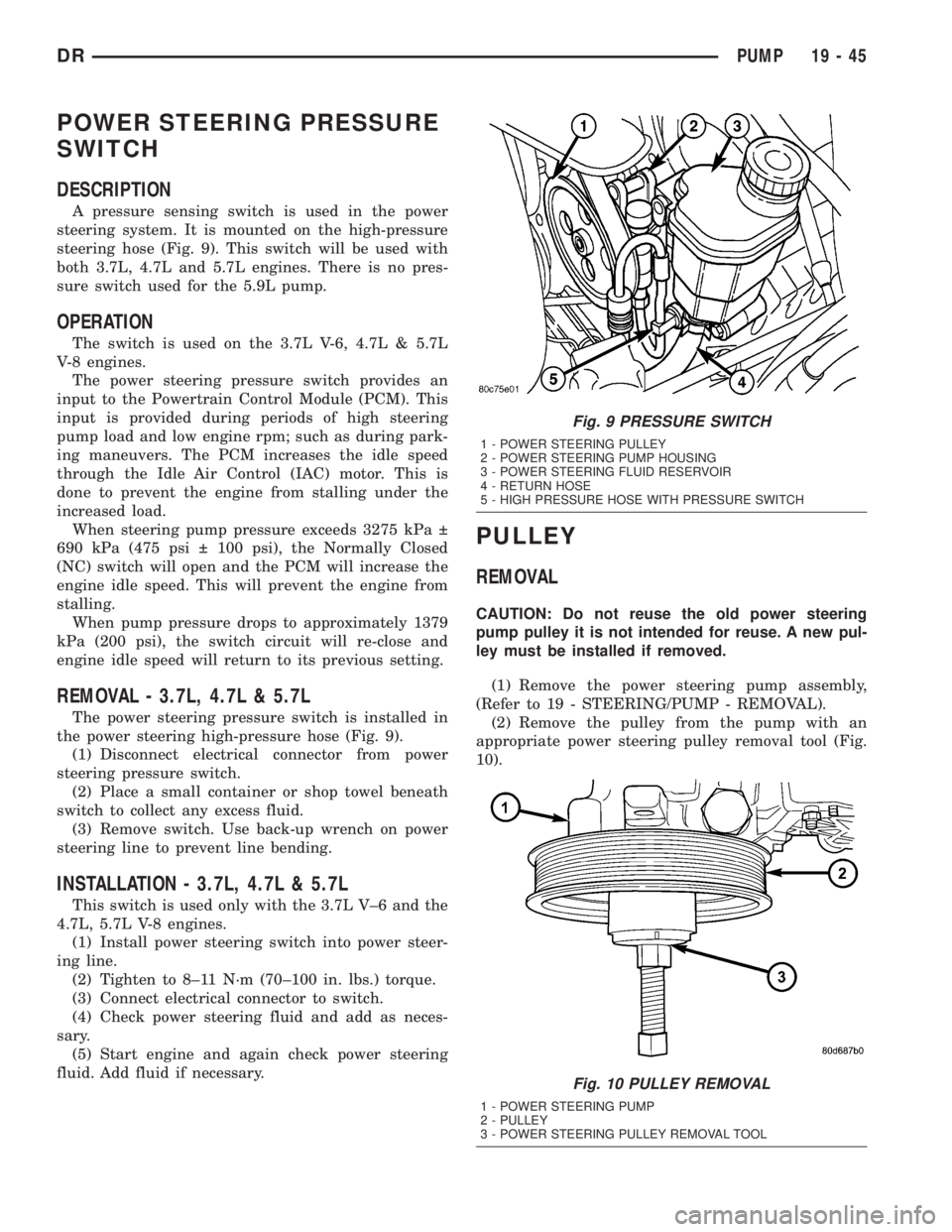
steering hose (Fig. 9). This switch will be used with
both 3.7L, 4.7L and 5.7L engines. There is no pres-
sure switch used for the 5.9L pump.
OPERATION
The switch is used on the 3.7L V-6, 4.7L & 5.7L
V-8 engines.
The power steering pressure switch provides an
input to the Powertrain Control Module (PCM). This
input is provided during periods of high steering
pump load and low engine rpm; such as during park-
ing maneuvers. The PCM increases the idle speed
through the Idle Air Control (IAC) motor. This is
done to prevent the engine from stalling under the
increased load.
When steering pump pressure exceeds 3275 kPa
690 kPa (475 psi 100 psi), the Normally Closed
(NC) switch will open and the PCM will increase the
engine idle speed. This will prevent the engine from
stalling.
When pump pressure drops to approximately 1379
kPa (200 psi), the switch circuit will re-close and
engine idle speed will return to its previous setting.
REMOVAL - 3.7L, 4.7L & 5.7L
The power steering pressure switch is installed in
the power steering high-pressure hose (Fig. 9).
(1) Disconnect electrical connector from power
steering pressure switch.
(2) Place a small container or shop towel beneath
switch to collect any excess fluid.
(3) Remove switch. Use back-up wrench on power
steering line to prevent line bending.
INSTALLATION - 3.7L, 4.7L & 5.7L
This switch is used only with the 3.7L V±6 and the
4.7L, 5.7L V-8 engines.
(1) Install power steering switch into power steer-
ing line.
(2) Tighten to 8±11 N´m (70±100 in. lbs.) torque.
(3) Connect electrical connector to switch.
(4) Check power steering fluid and add as neces-
sary.
(5) Start engine and again check power steering
fluid. Add fluid if necessary.
PULLEY
REMOVAL
CAUTION: Do not reuse the old power steering
pump pulley it is not intended for reuse. A new pul-
ley must be installed if removed.
(1) Remove the power steering pump assembly,
(Refer to 19 - STEERING/PUMP - REMOVAL).
(2) Remove the pulley from the pump with an
appropriate power steering pulley removal tool (Fig.
10).
Fig. 9 PRESSURE SWITCH
1 - POWER STEERING PULLEY
2 - POWER STEERING PUMP HOUSING
3 - POWER STEERING FLUID RESERVOIR
4 - RETURN HOSE
5 - HIGH PRESSURE HOSE WITH PRESSURE SWITCH
Fig. 10 PULLEY REMOVAL
1 - POWER STEERING PUMP
2 - PULLEY
3 - POWER STEERING PULLEY REMOVAL TOOL
DRPUMP 19 - 45
Page 1839 of 2895
INSTALLATION
CAUTION: Do not reuse the old power steering
pump pulley it is not intended for reuse. A new pul-
ley must be installed if removed.
(1) Replace the pulley if it's bent, cracked, or loose.
(2) Install the pulley on the pump with an appro-
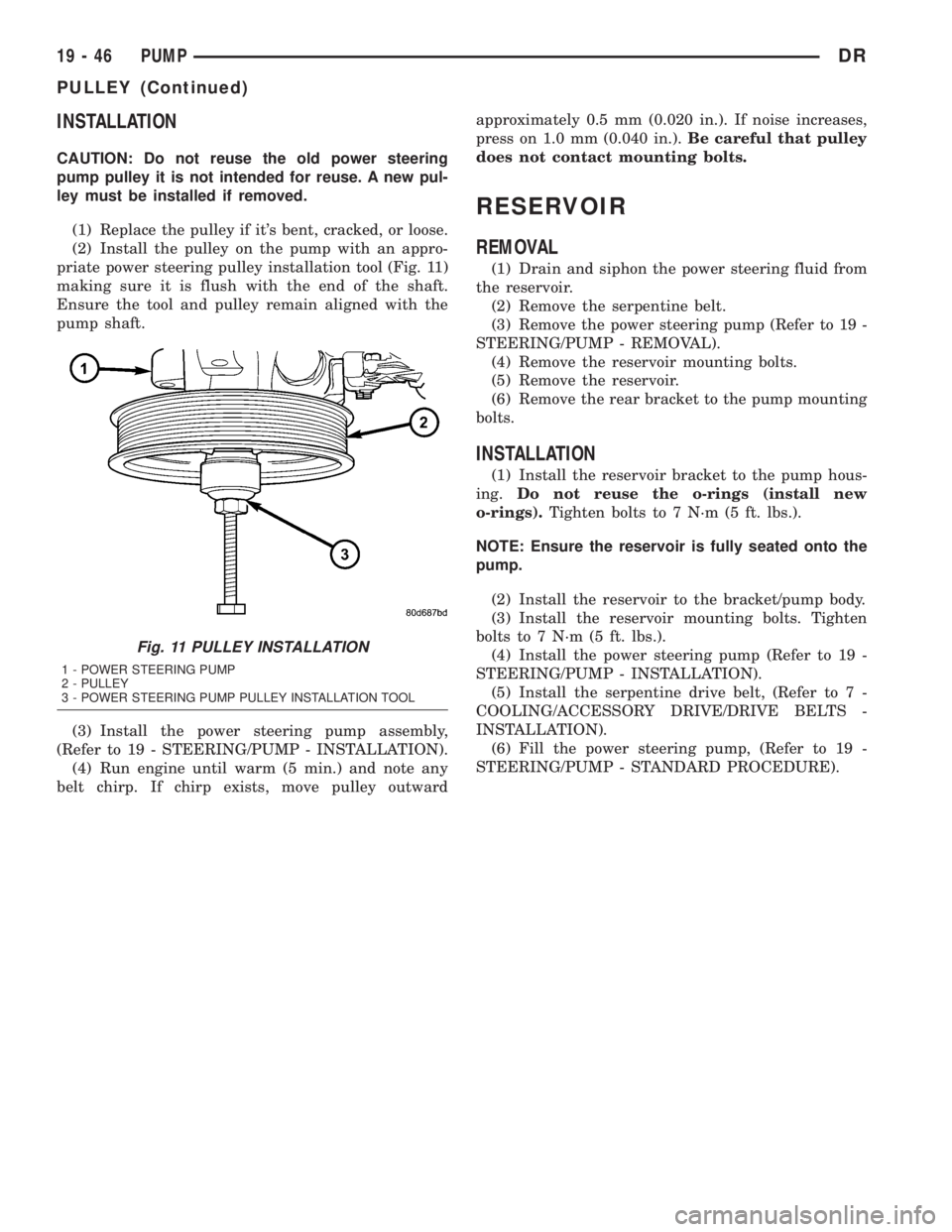
priate power steering pulley installation tool (Fig. 11)
making sure it is flush with the end of the shaft.
Ensure the tool and pulley remain aligned with the
pump shaft.
(3) Install the power steering pump assembly,
(Refer to 19 - STEERING/PUMP - INSTALLATION).
(4) Run engine until warm (5 min.) and note any
belt chirp. If chirp exists, move pulley outwardapproximately 0.5 mm (0.020 in.). If noise increases,
press on 1.0 mm (0.040 in.).Be careful that pulley
does not contact mounting bolts.
RESERVOIR
REMOVAL
(1) Drain and siphon the power steering fluid from
the reservoir.
(2) Remove the serpentine belt.
(3) Remove the power steering pump (Refer to 19 -
STEERING/PUMP - REMOVAL).
(4) Remove the reservoir mounting bolts.
(5) Remove the reservoir.
(6) Remove the rear bracket to the pump mounting
bolts.
INSTALLATION
(1) Install the reservoir bracket to the pump hous-
ing.Do not reuse the o-rings (install new
o-rings).Tighten bolts to 7 N´m (5 ft. lbs.).
NOTE: Ensure the reservoir is fully seated onto the
pump.
(2) Install the reservoir to the bracket/pump body.
(3) Install the reservoir mounting bolts. Tighten
bolts to 7 N´m (5 ft. lbs.).
(4) Install the power steering pump (Refer to 19 -
STEERING/PUMP - INSTALLATION).
(5) Install the serpentine drive belt, (Refer to 7 -
COOLING/ACCESSORY DRIVE/DRIVE BELTS -
INSTALLATION).
(6) Fill the power steering pump, (Refer to 19 -
STEERING/PUMP - STANDARD PROCEDURE).
Fig. 11 PULLEY INSTALLATION
1 - POWER STEERING PUMP
2 - PULLEY
3 - POWER STEERING PUMP PULLEY INSTALLATION TOOL
19 - 46 PUMPDR
PULLEY (Continued)
Page 1845 of 2895
(10) Remove shift shaft detent plug from the side
of the transmission with Remover 8117A. Attach fin-
gers of the remover to the detent plug and push the
cup down till it contacts the trans. Then tighten the
nut till it pulls the plug from the case.
(11) Remove shift shaft detent plunger and spring
with a pencil magnet.
(12) Remove bolts that attach front housing to the
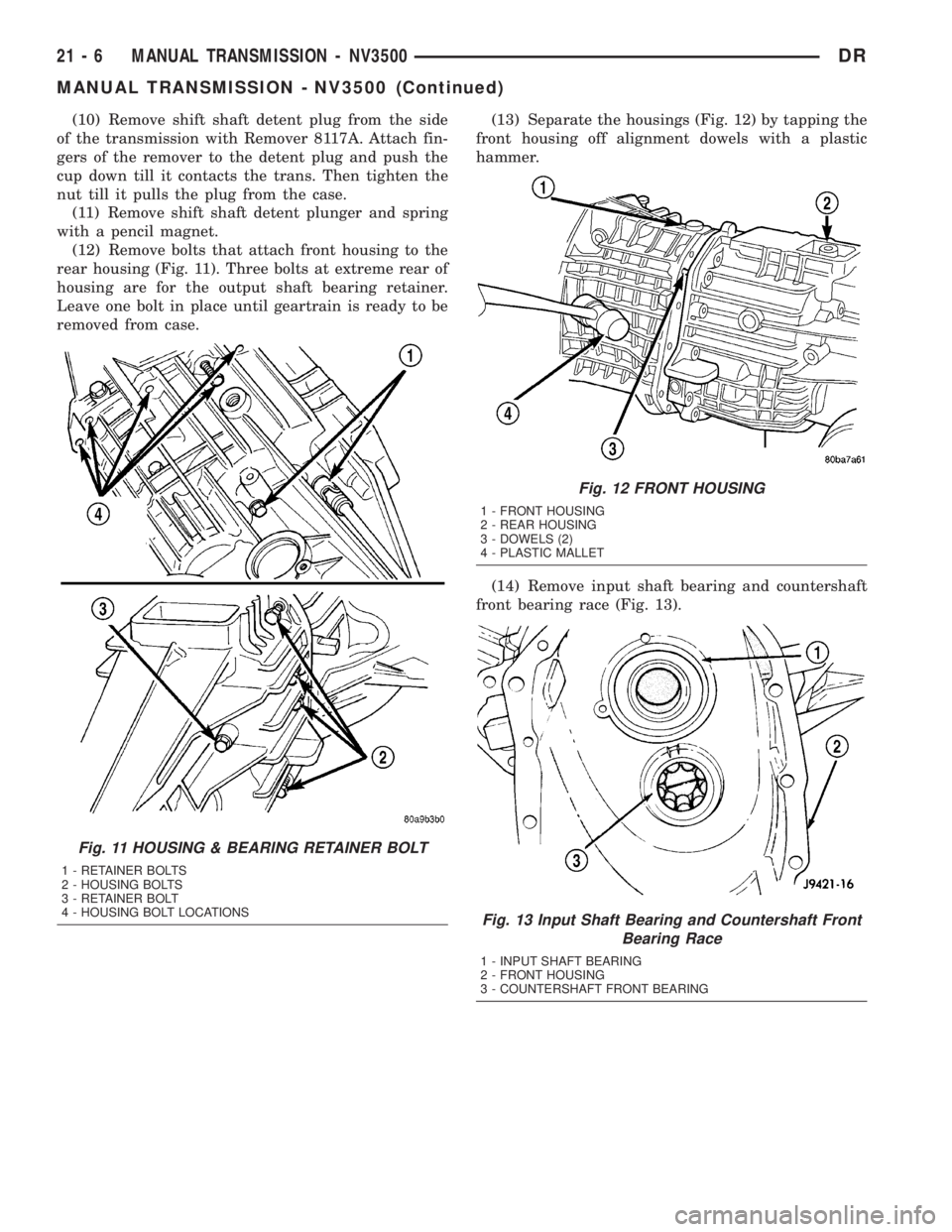
rear housing (Fig. 11). Three bolts at extreme rear of
housing are for the output shaft bearing retainer.
Leave one bolt in place until geartrain is ready to be
removed from case.(13) Separate the housings (Fig. 12) by tapping the
front housing off alignment dowels with a plastic
hammer.
(14) Remove input shaft bearing and countershaft
front bearing race (Fig. 13).
Fig. 11 HOUSING & BEARING RETAINER BOLT
1 - RETAINER BOLTS
2 - HOUSING BOLTS
3 - RETAINER BOLT
4 - HOUSING BOLT LOCATIONS
Fig. 12 FRONT HOUSING
1 - FRONT HOUSING
2 - REAR HOUSING
3 - DOWELS (2)
4 - PLASTIC MALLET
Fig. 13 Input Shaft Bearing and Countershaft Front
Bearing Race
1 - INPUT SHAFT BEARING
2 - FRONT HOUSING
3 - COUNTERSHAFT FRONT BEARING
21 - 6 MANUAL TRANSMISSION - NV3500DR
MANUAL TRANSMISSION - NV3500 (Continued)
Page 1846 of 2895
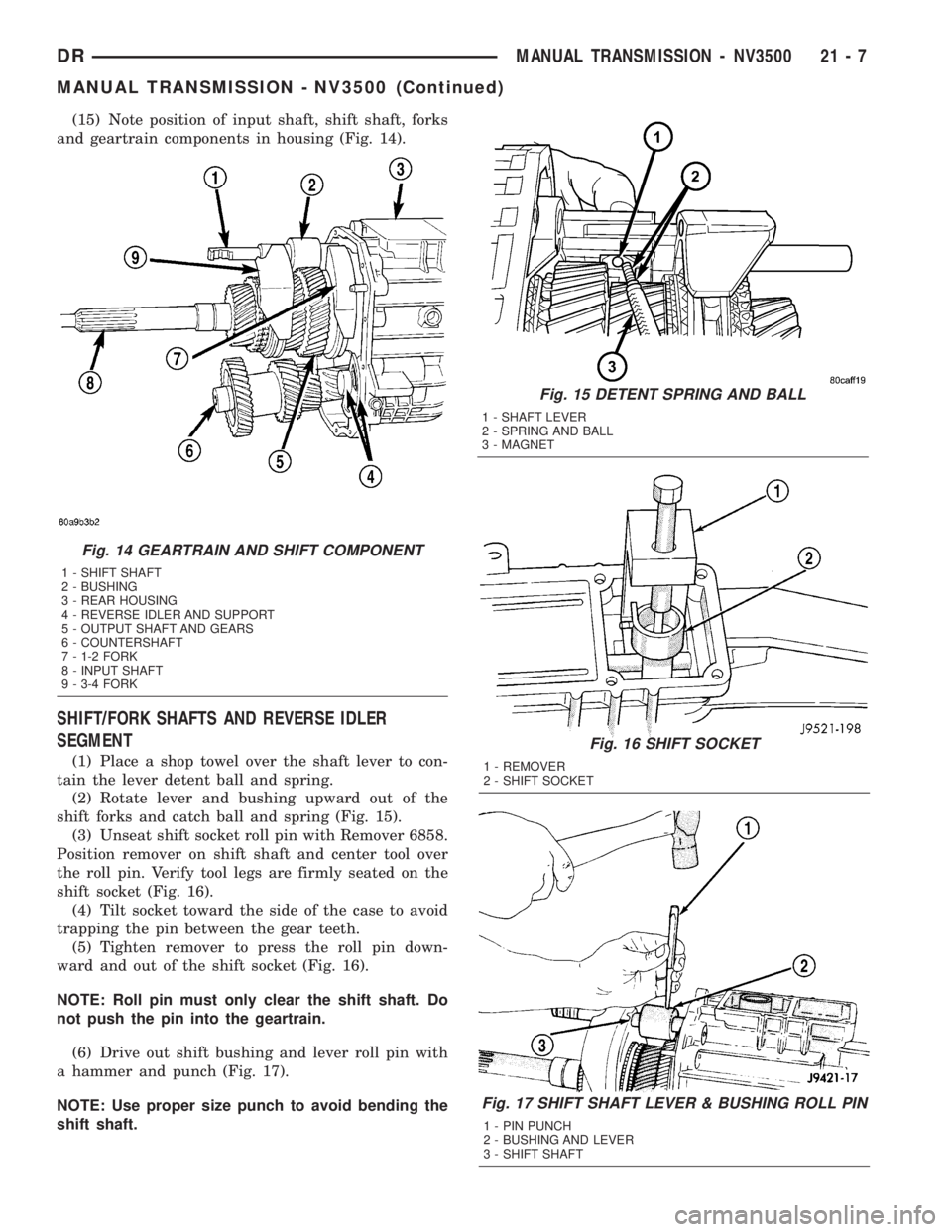
(15) Note position of input shaft, shift shaft, forks
and geartrain components in housing (Fig. 14).
SHIFT/FORK SHAFTS AND REVERSE IDLER
SEGMENT
(1) Place a shop towel over the shaft lever to con-
tain the lever detent ball and spring.
(2) Rotate lever and bushing upward out of the
shift forks and catch ball and spring (Fig. 15).
(3) Unseat shift socket roll pin with Remover 6858.
Position remover on shift shaft and center tool over
the roll pin. Verify tool legs are firmly seated on the
shift socket (Fig. 16).
(4) Tilt socket toward the side of the case to avoid
trapping the pin between the gear teeth.
(5) Tighten remover to press the roll pin down-
ward and out of the shift socket (Fig. 16).
NOTE: Roll pin must only clear the shift shaft. Do
not push the pin into the geartrain.
(6) Drive out shift bushing and lever roll pin with
a hammer and punch (Fig. 17).
NOTE: Use proper size punch to avoid bending the
shift shaft.
Fig. 15 DETENT SPRING AND BALL
1 - SHAFT LEVER
2 - SPRING AND BALL
3 - MAGNET
Fig. 16 SHIFT SOCKET
1 - REMOVER
2 - SHIFT SOCKET
Fig. 17 SHIFT SHAFT LEVER & BUSHING ROLL PIN
1 - PIN PUNCH
2 - BUSHING AND LEVER
3 - SHIFT SHAFT
Fig. 14 GEARTRAIN AND SHIFT COMPONENT
1 - SHIFT SHAFT
2 - BUSHING
3 - REAR HOUSING
4 - REVERSE IDLER AND SUPPORT
5 - OUTPUT SHAFT AND GEARS
6 - COUNTERSHAFT
7 - 1-2 FORK
8 - INPUT SHAFT
9 - 3-4 FORK
DRMANUAL TRANSMISSION - NV3500 21 - 7
MANUAL TRANSMISSION - NV3500 (Continued)
Page 1855 of 2895
FRONT/REAR HOUSINGS AND BEARING
RETAINERS
Inspect the housings carefully. Look for cracks,
stripped threads, scored mating surfaces, damaged
bearing bores or worn dowel pin holes. Minor nicks
on mating surfaces can be dressed off with a fine file
or emery cloth. Damaged threads can be renewed by
either re-tapping or installing Helicoil inserts.
NOTE: The front housing contains the countershaft
front bearing race. The rear housing contains the
countershaft rear bearing race. These components
are NOT serviceable items. The front housing will
have to be replaced if the countershaft bearing race
is loose, worn or damaged. The rear housing will
have to be replaced if the countershaft rear bearing
race is loose, worn or damaged.
Inspect the input shaft bearing retainer. Be sure
the release bearing slide surface of the retainer is in
good condition. Minor nicks on the surface can be
smoothed off with 320/420 grit emery cloth and final
polished with oil coated crocus cloth. Replace the
retainer seal if necessary.
Inspect output shaft bearing retainer, the
U-shaped retainer must be flat and free of distortion.
Replace the retainer if the threads are damaged or if
the retainer is bent or cracked.
COUNTERSHAFT BEARINGS AND RACES
The countershaft bearings and races are machine
lapped during manufacture to form matched sets.
The bearings and races should not be interchanged.
NOTE: The bearing races are a permanent press fit
in the housings and are NOT serviceable. If a bear-
ing race becomes damaged, the front or rear hous-
ing must be replaced. A new countershaft bearing
will be supplied with each new housing for service
use.
REVERSE IDLER COMPONENTS
Inspect the idler gear, bearing, shaft, thrust
washer, wave washer and thrust plate. Replace the
bearing if any of the needle bearing rollers are worn,
chipped, cracked, flat-spotted or brinnelled. Also
replace the bearing if the plastic bearing cage is
damaged or distorted.
Replace thrust washer, wave washer or thrust
plate if cracked, chipped or worn. Replace idler gear
if the teeth are chipped, cracked or worn thin.
Replace shaft if worn, scored or the bolt threads are
damaged beyond repair. Replace support segment if
cracked or chipped and replace the idler attaching
bolts if the threads are damaged.
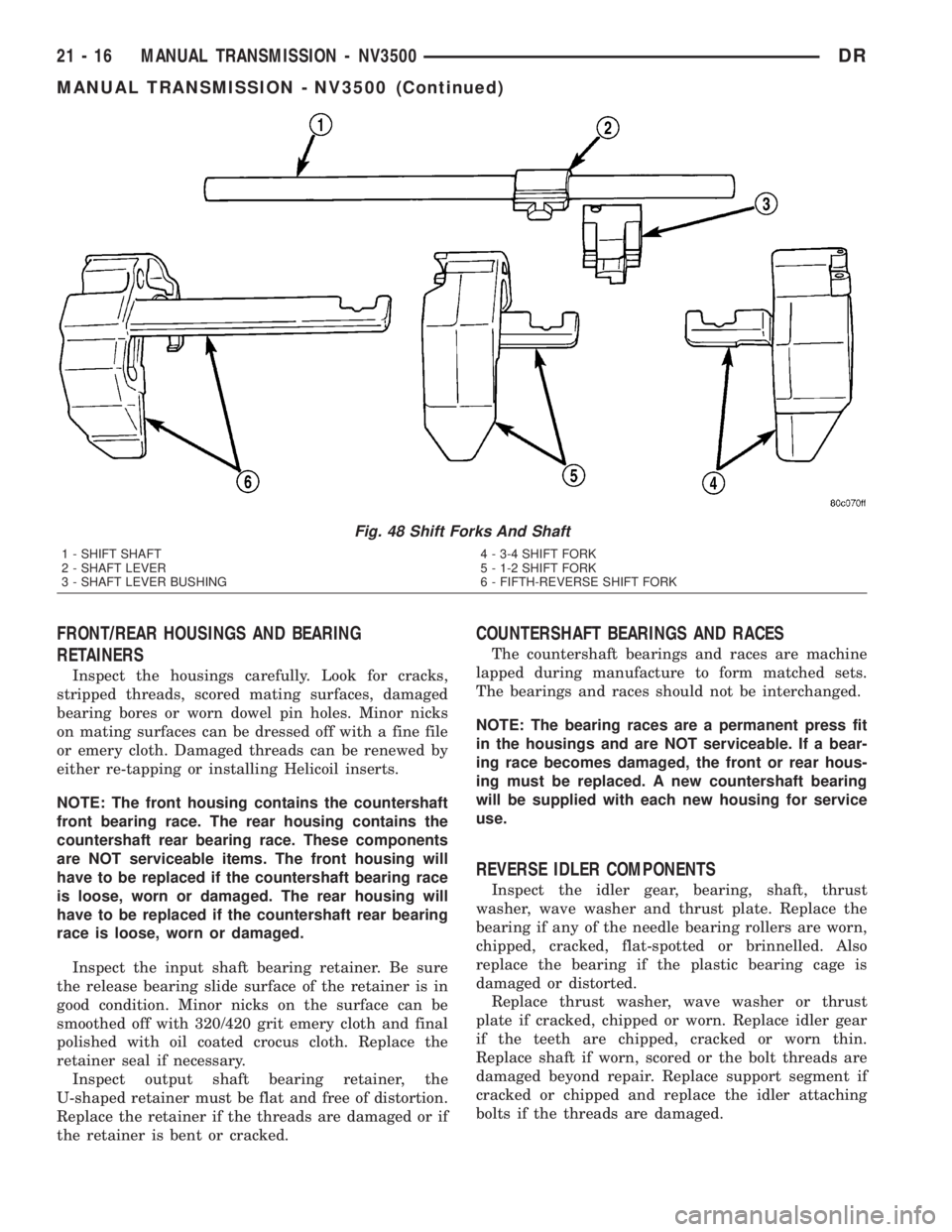
Fig. 48 Shift Forks And Shaft
1 - SHIFT SHAFT
2 - SHAFT LEVER
3 - SHAFT LEVER BUSHING4 - 3-4 SHIFT FORK
5 - 1-2 SHIFT FORK
6 - FIFTH-REVERSE SHIFT FORK
21 - 16 MANUAL TRANSMISSION - NV3500DR
MANUAL TRANSMISSION - NV3500 (Continued)
Page 1856 of 2895
Shift Socket
Inspect the shift socket for wear or damage.
Replace the socket if the roll pin or shift shaft bores
are damaged. Minor nicks in the shift lever ball seat
in the socket can be smoothed down with 400 grit
emery or wet/dry paper. Replace the socket if the ball
seat is worn or cracked. Do not reuse the original
shift socket roll pin. Install anewpin during assem-
bly. The socket roll pin is approximately 33 mm
(1-1/4 in.) long.
Output Shaft And Geartrain
Inspect all gears for worn, cracked, chipped or bro-
ken teeth. Also check condition of the bearing bore in
each gear. The bores should be smooth and free of
surface damage. Discoloration of the gear bores is a
normal occurrence and is not a reason for replace-
ment. Replace gears only when tooth damage has
occurred or if the bores are brinnelled or severely
scored.
Inspect the shaft splines and bearings surfaces.
Minor nicks on the bearing surfaces can be smoothed
with 320/420 grit emery and final polished with cro-
cus cloth. Replace the shaft if the splines are dam-
aged or bearing surfaces are deeply scored, worn or
brinnelled.
ASSEMBLY
NOTE: Sealers are used at all case joints. Use
Mopar Gasket Maker or equivalent for all case joints
and Mopar silicone sealer or equivalent for the
input shaft bearing retainer.
SYNCHRONIZER
(1) Slide sleeve onto the hub, leaving enough room
to install the spring in the hub and strut in the hub
groove.
(2) Install first spring in the hub, then install a
strut over the spring. Verify spring is seated in the
spring bore in the strut.
(3) Slide sleeve onto the hub far enough to hold
the first strut and spring in place.
(4) Place detent ball in the top of the strut, then
press the ball into place with a small screwdriver.
Work the sleeve over the ball to hold it in place.
(5) Repeat procedure for the remaining springs,
struts and balls. Use tape or rubber bands to tempo-
rarily secure each strut and ball as they are
installed.
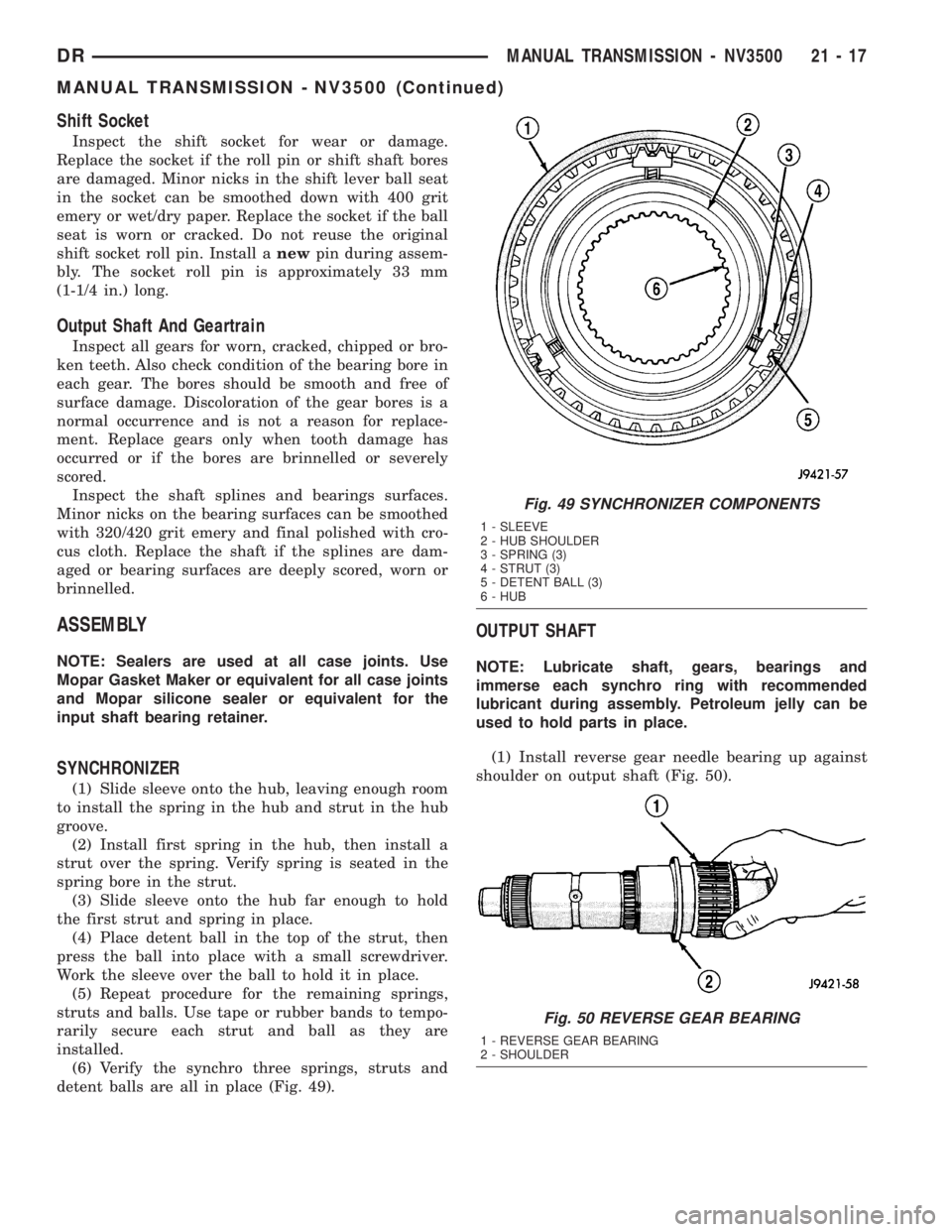
(6) Verify the synchro three springs, struts and
detent balls are all in place (Fig. 49).
OUTPUT SHAFT
NOTE: Lubricate shaft, gears, bearings and
immerse each synchro ring with recommended
lubricant during assembly. Petroleum jelly can be
used to hold parts in place.
(1) Install reverse gear needle bearing up against
shoulder on output shaft (Fig. 50).
Fig. 49 SYNCHRONIZER COMPONENTS
1 - SLEEVE
2 - HUB SHOULDER
3 - SPRING (3)
4 - STRUT (3)
5 - DETENT BALL (3)
6 - HUB
Fig. 50 REVERSE GEAR BEARING
1 - REVERSE GEAR BEARING
2 - SHOULDER
DRMANUAL TRANSMISSION - NV3500 21 - 17
MANUAL TRANSMISSION - NV3500 (Continued)
Page 1869 of 2895
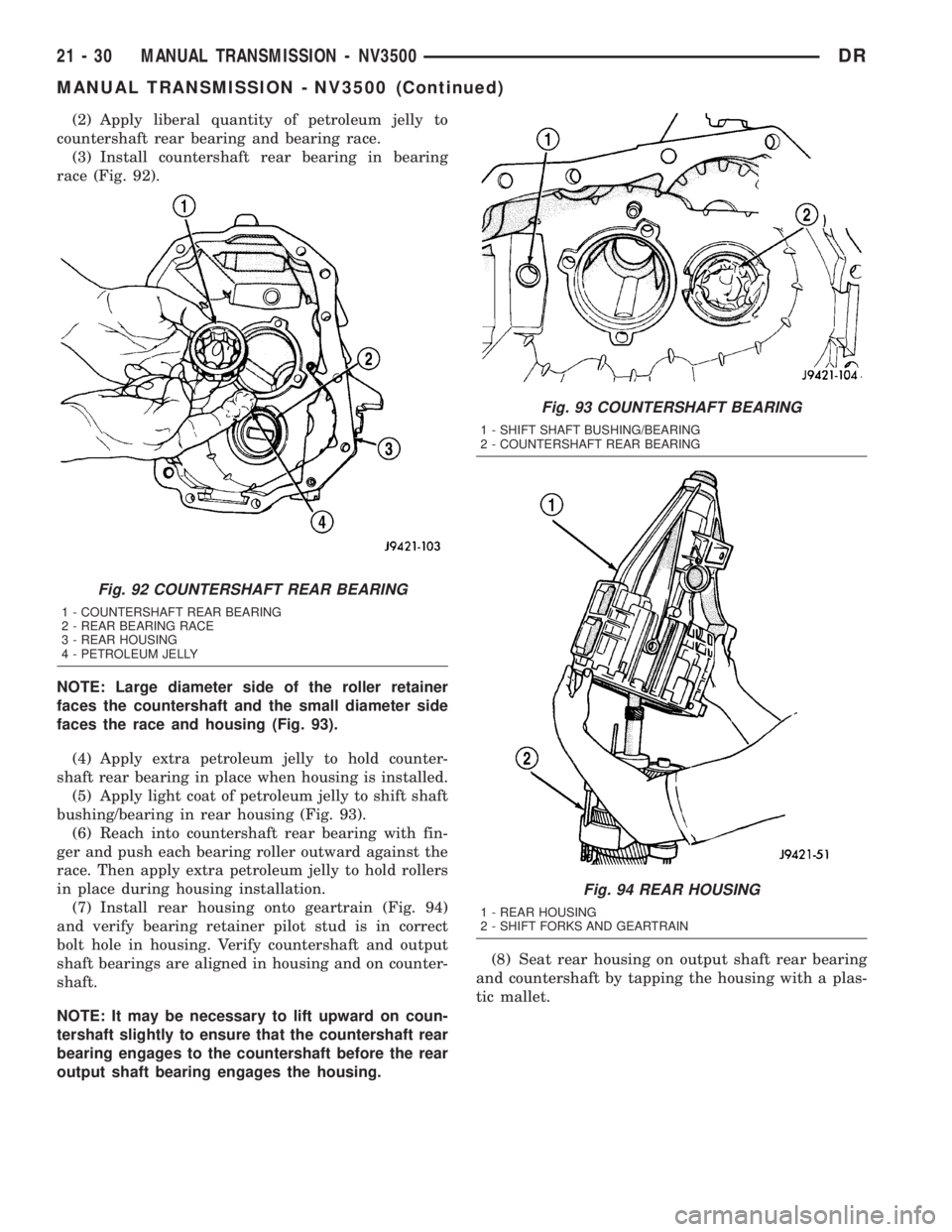
(2) Apply liberal quantity of petroleum jelly to
countershaft rear bearing and bearing race.
(3) Install countershaft rear bearing in bearing
race (Fig. 92).
NOTE: Large diameter side of the roller retainer
faces the countershaft and the small diameter side
faces the race and housing (Fig. 93).
(4) Apply extra petroleum jelly to hold counter-
shaft rear bearing in place when housing is installed.
(5) Apply light coat of petroleum jelly to shift shaft
bushing/bearing in rear housing (Fig. 93).
(6) Reach into countershaft rear bearing with fin-
ger and push each bearing roller outward against the
race. Then apply extra petroleum jelly to hold rollers
in place during housing installation.
(7) Install rear housing onto geartrain (Fig. 94)
and verify bearing retainer pilot stud is in correct
bolt hole in housing. Verify countershaft and output
shaft bearings are aligned in housing and on counter-
shaft.
NOTE: It may be necessary to lift upward on coun-
tershaft slightly to ensure that the countershaft rear
bearing engages to the countershaft before the rear
output shaft bearing engages the housing.(8) Seat rear housing on output shaft rear bearing
and countershaft by tapping the housing with a plas-
tic mallet.
Fig. 92 COUNTERSHAFT REAR BEARING
1 - COUNTERSHAFT REAR BEARING
2 - REAR BEARING RACE
3 - REAR HOUSING
4 - PETROLEUM JELLY
Fig. 93 COUNTERSHAFT BEARING
1 - SHIFT SHAFT BUSHING/BEARING
2 - COUNTERSHAFT REAR BEARING
Fig. 94 REAR HOUSING
1 - REAR HOUSING
2 - SHIFT FORKS AND GEARTRAIN
21 - 30 MANUAL TRANSMISSION - NV3500DR
MANUAL TRANSMISSION - NV3500 (Continued)