Page 193 of 386

3-24
After you clean the player, press and hold the eject
button for three seconds to reset the CLN indicator. The
radio will display
--- to show the indicator was reset.
Cassettes are subject to wear and the sound quality
may degrade over time. Always make sure the cassette
tape is in good condition before you have your tape
player serviced.
Care of Your Compact Discs
Handle discs carefully. Store them in their original cases
or other protective cases and away from direct sunlight
and dust. If the surface of a disc is soiled, dampen a
clean, soft cloth in a mild, neutral detergent solution and
clean it, wiping from the center to the edge.
Be sure never to touch the signal surface when handling
discs. Pick up discs by grasping the outer edges or the
edge of the hole and the outer edge.
Care of Your Compact Disc Player
The use of CD lens cleaner discs is not advised, due to
the risk of contaminating the lens of the CD optics with
lubricants internal to the CD mechanism.
Fixed Mast Antenna
The fixed mast antenna can withstand most vehicle
washes without being damaged. If the mast should ever
become slightly bent, you can straighten it out by hand.
If the mast is badly bent, as it might be by vandals, you
should replace it.
Check occasionally to be sure the mast is still tightened
to the fender. If tightening is required, tighten by hand,
then with a wrench one quarter turn.
Chime Level Adjustment
The radio is the vehicle chime producer. The chime is
produced from the driver's side front door speakers. To
change the volume level, press and hold pushbutton 6
with the ignition on and the radio power off. The chime
volume level will change from the normal level to loud,
and HI will be displayed on the radio. To change back
to the default or normal setting, press and hold
pushbutton 6 again. The chime level will change from
the loud level to normal, and LO will be displayed.
Each time the chime volume is changed, three chimes
will sound as an example of the new volume selected.
Removing the radio and not replacing it with a factory
radio or chime module will disable vehicle chimes.
Page 216 of 386

4-23
Reduce your speed according to your speedometer, not
to your sense of motion. After driving for any distance
at higher speeds, you may tend to think you are going
slower than you actually are.
Highway Hypnosis
Is there actually such a condition as ªhighway
hypnosisº? Or is it just plain falling asleep at the
wheel? Call it highway hypnosis, lack of awareness,
or whatever.
When you drive the vehicle for a long distance, there is
something about an easy stretch of road with the same
scenery, along with the hum of the tires on the road, the
drone of the engine, and the rush of the wind against the
vehicle that can make you sleepy. Don't let it happen to
you! If it does, your vehicle can leave the road in less
than a second, and you could crash and be injured.What can you do about highway hypnosis? First, be
aware that it can happen.
Then here are some tips:
�Make sure your vehicle is well ventilated, with a
comfortably cool interior.
�Keep your eyes moving. Scan the road ahead and to
the sides. Check your mirrors and your instruments
frequently.
�If you get sleepy, pull off the road into a rest, service
or parking area and take a nap, get some exercise, or
both. For safety, treat drowsiness on the highway as
an emergency.
Page 233 of 386
5-8
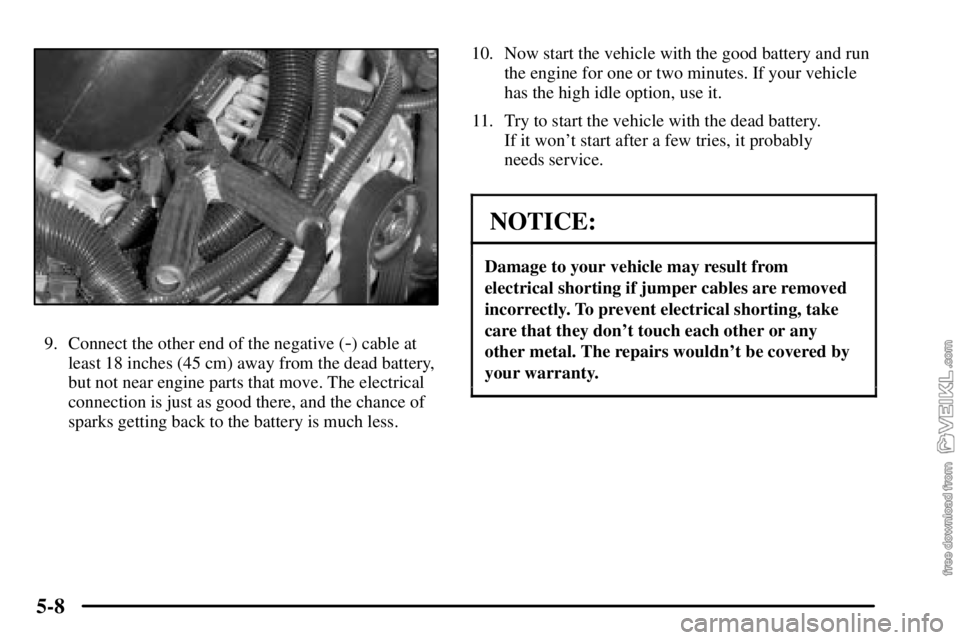
9. Connect the other end of the negative (-) cable at
least 18 inches (45 cm) away from the dead battery,
but not near engine parts that move. The electrical
connection is just as good there, and the chance of
sparks getting back to the battery is much less.10. Now start the vehicle with the good battery and run
the engine for one or two minutes. If your vehicle
has the high idle option, use it.
11. Try to start the vehicle with the dead battery.
If it won't start after a few tries, it probably
needs service.
NOTICE:
Damage to your vehicle may result from
electrical shorting if jumper cables are removed
incorrectly. To prevent electrical shorting, take
care that they don't touch each other or any
other metal. The repairs wouldn't be covered by
your warranty.
Page 235 of 386
5-10
Towing Your Vehicle
CAUTION:
To help avoid serious personal injury to you
or others:
�Never let passengers ride in a vehicle that is
being towed.
�Never tow faster than safe or posted speeds.
�Never tow with damaged parts not fully
secured.
�Never get under your vehicle after it has
been lifted by the tow truck.
�Always secure the vehicle on each side with
separate safety chains when towing it.
�Working on air brakes without first using
the release studs to compress the springs
can lead to injury. Never work on the air
brakes chambers without first using the
release studs to compress the brake springs.
CAUTION: (Continued)
CAUTION: (Continued)
�When the brake springs are manually
compressed, you will have no brakes.
Release your air
-operated parking brakes
manually only to tow the vehicle. Never
drive the vehicle with the brakes released.
Consult your dealer or a professional towing service if
you need to have your vehicle towed. They can provide
the right equipment and know
-how to tow it without
damage. See ªRoadside Assistanceº in the Index.
Before you do anything, turn on the hazard warning
flashers (if they have not been damaged).
When you call, tell the towing service:
�That your vehicle has rear
-wheel drive.
�The make, model and year of your vehicle.
�Whether you can still move the shift lever.
�If there was an accident, what was damaged.
When the towing service arrives, let the tow operator
know that this manual contains towing instructions.
The operator may want to see them.
Page 244 of 386

5-19 If No Steam Is Coming From Your Engine
An overheat warning, along with a low coolant light,
can indicate a serious problem. See ªLow Coolant
Lightº in the Index.
If you get an engine overheat warning with no low
coolant light, but see or hear no steam, the problem may
not be too serious. Sometimes the engine can get a little
too hot when you:
�Climb a long hill on a hot day.
�Stop after high
-speed driving.
�Idle for long periods in traffic.
If you get the overheat warning with no sign of steam,
try this for a minute or so:
1. In heavy traffic, let the engine idle in neutral while
stopped. If it is safe to do so, pull off the road, shift
to park or neutral and let the engine idle.
2. Turn on your heater to full hot at the highest fan
speed and open the window as necessary.
3. If climbing a hill, downshift to raise engine and
fan speeds.If you no longer have the overheat warning, you can
drive. Just to be safe, drive slower for about 10 minutes.
If the warning doesn't come back on, you can drive
normally.
If the warning continues and you have not stopped, pull
over, stop, and park your vehicle right away.
If there's still no sign of steam, you can push down the
accelerator until the engine speed is about twice as fast
as normal idle speed for at least three minutes while
you're parked. If you still have the warning, turn off
the engine and get everyone out of the vehicle until it
cools down.
You may decide not to lift the hood but to get service
help right away.
Page 246 of 386
5-21
CAUTION:
Heater and radiator hoses, and other engine
parts, can be very hot. Don't touch them. If you
do, you can be burned.
Don't run the engine if there is a leak. If you run
the engine, it could lose all coolant. That could
cause an engine fire, and you could be burned.
Get any leak fixed before you drive the vehicle.
If there seems to be no leak, start the engine again.
The engine cooling fan speed should increase when idle
speed is doubled by pushing the accelerator pedal
down. If it doesn't, your vehicle needs service.
Turn off the engine.
NOTICE:
Engine damage from running your engine
without coolant isn't covered by your warranty.
NOTICE:
When adding coolant, it is important that you use
only DEX
-COOL� (silicate-free) coolant.
If coolant other than DEX-COOL is added to
the system, premature engine, heater core or
radiator corrosion may result. In addition, the
engine coolant will require change sooner
-- at
30,000 miles (50 000 km) or 24 months,
whichever occurs first. Damage caused by the
use of coolant other than DEX
-COOL� is not
covered by your new vehicle warranty.
Page 252 of 386
5-27
Changing a Flat Tire
Your truck, when new, did not include tire changing
equipment or a place to store a tire in the vehicle.
Few drivers of these vehicles have the necessary
equipment aboard to be able to change a flat tire safely.
For example, you would need a truck jack that can lift
several thousand pounds and a torque wrench that can
generate several hundred foot
-pounds (Newton-meters)
of twisting force.
CAUTION:
If you try to put air back into a tire that has run
flat, or even a tire that was quite low on air, the
tire can have a sudden air
-out. This could cause
you to lose control of the vehicle and have a
serious crash. Don't refill a flat or very low tire
with air without first having the tire taken off the
wheel and checked for damage.
So if you're stopped somewhere by a flat or damaged
tire or wheel, you should get expert help. See ªRoadside
Assistanceº in the Index.
CAUTION:
Your vehicle, when new, did not include tire
changing equipment or a place to store a tire in
the vehicle. Special tools and procedures are
required if a tire needs to be serviced. If these
tools and procedures aren't used, you or others
could be injured or killed while trying to change
or service a truck tire.
Page 255 of 386

6-
6-1
Section 6 Service and Appearance Care
Here you will find information about the care of your vehicle. This section begins with service and fuel information,
and then it shows how to check important fluid and lubricant levels. There is also technical information about your
vehicle, and a part devoted to its appearance care.
6
-2 Service
6
-4 Fuel (Gasoline Engine)
6
-5 Diesel Fuel Requirements and Fuel System
6
-15 Fuels in Foreign Countries (Gasoline Engines)
6
-15 Filling Your Tank
6
-17 Filling a Portable Fuel Container
6
-18 Checking Things Under the Hood
6
-20 Noise Control System
6
-21 Engine Oil (Gasoline Engines)
6
-27 Engine Oil (Caterpillar� Diesel Engines)
6
-27 Engine Oil (DURAMAX� Diesel)
6
-30 Engine Air Cleaner/Filter
6
-32 Automatic Transmission Fluid
6
-32 Manual Transmission Fluid
6
-34 Rear Axle
6
-34 Rear Axle Shift Motor (Option)
6
-35 Engine Coolant
6
-38 Engine Coolant (Caterpillar� Diesel Engine)6
-38 Surge Tank Pressure Cap
6
-39 Power Steering Fluid
6
-40 Windshield Washer Fluid
6
-41 Brakes
6
-52 Battery
6
-54 Other Service Items
6
-58 Tires
6
-67 Appearance Care
6
-68 Cleaning the Inside of Your Vehicle
6
-71 Cleaning the Outside Your Vehicle
6
-75 GM Vehicle Care/Appearance Materials
6
-76 Vehicle Identification Number (VIN)
6
-76 Service Statement
6
-77 Service Parts Identification Label
6
-77 Electrical System
6
-86 Capacities and Specifications
6
-90 Normal Maintenance Replacement Parts