Page 102 of 386

2-27
Engine Checks Before Operating
When you've started your engine, let it run for 20 to
30 seconds before you put a load on the engine. But
don't leave the vehicle while the engine is running.
Avoid unnecessary idling of diesel engine equipped
vehicles.
If the engine idles too long, the temperature of the
engine coolant will fall below the normal operating
range. Low engine operating temperature causes several
conditions which affect engine operation and reduce
engine life.
The engine should be permitted to go through a
warm
-up period. Operate the vehicle at a minimum of
600 rpm during the warm
-up period. During this period
and during operation, the following observations should
be made.
During this warm
-up period, check your warning lights
and gages:
�If oil pressure doesn't begin to rise within
15 seconds of starting, stop the engine and
find the cause.�If the engine coolant temperature gage needle goes
into the hot area on the gage, stop the engine and
find the cause of the overheating.
�If you have air brakes, the dual
-needle air pressure
gage should read at least 115 psi (790 kPa) for both
service systems before you try to move the vehicle.
When air pressure is below 60 psi (420 kPa), the
LOW AIR light will come on and you will hear a
tone alarm. If the pressure doesn't build up or
drops during warm
-up, stop the engine and find
the cause before you try to move the vehicle.
Recommended air pressure before actually driving
away is 120 psi (830 kPa).
�The charging system light should come on when
the ignition key is turned to RUN or START and
should go out when the engine is running above idle.
If the light doesn't go out or comes back on during
normal engine operation, have the charging system
checked right away. (This light tells you if the
generator is not charging; it doesn't reflect the
condition of the battery.)
Page 114 of 386

2-39 Eaton Fuller Nine and Ten-Speed
Non-Synchronized Manual Transmissions
(If Equipped)
If your vehicle has one of these unsynchronized
transmissions, it's naturally somewhat complicated.
The label above the windshield will tell you the
operating basics you need to know.
The following are driving tips.
�Always choose an initial starting gear suitable for
the load and terrain.
�Always use double
-clutching procedures
when shifting.
�Never move the range shift lever to the LO speed
gear position after HI range preselection, or anytime
the transmission is in the HI range.
�Never move the range knob or lever with the shift
lever in NEUTRAL while the vehicle is moving.
�Never make a range shift while moving
in REVERSE (R).
Clutch Brake (Vehicles with
Non-Synchronized Transmission)
A clutch brake is used to stop transmission input shaft
rotation so that FIRST (1) or REVERSE (R) gear
selection can be initiated when the vehicle is at a
standstill and the engine is idling.
Press the clutch pedal all the way down to the
floorboard to apply the clutch brake.
When using the clutch brake, disengage the clutch pedal
and shift the transmission into either the initial starting
gear or REVERSE (R). If the tooth
-butting occurs
between the clutching teeth, re
-engage the clutch while
applying light pressure to the shift lever. This will
provide for a smooth shift into either FIRST (1) or
REVERSE (R) gear.
NOTICE:
After engaging FIRST (1) or REVERSE (R) gear,
do not use the clutch brake for upshifting and
downshifting. To do so will shorten the service life
of the clutch brake and gear selection shift efforts
may be increased.
Page 150 of 386

2-75 Air Bag Readiness Light
There is an air bag readiness light on the instrument
panel, which shows the airbag symbol. The system
checks the air bag's electrical system for malfunctions.
The light tells you if there is an electrical problem. The
system check includes the air bag sensors, the air bag
modules, the wiring, the passenger air bag suppression
circuit and the crash sensing and diagnostic module. For
more information on the air bag system, see ªAir Bagº
in the Index.
This light will come on
when you start your vehicle,
and it will flash for a few
seconds. Then the light
should go out. This means
the system is ready.
If the air bag readiness light stays on after you start the
vehicle or comes on when you are driving, your air bag
system may not work properly. Have your vehicle
serviced right away.
CAUTION:
If the air bag readiness light stays on after you
start your vehicle, it means the air bag system
may not be working properly. The air bags in
your vehicle may not inflate in a crash, or they
could even inflate without a crash. To help avoid
injury to yourself or others, have your vehicle
serviced right away if the air bag readiness light
stays on after you start your vehicle.
The air bag readiness light should flash for a few
seconds when you turn the ignition key to RUN or
START. If the light doesn't come on then, have it fixed
so it will be ready to warn you if there is a problem.
Page 152 of 386
2-77
CAUTION:
If the right front passenger's air bag is turned off
for a person who isn't in a risk group identified
by the national government, that person won't
have the extra protection of an air bag. In a
crash, the air bag wouldn't be able to inflate and
help protect the person sitting there. Don't turn
off the passenger's air bag unless the person
sitting there is in a risk group. See ªAir Bag Off
Switchº in the Index for more on this, including
important safety information.
CAUTION:
If the air bag readiness light ever comes on when
you have turned off the air bag, it means that
something may be wrong with the air bag system.
The right front passenger's air bag could inflate
even though the switch is off.
If this ever happens, don't let anyone whom the
national government has identified as a member
of a passenger air bag risk group sit in the right
front passenger's position (for example, don't
secure a rear
-facing child restraint in the right
front passenger's seat) until you have your
vehicle serviced.
Page 153 of 386

2-78 Charging System Indicator Light
The charging system
indicator light may be
located in the instrument
panel cluster, or with the
auxiliary warning lights
in the center of the
instrument panel.
It should come on briefly when you turn on the ignition,
before the engine is running, as a check to show that it
is working.
If it stays on, or comes on while you are driving, have it
checked right away. You could have a loose generator
drive belt or some other problem.
Driving while this light is on will drain your battery. If
you must drive a short distance with the light on, turn
off your radio and other accessories.
Sustained driving with a generator failure could result in
a lack of back
-up braking if the engine quits or the
power steering pump should fail.
Voltmeter
When your engine is
running, the voltmeter
gage, at the right side of
the instrument panel cluster,
shows the charging
system voltage.
Readings in either warning zone indicate a possible
problem in the electrical system.
Readings in the low warning zone may occur when a
large number of electrical accessories are operating in the
vehicle and the engine is left at an idle for an extended
period. This condition is normal since the charging
system may not be able to provide full power at engine
idle. As engine speeds are increased, this condition
should correct itself because higher engine speeds allow
the charging system to create maximum power.
You can only drive a short time on the battery. Be sure
to shut off the radio, the fan or any unnecessary
accessories and have the system serviced.
Page 154 of 386
2-79 Service Transmission Warning Light
(If Equipped)
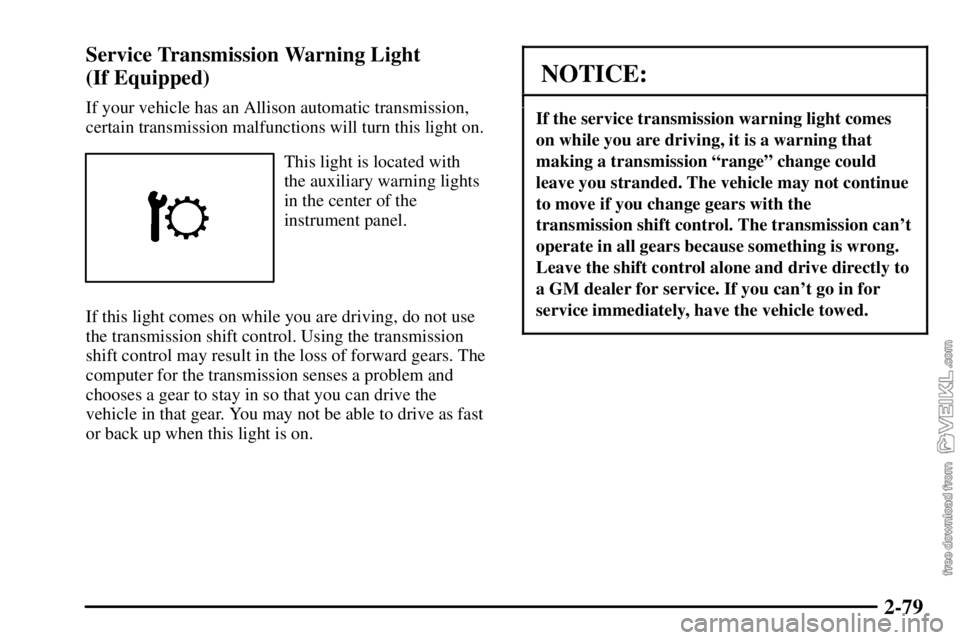
If your vehicle has an Allison automatic transmission,
certain transmission malfunctions will turn this light on.
This light is located with
the auxiliary warning lights
in the center of the
instrument panel.
If this light comes on while you are driving, do not use
the transmission shift control. Using the transmission
shift control may result in the loss of forward gears. The
computer for the transmission senses a problem and
chooses a gear to stay in so that you can drive the
vehicle in that gear. You may not be able to drive as fast
or back up when this light is on.
NOTICE:
If the service transmission warning light comes
on while you are driving, it is a warning that
making a transmission ªrangeº change could
leave you stranded. The vehicle may not continue
to move if you change gears with the
transmission shift control. The transmission can't
operate in all gears because something is wrong.
Leave the shift control alone and drive directly to
a GM dealer for service. If you can't go in for
service immediately, have the vehicle towed.
Page 156 of 386

2-81
If the amber SERVICE
BRAKES SOON warning
light comes on, it means
that there is something
wrong in the brake system.
When this light comes on, you will also hear a warning
tone. If this light comes on, have the system repaired
immediately.
Both of these lights should come on briefly every time
you start the engine. If they don't come on then, have
them fixed so they will be ready to warn you if there's a
problem. If one or both of these warning lights stay on
after you start the engine, there could be a brake
problem. Have your brake system inspected right away.If one or both of these lights come on and stay on while
you are driving, pull off the road and stop carefully. You
may notice that the pedal is harder to push. Or, the pedal
may go closer to the floor. It may take longer to stop. If
the BRAKE light is still on, have the vehicle towed for
service. See ªTowing Your Vehicleº in the Index. See
ªHydraulic Brake Systemsº in the Index for more
information.
CAUTION:
Your brake system may not be working properly
if a brake system warning light is on. Driving
with a brake system warning light on can lead to
an accident. If the light is still on after you've
pulled off the road and stopped carefully, have
the vehicle towed for service.
Page 158 of 386

2-83 Parking Brake Indicator Light
Your vehicle has a brake
indicator light. When the
ignition is on, this light will
come on when you set your
parking brake. The light
will stay on if your parking
brake doesn't release fully.
This light should also come on when you turn the
ignition key to START. If it doesn't come on then, have
it fixed so it will be ready to remind you if the parking
brake is applied or hasn't released fully.
Anti-Lock Brake System Warning Light
With the anti-lock brake
system, this light will come
on when you start your
engine and it may stay
on for several seconds.
That's normal.
If the light stays on, or comes on when you're driving,
your vehicle needs service. If the BRAKE or LOW AIR
warning light isn't on, you still have brakes, but you
don't have the anti
-lock brake feature. If the BRAKE
and/or LOW AIR warning light is on, you don't have
anti
-lock brakes and there's a problem with your regular
brakes. See ªBrake System Warning Lightº earlier in
this section.
The anti
-lock brake system warning light should come
on briefly when you start the engine. If the light doesn't
come on then, have it fixed so it will be ready to warn
you if there is a problem.