2003 BMW 540I SEDAN light
[x] Cancel search: lightPage 103 of 187
103n
OverviewControlsMaintenanceRepairsDataIndex
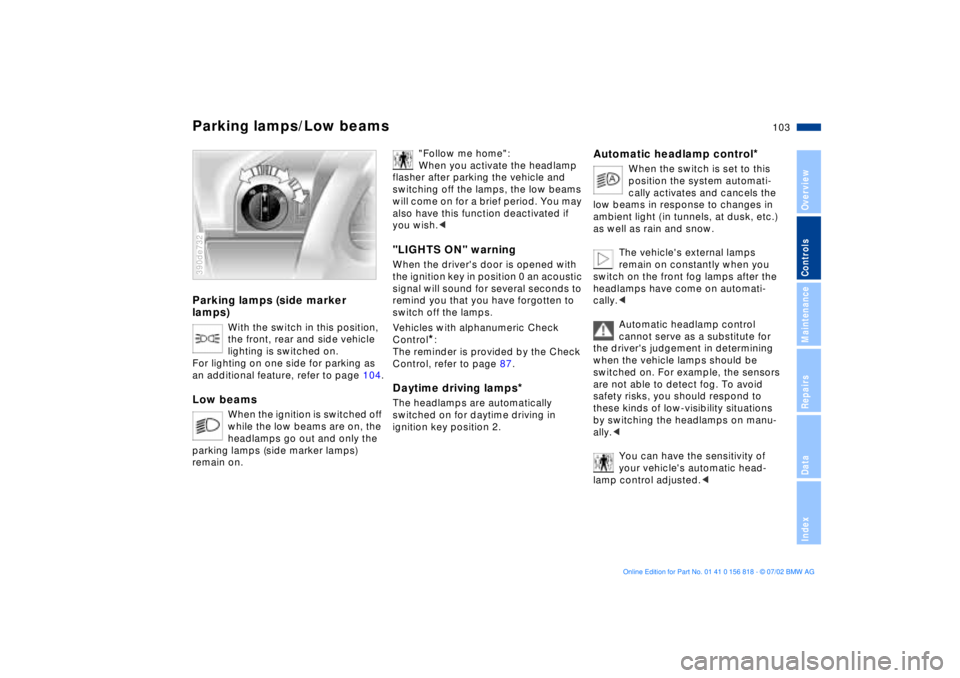
Parking lamps (side marker
lamps)
With the switch in this position,
the front, rear and side vehicle
lighting is switched on.
For lighting on one side for parking as
an additional feature, refer to page 104.
Low beams
When the ignition is switched off
while the low beams are on, the
headlamps go out and only the
parking lamps (side marker lamps)
remain on.
390de732
"Follow me home":
When you activate the headlamp
flasher after parking the vehicle and
switching off the lamps, the low beams
will come on for a brief period. You may
also have this function deactivated if
you wish.<
"LIGHTS ON" warningWhen the driver's door is opened with
the ignition key in position 0 an acoustic
signal will sound for several seconds to
remind you that you have forgotten to
switch off the lamps
.
Vehicles with alphanumeric Check
Control
*:
The reminder is provided by the Check
Control, refer to page 87.
Daytime driving lamps
*
The headlamps are automatically
switched on for daytime driving in
ignition key position 2.
Automatic headlamp control
*
When the switch is set to this
position the system automati-
cally activates and cancels the
low beams in response to changes in
ambient light ( in tunnels, at dusk, etc.)
as well as rain and snow.
The vehicle's external lamps
remain on constantly when you
switch on the front fog lamps after the
headlamps have come on automati-
cally.<
Automatic headlamp control
cannot serve as a substitute for
the driver's judgement in determining
when the vehicle lamps should be
switched on. For example, the sensors
are not able to detect fog. To avoid
safety risks, you should respond to
these kinds of low-visibility situations
by switching the headlamps on manu-
ally.<
You can have the sensitivity of
your vehicle's automatic head-
lamp control adjusted.<
Parking lamps/Low beams
Page 104 of 187
104n
Instrument lighting
High beams/Standing lamps
Fog lamps
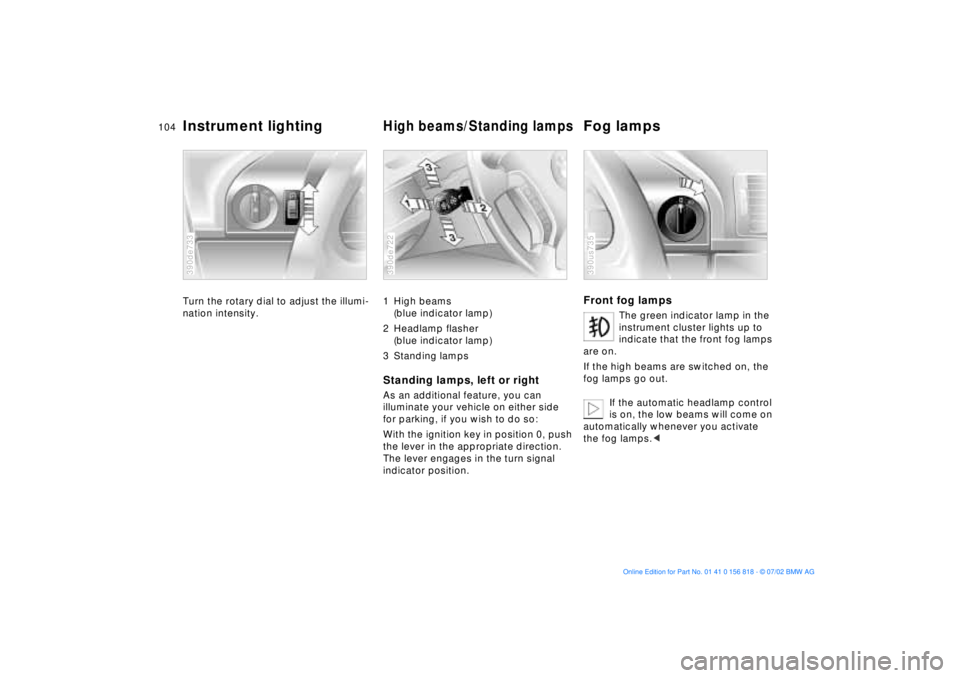
Turn the rotary dial to adjust the illumi-
nation intensity.390de733
1 High beams
(blue indicator lamp)
2 Headlamp flasher
(blue indicator lamp)
3 Standing lampsStanding lamps, left or rightAs an additional feature, you can
illuminate your vehicle on either side
for parking, if you wish to do so:
With the ignition key in position 0, push
the lever in the appropriate direction.
The lever engages in the turn signal
indicator position.390de722
Front fog lamps
The green indicator lamp in the
instrument cluster lights up to
indicate that the front fog lamps
are on.
If the high beams are switched on, the
fog lamps go out.
If the automatic headlamp control
is on, the low beams will come on
automatically whenever you activate
the fog lamps.<
390us735
Page 113 of 187
113n
OverviewControlsMaintenanceRepairsDataIndex
Automatic climate control
*
Residual heating mode
The heat which is stored in
the engine is utilized for
heating the interior when the engine
has been switched off (while waiting at
a railroad crossing, for instance).
In ignition key position 1, you can alter
the settings of the automatic climate
control. In ignition key position 0, the
system automatically directs heated air
to the windshield, side windows and
footwells.
This function is available for oper-
ation when the outside tempera-
ture is below approx. 59 7 (15 6),
with the engine warm from recent oper-
ation and an adequate charge in the
battery. The LED on the button will light
up when all conditions have been
met.<
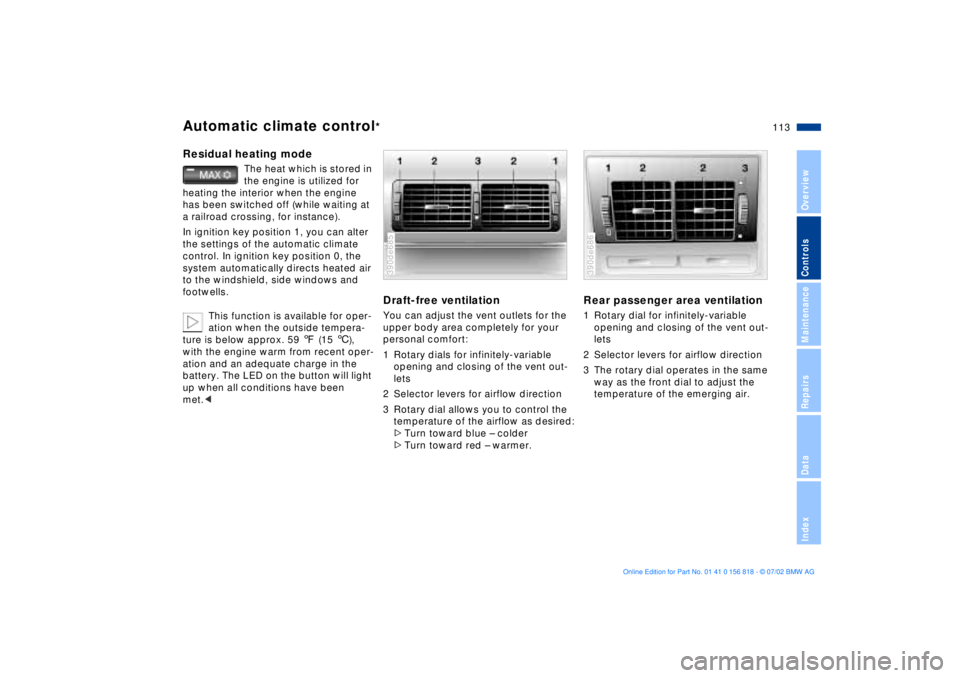
Draft-free ventilationYou can adjust the vent outlets for the
upper body area completely for your
personal comfort:
1 Rotary dials for infinitely-variable
opening and closing of the vent out-
lets
2 Selector levers for airflow direction
3 Rotary dial allows you to control the
temperature of the airflow as desired:
>Turn toward blue Ð colder
>Turn toward red Ð warmer.390de685
Rear passenger area ventilation1 Rotary dial for infinitely-variable
opening and closing of the vent out-
lets
2 Selector levers for airflow direction
3 The rotary dial operates in the same
way as the front dial to adjust the
temperature of the emerging air.390de686
Page 118 of 187
118n
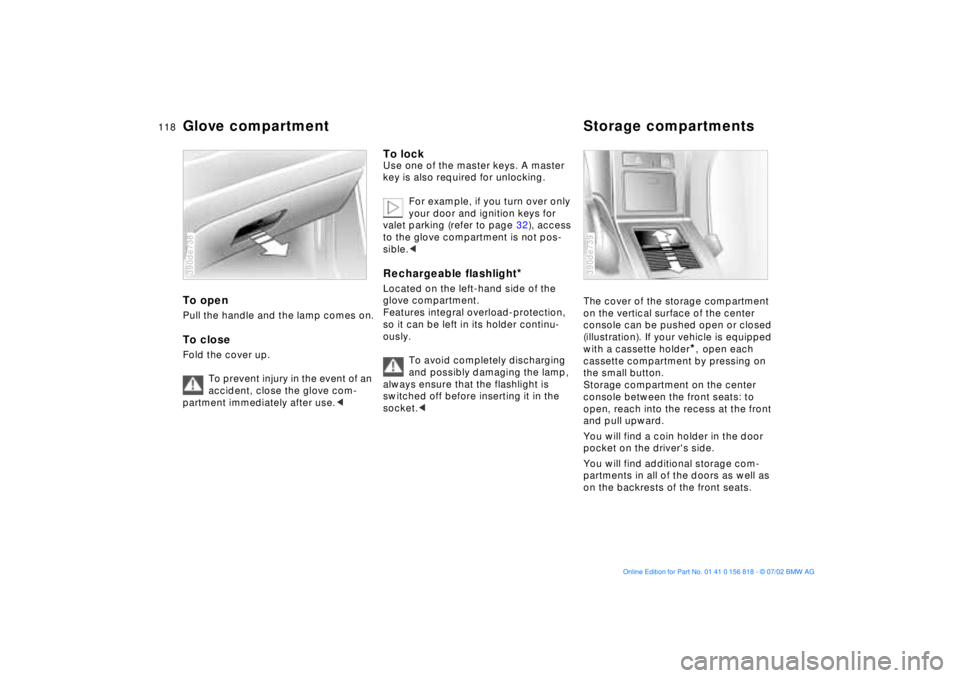
Glove compartment Storage compartmentsTo openPull the handle and the lamp comes on.To closeFold the cover up.
To prevent injury in the event of an
accident, close the glove com-
partment immediately after use.< 390de738
To lockUse one of the master keys. A master
key is also required for unlocking.
For example, if you turn over only
your door and ignition keys for
valet parking (refer to page 32), access
to the glove compartment is not pos-
sible.< Rechargeable flashlight
*
Located on the left-hand side of the
glove compartment.
Features integral overload-protection,
so it can be left in its holder continu-
ously.
To avoid completely discharging
and possibly damaging the lamp,
always ensure that the flashlight is
switched off before inserting it in the
socket.<
The cover of the storage compartment
on the vertical surface of the center
console can be pushed open or closed
(illustration). If your vehicle is equipped
with a cassette holder
*, open each
cassette compartment by pressing on
the small button.
Storage compartment on the center
console between the front seats: to
open, reach into the recess at the front
and pull upward.
You will find a coin holder in the door
pocket on the driver's side.
You will find additional storage com-
partments in all of the doors as well as
on the backrests of the front seats.
390de739
Page 120 of 187
120n
Cigarette lighter
*
Ashtray, rear
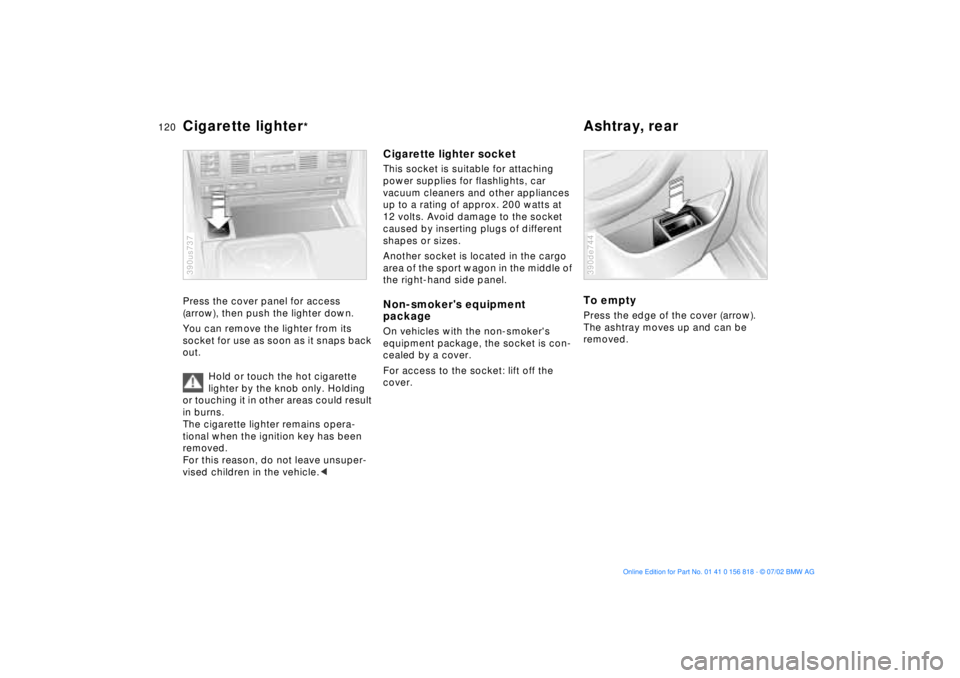
Press the cover panel for access
(arrow), then push the lighter down.
You can remove the lighter from its
socket for use as soon as it snaps back
out.
Hold or touch the hot cigarette
lighter by the knob only. Holding
or touching it in other areas could result
in burns.
The cigarette lighter remains opera-
tional when the ignition key has been
removed.
For this reason, do not leave unsuper-
vised children in the vehicle.< 390us737
Cigarette lighter socketThis socket is suitable for attaching
power supplies for flashlights, car
vacuum cleaners and other appliances
up to a rating of approx. 200 watts at
12 volts. Avoid damage to the socket
caused by inserting plugs of different
shapes or sizes.
Another socket is located in the cargo
area of the sport wagon in the middle of
the right-hand side panel.Non-smoker's equipment
packageOn vehicles with the non-smoker's
equipment package, the socket is con-
cealed by a cover.
For access to the socket: lift off the
cover.
To emptyPress the edge of the cover (arrow).
The ashtray moves up and can be
removed.390de744
Page 125 of 187
125n
OverviewControlsMaintenanceRepairsDataIndex
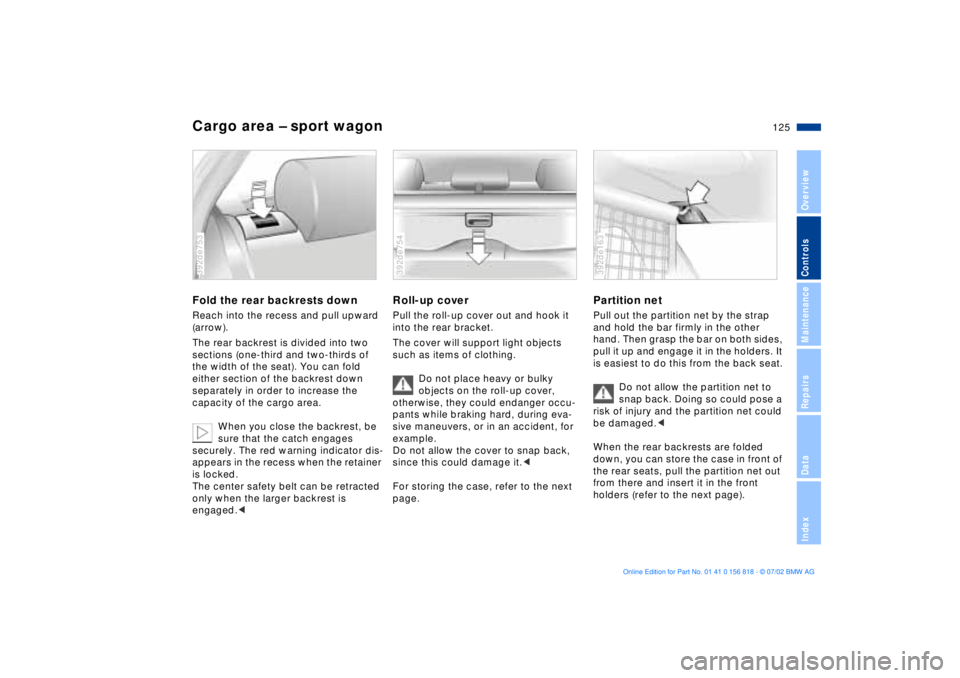
Cargo area Ð sport wagonFold the rear backrests downReach into the recess and pull upward
(arrow).
The rear backrest is divided into two
sections (one-third and two-thirds of
the width of the seat). You can fold
either section of the backrest down
separately in order to increase the
capacity of the cargo area.
When you close the backrest, be
sure that the catch engages
securely. The red warning indicator dis-
appears in the recess when the retainer
is locked.
The center safety belt can be retracted
only when the larger backrest is
engaged.<392de753
Roll-up coverPull the roll-up cover out and hook it
into the rear bracket.
The cover will support light objects
such as items of clothing.
Do not place heavy or bulky
objects on the roll-up cover,
otherwise, they could endanger occu-
pants while braking hard, during eva-
sive maneuvers, or in an accident, for
example.
Do not allow the cover to snap back,
since this could damage it.<
For storing the case, refer to the next
page.392de754
Partition netPull out the partition net by the strap
and hold the bar firmly in the other
hand. Then grasp the bar on both sides,
pull it up and engage it in the holders. It
is easiest to do this from the back seat.
Do not allow the partition net to
snap back. Doing so could pose a
risk of injury and the partition net could
be damaged.<
When the rear backrests are folded
down, you can store the case in front of
the rear seats, pull the partition net out
from there and insert it in the front
holders (refer to the next page).392de163
Page 128 of 187
128n
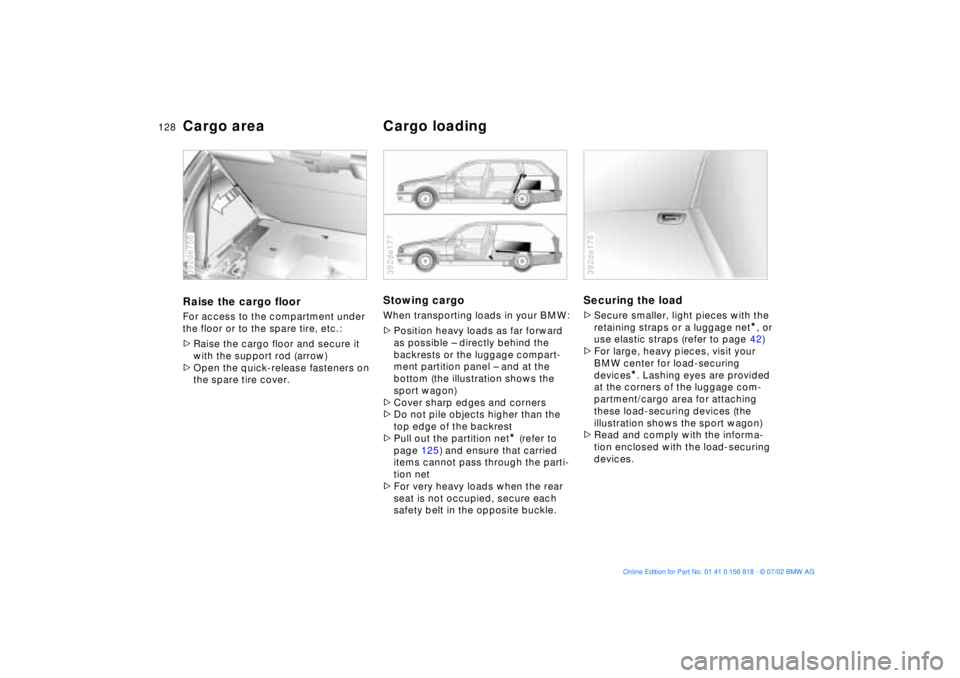
Cargo area Cargo loadingRaise the cargo floorFor access to the compartment under
the floor or to the spare tire, etc.:
>Raise the cargo floor and secure it
with the support rod (arrow)
>Open the quick-release fasteners on
the spare tire cover.392de756
Stowing cargoWhen transporting loads in your BMW:
>Position heavy loads as far forward
as possible Ð directly behind the
backrests or the luggage compart-
ment partition panel Ð and at the
bottom (the illustration shows the
sport wagon)
>Cover sharp edges and corners
>Do not pile objects higher than the
top edge of the backrest
>Pull out the partition net
* (refer to
page 125) and ensure that carried
items cannot pass through the parti-
tion net
>For very heavy loads when the rear
seat is not occupied, secure each
safety belt in the opposite buckle.
392de177
Securing the load>Secure smaller, light pieces with the
retaining straps or a luggage net
*, or
use elastic straps (refer to page 42)
>For large, heavy pieces, visit your
BMW center for load-securing
devices
*. Lashing eyes are provided
at the corners of the luggage com-
partment/cargo area for attaching
these load-securing devices (the
illustration shows the sport wagon)
>Read and comply with the informa-
tion enclosed with the load-securing
devices.
392de178
Page 132 of 187

132n
Break-in proceduresTo ensure that your vehicle provides
maximum economy throughout a long
service life, we request that you
observe the following suggestions.Engine and differentialUp to 1,200 miles (2,000 km):
Drive at varying engine speeds and
road speeds, but do not exceed
4,500 rpm and the following road
speeds during this initial period:
BMW 525i, 530i: 100 mph (160 km/h)
BMW 540i: 106 mph (170 km/h).
Comply with all official speed limits.
Refrain from using full throttle and avoid
pressing the accelerator beyond the
kickdown point.
Once you have driven 1,200 miles
(2,000 km), engine and vehicle speeds
can gradually be increased.
You should also comply with these
break-in procedures if the engine or dif-
ferential is replaced later in the course
of the vehicle service life.
TiresOwing to technical factors associated
with their manufacture, tires do not
achieve their full traction potential until
an initial break-in period has elapsed.
For this reason, you should drive with
extra care during the initial 200 miles
(300 km).
Comply with all official speed limits.
When the vehicle is operated on
wet or slushy roads, a wedge of
water may form between the tire and
the road surface. This phenomenon is
referred to as aquaplaning or hydro-
planing, and can lead to partial or com-
plete loss of traction, vehicle control
and braking effectiveness. Reduce your
speed on wet roads.<
Brake systemApprox. 300 miles (500 km) must
elapse before the brake pads and
rotors achieve the optimal pad-surface
and wear patterns required for trouble-
free operation and long service life later
on.
To break-in the separate parking brake
drums, apply the parking brake lightly
when coasting to a standstill (at a traffic
signal, for instance), provided that
traffic conditions allow you to do so.
To avoid corrosion, repeat this proce-
dure from time to time.
The brake lamps do not come on
when the parking brake is applied.
Vacuum for the brake system servo unit
on your BMW is available only when the
engine is running. When you move the
vehicle with the engine switched off Ð
when towing, for instance Ð substan-
tially higher levels of pedal force will be
required to brake the vehicle.< ClutchThe clutch will also begin to function
optimally after about 300 miles
(500 km). Engage the gears carefully
during the break-in period.