Page 762 of 1672

TRANSFER BOX - LT230SE
REPAIRS 41-29
22.Remove 4 bolts and nut securing RH mounting
to body and transfer box.
23.Remove nut securing LH mounting to body.
24.Raise gearbox and remove RH mounting.
25.With assistance, remove transfer box from
gearbox.
26.Remove input shaft oil seal.
+ TRANSFER BOX - LT230SE,
REPAIRS, Oil seal - input shaft.
Refit
1.Fit new input shaft oil seal.
+ TRANSFER BOX - LT230SE,
REPAIRS, Oil seal - input shaft.
2.Clean transfer box to gearbox mating faces.
3.Raise transfer box on jack and align to guide
studs LRT-41-009.
4.Clean transfer box to gearbox bolt threads.
5.Apply Loctite 290 to bolt and stud threads.
6.Fit and lightly tighten 2 bolts and nut securing
transfer box to gearbox. If new stud is to be
fitted apply Loctite 290 to threads of stud
and tighten to 45 Nm (33 lbf.ft)
7.Remove guide studs, fit and lightly tighten 3
bolts.
8.Tighten bolts and nut by diagonal selection to
45 Nm (33 lbf.ft.
9.Position gearbox RH mounting and tighten
bolts to 85 Nm (63 lbf.ft).
10.Tighten gearbox RH mounting nut to 48 Nm
(35 lbf.ft).
11.Fit nut to LH mounting and tighten to 48 Nm (35
lbf.ft).
12.Remove 4 bolts securing support plate to
gearbox jack.
13.Remove 4 bolts securing support plate LRT-99-
010 to transfer box and remove plate.
14.Clean threads of bottom plate bolts.
15.Apply Loctite 290 to threads of bolts.
16.Fit 4 bolts securing bottom plate and tighten to
25 Nm (18 lbf.ft).
17.Using new washers position breather pipe and
tighten banjo bolt.
18.Connect multiplug to transfer box neutral switch
and secure harness. 19. If fitted - Connect Lucars to differential lock
switch.
20.Connect multiplug and Lucars to reverse lamp
switch and oil temperature sensor.
21.Position high/low ratio selector cable and
secure with 'C' washer and clevis pin.
22.Secure cable to fuel pipes with new cable ties.
23.Clean handbrake back plate and mating face.
24.Position handbrake back plate, fit bolts and
tighten to 75 Nm (55 lbf.ft).
25.Clean handbrake drum.
26.Fit handbrake drum and tighten retaining
screw.
27.Fit front propeller shaft.
+ PROPELLER SHAFTS, REPAIRS,
Propeller shaft - front.
28.Fit rear propeller shaft.
+ PROPELLER SHAFTS, REPAIRS,
Propeller shaft - rear.
29.Clean exhaust silencer and tail pipe mating
faces.
30.Position silencer and secure on mountings,
using a new gasket align to tail pipe, fit nuts
and tighten to 25 Nm (18 lbf.ft).
31.Position rear cross member, fit bolts and
tighten to 26 Nm (19 lbf.ft).
32.Refill transfer box with oil.
+ MAINTENANCE, PROCEDURES,
Transfer box.
33.Fit front exhaust pipe.
+ MANIFOLDS AND EXHAUST
SYSTEMS - V8, REPAIRS, Front pipe.
Page 767 of 1672
TRANSFER BOX - LT230SE
41-34 REPAIRS
Seal - rear output shaft
$% 41.20.54
Remove
1.Remove rear propeller shaft.
+ PROPELLER SHAFTS, REPAIRS,
Propeller shaft - rear.
2.Loosen brake shoe adjuster bolt.
3.Remove screw securing handbrake drum. 4.Remove handbrake drum.
5.Restrain transfer box drive flange using tool
LRT-51-003. Remove and discard drive flange
nut, remove and discard steel and felt washers.
6.Using tool LRT-99-500 if necessary, remove
drive flange from transfer box.
7.Remove seal from transfer box.
Refit
1.Clean seal mating faces.
2.Lubricate seal with gearbox oil.
Page 768 of 1672

TRANSFER BOX - LT230SE
REPAIRS 41-35
3.Fit new seal using tool LRT-41-012.
4.Position drive flange, fit new felt and steel
washers.
5.Position tool LRT-51-003 and tighten new
drive flange nut to 148 Nm (109 lbf.ft).
6.Position handbrake drum and tighten screw.
7.Tighten brake shoe adjuster bolt to 25 Nm (18
lbf.ft) then loosen one and a half turns.
8.Check that brake drum is free to rotate.
9.Fit propeller shaft.
+ PROPELLER SHAFTS, REPAIRS,
Propeller shaft - front.
10.Top-up transfer box oil.
+ MAINTENANCE, PROCEDURES,
Transfer box.
Gasket - rear output shaft housing
$% 41.20.55
Remove
1.Drain transfer gearbox oil.
+ MAINTENANCE, PROCEDURES,
Transfer box.
2.Remove rear output shaft seal.
+ TRANSFER BOX - LT230SE,
REPAIRS, Seal - rear output shaft.
3.Mark output shaft housing to main casing for
assembly purposes.
4.Note position of shoulder bolt, remove 6 bolts
securing housing to main casing.
Refit
1.Clean output shaft housing, mating face on
main casing and sealant from bolt threads.
2.Apply sealant, Part No. STC 3254 to mating
flange on output shaft housing.
3.Fit output shaft housing to main casing.
4.Apply Loctite 290 to bolt threads.
5.Fit output shaft housing bolts and tighten by
diagonal selection to 45 Nm (33 lbf.ft).
6.Fit rear output shaft seal.
+ TRANSFER BOX - LT230SE,
REPAIRS, Seal - rear output shaft.
7.Fill transfer gearbox with oil.
+ MAINTENANCE, PROCEDURES,
Transfer box.
Page 818 of 1672

AUTOMATIC GEARBOX - ZF4HP22 - 24
ADJUSTMENTS 44-21
ADJUST ME NTS
Cable - selector
$% 44.30.04
Check
1.Position vehicle on ramp.
2.Select position 'P'.
3.Loosen selector cable trunnion nut.
4.Ensure that gearbox selector lever is in 'P'
position, (fully forward) and tighten trunnion
nut.
5.Lower ramp.
Stall test
$% 44.30.13
Testing
1.Chock the wheels and fully apply the
handbrake.
2.Start the engine and run it until it reaches
normal operating temperature.
3.Apply the footbrake and select 'D'.
4.Fully depress the accelerator pedal and note
the tachometer reading. The figures should be
as given below. Do not carry out stall test for
longer than 10 seconds, and DO NOT repeat
until 30 minutes have elapsed.
lV8: 2200 to 2400 rev/min
lDiesel: 2600 to 2800 rev/min
5.A reading below 1300 rev/min indicates a
torque converter fault, ie stator free-wheel.
6.A reading between 1300 and 2200 rev/min (V8)
or between 1300 and 2600 rev/min (Diesel)
indicates reduced engine power.
7.A reading above 2400 rev/min (V8) or above
2800 rev/min (Diesel) indicates clutch slip.
NOTE: The figures quoted above were
measured at sea level with an ambient
temperature of 20
°C (68°F). At higher altitudes
or higher ambient temperatures, these figures
will be reduced.
Page 824 of 1672
AUTOMATIC GEARBOX - ZF4HP22 - 24
REPAIRS 44-27
11.Drain transfer gearbox oil.
+ MAINTENANCE, PROCEDURES,
Transfer box.
12.Remove front propeller shaft
+ PROPELLER SHAFTS, REPAIRS,
Propeller shaft - front.
13.Remove rear propeller shaft
+ PROPELLER SHAFTS, REPAIRS,
Propeller shaft - rear.
14.Remove and discard 3 bolts securing torque
converter to drive plate.
15.Remove handbrake drum retaining screw and
remove brake drum. 16.Remove 4 bolts from handbrake back plate,
release back plate and tie aside.
17.Remove clip securing high/low ratio selector
cable to transfer gearbox lever, remove 'C' clip
and remove outer cable from gearbox.
18.Disconnect 2 Lucars from differential lock
switch and multiplugs from high/low ratio switch
and neutral sensor.
19.Remove cable tie and multi plug from bracket
to transfer box.
Page 1064 of 1672
BRAKES
DESCRIPTION AND OPERATION 70-19
HDC switch
The HDC switch is a latching push switch installed on the fascia, in the switchpack inboard of the steering wheel.
When pushed in, the switch connects an ignition supply to the SLABS ECU to initiate HDC.
Warning indications
The SLABS ECU operates audible and visual warnings to convey brake system status.
Audible warning
A repetitive chime, at a frequency of 2 Hz, draws attention to warning lamp indications. The chime is produced on the
speaker in the instrument pack.
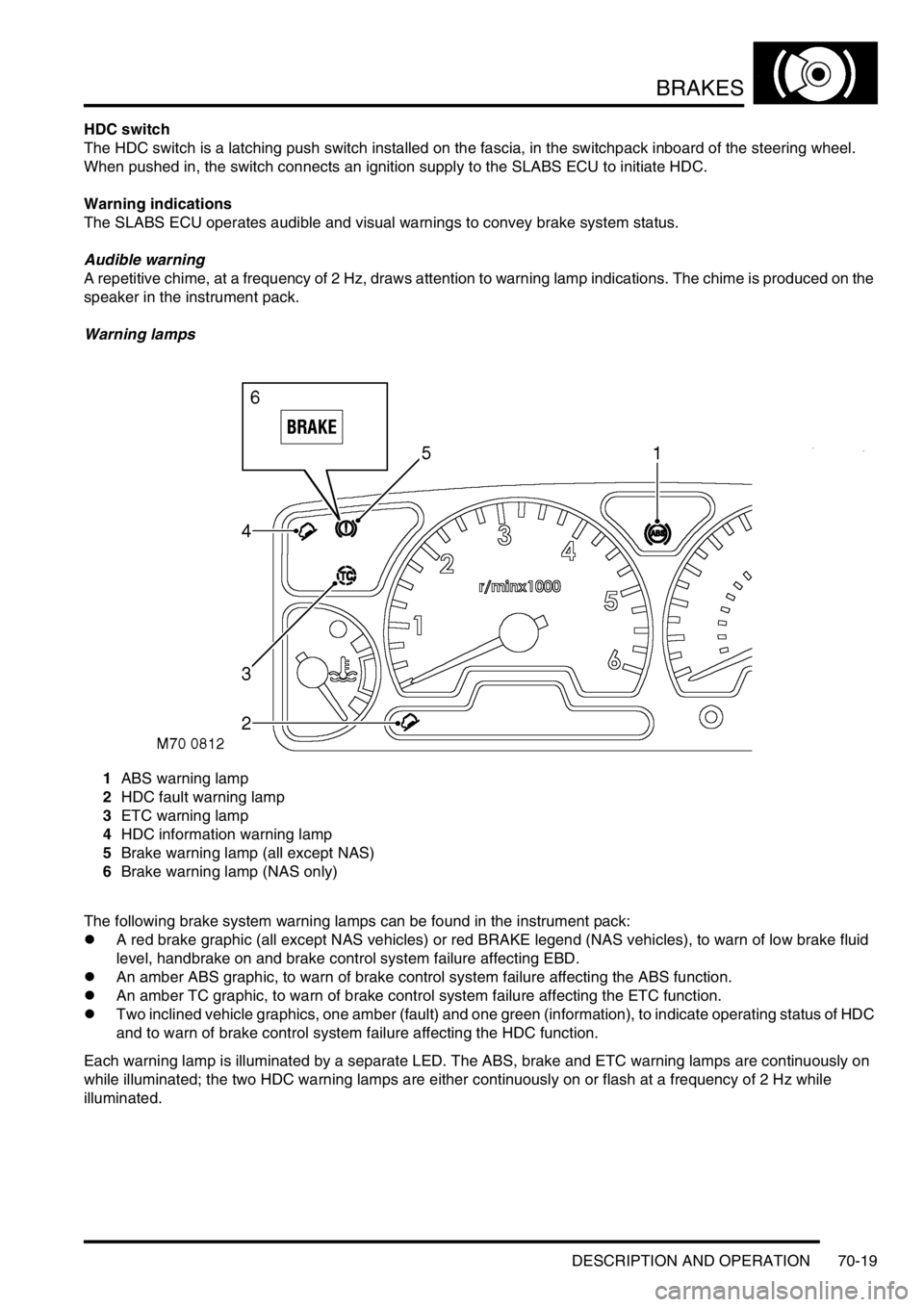
Warning lamps
1ABS warning lamp
2HDC fault warning lamp
3ETC warning lamp
4HDC information warning lamp
5Brake warning lamp (all except NAS)
6Brake warning lamp (NAS only)
The following brake system warning lamps can be found in the instrument pack:
lA red brake graphic (all except NAS vehicles) or red BRAKE legend (NAS vehicles), to warn of low brake fluid
level, handbrake on and brake control system failure affecting EBD.
lAn amber ABS graphic, to warn of brake control system failure affecting the ABS function.
lAn amber TC graphic, to warn of brake control system failure affecting the ETC function.
lTwo inclined vehicle graphics, one amber (fault) and one green (information), to indicate operating status of HDC
and to warn of brake control system failure affecting the HDC function.
Each warning lamp is illuminated by a separate LED. The ABS, brake and ETC warning lamps are continuously on
while illuminated; the two HDC warning lamps are either continuously on or flash at a frequency of 2 Hz while
illuminated.
Page 1070 of 1672
BRAKES
DESCRIPTION AND OPERATION 70-25
DESCRIPTION AND OPERAT ION
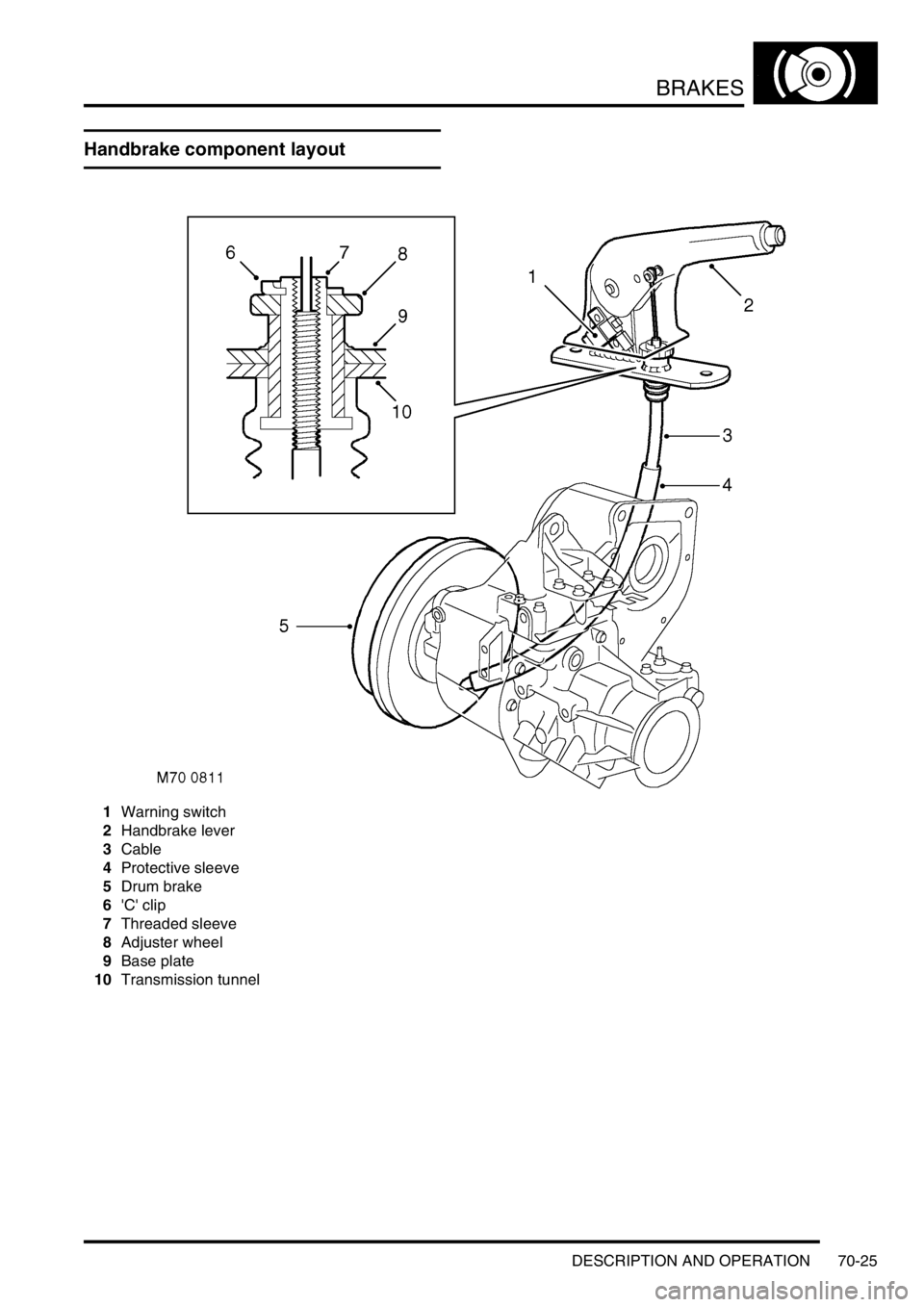
Handbrake component layout
1Warning switch
2Handbrake lever
3Cable
4Protective sleeve
5Drum brake
6'C' clip
7Threaded sleeve
8Adjuster wheel
9Base plate
10Transmission tunnel
Page 1071 of 1672

BRAKES
70-26 DESCRIPTION AND OPERATION
Description
General
The handbrake consists of a drum brake, installed on the rear of the transfer box, operated by a cable connected to
a handbrake lever between the front seats.
Handbrake lever
The handbrake lever is mounted on a base plate which attaches to the transmission tunnel. A conventional ratchet
and thumb operated release button are incorporated for locking and unlocking the lever. A warning switch on the base
of the lever operates the brake warning lamp in the instrument pack. While the handbrake is applied the warning
switch connects an earth to the instrument pack which, if the ignition is on, illuminates the brake warning lamp. In
some markets, the instrument pack performs a bulb check of the brake warning lamp each time the ignition is switched
on.
Cable
The handbrake cable consists of inner and outer cables installed between the handbrake lever and the drum brake.
A protective sleeve is installed on the cable to protect the cable from heat from the exhaust system. Handbrake
adjustment is provided by a threaded sleeve installed on the outer cable where it locates in the handbrake lever.
Turning an adjuster wheel, which is keyed to the threaded sleeve and secured by a 'C' clip, alters the effective length
of the outer sleeve and consequently changes the handbrake lever movement needed to apply the drum brake.