2002 LAND ROVER DISCOVERY wheel
[x] Cancel search: wheelPage 992 of 1672

FRONT SUSPENSION
REPAIRS 60-53
11.Remove 2 cap nuts securing pipes to ACE
actuator. Disconnect pipes and discard sealing
washers.
CAUTION: Always fit plugs to open
connections to prevent contamination.
12.Release pipes from isolator above chassis RH
front outrigger.
13.Remove pipe assembly.Refit
1.Position pipe assembly.
2.Locate pipes in isolator above chassis RH front
outrigger. Fit cable tie around isolator to secure
pipes.
3.Ensure valve block and pipe connections are
clean.
4.Fit collets and pipes to clamping plate.
5.Connect pipes to valve block. To avoid seal
damage, keep pipes square to valve block.
Fit and tighten nuts securing clamping plate to
valve block to 21 Nm (15 lbf.ft).
CAUTION: Ensure pipes are installed in
their correct ports or serious system
damage will occur.
6.Fit pipe clamps. Secure to chassis with bolt and
to bracket on suspension turret with nut.
7.Connect pipes to ACE actuator with cap nuts
and new sealing washers Tighten cap nuts to
29 Nm (21 lbf.ft). Ensure pipes are not under
tension or kinked.
8.Secure harness to suspension turret.
9.Fit splash shield and secure with screws.
10.Fit RH wheel arch liner extension and secure
with screws.
11.Renew ACE high pressure filter.
+ FRONT SUSPENSION, REPAIRS,
Filter - high pressure - ACE.
12.Fit road wheel(s) and tighten nuts to 140 Nm
(103 lbf.ft).
13.Refill and bleed ARC system.
+ FRONT SUSPENSION,
ADJUSTMENTS, ACE hydraulic system
bleeding.
14.Lower vehicle.
Page 993 of 1672

FRONT SUSPENSION
60-54 REPAIRS
Pipe assembly - pump or reservoir to
valve block - ACE - V8
$% 60.60.32
Introduction
CAUTION: The ACE hydraulic system is
extremely sensitive to the ingress of dirt or
debris. The smallest amount could render the
system unserviceable. It is imperative that the
following precautions are taken.
lACE components are thoroughly cleaned
externally before work commences;
lall opened pipe and module ports are
capped immediately;
lall fluid is stored in and administered
through clean containers.
Remove
1.To avoid any possibility of swarf ingress,
remove the valve block.
+ FRONT SUSPENSION, REPAIRS,
Valve block - ACE.
2.Raise front of vehicle.
WARNING: Do not work on or under a
vehicle supported only by a jack. Always
support the vehicle on safety stands.
3.Remove RH front road wheel.
4.Remove 3 screws and remove splash shield.
5.Remove viscous fan.
+ COOLING SYSTEM - V8, REPAIRS,
Fan - viscous.6.Remove 2 screws securing lower fan cowl and
remove cowl.
7.Disconnect multiplug from MAF sensor.
Note: Pre 03 MY air intake hose illustrated.
8.Release clips and remove air flow meter from
air cleaner.
9.Collect 'O' ring.
Page 996 of 1672

FRONT SUSPENSION
REPAIRS 60-57
7.Fit pipe clamps to pipe, align clamps to front
cross member and fit bolts.
8. Valve block to reservoir pipe: F it pi pe to c li p
on LH chassis member.
9.Fit pipe clamp to pipes, align clamp to
suspension turret and secure with nut.
10.Fit pipe clamp to pipes, align clamp to RH
chassis member and secure with bolt.
11.Align and secure harness to suspension turret.
12.Fit 'O' ring to air cleaner.
13.Fit air hose to throttle body and secure with clip.
14.Fit air flow meter and secure with clips.
15.Connect multiplug to MAF sensor.
16.Fit lower fan cowl and secure with screws.
17.Fit viscous fan.
+ COOLING SYSTEM - V8, REPAIRS,
Fan - viscous.
18.Fit RH splash shield and secure with screws.
19.Fit road wheel(s).
20.Fit valve block.
+ FRONT SUSPENSION, REPAIRS,
Valve block - ACE.
21.Renew ACE high pressure filter.
22.Lower vehicle.
Pipe assembly - pump or reservoir to
valve block - ACE - diesel
$% 60.60.32
CAUTION: The ACE hydraulic system is
extremely sensitive to the ingress of dirt or
debris. The smallest amount could render the
system unserviceable. It is imperative that the
following precautions are taken.
lACE components are thoroughly cleaned
externally before work commences;
lall opened pipe and module ports are
capped immediately;
lall fluid is stored in and administered
through clean containers.
Remove
1.To avoid any possibility of swarf ingress,
remove valve block.
+ FRONT SUSPENSION, REPAIRS,
Valve block - ACE.
2.Drain cooling system.
+ COOLING SYSTEM - Td5,
ADJUSTMENTS, Drain and refill.
3.Raise front of vehicle.
WARNING: Do not work on or under a
vehicle supported only by a jack. Always
support the vehicle on safety stands.
4.Remove RH front road wheel.
5.Remove 3 screws and remove splash shield.
6.Remove viscous fan.
+ COOLING SYSTEM - Td5, REPAIRS,
Fan - viscous.
Page 1000 of 1672

FRONT SUSPENSION
REPAIRS 60-61
7.Fit pipe clamps to pipes, align clamps to
chassis front cross member and fit bolts.
8. Valve block to reservoir pipe: F it pi pe to c li p
on LH chassis member.
9.Fit pipe clamp to pipes, align clamp to
suspension turret and secure with nut.
10.Fit pipe clamp to pipes, align clamp to RH
chassis member and secure with bolt.
11.Align and secure harness to suspension turret.
12.Fit thermostat housing and hoses and secure
hoses with clips.
13.Fit turbocharger outlet pipe and secure hoses
with clips.
14.Connect turbocharger pressure sensing hose
and secure with clip.
15.Fit 'O' ring to air cleaner.
16.Fit air hose to turbocharger and tighten clip.
17.Fit air flow meter to air cleaner and secure with
clips.
18.Connect multiplug to air flow meter.
19.Fit lower half of fan cowl and secure with
screws.
20.Fit viscous fan.
+ COOLING SYSTEM - Td5, REPAIRS,
Fan - viscous.
21.Fit RH splash shield and secure with screws.
22.Fit road wheel.
23.Fit valve block.
+ FRONT SUSPENSION, REPAIRS,
Valve block - ACE.
24.Renew ACE high pressure filter
+ FRONT SUSPENSION, REPAIRS,
Filter - high pressure - ACE.
25.Lower vehicle.
26.Fill cooling system.
+ COOLING SYSTEM - Td5,
ADJUSTMENTS, Drain and refill.
Pipe assembly - valve block to rear
actuator - ACE
$% 60.60.33
CAUTION: The ACE hydraulic system is
extremely sensitive to the ingress of dirt or
debris. The smallest amount could render the
system unserviceable. It is imperative that the
following precautions are taken.
lACE components are thoroughly cleaned
externally before work commences;
lall opened pipe and module ports are
capped immediately;
lall fluid is stored in and administered
through clean containers.
Remove
1.Raise vehicle on a ramp.
2.Position container under valve block to collect
fluid spillage.
3.Remove 2 bolts securing 2 rear pipe clips to
chassis.
Page 1002 of 1672
FRONT SUSPENSION
REPAIRS 60-63
Actuator - front - ACE
$% 60.60.40
CAUTION: The ACE hydraulic system is
extremely sensitive to the ingress of dirt or
debris. The smallest amount could render the
system unserviceable. It is imperative that the
following precautions are taken.
lACE components are thoroughly cleaned
externally before work commences;
lall opened pipe and module ports are
capped immediately;
lall fluid is stored in and administered
through clean containers.
Remove
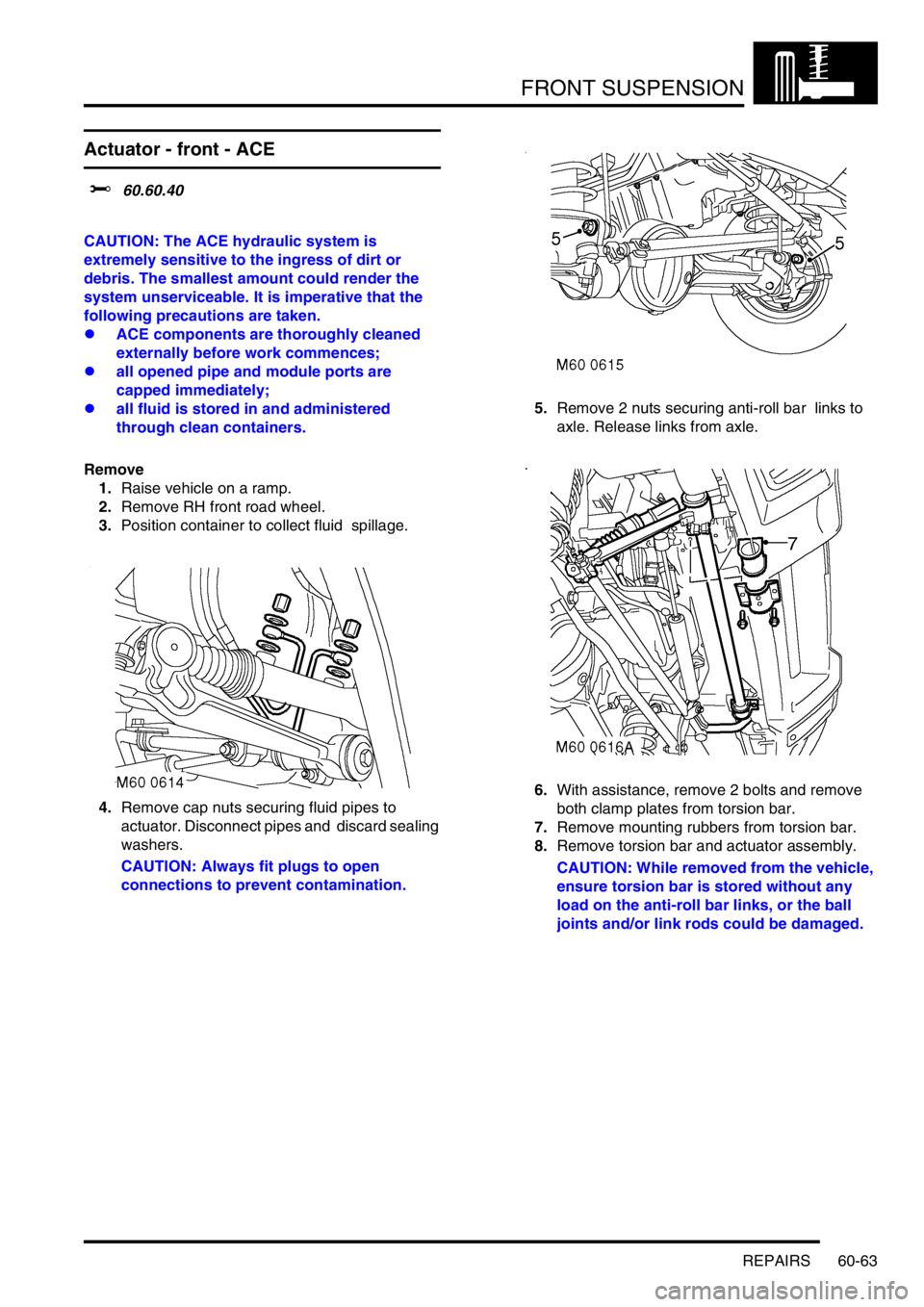
1.Raise vehicle on a ramp.
2.Remove RH front road wheel.
3.Position container to collect fluid spillage.
4.Remove cap nuts securing fluid pipes to
actuator. Disconnect pipes and discard sealing
washers.
CAUTION: Always fit plugs to open
connections to prevent contamination.5.Remove 2 nuts securing anti-roll bar links to
axle. Release links from axle.
6.With assistance, remove 2 bolts and remove
both clamp plates from torsion bar.
7.Remove mounting rubbers from torsion bar.
8.Remove torsion bar and actuator assembly.
CAUTION: While removed from the vehicle,
ensure torsion bar is stored without any
load on the anti-roll bar links, or the ball
joints and/or link rods could be damaged.
Page 1003 of 1672
FRONT SUSPENSION
60-64 REPAIRS
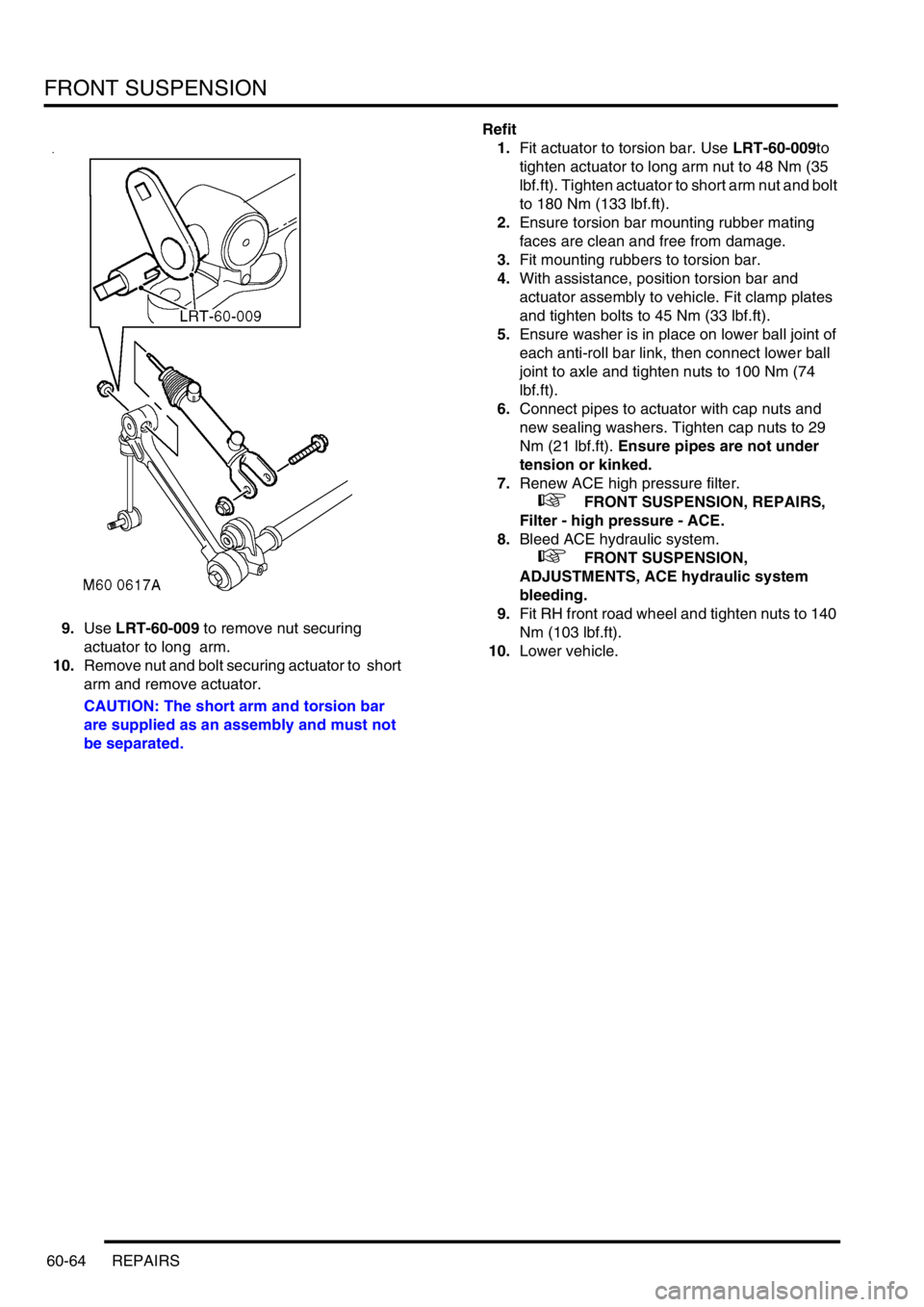
9.Use LRT-60-009 to remove nut securing
actuator to long arm.
10.Remove nut and bolt securing actuator to short
arm and remove actuator.
CAUTION: The short arm and torsion bar
are supplied as an assembly and must not
be separated.Refit
1.Fit actuator to torsion bar. Use LRT-60-009to
tighten actuator to long arm nut to 48 Nm (35
lbf.ft). Tighten actuator to short arm nut and bolt
to 180 Nm (133 lbf.ft).
2.Ensure torsion bar mounting rubber mating
faces are clean and free from damage.
3.Fit mounting rubbers to torsion bar.
4.With assistance, position torsion bar and
actuator assembly to vehicle. Fit clamp plates
and tighten bolts to 45 Nm (33 lbf.ft).
5.Ensure washer is in place on lower ball joint of
each anti-roll bar link, then connect lower ball
joint to axle and tighten nuts to 100 Nm (74
lbf.ft).
6.Connect pipes to actuator with cap nuts and
new sealing washers. Tighten cap nuts to 29
Nm (21 lbf.ft). Ensure pipes are not under
tension or kinked.
7.Renew ACE high pressure filter.
+ FRONT SUSPENSION, REPAIRS,
Filter - high pressure - ACE.
8.Bleed ACE hydraulic system.
+ FRONT SUSPENSION,
ADJUSTMENTS, ACE hydraulic system
bleeding.
9.Fit RH front road wheel and tighten nuts to 140
Nm (103 lbf.ft).
10.Lower vehicle.
Page 1011 of 1672

REAR SUSPENSION
64-6 DESCRIPTION AND OPERATION
Description
General
The rear suspension comprises two dampers, two radius arms, a Watts linkage and an anti-roll bar assembly. On
vehicles without Self Levelling Suspension (SLS) coil springs are used. On vehicles with SLS air springs are used.
The anti-roll bar is an essential part of the rear suspension. On vehicles without ACE, a conventional 'passive' anti-
roll bar is fitted. On vehicles fitted with the ACE system, a thicker diameter anti-roll bar, known as a torsion bar, is used
with an actuator at one end.
+ FRONT SUSPENSION, DESCRIPTION AND OPERATION, Description - ACE.
The hydraulic dampers and springs provide springing for each rear wheel. The long travel dampers, springs and
radius arms provide maximum axle articulation and wheel travel for off-road driving. The rear axle is controlled
longitudinally by two forged steel radius arms and transversely by a Watts linkage.
Radius arms
Each radius arm is manufactured from forged steel. Two bushes are pressed into the rear of the radius arm. The rear
of the radius arm is located between a fabricated bracket on the axle and secured through the bushes with two bolts
and nuts. A bush is pressed into the forward end of the radius arm which is located in a fabricated bracket on each
chassis longitudinal and secured through the bush with a bolt and nut. Each radius arm is similar in its construction
to the front radius arms. The rear radius arms are shorter than the front and have a lug for attachment of the SLS
height sensor (when fitted).
The radius arms prevent longitudinal movement of the rear axle and because of their length allow maximum axle
articulation. The stiffness of the bushes in each radius arm also contributes to the vehicle roll stiffness.
Each radius arm has a notch on its lower edge which provides location for the vehicle jack.
Dampers
Two conventional telescopic dampers are used to control body/axle movement. The upper damper mounting is fitted
with a bush which locates in a bracket on the chassis longitudinal. The damper is secured with a bolt which screws
into a captive nut on the bracket. The lower damper mounting is also fitted with a bush and locates in a fabricated
bracket attached to the rear axle. The lower mounting is secured with a bolt which screws into a captive nut on the
bracket. The upper and lower bushes are replaceable items.
Air springs (vehicles with SLS)
On vehicles with SLS fitted, air springs are fitted between the rear axle and the chassis. Each spring is located at its
base on a fabricated platform on the rear axle. The top of the spring locates in a fabricated bracket attached to the
outside of each chassis longitudinal.
The plastic base of the air spring has two lugs which locate in a slotted hole in the rear axle platform. The spring is
secured by rotating the spring through 90
°, locating the lug in the platform. The plastic top of the air spring has two
grooved pins which locate in holes in the bracket on the chassis. Two spring clips locate on the grooved pins and
retain the top of the spring in position.
Each air spring comprises a top plate assembly, an air bag and a base piston. The air bag is attached to the top plate
and the piston with a crimped ring. The air bag is made from a flexible rubber material which allows the bag to expand
with air pressure and deform under load. The top plate assembly comprises the plastic top plate with two bonded
grooved pins on its top face. In the centre of the top face is a female connector which allows for the attachment of the
air hose from the SLS compressor. The piston is made from plastic and is shaped to allow the air bag to roll over its
outer diameter. The base of the piston is recessed with a boss moulded in the centre. The boss has two lugs which
provide attachment to the axle platform.
Page 1026 of 1672

REAR SUSPENSION
DESCRIPTION AND OPERATION 64-21
Normal ride height
When the vehicle is stationary, a door is open and the ignition is off, the SLS system will allow the rear of the vehicle
to lower to within 20 mm of the normal ride height as load is removed from the vehicle. The SLS system will only
operate the compressor to raise the rear of the vehicle when the engine is running, unless requested using the remote
handset.
Off-road mode (ORM)
ORM is used to raise the rear of the vehicle from normal ride height to the ORM ride height of 100 mm between the
tip of the bump stop and the axle.
ORM is activated by depressing the ORM switch located on the fascia for not less than 0.5 seconds. With the engine
running, all doors closed and the vehicle speed below 18 mph (30 km/h), the audible warning will sound once and the
ORM warning lamp in the instrument pack will start to flash when the switch is released. The compressor will be
started and the air control valves will be energised by the ECU to inflate the air springs and raise the rear of the vehicle.
When the full ORM height is reached, the ECU will terminate compressor operation and close the air valves. The ORM
warning lamp will stop flashing and remain continuously illuminated to inform the driver that the SLS system is in ORM.
When ORM is no longer required, depressing the ORM switch for not less than 0.5 seconds with all doors closed will
lower the SLS to normal ride height. The audible warning will sound once and the ORM warning lamp will flash as the
suspension lowers. The ECU energises the air control valves and the exhaust valve to release air pressure from the
air springs. When standard ride height is reached the ORM warning lamp will extinguish and the ECU will de-energise
the air control valves and the exhaust valve solenoids.
If the SLS is in ORM and the vehicle speed exceeds 18 mph (30 km/h), the ECU will lower the SLS to standard ride
height. The driver will be informed of this by an audible warning and the ORM warning lamp flashing as the suspension
lowers. When normal ride height is achieved, the ORM warning lamp will extinguish.
At sea level, the time to change the SLS from normal ride height to ORM or visa versa will take between 15 and 20
seconds.
If the ECU determines that conditions are not correct for SLS operation, i.e.; axle articulation or system fault, the
audible warning will sound three times to inform the driver that the ORM request has not been granted.
Extended mode
The extended mode is automatically operated by the ECU and requires no input from the driver. Extended mode
operates when the chassis is grounded causing the rear wheels to spin. This information is generated by the ABS
function of the SLABS ECU.
When the ECU senses that the chassis is grounded and the vehicle speed is less than 6 mph (10 km/h), the ECU will
operate the compressor and energise the air control valves for 25 seconds to raise the rear of the vehicle. This
operates irrespective of the mode that the SLS system is in at that time. To inform the driver, the ORM warning lamp
will flash continuously at all times that the system is in extended mode.
The driver can exit the extended mode by depressing the ORM switch for not less than 0.5 seconds or by exceeding
8 mph (13 km/h).
Remote handset SLS control
The remote handset is an accessory item which allows the SLS to be operated between normal ride height and bump
stop height to allow easier connection and disconnection of trailers. The remote handset is similar in appearance to
that of the remote door locking handset but does not have an integral key. A circular button with an arrow is used to
raise the SLS and an oval button with the 'Land Rover' logo is used to lower the SLS.
The remote handset control requires all doors to be closed and the ignition to be in position II, but the engine does
not need to be running.