2002 Hyundai Atos check engine
[x] Cancel search: check enginePage 69 of 249

DRIVING YOUR HYUNDAI
DRIVING YOUR HYUNDAI DRIVING YOUR HYUNDAI
DRIVING YOUR HYUNDAI
DRIVING YOUR HYUNDAI
2- 6 C090G01S-GAT
o L (Low gear):
o L (Low gear): o L (Low gear):
o L (Low gear):
o L (Low gear): Use for driving up a very steep grade or for engine braking when descending steep hills.When downshifting to "L", the transaxle willtemporarily remain in second gear until thevehicle has slowed enough for low gear toengage. Do not exceed 50 km/h (30 mph) in lowgear. "L" shifts to 1st gear only. However, shift up to 2nd is performed when the car exceeds acertain speed and, as speed increases, thetransaxle will shift up to 3rd gear to preventover-revving the engine. C090H01E-GAT
NOTE:
NOTE: NOTE:
NOTE:
NOTE:
oo
oo
o For smooth and safe operation, depress
For smooth and safe operation, depress For smooth and safe operation, depress
For smooth and safe operation, depress
For smooth and safe operation, depress
the brake pedal when shifting from "Neu-
the brake pedal when shifting from "Neu- the brake pedal when shifting from "Neu-
the brake pedal when shifting from "Neu-
the brake pedal when shifting from "Neu-
tral" position or "Park" position to a for-
tral" position or "Park" position to a for- tral" position or "Park" position to a for-
tral" position or "Park" position to a for-
tral" position or "Park" position to a for-
ward or reverse gear.
ward or reverse gear. ward or reverse gear.
ward or reverse gear.
ward or reverse gear.
oo
oo
o The brake pedal fully depressed in order
The brake pedal fully depressed in order The brake pedal fully depressed in order
The brake pedal fully depressed in order
The brake pedal fully depressed in order
to move the shift lever from the "P"
to move the shift lever from the "P" to move the shift lever from the "P"
to move the shift lever from the "P"
to move the shift lever from the "P"
(Park) position to any of the other posi-
(Park) position to any of the other posi- (Park) position to any of the other posi-
(Park) position to any of the other posi-
(Park) position to any of the other posi-
tions.
tions. tions.
tions.
tions.
oo
oo
o It is always possible to shift from "R",
It is always possible to shift from "R", It is always possible to shift from "R",
It is always possible to shift from "R",
It is always possible to shift from "R",
"N", "D", "2", "L" position to "P" posi-
"N", "D", "2", "L" position to "P" posi- "N", "D", "2", "L" position to "P" posi-
"N", "D", "2", "L" position to "P" posi-
"N", "D", "2", "L" position to "P" posi-
tion. The vehicle must be fully stopped to
tion. The vehicle must be fully stopped to tion. The vehicle must be fully stopped to
tion. The vehicle must be fully stopped to
tion. The vehicle must be fully stopped to
avoid transaxle damage.
avoid transaxle damage. avoid transaxle damage.
avoid transaxle damage.
avoid transaxle damage.
C090I01E-AAT CAUTION:
CAUTION: CAUTION:
CAUTION:
CAUTION:
oo
oo
o
Shift into "R" and "P" position only when
Shift into "R" and "P" position only when Shift into "R" and "P" position only when
Shift into "R" and "P" position only when
Shift into "R" and "P" position only when
the vehicle has completely stopped.
the vehicle has completely stopped. the vehicle has completely stopped.
the vehicle has completely stopped.
the vehicle has completely stopped. When the overdrive switch is turned on, the transaxle will automatically upshift to the sec-ond, third and overdrive gears. When the over-
C090P01A-GAT
Overdrive Switch
Overdrive Switch Overdrive Switch
Overdrive Switch
Overdrive Switch
C090P01X
oo
oo
o Do not accelerate the engine in reverse
Do not accelerate the engine in reverse Do not accelerate the engine in reverse
Do not accelerate the engine in reverse
Do not accelerate the engine in reverse
or any of the forward positions with the
or any of the forward positions with the or any of the forward positions with the
or any of the forward positions with the
or any of the forward positions with the
brakes applied.
brakes applied. brakes applied.
brakes applied.
brakes applied.
oo
oo
o
Always apply the footbrake when shift-
Always apply the footbrake when shift- Always apply the footbrake when shift-
Always apply the footbrake when shift-
Always apply the footbrake when shift-
ing from "P" or "N", to "R", "D", "2" or
ing from "P" or "N", to "R", "D", "2" or ing from "P" or "N", to "R", "D", "2" or
ing from "P" or "N", to "R", "D", "2" or
ing from "P" or "N", to "R", "D", "2" or
"L" position.
"L" position. "L" position.
"L" position.
"L" position.
oo
oo
o Do not use the "P" (Park) position in
Do not use the "P" (Park) position in Do not use the "P" (Park) position in
Do not use the "P" (Park) position in
Do not use the "P" (Park) position in
place of the parking brake. Always set
place of the parking brake. Always set place of the parking brake. Always set
place of the parking brake. Always set
place of the parking brake. Always set
the parking brake, shift the transaxle into
the parking brake, shift the transaxle into the parking brake, shift the transaxle into
the parking brake, shift the transaxle into
the parking brake, shift the transaxle into
"P" (Park) position and turn off the igni-
"P" (Park) position and turn off the igni- "P" (Park) position and turn off the igni-
"P" (Park) position and turn off the igni-
"P" (Park) position and turn off the igni-
tion when you leave the vehicle, even
tion when you leave the vehicle, even tion when you leave the vehicle, even
tion when you leave the vehicle, even
tion when you leave the vehicle, even
momentarily. Never leave the vehicle
momentarily. Never leave the vehicle momentarily. Never leave the vehicle
momentarily. Never leave the vehicle
momentarily. Never leave the vehicle
unattended while the engine is running.
unattended while the engine is running. unattended while the engine is running.
unattended while the engine is running.
unattended while the engine is running.
oo
oo
o Check the automatic transaxle fluid level
Check the automatic transaxle fluid level Check the automatic transaxle fluid level
Check the automatic transaxle fluid level
Check the automatic transaxle fluid level
regularly, and add fluid as necessary.
regularly, and add fluid as necessary. regularly, and add fluid as necessary.
regularly, and add fluid as necessary.
regularly, and add fluid as necessary.
C090C01A-AAT
o R(Reverse):
o R(Reverse): o R(Reverse):
o R(Reverse):
o R(Reverse):
Use for backing up the vehicle. Bring the car to
a complete stop before shifting the selector lever to "R" position.
C090E01A-GATo D (Drive):
o D (Drive): o D (Drive):
o D (Drive):
o D (Drive):
Use for normal driving. The transaxle will auto-
matically shift through a four-gear sequence,giving best economy and power. Never down-shift manually to "2" position or "L" positionwhen vehicle speed is more than 95 km/h (60mph). C090D02A-AAT
o N (Neutral):
o N (Neutral): o N (Neutral):
o N (Neutral):
o N (Neutral):
In the "N" position, the transaxle is in neutral
position, which means that no gears are en-gaged. The engine can be started with the shiftlever in "N" position, although this is not recom-mended except if the engine stalls while the caris moving.
C090F01A-AATo 2 (Second gear):
o 2 (Second gear): o 2 (Second gear):
o 2 (Second gear):
o 2 (Second gear):
Use for driving on a slippery road, hill climbing
or engine braking downhill. "2" automaticallyshifts between first and second gears.
This means that no shift-up to 3rd gear is
performed. However, the shift-up to third gear isdone when the car speed exceeds a certainvalue to prevent the engine from over-revving. Manually move the selector to "D" returning to normal driving condition.
Page 70 of 249

DRIVING YOUR HYUNDAI
DRIVING YOUR HYUNDAI DRIVING YOUR HYUNDAI
DRIVING YOUR HYUNDAI
DRIVING YOUR HYUNDAI
2- 7
C130A01A-AAT
GOOD BRAKING PRACTICES
GOOD BRAKING PRACTICES GOOD BRAKING PRACTICES
GOOD BRAKING PRACTICES
GOOD BRAKING PRACTICES
WARNING:
WARNING: WARNING:
WARNING:
WARNING:
Do not allow passengers to sit on the cargo
Do not allow passengers to sit on the cargo Do not allow passengers to sit on the cargo
Do not allow passengers to sit on the cargo
Do not allow passengers to sit on the cargo
area while the
area while the area while the
area while the
area while the car is moving as this is not a
car is moving as this is not a car is moving as this is not a
car is moving as this is not a
car is moving as this is not a
proper seating position and no seat belts
proper seating position and no seat belts proper seating position and no seat belts
proper seating position and no seat belts
proper seating position and no seat belts
are are
are are
are available for use when the seat back is
available for use when the seat back is available for use when the seat back is
available for use when the seat back is
available for use when the seat back is
folded down. This could result in
folded down. This could result in folded down. This could result in
folded down. This could result in
folded down. This could result in serious
serious serious
serious
serious
injury or death in case of an accident or a
injury or death in case of an accident or a injury or death in case of an accident or a
injury or death in case of an accident or a
injury or death in case of an accident or a
sudden stop. Objects should
sudden stop. Objects should sudden stop. Objects should
sudden stop. Objects should
sudden stop. Objects should not extend
not extend not extend
not extend
not extend
higher than the top of the front seats. This
higher than the top of the front seats. This higher than the top of the front seats. This
higher than the top of the front seats. This
higher than the top of the front seats. This
could allow cargo
could allow cargo could allow cargo
could allow cargo
could allow cargo
to slide forward and cause
to slide forward and cause to slide forward and cause
to slide forward and cause
to slide forward and cause
injury or damage during sudden stops.
injury or damage during sudden stops. injury or damage during sudden stops.
injury or damage during sudden stops.
injury or damage during sudden stops.
o After being parked, check to be sure the parking brake is not engaged and that the parking brake indicator light is out beforedriving away.
o Driving through water may get the brakes wet. They can also get wet when the car iswashed. Wet brakes can be dangerous!
Your car will not stop as quickly if the brakesare wet and it may also pull to one side. Todry the brakes, apply the brakes lightly untilthe braking action returns to normal, takingcare to keep the car under control at alltimes. If the braking action does not return tonormal, stop as soon as it is safe to do soand call your Hyundai dealer for assistance.
o Don't coast down hills with the car out of gear. This is extremely hazardous. Keep thecar in gear at all times, use the brakes toslow down, then shift to a lower gear so thatengine braking will help you maintain a safespeed.
o Exercise extreme caution when driving on a
slippery surface. Be especially careful whenbraking, accelerating or shifting gears. On aslippery surface, an abrupt change in ve-hicle speed can cause the drive wheels tolose traction and the vehicle to go out ofcontrol.
o Turn the overdrive switch on for good fuel economy and smooth driving. If engine brak-ing is needed in the "D" range or if repeatedupshifting and downshifting between 3rd and4th gear is needed when climbing a gentleslope, it is recommended that the overdriveswitch be turned off. Turn the overdriveswitch back on immediately afterward.
CAUTION:
CAUTION: CAUTION:
CAUTION:
CAUTION:
oo
oo
o The risk of rollover is greatly increased if
The risk of rollover is greatly increased if The risk of rollover is greatly increased if
The risk of rollover is greatly increased if
The risk of rollover is greatly increased if
you lose control of your vehicle at high-
you lose control of your vehicle at high- you lose control of your vehicle at high-
you lose control of your vehicle at high-
you lose control of your vehicle at high-
way speeds.
way speeds. way speeds.
way speeds.
way speeds.
oo
oo
o Loss of control often occurs if two or
Loss of control often occurs if two or Loss of control often occurs if two or
Loss of control often occurs if two or
Loss of control often occurs if two or
more wheels drop off the roadway and
more wheels drop off the roadway and more wheels drop off the roadway and
more wheels drop off the roadway and
more wheels drop off the roadway and
the driver oversteers to reenter the road-
the driver oversteers to reenter the road- the driver oversteers to reenter the road-
the driver oversteers to reenter the road-
the driver oversteers to reenter the road-
way.
way. way.
way.
way.
oo
oo
o In the event your vehicle leaves the road-
In the event your vehicle leaves the road- In the event your vehicle leaves the road-
In the event your vehicle leaves the road-
In the event your vehicle leaves the road-
way, do not steer sharply. Instead, slow
way, do not steer sharply. Instead, slow way, do not steer sharply. Instead, slow
way, do not steer sharply. Instead, slow
way, do not steer sharply. Instead, slow
down before pulling back into the travel
down before pulling back into the travel down before pulling back into the travel
down before pulling back into the travel
down before pulling back into the travel
lanes.
lanes. lanes.
lanes.
lanes.
oo
oo
o In a collision crash, on unbelted person
In a collision crash, on unbelted person In a collision crash, on unbelted person
In a collision crash, on unbelted person
In a collision crash, on unbelted person
is significantly more likely to die than a
is significantly more likely to die than a is significantly more likely to die than a
is significantly more likely to die than a
is significantly more likely to die than a
person wearing a seatbelt.
person wearing a seatbelt. person wearing a seatbelt.
person wearing a seatbelt.
person wearing a seatbelt.
C090N02A-AAT
Good Driving Practices
Good Driving Practices Good Driving Practices
Good Driving Practices
Good Driving Practices
o Never move the gear selector lever from "P"
or "N" to any other position with the acceler- ator pedal depressed.
o Never move the gear selector lever into "P" when the vehicle is in motion.
o Be sure the car is completely stopped be- fore you attempt to shift into "R".
o Never take the car out of gear and coast down a hill. This may be extremely hazard-ous. Always leave the car in gear whenmoving.
o Do not "ride" the brakes. This can cause them to overheat and malfunction. Instead,when you are driving down a long hill, slowdown and shift to a lower gear. When you dothis, engine braking will help slow the car.
o Slow down before shifting to a lower gear. Otherwise, the lower gear may not be en-gaged.
o Always use the parking brake. Do not de- pend on placing the transaxle in "P" to keepthe car from moving.
drive switch is turned off, the transaxle will notupshift to the overdrive gear. For normal driv-ing, the selector lever should be left in the "D"position and the overdrive switch turned on.
If you need to accelerate rapidly, press the
accelerator pedal all the way to the floor. Thetransaxle will automatically shift to a lower gear,depending on the vehicle speed and load.
Page 72 of 249

DRIVING YOUR HYUNDAI
DRIVING YOUR HYUNDAI DRIVING YOUR HYUNDAI
DRIVING YOUR HYUNDAI
DRIVING YOUR HYUNDAI
2- 9
resulting in the engine bucking. If this hap- pens, shift to a lower gear. Over-revving isracing the engine beyond its safe limit. Thiscan be avoided by shifting at the recom-mended speeds.
o Use your air conditioning sparingly. The air conditioning system is operated by enginepower so your fuel economy is reducedwhen you use it.
C150A01A-AAT SMOOTH CORNERING
SMOOTH CORNERING SMOOTH CORNERING
SMOOTH CORNERING
SMOOTH CORNERING
Avoid braking or gear changing in corners,
especially when roads are wet. Ideally, cornersshould always be taken under gentle accelera-tion. If you follow these suggestions, tire wearwill be held to a minimum.
C160A01A-AATWINTER DRIVING
WINTER DRIVING WINTER DRIVING
WINTER DRIVING
WINTER DRIVING
The more severe weather conditions of winter
result in greater wear and other problems. Tominimize the problems of winter driving, youshould follow these suggestions:
C160B01A-GATSnowy or Icy Conditions
Snowy or Icy Conditions Snowy or Icy Conditions
Snowy or Icy Conditions
Snowy or Icy Conditions
To drive your vehicle in deep snow, it may be
necessary to use snow tires or to install tirechains on your tires. If snow tires are needed,
it is necessary to select tires equivalent in size
and type to the original equipment tires.
o Be sure that the wheels are aligned correct-
ly. Improper alignment can result from hittingcurbs or driving too fast over irregular sur-faces. Poor alignment causes faster tirewear and may also result in other problemsas well as greater fuel consumption.
o Keep your car in good condition. For better fuel economy and reduced maintenancecosts, maintain your car in accordance withthe maintenance schedule in Section 5. Ifyou drive your car in severe conditions,more frequent maintenance is required (seeSection 5 for details).
o Keep your car clean. For maximum service, your Hyundai should be kept clean and freeof corrosive materials. It is especially impor-tant that mud, dirt, ice, etc. not be allowed toaccumulate on the underside of the car. Thisextra weight can result in increased fuelconsumption and also contribute to corro-sion.
o Travel lightly. Don't carry unnecessary weight in your car. Weight reduces fuel economy.
o Don't let the engine idle longer than neces- sary. If you are waiting (and not in traffic),turn off your engine and restart only whenyou're ready to go.
o Remember, your Hyundai does not require extended warm-up. As soon as the engine isrunning smoothly, you can drive away. Invery cold weather, however, give your en-gine a slightly longer warm-up period.
o Don't "lug" or "over-rev" the engine. Lugging is driving too slowly in too high a gear
C140A01A-AAT
DRIVING FOR ECONOMY
DRIVING FOR ECONOMY DRIVING FOR ECONOMY
DRIVING FOR ECONOMY
DRIVING FOR ECONOMY
You can save fuel and get more kilometers from
your car if you follow these suggestions:
o Drive smoothly. Accelerate at a moderate rate. Don't make "jack-rabbit" starts or full- throttle shifts and maintain a steady cruisingspeed. Don't race between stoplights. Try toadjust your speed to that of the other trafficso you don't have to change speeds unnec-essarily. Avoid heavy traffic whenever pos-sible. Always maintain a safe distance fromother vehicles so you can avoid unneces-sary braking. This also reduces brake wear.
o Drive at a moderate speed. The faster you drive, the more fuel your car uses. Driving ata moderate speed, especially on the high-way, is one of the most effective ways toreduce fuel consumption.
o Don't "ride" the brake or clutch pedal. This can increase fuel consumption and alsoincrease wear on these components. In ad-dition, driving with your foot resting on thebrake pedal may cause the brakes to over-heat, which reduces their effectiveness andmay lead to more serious consequences.
o Take care of your tires. Keep them inflated to the recommended pressure. Incorrect in-flation, either too much or too little, results inunnecessary tire wear. Check the tire pres-sures at least once a month.
Page 73 of 249

DRIVING YOUR HYUNDAI
DRIVING YOUR HYUNDAI DRIVING YOUR HYUNDAI
DRIVING YOUR HYUNDAI
DRIVING YOUR HYUNDAI
2- 10 ice. If the lock is frozen internally, you may be able to thaw it out by using a heated key.Handle the heated key with care to avoid burn-ing your fingers.
NOTE:
NOTE: NOTE:
NOTE:
NOTE:
The proper temperature for using the immo-
The proper temperature for using the immo- The proper temperature for using the immo-
The proper temperature for using the immo-
The proper temperature for using the immo-
bilizer key is from -40°C to 80°C. If you heat
bilizer key is from -40°C to 80°C. If you heat bilizer key is from -40°C to 80°C. If you heat
bilizer key is from -40°C to 80°C. If you heat
bilizer key is from -40°C to 80°C. If you heat
the immobilizer key over 80°C to open the
the immobilizer key over 80°C to open the the immobilizer key over 80°C to open the
the immobilizer key over 80°C to open the
the immobilizer key over 80°C to open the
frozen lock,
frozen lock, frozen lock,
frozen lock,
frozen lock, it may cause damage to the
it may cause damage to the it may cause damage to the
it may cause damage to the
it may cause damage to the
transponder in its head.
transponder in its head. transponder in its head.
transponder in its head.
transponder in its head. C160H01A-AAT
Use Approved Anti-Freeze in Window
Use Approved Anti-Freeze in Window Use Approved Anti-Freeze in Window
Use Approved Anti-Freeze in Window
Use Approved Anti-Freeze in Window
Washer System
Washer System Washer System
Washer System
Washer System
To keep the water in the window washer sys- tem from freezing, add an approved anti-freezesolution in accordance with instructions on thecontainer. Window washer anti-freeze is avail-able from Hyundai dealers and most auto partsoutlets. Do not use engine coolant or othertypes of anti-freeze as these may damage thefinish. C160I01X-GAT
Don't Let Your Parking Brake Freeze
Don't Let Your Parking Brake Freeze Don't Let Your Parking Brake Freeze
Don't Let Your Parking Brake Freeze
Don't Let Your Parking Brake Freeze
Under some conditions your parking brake can freeze in the engaged position. This is mostlikely to happen when there is an accumulationof snow or ice around or near the rear brakes orif the brakes are wet. If there is a risk theparking brake may freeze, apply it only tempo-
C160F01A-AAT
Check Spark Plugs and Ignition
Check Spark Plugs and Ignition Check Spark Plugs and Ignition
Check Spark Plugs and Ignition
Check Spark Plugs and Ignition
System
System System
System
System
Inspect your spark plugs as described in Sec-tion 6 and replace them if necessary. Alsocheck all ignition wiring and components to besure they are not cracked, worn or damaged inany way.
C160D01A-AAT
Check Battery and Cables
Check Battery and Cables Check Battery and Cables
Check Battery and Cables
Check Battery and Cables
Winter puts additional burdens on the batterysystem. Visually inspect the battery and cablesas described in Section 6. The level of chargein your battery can be checked by your Hyundaidealer or a service station. C160E01A-AATChange to "Winter Weight" Oil if
Change to "Winter Weight" Oil if Change to "Winter Weight" Oil if
Change to "Winter Weight" Oil if
Change to "Winter Weight" Oil if
Necessary
Necessary Necessary
Necessary
Necessary
In some climates it is recommended that a lower viscosity "winter weight" oil be used dur-ing cold weather. See Section 9 for recommen-dations. If you aren't sure what weight oil youshould use, consult your Hyundai dealer. C160G01A-GAT
To Keep Locks from Freezing
To Keep Locks from Freezing To Keep Locks from Freezing
To Keep Locks from Freezing
To Keep Locks from Freezing
To keep the locks from freezing, squirt an approved de-icer fluid or glycerine into the keyopening. If a lock is covered with ice, squirt itwith an approved de-icing fluid to remove the
Failure to do so may adversely affect the safety
and handling of your car. Speeding, rapid accel-eration, sudden brake applications, and sharpturns are potentially very hazardous practices.During deceleration, use engine braking to thefullest extent. Sudden brake applications onsnowy or icy roads may cause skids to occur.
You need to keep sufficient distance betweenthe vehicle in front and your vehicle. Also, applythe brake gently.
It should be noted that installing tire chains on
the tire will provide a greater driving force, butwill not prevent side skids.
NOTE:
NOTE: NOTE:
NOTE:
NOTE:
Tire chains are not legal in all provinces.
Tire chains are not legal in all provinces. Tire chains are not legal in all provinces.
Tire chains are not legal in all provinces.
Tire chains are not legal in all provinces. Check
Check Check
Check
Check province laws before fitting tire
province laws before fitting tire province laws before fitting tire
province laws before fitting tire
province laws before fitting tire
chains.
chains. chains.
chains.
chains.
C160C01A-AATUse High Quality Ethylene Glycol
Use High Quality Ethylene Glycol Use High Quality Ethylene Glycol
Use High Quality Ethylene Glycol
Use High Quality Ethylene Glycol
Coolant
Coolant Coolant
Coolant
Coolant
Your Hyundai is delivered with high quality
ethylene glycol coolant in the cooling system. It is the only type of coolant that should be usedbecause it helps prevent corrosion in the cool-ing system, lubricates the water pump andprevents freezing. Be sure to replace or replen-ish your coolant in accordance with the main-tenance schedule in Section 5. Before winter,have your coolant tested to assure that itsfreezing point is sufficient for the temperaturesanticipated during the winter.
Page 74 of 249

DRIVING YOUR HYUNDAI
DRIVING YOUR HYUNDAI DRIVING YOUR HYUNDAI
DRIVING YOUR HYUNDAI
DRIVING YOUR HYUNDAI
2- 11
C190A01A-GAT
TRAILER OR VEHICLE TOWING
TRAILER OR VEHICLE TOWING TRAILER OR VEHICLE TOWING
TRAILER OR VEHICLE TOWING
TRAILER OR VEHICLE TOWING
If you are considering towing with your car, you
should first check with your Province Depart- ment of Motor Vehicles to determine their legal
requirements. Since laws vary from province to province the
requirements for towing trailers, cars, or other types of vehicles or apparatus may differ. Askyour Hyundai dealer for further details beforetowing.
CAUTION:
CAUTION: CAUTION:
CAUTION:
CAUTION:
Do not do any towing with your car during
Do not do any towing with your car during Do not do any towing with your car during
Do not do any towing with your car during
Do not do any towing with your car during its first 2,000 km (1,200 miles) in order to
its first 2,000 km (1,200 miles) in order to its first 2,000 km (1,200 miles) in order to
its first 2,000 km (1,200 miles) in order to
its first 2,000 km (1,200 miles) in order to
allow the engine to properly break in. Fail-
allow the engine to properly break in. Fail- allow the engine to properly break in. Fail-
allow the engine to properly break in. Fail-
allow the engine to properly break in. Fail-
ure to heed this caution may result in seri-
ure to heed this caution may result in seri- ure to heed this caution may result in seri-
ure to heed this caution may result in seri-
ure to heed this caution may result in seri-
ous engine or transaxle damage.
ous engine or transaxle damage. ous engine or transaxle damage.
ous engine or transaxle damage.
ous engine or transaxle damage.
C190B01S-AATTrailer Hitches
Trailer Hitches Trailer Hitches
Trailer Hitches
Trailer Hitches
Select the proper hitch and ball combination,
making sure that it's location is compatible with that of the trailer or vehicle being towed.
Use a quality non-equalizing hitch which distrib-
utes the tongue load uniformly throughout thechassis.
The hitch should be bolted securely to the car
and installed by a qualified technician. DO NOTUSE A HITCH DESIGNED FOR TEMPORARYINSTALLATION AND NEVER USE ONE THATATTACHES ONLY TO THE BUMPER.
C170A01A-AAT
HIGHER SPEED MOTORING
HIGHER SPEED MOTORING HIGHER SPEED MOTORING
HIGHER SPEED MOTORING
HIGHER SPEED MOTORING
Pre-Trip Inspections
Pre-Trip Inspections Pre-Trip Inspections
Pre-Trip Inspections
Pre-Trip Inspections 1. Tires:
Adjust the tire inflation pressures to specifica-
tion driving. Low tire inflation pressures will result in overheating and possible failure of thetires.
Avoid using worn or damaged tires which may
result in reduced traction or tire failure.
NOTE:
NOTE: NOTE:
NOTE:
NOTE:
Never exceed the maximum tire inflation
Never exceed the maximum tire inflation Never exceed the maximum tire inflation
Never exceed the maximum tire inflation
Never exceed the maximum tire inflation pressure shown on the tires.
pressure shown on the tires. pressure shown on the tires.
pressure shown on the tires.
pressure shown on the tires.
2. Fuel, engine coolant and engine oil:High speed travel consumes 1.5 times more
fuel than urban motoring. Do not forget to check both engine coolant and engine oil. 3. Drive belt:
A loose or damaged drive belt may result in
overheating of the engine.
C180A01A-AATUSE OF LIGHTS
USE OF LIGHTS USE OF LIGHTS
USE OF LIGHTS
USE OF LIGHTS
Check your lights regularly for correct operation
and always keep them clean. When driving during the day in conditions of poor visibility, itis helpful to drive with headlights on low beam.This enables you to be seen as well as to see.
rarily while you put the gear selector lever in"P" (automatic transaxle) or in first or reversegear (manual transaxle) and block the rearwheels so the car cannot roll. Then release theparking brake.
C160J01A-AATDon't Let Ice and Snow Accumulate
Don't Let Ice and Snow Accumulate Don't Let Ice and Snow Accumulate
Don't Let Ice and Snow Accumulate
Don't Let Ice and Snow Accumulate
Underneath
Underneath Underneath
Underneath
Underneath
Under some conditions, snow and ice can build
up under the fenders and interfere with thesteering. When driving in severe winter condi-tions where this may happen, you should peri-odically check underneath the car to be surethe movement of the front wheels and thesteering components are not obstructed.
C160K01A-AATCarry Emergency Equipment
Carry Emergency Equipment Carry Emergency Equipment
Carry Emergency Equipment
Carry Emergency Equipment
Depending on the severity of the weather where
you drive your car, you should carry appropri-ate emergency equipment. Some of the itemsyou may want to carry include tire chains, towstraps or chains, flashlight, emergency flares,sand, a shovel, jumper cables, a windowscraper, gloves, ground cloth, coveralls, a blan-ket, etc.
Page 75 of 249
DRIVING YOUR HYUNDAI
DRIVING YOUR HYUNDAI DRIVING YOUR HYUNDAI
DRIVING YOUR HYUNDAI
DRIVING YOUR HYUNDAI
2- 12 NOTE:
NOTE: NOTE:
NOTE:
NOTE:
1.1.
1.1.
1.
Never load the trailer with more weight in
Never load the trailer with more weight in Never load the trailer with more weight in
Never load the trailer with more weight in
Never load the trailer with more weight in
the back
the back the back
the back
the back
than in the front. About 60% of
than in the front. About 60% of than in the front. About 60% of
than in the front. About 60% of
than in the front. About 60% of
the trailer load should be in the front half
the trailer load should be in the front half the trailer load should be in the front half
the trailer load should be in the front half
the trailer load should be in the front half
on the trailer and the remaining 40% in
on the trailer and the remaining 40% in on the trailer and the remaining 40% in
on the trailer and the remaining 40% in
on the trailer and the remaining 40% in
the rear.
the rear. the rear.
the rear.
the rear.
2.2.
2.2.
2. The total gross vehicle weight with trailer
The total gross vehicle weight with trailer The total gross vehicle weight with trailer
The total gross vehicle weight with trailer
The total gross vehicle weight with trailer
must not exceed the
must not exceed the must not exceed the
must not exceed the
must not exceed the Gross Vehicle Weight
Gross Vehicle Weight Gross Vehicle Weight
Gross Vehicle Weight
Gross Vehicle Weight
Rating (GVWR) shown on the vehicle iden-
Rating (GVWR) shown on the vehicle iden- Rating (GVWR) shown on the vehicle iden-
Rating (GVWR) shown on the vehicle iden-
Rating (GVWR) shown on the vehicle iden-
tification plate
tification plate tification plate
tification plate
tification plate (see page 8-1). The total
(see page 8-1). The total (see page 8-1). The total
(see page 8-1). The total
(see page 8-1). The total
gross vehicle weight
gross vehicle weight gross vehicle weight
gross vehicle weight
gross vehicle weight
is the combined
is the combined is the combined
is the combined
is the combined
weight of the vehicle, driver, all passen-
weight of the vehicle, driver, all passen- weight of the vehicle, driver, all passen-
weight of the vehicle, driver, all passen-
weight of the vehicle, driver, all passen-
gers and their luggage,
gers and their luggage, gers and their luggage,
gers and their luggage,
gers and their luggage, cargo, hitch, trailer
cargo, hitch, trailer cargo, hitch, trailer
cargo, hitch, trailer
cargo, hitch, trailer
tongue load and other optional equip-
tongue load and other optional equip- tongue load and other optional equip-
tongue load and other optional equip-
tongue load and other optional equip-
ment.
ment. ment.
ment.
ment.
3.3.
3.3.
3.
The front or rear axle weight must not
The front or rear axle weight must not The front or rear axle weight must not
The front or rear axle weight must not
The front or rear axle weight must not
exceed the Gross Axle Weight
exceed the Gross Axle Weight exceed the Gross Axle Weight
exceed the Gross Axle Weight
exceed the Gross Axle Weight
Rating
Rating Rating
Rating
Rating
(GAWR) shown on the vehicle identifica-
(GAWR) shown on the vehicle identifica- (GAWR) shown on the vehicle identifica-
(GAWR) shown on the vehicle identifica-
(GAWR) shown on the vehicle identifica-
tion plate (see page 8-1). It is possible
tion plate (see page 8-1). It is possible tion plate (see page 8-1). It is possible
tion plate (see page 8-1). It is possible
tion plate (see page 8-1). It is possible
that your towing package does not ex-
that your towing package does not ex- that your towing package does not ex-
that your towing package does not ex-
that your towing package does not ex-
ceed
ceed ceed
ceed
ceed the GVWR but exceeds the GAWR.
the GVWR but exceeds the GAWR. the GVWR but exceeds the GAWR.
the GVWR but exceeds the GAWR.
the GVWR but exceeds the GAWR.
Improper trailer loading and/or too much
Improper trailer loading and/or too much Improper trailer loading and/or too much
Improper trailer loading and/or too much
Improper trailer loading and/or too much
luggage in the trunk can overload
luggage in the trunk can overload luggage in the trunk can overload
luggage in the trunk can overload
luggage in the trunk can overload thethe
thethe
the
rear axle. Redistribute the load and check
rear axle. Redistribute the load and check rear axle. Redistribute the load and check
rear axle. Redistribute the load and check
rear axle. Redistribute the load and check
the axle weight again.
the axle weight again. the axle weight again.
the axle weight again.
the axle weight again.
4.4.
4.4.
4. The maximum permissible overhang of
The maximum permissible overhang of The maximum permissible overhang of
The maximum permissible overhang of
The maximum permissible overhang of
the coupling point is 570 mm.
the coupling point is 570 mm. the coupling point is 570 mm.
the coupling point is 570 mm.
the coupling point is 570 mm.
(ATOS VAN : 568mm)
(ATOS VAN : 568mm) (ATOS VAN : 568mm)
(ATOS VAN : 568mm)
(ATOS VAN : 568mm)
C190D01A-GAT
Safety Chains
Safety Chains Safety Chains
Safety Chains
Safety Chains
Should the hitch connection between your car
and the trailer or vehicle you are towing fail, the trailer or vehicle could wander dangerouslyacross other lanes of traffic and ultimately col-lide with another vehicle. To eliminate this po-tentially dangerous situation, safety chains, at-tached between your car and the trailer ortowed vehicle, are required in most provinces.
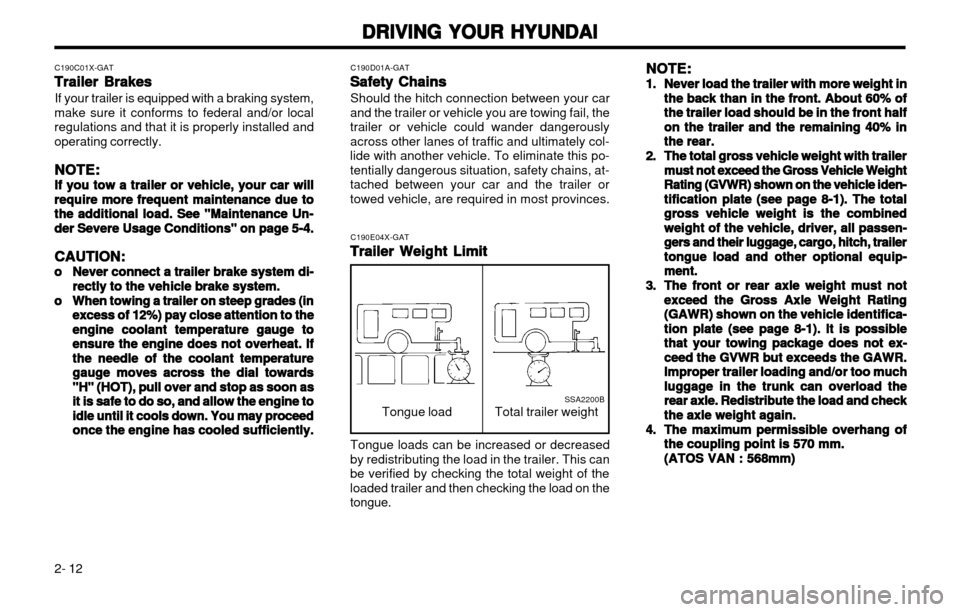
C190E04X-GATTrailer Weight Limit
Trailer Weight Limit Trailer Weight Limit
Trailer Weight Limit
Trailer Weight Limit
Tongue load Total trailer weightSSA2200B
Tongue loads can be increased or decreased
by redistributing the load in the trailer. This can be verified by checking the total weight of the
loaded trailer and then checking the load on thetongue.
C190C01X-GAT
Trailer Brakes
Trailer Brakes Trailer Brakes
Trailer Brakes
Trailer Brakes
If your trailer is equipped with a braking system,
make sure it conforms to federal and/or localregulations and that it is properly installed andoperating correctly.
NOTE:
NOTE: NOTE:
NOTE:
NOTE:
If you tow a trailer or vehicle, your car will
If you tow a trailer or vehicle, your car will If you tow a trailer or vehicle, your car will
If you tow a trailer or vehicle, your car will
If you tow a trailer or vehicle, your car will require more frequent
require more frequent require more frequent
require more frequent
require more frequent maintenance due to
maintenance due to maintenance due to
maintenance due to
maintenance due to
the additional load. See "Maintenance Un-
the additional load. See "Maintenance Un- the additional load. See "Maintenance Un-
the additional load. See "Maintenance Un-
the additional load. See "Maintenance Un-
der Severe
der Severe der Severe
der Severe
der Severe Usage Conditions" on page 5-4.
Usage Conditions" on page 5-4. Usage Conditions" on page 5-4.
Usage Conditions" on page 5-4.
Usage Conditions" on page 5-4.
CAUTION:
CAUTION: CAUTION:
CAUTION:
CAUTION:
oo
oo
o
Never connect a trailer brake system di-
Never connect a trailer brake system di- Never connect a trailer brake system di-
Never connect a trailer brake system di-
Never connect a trailer brake system di-
rectly
rectly rectly
rectly
rectly to the vehicle brake system.
to the vehicle brake system. to the vehicle brake system.
to the vehicle brake system.
to the vehicle brake system.
oo
oo
o
When towing a trailer on steep grades (in
When towing a trailer on steep grades (in When towing a trailer on steep grades (in
When towing a trailer on steep grades (in
When towing a trailer on steep grades (in
excess of 12%) pay close
excess of 12%) pay close excess of 12%) pay close
excess of 12%) pay close
excess of 12%) pay close
attention to the
attention to the attention to the
attention to the
attention to the
engine coolant temperature gauge to
engine coolant temperature gauge to engine coolant temperature gauge to
engine coolant temperature gauge to
engine coolant temperature gauge to
ensure the engine does
ensure the engine does ensure the engine does
ensure the engine does
ensure the engine does not overheat. If
not overheat. If not overheat. If
not overheat. If
not overheat. If
the needle of the coolant temperature
the needle of the coolant temperature the needle of the coolant temperature
the needle of the coolant temperature
the needle of the coolant temperature
gauge moves across
gauge moves across gauge moves across
gauge moves across
gauge moves across the dial towards
the dial towards the dial towards
the dial towards
the dial towards
"H" (HOT), pull over and stop as soon as
"H" (HOT), pull over and stop as soon as "H" (HOT), pull over and stop as soon as
"H" (HOT), pull over and stop as soon as
"H" (HOT), pull over and stop as soon as
it is safe to do
it is safe to do it is safe to do
it is safe to do
it is safe to do so, and allow the engine to
so, and allow the engine to so, and allow the engine to
so, and allow the engine to
so, and allow the engine to
idle until it cools down. You may proceed
idle until it cools down. You may proceed idle until it cools down. You may proceed
idle until it cools down. You may proceed
idle until it cools down. You may proceed
once
once once
once
once the engine has cooled sufficiently.
the engine has cooled sufficiently. the engine has cooled sufficiently.
the engine has cooled sufficiently.
the engine has cooled sufficiently.
Page 76 of 249
DRIVING YOUR HYUNDAI
DRIVING YOUR HYUNDAI DRIVING YOUR HYUNDAI
DRIVING YOUR HYUNDAI
DRIVING YOUR HYUNDAI
2- 13
4. To maintain engine braking efficiency andelectrical charging performance, do not use fifth gear (manual transaxle) or overdrive(automatic transaxle).
5. Always secure items in the trailer to prevent load shift while driving.
6. Check the condition and air pressure of all tires on the trailer and your car. Low tirepressure can seriously affect the handling.Also check the spare tire.
7. The vehicle/trailer combination is more af- fected by crosswind and buffeting. When being passed by a large vehicle, keep a constant speed and steer straight ahead.If there is too much wind buffeting slowdown to get out of the other vehicle's airturbulence.
8. When parking your car and trailer, especial- ly on a hill, be sure to follow all the normalprecautions. Turn your front wheel into thecurb, set the parking brake firmly, and putthe transaxle in 1st or Reverse (manual) orPark (automatic). In addition, place wheelchocks at each of the trailer's tires.
9. If the trailer has electric brakes, start your vehicle and trailer moving, and then applythe trailer brake controller by hand to besure the brakes are working. This lets youcheck your electrical connection at the sametime.
10. During your trip, check occasionally to be sure that the load is secure, and that thelights and any trailer brakes are still working.
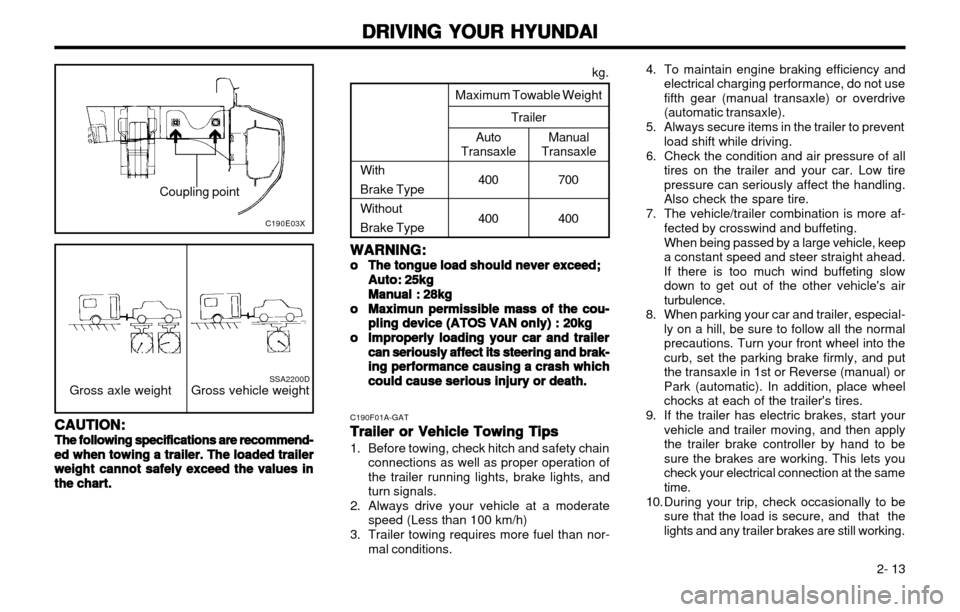
WARNING:
WARNING: WARNING:
WARNING:
WARNING:
oo
oo
o The tongue load should never exceed;
The tongue load should never exceed; The tongue load should never exceed;
The tongue load should never exceed;
The tongue load should never exceed;
Auto: 25kg
Auto: 25kg Auto: 25kg
Auto: 25kg
Auto: 25kg
Manual : 28kg
Manual : 28kg Manual : 28kg
Manual : 28kg
Manual : 28kg
oo
oo
o Maximun permissible mass of the cou-
Maximun permissible mass of the cou- Maximun permissible mass of the cou-
Maximun permissible mass of the cou-
Maximun permissible mass of the cou-
pling device (ATOS VAN only) : 20kg
pling device (ATOS VAN only) : 20kg pling device (ATOS VAN only) : 20kg
pling device (ATOS VAN only) : 20kg
pling device (ATOS VAN only) : 20kg
oo
oo
o Improperly loading your car and trailer
Improperly loading your car and trailer Improperly loading your car and trailer
Improperly loading your car and trailer
Improperly loading your car and trailer
can seriously affect its steering and brak-
can seriously affect its steering and brak- can seriously affect its steering and brak-
can seriously affect its steering and brak-
can seriously affect its steering and brak-
ing performance causing a crash which
ing performance causing a crash which ing performance causing a crash which
ing performance causing a crash which
ing performance causing a crash which
could cause serious injury or death.
could cause serious injury or death. could cause serious injury or death.
could cause serious injury or death.
could cause serious injury or death. kg.
Maximum Towable Weight Trailer
Manual
TransaxleAuto
Transaxle
With Brake TypeWithoutBrake Type 400 400
C190F01A-GAT
Trailer or Vehicle Towing Tips
Trailer or Vehicle Towing Tips Trailer or Vehicle Towing Tips
Trailer or Vehicle Towing Tips
Trailer or Vehicle Towing Tips
1. Before towing, check hitch and safety chain
connections as well as proper operation of the trailer running lights, brake lights, andturn signals.
2. Always drive your vehicle at a moderate speed (Less than 100 km/h)
3. Trailer towing requires more fuel than nor- mal conditions.
Gross axle weight Gross vehicle weightSSA2200D
CAUTION:
CAUTION: CAUTION:
CAUTION:
CAUTION:
The following specifications are recommend-
The following specifications are recommend- The following specifications are recommend-
The following specifications are recommend-
The following specifications are recommend- ed when towing a
ed when towing a ed when towing a
ed when towing a
ed when towing a trailer. The loaded trailer
trailer. The loaded trailer trailer. The loaded trailer
trailer. The loaded trailer
trailer. The loaded trailer
weight cannot safely exceed the values in
weight cannot safely exceed the values in weight cannot safely exceed the values in
weight cannot safely exceed the values in
weight cannot safely exceed the values in
the the
the the
the chart.
chart. chart.
chart.
chart. Coupling point
C190E03X
700 400
Page 77 of 249
DRIVING YOUR HYUNDAI
DRIVING YOUR HYUNDAI DRIVING YOUR HYUNDAI
DRIVING YOUR HYUNDAI
DRIVING YOUR HYUNDAI
2- 14
11. Avoid jerky starts, sudden acceleration or
sudden stops.
12. Avoid sharp turns and rapid lane changes.
13. Avoid holding the brake pedal down too long or too frequently. This could cause the brakes to overheat, resulting in reduced brakingefficiency.
14. When going down a hill, shift into a lower gear and use the engine braking effect. When ascending a long grade, downshift the transaxle to a lower gear and reduce speedto reduce chances of engine overloadingand/or overheating.
15. If you have to stop while going uphill, do not hold the vehicle in place by pressing on theaccelerator. This can cause the automatictransaxle to overheat. Use the parking brakeor footbrake.
NOTE:
NOTE: NOTE:
NOTE:
NOTE:
When towing check transaxle fluid more
When towing check transaxle fluid more When towing check transaxle fluid more
When towing check transaxle fluid more
When towing check transaxle fluid more frequently.
frequently. frequently.
frequently.
frequently.
CAUTION:
CAUTION: CAUTION:
CAUTION:
CAUTION:
If overheating should occur when towing,
If overheating should occur when towing, If overheating should occur when towing,
If overheating should occur when towing,
If overheating should occur when towing,(temperature gauge reads near red zone),
(temperature gauge reads near red zone), (temperature gauge reads near red zone),
(temperature gauge reads near red zone),
(temperature gauge reads near red zone),
taking the following action may reduce or
taking the following action may reduce or taking the following action may reduce or
taking the following action may reduce or
taking the following action may reduce or
eliminate the problem.
eliminate the problem. eliminate the problem.
eliminate the problem.
eliminate the problem. 1. Turn off the air conditioner.
2. Reduce highway speed.
3. Select a lower gear when going uphill.
4. While in stop and go traffic, place the gear
selector in park or neutral and idle the en- gine at a higher speed.