2002 Hyundai Atos airbag off
[x] Cancel search: airbag offPage 15 of 249
FEATURES OF YOUR HYUNDAI
FEATURES OF YOUR HYUNDAI FEATURES OF YOUR HYUNDAI
FEATURES OF YOUR HYUNDAI
FEATURES OF YOUR HYUNDAI
1- 6 To raise or lower the window, turn the window regulator handle clockwise or counterclockwise. WARNING: When opening or closing the windows, makesure your passenger's arms, hands and bodyare safely out of the way.
B050A01A-AAT WINDOW GLASS
B050A01A
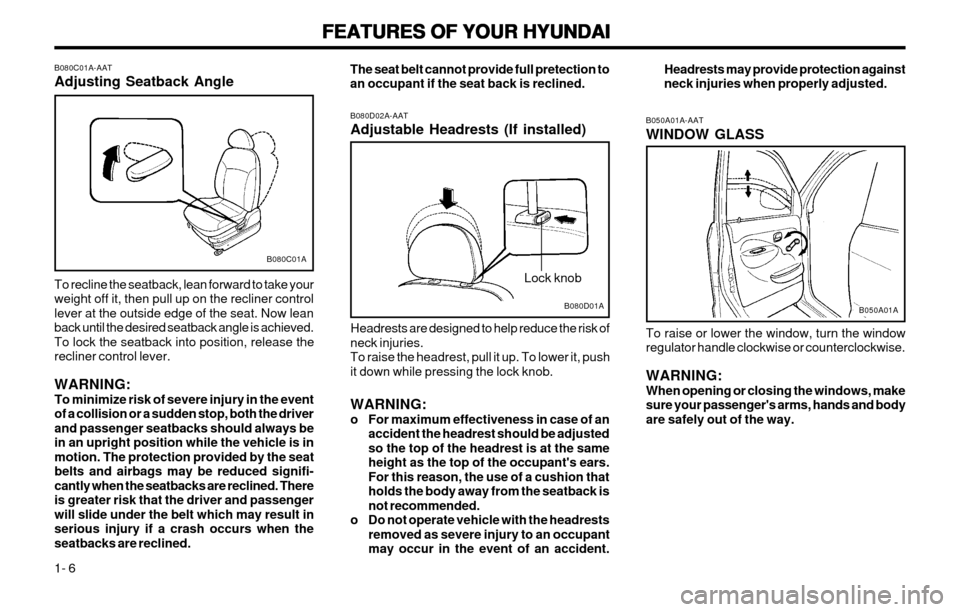
B080D02A-AAT Adjustable Headrests (If installed) Headrests are designed to help reduce the risk of neck injuries.To raise the headrest, pull it up. To lower it, pushit down while pressing the lock knob. WARNING:
o For maximum effectiveness in case of an
accident the headrest should be adjustedso the top of the headrest is at the sameheight as the top of the occupant's ears.For this reason, the use of a cushion thatholds the body away from the seatback isnot recommended.
o Do not operate vehicle with the headrests removed as severe injury to an occupantmay occur in the event of an accident.B080D01A
Lock knob
The seat belt cannot provide full pretection to an occupant if the seat back is reclined.
Headrests may provide protection againstneck injuries when properly adjusted.
B080C01A-AAT Adjusting Seatback Angle To recline the seatback, lean forward to take your weight off it, then pull up on the recliner controllever at the outside edge of the seat. Now leanback until the desired seatback angle is achieved.To lock the seatback into position, release therecliner control lever. WARNING: To minimize risk of severe injury in the eventof a collision or a sudden stop, both the driverand passenger seatbacks should always bein an upright position while the vehicle is inmotion. The protection provided by the seatbelts and airbags may be reduced signifi-cantly when the seatbacks are reclined. Thereis greater risk that the driver and passengerwill slide under the belt which may result inserious injury if a crash occurs when theseatbacks are reclined.
B080C01A
Page 22 of 249
FEATURES OF YOUR HYUNDAI
FEATURES OF YOUR HYUNDAI FEATURES OF YOUR HYUNDAI
FEATURES OF YOUR HYUNDAI
FEATURES OF YOUR HYUNDAI
1- 13
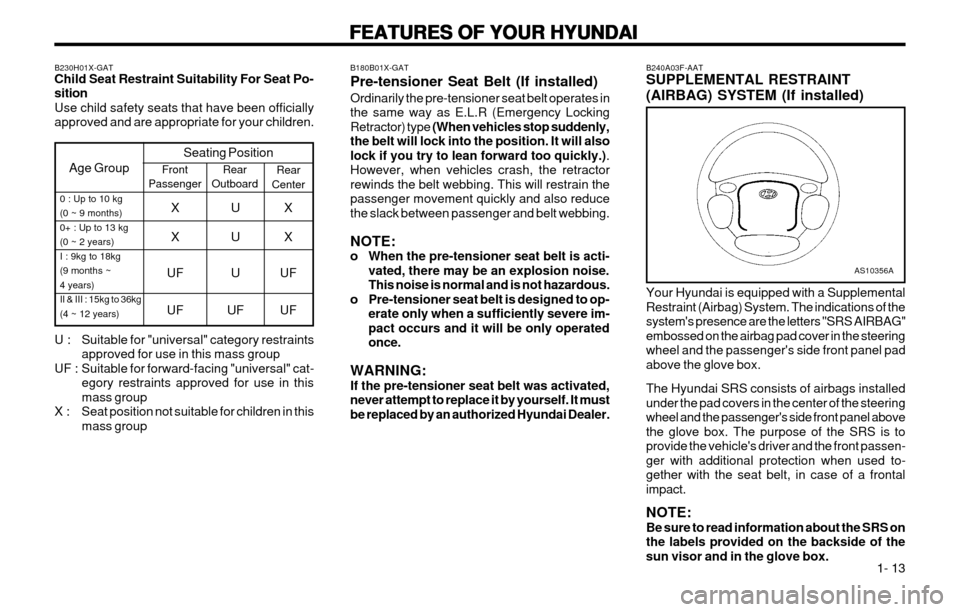
B240A03F-AAT SUPPLEMENTAL RESTRAINT (AIRBAG) SYSTEM (If installed)
AS10356A
Your Hyundai is equipped with a Supplemental Restraint (Airbag) System. The indications of thesystem's presence are the letters "SRS AIRBAG"embossed on the airbag pad cover in the steeringwheel and the passenger's side front panel padabove the glove box. The Hyundai SRS consists of airbags installed under the pad covers in the center of the steeringwheel and the passenger's side front panel abovethe glove box. The purpose of the SRS is toprovide the vehicle's driver and the front passen-ger with additional protection when used to-gether with the seat belt, in case of a frontalimpact. NOTE: Be sure to read information about the SRS onthe labels provided on the backside of thesun visor and in the glove box.
B180B01X-GAT Pre-tensioner Seat Belt (If installed)Ordinarily the pre-tensioner seat belt operates in the same way as E.L.R (Emergency LockingRetractor) type (When vehicles stop suddenly,
the belt will lock into the position. It will alsolock if you try to lean forward too quickly.) .
However, when vehicles crash, the retractorrewinds the belt webbing. This will restrain thepassenger movement quickly and also reducethe slack between passenger and belt webbing. NOTE:
o When the pre-tensioner seat belt is acti- vated, there may be an explosion noise.This noise is normal and is not hazardous.
o Pre-tensioner seat belt is designed to op- erate only when a sufficiently severe im-pact occurs and it will be only operatedonce.
WARNING:If the pre-tensioner seat belt was activated,never attempt to replace it by yourself. It mustbe replaced by an authorized Hyundai Dealer.
Age Group Seating PositionFront
Passenger Rear
Outboard Rear
Center
0 : Up to 10 kg (0 ~ 9 months)0+ : Up to 13 kg(0 ~ 2 years)I : 9kg to 18kg(9 months ~4 years)II & III : 15kg to 36kg(4 ~ 12 years)XUX
XUX
UF U UF
UF UF UF
U : Suitable for "universal" category restraints approved for use in this mass group
UF : Suitable for forward-facing "universal" cat- egory restraints approved for use in this mass group
X : Seat position not suitable for children in this mass group
B230H01X-GAT Child Seat Restraint Suitability For Seat Po- sitionUse child safety seats that have been officiallyapproved and are appropriate for your children.
Page 30 of 249

FEATURES OF YOUR HYUNDAI
FEATURES OF YOUR HYUNDAI FEATURES OF YOUR HYUNDAI
FEATURES OF YOUR HYUNDAI
FEATURES OF YOUR HYUNDAI
1- 21
B270A01A-AAT BRAKE PAD WEAR WARNING SOUND The front disc brake pads have wear indicators that should make a high-pitched squealing orscraping noise when new pads are needed. Thesound may come and go or be heard all the timewhen the vehicle is moving. It may also be heard
B260M01A-AAT
Low Fuel Level Warning Light
The low fuel level warning light comes on when thefuel tank is approaching empty. When it comes on,you should add fuel as soon as possible. Drivingwith the fuel level warning light on or with the fuellevel below "E" can cause the engine to misfireand damage the catalytic converter.
hydraulic system is dangerous, and could result in serious injury or death. Warning Light Operation The parking brake/brake fluid level warning light should come on when the parking brake is ap-plied and the ignition switch is turned to "ON" or"START". After the engine is started, the lightshould go out when the parking brake is re-leased.If the parking brake is not applied, the warninglight should come on when the ignition switch isturned to "ON" or "START", then go out when theengine starts. If the light comes on at any othertime, you should slow the vehicle and bring it toa complete stop in a safe location off the road-way.The brake warning light indicates that the brakefluid level in the brake master cylinder is low andhydraulic brake fluid conforming to DOT 3 orDOT 4 specifications should be added. Afteradding fluid, if no other trouble is found, the carshould be immediately and carefully drivento a Hyundai dealer for inspection. If furthertrouble is experienced, the vehicle should not bedriven at all but taken to a dealer by a profes-sional towing service or some other safe method.Your Hyundai is equipped with dual-diagonalbraking systems. This means you still have brak-ing on two wheels even if one of the dual systemsshould fail. With only one of the dual systemsworking, more than normal pedal travel andgreater pedal pressure are required to stop thecar. Also, the car will not stop in as short a B260J01S-GAT
Charging System Warning Light
The charging system warning light should comeon when the ignition is turned on, then go outwhen the engine is running. If the light stays onwhile the engine is running, there is a malfunctionin the electrical charging system. If the lightcomes on while you are driving, stop, turn off theengine and check under the hood. First, makecertain the generator drive belt is in place. If it is,check the tension of the belt.And then, have the system checked by yourHyundai dealer. CAUTION: If the drive belt (generator belt) is loosen,broken, or mission while the vehicle is driv-ing, there may be a serious malfunction, en-gine could overheat because this belt alsodrives the water pump.
B260L01A-GAT Door Ajar Warning Light
The door ajar warning light warns you that a door is not completely closed.
B260B01S-GAT SRS (Airbag) Service Reminder Indicator (SRI) (If installed)
The SRS service reminder indicator (SRI) comes on and flashes for about 6 seconds after theignition key is turned to the "ON" position or afterthe engine is started, after which it will go out.This light also comes on when the SRS is notworking properly. If the SRI does not come on, orcontinuously remains on after flashing for about6 seconds when you turned the ignition key to the"ON" position or started the engine, or if it comeson while driving, have the SRS inspected by anauthorized Hyundai Dealer.
distance with only half of the brake system work- ing. If the brakes fail while you are driving, shift toa lower gear for additional engine braking andstop the car as soon as it is safe to do so.
Page 142 of 249
FEATURES OF YOUR HYUNDAI 1-5
B080A01A-AAT ADJUSTABLE FRONT SEATS WARNING: Never attempt to adjust the seat while the vehicle is moving. This could result in lossof control, and an accident causing death,serious injury, or property damage. B080B01A-AAT Adjusting Seat Forward and Rearward
B080C01A-AATAdjusting Seatback Angle
XV10110E
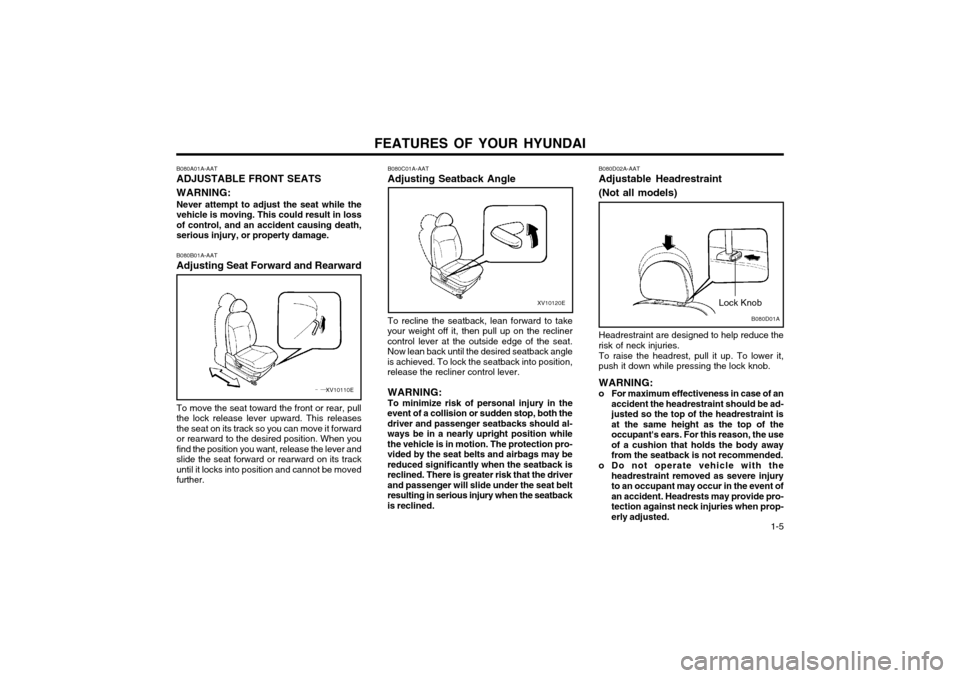
To move the seat toward the front or rear, pull the lock release lever upward. This releasesthe seat on its track so you can move it forwardor rearward to the desired position. When youfind the position you want, release the lever andslide the seat forward or rearward on its trackuntil it locks into position and cannot be movedfurther.
XV10120E
To recline the seatback, lean forward to take
your weight off it, then pull up on the recliner control lever at the outside edge of the seat.Now lean back until the desired seatback angleis achieved. To lock the seatback into position,release the recliner control lever.
WARNING: To minimize risk of personal injury in the
event of a collision or sudden stop, both the driver and passenger seatbacks should al-ways be in a nearly upright position whilethe vehicle is in motion. The protection pro-vided by the seat belts and airbags may bereduced significantly when the seatback isreclined. There is greater risk that the driverand passenger will slide under the seat beltresulting in serious injury when the seatbackis reclined.B080D01A
Lock Knob
B080D02A-AAT Adjustable Headrestraint (Not all models) Headrestraint are designed to help reduce the
risk of neck injuries.
To raise the headrest, pull it up. To lower it,
push it down while pressing the lock knob.
WARNING:
o For maximum effectiveness in case of an accident the headrestraint should be ad- justed so the top of the headrestraint isat the same height as the top of theoccupant's ears. For this reason, the useof a cushion that holds the body awayfrom the seatback is not recommended.
o Do not operate vehicle with the headrestraint removed as severe injuryto an occupant may occur in the event ofan accident. Headrests may provide pro-tection against neck injuries when prop-erly adjusted.
Page 148 of 249
FEATURES OF YOUR HYUNDAI 1-11
B230G01A-GAT Installation on Outboard Rear Seats
YR10400B
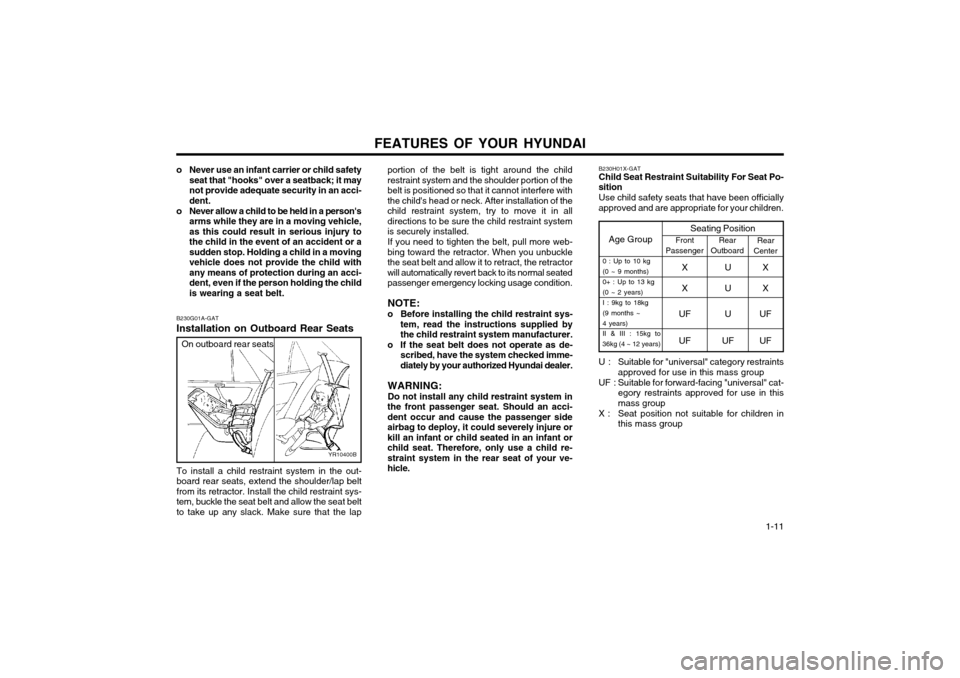
To install a child restraint system in the out- board rear seats, extend the shoulder/lap beltfrom its retractor. Install the child restraint sys-tem, buckle the seat belt and allow the seat beltto take up any slack. Make sure that the lap
On outboard rear seats
o Never use an infant carrier or child safety
seat that "hooks" over a seatback; it may not provide adequate security in an acci-dent.
o Never allow a child to be held in a person's arms while they are in a moving vehicle,as this could result in serious injury tothe child in the event of an accident or asudden stop. Holding a child in a movingvehicle does not provide the child withany means of protection during an acci-dent, even if the person holding the childis wearing a seat belt. portion of the belt is tight around the childrestraint system and the shoulder portion of thebelt is positioned so that it cannot interfere withthe child's head or neck. After installation of thechild restraint system, try to move it in alldirections to be sure the child restraint systemis securely installed.
If you need to tighten the belt, pull more web-
bing toward the retractor. When you unbucklethe seat belt and allow it to retract, the retractorwill automatically revert back to its normal seatedpassenger emergency locking usage condition.
NOTE:
o Before installing the child restraint sys- tem, read the instructions supplied bythe child restraint system manufacturer.
o If the seat belt does not operate as de- scribed, have the system checked imme-diately by your authorized Hyundai dealer.
WARNING: Do not install any child restraint system in
the front passenger seat. Should an acci- dent occur and cause the passenger sideairbag to deploy, it could severely injure orkill an infant or child seated in an infant orchild seat. Therefore, only use a child re-straint system in the rear seat of your ve-hicle.
Age Group Seating PositionFront
Passenger Rear
Outboard Rear
Center
0 : Up to 10 kg (0 ~ 9 months) 0+ : Up to 13 kg(0 ~ 2 years)I : 9kg to 18kg(9 months ~4 years) II & III : 15kg to
36kg (4 ~ 12 years)XUX
XUX
UF U UF
UF UF UF
B230H01X-GAT Child Seat Restraint Suitability For Seat Po-
sition
Use child safety seats that have been officially
approved and are appropriate for your children.
U : Suitable for "universal" category restraints approved for use in this mass group
UF : Suitable for forward-facing "universal" cat- egory restraints approved for use in this mass group
X : Seat position not suitable for children in this mass group
Page 149 of 249
FEATURES OF YOUR HYUNDAI
1-12 NOTE: Be sure to read information about the SRS on the labels provided on the backside ofthe sun visor and in the glove box. WARNING:
o As its name implies, the SRS is designed
to work with, and be supplemental to, the driver's and the passenger's three pointseat belt systems and is not a substitutefor them. Therefore your seat belts mustbe worn at all times while the vehicle is inmotion. In addition, the airbags deployonly in certain frontal impact conditionssevere enough to likely cause significantinjury to the vehicle occupants.
o The SRS is designed to deploy the airbags only when an impact is sufficiently se-vere and when the impact angle is lessthan 30° from the forward longitudinalaxis of the vehicle and will not deploy inside, rear or rollover impacts. Additional-ly, the airbags will only deploy once. Thus, seat belts must be worn at all times.
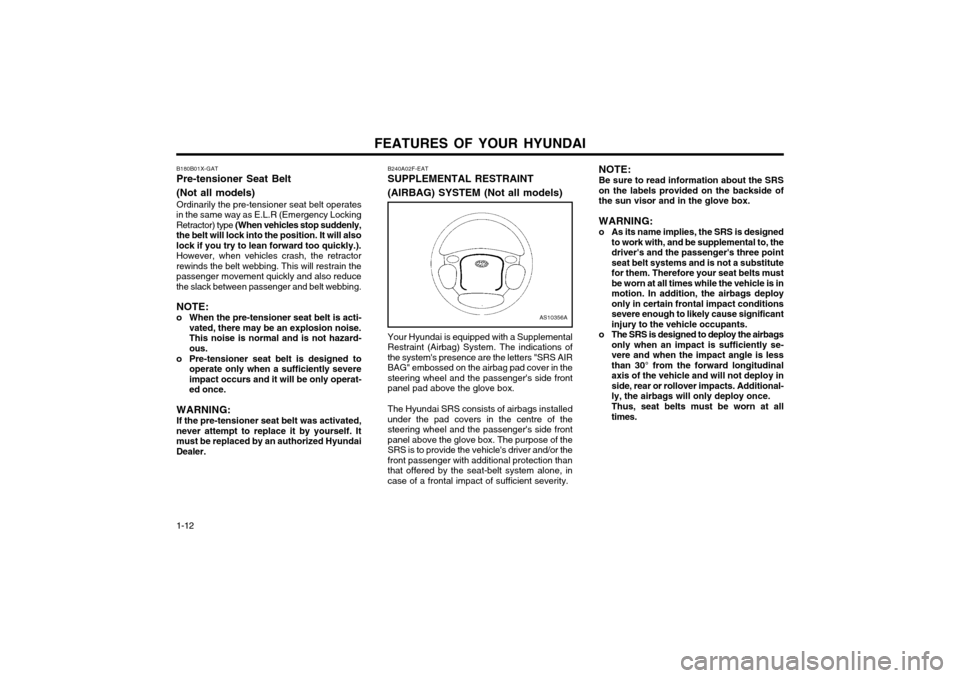
B240A02F-EAT SUPPLEMENTAL RESTRAINT (AIRBAG) SYSTEM (Not all models) Your Hyundai is equipped with a Supplemental Restraint (Airbag) System. The indications ofthe system's presence are the letters "SRS AIRBAG" embossed on the airbag pad cover in thesteering wheel and the passenger's side frontpanel pad above the glove box. The Hyundai SRS consists of airbags installed under the pad covers in the centre of thesteering wheel and the passenger's side frontpanel above the glove box. The purpose of theSRS is to provide the vehicle's driver and/or thefront passenger with additional protection thanthat offered by the seat-belt system alone, incase of a frontal impact of sufficient severity.
AS10356A
B180B01X-GAT Pre-tensioner Seat Belt (Not all models) Ordinarily the pre-tensioner seat belt operates
in the same way as E.L.R (Emergency Locking Retractor) type (When vehicles stop suddenly,
the belt will lock into the position. It will alsolock if you try to lean forward too quickly.).
However, when vehicles crash, the retractorrewinds the belt webbing. This will restrain thepassenger movement quickly and also reducethe slack between passenger and belt webbing.
NOTE:
o When the pre-tensioner seat belt is acti- vated, there may be an explosion noise.This noise is normal and is not hazard-ous.
o Pre-tensioner seat belt is designed to operate only when a sufficiently severeimpact occurs and it will be only operat-ed once.
WARNING: If the pre-tensioner seat belt was activated,
never attempt to replace it by yourself. It must be replaced by an authorized HyundaiDealer.
Page 156 of 249

FEATURES OF YOUR HYUNDAI 1-19
YB110C1-A
SRS (Airbag) SERVICE REMINDER INDICATOR(Not all models)
The SRS service reminder indicator (SRI) comes
on and flashes for about 6 seconds after the ignition key is turned to the “ON” position orafter the engine is started, after which it will goout.
This light also comes on when the SRS is not
working properly.
If the SRI does not come on, or continuously
remains on after flashing for about 6 secondswhen you turned the ignition key to the “ON”position or started the engine, or if it comes onwhile driving, have the SRS inspected by anauthorized Hyundai Dealer.
ZB110P2-E LOW FUEL LEVEL WARNING LIGHT
The low fuel level warning light comes on when the fuel tank is approaching empty. When itcomes on, you should add fuel as soon aspossible. Driving with the fuel level warning lighton or with the fuel level below "E" can cause theengine to misfire.
ZB110R1-E BRAKE PAD WEAR WARNING SOUNDWhen the brake pads of the front brakes be-
come worn to almost the limit of use, a metalfriction squealing sound will be heard as awarning to the driver that the brakes should bechecked. When this sound is heard, replace thebrake pads with new ones.
ZB110Q2-A MALFUNCTION INDICATOR LIGHT
This light illuminates when there is a malfunc- tion of an exhaust gas related component, andthe system is not functioning properly so that
B260L01A-GAT DOOR AJAR WARNING LIGHT
The door ajar warning light warns you that a
door is not completely closed.
ZB110M2-E CHARGING WARNING LIGHT
This red warning light indicates malfunctioning of the alternator and electrical charging system.If this warning light glows when the ignitionswitch is in the "ON" position (engine off), thebulb and electrical wiring are satisfactory. Thelight should go out when the engine is started.If the light glows when the engine is running, thealternator and electrical system should bechecked as soon as possible.
Warning Light Operation The parking brake/brake fluid level warning
light should come on when the parking brake is applied and the ignition switch is turned to "ON"or "START". After the engine is started, the lightshould go out when the parking brake is re-leased.
If the parking brake is not applied, the warning
light should come on when the ignition switch isturned to "ON" or "START", then go out whenthe engine starts. If the light comes on at anyother time, you should slow the vehicle andbring it to a complete stop in a safe location offthe roadway.
The brake warning light indicates that the brake
fluid level in the brake master cylinder is lowand hydraulic brake fluid conforming to DOT 3or DOT 4 specifications should be added. Afteradding fluid, if no other trouble is found, the carshould be immediately and carefully drivento a Hyundai dealer for inspection. If furthertrouble is experienced, the vehicle should notbe driven at all but taken to a dealer by aprofessional towing service or some other safemethod.
Your Hyundai is equipped with dual-diagonal
braking systems. This means you still havebraking on two wheels even if one of the dualsystems should fail. With only one of the dualsystems working, more than normal pedal trav-el and greater pedal pressure are required tostop the car. Also, the car will not stop in asshort a distance with only half of the brakesystem working. If the brakes fail while you are driving, shift to a lower gear for additional en-gine braking and stop the car as soon as it issafe to do so.
Page 169 of 249
FEATURES OF YOUR HYUNDAI
1-32
B670B02X-DAG
B670B02X-GAT Fan Speed Control (Blower Control)
This is used to turn the blower fan on and off
and to select the fan speed.
The blower fan speed, and therefore the vol-
ume of air delivered from the system, may be controlled manually by setting the blower con-trol between the "1" and "4" position.
B680A01X-GAT HEATING AND VENTILATION (Not all models)
B680A02X-DAG
1
2
3
4
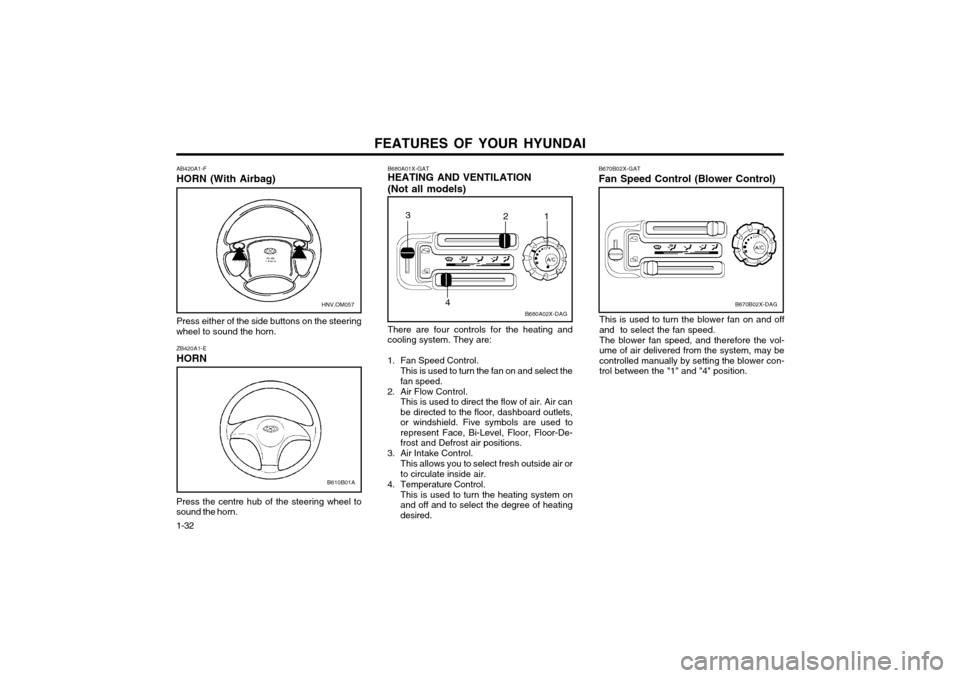
There are four controls for the heating and cooling system. They are:
1. Fan Speed Control. This is used to turn the fan on and select thefan speed.
2. Air Flow Control. This is used to direct the flow of air. Air canbe directed to the floor, dashboard outlets,or windshield. Five symbols are used torepresent Face, Bi-Level, Floor, Floor-De-frost and Defrost air positions.
3. Air Intake Control. This allows you to select fresh outside air orto circulate inside air.
4. Temperature Control. This is used to turn the heating system onand off and to select the degree of heatingdesired.
AB420A1-F HORN (With Airbag)
HNV.OM057
Press either of the side buttons on the steering
wheel to sound the horn.
ZB420A1-E HORN
B610B01A
Press the centre hub of the steering wheel to sound the horn.