2002 DODGE RAM fuse box
[x] Cancel search: fuse boxPage 1064 of 2255
to service. Refer toCharging Systemin the index of
this service manual for the charging system diagnos-
tic procedures.
(1) Position the generator cartridge fuse onto the
two B(+) terminal stud bus bars within the PDC.
(2) Install and tighten the two screws that secure
the generator cartridge fuse to the two B(+) terminal
stud bus bars within the PDC. Tighten the screws to
3.4 N´m (30 in. lbs.).Be certain that both screws
are tightened to the proper torque value.
(3) Install and latch the cover onto the PDC.
(4) Reconnect the battery negative cable.
IOD FUSE
DESCRIPTION
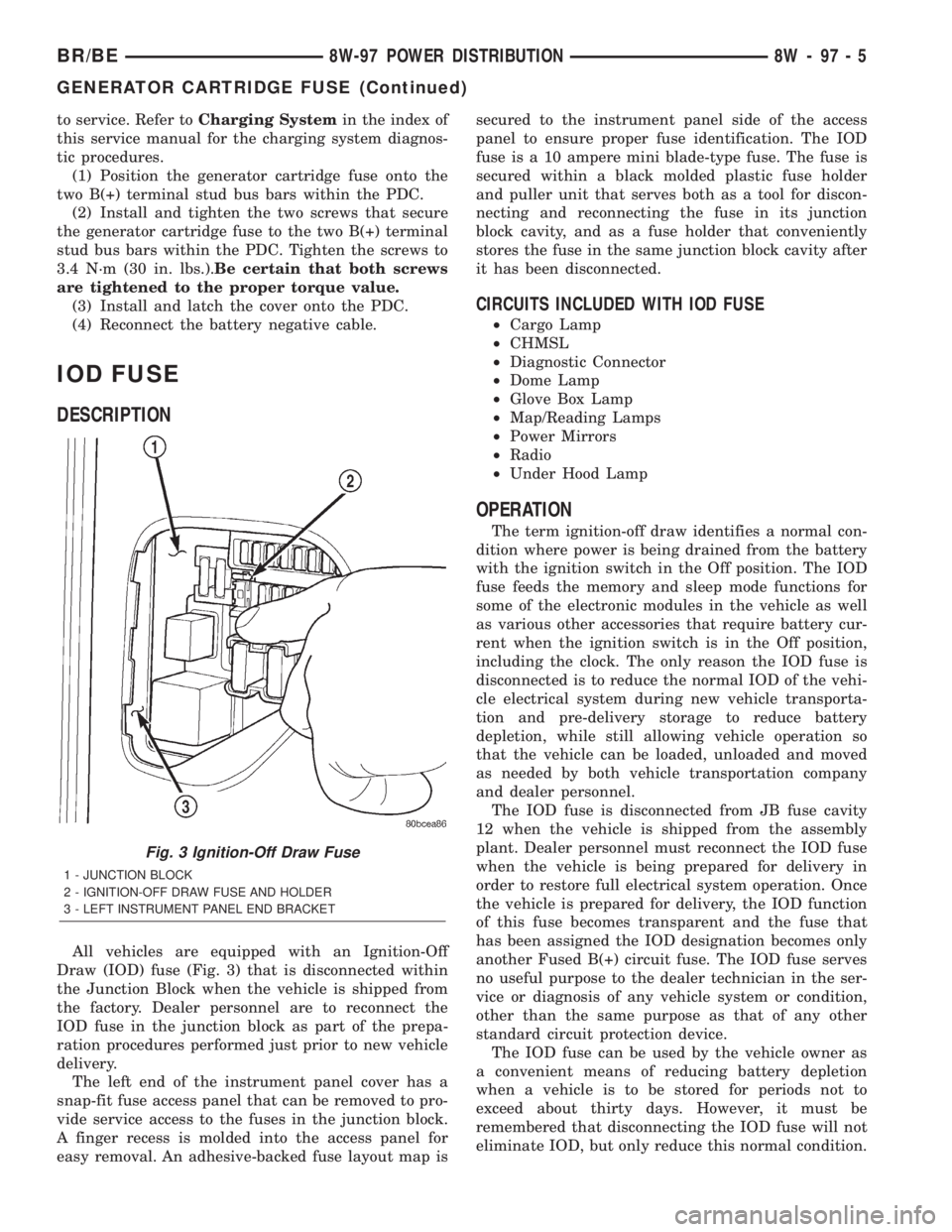
All vehicles are equipped with an Ignition-Off
Draw (IOD) fuse (Fig. 3) that is disconnected within
the Junction Block when the vehicle is shipped from
the factory. Dealer personnel are to reconnect the
IOD fuse in the junction block as part of the prepa-
ration procedures performed just prior to new vehicle
delivery.
The left end of the instrument panel cover has a
snap-fit fuse access panel that can be removed to pro-
vide service access to the fuses in the junction block.
A finger recess is molded into the access panel for
easy removal. An adhesive-backed fuse layout map issecured to the instrument panel side of the access
panel to ensure proper fuse identification. The IOD
fuse is a 10 ampere mini blade-type fuse. The fuse is
secured within a black molded plastic fuse holder
and puller unit that serves both as a tool for discon-
necting and reconnecting the fuse in its junction
block cavity, and as a fuse holder that conveniently
stores the fuse in the same junction block cavity after
it has been disconnected.
CIRCUITS INCLUDED WITH IOD FUSE
²Cargo Lamp
²CHMSL
²Diagnostic Connector
²Dome Lamp
²Glove Box Lamp
²Map/Reading Lamps
²Power Mirrors
²Radio
²Under Hood Lamp
OPERATION
The term ignition-off draw identifies a normal con-
dition where power is being drained from the battery
with the ignition switch in the Off position. The IOD
fuse feeds the memory and sleep mode functions for
some of the electronic modules in the vehicle as well
as various other accessories that require battery cur-
rent when the ignition switch is in the Off position,
including the clock. The only reason the IOD fuse is
disconnected is to reduce the normal IOD of the vehi-
cle electrical system during new vehicle transporta-
tion and pre-delivery storage to reduce battery
depletion, while still allowing vehicle operation so
that the vehicle can be loaded, unloaded and moved
as needed by both vehicle transportation company
and dealer personnel.
The IOD fuse is disconnected from JB fuse cavity
12 when the vehicle is shipped from the assembly
plant. Dealer personnel must reconnect the IOD fuse
when the vehicle is being prepared for delivery in
order to restore full electrical system operation. Once
the vehicle is prepared for delivery, the IOD function
of this fuse becomes transparent and the fuse that
has been assigned the IOD designation becomes only
another Fused B(+) circuit fuse. The IOD fuse serves
no useful purpose to the dealer technician in the ser-
vice or diagnosis of any vehicle system or condition,
other than the same purpose as that of any other
standard circuit protection device.
The IOD fuse can be used by the vehicle owner as
a convenient means of reducing battery depletion
when a vehicle is to be stored for periods not to
exceed about thirty days. However, it must be
remembered that disconnecting the IOD fuse will not
eliminate IOD, but only reduce this normal condition.
Fig. 3 Ignition-Off Draw Fuse
1 - JUNCTION BLOCK
2 - IGNITION-OFF DRAW FUSE AND HOLDER
3 - LEFT INSTRUMENT PANEL END BRACKET
BR/BE8W-97 POWER DISTRIBUTION 8W - 97 - 5
GENERATOR CARTRIDGE FUSE (Continued)
Page 2073 of 2255
²Glove Box- The hinged bin-type glove box in
the passenger side of the instrument panel features a
recessed paddle-operated latch handle. Three molded
hook formations on the lower edge of the glove box
door are engaged with and pivot on three hinge pins
integral to the lower edge of the instrument panel
support structure. The glove box door also serves as
the passenger side knee blocker. A honeycomb struc-
ture between the inner and outer glove box door pan-
els helps to absorb the impact load and distribute it
to the instrument panel structure.
²Steering Column Opening Cover- The steer-
ing column opening cover serves as the driver side
knee blocker. This molded plastic cover has an inte-
gral ribbed plastic liner concealed behind it, for
increased strength and integrity. The steering column
opening cover transfers impact loads to the instru-
ment panel structural support.
²Top Cover- The instrument panel top cover or
base trim is the molded, grained, and color impreg-
nated plastic outer skin of the instrument panel
structural support.
Hard wired circuitry connects the electrical compo-
nents on the instrument panel to each other through
the electrical system of the vehicle. These hard wired
circuits are integral to several wire harnesses, which
are routed throughout the vehicle and retained by
many different methods. These circuits may be con-
nected to each other, to the vehicle electrical system
and to the instrument panel components through the
use of a combination of soldered splices, splice block
connectors and many different types of wire harness
terminal connectors and insulators. Refer to the
appropriate wiring information. The wiring informa-
tion includes complete circuit diagrams, proper wire
and connector repair procedures, further details on
wire harness routing and retention, as well as pin-
out and location views for the various wire harness
connectors, splices, and grounds.
OPERATION
The instrument panel serves as the command cen-
ter of the vehicle, which necessarily makes it a very
complex unit. The instrument panel is designed to
house the controls and monitors for standard and
optional powertrains, climate control systems, audio
systems, safety systems, and many other comfort or
convenience items. When the components of the
instrument panel structural support are properly
assembled and secured in the vehicle they provide
superior instrument panel stiffness and integrity to
help reduce buzzes, squeaks, and rattles. This type of
construction also provides improved energy absorp-
tion which, in conjunction with the dual airbags and
seat belts, helps to improve occupant protection.The instrument panel is also designed so that all of
the various controls can be safely reached and the
monitors can be easily viewed by the vehicle operator
when driving, while still allowing relative ease of
access to each of these items for service. Modular
instrument panel construction allows all of the
gauges and controls to be serviced from the front of
the panel. In addition, most of the instrument panel
electrical components can be accessed without com-
plete instrument panel removal. However, if neces-
sary, the instrument panel can be removed from the
vehicle as an assembly.
The steering column opening cover with its inte-
gral knee blocker located on the driver side of the
instrument panel works in conjunction with the air-
bag system in a frontal vehicle impact to keep the
driver properly positioned for an airbag deployment.
In addition, removal of this component provides
access to the steering column mounts, the steering
column wiring, the Junction Block (JB) (removal of a
snap-fit fuse access panel on the left end of the
instrument panel allows access to the fuses and cir-
cuit breakers), the Central Timer Module (CTM), the
Infinity speaker filter choke and relay unit, much of
the instrument panel wiring, and the gear selector
indicator cable (automatic transmission).
In a frontal collision, the glove box door on the pas-
senger side of the instrument panel provides the
same function for the front seat passenger as the
knee blocker does for the driver. The glove box door
also incorporates a recessed latch handle. Removal of
the glove box provides access to the passenger airbag,
the glove box lamp and switch, the radio antenna
coaxial cable, the heating and air conditioning vac-
uum harness connector, and additional instrument
panel wiring.
Removal of the instrument panel cluster bezel
allows access to the headlamp switch, instrument
cluster, radio, passenger airbag on-off switch, heated
seat switches (if equipped), and the heating and air
conditioning control. Removal of the instrument clus-
ter allows access to the cluster illumination and indi-
cator bulbs, and more of the instrument panel
wiring. Complete instrument panel removal is
required for service of most components internal to
the heating and air conditioning system housing,
including the heater core and the evaporator.
See the owner's manual in the vehicle glove box for
more information on the features, use and operation
of all of the components and systems mounted on or
in the instrument panel.
23 - 106 INSTRUMENT PANEL SYSTEMBR/BE
INSTRUMENT PANEL SYSTEM (Continued)
Page 2139 of 2255
(1) The relay common feed terminal cavity (30) is
connected to fused battery feed. There should be bat-
tery voltage at the cavity for relay terminal 30 at all
times. If OK, go to Step 2. If not OK, repair the open
circuit to the fuse in the PDC as required.
(2) The relay normally closed terminal (87A) is not
used in this application. Go to Step 3.
(3) The relay normally open terminal cavity (87) is
connected to the compressor clutch coil. There should
be continuity between this cavity and the A/C com-
pressor clutch relay output circuit cavity of the com-
pressor clutch coil wire harness connector. If OK, go
to Step 4. If not OK, repair the open circuit as
required.
(4) The relay coil battery terminal (86) is con-
nected to the fused ignition switch output (run/start)
circuit. There should be battery voltage at the cavity
for relay terminal 86 with the ignition switch in the
On position. If OK, go to Step 5. If not OK, repair the
open circuit to the fuse in the junction block as
required.
(5) The coil ground terminal cavity (85) is switched
to ground through the Powertrain Control Module
(PCM). There should be continuity between this cav-
ity and the A/C compressor clutch relay control cir-
cuit cavity of the PCM wire harness connector C
(gray) at all times. If not OK, repair the open circuit
as required.
REMOVAL
(1) Disconnect and isolate the battery negative
cable.
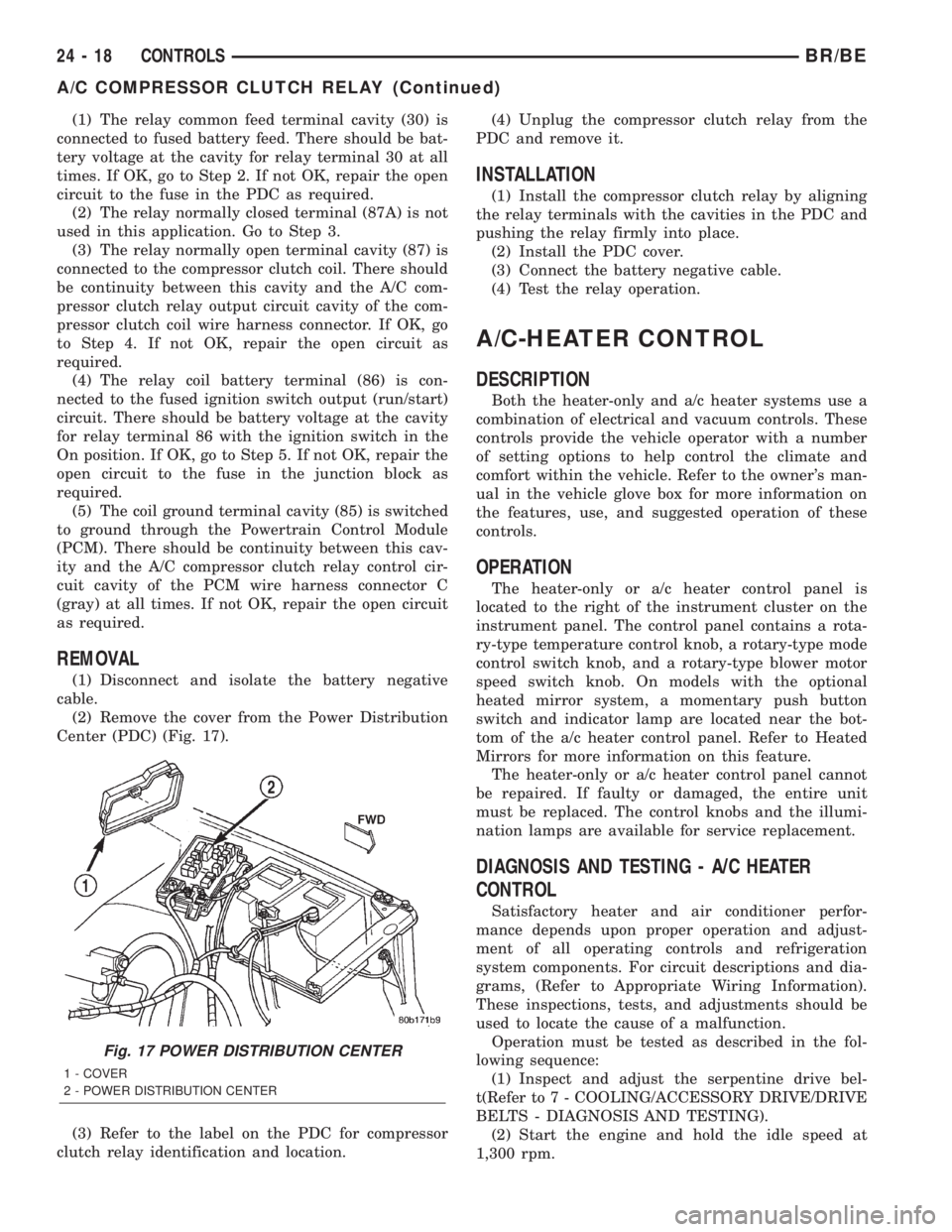
(2) Remove the cover from the Power Distribution
Center (PDC) (Fig. 17).
(3) Refer to the label on the PDC for compressor
clutch relay identification and location.(4) Unplug the compressor clutch relay from the
PDC and remove it.
INSTALLATION
(1) Install the compressor clutch relay by aligning
the relay terminals with the cavities in the PDC and
pushing the relay firmly into place.
(2) Install the PDC cover.
(3) Connect the battery negative cable.
(4) Test the relay operation.
A/C-HEATER CONTROL
DESCRIPTION
Both the heater-only and a/c heater systems use a
combination of electrical and vacuum controls. These
controls provide the vehicle operator with a number
of setting options to help control the climate and
comfort within the vehicle. Refer to the owner's man-
ual in the vehicle glove box for more information on
the features, use, and suggested operation of these
controls.
OPERATION
The heater-only or a/c heater control panel is
located to the right of the instrument cluster on the
instrument panel. The control panel contains a rota-
ry-type temperature control knob, a rotary-type mode
control switch knob, and a rotary-type blower motor
speed switch knob. On models with the optional
heated mirror system, a momentary push button
switch and indicator lamp are located near the bot-
tom of the a/c heater control panel. Refer to Heated
Mirrors for more information on this feature.
The heater-only or a/c heater control panel cannot
be repaired. If faulty or damaged, the entire unit
must be replaced. The control knobs and the illumi-
nation lamps are available for service replacement.
DIAGNOSIS AND TESTING - A/C HEATER
CONTROL
Satisfactory heater and air conditioner perfor-
mance depends upon proper operation and adjust-
ment of all operating controls and refrigeration
system components. For circuit descriptions and dia-
grams, (Refer to Appropriate Wiring Information).
These inspections, tests, and adjustments should be
used to locate the cause of a malfunction.
Operation must be tested as described in the fol-
lowing sequence:
(1) Inspect and adjust the serpentine drive bel-
t(Refer to 7 - COOLING/ACCESSORY DRIVE/DRIVE
BELTS - DIAGNOSIS AND TESTING).
(2) Start the engine and hold the idle speed at
1,300 rpm.
Fig. 17 POWER DISTRIBUTION CENTER
1 - COVER
2 - POWER DISTRIBUTION CENTER
24 - 18 CONTROLSBR/BE
A/C COMPRESSOR CLUTCH RELAY (Continued)
Page 2152 of 2255
AIR OUTLETS
REMOVAL - DEMISTER GRILLES
(1) Using a trim stick or another suitable wide
flat-bladed tool, gently pry at the perimeter edges of
the demister grille to release the snap features from
the instrument panel top cover.
(2) Remove the demister grille from the instru-
ment panel.
REMOVAL - PANEL OUTLET BARRELS
WARNING: THE PANEL OUTLET BARRELS
INSTALLED IN THE PASSENGER SIDE AIRBAG
DOOR PANEL OUTLET HOUSINGS MUST NEVER
BE REINSTALLED FOLLOWING REMOVAL FOR ANY
REASON. THEY MUST BE REPLACED WITH NEW
BARRELS. FAILURE TO OBSERVE THIS WARNING
COULD RESULT IN OCCUPANT INJURIES UPON
AIRBAG DEPLOYMENT.
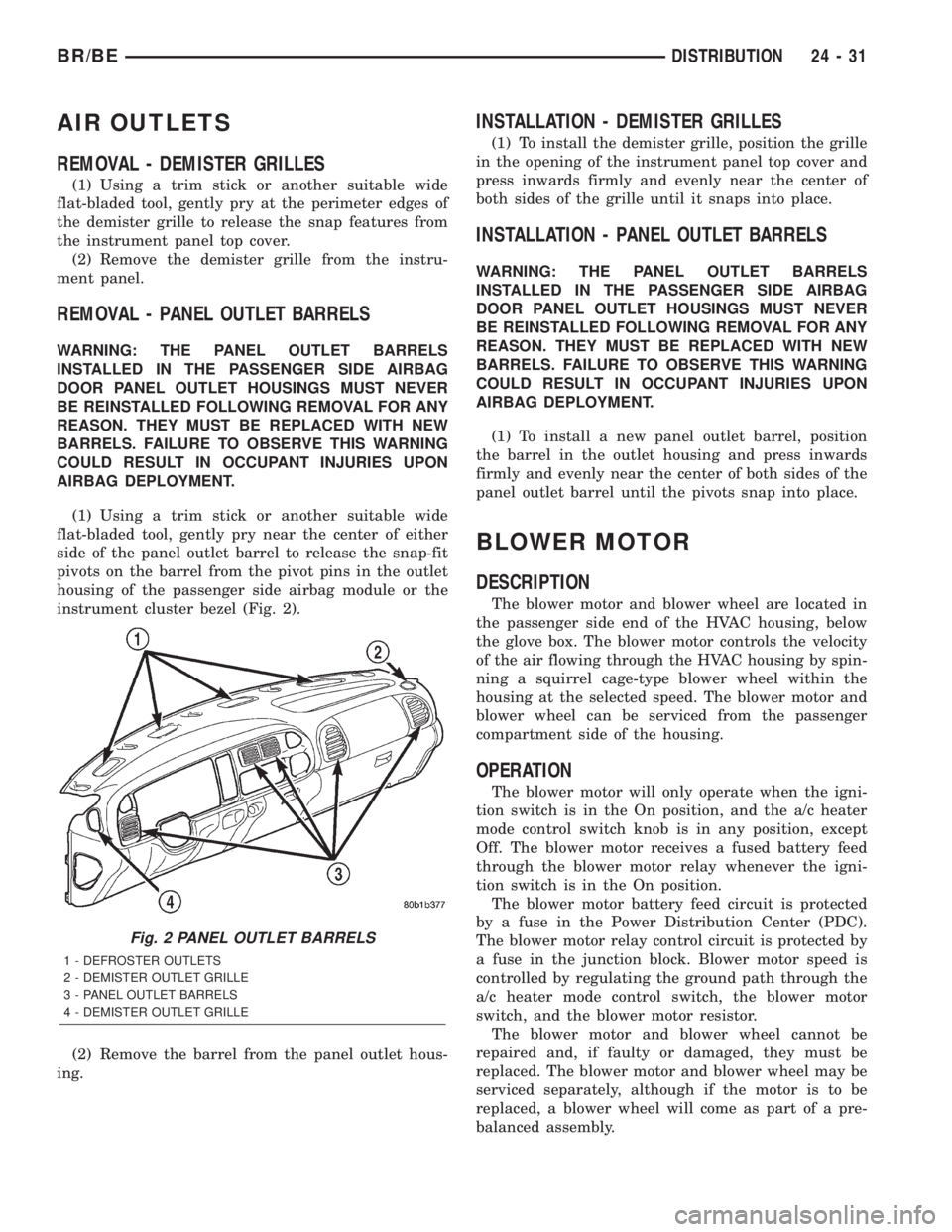
(1) Using a trim stick or another suitable wide
flat-bladed tool, gently pry near the center of either
side of the panel outlet barrel to release the snap-fit
pivots on the barrel from the pivot pins in the outlet
housing of the passenger side airbag module or the
instrument cluster bezel (Fig. 2).
(2) Remove the barrel from the panel outlet hous-
ing.
INSTALLATION - DEMISTER GRILLES
(1) To install the demister grille, position the grille
in the opening of the instrument panel top cover and
press inwards firmly and evenly near the center of
both sides of the grille until it snaps into place.
INSTALLATION - PANEL OUTLET BARRELS
WARNING: THE PANEL OUTLET BARRELS
INSTALLED IN THE PASSENGER SIDE AIRBAG
DOOR PANEL OUTLET HOUSINGS MUST NEVER
BE REINSTALLED FOLLOWING REMOVAL FOR ANY
REASON. THEY MUST BE REPLACED WITH NEW
BARRELS. FAILURE TO OBSERVE THIS WARNING
COULD RESULT IN OCCUPANT INJURIES UPON
AIRBAG DEPLOYMENT.
(1) To install a new panel outlet barrel, position
the barrel in the outlet housing and press inwards
firmly and evenly near the center of both sides of the
panel outlet barrel until the pivots snap into place.
BLOWER MOTOR
DESCRIPTION
The blower motor and blower wheel are located in
the passenger side end of the HVAC housing, below
the glove box. The blower motor controls the velocity
of the air flowing through the HVAC housing by spin-
ning a squirrel cage-type blower wheel within the
housing at the selected speed. The blower motor and
blower wheel can be serviced from the passenger
compartment side of the housing.
OPERATION
The blower motor will only operate when the igni-
tion switch is in the On position, and the a/c heater
mode control switch knob is in any position, except
Off. The blower motor receives a fused battery feed
through the blower motor relay whenever the igni-
tion switch is in the On position.
The blower motor battery feed circuit is protected
by a fuse in the Power Distribution Center (PDC).
The blower motor relay control circuit is protected by
a fuse in the junction block. Blower motor speed is
controlled by regulating the ground path through the
a/c heater mode control switch, the blower motor
switch, and the blower motor resistor.
The blower motor and blower wheel cannot be
repaired and, if faulty or damaged, they must be
replaced. The blower motor and blower wheel may be
serviced separately, although if the motor is to be
replaced, a blower wheel will come as part of a pre-
balanced assembly.
Fig. 2 PANEL OUTLET BARRELS
1 - DEFROSTER OUTLETS
2 - DEMISTER OUTLET GRILLE
3 - PANEL OUTLET BARRELS
4 - DEMISTER OUTLET GRILLE
BR/BEDISTRIBUTION 24 - 31
Page 2222 of 2255
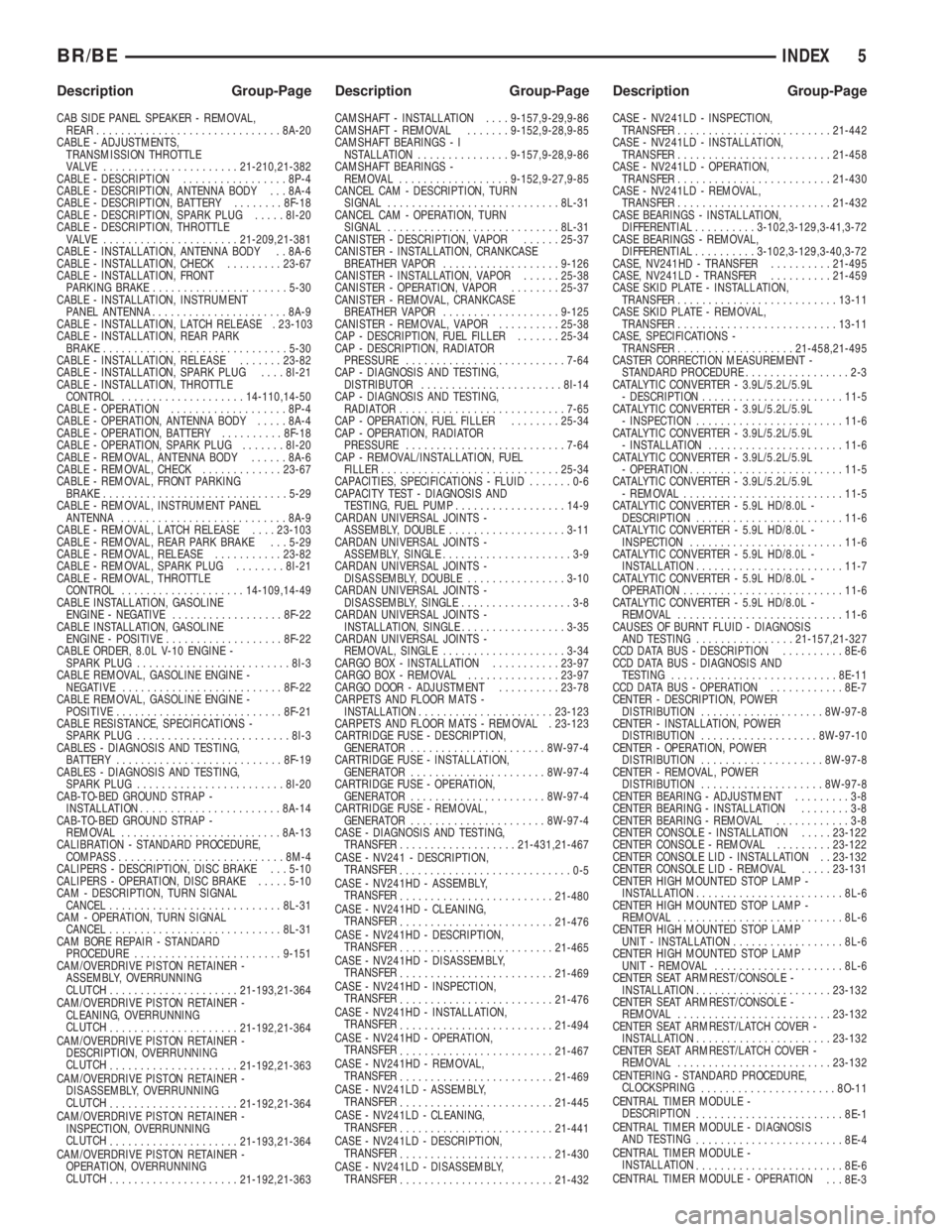
CAB SIDE PANEL SPEAKER - REMOVAL,
REAR..............................8A-20
CABLE - ADJUSTMENTS,
TRANSMISSION THROTTLE
VALVE ......................21-210,21-382
CABLE - DESCRIPTION.................8P-4
CABLE - DESCRIPTION, ANTENNA BODY . . . 8A-4
CABLE - DESCRIPTION, BATTERY........8F-18
CABLE - DESCRIPTION, SPARK PLUG.....8I-20
CABLE - DESCRIPTION, THROTTLE
VALVE ......................21-209,21-381
CABLE - INSTALLATION, ANTENNA BODY . . 8A-6
CABLE - INSTALLATION, CHECK.........23-67
CABLE - INSTALLATION, FRONT
PARKING BRAKE......................5-30
CABLE - INSTALLATION, INSTRUMENT
PANEL ANTENNA......................8A-9
CABLE - INSTALLATION, LATCH RELEASE . 23-103
CABLE - INSTALLATION, REAR PARK
BRAKE..............................5-30
CABLE - INSTALLATION, RELEASE.......23-82
CABLE - INSTALLATION, SPARK PLUG....8I-21
CABLE - INSTALLATION, THROTTLE
CONTROL....................14-110,14-50
CABLE - OPERATION...................8P-4
CABLE - OPERATION, ANTENNA BODY.....8A-4
CABLE - OPERATION, BATTERY..........8F-18
CABLE - OPERATION, SPARK PLUG.......8I-20
CABLE - REMOVAL, ANTENNA BODY......8A-6
CABLE - REMOVAL, CHECK.............23-67
CABLE - REMOVAL, FRONT PARKING
BRAKE..............................5-29
CABLE - REMOVAL, INSTRUMENT PANEL
ANTENNA...........................8A-9
CABLE - REMOVAL, LATCH RELEASE....23-103
CABLE - REMOVAL, REAR PARK BRAKE . . . 5-29
CABLE - REMOVAL, RELEASE...........23-82
CABLE - REMOVAL, SPARK PLUG........8I-21
CABLE - REMOVAL, THROTTLE
CONTROL....................14-109,14-49
CABLE INSTALLATION, GASOLINE
ENGINE - NEGATIVE..................8F-22
CABLE INSTALLATION, GASOLINE
ENGINE - POSITIVE...................8F-22
CABLE ORDER, 8.0L V-10 ENGINE -
SPARK PLUG.........................8I-3
CABLE REMOVAL, GASOLINE ENGINE -
NEGATIVE..........................8F-22
CABLE REMOVAL, GASOLINE ENGINE -
POSITIVE...........................8F-21
CABLE RESISTANCE, SPECIFICATIONS -
SPARK PLUG.........................8I-3
CABLES - DIAGNOSIS AND TESTING,
BATTERY...........................8F-19
CABLES - DIAGNOSIS AND TESTING,
SPARK PLUG........................8I-20
CAB-TO-BED GROUND STRAP -
INSTALLATION.......................8A-14
CAB-TO-BED GROUND STRAP -
REMOVAL..........................8A-13
CALIBRATION - STANDARD PROCEDURE,
COMPASS...........................8M-4
CALIPERS - DESCRIPTION, DISC BRAKE . . . 5-10
CALIPERS - OPERATION, DISC BRAKE.....5-10
CAM - DESCRIPTION, TURN SIGNAL
CANCEL............................8L-31
CAM - OPERATION, TURN SIGNAL
CANCEL............................8L-31
CAM BORE REPAIR - STANDARD
PROCEDURE........................9-151
CAM/OVERDRIVE PISTON RETAINER -
ASSEMBLY, OVERRUNNING
CLUTCH.....................21-193,21-364
CAM/OVERDRIVE PISTON RETAINER -
CLEANING, OVERRUNNING
CLUTCH
.....................21-192,21-364
CAM/OVERDRIVE PISTON RETAINER -
DESCRIPTION, OVERRUNNING
CLUTCH
.....................21-192,21-363
CAM/OVERDRIVE PISTON RETAINER -
DISASSEMBLY, OVERRUNNING
CLUTCH
.....................21-192,21-364
CAM/OVERDRIVE PISTON RETAINER -
INSPECTION, OVERRUNNING
CLUTCH
.....................21-193,21-364
CAM/OVERDRIVE PISTON RETAINER -
OPERATION, OVERRUNNING
CLUTCH
.....................21-192,21-363CAMSHAFT - INSTALLATION....9-157,9-29,9-86
CAMSHAFT - REMOVAL.......9-152,9-28,9-85
CAMSHAFT BEARINGS - I
NSTALLATION...............9-157,9-28,9-86
CAMSHAFT BEARINGS -
REMOVAL..................9-152,9-27,9-85
CANCEL CAM - DESCRIPTION, TURN
SIGNAL............................8L-31
CANCEL CAM - OPERATION, TURN
SIGNAL............................8L-31
CANISTER - DESCRIPTION, VAPOR......25-37
CANISTER - INSTALLATION, CRANKCASE
BREATHER VAPOR...................9-126
CANISTER - INSTALLATION, VAPOR......25-38
CANISTER - OPERATION, VAPOR........25-37
CANISTER - REMOVAL, CRANKCASE
BREATHER VAPOR...................9-125
CANISTER - REMOVAL, VAPOR..........25-38
CAP - DESCRIPTION, FUEL FILLER.......25-34
CAP - DESCRIPTION, RADIATOR
PRESSURE..........................7-64
CAP - DIAGNOSIS AND TESTING,
DISTRIBUTOR.......................8I-14
CAP - DIAGNOSIS AND TESTING,
RADIATOR...........................7-65
CAP - OPERATION, FUEL FILLER........25-34
CAP - OPERATION, RADIATOR
PRESSURE..........................7-64
CAP - REMOVAL/INSTALLATION, FUEL
FILLER.............................25-34
CAPACITIES, SPECIFICATIONS - FLUID.......0-6
CAPACITY TEST - DIAGNOSIS AND
TESTING, FUEL PUMP..................14-9
CARDAN UNIVERSAL JOINTS -
ASSEMBLY, DOUBLE...................3-11
CARDAN UNIVERSAL JOINTS -
ASSEMBLY, SINGLE.....................3-9
CARDAN UNIVERSAL JOINTS -
DISASSEMBLY, DOUBLE................3-10
CARDAN UNIVERSAL JOINTS -
DISASSEMBLY, SINGLE..................3-8
CARDAN UNIVERSAL JOINTS -
INSTALLATION, SINGLE.................3-35
CARDAN UNIVERSAL JOINTS -
REMOVAL, SINGLE....................3-34
CARGO BOX - INSTALLATION...........23-97
CARGO BOX - REMOVAL...............23-97
CARGO DOOR - ADJUSTMENT..........23-78
CARPETS AND FLOOR MATS -
INSTALLATION......................23-123
CARPETS AND FLOOR MATS - REMOVAL . 23-123
CARTRIDGE FUSE - DESCRIPTION,
GENERATOR......................8W-97-4
CARTRIDGE FUSE - INSTALLATION,
GENERATOR......................8W-97-4
CARTRIDGE FUSE - OPERATION,
GENERATOR......................8W-97-4
CARTRIDGE FUSE - REMOVAL,
GENERATOR......................8W-97-4
CASE - DIAGNOSIS AND TESTING,
TRANSFER...................21-431,21-467
CASE - NV241 - DESCRIPTION,
TRANSFER
............................0-5
CASE - NV241HD - ASSEMBLY,
TRANSFER
.........................21-480
CASE - NV241HD - CLEANING,
TRANSFER
.........................21-476
CASE - NV241HD - DESCRIPTION,
TRANSFER
.........................21-465
CASE - NV241HD - DISASSEMBLY,
TRANSFER
.........................21-469
CASE - NV241HD - INSPECTION,
TRANSFER
.........................21-476
CASE - NV241HD - INSTALLATION,
TRANSFER
.........................21-494
CASE - NV241HD - OPERATION,
TRANSFER
.........................21-467
CASE - NV241HD - REMOVAL,
TRANSFER
.........................21-469
CASE - NV241LD - ASSEMBLY,
TRANSFER
.........................21-445
CASE - NV241LD - CLEANING,
TRANSFER
.........................21-441
CASE - NV241LD - DESCRIPTION,
TRANSFER
.........................21-430
CASE - NV241LD - DISASSEMBLY,
TRANSFER
.........................21-432CASE - NV241LD - INSPECTION,
TRANSFER.........................21-442
CASE - NV241LD - INSTALLATION,
TRANSFER.........................21-458
CASE - NV241LD - OPERATION,
TRANSFER.........................21-430
CASE - NV241LD - REMOVAL,
TRANSFER.........................21-432
CASE BEARINGS - INSTALLATION,
DIFFERENTIAL..........3-102,3-129,3-41,3-72
CASE BEARINGS - REMOVAL,
DIFFERENTIAL..........3-102,3-129,3-40,3-72
CASE, NV241HD - TRANSFER..........21-495
CASE, NV241LD - TRANSFER..........21-459
CASE SKID PLATE - INSTALLATION,
TRANSFER..........................13-11
CASE SKID PLATE - REMOVAL,
TRANSFER..........................13-11
CASE, SPECIFICATIONS -
TRANSFER...................21-458,21-495
CASTER CORRECTION MEASUREMENT -
STANDARD PROCEDURE.................2-3
CATALYTIC CONVERTER - 3.9L/5.2L/5.9L
- DESCRIPTION.......................11-5
CATALYTIC CONVERTER - 3.9L/5.2L/5.9L
- INSPECTION........................11-6
CATALYTIC CONVERTER - 3.9L/5.2L/5.9L
- INSTALLATION......................11-6
CATALYTIC CONVERTER - 3.9L/5.2L/5.9L
- OPERATION.........................11-5
CATALYTIC CONVERTER - 3.9L/5.2L/5.9L
- REMOVAL..........................11-5
CATALYTIC CONVERTER - 5.9L HD/8.0L -
DESCRIPTION........................11-6
CATALYTIC CONVERTER - 5.9L HD/8.0L -
INSPECTION.........................11-6
CATALYTIC CONVERTER - 5.9L HD/8.0L -
INSTALLATION........................11-7
CATALYTIC CONVERTER - 5.9L HD/8.0L -
OPERATION..........................11-6
CATALYTIC CONVERTER - 5.9L HD/8.0L -
REMOVAL...........................11-6
CAUSES OF BURNT FLUID - DIAGNOSIS
AND TESTING................21-157,21-327
CCD DATA BUS - DESCRIPTION..........8E-6
CCD DATA BUS - DIAGNOSIS AND
TESTING...........................8E-11
CCD DATA BUS - OPERATION............8E-7
CENTER - DESCRIPTION, POWER
DISTRIBUTION....................8W-97-8
CENTER - INSTALLATION, POWER
DISTRIBUTION...................8W-97-10
CENTER - OPERATION, POWER
DISTRIBUTION....................8W-97-8
CENTER - REMOVAL, POWER
DISTRIBUTION....................8W-97-8
CENTER BEARING - ADJUSTMENT.........3-8
CENTER BEARING - INSTALLATION........3-8
CENTER BEARING - REMOVAL............3-8
CENTER CONSOLE - INSTALLATION.....23-122
CENTER CONSOLE - REMOVAL.........23-122
CENTER CONSOLE LID - INSTALLATION . . 23-132
CENTER CONSOLE LID - REMOVAL.....23-131
CENTER HIGH MOUNTED STOP LAMP -
INSTALLATION........................8L-6
CENTER HIGH MOUNTED STOP LAMP -
REMOVAL...........................8L-6
CENTER HIGH MOUNTED STOP LAMP
UNIT - INSTALLATION..................8L-6
CENTER HIGH MOUNTED STOP LAMP
UNIT - REMOVAL.....................8L-6
CENTER SEAT ARMREST/CONSOLE -
INSTALLATION......................23-132
CENTER SEAT ARMREST/CONSOLE -
REMOVAL.........................23-132
CENTER SEAT ARMREST/LATCH COVER -
INSTALLATION......................23-132
CENTER SEAT ARMREST/LATCH COVER -
REMOVAL.........................23-132
CENTERING - STANDARD PROCEDURE,
CLOCKSPRING
......................8O-11
CENTRAL TIMER MODULE -
DESCRIPTION
........................8E-1
CENTRAL TIMER MODULE - DIAGNOSIS
AND TESTING
........................8E-4
CENTRAL TIMER MODULE -
INSTALLATION
........................8E-6
CENTRAL TIMER MODULE - OPERATION
. . . 8E-3
BR/BEINDEX 5
Description Group-Page Description Group-Page Description Group-Page
Page 2231 of 2255
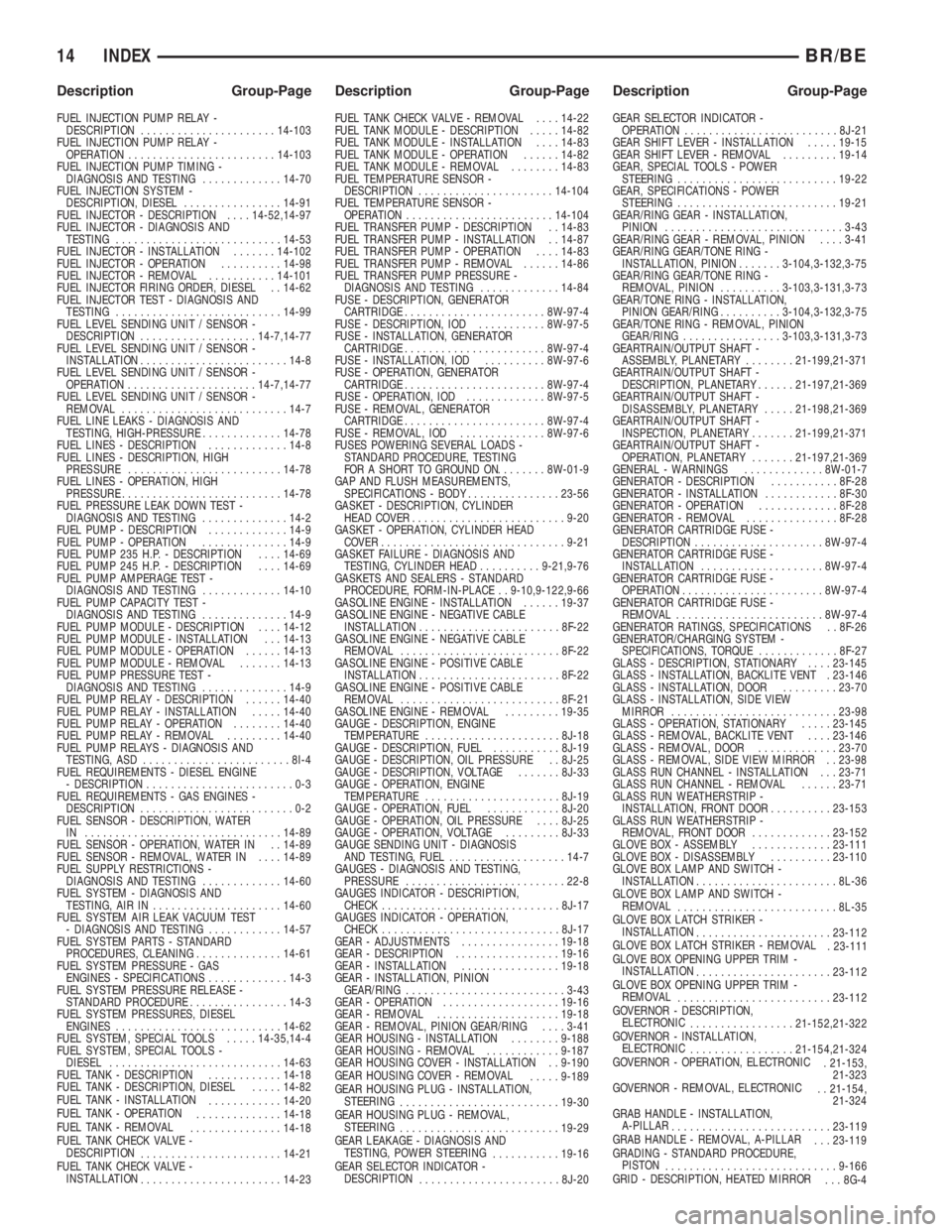
FUEL INJECTION PUMP RELAY -
DESCRIPTION......................14-103
FUEL INJECTION PUMP RELAY -
OPERATION........................14-103
FUEL INJECTION PUMP TIMING -
DIAGNOSIS AND TESTING.............14-70
FUEL INJECTION SYSTEM -
DESCRIPTION, DIESEL................14-91
FUEL INJECTOR - DESCRIPTION....14-52,14-97
FUEL INJECTOR - DIAGNOSIS AND
TESTING...........................14-53
FUEL INJECTOR - INSTALLATION.......14-102
FUEL INJECTOR - OPERATION..........14-98
FUEL INJECTOR - REMOVAL...........14-101
FUEL INJECTOR FIRING ORDER, DIESEL . . 14-62
FUEL INJECTOR TEST - DIAGNOSIS AND
TESTING...........................14-99
FUEL LEVEL SENDING UNIT / SENSOR -
DESCRIPTION...................14-7,14-77
FUEL LEVEL SENDING UNIT / SENSOR -
INSTALLATION........................14-8
FUEL LEVEL SENDING UNIT / SENSOR -
OPERATION.....................14-7,14-77
FUEL LEVEL SENDING UNIT / SENSOR -
REMOVAL...........................14-7
FUEL LINE LEAKS - DIAGNOSIS AND
TESTING, HIGH-PRESSURE.............14-78
FUEL LINES - DESCRIPTION.............14-8
FUEL LINES - DESCRIPTION, HIGH
PRESSURE.........................14-78
FUEL LINES - OPERATION, HIGH
PRESSURE...........................14-78
FUEL PRESSURE LEAK DOWN TEST -
DIAGNOSIS AND TESTING..............14-2
FUEL PUMP - DESCRIPTION.............14-9
FUEL PUMP - OPERATION..............14-9
FUEL PUMP 235 H.P. - DESCRIPTION....14-69
FUEL PUMP 245 H.P. - DESCRIPTION....14-69
FUEL PUMP AMPERAGE TEST -
DIAGNOSIS AND TESTING.............14-10
FUEL PUMP CAPACITY TEST -
DIAGNOSIS AND TESTING..............14-9
FUEL PUMP MODULE - DESCRIPTION....14-12
FUEL PUMP MODULE - INSTALLATION . . . 14-13
FUEL PUMP MODULE - OPERATION......14-13
FUEL PUMP MODULE - REMOVAL.......14-13
FUEL PUMP PRESSURE TEST -
DIAGNOSIS AND TESTING..............14-9
FUEL PUMP RELAY - DESCRIPTION......14-40
FUEL PUMP RELAY - INSTALLATION.....14-40
FUEL PUMP RELAY - OPERATION........14-40
FUEL PUMP RELAY - REMOVAL.........14-40
FUEL PUMP RELAYS - DIAGNOSIS AND
TESTING, ASD........................8I-4
FUEL REQUIREMENTS - DIESEL ENGINE
- DESCRIPTION........................0-3
FUEL REQUIREMENTS - GAS ENGINES -
DESCRIPTION.........................0-2
FUEL SENSOR - DESCRIPTION, WATER
IN ................................14-89
FUEL SENSOR - OPERATION, WATER IN . . 14-89
FUEL SENSOR - REMOVAL, WATER IN....14-89
FUEL SUPPLY RESTRICTIONS -
DIAGNOSIS AND TESTING.............14-60
FUEL SYSTEM - DIAGNOSIS AND
TESTING, AIR IN.....................14-60
FUEL SYSTEM AIR LEAK VACUUM TEST
- DIAGNOSIS AND TESTING............14-57
FUEL SYSTEM PARTS - STANDARD
PROCEDURES, CLEANING..............14-61
FUEL SYSTEM PRESSURE - GAS
ENGINES - SPECIFICATIONS.............14-3
FUEL SYSTEM PRESSURE RELEASE -
STANDARD PROCEDURE................14-3
FUEL SYSTEM PRESSURES, DIESEL
ENGINES...........................14-62
FUEL SYSTEM, SPECIAL TOOLS.....14-35,14-4
FUEL SYSTEM, SPECIAL TOOLS -
DIESEL............................14-63
FUEL TANK - DESCRIPTION............14-18
FUEL TANK - DESCRIPTION, DIESEL.....14-82
FUEL TANK - INSTALLATION
............14-20
FUEL TANK - OPERATION
..............14-18
FUEL TANK - REMOVAL
...............14-18
FUEL TANK CHECK VALVE -
DESCRIPTION
.......................14-21
FUEL TANK CHECK VALVE -
INSTALLATION
.......................14-23FUEL TANK CHECK VALVE - REMOVAL....14-22
FUEL TANK MODULE - DESCRIPTION.....14-82
FUEL TANK MODULE - INSTALLATION....14-83
FUEL TANK MODULE - OPERATION......14-82
FUEL TANK MODULE - REMOVAL........14-83
FUEL TEMPERATURE SENSOR -
DESCRIPTION......................14-104
FUEL TEMPERATURE SENSOR -
OPERATION........................14-104
FUEL TRANSFER PUMP - DESCRIPTION . . 14-83
FUEL TRANSFER PUMP - INSTALLATION . . 14-87
FUEL TRANSFER PUMP - OPERATION....14-83
FUEL TRANSFER PUMP - REMOVAL......14-86
FUEL TRANSFER PUMP PRESSURE -
DIAGNOSIS AND TESTING.............14-84
FUSE - DESCRIPTION, GENERATOR
CARTRIDGE.......................8W-97-4
FUSE - DESCRIPTION, IOD...........8W-97-5
FUSE - INSTALLATION, GENERATOR
CARTRIDGE.......................8W-97-4
FUSE - INSTALLATION, IOD..........8W-97-6
FUSE - OPERATION, GENERATOR
CARTRIDGE.......................8W-97-4
FUSE - OPERATION, IOD.............8W-97-5
FUSE - REMOVAL, GENERATOR
CARTRIDGE.......................8W-97-4
FUSE - REMOVAL, IOD..............8W-97-6
FUSES POWERING SEVERAL LOADS -
STANDARD PROCEDURE, TESTING
FOR A SHORT TO GROUND ON.........8W-01-9
GAP AND FLUSH MEASUREMENTS,
SPECIFICATIONS - BODY...............23-56
GASKET - DESCRIPTION, CYLINDER
HEAD COVER.........................9-20
GASKET - OPERATION, CYLINDER HEAD
COVER..............................9-21
GASKET FAILURE - DIAGNOSIS AND
TESTING, CYLINDER HEAD..........9-21,9-76
GASKETS AND SEALERS - STANDARD
PROCEDURE, FORM-IN-PLACE . . 9-10,9-122,9-66
GASOLINE ENGINE - INSTALLATION......19-37
GASOLINE ENGINE - NEGATIVE CABLE
INSTALLATION.......................8F-22
GASOLINE ENGINE - NEGATIVE CABLE
REMOVAL..........................8F-22
GASOLINE ENGINE - POSITIVE CABLE
INSTALLATION.......................8F-22
GASOLINE ENGINE - POSITIVE CABLE
REMOVAL..........................8F-21
GASOLINE ENGINE - REMOVAL.........19-35
GAUGE - DESCRIPTION, ENGINE
TEMPERATURE......................8J-18
GAUGE - DESCRIPTION, FUEL...........8J-19
GAUGE - DESCRIPTION, OIL PRESSURE . . 8J-25
GAUGE - DESCRIPTION, VOLTAGE.......8J-33
GAUGE - OPERATION, ENGINE
TEMPERATURE......................8J-19
GAUGE - OPERATION, FUEL............8J-20
GAUGE - OPERATION, OIL PRESSURE....8J-25
GAUGE - OPERATION, VOLTAGE.........8J-33
GAUGE SENDING UNIT - DIAGNOSIS
AND TESTING, FUEL...................14-7
GAUGES - DIAGNOSIS AND TESTING,
PRESSURE..........................22-8
GAUGES INDICATOR - DESCRIPTION,
CHECK.............................8J-17
GAUGES INDICATOR - OPERATION,
CHECK.............................8J-17
GEAR - ADJUSTMENTS................19-18
GEAR - DESCRIPTION.................19-16
GEAR - INSTALLATION................19-18
GEAR - INSTALLATION, PINION
GEAR/RING..........................3-43
GEAR - OPERATION...................19-16
GEAR - REMOVAL....................19-18
GEAR - REMOVAL, PINION GEAR/RING....3-41
GEAR HOUSING - INSTALLATION........9-188
GEAR HOUSING - REMOVAL............9-187
GEAR HOUSING COVER - INSTALLATION . . 9-190
GEAR HOUSING COVER - REMOVAL
.....9-189
GEAR HOUSING PLUG - INSTALLATION,
STEERING
..........................19-30
GEAR HOUSING PLUG - REMOVAL,
STEERING
..........................19-29
GEAR LEAKAGE - DIAGNOSIS AND
TESTING, POWER STEERING
...........19-16
GEAR SELECTOR INDICATOR -
DESCRIPTION
.......................8J-20GEAR SELECTOR INDICATOR -
OPERATION.........................8J-21
GEAR SHIFT LEVER - INSTALLATION.....19-15
GEAR SHIFT LEVER - REMOVAL.........19-14
GEAR, SPECIAL TOOLS - POWER
STEERING..........................19-22
GEAR, SPECIFICATIONS - POWER
STEERING..........................19-21
GEAR/RING GEAR - INSTALLATION,
PINION.............................3-43
GEAR/RING GEAR - REMOVAL, PINION....3-41
GEAR/RING GEAR/TONE RING -
INSTALLATION, PINION.......3-104,3-132,3-75
GEAR/RING GEAR/TONE RING -
REMOVAL, PINION..........3-103,3-131,3-73
GEAR/TONE RING - INSTALLATION,
PINION GEAR/RING..........3-104,3-132,3-75
GEAR/TONE RING - REMOVAL, PINION
GEAR/RING................3-103,3-131,3-73
GEARTRAIN/OUTPUT SHAFT -
ASSEMBLY, PLANETARY........21-199,21-371
GEARTRAIN/OUTPUT SHAFT -
DESCRIPTION, PLANETARY......21-197,21-369
GEARTRAIN/OUTPUT SHAFT -
DISASSEMBLY, PLANETARY.....21-198,21-369
GEARTRAIN/OUTPUT SHAFT -
INSPECTION, PLANETARY.......21-199,21-371
GEARTRAIN/OUTPUT SHAFT -
OPERATION, PLANETARY.......21-197,21-369
GENERAL - WARNINGS.............8W-01-7
GENERATOR - DESCRIPTION...........8F-28
GENERATOR - INSTALLATION............8F-30
GENERATOR - OPERATION.............8F-28
GENERATOR - REMOVAL...............8F-28
GENERATOR CARTRIDGE FUSE -
DESCRIPTION.....................8W-97-4
GENERATOR CARTRIDGE FUSE -
INSTALLATION....................8W-97-4
GENERATOR CARTRIDGE FUSE -
OPERATION.......................8W-97-4
GENERATOR CARTRIDGE FUSE -
REMOVAL........................8W-97-4
GENERATOR RATINGS, SPECIFICATIONS . . 8F-26
GENERATOR/CHARGING SYSTEM -
SPECIFICATIONS, TORQUE.............8F-27
GLASS - DESCRIPTION, STATIONARY....23-145
GLASS - INSTALLATION, BACKLITE VENT . 23-146
GLASS - INSTALLATION, DOOR.........23-70
GLASS - INSTALLATION, SIDE VIEW
MIRROR...........................23-98
GLASS - OPERATION, STATIONARY.....23-145
GLASS - REMOVAL, BACKLITE VENT....23-146
GLASS - REMOVAL, DOOR.............23-70
GLASS - REMOVAL, SIDE VIEW MIRROR . . 23-98
GLASS RUN CHANNEL - INSTALLATION . . . 23-71
GLASS RUN CHANNEL - REMOVAL......23-71
GLASS RUN WEATHERSTRIP -
INSTALLATION, FRONT DOOR..........23-153
GLASS RUN WEATHERSTRIP -
REMOVAL, FRONT DOOR.............23-152
GLOVE BOX - ASSEMBLY.............23-111
GLOVE BOX - DISASSEMBLY..........23-110
GLOVE BOX LAMP AND SWITCH -
INSTALLATION.......................8L-36
GLOVE BOX LAMP AND SWITCH -
REMOVAL
..........................8L-35
GLOVE BOX LATCH STRIKER -
INSTALLATION
......................23-112
GLOVE BOX LATCH STRIKER - REMOVAL
. 23-111
GLOVE BOX OPENING UPPER TRIM -
INSTALLATION
......................23-112
GLOVE BOX OPENING UPPER TRIM -
REMOVAL
.........................23-112
GOVERNOR - DESCRIPTION,
ELECTRONIC
.................21-152,21-322
GOVERNOR - INSTALLATION,
ELECTRONIC
.................21-154,21-324
GOVERNOR - OPERATION, ELECTRONIC
. 21-153,
21-323
GOVERNOR - REMOVAL, ELECTRONIC
. . 21-154,
21-324
GRAB HANDLE - INSTALLATION,
A-PILLAR
..........................23-119
GRAB HANDLE - REMOVAL, A-PILLAR
. . . 23-119
GRADING - STANDARD PROCEDURE,
PISTON
............................9-166
GRID - DESCRIPTION, HEATED MIRROR
. . . 8G-4
14 INDEXBR/BE
Description Group-Page Description Group-Page Description Group-Page