2002 DODGE RAM Diagram section
[x] Cancel search: Diagram sectionPage 1018 of 2255
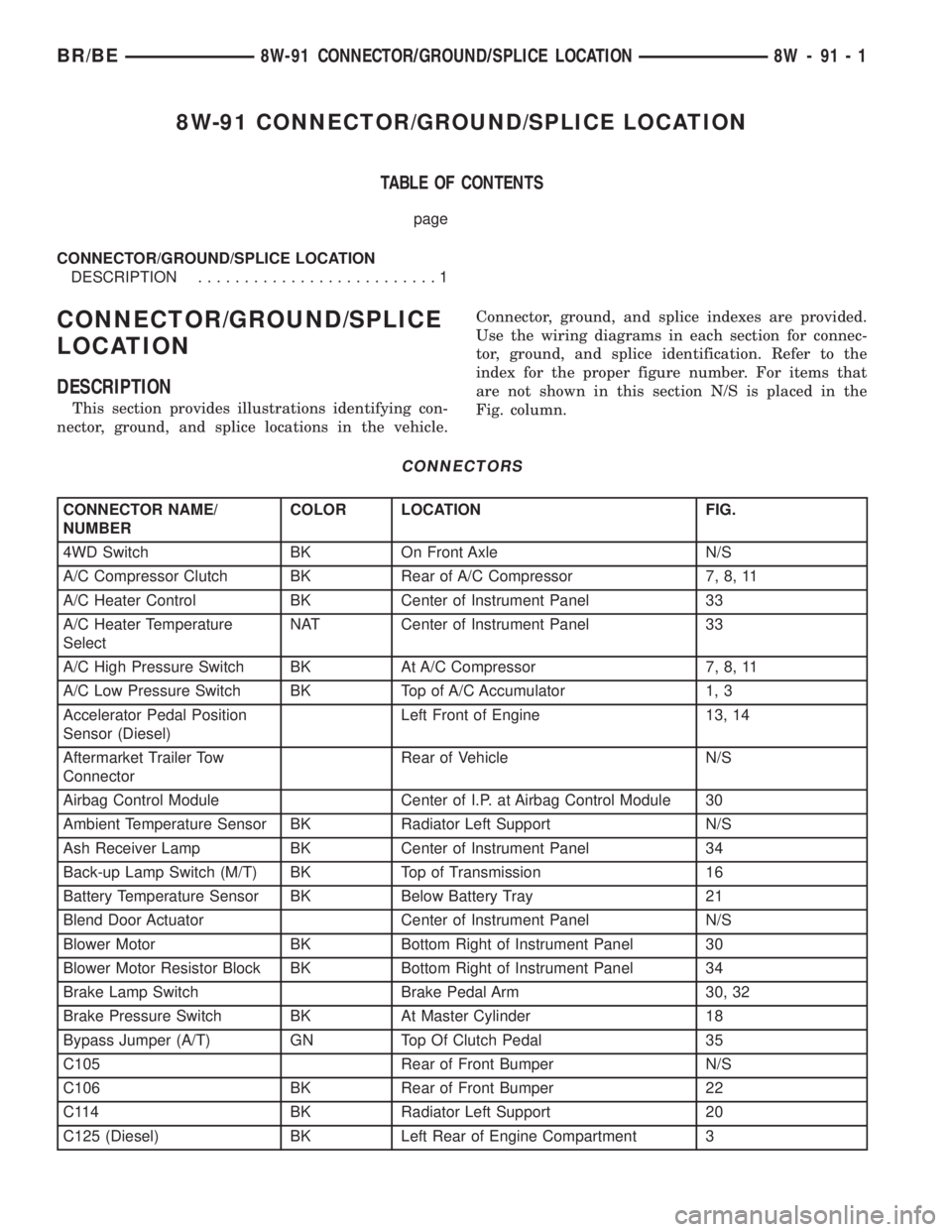
8W-91 CONNECTOR/GROUND/SPLICE LOCATION
TABLE OF CONTENTS
page
CONNECTOR/GROUND/SPLICE LOCATION
DESCRIPTION..........................1
CONNECTOR/GROUND/SPLICE
LOCATION
DESCRIPTION
This section provides illustrations identifying con-
nector, ground, and splice locations in the vehicle.Connector, ground, and splice indexes are provided.
Use the wiring diagrams in each section for connec-
tor, ground, and splice identification. Refer to the
index for the proper figure number. For items that
are not shown in this section N/S is placed in the
Fig. column.
CONNECTORS
CONNECTOR NAME/
NUMBERCOLOR LOCATION FIG.
4WD Switch BK On Front Axle N/S
A/C Compressor Clutch BK Rear of A/C Compressor 7, 8, 11
A/C Heater Control BK Center of Instrument Panel 33
A/C Heater Temperature
SelectNAT Center of Instrument Panel 33
A/C High Pressure Switch BK At A/C Compressor 7, 8, 11
A/C Low Pressure Switch BK Top of A/C Accumulator 1, 3
Accelerator Pedal Position
Sensor (Diesel)Left Front of Engine 13, 14
Aftermarket Trailer Tow
ConnectorRear of Vehicle N/S
Airbag Control Module Center of I.P. at Airbag Control Module 30
Ambient Temperature Sensor BK Radiator Left Support N/S
Ash Receiver Lamp BK Center of Instrument Panel 34
Back-up Lamp Switch (M/T) BK Top of Transmission 16
Battery Temperature Sensor BK Below Battery Tray 21
Blend Door Actuator Center of Instrument Panel N/S
Blower Motor BK Bottom Right of Instrument Panel 30
Blower Motor Resistor Block BK Bottom Right of Instrument Panel 34
Brake Lamp Switch Brake Pedal Arm 30, 32
Brake Pressure Switch BK At Master Cylinder 18
Bypass Jumper (A/T) GN Top Of Clutch Pedal 35
C105 Rear of Front Bumper N/S
C106 BK Rear of Front Bumper 22
C114 BK Radiator Left Support 20
C125 (Diesel) BK Left Rear of Engine Compartment 3
BR/BE8W-91 CONNECTOR/GROUND/SPLICE LOCATION 8W - 91 - 1
Page 1061 of 2255
tribution points for the electrical current required to
operate all of the many standard and optional facto-
ry-installed electrical and electronic powertrain,
chassis, safety, security, comfort and convenience sys-
tems. At the same time, the power distribution sys-
tem was designed to provide ready access to these
electrical distribution points for the vehicle techni-
cian to use when conducting diagnosis and repair of
faulty circuits. The power distribution system can
also prove useful for the sourcing of additional elec-
trical circuits that may be required to provide the
electrical current needed to operate many accessories
that the vehicle owner may choose to have installed
in the aftermarket.
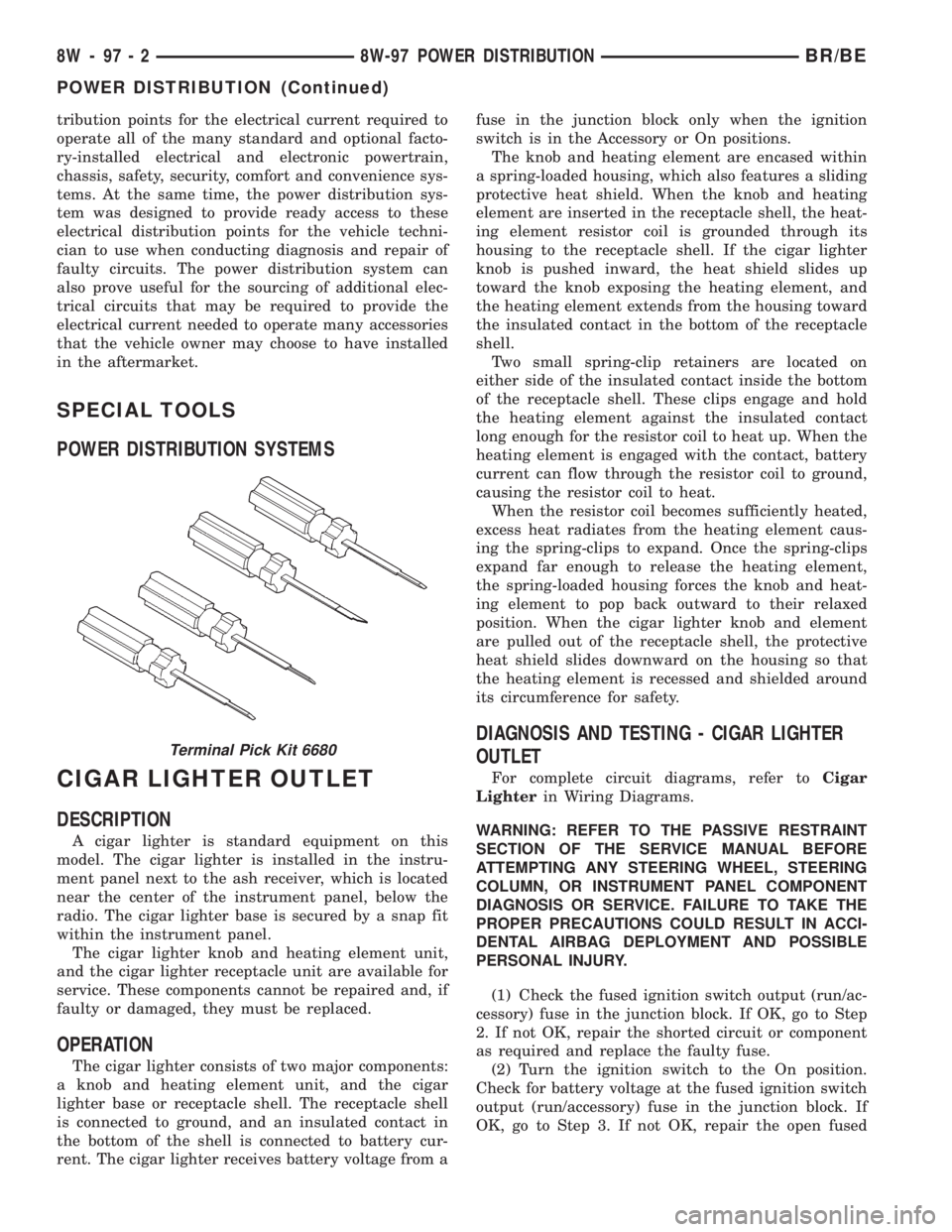
SPECIAL TOOLS
POWER DISTRIBUTION SYSTEMS
CIGAR LIGHTER OUTLET
DESCRIPTION
A cigar lighter is standard equipment on this
model. The cigar lighter is installed in the instru-
ment panel next to the ash receiver, which is located
near the center of the instrument panel, below the
radio. The cigar lighter base is secured by a snap fit
within the instrument panel.
The cigar lighter knob and heating element unit,
and the cigar lighter receptacle unit are available for
service. These components cannot be repaired and, if
faulty or damaged, they must be replaced.
OPERATION
The cigar lighter consists of two major components:
a knob and heating element unit, and the cigar
lighter base or receptacle shell. The receptacle shell
is connected to ground, and an insulated contact in
the bottom of the shell is connected to battery cur-
rent. The cigar lighter receives battery voltage from afuse in the junction block only when the ignition
switch is in the Accessory or On positions.
The knob and heating element are encased within
a spring-loaded housing, which also features a sliding
protective heat shield. When the knob and heating
element are inserted in the receptacle shell, the heat-
ing element resistor coil is grounded through its
housing to the receptacle shell. If the cigar lighter
knob is pushed inward, the heat shield slides up
toward the knob exposing the heating element, and
the heating element extends from the housing toward
the insulated contact in the bottom of the receptacle
shell.
Two small spring-clip retainers are located on
either side of the insulated contact inside the bottom
of the receptacle shell. These clips engage and hold
the heating element against the insulated contact
long enough for the resistor coil to heat up. When the
heating element is engaged with the contact, battery
current can flow through the resistor coil to ground,
causing the resistor coil to heat.
When the resistor coil becomes sufficiently heated,
excess heat radiates from the heating element caus-
ing the spring-clips to expand. Once the spring-clips
expand far enough to release the heating element,
the spring-loaded housing forces the knob and heat-
ing element to pop back outward to their relaxed
position. When the cigar lighter knob and element
are pulled out of the receptacle shell, the protective
heat shield slides downward on the housing so that
the heating element is recessed and shielded around
its circumference for safety.
DIAGNOSIS AND TESTING - CIGAR LIGHTER
OUTLET
For complete circuit diagrams, refer toCigar
Lighterin Wiring Diagrams.
WARNING: REFER TO THE PASSIVE RESTRAINT
SECTION OF THE SERVICE MANUAL BEFORE
ATTEMPTING ANY STEERING WHEEL, STEERING
COLUMN, OR INSTRUMENT PANEL COMPONENT
DIAGNOSIS OR SERVICE. FAILURE TO TAKE THE
PROPER PRECAUTIONS COULD RESULT IN ACCI-
DENTAL AIRBAG DEPLOYMENT AND POSSIBLE
PERSONAL INJURY.
(1) Check the fused ignition switch output (run/ac-
cessory) fuse in the junction block. If OK, go to Step
2. If not OK, repair the shorted circuit or component
as required and replace the faulty fuse.
(2) Turn the ignition switch to the On position.
Check for battery voltage at the fused ignition switch
output (run/accessory) fuse in the junction block. If
OK, go to Step 3. If not OK, repair the open fused
Terminal Pick Kit 6680
8W - 97 - 2 8W-97 POWER DISTRIBUTIONBR/BE
POWER DISTRIBUTION (Continued)
Page 1071 of 2255
(4) Press firmly on the cigar lighter or power out-
let receptacle base until the retaining bosses of the
mount are fully engaged in their receptacles.
(5) Install the cigar lighter knob and element into
the cigar lighter receptacle base, or the protective cap
into the power outlet receptacle base.
(6) Reconnect the battery negative cable.
HORN RELAY
DESCRIPTION
The horn relay is a International Standards Orga-
nization (ISO) micro-relay. The terminal designations
and functions are the same as a conventional ISO
relay. However, the micro-relay terminal orientation
(or footprint) is different, current capacity is lower,
and the relay case dimensions are smaller than those
of the conventional ISO relay.
The horn relay is a electromechanical device that
switches battery current to the horn when the horn
switch or when the high-line or premium Central
Timer Module (CTM) grounds the relay coil. See
Horn Relay in the Diagnosis and Testing section of
this group for more information.
The horn relay is located in the Power Distribution
Center (PDC), in the engine compartment. Refer to
the PDC label for relay identification and location.
If a problem is encountered with a continuously
sounding horn, it can usually be quickly resolved by
removing the horn relay from the PDC until further
diagnosis is completed.
The horn relay cannot be repaired and, if faulty or
damaged, it must be replaced.
DIAGNOSIS AND TESTING - HORN RELAY
The headlamp (or security) relay and the horn
relay are located in the Power Distribution Center
(PDC) in the engine compartment. Each of these
relays can be tested as described in the following pro-
cedure, however the circuits they are used in do vary.
To test the relay circuits, refer to the circuit descrip-
tions and diagrams in Wiring Diagrams.
WARNING: ON VEHICLES EQUIPPED WITH AIR-
BAGS, REFER TO THE RESTRAINTS SECTION OF
THE SERVICE MANUAL BEFORE ATTEMPTING ANY
STEERING WHEEL, STEERING COLUMN, OR
INSTRUMENT PANEL COMPONENT DIAGNOSIS OR
SERVICE. FAILURE TO TAKE THE PROPER PRE-
CAUTIONS COULD RESULT IN ACCIDENTAL AIR-
BAG DEPLOYMENT AND POSSIBLE PERSONAL
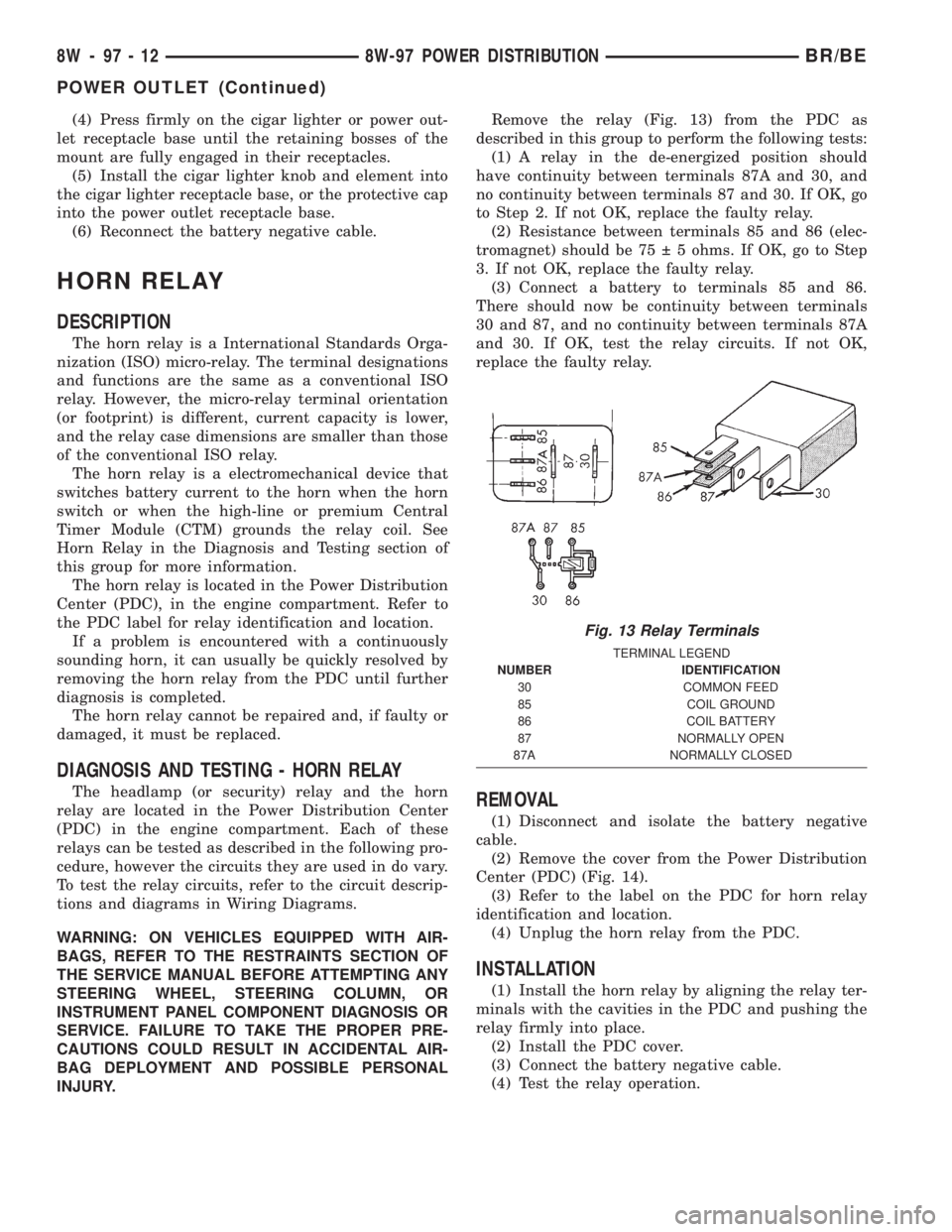
INJURY.Remove the relay (Fig. 13) from the PDC as
described in this group to perform the following tests:
(1) A relay in the de-energized position should
have continuity between terminals 87A and 30, and
no continuity between terminals 87 and 30. If OK, go
to Step 2. If not OK, replace the faulty relay.
(2) Resistance between terminals 85 and 86 (elec-
tromagnet) should be 75 5 ohms. If OK, go to Step
3. If not OK, replace the faulty relay.
(3) Connect a battery to terminals 85 and 86.
There should now be continuity between terminals
30 and 87, and no continuity between terminals 87A
and 30. If OK, test the relay circuits. If not OK,
replace the faulty relay.REMOVAL
(1) Disconnect and isolate the battery negative
cable.
(2) Remove the cover from the Power Distribution
Center (PDC) (Fig. 14).
(3) Refer to the label on the PDC for horn relay
identification and location.
(4) Unplug the horn relay from the PDC.
INSTALLATION
(1) Install the horn relay by aligning the relay ter-
minals with the cavities in the PDC and pushing the
relay firmly into place.
(2) Install the PDC cover.
(3) Connect the battery negative cable.
(4) Test the relay operation.
Fig. 13 Relay Terminals
TERMINAL LEGEND
NUMBER IDENTIFICATION
30 COMMON FEED
85 COIL GROUND
86 COIL BATTERY
87 NORMALLY OPEN
87A NORMALLY CLOSED
8W - 97 - 12 8W-97 POWER DISTRIBUTIONBR/BE
POWER OUTLET (Continued)
Page 1418 of 2255
(3) Remove the shipping lock pin if necessary.
(4) Install the column through the floor pan.
(5) Position the column bracket breakaway cap-
sules on the mounting studs. Install, butloose
assemblethe two upper bracket nuts.
(6) With the front wheels in the straight-ahead
position. Align steering column shaft to the coupler.
Install anewpinch bolt and tighten to 49 N´m (36
ft. lbs.).
(7) Clip the wiring harness on the steering column.
Connect the multi- function switch wiring and
tighten with 7mm socket.
(8) Install the upper fixed shroud.
(9) Be sure both breakaway capsules are fully
seated in the slots in the column support bracket.
Pull the column rearward then tighten upper bracket
nuts to 12 N´m (105 in. lbs.).
(10) Tighten the toe plate to floor pan attaching
nuts to 22.5 N´m (200 in. lbs.).
(11) Install the wiring connections to the column.
Install the lower fixed shroud.
(12) Column shift vehicles, install the PRNDL
driver cable. Place shifter in Park position. If indica-tor needs adjusting, turn thumb screw on cable
retainer to adjust cable.
(13) Install the lock housing shrouds. Install the
tilt lever (if equipped).
(14) Install the knee blocker and steering column
opening cover, (Refer to 23 - BODY/INSTRUMENT
PANEL/STEERING COLUMN OPENING COVER -
INSTALLATION).
(15) Install steering wheel and tighten nut to 61
N´m (45 ft. lbs.), (Refer to 19 - STEERING/COL-
UMN/STEERING WHEEL - INSTALLATION).
(16) Install the airbag, (Refer to 8 - ELECTRICAL/
RESTRAINTS/DRIVER AIRBAG - INSTALLATION).
(17) Column shift vehicles, connect the shift link
rod to the transmission shift lever. Use multi-purpose
lubricant, or an equivalent product, to aid the instal-
lation.
(18) Install the battery ground (negative) cable.
(19) Verify operation of the automatic transmission
shift linkage and adjust as necessary, (Refer to 21 -
TRANSMISSION/TRANSAXLE/AUTOMATIC -
44RE/GEAR SHIFT CABLE - ADJUSTMENTS).
SPECIFICATIONS
TORQUE CHART
TORQUE SPECIFICATIONS
DESCRIPTION N´m Ft. Lbs. In. Lbs.
Steering Wheel
Nut61 45 Ð
Steering Coupler
Bolt49 36 Ð
Steering Column
Upper Bracket12 Ð 105
Steering Column
Toe Plate23 Ð 200
KEY-IN IGNITION SWITCH
DESCRIPTION
The key-in ignition switch is integral to the igni-
tion switch, which is mounted on the left side of the
steering column. It closes a path to ground for the
Central Timer Module (CTM) when the ignition key
is inserted in the ignition lock cylinder and the
driver door ajar switch is closed (driver door is open).
The key-in ignition switch opens the ground path
when the key is removed from the ignition lock cyl-
inder. The ground path is also opened when the
driver door ajar switch is open (driver door is closed).The key-in ignition switch cannot be repaired and,
if faulty or damaged, the entire ignition switch must
be replaced, (Refer to 19 - STEERING/COLUMN/IG-
NITION SWITCH - REMOVAL).
DIAGNOSIS AND TESTING - IGNITION SWITCH
AND KEY LOCK CYLINDER
ELECTRICAL DIAGNOSIS
For ignition switch electrical schematics, refer to
Ignition Switch in the appropriate section of Electri-
cal Wiring Diagrams.
BR/BECOLUMN 19 - 9
COLUMN (Continued)
Page 1555 of 2255
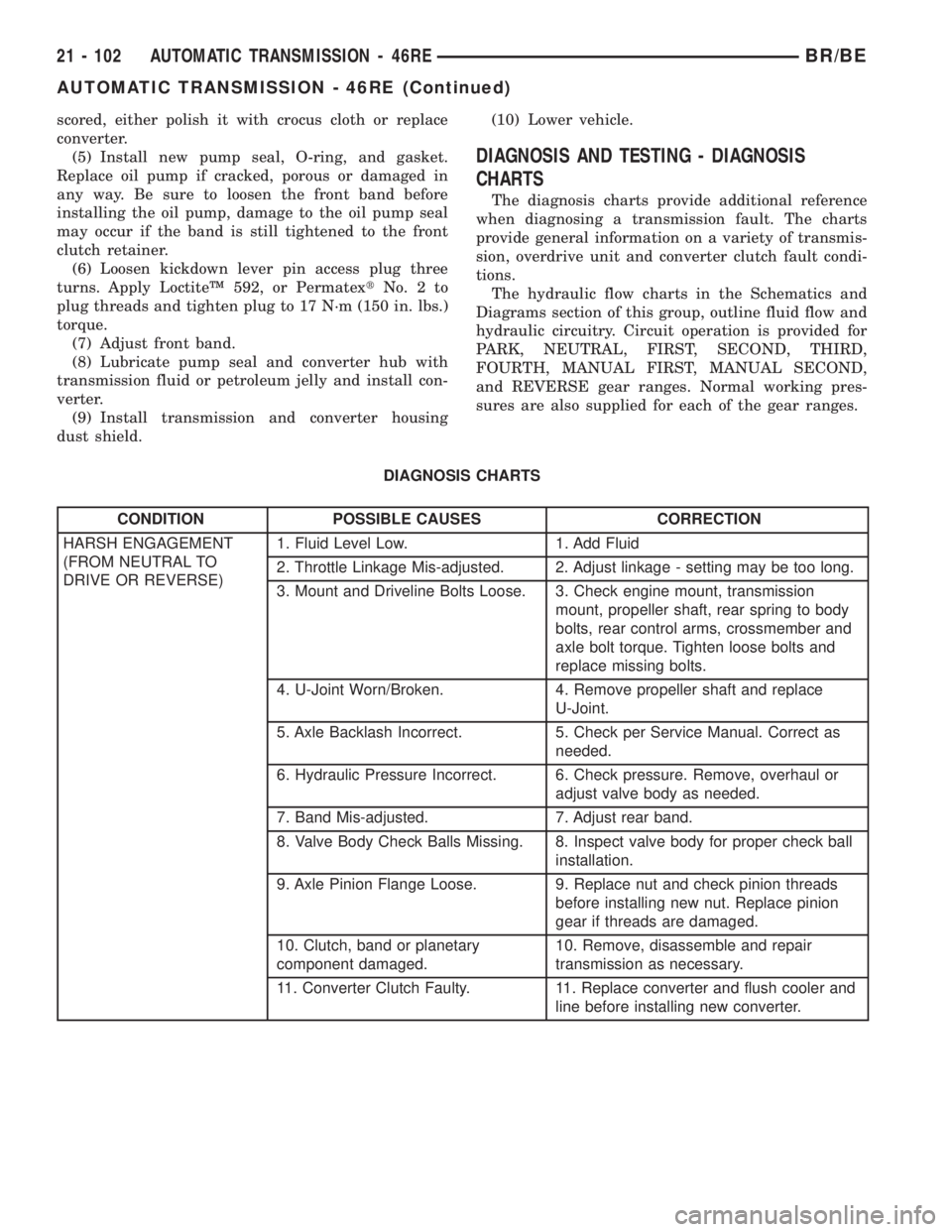
scored, either polish it with crocus cloth or replace
converter.
(5) Install new pump seal, O-ring, and gasket.
Replace oil pump if cracked, porous or damaged in
any way. Be sure to loosen the front band before
installing the oil pump, damage to the oil pump seal
may occur if the band is still tightened to the front
clutch retainer.
(6) Loosen kickdown lever pin access plug three
turns. Apply LoctiteŸ 592, or PermatextNo.2to
plug threads and tighten plug to 17 N´m (150 in. lbs.)
torque.
(7) Adjust front band.
(8) Lubricate pump seal and converter hub with
transmission fluid or petroleum jelly and install con-
verter.
(9) Install transmission and converter housing
dust shield.(10) Lower vehicle.
DIAGNOSIS AND TESTING - DIAGNOSIS
CHARTS
The diagnosis charts provide additional reference
when diagnosing a transmission fault. The charts
provide general information on a variety of transmis-
sion, overdrive unit and converter clutch fault condi-
tions.
The hydraulic flow charts in the Schematics and
Diagrams section of this group, outline fluid flow and
hydraulic circuitry. Circuit operation is provided for
PARK, NEUTRAL, FIRST, SECOND, THIRD,
FOURTH, MANUAL FIRST, MANUAL SECOND,
and REVERSE gear ranges. Normal working pres-
sures are also supplied for each of the gear ranges.
DIAGNOSIS CHARTS
CONDITION POSSIBLE CAUSES CORRECTION
HARSH ENGAGEMENT
(FROM NEUTRAL TO
DRIVE OR REVERSE)1. Fluid Level Low. 1. Add Fluid
2. Throttle Linkage Mis-adjusted. 2. Adjust linkage - setting may be too long.
3. Mount and Driveline Bolts Loose. 3. Check engine mount, transmission
mount, propeller shaft, rear spring to body
bolts, rear control arms, crossmember and
axle bolt torque. Tighten loose bolts and
replace missing bolts.
4. U-Joint Worn/Broken. 4. Remove propeller shaft and replace
U-Joint.
5. Axle Backlash Incorrect. 5. Check per Service Manual. Correct as
needed.
6. Hydraulic Pressure Incorrect. 6. Check pressure. Remove, overhaul or
adjust valve body as needed.
7. Band Mis-adjusted. 7. Adjust rear band.
8. Valve Body Check Balls Missing. 8. Inspect valve body for proper check ball
installation.
9. Axle Pinion Flange Loose. 9. Replace nut and check pinion threads
before installing new nut. Replace pinion
gear if threads are damaged.
10. Clutch, band or planetary
component damaged.10. Remove, disassemble and repair
transmission as necessary.
11. Converter Clutch Faulty. 11. Replace converter and flush cooler and
line before installing new converter.
21 - 102 AUTOMATIC TRANSMISSION - 46REBR/BE
AUTOMATIC TRANSMISSION - 46RE (Continued)
Page 1727 of 2255
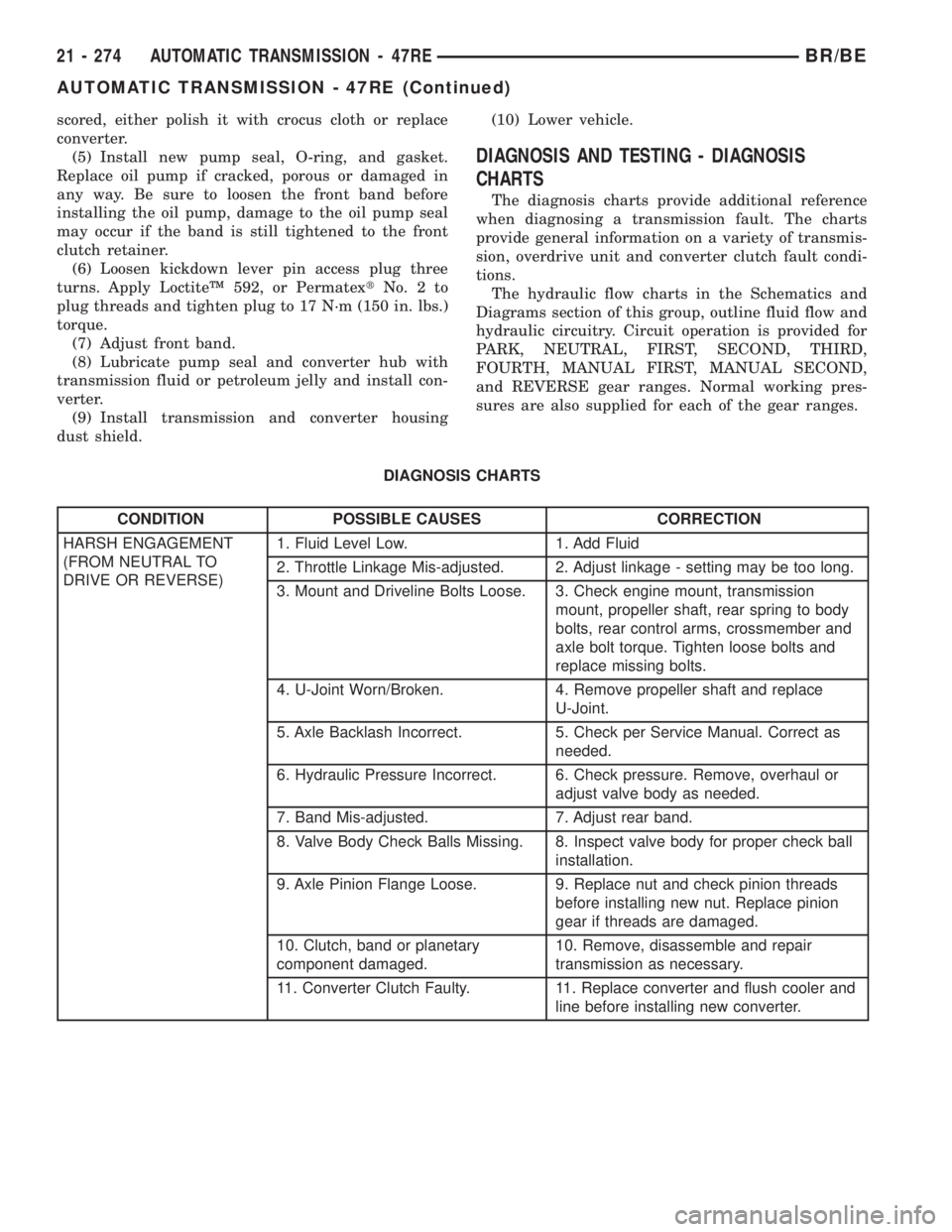
scored, either polish it with crocus cloth or replace
converter.
(5) Install new pump seal, O-ring, and gasket.
Replace oil pump if cracked, porous or damaged in
any way. Be sure to loosen the front band before
installing the oil pump, damage to the oil pump seal
may occur if the band is still tightened to the front
clutch retainer.
(6) Loosen kickdown lever pin access plug three
turns. Apply LoctiteŸ 592, or PermatextNo.2to
plug threads and tighten plug to 17 N´m (150 in. lbs.)
torque.
(7) Adjust front band.
(8) Lubricate pump seal and converter hub with
transmission fluid or petroleum jelly and install con-
verter.
(9) Install transmission and converter housing
dust shield.(10) Lower vehicle.
DIAGNOSIS AND TESTING - DIAGNOSIS
CHARTS
The diagnosis charts provide additional reference
when diagnosing a transmission fault. The charts
provide general information on a variety of transmis-
sion, overdrive unit and converter clutch fault condi-
tions.
The hydraulic flow charts in the Schematics and
Diagrams section of this group, outline fluid flow and
hydraulic circuitry. Circuit operation is provided for
PARK, NEUTRAL, FIRST, SECOND, THIRD,
FOURTH, MANUAL FIRST, MANUAL SECOND,
and REVERSE gear ranges. Normal working pres-
sures are also supplied for each of the gear ranges.
DIAGNOSIS CHARTS
CONDITION POSSIBLE CAUSES CORRECTION
HARSH ENGAGEMENT
(FROM NEUTRAL TO
DRIVE OR REVERSE)1. Fluid Level Low. 1. Add Fluid
2. Throttle Linkage Mis-adjusted. 2. Adjust linkage - setting may be too long.
3. Mount and Driveline Bolts Loose. 3. Check engine mount, transmission
mount, propeller shaft, rear spring to body
bolts, rear control arms, crossmember and
axle bolt torque. Tighten loose bolts and
replace missing bolts.
4. U-Joint Worn/Broken. 4. Remove propeller shaft and replace
U-Joint.
5. Axle Backlash Incorrect. 5. Check per Service Manual. Correct as
needed.
6. Hydraulic Pressure Incorrect. 6. Check pressure. Remove, overhaul or
adjust valve body as needed.
7. Band Mis-adjusted. 7. Adjust rear band.
8. Valve Body Check Balls Missing. 8. Inspect valve body for proper check ball
installation.
9. Axle Pinion Flange Loose. 9. Replace nut and check pinion threads
before installing new nut. Replace pinion
gear if threads are damaged.
10. Clutch, band or planetary
component damaged.10. Remove, disassemble and repair
transmission as necessary.
11. Converter Clutch Faulty. 11. Replace converter and flush cooler and
line before installing new converter.
21 - 274 AUTOMATIC TRANSMISSION - 47REBR/BE
AUTOMATIC TRANSMISSION - 47RE (Continued)
Page 2233 of 2255
HIGH MOUNTED STOP LAMP -
INSTALLATION, CENTER................8L-6
HIGH MOUNTED STOP LAMP -
REMOVAL, CENTER....................8L-6
HIGH MOUNTED STOP LAMP UNIT -
INSTALLATION, CENTER................8L-6
HIGH MOUNTED STOP LAMP UNIT -
REMOVAL, CENTER....................8L-6
HIGH PRESSURE FUEL LINES -
DESCRIPTION.......................14-78
HIGH PRESSURE FUEL LINES -
OPERATION.........................14-78
HIGH PRESSURE RELIEF VALVE -
DESCRIPTION.......................24-46
HIGH PRESSURE RELIEF VALVE -
OPERATION.........................24-47
HIGH PRESSURE SWITCH -
DESCRIPTION, A/C...................24-20
HIGH PRESSURE SWITCH - DIAGNOSIS
AND TESTING, A/C...................24-20
HIGH PRESSURE SWITCH -
INSTALLATION, A/C...................24-20
HIGH PRESSURE SWITCH - OPERATION,
A/C................................24-20
HIGH PRESSURE SWITCH - REMOVAL,
A/C................................24-20
HIGH SPEEDS - DESCRIPTION, TIRE
PRESSURE..........................22-7
HIGH-PRESSURE FUEL LINE LEAKS -
DIAGNOSIS AND TESTING.............14-78
HINGE - INSTALLATION.....23-100,23-72,23-80
HINGE - REMOVAL........23-100,23-72,23-79
HITCH - INSTALLATION, TRAILER.........13-11
HITCH - REMOVAL, TRAILER...........13-11
HOISTING - STANDARD PROCEDURE.......0-9
HOLDDOWN - DESCRIPTION, BATTERY . . . 8F-17
HOLDDOWN - INSTALLATION, BATTERY . . . 8F-18
HOLDDOWN - OPERATION, BATTERY.....8F-17
HOLDDOWN - REMOVAL, BATTERY......8F-17
HOLDER - INSTALLATION, CUP........23-110
HOLDER - REMOVAL, CUP............23-109
HOLE REPAIR - DESCRIPTION,
THREADED........................Intro.-9
HONING - STANDARD PROCEDURE,
CYLINDER BORE..................9-11,9-65
HOOD - INSTALLATION...............23-101
HOOD - REMOVAL...................23-101
HOOK - INSTALLATION, COAT..........23-125
HOOK - INSTALLATION, FRONT TOW.....13-10
HOOK - REMOVAL, COAT.............23-124
HOOK - REMOVAL, FRONT TOW.........13-10
HORN - DESCRIPTION.............8H-1,8H-2
HORN - DIAGNOSIS AND TESTING.......8H-2
HORN - INSTALLATION.................8H-3
HORN - OPERATION...............8H-1,8H-2
HORN - REMOVAL....................8H-2
HORN RELAY - DESCRIPTION.......8W-97-12
HORN RELAY - DESCRIPTION...........8H-3
HORN RELAY - DIAGNOSIS AND
TESTING........................8W-97-12
HORN RELAY - DIAGNOSIS AND
TESTING............................8H-3
HORN RELAY - INSTALLATION.......8W-97-12
HORN RELAY - INSTALLATION...........8H-4
HORN RELAY - OPERATION.............8H-3
HORN RELAY - REMOVAL..........8W-97-12
HORN RELAY - REMOVAL..............8H-4
HORN SWITCH - DESCRIPTION..........8H-4
HORN SWITCH - DIAGNOSIS AND
TESTING............................8H-5
HORN SWITCH - OPERATION............8H-5
HORN SWITCH - REMOVAL.............8H-5
HOSE CLAMPS - DESCRIPTION...........7-4
HOSE CLAMPS - OPERATION.............7-4
HOSE WITH AIR CONDITIONING -
INSTALLATION, WATER PUMP BYPASS....7-76
HOSE WITH AIR CONDITIONING -
REMOVAL, WATER PUMP BYPASS........7-73
HOSE WITHOUT AIR CONDITIONING -
INSTALLATION, WATER PUMP BYPASS....7-77
HOSE WITHOUT AIR CONDITIONING -
REMOVAL, WATER PUMP BYPASS........7-76
HOSES - PRESSURE - DESCRIPTION
.....19-39
HOSES - PRESSURE - OPERATION
.......19-39
HOSES - RETURN - DESCRIPTION
.......19-39
HOSES - RETURN - OPERATION
.........19-39
HOSES/LINES/TUBES PRECAUTIONS -
CAUTION, REFRIGERANT
..............24-43HOSES/TUBES - DESCRIPTION, WASHER . . 8R-8
HOSES/TUBES - OPERATION, WASHER....8R-8
HOUSING - ASSEMBLY, HVAC...........24-36
HOUSING - DIAGNOSIS AND TESTING,
CLUTCH..............................6-9
HOUSING - DISASSEMBLY, HVAC........24-35
HOUSING - INSTALLATION, CLUTCH......6-11
HOUSING - INSTALLATION, GEAR........9-188
HOUSING - INSTALLATION, HVAC........24-36
HOUSING - REMOVAL, CLUTCH..........6-11
HOUSING - REMOVAL, GEAR...........9-187
HOUSING - REMOVAL, HVAC...........24-34
HOUSING BUSHING - INSTALLATION,
EXTENSION..................21-156,21-326
HOUSING BUSHING - REMOVAL,
EXTENSION..................21-156,21-326
HOUSING BUSHING AND SEAL -
INSTALLATION, EXTENSION.....21-460,21-497
HOUSING BUSHING AND SEAL -
REMOVAL, EXTENSION.........21-460,21-497
HOUSING COVER - INSTALLATION, GEAR . 9-190
HOUSING COVER - REMOVAL, GEAR.....9-189
HOUSING FLUID LEAK - DIAGNOSIS AND
TESTING, CONVERTER.........21-101,21-273
HOUSING INLET BAFFLE -
INSTALLATION, HVAC.................24-36
HOUSING INLET BAFFLE - REMOVAL,
HVAC..............................24-35
HOUSING PLUG - INSTALLATION,
STEERING GEAR.......................19-30
HOUSING PLUG - REMOVAL, STEERING
GEAR..............................19-29
HOUSING SEAL - INSTALLATION,
EXTENSION..................21-156,21-327
HOUSING SEAL - NV4500 -
INSTALLATION, ADAPTER..............21-42
HOUSING SEAL - NV4500 -
INSTALLATION, EXTENSION............21-42
HOUSING SEAL - NV4500 - REMOVAL,
ADAPTER...........................21-42
HOUSING SEAL - NV4500 - REMOVAL,
EXTENSION.........................21-42
HOUSING SEAL - NV5600 -
INSTALLATION, ADAPTER..............21-85
HOUSING SEAL - NV5600 -
INSTALLATION, EXTENSION............21-85
HOUSING SEAL - NV5600 - REMOVAL,
ADAPTER...........................21-85
HOUSING SEAL - NV5600 - REMOVAL,
EXTENSION.........................21-85
HOUSING SEAL - REMOVAL,
EXTENSION..................21-156,21-326
HUB / BEARING - INSTALLATION......2-17,2-9
HUB / BEARING - REMOVAL..........2-16,2-9
HVAC HOUSING - ASSEMBLY...........24-36
HVAC HOUSING - DISASSEMBLY........24-35
HVAC HOUSING - INSTALLATION........24-36
HVAC HOUSING - REMOVAL............24-34
HVAC HOUSING INLET BAFFLE -
INSTALLATION.......................24-36
HVAC HOUSING INLET BAFFLE -
REMOVAL..........................24-35
HVAC SYSTEM AIRFLOW - DESCRIPTION . 24-30
HYDRAULIC BOOSTER - DIAGNOSIS
AND TESTING........................5-18
HYDRAULIC LIFTERS - CLEANING
....9-37,9-92
HYDRAULIC LIFTERS - INSTALLATION
. 9-37,9-92
HYDRAULIC LIFTERS - REMOVAL
....9-37,9-92
HYDRAULIC PRESSURE TEST -
DIAGNOSIS AND TESTING
.......21-270,21-98
HYDRAULIC SCHEMATICS, SCHEMATICS
AND DIAGRAMS
..............21-132,21-302
HYDRAULIC TAPPETS - DIAGNOSIS AND
TESTING
........................9-36,9-91
HYDRAULIC/MECHANICAL -
DESCRIPTION
.........................5-4
HYDRAULIC/MECHANICAL - WARNING
.....5-4
HYDROMETER TEST - STANDARD
PROCEDURE
........................8F-11
HYDROSTATIC LOCK - STANDARD
PROCEDURE
................9-11,9-122,9-66
IDENTIFICATION - DESCRIPTION,
FASTENER
.........................Intro.-6
IDENTIFICATION AND INFORMATION -
DESCRIPTION, SECTION
.............8W-01-6
IDENTIFICATION LAMP - INSTALLATION,
OUTBOARD
.........................8L-29IDENTIFICATION LAMP - REMOVAL,
OUTBOARD.........................8L-28
IDENTIFICATION NUMBER -
DESCRIPTION, VEHICLE..............Intro.-1
IDENTIFICATION PLATE - DESCRIPTION,
EQUIPMENT.......................Intro.-3
IDLE AIR CONTROL MOTOR -
DESCRIPTION.......................14-40
IDLE AIR CONTROL MOTOR -
OPERATION.........................14-40
IGNITION - SPECIFICATIONS, TORQUE.....8I-2
IGNITION CIRCUIT SENSE -
DESCRIPTION.......................8E-17
IGNITION CIRCUIT SENSE - OPERATION . . 8E-19
IGNITION COIL RESISTANCE, 5.9L
ENGINES............................8I-3
IGNITION COIL RESISTANCE, 8.0L V-10
ENGINE..............................8I-4
IGNITION SWITCH - DESCRIPTION.......19-11
IGNITION SWITCH - DESCRIPTION,
KEY-IN..............................19-9
IGNITION SWITCH - DIAGNOSIS AND
TESTING...........................19-11
IGNITION SWITCH - INSTALLATION......19-12
IGNITION SWITCH - OPERATION........19-11
IGNITION SWITCH - REMOVAL..........19-12
IGNITION SWITCH AND KEY LOCK
CYLINDER - DIAGNOSIS AND TESTING....19-9
IGNITION TIMING, SPECIFICATIONS.......8I-4
IGNITION-OFF DRAW TEST - STANDARD
PROCEDURE........................8F-13
INDEPENDENT FRONT SUSPENSION,
SPECIAL TOOLS.......................2-9
INDICATOR - DESCRIPTION, ABS........8J-14
INDICATOR - DESCRIPTION, AIRBAG.....8J-15
INDICATOR - DESCRIPTION, BRAKE/
PARK BRAKE........................8J-15
INDICATOR - DESCRIPTION, CHECK
GAUGES............................8J-17
INDICATOR - DESCRIPTION, CRUISE.....8J-18
INDICATOR - DESCRIPTION, GEAR
SELECTOR..........................8J-20
INDICATOR - DESCRIPTION, HIGH BEAM . . 8J-21
INDICATOR - DESCRIPTION, LOW FUEL . . . 8J-22
INDICATOR - DESCRIPTION, OVERDRIVE
OFF ...............................8J-26
INDICATOR - DESCRIPTION, SEATBELT . . . 8J-27
INDICATOR - DESCRIPTION, SERVICE
REMINDER..........................8J-27
INDICATOR - DESCRIPTION, TRANS
OVERTEMP.........................8J-31
INDICATOR - DESCRIPTION, TURN
SIGNAL............................8J-32
INDICATOR - DESCRIPTION, UPSHIFT....8J-32
INDICATOR - DESCRIPTION, VTSS........8Q-3
INDICATOR - DESCRIPTION, WAIT-TO-
START .............................8J-34
INDICATOR - DESCRIPTION, WASHER
FLUID..............................8J-35
INDICATOR - DESCRIPTION, WATER-IN-
FUEL..............................8J-36
INDICATOR - DIAGNOSIS AND TESTING,
BRAKE.............................8J-16
INDICATOR - DIAGNOSIS AND TESTING,
FOUR-WHEEL DRIVE..................8J-29
INDICATOR - DIAGNOSIS AND TESTING,
HIGH BEAM.........................8J-21
INDICATOR - DIAGNOSIS AND TESTING,
TURN SIGNAL
.......................8J-32
INDICATOR - DIAGNOSIS AND TESTING,
VTSS
...............................8Q-4
INDICATOR - DIAGNOSIS AND TESTING,
WASHER FLUID
......................8J-35
INDICATOR - OPERATION, ABS
..........8J-14
INDICATOR - OPERATION, AIRBAG
.......8J-15
INDICATOR - OPERATION, BRAKE/PARK
BRAKE
.............................8J-15
INDICATOR - OPERATION, CHECK
GAUGES
............................8J-17
INDICATOR - OPERATION, CRUISE
.......8J-18
INDICATOR - OPERATION, GEAR
SELECTOR
..........................8J-21
INDICATOR - OPERATION, HIGH BEAM
....8J-21
INDICATOR - OPERATION, LOW FUEL
.....8J-22
INDICATOR - OPERATION, OVERDRIVE
OFF
...............................8J-26
INDICATOR - OPERATION, SEATBELT
.....8J-27
16 INDEXBR/BE
Description Group-Page Description Group-Page Description Group-Page