2002 DODGE RAM lumbar support
[x] Cancel search: lumbar supportPage 583 of 2255
POWER SEAT SYSTEM
TABLE OF CONTENTS
page page
POWER SEAT SYSTEM
DESCRIPTION.........................16
OPERATION...........................16
DIAGNOSIS AND TESTING - POWER SEAT
SYSTEM............................16
DRIVER POWER SEAT SWITCH
DESCRIPTION.........................17
OPERATION...........................17
DIAGNOSIS AND TESTING - DRIVER POWER
SEAT SWITCH........................17
REMOVAL.............................18
INSTALLATION.........................18
LUMBAR CONTROL SWITCH
DESCRIPTION.........................18
OPERATION...........................19
REMOVAL.............................19
LUMBAR MOTOR
DESCRIPTION.........................19OPERATION...........................19
DIAGNOSIS AND TESTING - LUMBAR MOTOR . 19
PASSENGER POWER SEAT SWITCH
DESCRIPTION.........................20
OPERATION...........................20
DIAGNOSIS AND TESTING - PASSENGER
POWER SEAT SWITCH.................20
REMOVAL.............................21
INSTALLATION.........................21
POWER SEAT TRACK
DESCRIPTION.........................21
OPERATION...........................22
DIAGNOSIS AND TESTING - POWER SEAT
TRACK.............................22
REMOVAL.............................22
INSTALLATION.........................22
POWER SEAT SYSTEM
DESCRIPTION
The power seat system option allows the driver (or
passenger on SLT Plus with power seats) to electri-
cally adjust the seat position for optimum control and
comfort using the power seat switches located on the
outboard seat cushion side shield. The power seat
system allows the seating position to be adjusted for-
ward, rearward, front up, front down, rear up, or
rear down. The power seat system receives battery
current through a fuse in the Power Distribution
Center and a circuit breaker in the junction block,
regardless of the ignition switch position.
The quad cab models equipped with the power seat
option also feature a power operated lumbar support
in the seat back. The power lumbar support allows
the user to inflate or deflate a bladder located in the
lower seat back to achieve optimum comfort and sup-
port in the lower lumbar region of the spinal column.
The power lumbar support shares the battery feed
circuit of the power seat system.
The power seat system includes the power seat
adjuster and motors unit, the power lumbar support
bladder and electric pump (quad cab only), the power
seat switch, and the circuit breaker. Following are
general descriptions of the major components in the
power seat system. Refer toHeated Seat Systemfor information on the individually controlled heated
front seats. Refer to the owner's manual in the vehi-
cle glove box for more information on the features,
use and operation of the power seat system.
OPERATION
The power seat system allows the driver and/or
front passenger seating positions to be adjusted elec-
trically and independently using the separate power
seat switches found on the outboard seat cushion
side shield of each front seat. See the owner's manual
in the vehicle glove box for more information on the
features, use and operation of the power seat system.
DIAGNOSIS AND TESTING - POWER SEAT
SYSTEM
Before any testing of the power seat system is
attempted, the battery should be fully-charged and
all wire harness connections and pins cleaned and
tightened to ensure proper continuity and grounds.
For circuit descriptions and diagrams, refer to Wiring
Diagrams.
With the dome lamp on, apply the power seat
switch in the direction of the failure. If the dome
lamp dims, the seat may be jamming. Check under
and behind the seat for binding or obstructions. If
the dome lamp does not dim, proceed with testing of
the individual components and circuits.
8N - 16 POWER SEAT SYSTEMBR/BE
Page 584 of 2255
DRIVER POWER SEAT SWITCH
DESCRIPTION
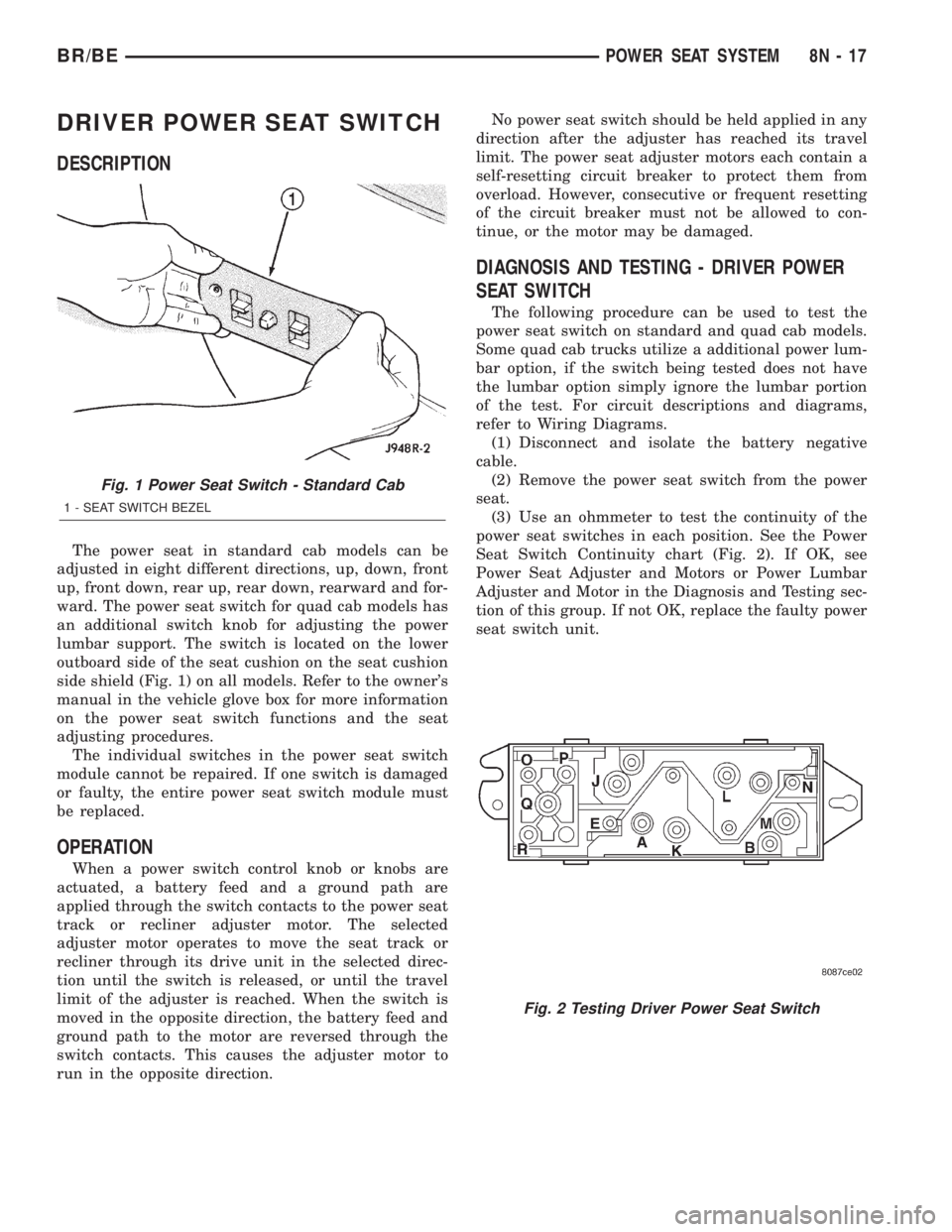
The power seat in standard cab models can be
adjusted in eight different directions, up, down, front
up, front down, rear up, rear down, rearward and for-
ward. The power seat switch for quad cab models has
an additional switch knob for adjusting the power
lumbar support. The switch is located on the lower
outboard side of the seat cushion on the seat cushion
side shield (Fig. 1) on all models. Refer to the owner's
manual in the vehicle glove box for more information
on the power seat switch functions and the seat
adjusting procedures.
The individual switches in the power seat switch
module cannot be repaired. If one switch is damaged
or faulty, the entire power seat switch module must
be replaced.
OPERATION
When a power switch control knob or knobs are
actuated, a battery feed and a ground path are
applied through the switch contacts to the power seat
track or recliner adjuster motor. The selected
adjuster motor operates to move the seat track or
recliner through its drive unit in the selected direc-
tion until the switch is released, or until the travel
limit of the adjuster is reached. When the switch is
moved in the opposite direction, the battery feed and
ground path to the motor are reversed through the
switch contacts. This causes the adjuster motor to
run in the opposite direction.No power seat switch should be held applied in any
direction after the adjuster has reached its travel
limit. The power seat adjuster motors each contain a
self-resetting circuit breaker to protect them from
overload. However, consecutive or frequent resetting
of the circuit breaker must not be allowed to con-
tinue, or the motor may be damaged.
DIAGNOSIS AND TESTING - DRIVER POWER
SEAT SWITCH
The following procedure can be used to test the
power seat switch on standard and quad cab models.
Some quad cab trucks utilize a additional power lum-
bar option, if the switch being tested does not have
the lumbar option simply ignore the lumbar portion
of the test. For circuit descriptions and diagrams,
refer to Wiring Diagrams.
(1) Disconnect and isolate the battery negative
cable.
(2) Remove the power seat switch from the power
seat.
(3) Use an ohmmeter to test the continuity of the
power seat switches in each position. See the Power
Seat Switch Continuity chart (Fig. 2). If OK, see
Power Seat Adjuster and Motors or Power Lumbar
Adjuster and Motor in the Diagnosis and Testing sec-
tion of this group. If not OK, replace the faulty power
seat switch unit.
Fig. 1 Power Seat Switch - Standard Cab
1 - SEAT SWITCH BEZEL
Fig. 2 Testing Driver Power Seat Switch
BR/BEPOWER SEAT SYSTEM 8N - 17
Page 585 of 2255

DRIVER POWER SEAT SWITCH TEST TABLE
DRIVER SWITCH
POSITIONCONTINUITY BETWEEN
OFF B-N, B-J, B-M
B-E, B-L, B-K
VERTICAL UP A-E, A-M, B-N, B-E
VERTICAL DOWN A-J, A-N, B-M, B-E
HORIZONTAL
FORWARDA-L, B-K
HORIZONTAL
REARWARDA-K, B-L
FRONT TILT UP A-M, B-N
FRONT TILT DOWN A-N, B-M
REAR TILT UP A-E, B-J
REAR TILT DOWN A-J, B-E
LUMBAR OFF O-P, O-R, P-R
LUMPAR UP (INFLATE) O-P, Q-R
LUMBAR DOWN
(DEFLATE)O-R, P-Q
REMOVAL
(1) Disconnect and isolate the battery negative
cable.
(2) Standard cab models, remove the two screws
that secure the power seat switch and bezel unit to
the seat cushion frame.
(3) Quad cab models, remove the seat cushion side
shield from the seat. Refer to Body for the procedure.
(4) Pull the switch bezel or side shield unit out
from the seat far enough to access the switch wire
harness connector. Gently pry the locking tabs of the
switch away from the wire harness connector and
carefully unplug the connector from the power seat
switch module (Fig. 3).
(5) Remove the screws that secure the power seat
switch (Fig. 4).
INSTALLATION
(1) Position the power seat switch on the seat
cushion side shield and connect the electrical connec-
tor.
(2) Install the screws that secure the power seat
switch to seat cushion side shield.
(3) Install the seat cushion side shield on the seat.
Refer to Body for the procedure.
(4) If equipped, install the recliner lever on the
recliner mechanism release shaft.
(5) If equipped, install the screw that secures the
recliner lever to the recliner mechanism release shaft
on the outboard side of the front seat.
(6) Connect the battery negative cable.
LUMBAR CONTROL SWITCH
DESCRIPTION
The power lumbar seat option includes an electri-
cally operated lumbar support mechanism. A single
two-way momentary power lumbar switch is integral
with the power seat switches. The power lumbar
switch is secured to the back of the seat cushion side
shield with screws, and the switch paddle protrudes
through a hole to the outside of the shield. The
switch paddle is located in a shallow depression
molded into the outer surface of the seat cushion side
shield that helps to shroud it from unintentional
actuation when entering or leaving the vehicle.
The power lumbar switches cannot be adjusted or
repaired and, if faulty or damaged, the seat switch
assembly must be replaced.
Fig. 3 Power Seat Switch Connector Remove -
Standard Cab
1 - RELEASE TABS (3)
Fig. 4 Power Seat Switch Remove/Install - Quad Cab
1 - SEAT SIDE SHIELD
2 - POWER SEAT SWITCH
3 - SCREWS
8N - 18 POWER SEAT SYSTEMBR/BE
DRIVER POWER SEAT SWITCH (Continued)
Page 586 of 2255

OPERATION
When the power lumbar switch paddle is actuated,
a battery feed and a ground path are applied through
the switch contacts to the power lumbar adjuster
motor. The motor operates to move the lumbar
adjuster through its drive unit in the selected direc-
tion until the switch is released, or until the travel
limit of the adjuster is reached. When the switch is
moved in the opposite direction, the battery feed and
ground path to the motor are reversed through the
switch contacts. This causes the motor to run in the
opposite direction.
The power lumbar switch should not be held
applied in either direction after the adjuster has
reached its travel limit. The power lumbar adjuster
motor contains a self-resetting circuit breaker to pro-
tect it from overload. However, consecutive or fre-
quent resetting of the circuit breaker must not be
allowed to continue, or the motor may be damaged.
REMOVAL
The power lumbar switch is integral with the other
power seat switches. Refer to the appropriate driver
or passenger power front seat switch removal and/or
installation procedure.
LUMBAR MOTOR
DESCRIPTION
The power lumbar seat option includes an electri-
cally operated lumbar support mechanism. The only
visible evidence of this option is the separate power
lumbar switch control paddle that is located on the
outboard seat cushion side shield, next to the other
power seat switch control knobs. The power lumbar
adjuster and motor are concealed beneath the seat
back trim cover and padding, where they are secured
to a molded plastic back panel and to the seat back
frame.
The power lumbar adjuster cannot be repaired, and
is serviced only as a unit with the seat back frame. If
the power lumbar adjuster or the seat back frame
are damaged or faulty, the entire seat back frame
unit must be replaced (Refer to 23 - BODY/SEATS/
SEAT BACK - REMOVAL).
OPERATION
The power lumbar adjuster mechanism includes a
reversible electric motor that is secured to the
inboard side of the seat back panel and is connected
to a worm-drive gearbox. The motor and gearbox
operate the lumbar adjuster mechanism in the center
of the seat back by extending and retracting a cable
that actuates a lever. The action of this lever com-
presses or relaxes a grid of flexible slats. The morethis grid is compressed, the more the slats bow out-
ward against the center of the seat back padding,
providing additional lumbar support.
DIAGNOSIS AND TESTING - LUMBAR MOTOR
Actuate the power lumbar switch to move the
power lumbar adjuster in each direction. The power
lumbar adjuster should move in both directions. It
should be noted that the power lumber adjuster nor-
mally operates very quietly and exhibits little visible
movement. If the power lumbar adjuster fails to oper-
ate in only one direction, move the adjuster a short
distance in the opposite direction and test again to be
certain that the adjuster is not at its travel limit. If
the power lumbar adjuster still fails to operate in
only one direction, (Refer to 8 - ELECTRICAL/
POWER SEATS/DRIVER SEAT SWITCH - DIAGNO-
SIS AND TESTING). If the power lumbar adjuster
fails to operate in either direction, perform the fol-
lowing tests. For complete circuit diagrams, refer to
Wiring Diagrams.
(1) Check the power seat circuit breaker in the
junction block. If OK, go to Step 2. If not OK, replace
the faulty power seat circuit breaker.
(2) Check for battery voltage at the power seat cir-
cuit breaker in the junction block. If OK, go to Step
3. If not OK, repair the open fused B(+) circuit to the
fuse in the Power Distribution Center as required.
(3) Remove the outboard seat cushion side shield
from the seat. Disconnect the seat wire harness con-
nector from the power lumbar switch connector
receptacle. Check for battery voltage at the fused
B(+) circuit cavity of the power seat wire harness
connector for the power lumbar switch. If OK, go to
Step 4. If not OK, repair the open fused B(+) circuit
to the power seat circuit breaker in the junction
block as required.
(4) Check for continuity between the ground cir-
cuit cavity of the power seat wire harness connector
for the power lumbar switch and a good ground.
There should be continuity. If OK, go to Step 5. If not
OK, repair the open ground circuit to ground as
required.
(5) Test the power lumbar switch. . If the switch
tests OK, test the circuits of the power seat wire har-
ness between the power lumbar adjuster motor and
the power lumbar switch for shorts or opens. If the
circuits check OK, replace the faulty seat back frame
assembly. If the circuits are not OK, repair the power
seat wire harness as required.
BR/BEPOWER SEAT SYSTEM 8N - 19
LUMBAR CONTROL SWITCH (Continued)
Page 587 of 2255

PASSENGER POWER SEAT
SWITCH
DESCRIPTION
The power seat in standard cab models can be
adjusted in eight different directions, up, down, front
up, front down, rear up, rear down, rearward and for-
ward. The power seat switch for quad cab models has
an additional switch knob for adjusting the power
lumbar support. The switch is located on the lower
outboard side of the seat cushion on the seat cushion
side shield (Fig. 5) on all models. Refer to the owner's
manual in the vehicle glove box for more information
on the power seat switch functions and the seat
adjusting procedures.
The individual switches in the power seat switch
module cannot be repaired. If one switch is damaged
or faulty, the entire power seat switch module must
be replaced.
OPERATION
When a power switch control knob or knobs are
actuated, a battery feed and a ground path are
applied through the switch contacts to the power seat
track or recliner adjuster motor. The selected
adjuster motor operates to move the seat track or
recliner through its drive unit in the selected direc-
tion until the switch is released, or until the travel
limit of the adjuster is reached. When the switch is
moved in the opposite direction, the battery feed and
ground path to the motor are reversed through the
switch contacts. This causes the adjuster motor to
run in the opposite direction.No power seat switch should be held applied in any
direction after the adjuster has reached its travel
limit. The power seat adjuster motors each contain a
self-resetting circuit breaker to protect them from
overload. However, consecutive or frequent resetting
of the circuit breaker must not be allowed to con-
tinue, or the motor may be damaged.
DIAGNOSIS AND TESTING - PASSENGER
POWER SEAT SWITCH
The following procedure can be used to test the
power seat switch on standard and quad cab models.
Some quad cab trucks utilize a additional power lum-
bar option, if the switch being tested does not have
the lumbar option simply ignore the lumbar portion
of the test. For circuit descriptions and diagrams,
refer to Wiring Diagrams.
(1) Disconnect and isolate the battery negative
cable.
(2) Remove the power seat switch from the power
seat.
(3) Use an ohmmeter to test the continuity of the
power seat switches in each position. See the Power
Seat Switch Continuity chart below (Fig. 6). If OK,
see Power Seat Adjuster and Motors or Power Lum-
bar Adjuster and Motor in the Diagnosis and Testing
section of this group. If not OK, replace the faulty
power seat switch unit.
Fig. 5 Power Seat Switch - Standard Cab
1 - SEAT SWITCH BEZEL
Fig. 6 Testing Passenger Power Seat Switch
8N - 20 POWER SEAT SYSTEMBR/BE
Page 1024 of 2255
CONNECTOR NAME/
NUMBERCOLOR LOCATION FIG.
Passenger Heated Seat
SwitchBL Center of Instrument Panel N/S
Passenger Heated Seat
CushionUnder Seat N/S
Passenger Lumbar Motor Under Seat N/S
Passenger Power Seat Front
Vertical MotorUnder Seat N/S
Passenger Power Seat
Horizontal MotorUnder Seat N/S
Passenger Power Seat Rear
Vertical MotorUnder Seat N/S
Passenger Power Seat
SwitchAt Seat N/S
Passenger Power Window
MotorIn Door N/S
Power Mirror Switch Driver Door 24
Power Outlet BK Center of I.P. 33
Powertrain Control Module
C1BK Right Rear Engine Compartment 1, 3
Powertrain Control Module
C2WT Right Rear Engine Compartment 1, 3
Powertrain Control Module
C3GY Right Rear Engine Compartment 1, 3
Radio Choke Relay BK Instrument Panel Center support 30, 33
Radio C1 GY Rear of Radio 33
Radio C2 BK Rear of Radio 33
Radio C3 BK Instrument Panel Center Support 33
Rear Wheel Speed Sensor
(ABS)BK Left Frame Rail, Near Fuel Tank 27, 29
Right Back-Up Lamp GY Rear of Lamp N/S
Right Fog Lamp WT Rear of Fog Lamp N/S
Right Front Door
Speaker(PremiumBK In Door N/S
Right Front Door
Speaker(StandardBK In Door N/SN/S
Right Front Fender Lamp BK On Fender 27
Right Front Wheel Speed
Sensor (ABS)BK Right Fender Side Shield 22
Right Headlamp BK At Headlamp N/S
Right License Lamp BK At Rear Bumper N/S
Right Outboard Clearance
LampBK Behind Front of Headliner 25
Right Outboard Headlamp At Headlamp N/S
Right Outboard Identification
LampBK Behind Front of Headliner 25
BR/BE8W-91 CONNECTOR/GROUND/SPLICE LOCATION 8W - 91 - 7
CONNECTOR/GROUND/SPLICE LOCATION (Continued)
Page 2098 of 2255
SEATS
TABLE OF CONTENTS
page page
SEATS
DESCRIPTION........................131
OPERATION..........................131
CENTER CONSOLE LID
REMOVAL............................131
INSTALLATION........................132
CENTER SEAT ARMREST/CONSOLE
REMOVAL............................132
INSTALLATION........................132
CENTER SEAT ARMREST/LATCH COVER
REMOVAL............................132
INSTALLATION........................132
LUMBAR SUPPORT
REMOVAL............................132
INSTALLATION........................133
SEAT - BENCH SEAT
REMOVAL............................133
INSTALLATION........................133
SEAT - SPLIT BENCH
REMOVAL............................133
INSTALLATION........................134
SEAT BACK - BENCH SEAT
REMOVAL............................135
INSTALLATION........................135
SEAT BACK - SPLIT BENCH
REMOVAL............................135
INSTALLATION........................136
SEAT BACK COVER
REMOVAL............................137
INSTALLATION........................137
SEAT BACK COVER - SPLIT BENCH
REMOVAL............................137
INSTALLATION........................137SEAT BACK RECLINER
REMOVAL............................138
INSTALLATION........................138
SEAT CUSHION
REMOVAL............................138
INSTALLATION........................138
SEAT CUSHION COVER
REMOVAL............................139
INSTALLATION........................139
SEAT CUSHION COVER - SPLIT BENCH
REMOVAL............................139
INSTALLATION........................140
SEAT RISER
REMOVAL............................141
INSTALLATION........................141
SEAT TRACK
REMOVAL............................141
INSTALLATION........................141
SEAT TRACK - SPLIT BENCH
REMOVAL............................142
INSTALLATION........................142
EASY ENTRY SEAT TRACK
REMOVAL............................143
INSTALLATION........................143
SEAT TRACK ADJUSTER
REMOVAL............................143
INSTALLATION........................143
STANCHION COVER
REMOVAL............................143
INSTALLATION........................143
REAR SEAT
REMOVAL............................144
INSTALLATION........................144
SEATS
DESCRIPTION
Seat modules are made up of a seat frame, seat
cushion, seat back cushion, a covering material, and
the electrical components used for power operation, if
equipped. Some seat systems also contain seat belt
components and supplemental restraint systems.
OPERATION
Seat assemblies transport the occupants in comfort
and safety. Seat assemblies also help position occupants
correctly in the event of airbag deployment. Seat cush-
ions, coverings, and electrical components are service-
able. Refer to the appropriate group in this manual.
CENTER CONSOLE LID
REMOVAL
(1) Open console lid.
(2) Using a small flat blade screwdriver, disengage
locking tabs located under the console lid trim bezel.
(3) Separate bezel from lid.
(4) Move driver and passenger seat to full forward
position.
(5) Using a small drift and hammer, tap out con-
sole lid hinge pin.
(6) Separate lid from console.
BR/BESEATS 23 - 131
Page 2099 of 2255
INSTALLATION
(1) Align console lid with console. Verify lid tension
spring is in position.
(2) Install hinge pin.
(3) Position trim bezel on lid and snap into place.
CENTER SEAT ARMREST/
CONSOLE
REMOVAL
(1) Remove bolts on driver and passenger seat
inboard seat tracks.
(2) Separate center section.
INSTALLATION
(1) Position and align center section on driver and
passenger seat inboard seat tracks.
(2) Install bolts. Tighten to 19.5 N´m (14 ft. lbs.)
torque.
CENTER SEAT ARMREST/
LATCH COVER
REMOVAL
(1) With the seat back fully forward, move the
driver's seat to a full forward position.
(2) Place the center arm rest in a full up position.
(3) Remove the fastener securing the cover to the
inertia latch.
(4) Disengage the front edge of the cover, then
lower the arm rest.
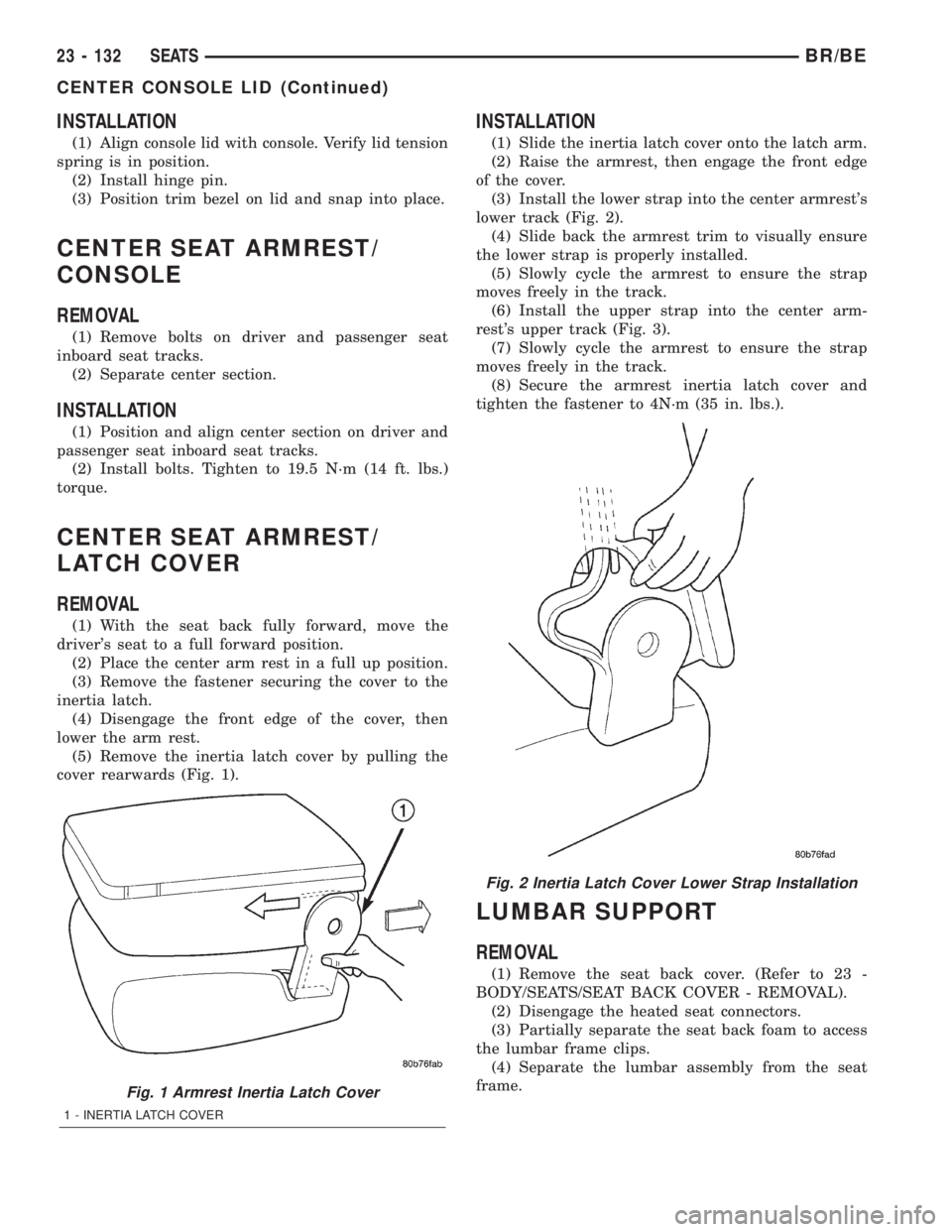
(5) Remove the inertia latch cover by pulling the
cover rearwards (Fig. 1).
INSTALLATION
(1) Slide the inertia latch cover onto the latch arm.
(2) Raise the armrest, then engage the front edge
of the cover.
(3) Install the lower strap into the center armrest's
lower track (Fig. 2).
(4) Slide back the armrest trim to visually ensure
the lower strap is properly installed.
(5) Slowly cycle the armrest to ensure the strap
moves freely in the track.
(6) Install the upper strap into the center arm-
rest's upper track (Fig. 3).
(7) Slowly cycle the armrest to ensure the strap
moves freely in the track.
(8) Secure the armrest inertia latch cover and
tighten the fastener to 4N´m (35 in. lbs.).
LUMBAR SUPPORT
REMOVAL
(1) Remove the seat back cover. (Refer to 23 -
BODY/SEATS/SEAT BACK COVER - REMOVAL).
(2) Disengage the heated seat connectors.
(3) Partially separate the seat back foam to access
the lumbar frame clips.
(4) Separate the lumbar assembly from the seat
frame.
Fig. 1 Armrest Inertia Latch Cover
1 - INERTIA LATCH COVER
Fig. 2 Inertia Latch Cover Lower Strap Installation
23 - 132 SEATSBR/BE
CENTER CONSOLE LID (Continued)