Page 729 of 1943
A14021
HCLSON
A13624
E2 VC ON
(+)
(±)
± DIAGNOSTICSENGINE
DI±129
2001 PRIUS (RM778U)
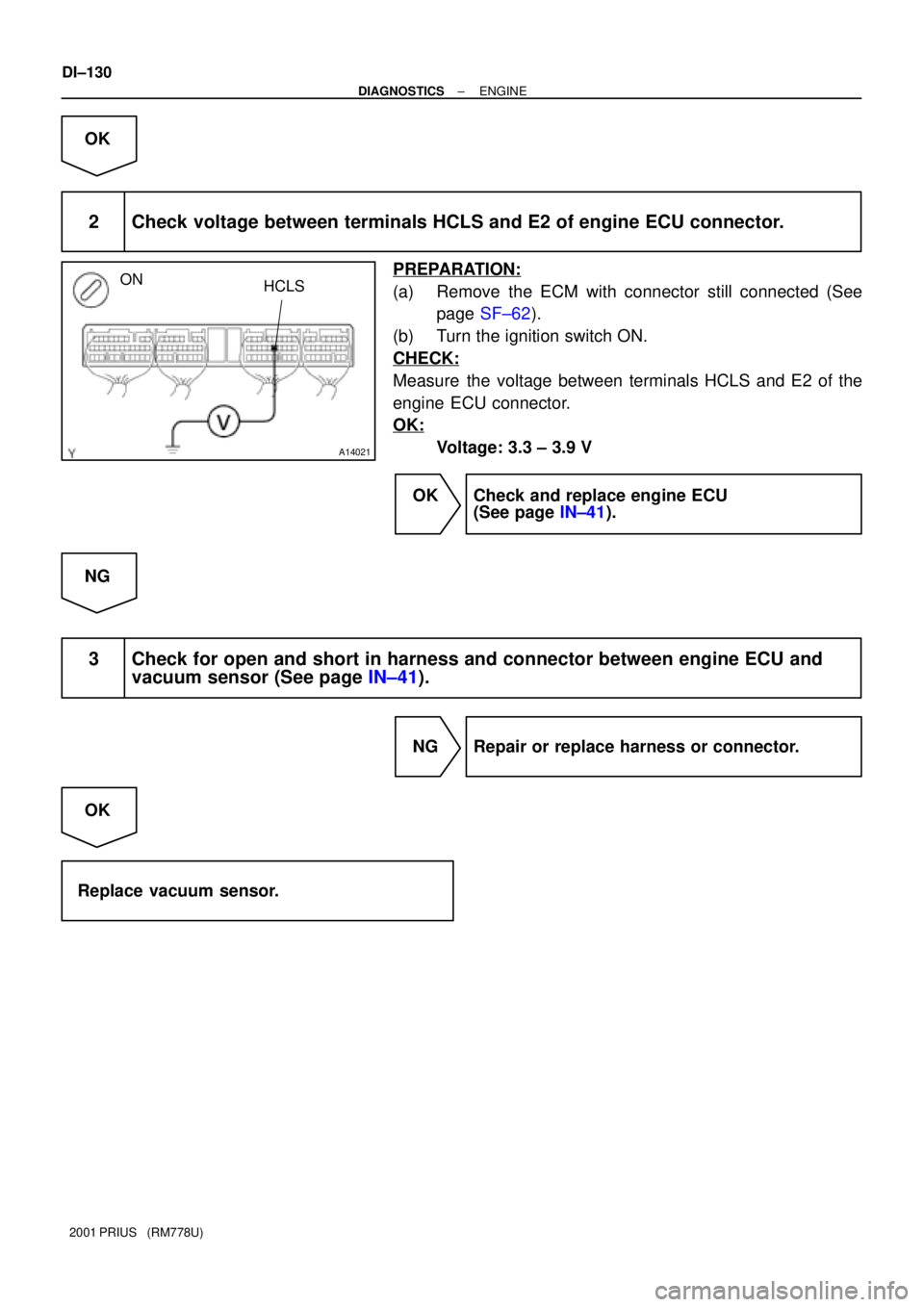
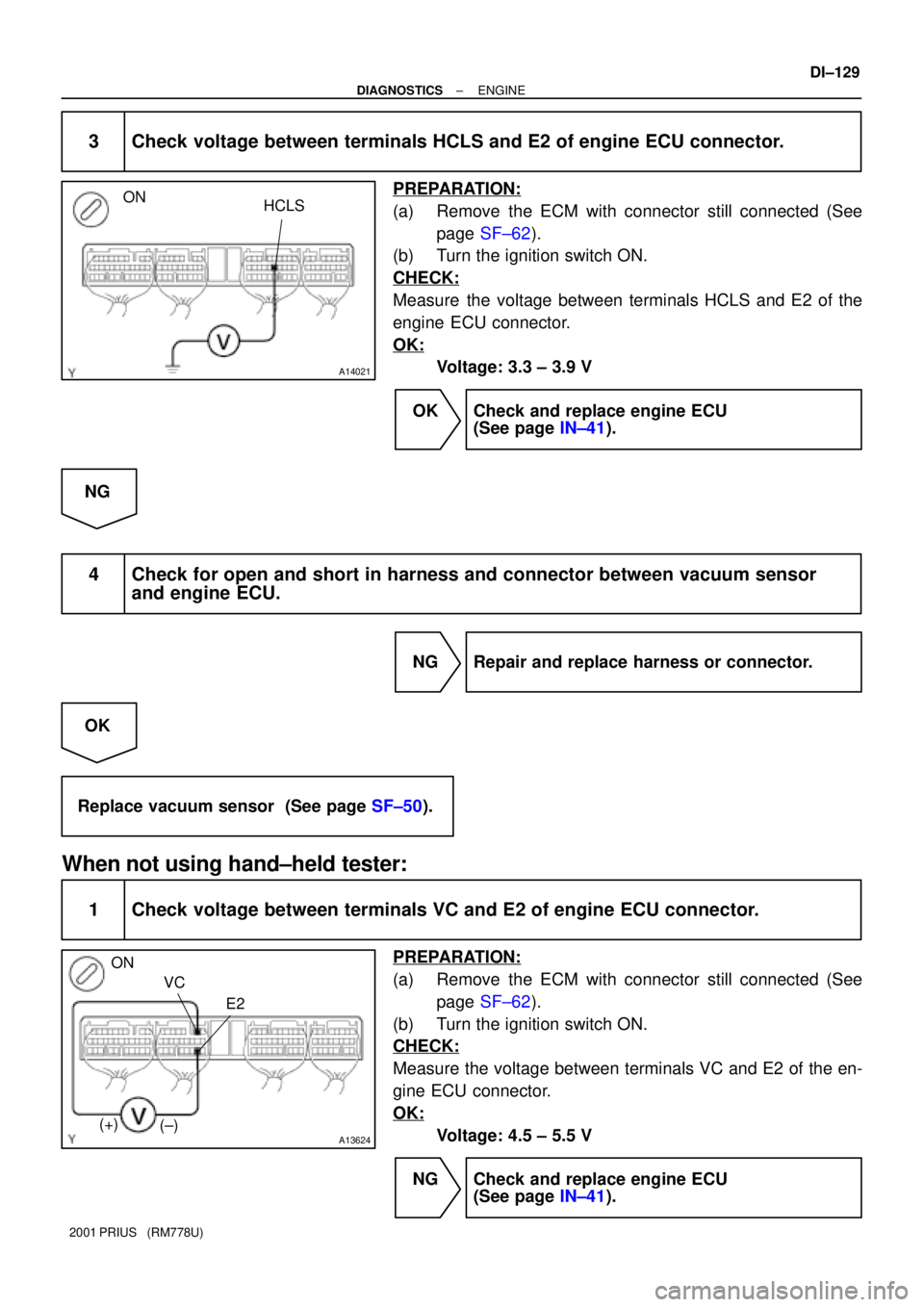
3 Check voltage between terminals HCLS and E2 of engine ECU connector.
PREPARATION:
(a) Remove the ECM with connector still connected (See
page SF±62).
(b) Turn the ignition switch ON.
CHECK:
Measure the voltage between terminals HCLS and E2 of the
engine ECU connector.
OK:
Voltage: 3.3 ± 3.9 V
OK Check and replace engine ECU
(See page IN±41).
NG
4 Check for open and short in harness and connector between vacuum sensor
and engine ECU.
NG Repair and replace harness or connector.
OK
Replace vacuum sensor (See page SF±50).
When not using hand±held tester:
1 Check voltage between terminals VC and E2 of engine ECU connector.
PREPARATION:
(a) Remove the ECM with connector still connected (See
page SF±62).
(b) Turn the ignition switch ON.
CHECK:
Measure the voltage between terminals VC and E2 of the en-
gine ECU connector.
OK:
Voltage: 4.5 ± 5.5 V
NG Check and replace engine ECU
(See page IN±41).
Page 730 of 1943
A14021
HCLSON
DI±130
± DIAGNOSTICSENGINE
2001 PRIUS (RM778U)
OK
2 Check voltage between terminals HCLS and E2 of engine ECU connector.
PREPARATION:
(a) Remove the ECM with connector still connected (See
page SF±62).
(b) Turn the ignition switch ON.
CHECK:
Measure the voltage between terminals HCLS and E2 of the
engine ECU connector.
OK:
Voltage: 3.3 ± 3.9 V
OK Check and replace engine ECU
(See page IN±41).
NG
3 Check for open and short in harness and connector between engine ECU and
vacuum sensor (See page IN±41).
NG Repair or replace harness or connector.
OK
Replace vacuum sensor.
Page 731 of 1943

± DIAGNOSTICSENGINE
DI±131
2001 PRIUS (RM778U)
DTC P1431Vacuum Sensor for HC Adsorber and Catalyst Sys-
tem Circuit Range/Performance Problem
CIRCUIT DESCRIPTION
Refer to DTC P1430 on page DI±127.
DTC No.DTC Detecting ConditionTrouble Area
P1431
Conditions (a), (b), (c) and (d) continue with more than 10
seconds: (2 trip detection logic)
(b) PIM > 3.96 V
(c) VSV for HC Adsorber and Catalyst System is ON
(d) Engine speed is 1,000 rpm or more
(e) THW � 0°C (32°F)
�Vacuum sensor for HC adsorber and catalyst systemP1431Conditions (a), (b) and (c) continue with more than 10 se-
cond: (2 trip detection logic)
(a) PIM < 1.2 V
(b) Engine stopped
(c) VSV for HC Adsorber and Catalyst System is OFF
(d) THW � 0°C (32°F)
�Vacuum sensor for HC adsorber and catalyst system
�Vacuum line
INSPECTION PROCEDURE
HINT:
�If DTCs P1430, P1431, P0110, P0115, P0116, P0120, P0121 are output simultaneously, E2 (sensor
ground) may be open.
�Read freeze frame data using hand±held tester. Because freeze frame records the engine conditions
when the malfunction is detected. When troubleshooting it is useful for determining whether the vehicle
was running or stopped, the engine was warmed up or not, the air±fuel ratio was lean or rich, etc. at
the time of the malfunction.
�When a bypass valve has a trouble, it is possible that DTC P1341 will be detected ahead of DTC
P1436, and P1437, so in case that P1431 even if they are not memorized.
1 Are there any other codes (besides DTC P1431) being output?
YES Go to relevant DTC chart.
NO
DI7SZ±01
Page 732 of 1943
DI±132
± DIAGNOSTICSENGINE
2001 PRIUS (RM778U)
2 Check vacuum sensor for HC adsorber and catalyst system (See page SF±51).
NG Replace vacuum sensor.
OK
Check vacuum line for vacuum sensor for
blockage.
Page 735 of 1943

± DIAGNOSTICSENGINE
DI±135
2001 PRIUS (RM778U)
DTC P1437 Vacuum Line Malfunction
CIRCUIT DESCRIPTION
Refer to DTC P1436 on page DI±133.
DTC No.DTC Detecting ConditionTrouble Area
P1437
With cold start when the water temperature and intake air
temperature were ± 10 °C (14 °F) to 40 °C (104 °F), and
when the water temperature has reached 45 °C (113 °F) or
more and the engine load factor has become more than 30
%, the negative pressure has abnormality.�Vacuum line
�VSV for HC adsober and catalyst system
�Vacuum sensor for HC adsober and catalyst system
�Check valve
INSPECTION PROCEDURE
TOYOTA hand±held tester:
1 Check vacuum hoses and tube between intake manifold and actuator.
CHECK:
(a) Check that the vacuum hoses is connected correctly.
(b) Check the vacuum hose for looseness and disconnection.
(c) Check the vacuum hose and tube for cracks, holes and damage.
(d) Check the vacuum hose for clog.
NG Repair or replace.
OK
2 Check for open and short in harness and connector between VSV (for HC adsob-
er and catalyst system) and ECM (See page IN±41).
NG Repair or replace harness or connector.
OK
3 Check VSV (for HC adsorber and catalyst system) (See page SF±47).
NG Replace VSV.
OK
DI7T1±01
Page 736 of 1943
DI±136
± DIAGNOSTICSENGINE
2001 PRIUS (RM778U)
4 Check vacuum stored in vacuum hose between check valve and actuator.
PREPARATION:
(a) Disconnect the vacuum hose from the pressure sensor for HC adsober and catalyst system.
(b) Connect the MITYVAC (Hand±held vacuum pump) to the vacuum hose.
(c) Connect the TOYOTA hand±held tester to the DLC3.
CHECK:
(a) VSV (for HC adsober and catalyst system) is operate by TOYOTA hand±held tester.
(b) Apply vacuum of 55 kPa (420 mmHg, 16.24 in.Hg).
(c) Check that the vacuum after 30 sec.
OK:
The vacuum is 25 Kpa (188 mmHg, 7.38 in.Hg) or more.
OK Check and replace vacuum hose between in-
take manifold and actuator.
NG
5 Check check valve.
NG Replace check valve.
OK
6 Check stored vacuum of VSV.
NG Replace VSV (for HC adsober and catalyst sys-
tem).
OK
7 Check stored vacuum of actuator(See page EC±13).
NG Replace actuator.
OK
Page 738 of 1943
A14019
ONHCC
DI±138
± DIAGNOSTICSENGINE
2001 PRIUS (RM778U)
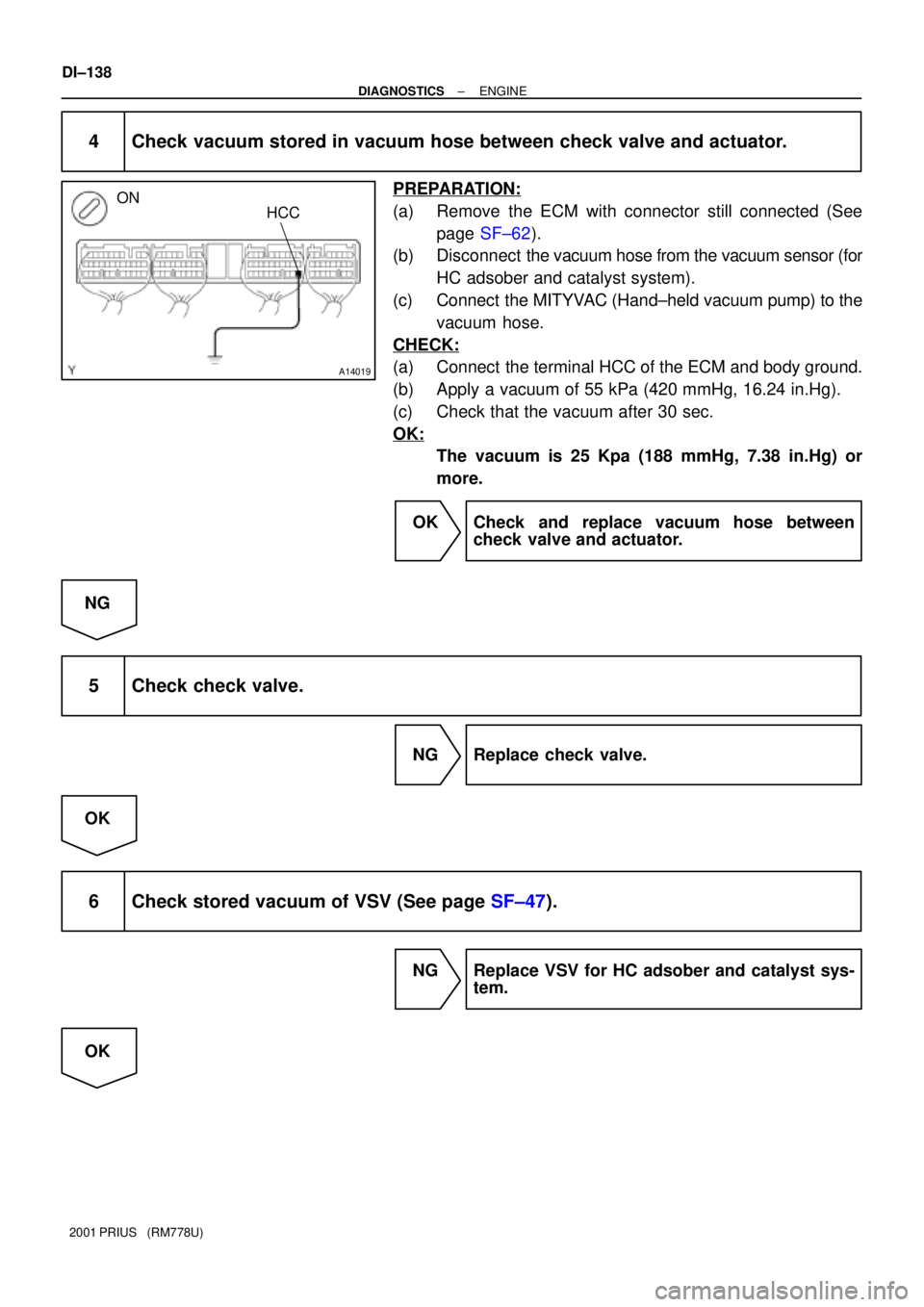
4 Check vacuum stored in vacuum hose between check valve and actuator.
PREPARATION:
(a) Remove the ECM with connector still connected (See
page SF±62).
(b) Disconnect the vacuum hose from the vacuum sensor (for
HC adsober and catalyst system).
(c) Connect the MITYVAC (Hand±held vacuum pump) to the
vacuum hose.
CHECK:
(a) Connect the terminal HCC of the ECM and body ground.
(b) Apply a vacuum of 55 kPa (420 mmHg, 16.24 in.Hg).
(c) Check that the vacuum after 30 sec.
OK:
The vacuum is 25 Kpa (188 mmHg, 7.38 in.Hg) or
more.
OK Check and replace vacuum hose between
check valve and actuator.
NG
5 Check check valve.
NG Replace check valve.
OK
6 Check stored vacuum of VSV (See page SF±47).
NG Replace VSV for HC adsober and catalyst sys-
tem.
OK
Page 751 of 1943

± DIAGNOSTICSENGINE
DI±153
2001 PRIUS (RM778U)
DTC P3190 Poor Engine Power
DTC P3191 Engine dose not Start
CIRCUIT DESCRIPTION
From the HV ECU, the ECM receives data such as power output required for the engine (required output),
estimated torque produced by the engine (estimated torque), engine RPM of control target (target RPM),
whether the engine is in start mode or not. Then, based on the required output and target RPM, the ECM
calculates a target torque that is to be produced by the engine and compares it with the estimated torque.
If the estimated torque is very low compared with the target torque, or the engine start mode continues at
the engine RPM or for the duration calculated by water temperature, an abnormal condition is detected.
DTC No.DTC Detecting ConditionTrouble Area
P3190
Following condition (a) to (e) continues at a fixed engine RPM
or a fixed length of time:
(a) Communication with HV ECU is normal.
(b) Engine RPM is a fixed value or more.
(c) Engine star mode is not active.
(d) Target torque is a fixed value or more.
(e) Ratio of estimated torque against target torque is less than
20 %.
�Air induction system
�Throttle body
�Fuel pressure
�Engine
�Air flow meter
�Out of fuel
Wt t
P3191
Following condition (a) to (c) continues at a fixed engine RPM
or for a fixed length of time:
(a) Vommunication with HV ECU is normal.
(b) Engine RPM is a fixed value or more.
(c) Engine start mode is active.�Water temp. sensor
�Crankshaft position sensor
�Camshaft position sensor
�ECM
WIRING DIAGRAM
Refer to DTC P1636 on page DI±146.
INSPECTION PROCEDURE
1 Are there any other codes begin output?
YES Go to relevant DTC chart.
NO
DI7T6±01