Page 666 of 1943
P18349
± DIAGNOSTICSENGINE
DI±63
2001 PRIUS (RM778U)
5 Check fuel pressure (See page SF±6).
NG Check and repair fuel pump and fuel pipe line.
OK
6 Check gas leakade on exhaust system.
NG Repair or replace.
OK
7 Check the output voltage of heated oxygen sensor during idling.
PREPARATION:
Warm up the oxygen sensor the engine at 2,500 rpm for approx. 90 sec.
CHECK:
Use the OBD II scan tool or TOYOTA hand±held tester read the output voltage of the heated oxygen sensor
during idling.
OK:
Oxygen sensor output voltage:
Alternates repeatedly between less than 0.4 V and more than 0.55 V (See the following table).
OK Go to step 9.
NG
Page 667 of 1943
DI±64
± DIAGNOSTICSENGINE
2001 PRIUS (RM778U)
8 Check for open and short in harness and connector between ECM and heated
oxygen sensor (See page IN±30).
NG Repair or replace harness or connector.
OK
Replace heated oxygen sensor.
9 Perform confirmation driving pattern (See page DI±50).
GO
10 Is there DTC P0171 being output again?
YES Check and replace ECM.
NO
11 Did vehicle runs out of fuel in the past?
NO Check for intermittent problems.
YES
DTC P0171 or P0172 is caused by running out
of fuel.
Page 668 of 1943

± DIAGNOSTICSENGINE
DI±65
2001 PRIUS (RM778U)
DTC P0300 Random/Multiple Cylinder Misfire Detected
DTC P0301 Cylinder 1 Misfire Detected
DTC P0302 Cylinder 2 Misfire Detected
DTC P0303 Cylinder 3 Misfire Detected
DTC P0304 Cylinder 4 Misfire Detected
CIRCUIT DESCRIPTION
Misfire: The ECM uses the crankshaft position sensor and camshaft position sensor to monitor changes in
the crankshaft rotation for each cylinder.
The ECM counts the number of times the engine speed change rate indicates that misfire has occurred. And
when the misfire rate equals or exceeds the count indicating that the engine condition has deteriorated, the
MIL lights up.
If the misfire rate is high enough and the driving conditions will cause catalyst overheating, the MIL blinks
when misfiring occurs.
DTC No.DTC Detecting ConditionTrouble Area
P0300Mi fi i f d li d i d t t d d i ti l
�Open or short in engine wire
�Connector connection
�Vacuum hose connection
�I
gnition systemP0300
P0301
P0302
P0303
P0304
Misfiring of random cylinders is detected during any particular
200 or 1,000 revolutions
For any particular 200 revolutions for the engine, misfiring is
detected which can cause catalyst overheating
(This causes MIL to blink)
�Ignition system
�Injector
�Fuel pressure
�Manifold absolute pressure sensor
�En
gine coolant temp. sensorP0304(This causes MIL to blink)�Engine coolant tem. sensor
�Compression pressure
�Valve clearance
�Valve timing
�ECM
HINT:
�When the 2 or more codes for a misfiring cylinder are recorded repeatedly but no random misfire code
is recorded, it indicates that the misfires were detected and recorded at different times.
�There is a case where the cylinder other than memorized has an accidental fire (the cylinder which is
one ahead of fired cylinder), so. at the time of checking all the checking items and if there is no ab-
normality, check the cylinder which is different from the recorded cylinder as fired.
DI6V8±03
Page 672 of 1943
± DIAGNOSTICSENGINE
DI±69
2001 PRIUS (RM778U)
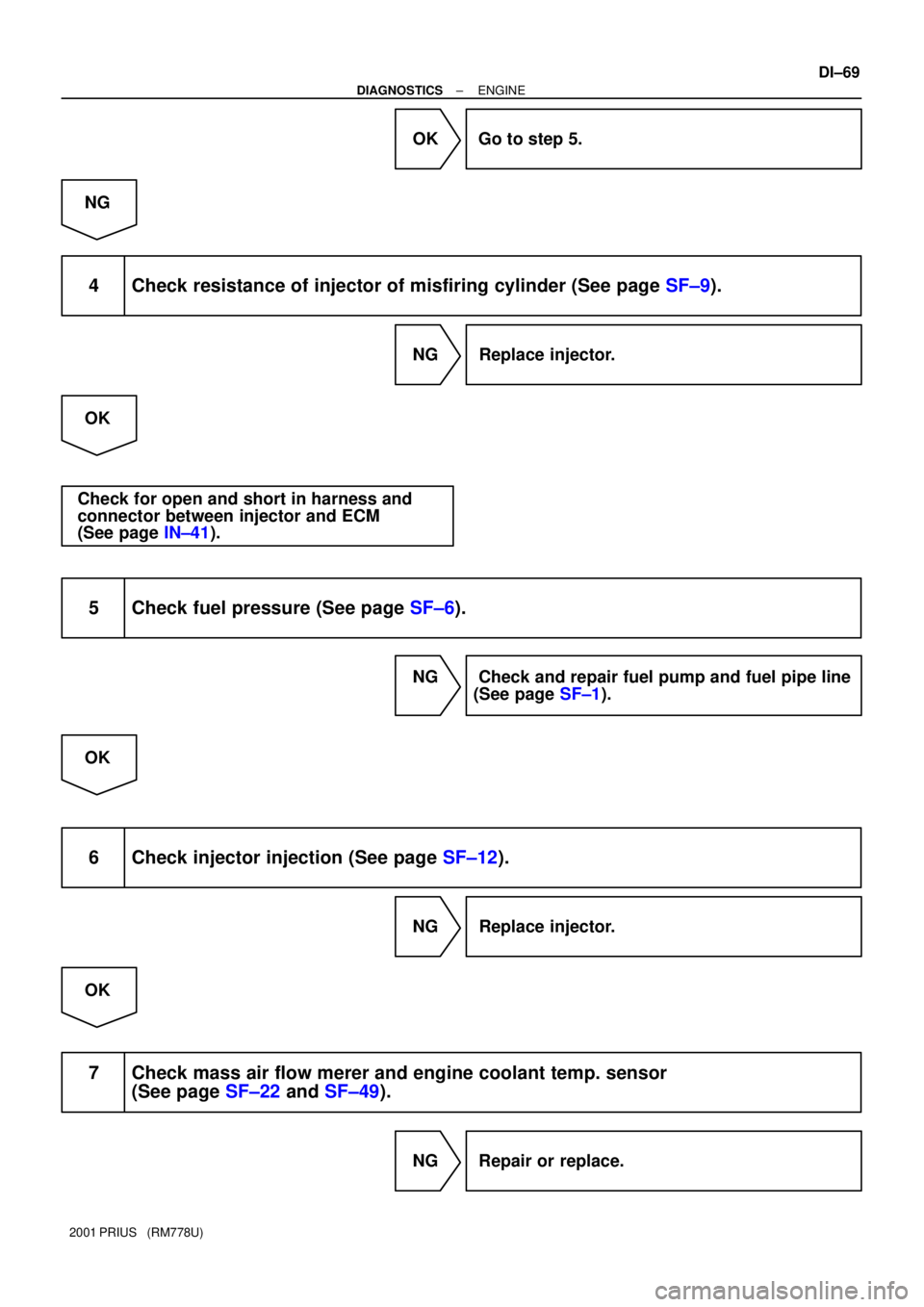
OK Go to step 5.
NG
4 Check resistance of injector of misfiring cylinder (See page SF±9).
NG Replace injector.
OK
Check for open and short in harness and
connector between injector and ECM
(See page IN±41).
5 Check fuel pressure (See page SF±6).
NG Check and repair fuel pump and fuel pipe line
(See page SF±1).
OK
6 Check injector injection (See page SF±12).
NG Replace injector.
OK
7 Check mass air flow merer and engine coolant temp. sensor
(See page SF±22 and SF±49).
NG Repair or replace.
Page 674 of 1943
A14027
Knock
SensorECM
KNK1 E7 1
EA1128
B
BR
EB
BR(Shielded)
A
J8 A
J9J/C
± DIAGNOSTICSENGINE
DI±71
2001 PRIUS (RM778U)
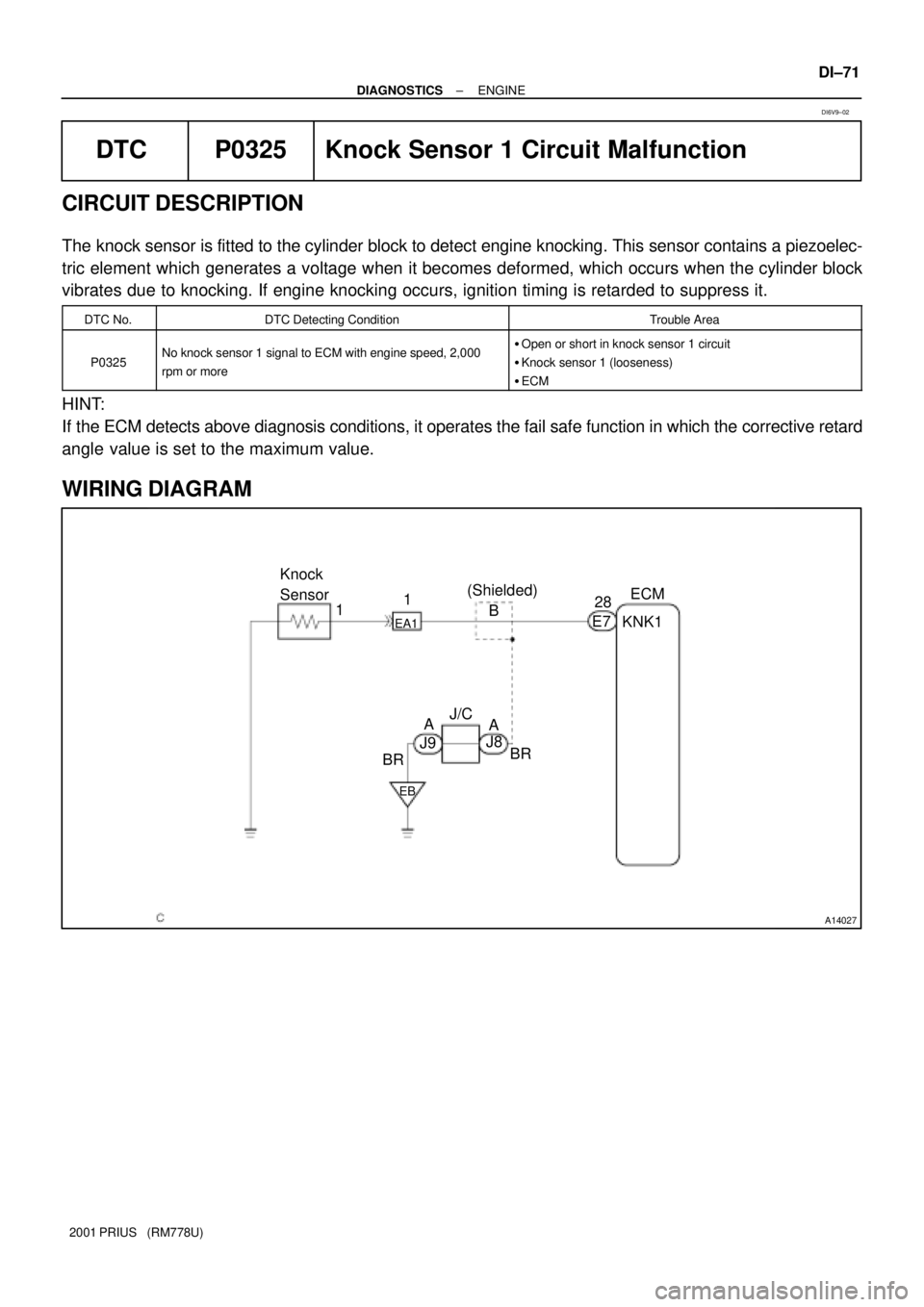
DTC P0325 Knock Sensor 1 Circuit Malfunction
CIRCUIT DESCRIPTION
The knock sensor is fitted to the cylinder block to detect engine knocking. This sensor contains a piezoelec-
tric element which generates a voltage when it becomes deformed, which occurs when the cylinder block
vibrates due to knocking. If engine knocking occurs, ignition timing is retarded to suppress it.
DTC No.DTC Detecting ConditionTrouble Area
P0325No knock sensor 1 signal to ECM with engine speed, 2,000
rpm or more�Open or short in knock sensor 1 circuit
�Knock sensor 1 (looseness)
�ECM
HINT:
If the ECM detects above diagnosis conditions, it operates the fail safe function in which the corrective retard
angle value is set to the maximum value.
WIRING DIAGRAM
DI6V9±02
Page 675 of 1943
A13628
E7 Connector LOCK
KNK1
DI±72
± DIAGNOSTICSENGINE
2001 PRIUS (RM778U)
INSPECTION PROCEDURE
HINT:
Read freeze frame data using TOYOTA hand±held tester or OBD II scan tool. Because freeze frame records
the engine conditions when the malfunction is detected, when troubleshooting it is useful for determining
whether the vehicle was running or stopped, the engine warmed up or not, the air±fuel ratio lean or rich, etc.
at the time of the malfunction.
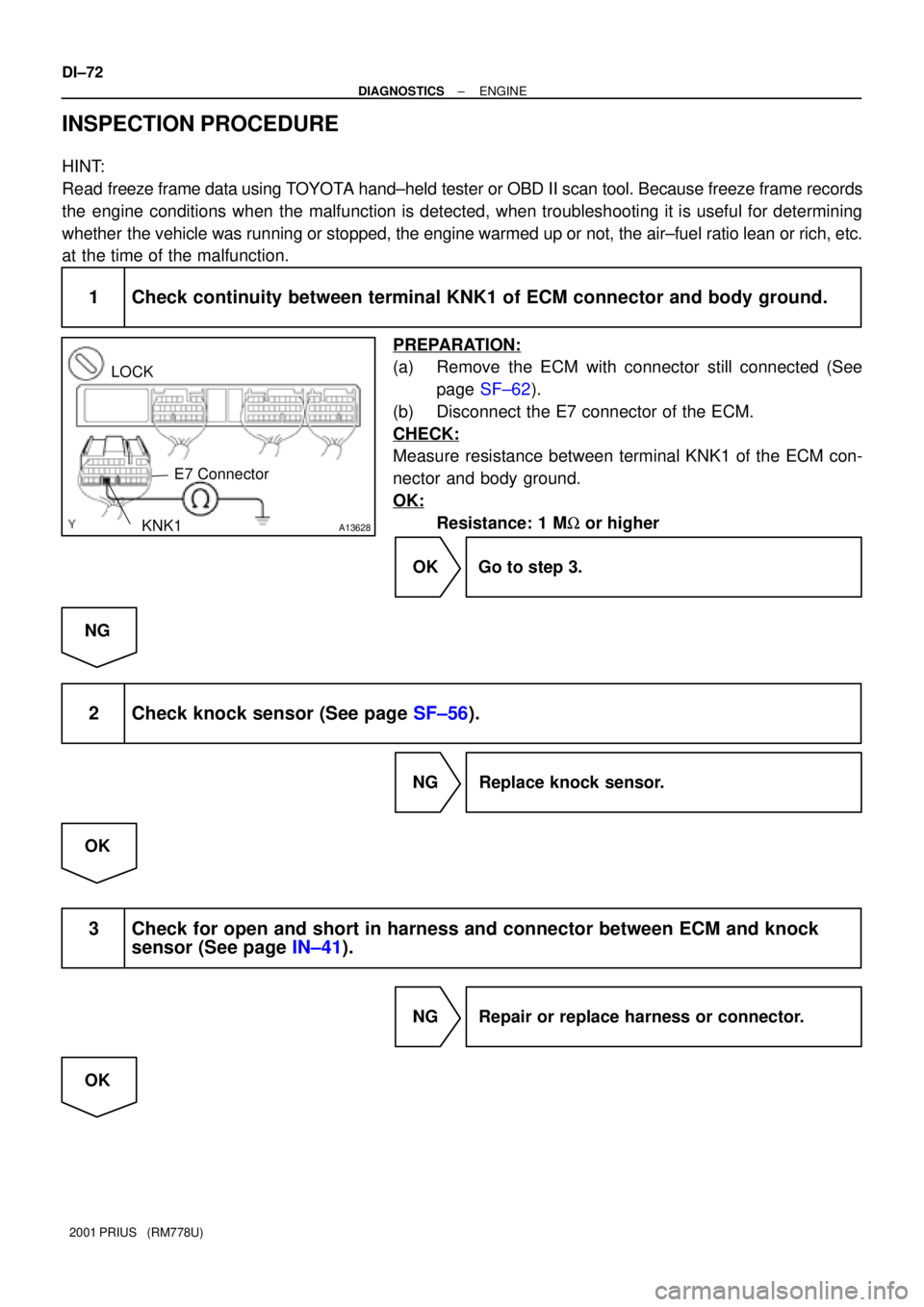
1 Check continuity between terminal KNK1 of ECM connector and body ground.
PREPARATION:
(a) Remove the ECM with connector still connected (See
page SF±62).
(b) Disconnect the E7 connector of the ECM.
CHECK:
Measure resistance between terminal KNK1 of the ECM con-
nector and body ground.
OK:
Resistance: 1 MW or higher
OK Go to step 3.
NG
2 Check knock sensor (See page SF±56).
NG Replace knock sensor.
OK
3 Check for open and short in harness and connector between ECM and knock
sensor (See page IN±41).
NG Repair or replace harness or connector.
OK
Page 676 of 1943
A00406
KNK signal waveform
0.5V/
Division
0V
0V5 m sec./Division
100
sec./Division 0.5V/
Division
± DIAGNOSTICSENGINE
DI±73
2001 PRIUS (RM778U)
4 Does malfunction disappear when a good knock sensor is installed?
YES Replace knock sensor.
NO
Check and replace ECM (See page IN±41).
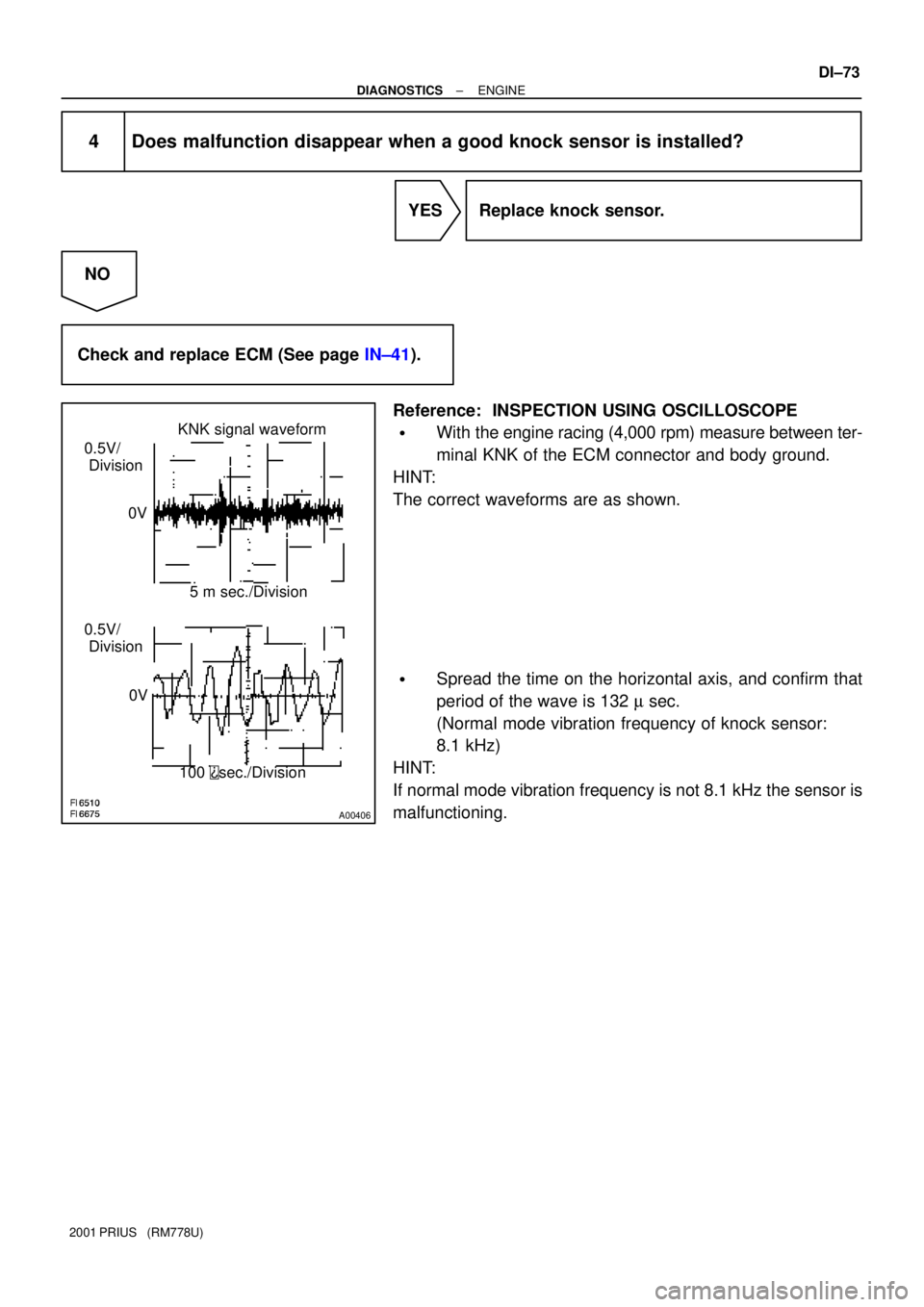
Reference: INSPECTION USING OSCILLOSCOPE
�With the engine racing (4,000 rpm) measure between ter-
minal KNK of the ECM connector and body ground.
HINT:
The correct waveforms are as shown.
�Spread the time on the horizontal axis, and confirm that
period of the wave is 132 m sec.
(Normal mode vibration frequency of knock sensor:
8.1 kHz)
HINT:
If normal mode vibration frequency is not 8.1 kHz the sensor is
malfunctioning.
Page 677 of 1943
A14028
1
2R
E7
J/C
J8NE+ NE± C1
Camshaft
Position
Sensor
2
1 C6
Crankshaft
Position
Sensor
E8 E8
BRG
EBECM
BRBRG2
J8
J9 R G
A A
A24
16 10 (Shielded)
(Shielded)
BRG
DI±74
± DIAGNOSTICSENGINE
2001 PRIUS (RM778U)
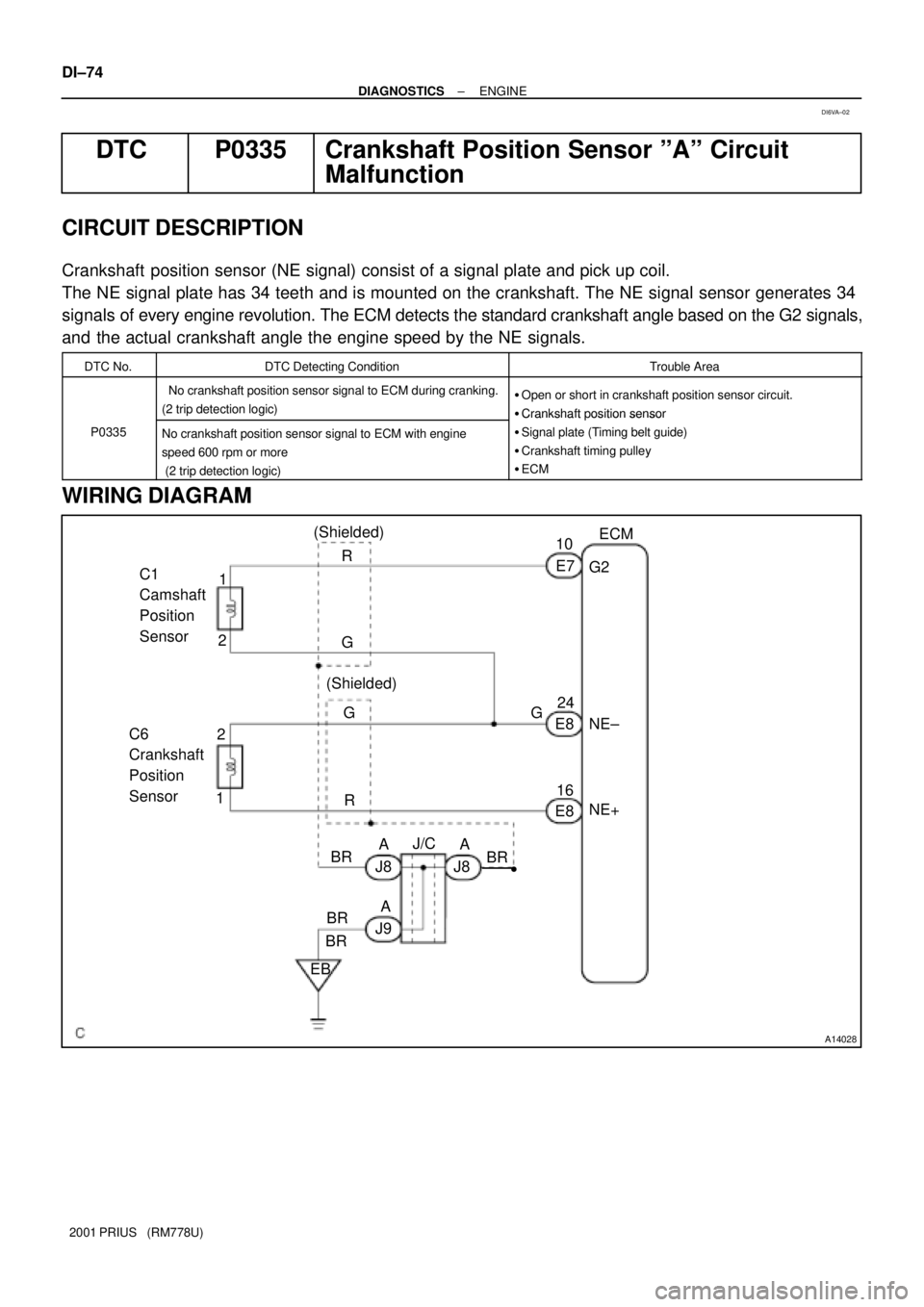
DTC P0335 Crankshaft Position Sensor ºAº Circuit
Malfunction
CIRCUIT DESCRIPTION
Crankshaft position sensor (NE signal) consist of a signal plate and pick up coil.
The NE signal plate has 34 teeth and is mounted on the crankshaft. The NE signal sensor generates 34
signals of every engine revolution. The ECM detects the standard crankshaft angle based on the G2 signals,
and the actual crankshaft angle the engine speed by the NE signals.
DTC No.DTC Detecting ConditionTrouble Area
No crankshaft position sensor signal to ECM during cranking.
(2 trip detection logic)�Open or short in crankshaft position sensor circuit.
�Crankshaft position sensor
P0335No crankshaft position sensor signal to ECM with engine
speed 600 rpm or more
(2 trip detection logic)
�Crankshaft osition sensor
�Signal plate (Timing belt guide)
�Crankshaft timing pulley
�ECM
WIRING DIAGRAM
DI6VA±02