Page 648 of 1943

P21242 FI7210
A04485
Atmosphere
Flange
Platinum Electrode
Solid Electrolyte
(Zirconia Element)
Platinum Electrode
Heater
Coating (Ceramic)
Exhaust Gas CoverIdeal Air±Fuel Mixture
Output Voltage
Richer ± Air Fuel Ratio ± Leaner
DI±44
± DIAGNOSTICSENGINE
2001 PRIUS (RM778U)
DTC P0125 Insufficient Temp. for Closed Loop
Fuel Control
CIRCUIT DESCRIPTION
To obtain a high purification rate for the CO, HC and NOx components of the exhaust gas, a three±way
catalytic converter is used, but for the most efficient use of the three±way catalytic converter, the air±fuel
ratio must be precisely controlled so that it is always close to the stoichiometric air±fuel ratio.
The oxygen sensor has the characteristic whereby its output voltage changes suddenly in the vicinity of the
stoichiometric air±fuel ratio. This is used to detect the oxygen concentration in the exhaust gas and provide
feedback to the computer for control of the air±fuel ratio.
When the air±fuel ratio becomes LEAN, the oxygen concentration in the exhaust increases and the oxygen
sensor informs the ECM of the LEAN condition (small electromotive force: < 0.45 V).
When the air±fuel ratio is RICHER than the stoichiometric air±fuel ratio the oxygen concentration in the ex-
haust gas in reduced and the oxygen sensor informs the ECM of the RICH condition (large electromotive
force: > 0.45V).
The ECM judges by the electromotive force from the oxygen sensor whether the air±fuel ratio is RICH or
LEAN and controls the injection time accordingly. However, if malfunction of the oxygen sensor causes out-
put of abnormal electromotive force, the ECM is unable to perform accurate air±fuel ratio control.
The oxygen sensors include a heater which heats the zirconia element. The heater is controlled by the ECM.
When the intake air volume is low (the temp. of the exhaust gas is low) current flows to the heater to heat
the sensor for accurate oxygen concentration detection.
DTC No.DTC Detecting ConditionTrouble Area
P0125
After the engine is warmed up, oxygen sensor (bank 1 sensor
1) output does not indicate RICH (� 0.45 V) even once when
conditions (a), (b), and (c) continue for at least 50 sec.
(a) Engine speed: 800 rpm or more
(b) Vehicle speed: 40 ± 100 km/h (25 ± 62 mph)
(c) 20 sec. or more after starting engine
�Fuel system
�Air induction system
�Injector
�Ignition system
�Gas leakage on exhaust system
�Open or short in heated oxygen sensor (bank 1 sensor 1)
circuit
�Heated oxygen sensor (bank 1 sensor 1)
�ECM
DI6V2±03
Page 649 of 1943
A14052
ECM
G±R
7
236 1B1AIA2 12
BR
G±Y 1
1 EFI2
1 5
11
1 1
12
3 Engine Room J/B
B±GF12
MAINFL
Block
No. 2
BatteryJ1
J/C W±B4
B
P±L
Y12
2
4 3
A
IEB
IP1BR
J23 BR
H9
Bank 1
Sensor 22
1 4
3
18
E10
E10E2 MREL
E11
BR IE1
IE1
IE1 W
W
D
11 2225
16
7 (Shielded) (Shielded)(Shielded) 2
FL Block No. 1
F13
J7
J/CJ4
J/C
J/C
A
ACHT1A
OX1B E10E10 E10E8E9
OX1A
HT1B G±R
EFI
Relay
1K 1F
1F
C
B
J23 J22 J23E
E EBR BR IK1
IK1
IK1 W (Shielded)P±L
P±L H3
Bank 1
Sensor 1
B
B
W±B 3
13
12
± DIAGNOSTICSENGINE
DI±45
2001 PRIUS (RM778U)
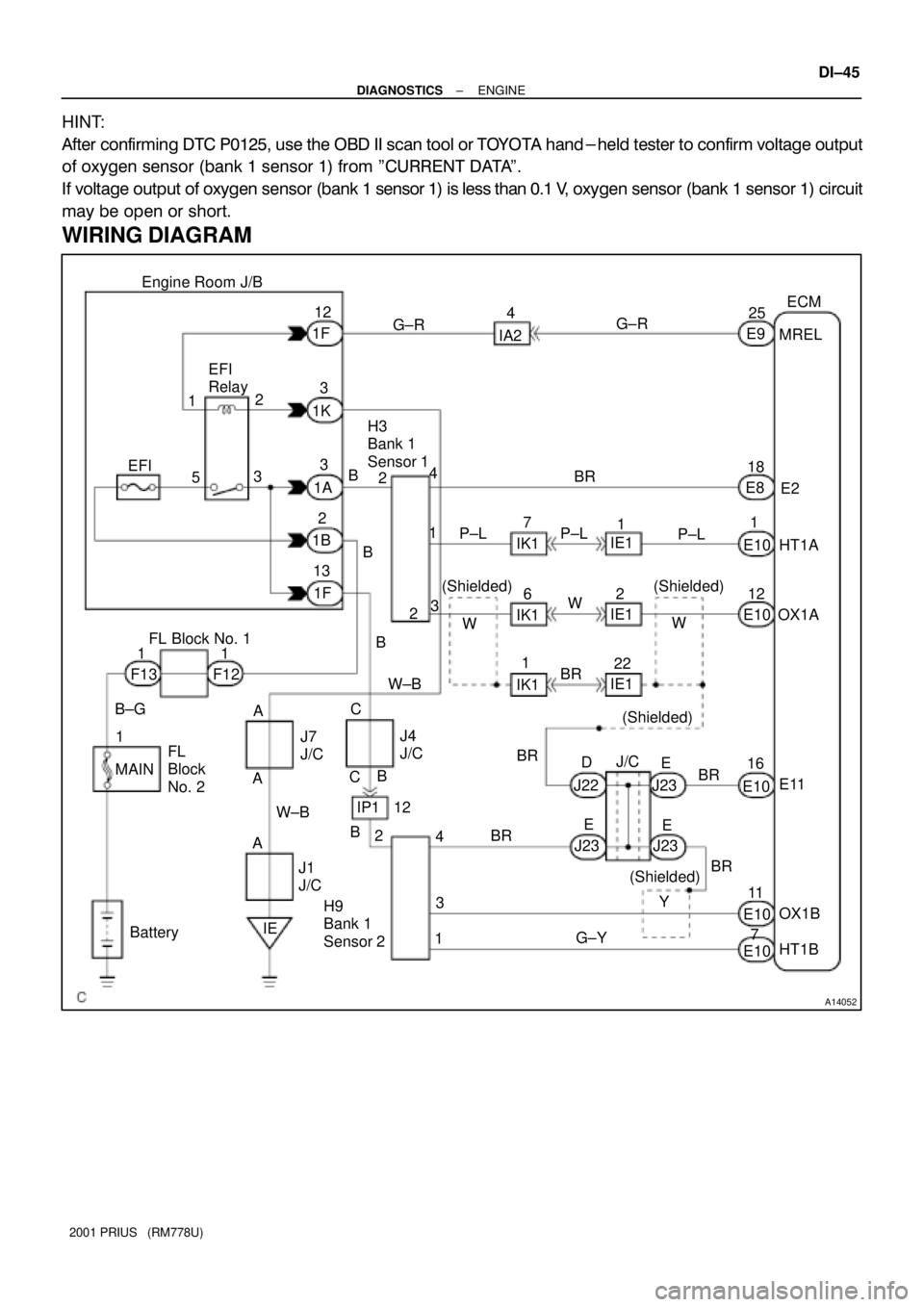
HINT:
After confirming DTC P0125, use the OBD II scan tool or TOYOTA hand-held tester to confirm voltage output
of oxygen sensor (bank 1 sensor 1) from "CURRENT DATA".
If voltage output of oxygen sensor (bank 1 sensor 1) is less than 0.1 V, oxygen sensor (bank 1 sensor 1) circuit
may be open or short.
WIRING DIAGRAM
Page 650 of 1943

DI±46
± DIAGNOSTICSENGINE
2001 PRIUS (RM778U)
INSPECTION PROCEDURE
HINT:
�If the vehicle run out of fuel, the air±fuel ratio is LEAN and DTC P0125 will be recorded .
The MIL then comes on.
�Read freeze frame data using TOYOTA hand±held tester or OBD II scan tool. Because freeze frame
records the engine conditions when the malfunction is detected, when troubleshooting it is useful for
determining whether the vehicle was running or stopped, the engine warmed up or not, the air±fuel
ratio lean or rich, etc at the time of the malfunction.
�There is a possibility that P0125 is detected because of abnormal fuel system, so, when P0125 is mem-
orized, check P0171 and P0172 even if P0171 and P0172 are memorized.
1 Are there any other codes (besides DTC P0125) being output ?
YES Go to relevant DTC chart.
NO
2 Connect the OBD II scan tool or TOYOTA hand±held tester and read value for
voltage output of oxygen sensor (bank 1 sensor 1).
PREPARATION:
(a) Connect the OBD II scan tool or TOYOTA hand±held tester to the DLC3.
(b) Warm up engine to normal operating temp (above 75°C).
CHECK:
Read voltage output of the oxygen sensor (bank 1 sensor 1) when engine is suddenly raced.
HINT:
Perform quick racing to 4,000 rpm 3 times using accelerator pedal.
OK:
Both oxygen sensor (bank 1 sensor 1) output a RICH signal (0.45 V or more) at least once.
OK Go to step 9.
NG
3 Check for open and short in harness and connector between ECM and oxygen
sensor (bank 1 sensor 1) (See page IN±41).
NG Repair or replace harness or connector.
OK
Page 652 of 1943
DI±48
± DIAGNOSTICSENGINE
2001 PRIUS (RM778U)
Replace oxygen sensor (bank 1 sensor 1).
9 Perform confirmation driving pattern (See page DI±50).
Go
10 Is there DTC P0125 being output again?
YES Check and replace ECM.
NO
11 Did vehicle runs out of fuel in the past?
NO Check for intermittent problems
(See page DI±3).
YES
DTC P0125 is caused by running out of fuel.
Page 653 of 1943

FI7130A14461
Vehicle
speed
Constant
speed
Start
online(c)(d)
IG SW
OFF30 sec. 36 sec.Time
(a) (b)
DI±50
± DIAGNOSTICSENGINE
2001 PRIUS (RM778U)
DTC P0130 Oxygen Sensor Circuit Malfunction
(Bank 1 Sensor 1)
CIRCUIT DESCRIPTION
Refer to DTC P0125 on page DI±44.
DTC No.DTC Detecting ConditionTrouble Area
P0130
Voltage output of oxygen sensor remains at 0.42 V or more, or
0.48 V or less, during idling after the engine is warmed up (2
trip detection logic)
�Open or short in heated oxygen sensor circuit
�Heated oxygen sensor
�Air induction system
�Fuel pressure
�Injector
�ECM
HINT:
Sensor 1 refers to the sensor closer to the engine body.
The oxygen sensor's output voltage and the short-term fuel trim value can be read using the OBD II scan
tool or TOYOTA hand-held tester.
WIRING DIAGRAM
Refer to DTC P0125 on page DI±44.
CONFIRMATION DRIVING PATTERN
(a) Connect the TOYOTA hand±held tester to the DLC3.
(b) Switch the TOYOTA hand±held tester from normal mode to check mode (See page DI±3).
(c) Start the engine and pass for 30 sec. or more.
(d) Drive the vehicle at constant speed for 36 sec. or more.
HINT:
If a malfunction exists, the MIL will light up during step (d).
NOTICE:
If the conditions in this test are not strictly followed, detection of the malfunction will not be possible.
If you do not have a TOYOTA hand±held tester, turn the ignition switch OFF after performing steps
(c) to (d), then perform steps (c) to (d) again.
DI6V3±02
Page 654 of 1943
P18349
0.48 V
0.42 V
± DIAGNOSTICSENGINE
DI±51
2001 PRIUS (RM778U)
INSPECTION PROCEDURE
HINT:
Read freeze frame data using TOYOTA hand±held tester or OBD II scan tool. Because freeze frame records
the engine conditions when the malfunction is detected, when troubleshooting it is useful for determining
whether the vehicle was running or stopped, the engine warmed up or not, the air±fuel ratio lean or rich, etc.
at the time of the malfunction.
1 Are there any other codes (besides DTC P0130) being output?
YES Go to relevant DTC chart.
NO
2 Check the output voltage of oxygen sensor during idling.
PREPARATION:
Warm up the oxygen sensor the engine at 2,500 rpm for approx. 90 sec.
CHECK:
Use the OBD II scan tool or TOYOTA hand±held tester read the output voltage of the oxygen sensor during
idling.
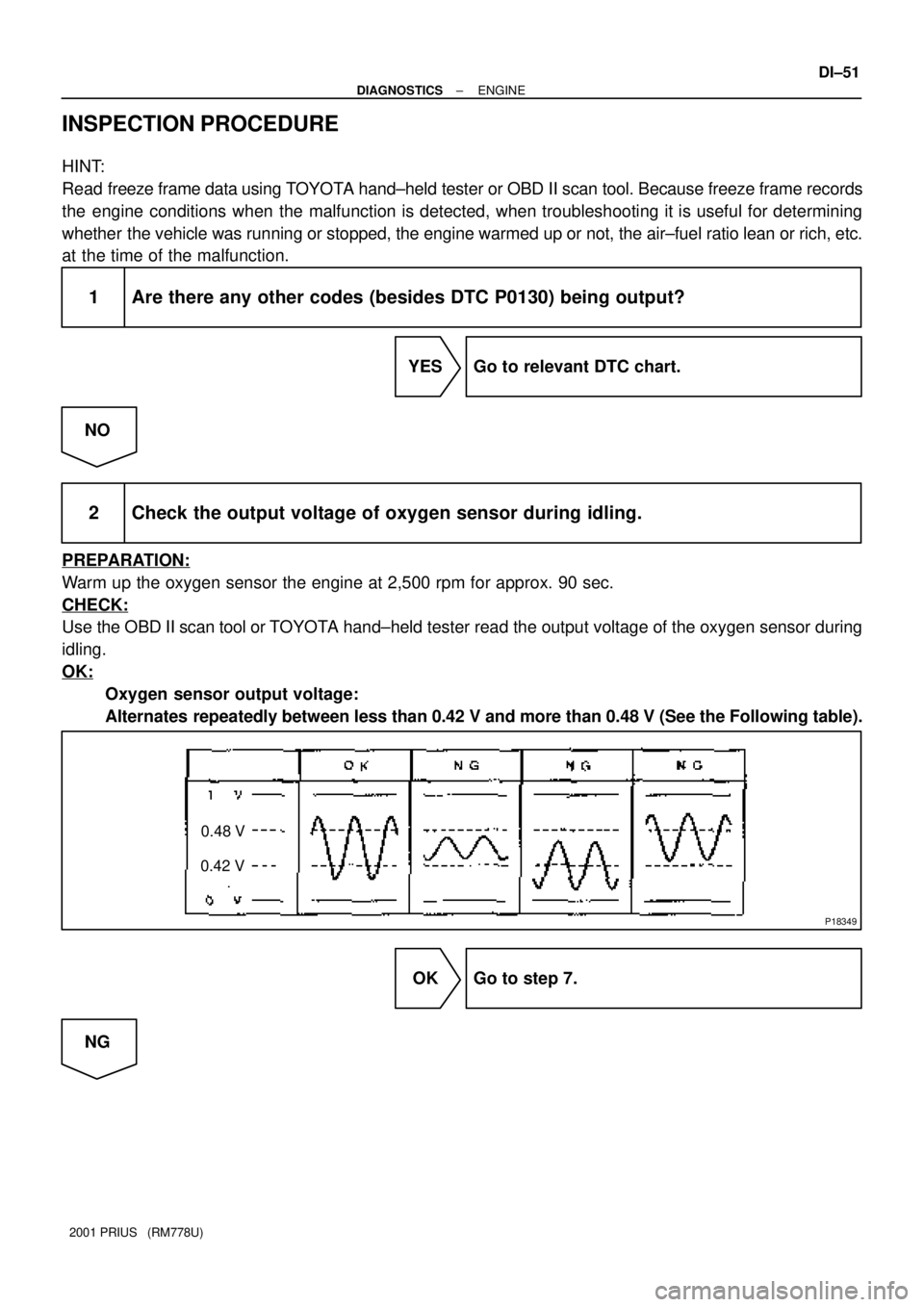
OK:
Oxygen sensor output voltage:
Alternates repeatedly between less than 0.42 V and more than 0.48 V (See the Following table).
OK Go to step 7.
NG
Page 655 of 1943
DI±52
± DIAGNOSTICSENGINE
2001 PRIUS (RM778U)
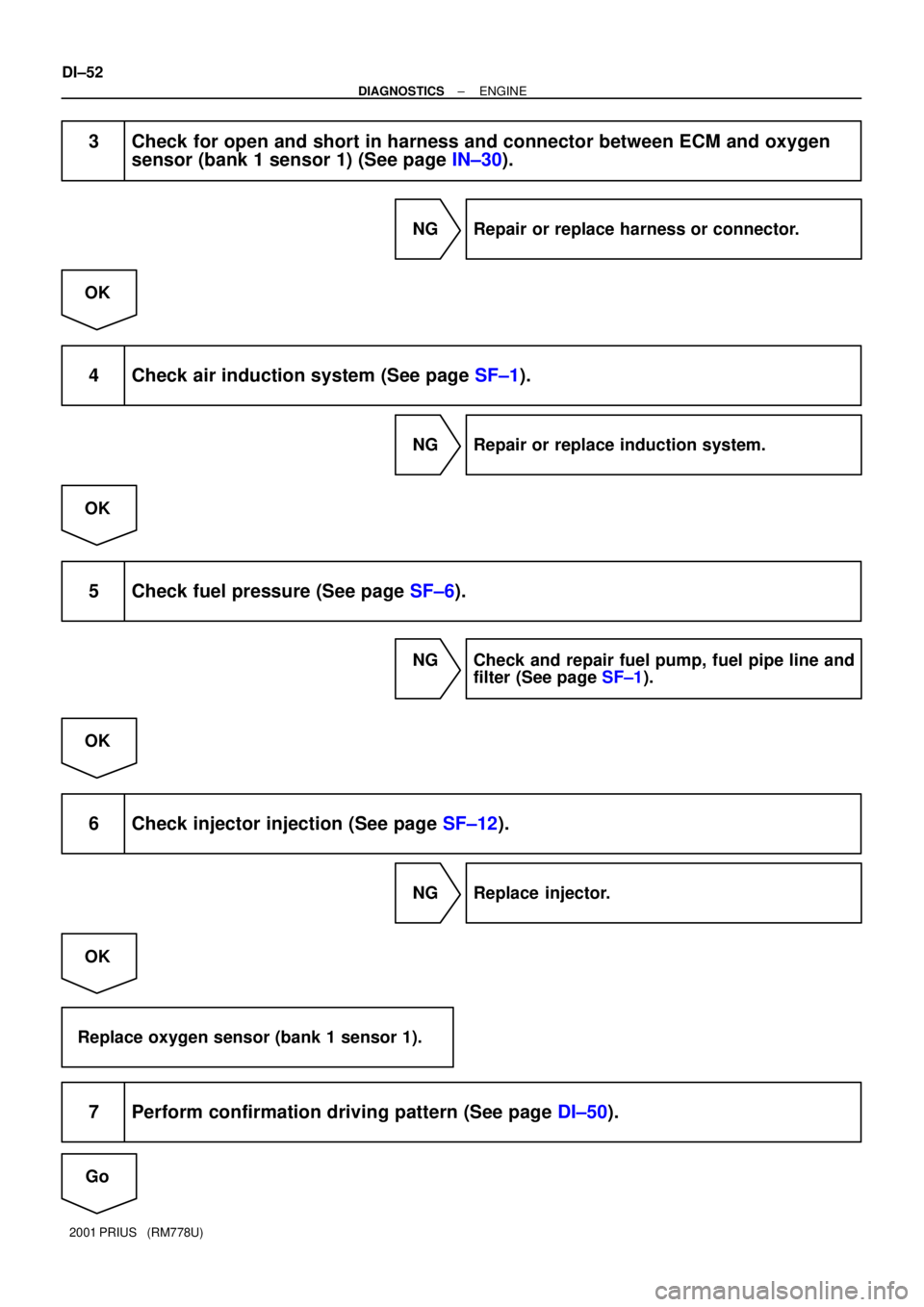
3 Check for open and short in harness and connector between ECM and oxygen
sensor (bank 1 sensor 1) (See page IN±30).
NG Repair or replace harness or connector.
OK
4 Check air induction system (See page SF±1).
NG Repair or replace induction system.
OK
5 Check fuel pressure (See page SF±6).
NG Check and repair fuel pump, fuel pipe line and
filter (See page SF±1).
OK
6 Check injector injection (See page SF±12).
NG Replace injector.
OK
Replace oxygen sensor (bank 1 sensor 1).
7 Perform confirmation driving pattern (See page DI±50).
Go
Page 657 of 1943

DI±54
± DIAGNOSTICSENGINE
2001 PRIUS (RM778U)
DTC P0133 Oxygen Sensor Circuit Slow
Responce (Bank 1 Sensor 1)
CIRCUIT DESCRIPTION
Refer to DTC P0125 on page DI±44.
DTC No.DTC Detecting ConditionTrouble Area
P0133
Response time for the oxygen sensor's voltage output to-
change from rich to lean, or from lean to rich, is 0.4 sec. or
more during constant vehicle speed after the engine is warmed
up
(2 trip detection logic)�Open or short in heated oxygen sensor circuit
�Heated oxygen sensor
�Air induction system
�Fuel pressure
�Injector
�ECM
HINT:
Sensor 1 refers to the sensor closer to the engine body.
INSPECTION PROCEDURE
HINT:
Read freeze frame data using TOYOTA hand±held tester or OBD II scantool. Because freeze frame records
the engine conditions when the malfunction is detected, when troubleshooting it is useful for determining
whether the vehicle was running or stopped, the engine warmed up or not, the air±fuel ratio lean or rich, etc.
at the time of the malfunction.
1 Are there any other codes (besides DTC P0133) being output?
YES Go to relevant DTC chart.
NO
DI6V4±02