Page 921 of 1306
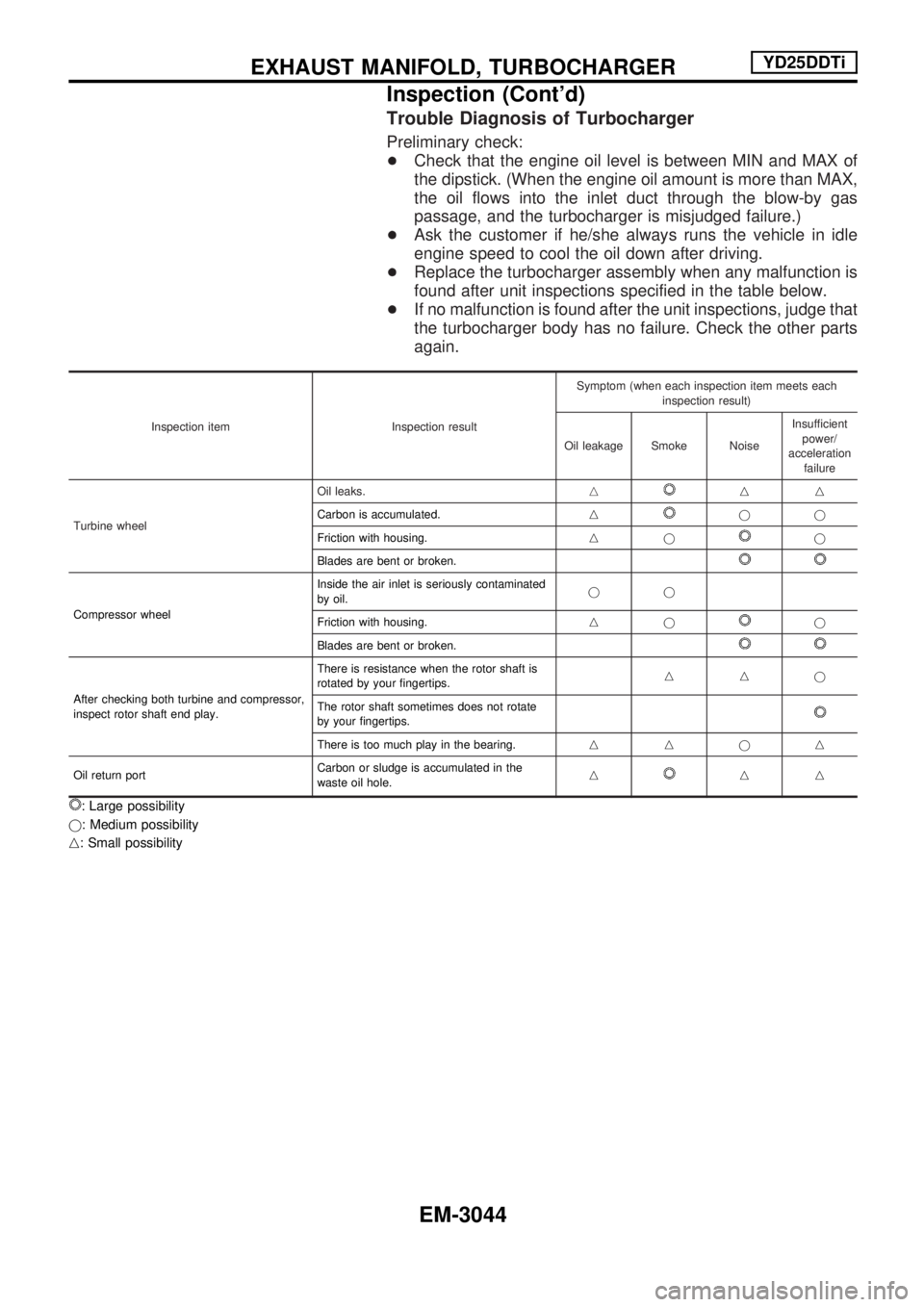
Trouble Diagnosis of Turbocharger
Preliminary check:
+Check that the engine oil level is between MIN and MAX of
the dipstick. (When the engine oil amount is more than MAX,
the oil flows into the inlet duct through the blow-by gas
passage, and the turbocharger is misjudged failure.)
+Ask the customer if he/she always runs the vehicle in idle
engine speed to cool the oil down after driving.
+Replace the turbocharger assembly when any malfunction is
found after unit inspections specified in the table below.
+If no malfunction is found after the unit inspections, judge that
the turbocharger body has no failure. Check the other parts
again.
Inspection item Inspection resultSymptom (when each inspection item meets each
inspection result)
Oil leakage Smoke NoiseInsufficient
power/
acceleration
failure
Turbine wheelOil leaks.n
nn
Carbon is accumulated.n
jj
Friction with housing.nj
j
Blades are bent or broken.
Compressor wheelInside the air inlet is seriously contaminated
by oil.jj
Friction with housing.njj
Blades are bent or broken.
After checking both turbine and compressor,
inspect rotor shaft end play.There is resistance when the rotor shaft is
rotated by your fingertips.nnj
The rotor shaft sometimes does not rotate
by your fingertips.
There is too much play in the bearing.nnjn
Oil return portCarbon or sludge is accumulated in the
waste oil hole.n
nn
: Large possibility
j: Medium possibility
n: Small possibility
EXHAUST MANIFOLD, TURBOCHARGERYD25DDTi
Inspection (Cont'd)
EM-3044
Page 922 of 1306
Removal and Installation
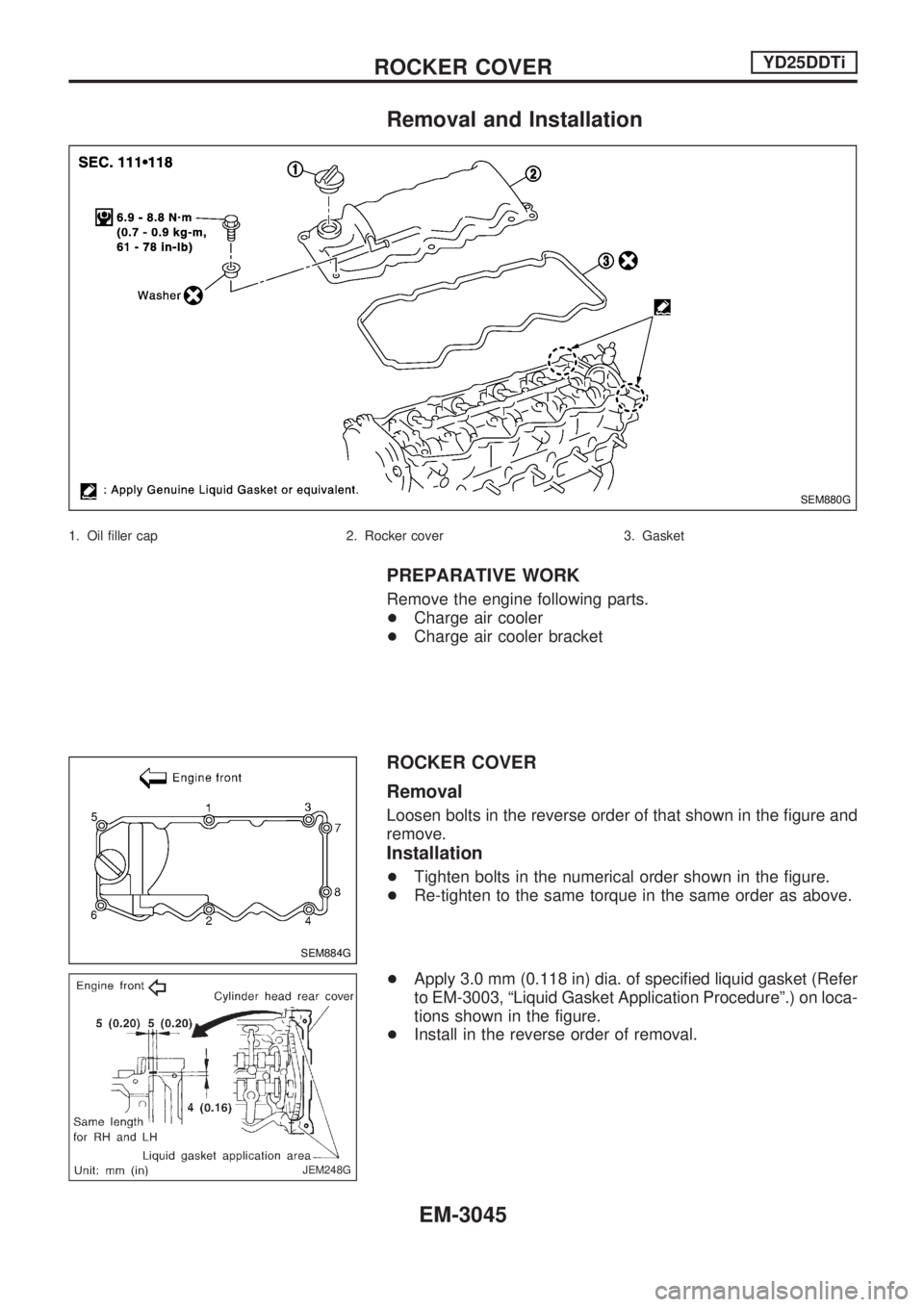
1. Oil filler cap 2. Rocker cover 3. Gasket
PREPARATIVE WORK
Remove the engine following parts.
+Charge air cooler
+Charge air cooler bracket
ROCKER COVER
Removal
Loosen bolts in the reverse order of that shown in the figure and
remove.
Installation
+Tighten bolts in the numerical order shown in the figure.
+Re-tighten to the same torque in the same order as above.
+Apply 3.0 mm (0.118 in) dia. of specified liquid gasket (Refer
to EM-3003, ªLiquid Gasket Application Procedureº.) on loca-
tions shown in the figure.
+Install in the reverse order of removal.
SEM880G
SEM884G
JEM248G
ROCKER COVERYD25DDTi
EM-3045
Page 924 of 1306
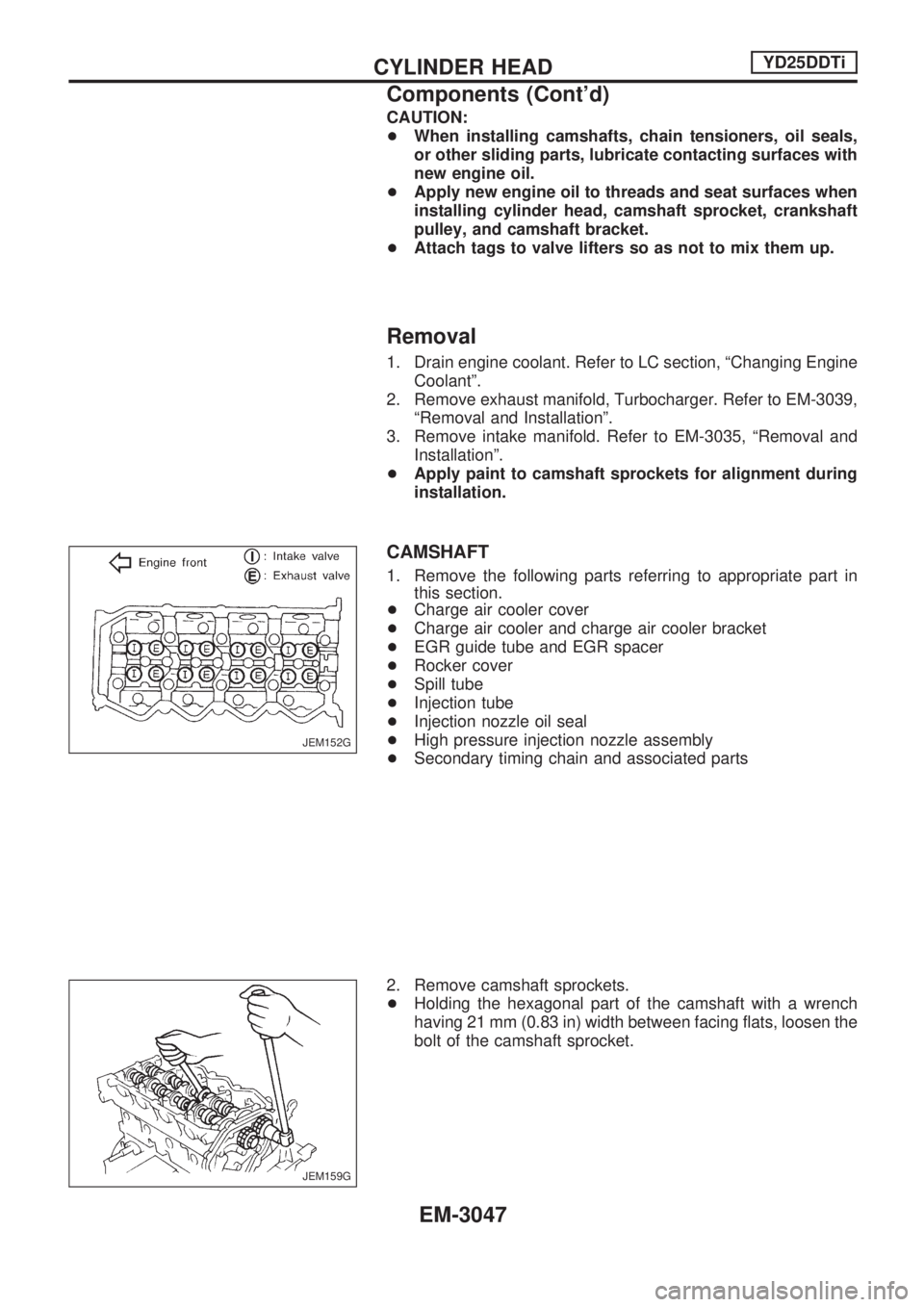
CAUTION:
+When installing camshafts, chain tensioners, oil seals,
or other sliding parts, lubricate contacting surfaces with
new engine oil.
+Apply new engine oil to threads and seat surfaces when
installing cylinder head, camshaft sprocket, crankshaft
pulley, and camshaft bracket.
+Attach tags to valve lifters so as not to mix them up.
Removal
1. Drain engine coolant. Refer to LC section, ªChanging Engine
Coolantº.
2. Remove exhaust manifold, Turbocharger. Refer to EM-3039,
ªRemoval and Installationº.
3. Remove intake manifold. Refer to EM-3035, ªRemoval and
Installationº.
+Apply paint to camshaft sprockets for alignment during
installation.
CAMSHAFT
1. Remove the following parts referring to appropriate part in
this section.
+Charge air cooler cover
+Charge air cooler and charge air cooler bracket
+EGR guide tube and EGR spacer
+Rocker cover
+Spill tube
+Injection tube
+Injection nozzle oil seal
+High pressure injection nozzle assembly
+Secondary timing chain and associated parts
2. Remove camshaft sprockets.
+Holding the hexagonal part of the camshaft with a wrench
having 21 mm (0.83 in) width between facing flats, loosen the
bolt of the camshaft sprocket.
JEM152G
JEM159G
CYLINDER HEADYD25DDTi
Components (Cont'd)
EM-3047
Page 935 of 1306
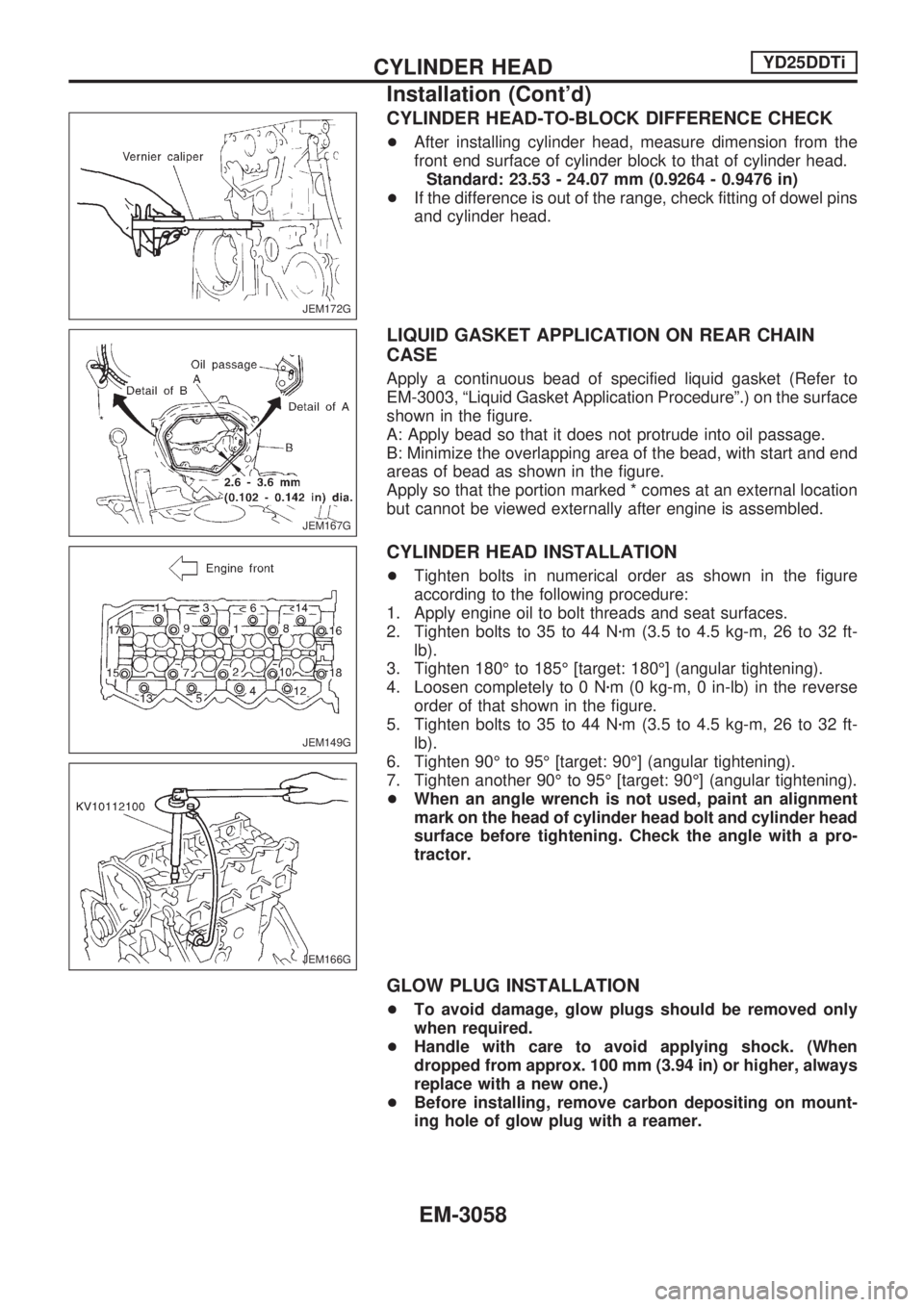
CYLINDER HEAD-TO-BLOCK DIFFERENCE CHECK
+After installing cylinder head, measure dimension from the
front end surface of cylinder block to that of cylinder head.
Standard: 23.53 - 24.07 mm (0.9264 - 0.9476 in)
+If the difference is out of the range, check fitting of dowel pins
and cylinder head.
LIQUID GASKET APPLICATION ON REAR CHAIN
CASE
Apply a continuous bead of specified liquid gasket (Refer to
EM-3003, ªLiquid Gasket Application Procedureº.) on the surface
shown in the figure.
A: Apply bead so that it does not protrude into oil passage.
B: Minimize the overlapping area of the bead, with start and end
areas of bead as shown in the figure.
Apply so that the portion marked * comes at an external location
but cannot be viewed externally after engine is assembled.
CYLINDER HEAD INSTALLATION
+Tighten bolts in numerical order as shown in the figure
according to the following procedure:
1. Apply engine oil to bolt threads and seat surfaces.
2. Tighten bolts to 35 to 44 Nzm (3.5 to 4.5 kg-m, 26 to 32 ft-
lb).
3. Tighten 180É to 185É [target: 180É] (angular tightening).
4. Loosen completely to 0 Nzm (0 kg-m, 0 in-lb) in the reverse
order of that shown in the figure.
5. Tighten bolts to 35 to 44 Nzm (3.5 to 4.5 kg-m, 26 to 32 ft-
lb).
6. Tighten 90É to 95É [target: 90É] (angular tightening).
7. Tighten another 90É to 95É [target: 90É] (angular tightening).
+When an angle wrench is not used, paint an alignment
mark on the head of cylinder head bolt and cylinder head
surface before tightening. Check the angle with a pro-
tractor.
GLOW PLUG INSTALLATION
+To avoid damage, glow plugs should be removed only
when required.
+Handle with care to avoid applying shock. (When
dropped from approx. 100 mm (3.94 in) or higher, always
replace with a new one.)
+Before installing, remove carbon depositing on mount-
ing hole of glow plug with a reamer.
JEM172G
JEM167G
JEM149G
JEM166G
CYLINDER HEADYD25DDTi
Installation (Cont'd)
EM-3058
Page 937 of 1306
Valve Clearance
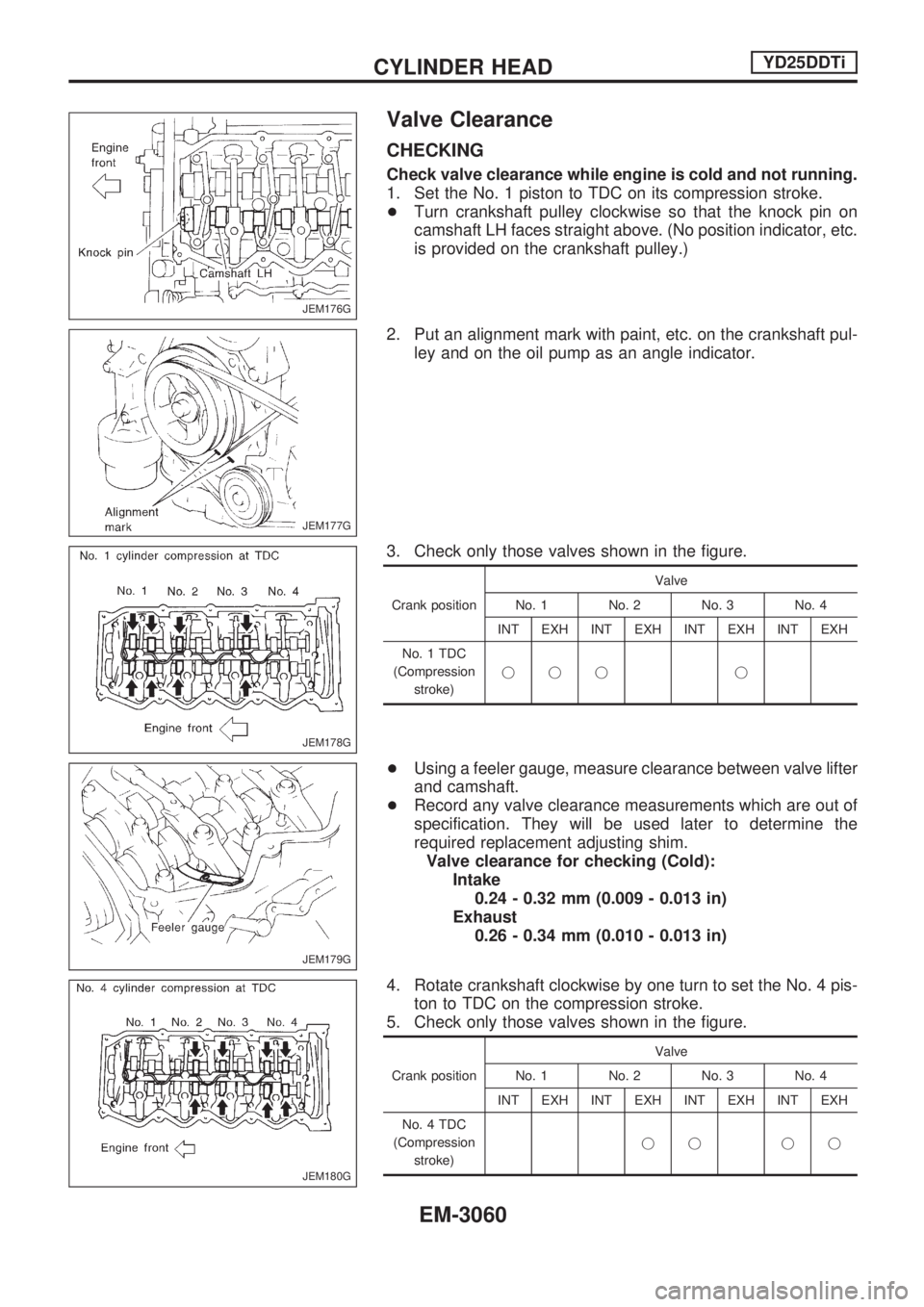
CHECKING
Check valve clearance while engine is cold and not running.
1. Set the No. 1 piston to TDC on its compression stroke.
+Turn crankshaft pulley clockwise so that the knock pin on
camshaft LH faces straight above. (No position indicator, etc.
is provided on the crankshaft pulley.)
2. Put an alignment mark with paint, etc. on the crankshaft pul-
ley and on the oil pump as an angle indicator.
3. Check only those valves shown in the figure.
Crank positionValve
No. 1 No. 2 No. 3 No. 4
INT EXH INT EXH INT EXH INT EXH
No. 1 TDC
(Compression
stroke)jjj j
+Using a feeler gauge, measure clearance between valve lifter
and camshaft.
+Record any valve clearance measurements which are out of
specification. They will be used later to determine the
required replacement adjusting shim.
Valve clearance for checking (Cold):
Intake
0.24 - 0.32 mm (0.009 - 0.013 in)
Exhaust
0.26 - 0.34 mm (0.010 - 0.013 in)
4. Rotate crankshaft clockwise by one turn to set the No. 4 pis-
ton to TDC on the compression stroke.
5. Check only those valves shown in the figure.
Crank positionValve
No. 1 No. 2 No. 3 No. 4
INT EXH INT EXH INT EXH INT EXH
No. 4 TDC
(Compression
stroke)jj jj
JEM176G
JEM177G
JEM178G
JEM179G
JEM180G
CYLINDER HEADYD25DDTi
EM-3060
Page 938 of 1306
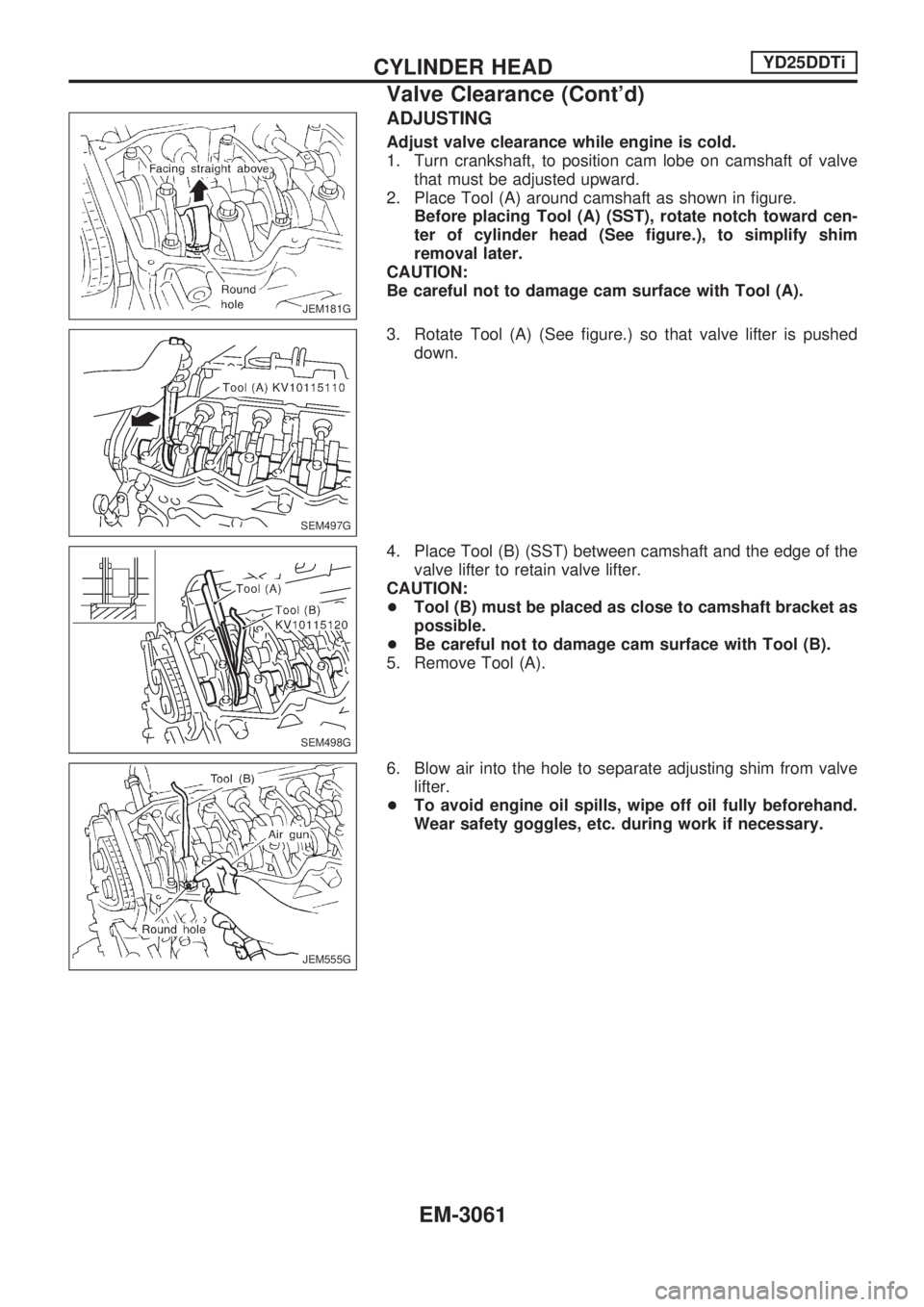
ADJUSTING
Adjust valve clearance while engine is cold.
1. Turn crankshaft, to position cam lobe on camshaft of valve
that must be adjusted upward.
2. Place Tool (A) around camshaft as shown in figure.
Before placing Tool (A) (SST), rotate notch toward cen-
ter of cylinder head (See figure.), to simplify shim
removal later.
CAUTION:
Be careful not to damage cam surface with Tool (A).
3. Rotate Tool (A) (See figure.) so that valve lifter is pushed
down.
4. Place Tool (B) (SST) between camshaft and the edge of the
valve lifter to retain valve lifter.
CAUTION:
+Tool (B) must be placed as close to camshaft bracket as
possible.
+Be careful not to damage cam surface with Tool (B).
5. Remove Tool (A).
6. Blow air into the hole to separate adjusting shim from valve
lifter.
+To avoid engine oil spills, wipe off oil fully beforehand.
Wear safety goggles, etc. during work if necessary.
JEM181G
SEM497G
SEM498G
JEM555G
CYLINDER HEADYD25DDTi
Valve Clearance (Cont'd)
EM-3061
Page 940 of 1306
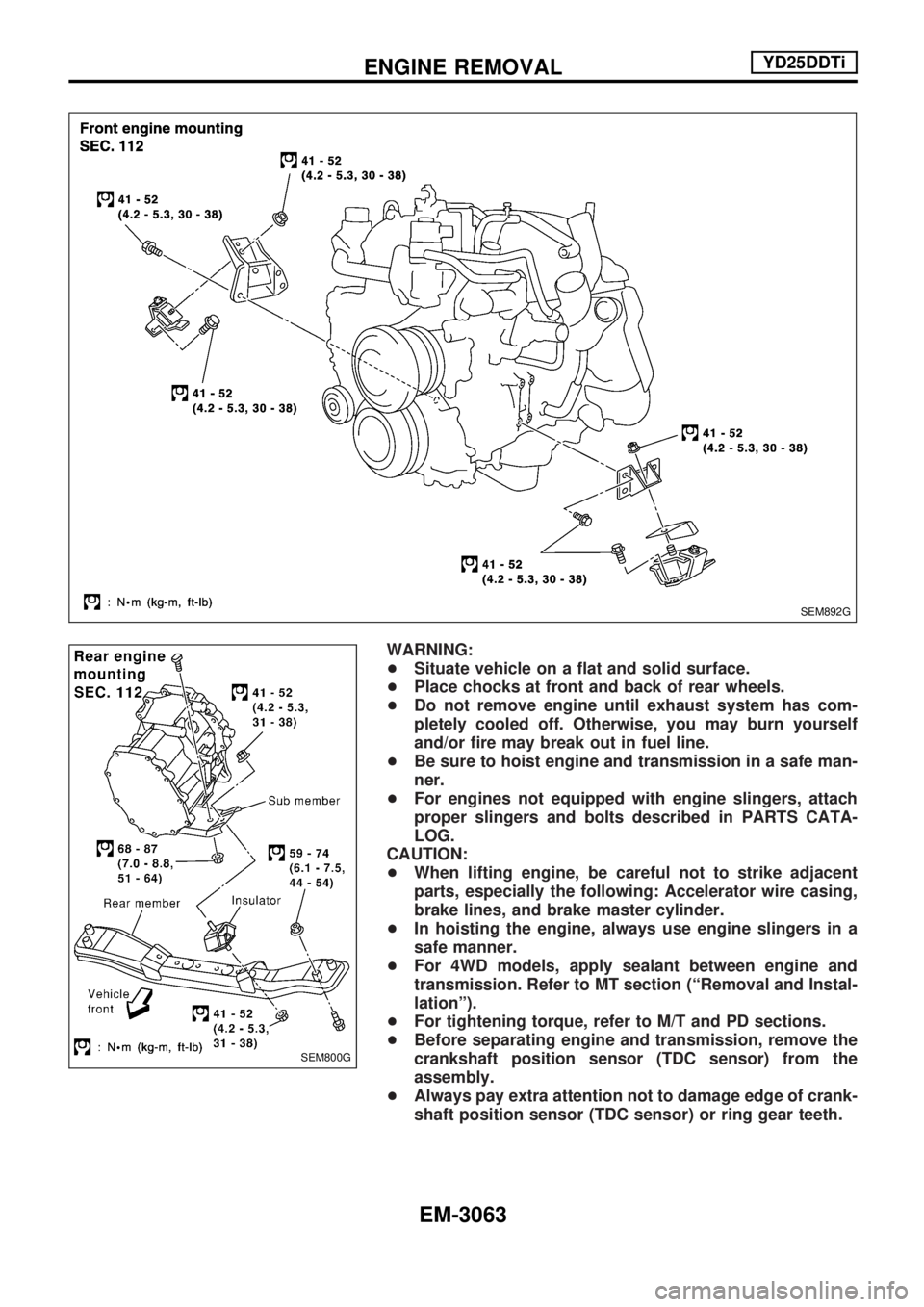
WARNING:
+Situate vehicle on a flat and solid surface.
+Place chocks at front and back of rear wheels.
+Do not remove engine until exhaust system has com-
pletely cooled off. Otherwise, you may burn yourself
and/or fire may break out in fuel line.
+Be sure to hoist engine and transmission in a safe man-
ner.
+For engines not equipped with engine slingers, attach
proper slingers and bolts described in PARTS CATA-
LOG.
CAUTION:
+When lifting engine, be careful not to strike adjacent
parts, especially the following: Accelerator wire casing,
brake lines, and brake master cylinder.
+In hoisting the engine, always use engine slingers in a
safe manner.
+For 4WD models, apply sealant between engine and
transmission. Refer to MT section (ªRemoval and Instal-
lationº).
+For tightening torque, refer to M/T and PD sections.
+Before separating engine and transmission, remove the
crankshaft position sensor (TDC sensor) from the
assembly.
+Always pay extra attention not to damage edge of crank-
shaft position sensor (TDC sensor) or ring gear teeth.
SEM892G
SEM800G
ENGINE REMOVALYD25DDTi
EM-3063
Page 941 of 1306
Removal
Preparation
1. Drain coolant from radiator drain plugs.
2. Remove the following parts.
+Engine hood
+Charge air cooler
+Under protector
+Battery
+Radiator shroud
+Radiator
+Accessory belt
+Cooling fan
+Exhaust front tube
Engine room (Left)
3. Remove air duct and air cleaner case.
4. Disconnect harness connectors from alternator and air con-
ditioner compressor.
5. Remove alternator.
6. Remove installation bolts. Relocate air conditioner compres-
sor. Use a rope to temporarily anchor it to vehicle side.
7. Disconnect and relocate heating hose, install blank cap to
hose to prevent coolant from leaking.
8. Remove heat insulator.
Engine room (Right)
9. Remove fuel feed and return hoses.
CAUTION:
Install blank caps immediately to avoid fuel leakage.
10. Remove all harness connectors on the engine, and move
harnesses to the side of the vehicle.
Vehicle underfloor
11. Remove starter motor.
12. Remove front propeller shaft.
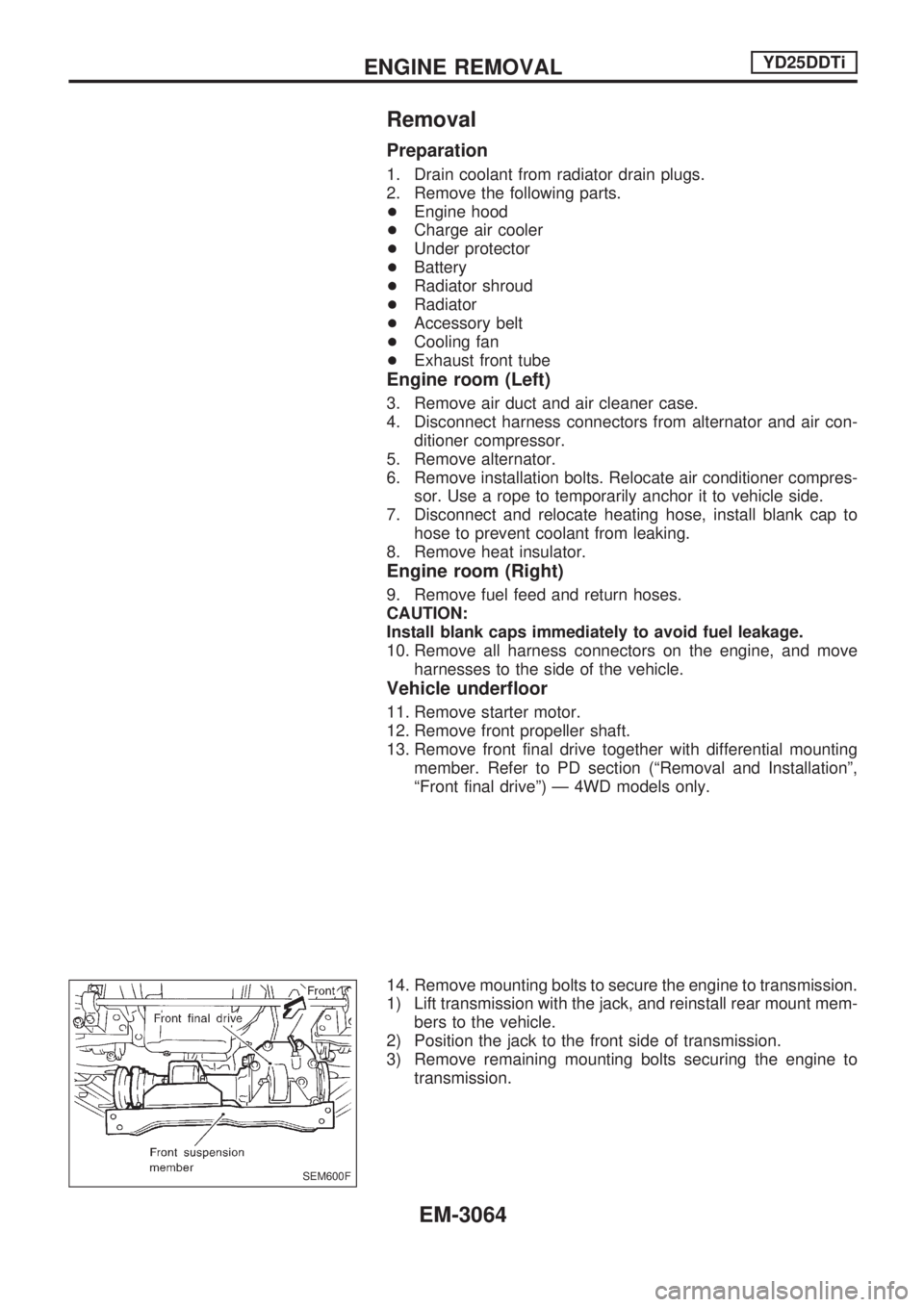
13. Remove front final drive together with differential mounting
member. Refer to PD section (ªRemoval and Installationº,
ªFront final driveº) Ð 4WD models only.
14. Remove mounting bolts to secure the engine to transmission.
1) Lift transmission with the jack, and reinstall rear mount mem-
bers to the vehicle.
2) Position the jack to the front side of transmission.
3) Remove remaining mounting bolts securing the engine to
transmission.
SEM600F
ENGINE REMOVALYD25DDTi
EM-3064